[Anime Central 2025] The Global Anime Challenge Panel

Anime Central 2025 featured the Global Anime Challenge, what is described on ACen’s official site as “a three-year program funded by the Japanese government’s Agency for Cultural Affairs. Its goal is to nurture the Japanese anime industry’s next generation of creators. The program participants aim to develop brand new and exciting contents for the ever increasing global anime fans.”

While it’s not entirely clear how the GAC plans to accomplish this, their panel at the convention gave some basic ideas. Essentially, the animators do internships abroad with the eventual goal of making pilots or short films to be presented at Annecy and AX. They’re also involved in participating in and even creating events, such as a lecture by animator Inoue Toshiyuki, who worked on Ghost in the Shell and The Eccentric Family, among numerous other works.

The guests at ACen were Sato Keiichiro (director of Frieren), Nakame Takafumi (producer of Frieren), Tanimoto Kaoru (calligrapher and animator whose brush work was used extensively in Sengoku Youko), and Kudo Mana (animator on the Cardfight!! Vanguard franchise). The panel began with introductions from all the guests, where they showed things they’ve worked on, as well as drawings and other items of note from childhood. It was a nice window into how these creators discovered the joy of creating.

  • Nakame’s early drawing was of him capturing a stray cat as a pet, and his first manga he ever bought: Vols 3 and 10 of KochiKame. He showed the opening to Witch Watch, a show he helped produce. 
  • Saito showed the dream of his five-year-old self, to become a truck driver selling toys. Another drawing was a perspective shot looking down at the school yard from a window in 4th or 5th grade. (It looked extremely good for elementary school.) His hometown is known for getting a lot of snow, but the only reason the drawing had lots of it is because he didn’t want to color it. His featured video was from Bocchi the Rock!
  • Kudo Mana’s childhood art was of a stuffed pheasant in her grandmother’s house. She then showed some clips from Cardfight!! Vanguard will+Dress of a character freaking out and hitting her shin on a bench.
  • Tanimoto’s first drawing was a very crude one of him with his mom and dad. He also made a picture book with his mom. His showcase was of his calligraphy used in attacks, episode titles, and the end-of-series image for Sengoku Youko. In one case, there were numerous talisman papers, and despite it being the same words written over and over, it was not a copy-and-paste job. Instead, Tanimoto actually wrote separate ones for each piece of paper. 

After the introductions to each creator, they had a Q&A mixed with a live drawing. Saito drew Kikuri from Bocchi the Rock! Kudo decided on Yuyu from Cardfight!! Vanguard crossdressing. Tanimoto did two girls from Sengoku Youko, and Nakame didn’t draw.

  • Tanimoto was asked when he was satisfied with the storyboard, and he said he would try to get it good enough initially and then spruce it up during the QC stage.
  • Nakame wants to learn what people love overseas through the Global Anime Challenge. He works domestically in Japan, but wants to co-produce with great animators abroad.
  • Saito’s favorite part of Frieren is the introduction and how it feels like both an epilogue and the beginning of a story.
  • According to Nakame, the challenge of making the Frieren anime is that both the action sequences and the everyday life parts need a lot of work.

They all collaborated on artwork to be used on various merchandise, such as t-shirts and even alcohol. “Chicago” is written on the shirt and poster using the official kanji to spell it:  市俄古.

Snake? Snaaaake!!!: Ogiue Maniax Status Update for January 2025

It’s customary to see the New Year as a fresh start, and an opportunity to say farewell to the previous year. I don’t expect 2025 to be an especially fantastic year, but I do know we have a lot of anime to look forward to. Witch Hat Atelier! Wandance! And more! At the very least, I hope that we can find comfort in art created by artists.

Thanks to my supporters on Patreon. I appreciate that you’ve stuck with me, and hope you’ll be safe in 2025 and on. And remember: Don’t subscribe on iOS if you can help it!

General:

Ko Ransom

Diogo Prado

Alex

Dsy

Sue Hopkins fans:

Serxeid

Hato Kenjirou fans:

Elizabeth

Yajima Mirei fans:

Machi-Kurada

Blog Highlights from December

I had to write about the fact that this anime even exists.

I decided against all common sense to attend this concert, and it was totally worth it.

Who are your picks?

Kio Shimoku

One last Kio twitter summary for 2024.

Closing

I don’t exactly have any big plans for Ogiue Maniax in 2025, but perhaps if I write about my lack of ideas, something fun will manifest. I really should get back around to doing a Gattai Girls series…

Best Anime Characters of 2024

BEST MALE CHARACTER 

Laios Touden (Delicious in Dungeon)

Finding characters you can relate to is part of the fun of fiction. Over the years, I’ve found a fair many that I could connect to, but exceedingly few have spoken to the core of my very being  in the same way as Laios Touden.

Laios lives in a fantasy world filled with magic and the supernatural, where he has the unusual hobby of eating monsters, but there are layers to that passion. Sure, he wants to know the best ways to cook the beasts that populate the dungeon, but he’s not like his travel companion Senshi, who wants to find the peak of labyrinth cooking. Instead, what drives Laios is culinary discovery and exploration. More important than figuring out what tastes best is the desire to taste flavors he’s never come across before, and to eat things that might not even be considered edible to most others. If I were in his shoes, I would be the same way. He and I share a similar philosophy: “You don’t know how it’ll taste until you actually eat it.”

And if Laios were just a goofy, relatable guy, that would be enough. But there’s a depth to his silly charm. He’s basically never lost his childhood curiosity, and his enthusiasm is both infectious and a positive force on everyone who gets to know him. I could only hope to be so lucky to do the same for the people I know.

BEST FEMALE CHARACTER

Frieren (Frieren: Beyond Journey’s End)

Over the past fifteen years, it’s often felt like anime has been lacking more traditional fantasy series. Then in comes Frieren: Beyond Journey’s End to show that something more classical-feeling still has a place. It feels refreshingly new yet orthodox, and central to that success is the protagonist herself.

Frieren is an elf mage who has basically already accomplished her biggest quest ever, and is now on a journey to retrace her old steps, indulge in her hobby of collecting obscure and delightfully frivolous spells, and help guide a new generation of adventurers. Her long years mean she has lived experience of things lost to time to most, yet she neither puts stock in the old or the new just because. To her, everything is a valuable learning experience. In a way, she reminds me of a previous Best Character of the Year, Yang Wen-Li from Legend of the Galactic Heroes.

There’s something that I think sums Frieren (and by extension the themes of the series) very well: How the character Serie sees her. To most, Frieren is like a walking myth and impossibly powerful, but Serie is actually even older and stronger. In her eyes, the younger elf has squandered her years and is well below her magical potential—like someone with 30 years of experience in a foreign language only being as fluent as someone who’s been studying for 20. However, Frieren sees value in pursuing things at the pace you want for the things you value, and it’s a lesson I constantly try to take to heart.

BEST ROBOT BRO

Bravern (Bang Brave Bang Bravern)

There is possibly no character who flips his entire world on its head more thoroughly than Bravern. When you first enter the story of Bang Brave Bang Bravern, you think it’s this gritty, relatively realistic mecha story. Colors are dark and subdued. Then, when a fearsome enemy attacks that overwhelms conventional human militaries, in comes a mysterious and bright-red super robot reminiscent of 90s Yuusha anime with little need for an indoor voice, but he literally plays his own fiery, trumpet-filled theme song!

Bravern is not just a fun character—he’s a representative of a style of giant robot and giant heroics lost to time. And he’s the massive unit you want by your side, whether for the bro friendship or the bromance. Or, you know.

FINAL THOUGHTS

Laios and Frieren have a lot in common. They’re both protagonists of fantasy series that have garnered incredible acclaim among fans and critics alike. The two are so popular that you might well accuse me of making the most boring and obvious choices. Yet, while it’s often said that “popular doesn’t mean good,” that doesn’t mean popular things are automatically bad either. With Delicious in Dungeon and Frieren: Beyond Journey’s End alike, you have titles that show how you don’t have to appeal to the lowest common denominator to garner love on a wider scale. 

But more important than all that stuff is this: If they met, Laios and Frieren would probably end up being incredible friends for each other. Their sense of wonder at amazement at things others overlook would probably get them talking for hours to each other. The two represent not just styles of fantasy fiction that aren’t as game/isekai-coded, but also approaches to heroes who don’t prioritize power or progress.

And as for Bravern, well, he’d probably be good chums with them too, don’t you think?

Time Well Spent: “Frieren: Beyond Journey’s End”

Frieren: Beyond Journey’s End is a major hit, and deservedly so. In an age where fantasy anime and manga often lean heavily on gaming and RPG tropes to a fault, here instead is a much more conventional setting that also isn’t prone to the typical older swords-and-sorcery clichés. It’s a marriage of old and new while quietly forging a path all its own.

Unlike many titles in the genre, Frieren: Beyond Journey’s End takes place after defeating the big threat to the world. Its heroine is the quiet elf mage Frieren, who helped vanquish the Demon King as a member of the party of heroes. Due to the nature of her species, Frieren is extremely long-lived: To many, their 15-year quest would be a milestone, but to her, it’s just a drop in the bucket. However, at the funeral of an old party member, the kindhearted (albeit somewhat vain) hero named Himmel, Frieren realizes just how life-changing that “brief excursion” really was. In response, she embarks on a new adventure that has her retracing the steps the Party of Heroes took, gaining a new appreciation for both the past and the present, and the people who walked into her life. 

Essentially, Frieren: Beyond Journey’s End is like an epilogue extended into an entire series of its own.

The original manga is currently serialized in the magazine Weekly Shounen Sunday. This ostensibly places it in the same demographic as works like Detective Conan and Inuyasha, but it also doesn’t carry the same essence as your average shounen or their typical power fantasies. Sure, Frieren can be seen kicking ass and schooling the ignorant, but what makes her an incredible heroine is not the ability to sling deadly magic or her many years of honing magic. Rather, it’s the way Frieren has very different priorities when it comes to magic. 

Her real motivation is collecting fake grimoires and spells of all kinds—especially ones that are often considered mundane or even useless by others. Frieren is like a master chef from the world’s most highly rated restaurant whose eyes light up every time she gets to try the latest fast food gimmick item or cheap street stall. To her, the beauty of magic is most deeply reflected in the small and humble spells, and Frieren’s experience makes her marvel at both the familiar and the unfamiliar. There’s only one very specific exception, and it’s where Frieren is most able to show her true power in combat.

I relate to Frieren and her ideals a lot. In the pursuit of my hobbies and interests, I try to view them through a lens of discovery where silly little things are valuable in their own right.

Frieren has neither rose-tinted nostalgia for the past, nor a conviction that the forward march of progress is inevitable. Some things used to be better, some were worse, and contemporary cultures are a product of centuries of change and development but also the fading of memories. Even magic is affected by cycles and trends, which is something Frieren tries to convey to her student, Fern, and also anyone willing to listen.

The combination of the epilogue-like nature of the series, its heroine’s personality, and her tendency to take a very long view on things makes Frieren: Beyond Journey’s End feel more like equal parts fantasy adventure and travelog in the vein of Kino’s Journey. Episodes can take place over the course of a day or even six months, and travel companions will sometimes literally mature. The series also often flashes back to moments with Frieren’s original party to provide context or an interesting parallel to her current journey. And much like Kino, when things go down and action is necessary, characters don’t disappoint. 

While Frieren: Beyond Journey’s End is not entirely devoid of console and PC RPG tropes (the hero and demon lord archetypes are chief among them), I want to reiterate just how much the series is not an isekai, a reincarnation story, or based heavily in the aesthetic trappings of RPGs where badassery is the main appeal. Sure, it can scratch a similar itch because Frieren is often secretly the strongest person in the room, but the series doesn’t rely on those tropes as lazy shorthand in lieu of actually being accessible. 

In other words, this is potentially a perfect gateway anime that also holds up for longtime fans of anime and manga. With Frieren: Beyond Journey’s End, you have a reminder that sometimes a work is popular not because it appeals to some lowest common denominator, but because it’s just solid storytelling with compelling characters, an interesting world, and a narrative that encourages thoughtfulness. It’s definitely going on my list of all-time greats, with Frieren herself being one of the best to ever do it. 

And by “do it,” I mean appreciate life and all its wrinkles.

Kio Shimoku Twitter Highlights March 2024

​​

Not a particularly momentous month for Kio Shimoku tweets, but still a decent variety.

Spotted Flower Chapter 45 is out in the physical edition of Rakuen (digital is end of March). Kio also shows off all the issues of Rakuen he’s collected.

Kio retweeted a previous tweet of his showing an old model kit of the L-Gaim MK-II that he tried to rework and improve. It’s not quite to his liking yet.

Joking that his heart is always in the Joker Star Cluster, the setting of The Five Star Stories.

Kio drew a short comic about building a model kit for the Ba Ga Hari BS Cobra from The Five Star Stories.

The adult video version of Kio’s 18+ doujinshi was on sale (ended 3/11). The tweet includes one old drawing, and I believe one that’s entirely new (on the right).

Kio reacts to the death of Toriyama Akira. “Ever since I discovered Dr. Slump in my boyhood days, I was happy to have the art of Toriyama Akira with me through life. May your soul find happiness.”

Kio finally finished reading through the 7th The Five Star Stories Designs book. He especially likes the character 剣聖ヴェイデリ・コーダンテ (Sword Saint Veidery Codante? I can’t find an official English spelling).

Responding to the death of Tarako, the voice of the main character of Chibi Maruko-chan (also the second voice of Monokuma in Danganronpa). “Whoa, whoa, whoa. Hold on…”

Kio tries out a Five Star Stories Shindanmaker, and the site decides that he would be part of the Magic Kingdom Buchtgma, his Motorhead would be Batsch the Black Knight, and he would be compatible with the Fatima Harper.

Kio has apparently been shadowbanned on Twitter for the past year. When someone replies that he should consider bluesky, he’s hesitant because of how long it took him to get on Twitter.  

In response to the latest chapter of the mecha manga Kayuuma, Kio calls it “awful” but in a complimentary way.

The actual members of How Do You Like Wednesday? actually appeared in the anime Snack Basue

Kio comments that between Snack Basue, Frieren, and Delicious in Dungeon, is personally loving the heck out of all this food-centric anime.

Kio reacts to the death of Inomata Mutsumi, character designer on the Tales RPG series. “Inomata Mutsumu-sensei…I feel so sad…May your soul find peace in the afterlife.”

Exhausted from backing up an old hard drive.

Kio is going to take time poring over the illustrations book he got from the Nagano Mamoru exhibit.

Reacting to the manga artist Kusada drawing the Jamru-Fin from Gundam ZZ, Kio joins in on talking about how awesome the design is. Kio remembers seeing it in a plastic modeling magazine back then.

Kio is surprised to discover there are Gundam model kits that are Real Grade Ver.2. He remembers having trouble with the fine details of the Version 1 Real Grades due to his aging eyes, but now he has Hazuki Loupe magnifying glasses, so it should be okay

https://twitter.com/kioshimoku1/status/1773178086017626143.

The guy is having fun in Miquella’s Haligtree in Elden Ring, even though it’s so difficult (I think).

Frieren, Ikari Shinji, and Lost Love

Frieren: Beyond Journey’s End is simply one of the finest fantasy series I’ve ever seen, on par with Witch Hat Atelier. From its premise, to its intriguing world-building, to its endearing cast of characters, Frieren is like an oasis in a desert of flimsily conceived genre works. Among its many strengths, one thing that I find most compelling is the way it portrays how different races perceive time differently. This is especially the case with the titular heroine, Frieren.

A long-lived elf mage, Frieren was originally a member of the small party that managed to defeat the demon lord after a decade of adventure. Shortly after their victory, she and her allies are invited to live in the royal capital, but she leaves for a “short” while to continue her pursuit of weird and obscure spells. By the time she returns (50 years later), their young and handsome leader, the vaunted hero Himmel, is old and gray. At his funeral, Frieren deeply regrets having been his companion for “only” 10 years—what others would consider a long and life-defining era instead barely existed for her.

Later episodes reinforce just how much of a drop in the bucket the 10-year quest was for Frieren. Against Aura the Guillotine, a mighty and feared demon, all other adventurers would do everything in their power to eliminate her for the danger she posed. Yet, Frieren held back so that she could deceive Aura for 80 years before dropping the hammer in the modern day. This truly gives a sense of how differently Frieren sees everything as an elf many centuries old, but also just how impactful Himmel was to her.

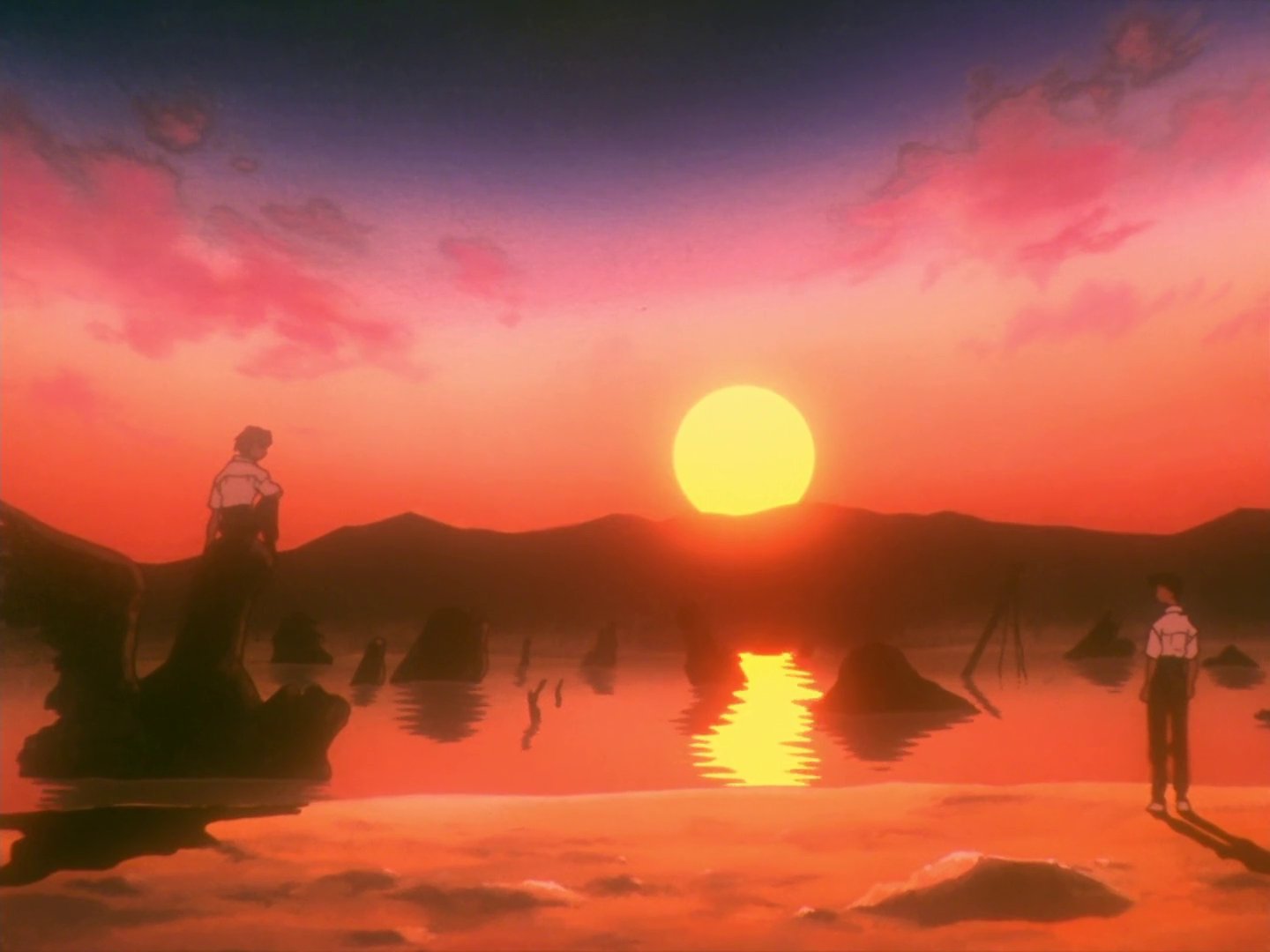
In thinking about Himmel’s influence, another anime character came to mind: Ikari Shinji from Evangelion. Specifically, his relationship with Nagisa Kaworu at the end of the TV series holds some parallels.

Kaworu shows up in Episode 24 of Neon Genesis Evangelion, and he makes an incredible impact on Shinji. Their immediate friendship is a salve for the emotionally wounded Shinji, who opens up to Kaworu. However, by the end of the episode, Kaworu is dead. This relationship lasted only half an hour of runtime, and less than a week in-story. Nevertheless, this brief love (be it platonic or romantic) is powerful indeed.

The way Frieren sees her time with Himmel is not unlike how Shinji views his few days with Kaworu. It was there, it was magical, and it was gone just like that. It’s beautiful yet heart-rending, and these couple of details really showcase how amazing Frieren the series is as a whole.