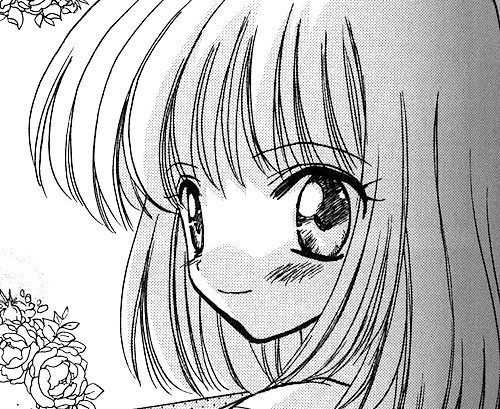
The Fujoshi Files 144: “Coming Out”

Name: N/A
Alias: N/A
Relationship Status: Dating
Origin: Happy Fujoshi: Coming Out

Information:
This female character recently started dating her boyfriend, who is surprised at all of her fujoshi qualities. When visiting Shibuya, a trendy part of Tokyo, she sees it primarily as a means to visit the otaku goods store Mandarake. Though she is into series popular with fujoshi such as Prince of Tennis, she also has knowledge of works such as Mahoromatic and Higurashi no Naku Koro ni. In fact, she pairs the two Higurashi characters Maebara Keiichi and Irie Kyousuke.

She finds it impossible to view her boyfriend as anything but an uke.

Fujoshi Level:
She once paired two businessmen she saw on the street together, but instead of putting them in a business setting she transported them in her imagination to a school academy.

Fun with Money Puns: Ogiue Maniax Status Update for September 2015

As September begins, I feel as if something is going to happening. I’ve been considering promoting the blog more than I have in the past, and really thinking about if I should make more efforts to have my posts reach people rather than writing them and waiting for readers to show up. I don’t want to push Ogiue Maniax at people who don’t care, but I do think that there are folks who might be interested in my blog, but who could very well know nothing about it. After all, I still get messages from people discovering Ogiue Maniax, albeit at a slower pace than what used to happen when anime blogging was a bigger thing in general.

This month’s special Patreon sponsors are:

Ko Ransom

Alex

Johnny Trovato

Anonymous

I had one other new sponsor who just barely missed the cut-off point for this month, but don’t worry (and you know who you are!). You’ll see your name next month.

This month’s sponsored posts covered food anime (though it turned more into a post about the Food Network’s anime-like qualities), and Senki Zesshou Symphogear. I had a lot of fun writing both, and I’m grateful that my sponsors enjoy the fact that I will sometimes twist their topics to suit my own particular interests and way of thinking. I feel appreciated, and I’m always happy to see others interested in my thoughts on anime, manga, and other topics.

I had a kind of crazy idea for the Patreon just the other day, and I don’t know how to properly reward people if they do this, but I wanted to make it possible to pledge certain amounts that also indicate your favorite Genshiken characters, based on Japanese wordplay. It would go something like this:

$10.00 for Ogiue (The Chi in Chika means “1000” and 1000 yen is about $10.00. I would say $1000 but I’m being realistic here)

$8.00 for Madarame (The Ha in Harunobu = 8)

$3.38 for Sasahara (Sa = 3, Ha = 8, thus $3.38)

$8.10 for Hato (Ha = 8, To = 10)

$4.40 for Yoshitake (4 = Yo, Shi = 4)

$4.37 for Sue (Susanna, Su = 4 (in Chinese and also Japanese mahjong), San/Zan = 3, Na = 7)

And so on.

What do you think of this idea? Would you be interested in pledging based on your favorite Genshiken character? Is this just another nefarious way for me to add more bad puns to the world?

Correcting Past Failures Through the Super Robot Wars Games

The Super Robot Wars series, which crosses over various mecha anime across history in the form of turn-based strategy video games, is known for trying to make giant robots look their best. One way in which this is accomplished is through the attack animations, which have become increasingly detailed, dynamic, and beautiful as graphics have improved, such that even the less popular and even less good-looking series of yesteryear appear to have a new lease on life.

However, on a few occasions there will be an attack, even an ultimate attack, that will within the context of the source material be followed by failure or tragedy, and I find it pretty funny to see when the makers of the Super Robot Wars games try to compensate for this in some way. Below are a few examples.

(Spoilers for some series below).

The first comes from King of Braves Gaogaigar Final.

The mighty King J-Der, rival and ally to Gaogaigar, launches its strongest attack, the J-Phoenix. In the OVAs, this attack is unsuccessful in taking down the enemy, but of course you can’t have that happen in the video game. I personally interpret that pause at the end of the attack animation in Super Robot Wars Alpha 3 to be a vestige of that past failure.

The second example comes from Shin Mazinger Shougeki!! Z-Hen (also known as Mazinger Edition Z: The Impact!).

In the final battle, archetypal hero Kabuto Kouji sends a shower of Rocket Punches at Dr. Hell, ending it off with a final blow with a “Big Bang Punch.” However, in the actual anime, while the attack succeeds, the consequences are revealed immediately after to be arguably worse than if Kouji had not defeated Dr. Hell. It turns out that Dr. Hell, while evil, was also trying to prevent an even more evil force from succeeding. While this is acknowledged in the Super Robot Wars Z games through its story, as the games move along you can just keep using the attack mission after mission. The fact that the background doesn’t just suddenly turn red to signal further horrific developments almost feels as if something is missing.

The third comes from Neon Genesis Evangelion.

When the Angel Zeruel appears, it’s the toughest enemy that Ikari Shinji and the other Evangelion pilots have ever faced. At one point Asuka, desperate to prove herself, launches a non-stop artillery volley at the Angel, only for it to prove utterly ineffective. In the anime, this is one of the stepping stones to Asuka’s total breakdown at the end of the series, but in the video from Super Robot Wars MX below shows it being used to defeat opponents with few problems.

As I mentioned, most of the attacks in Super Robot Wars don’t really have this issue, and generally it’s all about celebrating their successes and having fun with characters from multiple series working together. Though, if most of the attacks in Super Robot Wars were to come from failures in the original anime, that might say something about where mecha anime as a genre has gone.

If you liked this post, consider becoming a sponsor of Ogiue Maniax through Patreon. You can get rewards for higher pledges, including a chance to request topics for the blog.

Turnabout: Genshiken II, Chapter 115

It’s Keiko’s turn for with Madarame, and she uses the opportunity as only Keiko can. At the same time, she shows both some chinks in her armor and her resilience in spite of that. The chapter also ends with a reference to Overman King Gainer, which is never a bad thing.

One thing I’ve neglected when it comes to these recent Nikkou chapters of Genshiken is the potential meaning behind Yoshitake’s historical expositions. One purpose is to show that Yoshitake is indeed a history otaku, and visiting such a culturally significant place as Tokugawa Ieyasu’s tomb would set her off, yet I can’t help but feel that there’s a sense of metacommentary behind it. According to Yoshitake, Ieyasu purposely lied about the true location of his grave in order to mislead his enemies, and similarly it’s possible that Kio Shimoku has been placing one Madarame love interest in front of the others as a kind of red herring. The question is, then, which of the four is actually in the “lead?”

The answer is probably Keiko or Hato at this point, and you could make cases for either. In Chapter 115, Keiko outright states her case. Keiko: The Realistic Choice. It’s not the most inspiring campaign slogan, so to speak, but as I’ve mentioned in the past that is part of the Keiko x Mada pairing’s charm, that they already seem like a married couple, that opposites attract, etc. In certain ways, like a tangent graph, the more Keiko x Mada is a thing, the more it approaches (but never quite reaches) Spotted Flower. It’s realistic in a very specific sense of the word, where it reflects a popular image of how monogamous love and relationships are “behind the scenes.”

As for Hato, Yoshitake makes a comment that Hato has gotten closer to Madarame as a guy than he ever has in his female guise. Whether Yoshitake realizes it or not, she’s directly addressing one of Keiko’s criticisms of Hato, that he’s putting on an act, a performance, to get attention. Is this gender performativity, and is Keiko any less guilty of it?

If Hato is the front-runner, however, then this chapter is possibly the undermining of that, and again it has to do with Keiko. At the end of the chapter, Speaking of that, Keiko defies the standard manga progression, where secrets are unspoken and affect the dynamics of the love polygon, by just telling Hato about Yajima’s feelings for him. Cutting to the chase in that way is very characteristic of Keiko. You’d think it’d perhaps also be Saki-esque, but I feel like while Saki was devious, it’s a different kind of planning and awareness when Keiko is involved. Keiko is “realistic,” and part of her “reality” is that she both shatters illusions while creating others, and is very aware of everything that goes into presenting herself to Madarame. The main thing that throws her off is that Madarame is indecisive beyond her imagination, to the point that she at first interprets his waffling as rejection. There is a great deal of miscommunication because Keiko just perceives the world differently compared to the primarily otaku cast.

Keiko’s reaction to her “rejection” is fascinating in its own way. You can tell just from how shocked she is that Madarame might not be interested in her just how much confidence she had about winning. It actually didn’t occur to her that she wouldn’t be able to do just the right things to get Madarame to fall into her arms. It’s indicative of how she thinks that she feels that Angela is the biggest threat to her but is thankfully stymied by a long distance, and sees Sue as being too reticent for anything to happen, not realizing that this might be part of her appeal. Keiko aims for physical desire, and aims her personality in that direction.

So what does it mean that Hato is aware of Yajima now? It could go in a lot of different directions, but I could see it going for a while where Yajima doesn’t know that Hato knows about her crush. Yajima is fairly observant, but nowhere near on the level of Keiko or Saki, and Keiko is likely going to try and push them together. In other manga, Keiko might be viewed as the scheming villain, but I wonder if Hato and Yajima would be so bad after all. For one thing, characters like Yajima, especially in terms of physical appearance, are kind of a rarity in manga and anime, and to have them together might make for an interesting statement.

As for the red herrings, perhaps neither Keiko nor Hato are as likely choices as they seem.

If you liked this post, consider becoming a sponsor of Ogiue Maniax through Patreon. You can get rewards for higher pledges, including a chance to request topics for the blog.