Show By Rock!!: C’mon, Rock and Roll

showbyrock-plasmagica  What happens when Sanrio, the company behind Hello Kitty, creates a franchise aimed at men? The result is Show By Rock!!, an anime that’s an eclectic mix of seemingly contradictory visual aesthetics that somehow manages to bring it all together through clever humor, a heartfelt story of music and friendship, and a surprising amount of story.
showbyrock-cyan

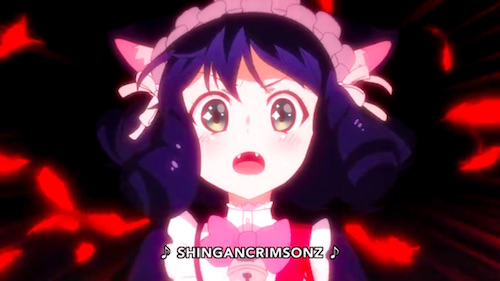
Hijirikawa Cyan is a high school girl too shy to join her school’s music club. While lamenting her lack of courage and playing on her cell phone (Show By Rock!! was originally a mobile game), she gets transported to the world of Myumons, half-animal people who share a love of music. She meets a talking guitar named Strawberry Heart, has to fight a giant hideous monster attacking a concert, and ends up staying on the other side and joining a small band called Plasmagica. Along with their ambitious leader and lead guitarist/vocalist Chuchu, tsundere bassist Retoree, and enigmatically cheerful drummer Moa, Cyan learns to gain confidence in herself and her love of music and saves Midi City in the process.

Though I might be biased as I am probably in that target audience of guys who like cute things, what I think draws me to this show is just how well it executes that cuteness in various capacities. I think often when it comes to how cuteness is utilized in anime, especially when trying to aim it at adult male fans, it can come across as a little too willing to revel in adorableness for its own sake, or to attach it heavily to tragedy. With Show By Rock!!, I actually hesitate to call a show like it “moe,” because there’s a different quality at work, a combination of silliness and seriousness that makes the anime feel closer to the morning cartoons that air alongside something like Precure than they would Hidamari Sketch, despite Show By Rock!! itself being a late-night anime.

I think I get this sense most from the show’s opening, “Seishun wa Non-Stop,” which is fun and addictive and the kind of introduction that I actually chose not to skip every episode. That, and seeing the glasses magically dissipate from Cyan’s head at the beginning of the opening is somehow hypnotic.

The moment that sealed the deal for me in terms of liking Show By Rock!! comes quite early on, in episode 2. During a scene when all of the girls of Plasmagica are discussing their reasons for joining the band, the camera closes in on each of their faces to reveal their actual reasons and not the innocent ones they’ve given on the surface. I don’t want to spoil the moment, but Moa’s reveal is so out of left field and hilarious that, even though I put the show on hold for months before finishing it, her inner thoughts stuck with me throughout my break from Show By Rock!!  What’s even better is that it pays off in a later episode.
showbyrock-catdaruma


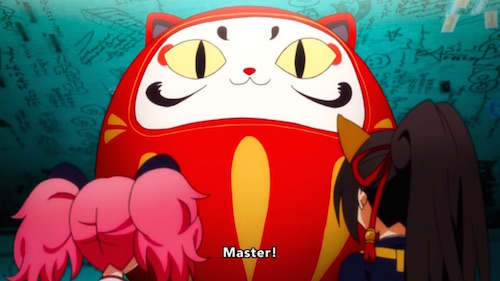
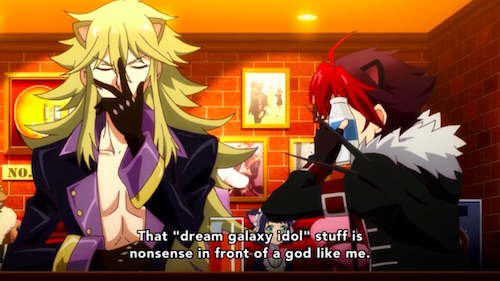
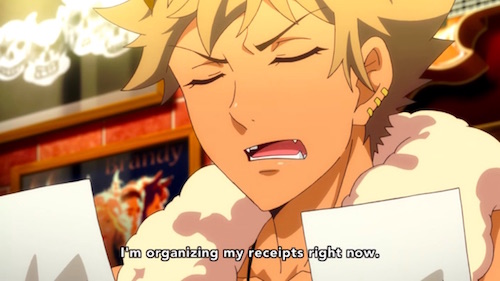
That moment is one of many indicators that Show By Rock!! is actually quite well-paced, with early hints at characters’ histories being built upon, a good sense of weight and understanding when it comes to the challenges each of the characters have to go through, and an extremely solid cast of supporting characters. While I can’t help but be fond of Tsurezurenaru Ayatsuri Mugenan, an Enka-themed band led by a woman in a giant cat daruma, the real stand-out side characters have to be SHINGANCRIMSONZ, a visual kei band with the most humorously overwrought members possible, chuunibyou types taken to the next level (plus one realist who nevertheless believes strongly in the power of music). If anything, even if you’re not a fan of hyper cute designs, you might just stay around for the SHINGANCRIMSONZ antics.
showbyrock-shingancrimsonz

showbyrock-rom

Going back to the idea of Show By Rock!! being a strange mix of various visual styles, this can be seen in the fact that the members of SHINGANCRIMSONZ are drawn closer to the bishounen archetype than an attempt to reconcile their designs with the cutesy look of the Plasmagica girls. However, it works because they’re in many ways just as adorable and fun to watch as Cyan and the rest. Another facet of this blending of styles is the use of 3DCG and transformation into Sanrio-esque mascot characters during performances. It can be jarring, especially when watching this series for the first time, though it’s not extremely different from the heavy use of CG dances in girls’ shows such as Pretty Rhythm. In fact, while it isn’t quite up to the level of 2D animation employed by Studio Bones, the 3D animation in Show By Rock!! is actually quite solid.

showbyrock-3dcg

At only 12 episodes, Show By Rock!! is a quick and easy watch. I don’t think it’ll rock anyone’s foundations, but the characters are charismatic, the overall narrative leads up well, and the music is catchy. If there’s a way to describe it based on other music anime, I’d say it’s like 50% Sound!! Euphonium, 50% Macross 7. Don’t believe me? I guess you’ll have to check it out.
[Apartment 507] Showa Nostalgia in Anime: What’s the Deal?

goods_358_main

I wrote a post over at Apartment 507 looking at the nostalgia for the Showa period that seems to be cropping up in anime. Leave a comment either here or there and tell me what you think!

Royally Good: Go! Princess Precure

vlcsnap-2016-02-04-11h58m04s696

After Happiness Charge Precure! failed to live up to its potential, I had hoped that the next series in the long-running Precure anime franchise would fare better. Fortunately, Go! Princess Precure wildly exceeded my expectations to become one of my favorite iterations of the popular magical girl anime. From the serious to the silly, Go! Princess Precure hits a homerun.

vlcsnap-2016-02-04-11h55m40s363

Go! Princess Precure follows Haruno Haruka, a teenage girl who dreams of becoming a princess. As a small child, she met a handsome young prince named Kanata who inspired her to hold onto her love of princesses, in spite of discouragement by others. In the present day, as Haruka comes to the prestigious “Noble Academy” with the goal of learning what it means to be a “true princess,” she finds out that monsters have begun to attack the school, preying on everyone’s hopes and aspirations. Haruka becomes a “Precure,” a magical warrior with the power to defend against the forces of Dysdark, and is soon joined by two other girls, Kaido Minami and Amanogawa Kirara, who also use their dreams to fight back.

Princess fever has taken over amidst the enormous popularity of Frozen in Japan, and Go! Princess Precure asks, “What is a princess?” While this question (as well as the thematic flourish of the series) can potentially be criticized on a surface level as sexist and regressive, a closer look shows that Go! Princess Precure aims to claim the concept of the princess as a symbol of hard work and kindness towards others. To this point, a major villain of the series, the powerful Princess Twilight (no relation) even confronts Haruka (Cure Flora) with the idea that one can only be born a princess, and while she’s technically more correct than Haruka in terms of how it works in real life, Go! Princess Precure shows how Haruka, Minami (Cure Mermaid), and Kirara (Cure Twinkle) strive to embrace the idea of a “princess” as being the product of one’s effort. In other words, according to Go! Princess Precure, being a princess doesn’t make you a better person. Rather, being a better person who strives for their dreams and helps others is the key that allows any girl to become a princess all on their own.

vlcsnap-2016-02-04-11h56m55s919

Not only is Go! Princess Precure strong thematically, it’s just an incredibly solid show in general. In terms of animation, it has some of the finest fight sequences in all of Precure as early as episode 1, and while it rises and dips in quality as is typical of a year-long anime, its overall consistency as well as its high points are notable. The outfits and character designs are all on point (In terms of narrative, the series benefits from an entertaining main cast with well thought out character development. Flora’s story at the half-way point connects to that greater theme of “princess” self actualization. Kirara as the donut-loving fashion model eager to speak her mind is one of the most unique Precure characters ever (I voted her as my favorite among the Princess Precures for this reason). The supporting characters, though not quite on the level of Heartcatch Precure!, grow admirably throughout the series as well.

Perhaps most notably, when the anime introduces a fourth Precure late into its run, she does not overshadow the rest of the cast. It’s a common problem for shows like Precure or Super Sentai, where in an effort to push the new character and her toys she ends up practically taking over the show. Honestly, I can’t recall a single bad episode.

Go! Princess Precure might be quite the hard act to follow. Whether it’s in comparison to the rest of Precure or as an anime all on its own, Go! Princess Precure is simply an outstanding work that embodies a lot of what is best in children’s shows and the magical girl anime genre. I highly recommend anyone, even those skeptical of mahou shoujo, to take a look.

vlcsnap-2016-02-04-11h57m26s047

If you liked this post, consider becoming a sponsor of Ogiue Maniax through Patreon. You can get rewards for higher pledges, including a chance to request topics for the blog.

Getting Along: Ogiue Maniax Status Update for February 2016

With Go Princess! Precure finally over, I feel like this is when the winter anime season truly begins. I hope that you’ll enjoy coming along the ride with me.

I’d like to thank the following Patreon supporters this month.

General:

Johnny Trovato

Ko Ransom

Alex

Diogo Prado

Yoshitake Rika fans:

Elliot Page

Hato Kenjirou fans:

Elizabeth

Yajima Mirei fans:

Machi-Kurada

In particular, I’d like to welcome back Johnny Trovato. He was the source for many past topics through Patreon, including posts on the Tokyo Olympics and CensorshipTouhou vs. Kantai Collection, and the rise and fall of Saimoe. If you’d like me to write about a specific topic on Ogiue Maniax, it’s a perk you can get for the highest reward tier on Patreon.

This past month has brought a lot of interesting changes for me. Outside of Ogiue Maniax, I recently started contributing articles to a site called Apartment 507. They were looking for someone who communicate with the hardcore Japanese pop culture fans that comprise their audience, and I’ve been happy to oblige. The main reason I got this gig was because of my efforts on Ogiue Maniax, so I am grateful to my readers here for reminding me of the value of writing and that, simply put, anime and manga are awesome.

I decided not to include those posts on the Patreon page itself because they’re not technically being supported by my patrons, but I have been linking to them on the blog itself. Just look for the [Apartment 507] tag in the title if you’re wonder which posts are which.

As for the blog proper, I think I’ve written some of my best work this past month. I wrote a response to another blogger where I talk about some of the problems that come with evangelizing sakuga, a review of the powerful new film The Anthem of the Heart, and of course the latest Genshiken chapter review. If you haven’t been keeping up with Genshiken, or even if you have, this chapter is a big deal, so I recommend you check it out! By the way, I’ve noticed that my Genshiken reviews are some of my most popular posts. I guess that shouldn’t come as a surprise but I’m actually really happy that I’ve established myself as a source for interesting insight into Genshiken.

January also marked the return of the Fujoshi Files with a historic Fujoshi #150. I have to confess that these might get more sporadic as I don’t have as much time to research fujoshi-themed anime and manga as much as I used to, but I do strongly believe that we’ll hit #200.

In addition, I decided to do something a little different and interview a Super Smash Bros. for Wii U competitive player. Earth, the world’s best Pit, is actually also a mahjong and The iDOLM@STER fan, so I had to ask him a few questions.

The last thing I want to say is that I’ll be traveling to Japan in May! I’ll be releasing posts the whole way through, and when I get back I’ll have plenty more to talk about. And yes, I will be getting all of the dagashi (have you been watching Dagashi Kashi? I highly recommend it).

How Evangelion References Ideon

This post is dedicated to Anime World Order‘s Daryl Surat, who over 10 years has pointed out repeatedly that people will bring up the relationship between the anime Neon Genesis Evangelion and Space Runaway Ideon without knowing exactly how they connect.

Love it or hate it, Neon Genesis Evangelion, is one of the most influential and well-known anime ever. The story of youths with crippling psychological problems who must fight to save the Earth resonated with many, and anime came to copy, challenge, and rethink Evangelion in the years since. However, Evangelion itself carries its own influences from shows of yesteryear. For this post, I’m going to be writing about one of the major progenitors of Evangelion, Space Runaway Ideon, because it’s often brought up as evidence against Evangelion‘s originality and innovation, without thorough understanding as to what Ideon did and did not do relative to Evangelion.

Evangelion is just a rehash of Ideon,” the argument goes, but structurally they don’t have very many things in common. The city structure, otherworldly invaders, time limits, and the sense of scale when the titanic EVAs fight the similarly enormous Angels all come from Ultraman. In fact, if you want to see just how much Ultraman influenced director Anno Hideaki, check out the manga Insufficient Direction, drawn by his mangaka wife, Anno Moyoco (Hataraki Man, Sugar Sugar Rune). The escalation of trauma and the mistrust between humans comes from DevilmanIdeon, while bearing a few minor similarities to these series, brings something else to the table.

To understand Ideon, it’s useful to start at the beginning. Its story takes place in an era of space exploration and colonization. A group of archaeologists discover three ancient vehicles, which they find out can be brought together to form a giant robot called Ideon. During this time, they also encounter an alien race of conquerors called the Buff Clan, who possess legends about Ideon as a mighty god of ancient times. Though they take a number of casualties, the humans escape with Ideon, and spend the rest of the series fending off attacks from the Buff Clan with the help of the Ideon.

This sounds pretty par for the course for the time in which it was airing (early 1980s), but one thing made Ideon, as a mecha, different: it didn’t like to behave. The pilots from the very beginning are even unsure as to how to rouse Ideon from its dormancy. It powers up and powers down seemingly with a mind of its own, as indicated by a mysterious display called the Ide Gauge. If there’s a pattern as to how strong Ideon will be in any given fight, it is utterly unclear to the humans responsible for it. It is ancient alien technology that they are unable to fully grasp.

Then, deep into the series they find themselves cornered and at the brink of death. Suddenly, the Ideon achieves a power greater than anything seen before, and wipes out the enemy in an instant. Though they’re happy to have escaped with their lives, one important detail looms over their thoughts: it was not by the humans’ actions that they were rescued. Rather, they were at the seemingly serendipitous whims of the Ideon itself. As they continue on their journey, and as they continue to fight the Buff Clan, the heroes are made increasingly aware of the fact that the Ideon is powerful enough to destroy entire worlds, rend galaxies into nothingness, and wipe out civilizations… and they have absolutely no control over it. In the Super Robot Wars games, the power of the Ideon’s strongest attacks, Ideon Sword and Ideon Gun, are labeled as having infinite range as a reference to this, though the mechanics are gamified into something manageable).

If you’ve seen Neon Genesis Evangelion, you probably know where this is going. Some of the most iconic scenes in Evangelion are when the EVA-01, the protagonist Shinji’s mecha, goes berserk. During these pivotal moments, Shinji somehow falls unconscious or is unable to fight, and the EVA roars to life with a mind of its own. It fights like a beast, clawing, biting, and tearing. Its chilling cry becomes a wake-up call to the human characters who believed that they could control all of this technology and power. In the cases of both Ideon and Evangelion, the power granted to the heroes ironically creates a sense of helplessness because of the loss of control. Unlike older giant robot anime, such as Mazinger Z or even Reideen the Brave which featured a similarly sentient super robot, the spirit of the hero, or indeed all of humanity, is made to feel small and insignificant in Ideon and Evangelion. Where Evangelion differs is in its deeply introspective focus, of characters and the deep, torturous labyrinths of their psyches, and so it would be incorrect to say that Evangelion simply copied Ideon.

The Ideon TV series ends more abruptly than almost any other anime you will ever see, and a proper finale would be provided in the form of two movies, one recap and one conclusion. In the movies, the secrets of the Ideon are explored, and it’s through those secrets that further connections to Evangelion can be seen. The second movie, Be Invoked, reveals what causes Ideon to awaken and gain power: life energy. The Ideon throughout the series appears to respond better to children than to adults, and even better to babies. Though there is nothing explicitly written as to why this is the case, and I’m inserting my own interpretation into this to an extent, I believe that it has to do with the fact that children are both more full of life, and are not as warped by their experiences as the cold, cynical adults.

As the fight between the humans and the Buff Clan rages on, it turns out that meteors have been raining down on both planets, wiping out their homes. The implication behind these mutual apocalypses is that the Ideon itself and its Id energy have been testing the two sides to see if they can reach some sort of peace. Because the two sides refused to understand each other and just kept on fighting, the Ideon basically decided that both civilizations are not worth saving as they are. Hence, meteors. Ultimately, even as this is all happening, the Ideon fights the Buff Clan’s ultimate weapon, the Ganda Rowa. The two destroy each other, triggering a massive explosion that wipes out life on the surrounding planets. The spirits of those who died, both human and Buff, gather together as if all is behind them.

A few similarities to Evangelion appear here. First, the effectiveness of children as a source of “power” for the Ideon is similar to how the Evangelions appear to only function when piloted by 14-year-olds. Second, the protective element of the Ideon towards those children resembles how the EVAs have souls within them that (for the most part) are the mothers of the pilots themselves, who go berserk to save their children. Third, the Ideon’s desire to bring these two warring civilizations, and the final moments of Ideon itself, resemble the Human Instrumentality Project at the center of Evangelion. The Human Instrumentality Project is the idea that, by having all of humanity merge together, we will be free from the problems caused by people being unable to properly communicate their feelings. When we are all as one, there will be no suffering. Again, however, even if you factor out the newer works (the Rebuild of Evangelion movies, the manga’s alternative ending), Evangelion does not say the same things because of the greater focus on individual characters and their personal emotions. Ideon thinks on more of a macro scale than Evangelion‘s micro approach, despite the fact that both series involve the death of humanity.

Overall, the influence of Ideon on Evangelion can be summarized as the exploration of humans having to deal with powers beyond their control, and the apocalyptic consequences of those who continue to make mistakes even with this knowledge in mind. I hope this has been useful to you, and if there is anyone who would like to add new points, expand upon the existing ones above, or even argue against them, I welcome you to make a response.

If you liked this post, consider becoming a sponsor of Ogiue Maniax through Patreon. You can get rewards for higher pledges, including a chance to request topics for the blog.