It’s rare that a manga gets adapted into anime as perfectly as Pluto on Netflix.The art and animation: almost as if Urasawa Naoki drew everything himself. The pacing: eight hour-ish episodes, one for every volume of the manga. This is something that might have been unthinkable 15 or even 10 years ago, but they actually pulled it off.
Pluto is a dramatic reimagining of a story from Tetsuwan Atom (or Astro Boy) called “The Greatest Robot on Earth,” changed to be equal parts speculative political fiction, introspective examination, murder mystery, and monster thriller. The story takes place in a world where robots have achieved greater rights as fully autonomous beings, but prejudices still persist. When a Swiss robot named Montblanc is murdered, everyone is shocked: As not only one of the most beloved robots in existence, but also one of the 7 most powerful, taking him out would not have been an easy task. Another one of the greatest robots, the Europol detective Gesicht, is assigned to the case, which takes him around the world to discover the truth—not only about the case, but also about himself and the moral/social/ethical conundrums among humanity and robotkind.
One of my favorite things about Pluto is the way “Pluto” is presented to the audience. At first, there are only hints and flashes, and over time, more gets revealed. However, by the time we have a fuller picture, the context changes how we perceive the threat, and causes all the philosophical challenges to become even greater.
Netflix hides its numbers, so there’s no telling how successful Pluto has been. Even so, I can’t help but remember when another Urasawa Naoki series, Monster, aired on the Syfy Network in 2009. At the time, the US was clearly not in a position to accept that kind of mature animation, despite the fact that his work should have been perfect for cable television. Over a decade later, however, anime has become more mainstream, and viewers are more accustomed to a greater range of visual styles. I think, or at least I hope, that we’re ready now.
Pluto is a prestige title, and very deservedly so. It’s generally well animated, has great writing and characters, tells a compelling story, raises a lot of poignant questions, and is just filled with complex emotions, all done in a way that feels both pulpy and sophisticated. I highly recommend that everyone check it out, whether by watching the anime or reading the original manga. It’s my favorite of Urasawa’s work, and I hope as many people as possible seek it out.
I watched the first episode of The Apothecary Diaries, and the opening is very reminiscent of a different and much older anime: The 1984 Glass Mask TV series.
Here is that intro:
And here is Glass Mask:
Between the heavy focus on the main heroines, the black background, and even the head movements, I can’t help but see similarities between protagonists Maomao and Kitajima Maya, respectively.
It might just be a coincidence that they’re similar, but I’d love to know if any inspiration was taken.
While I spent the majority of Anime NYC checking out the plethora of events related to hololive, I also want to broadcast my thoughts on various other topics.
Getting In
In previous years, Anime NYC would often run into issues with getting attendees into the Jacob Javits Center. This year, I did not hear any major rumblings, though I don’t know to what extent that was the result of improved planning and how much it was because the weekend was blessed by nice weather.
Crowds
As Anime NYC has grown and the COVID-19 pandemic still lingers, foot traffic and crowd size are topics of concern for me. That said, I found the convention center relatively easy to navigate this year. While bottlenecks did happen on occasion, I never really felt like a canned sardine, even in places where it could get very cramped last year, like the Artist Alley.
In terms of masking, at his point, it’s become increasingly uncommon in New York City as a whole, which is unfortunate. I still hold out a modicum of hope that convention runners here and elsewhere might be willing to get more stringent with a mask policy if things get more dire again, but for now, I can only recommend doing so for your own safety.
The Witch from Mercury Panel
Surprise—I actually did something that wasn’t hololive-related this year.
Upon arriving at Anime NYC to attend the Gundam: The Witch from Mercury panel, I was pleased to see how big the turn-out was. The line extended from essentially one end of the convention space to the other, and had people of all ages and genders. It’s only natural, given the pioneering nature of G-Witch both in Gundam and anime as a whole, but it was still a pleasant sight to behold.
WARNING: GUNDAM WITCH FROM MERCURY SPOILERS
The main takeaway from the panel is just how much everyone involved with the series sought to do something different with Gundam and to make it clear that G-Witch would chart its own direction. Production had already begun in 2019, and they had wanted to differentiate it from Iron-Blooded Orphans, even working with the technical director to give the series a different look. A lot of changes happened behind the scenes before the new show even aired.
The producer of G-Witch was there along with the two main actors, Ichinose Kana (Suletta Mercury) and Lynn (Miorine Rembran). I had actually interviewed Ichinose a few months ago at Anime Central, but at the time was not allowed to ask questions pertaining to Gundam. Though I was only an audience member here, I was glad to at least get some of her perspective, as well as the others’.
When asked what they liked about the series, Ichinose and Lynn both expressed a fondness for all the different relationships between characters, and just how even the same types of relationships were unique depending on who was involved. The example they gave was parents and children, and how they all lead to their own interesting conclusions.
Ichinose got the call about passing the audition after waking up, only to fall back asleep after. Because of this, she thought she might have dreamt it. Lynn is a long-time fan of Gundam even before voice acting, and actually found out about landing the role on her birthday.
Evoking Suletta’s sense of difficulty with interacting with people her age was something Ichinose worked hard on. As an introvert who gets anxiety herself, she empathized with Suletta. Lynn was aware Miorine would go through changes, that she would start off bored and prickly but would meet Suletta, get her own company, and so on, and become more of her own person in the process.
Ichinose had a tough time deciding a favorite scene, but chose one from Episode 21, where Suletta takes her mom’s mantra “Run, gain one. Move forward, gain two” and rethinks it to be about doing what you can even in hard circumstances. For Suletta, who always followed her mom and wasn’t her own person, her time with Miorine and the other students allowed her to form her own opinions and have her own life and destiny.
Lynn’s favorite is the climax in Episode 24, when Suletta brings the Gundams together and stops Quiet Zero, due to the sheer Gundam-ness of it all: characters, music, and mecha all on full display. The fact that Suletta truly shows herself as the main character also contributes to why Lynn likes it.
Towards the end, the two actors did a live reading of a scene from the episode “The Witches from Earth,” which was excellent. Following that was a video about how Gundam is sponsoring an F-1 racer, which just made me want to make Gundam F-91 jokes
Anime NYC 2024 in the Summer
I want to end by talking about what’s maybe the biggest news of the con: Anime NYC 2024 will be in August instead of November. I already gave a few thoughts in a previous post, but would like to elaborate on my opinion here.
It is uncommon for conventions to move dates so drastically from one year to the next. Sure, a week or even a month isn’t out of the question, but three months is a hell of a difference. The fact that they have a lot of advance warning is helpful, but I do feel for the people who plan longer-term and might have arranged things with the assumption that Anime NYC would be in the fall.
I do not have any insider knowledge about why LeftField Media made this decision, but I can imagine a number of reasons. First, Anime NYC has previously been the week before Thanksgiving, a holiday when people tend to travel. Second, the (typically) cold weather can be unpredictable: While this year was pleasant, we’ve also seen snowstorms in the past.
August means avoiding such issues. The summer is the time for vacations that don’t necessarily involve seeing family. It makes Anime NYC part of the packed summer convention circuit, which includes notably Anime Expo and Otakon. Also, Anime NYC has mentioned that the entire Javits will be open for the con in 2024, so I suspect that there is something preventing them from having full access in November.
One problem: While blizzards won’t be a concern, New York summers are very hot and humid, especially in recent years due to climate change. I worry that we’re trading shivering in the cold to passing out in the sun, and if Anime NYC isn’t on the ball, this can become a real issue.
I also have concerns about Anime NYC trying to compete with Otakon, despite the fact that they’re actually quite different from each other as anime cons: Anime NYC is a very slick product, while Otakon is more grassroots. That said, this date change might be mutually beneficial for them, as DC and NYC aren’t far from each other. I really hope this is a net positive overall.
I will likely attend Anime NYC 2024 regardless, and I really won’t know if it ends up being better or worse until it happens. But I will miss having a fall con season in New York City.
I recently read the book Quarterlife: The Search for Self in Early Adulthood by therapist Satya Doyle Byock, which talks about the concept of the “quarterlife crisis.” According to Doyle, it is when someone in early adulthood feels a sense of dissatisfaction from a certain imbalance—in the pursuit of either meaning or stability, the other is never developed. People typically tend toward one side, and if they fail to teach a degree of balance, it can eventually turn into a midlife crisis. While the book is primarily aimed towards actual flesh-and-blood people, that struggle between meaning and stability also made me think of the hero of a current popular manga: Denji from Chainsaw Man.
From the start, what we know of Denji is that he basically has nothing, and even his highest aspirations come from scarcity: He wants to eat jam on toast, and he wants to touch a boob. While he comes across as shallow and horny (and he is both), this is Denji seeking the stability he’s never had, symbolized in the freedom to eat whatever he wants and to be with a girl. Thanks to his Chainsaw Devil powers, he starts to get that life, but it’s also clear that things aren’t hitting quite right. “This isn’t what I expected it to be” is a common thought by Denji, as if all that stability brings him is a search for meaning.
However, when Denji pursues meaning, including embracing the public image of Chainsaw Man as a dark hero, he instead starts to wonder, “Is this really all there is?” The comfort of stability calls to him—a life where he doesn’t have to be Chainsaw Man anymore. Even as others try to force a sense of meaning onto Denji, he resists because he’s trying to see how he really feels.
This vacillating between stability and meaning occurs across Part 1 of the manga. It also extends into Part 2, where I find Denji’s to be even more intense. The addition of the character Nayuta shows a side of him we had only barely glimpsed before—now a big brother/dad of sorts, he tries to provide for her a comfortable life full of opportunities that he himself never had. My heart actually feels joy when I see Nayuta take after Denji’s odd mannerisms, or when she enthusiastically and aggressively participates in class. I suspect there might be an answer for him in their relationship.
Denji is not an “early adult,” but rather a teen. What he experiences is not that period in which society tells us that people are supposed to be in their prime. However, I do think Denji’s plight in this area is part of why Chainsaw Man has been such a phenomenon. The typical shounen hero does not have anything resembling a quarterlife crisis. They usually have an ambition that drives them, and is the presumed end goal of the story. The fact that Denji struggles as much as he does, on top of being both vapid and profound at once, is eminently relatable.
Of course, I highly doubt that the author Fujimoto has been thinking specifically of quarterlife crisis. Even if he was, there’s a good chance Denji just ends up in a worse place by the end. But I now see a painful and at times conflicting search for meaning and stability that is ever present in Chainsaw Man, and I think it gives the series a powerfully profound psychological quality absent in so many of its peers.
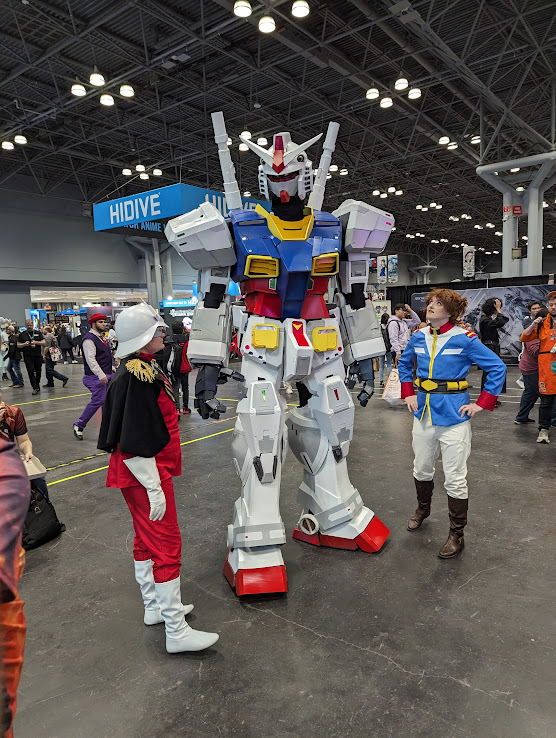
I didn’t intend for my Anime NYC 2023 experience to become more like “hololive NYC,” but that’s what ended up happening. Between multiple special events and an Exhibit Hall filled with sellers who knew that it’d be a hot commodity, my time was filled with VTubers and VTuber accessories.
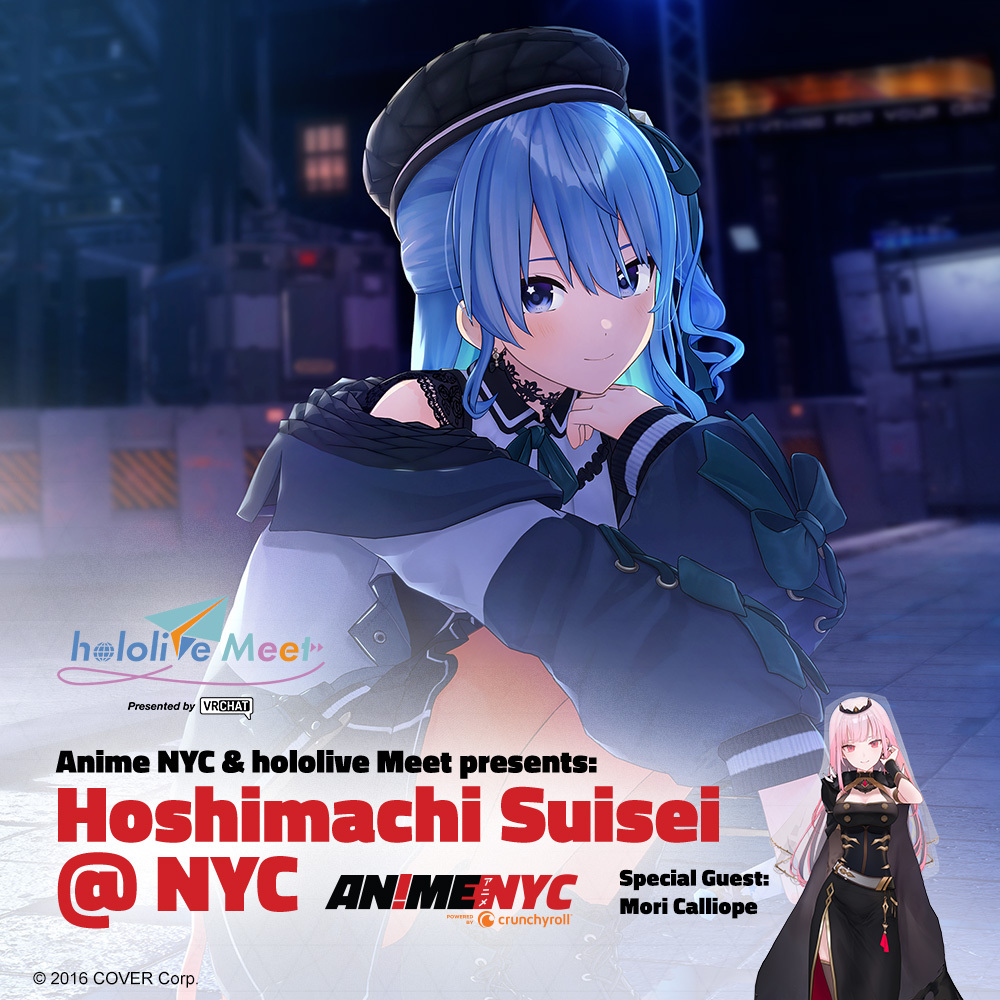
Anime NYC 2023 took place from November 17 through 19, once again on the west side of Manhattan at the Jacob Javits Center—a mediocre venue that tends to just win by default because there’s nothing bigger around. While the con brought guests and screenings from lots of different anime and manga, the highlight for me was indeed the sheer amount of hololive programming. Each day brought something big: the Hoshimachi Suisei paid concert on Friday, the very first hololive Advent panel on Saturday, and then the surprise hololive Indonesia tour concert, viv:ID Cruise. On top of that, Anime NYC had originally announced each one separately, so what we originally thought would be one major event (the Suisei concert) gradually turned into three—not to mention the hololive booth in the Exhibit Hall that had nonstop live programming.
One of the challenges for the big hololive events is that they all required attendees to go through a somewhat convoluted reservation system. Rather than first come, first served, people were randomly assigned a spot in the queue. The idea is to 1) not have people line up unnecessarily the day of an event, and 2) to make sure those with the privilege of more free time or fortunate timing didn’t have an unfair advantage. I find that there are pros and cons to this approach, the downside being that I think it makes many people try to get in even if they don’t necessarily care. Nevertheless, I count myself incredibly lucky that I managed to get into all three events.
Suisei
Hoshimachi Suisei is one of the most popular and celebrated VTuber singers today. She introduced viewers of the The First Take to the world of Virtual Youtubers, and she’s already had a couple concerts in Japan. Her appearance at Anime NYC was pioneering in multiple ways: Not only is it the first (mostly) solo 3D concert for hololive in the US, but it’s also the first to spotlight Japanese talent, as opposed to the English-focused Connect the World from last July. Suisei did not disappoint, bringing her characteristic powerful vocals and performing her original songs like “Ghost” and “Stellar Stellar.” In an industry where lots of post-processing is common to make people sound much better, Suisei stands out as someone with legit singing chops.
hololive EN’s Calliope Mori also guest-starred with a solo and a duet with Suisei. The big surprise to me was that, of all the pieces she could have done, Mori performed “Miraijima ~Future Island~,” her promotional song for the One Piece manga. Though in hindsight, it’s the perfect fit for an anime convention.
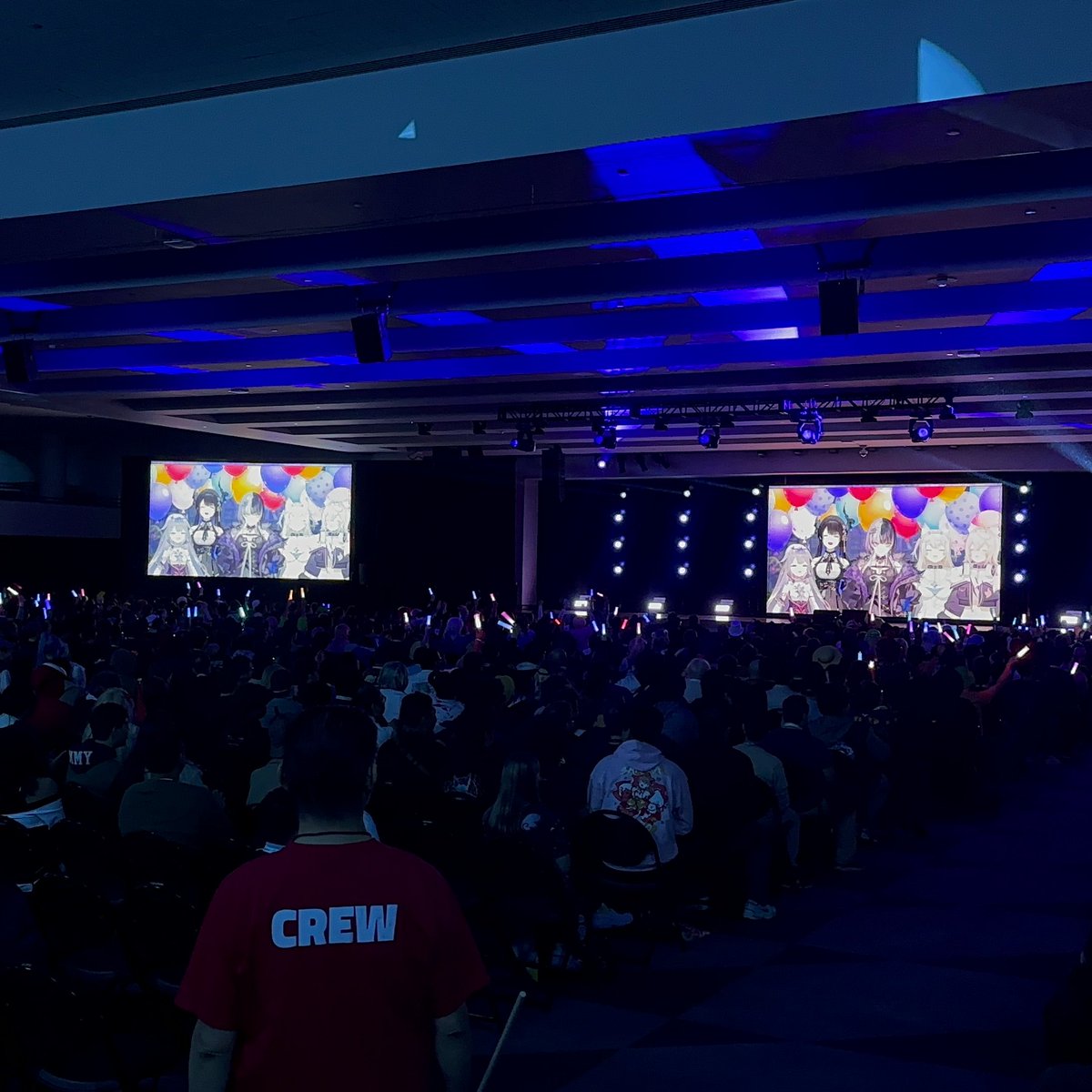
The concert was basically a glorified screening (Hatsune Miku–style 3D holograms aren’t a thing yet for parent company Cover Corp.), but buying into the kayfabe “live” notion is part and parcel with enjoying hololive in general. Also, the Special Events hall was not an ideal space for concerts (it’s just not built for that purpose), and standing on the hard concrete floor for extended periods was murder on my legs. Despite the pain, I had fun.
hololive Advent
Just like how hololive Council made their group convention debut at Anime NYC in 2021, the third generation of hololive English appear this year together for the first time. Unlike the other events over the weekend, it was not a musical performance. Instead, it was a Family Feud–adjacent panel where the members of Advent competed to see who could successfully guess what the audience would answer in polls related New York City. Questions included topics like iconic NYC foods (pizza) and the coolest New Yorker (Lady Gaga). The funniest thing was seeing the generational/informational divide among Advent—most notably Shiori Novella (an “archiver” in VTuber kayfabe) calling Al Pacino “Al Pakino” and “Al Capino.”
This panel ran a lot more smoothly than Council’s two years ago, and didn’t have the awkward formality that came from being connected to an official cultural tourism thing. I think it really goes to show what strides hololive has made among American fans that they didn’t feel the need to have that association.
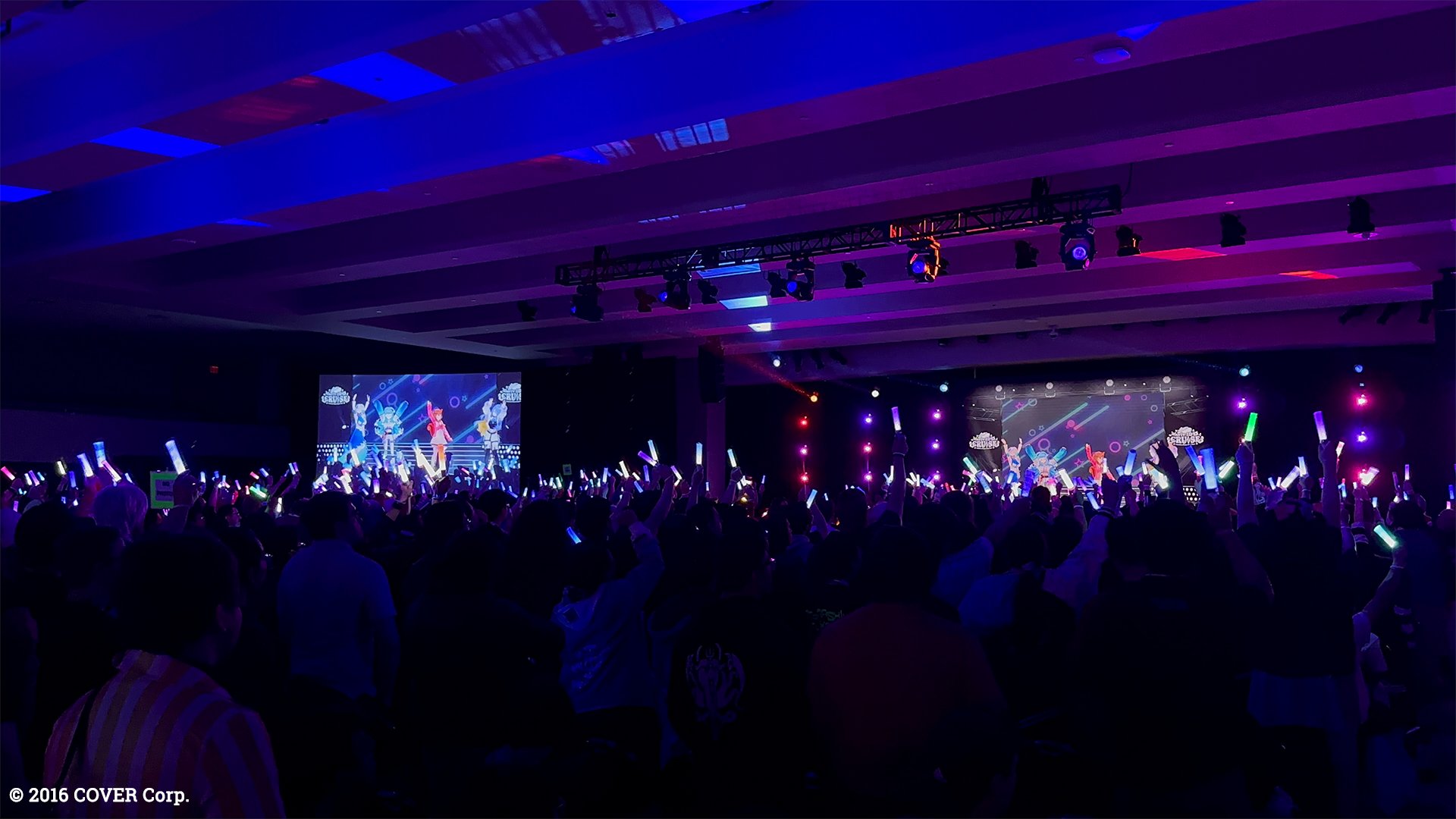
viv:ID CRUISE
The appearance of hololive Indonesia at the con was a big surprise, namely because viv:ID Cruise was originally announced for Southeast Asia only. Now, the tour schedule reads as “Jakarta, Singapore, Kuala Lampur…and New York.” I’m definitely not complaining, as it ended up being my favorite part of Anime NYC as a whole.
The members of viv:ID CRUISE are Moona Hoshinova, Ayunda Risu, Pavolia Reine, and Kobo Kanaeru. In their group numbers, it was great to see how each VTuber brought their own personal quirks to their performances and the choreography, such as Risu’s unmatched songstress status and Kobo’s theatrical dance moves. In their solos, each girl shone brilliantly. Moona made the biggest impression on me with her song “Perisai Jitsu,” particularly with the catchy chorus and the simple-yet-powerful choreography. I’ve had it stuck in my head for days, and it reinforces my opinion that Moona is one of the most complete packages in all of hololive.
https://www.youtube.com/watch?v=LXRSp8QbOeg
I also noticed that Reine seemed to be the most popular with the audience there, though I don’t know how representative the live crowd was compared to, say, US fandom for hololive Indonesia as a whole. Speaking of texting, before and after the concert, there was an ad promoting the new holostars English generation, Armis. Online opinion about male VTubers in hololive Production can be mixed or even negative, but the attendees seemed to be largely enthusiastic about the guys.
The hololive Booth
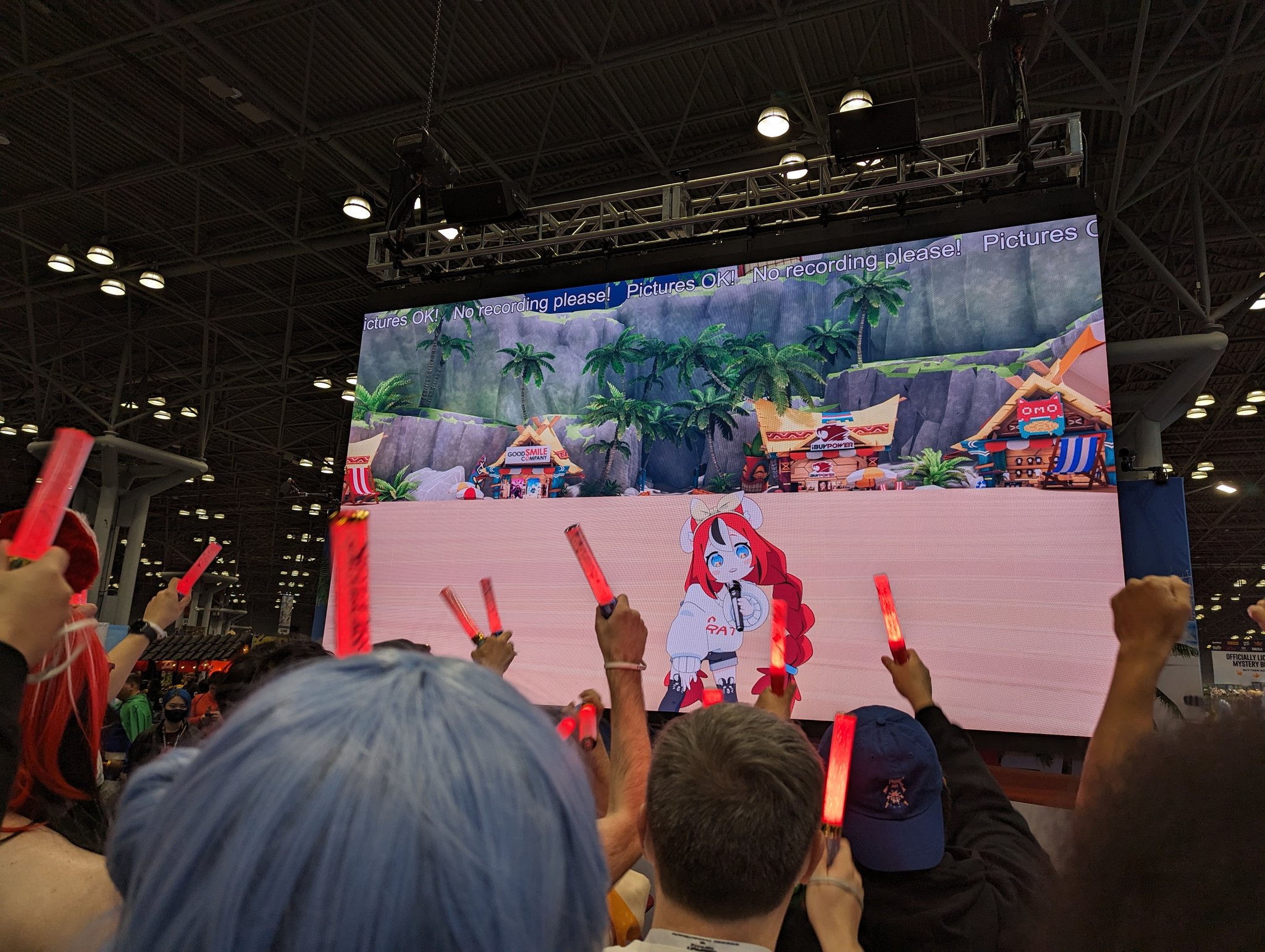
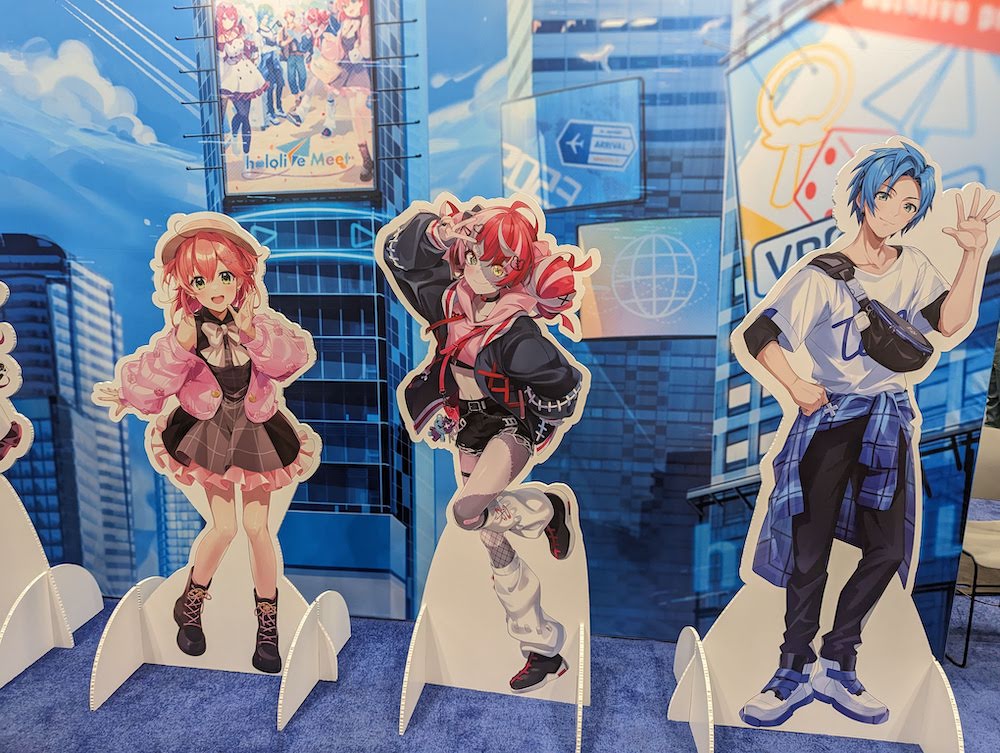
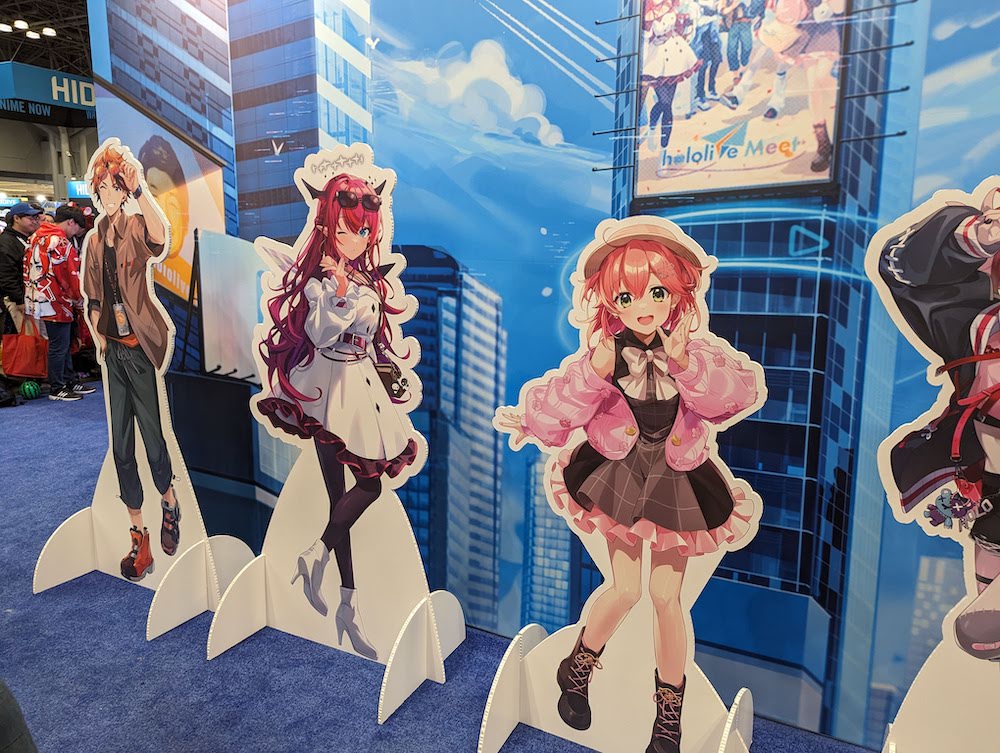
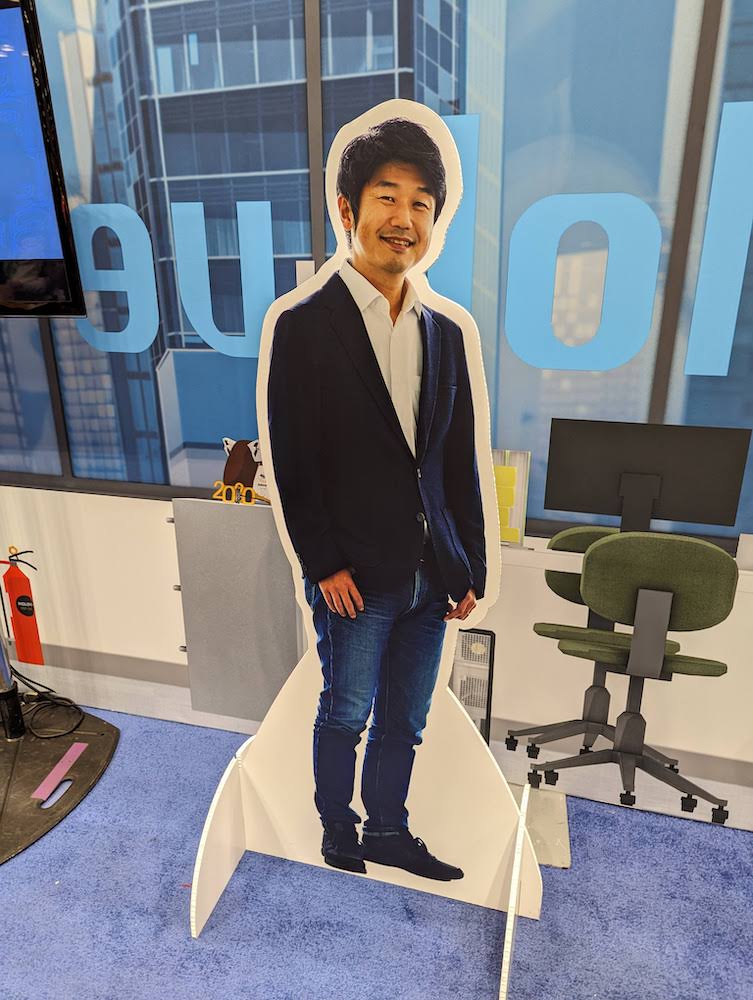
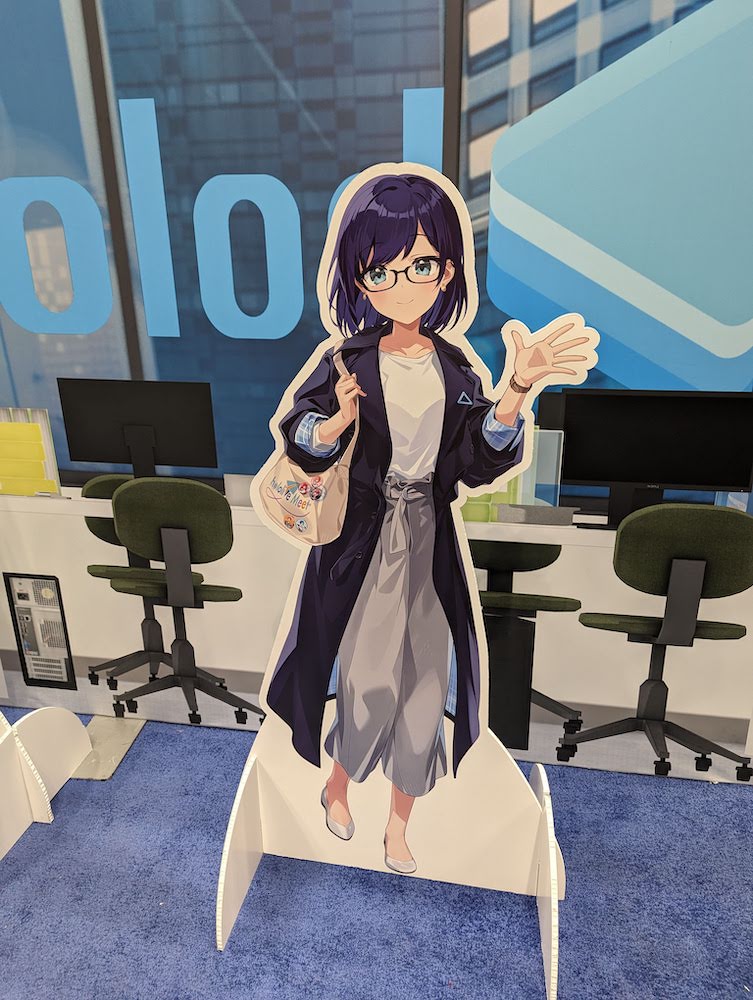
In addition to all the above events, the official hololive Meet booth returned to the Exhibit Hall this year. On the sides were life-size standees of this year’s representatives for hololive Meet, as well as ones for the CEO of hololive, Tanigo “Yagoo” Motoaki, and fan-favorite staff member A-chan. Like last year, they also had live streams on display there especially for Anime NYC. The booth was sponsored by VRChat, and fans not attending the con could still see them through VRChat. I think this was a great idea, and even provided something for the fans who couldn’t attend all the ticketed events mentioned above.
I wasn’t able to see all of them, but I did catch a couple.
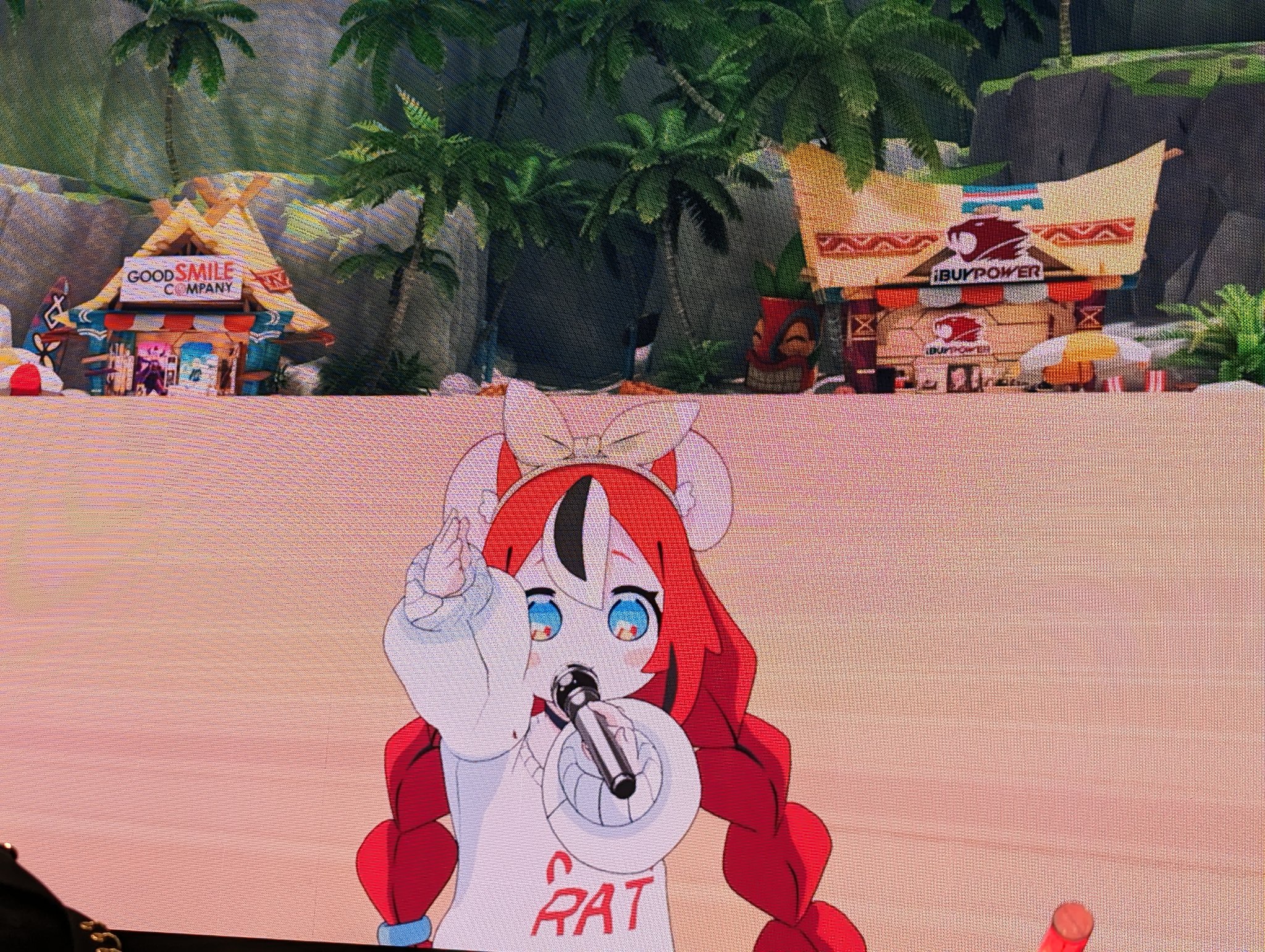
Hakos Baelz is an official ambassador for VRChat, so it’s no surprise that she’d be there, but her embracing of the platform—particularly through her “Dawn of the Dork” karaoke streams—makes her a fitting rep. She brought one such karaoke session to Anime NYC, and showed off both her fun, casual singing and her well-honed dance moves. Utilizing a cutesy model version of herself dubbed “Strawberry Bae,” she sang some anime tunes, took requests from members of the audience (each of whom only suggested hololive songs), and even almost covered Mariah Carey’s Christmas song, until a vocal part of the audience booed the notion. I wish I could have heard it.
The other stream I saw was by two members of the Indonesian branch who weren’t at the concert: Airani Iofifteen and Kureiji Ollie. They’re actually my two favorites of the Indonesian girls, so I was glad to have had the opportunity to see them. Their panel was more of a goofy one, where they had the audience tell them to do certain poses, and they had to see if they both did the same thing. Both Iofi and Ollie have ways of thinking that stray from innocence, so the antics could get rather spicy (but in a fairly PG-13 way). There were also some technical mishaps that would make one or the other disappear or mess up their models, but it was all in good fun and the audience understood.
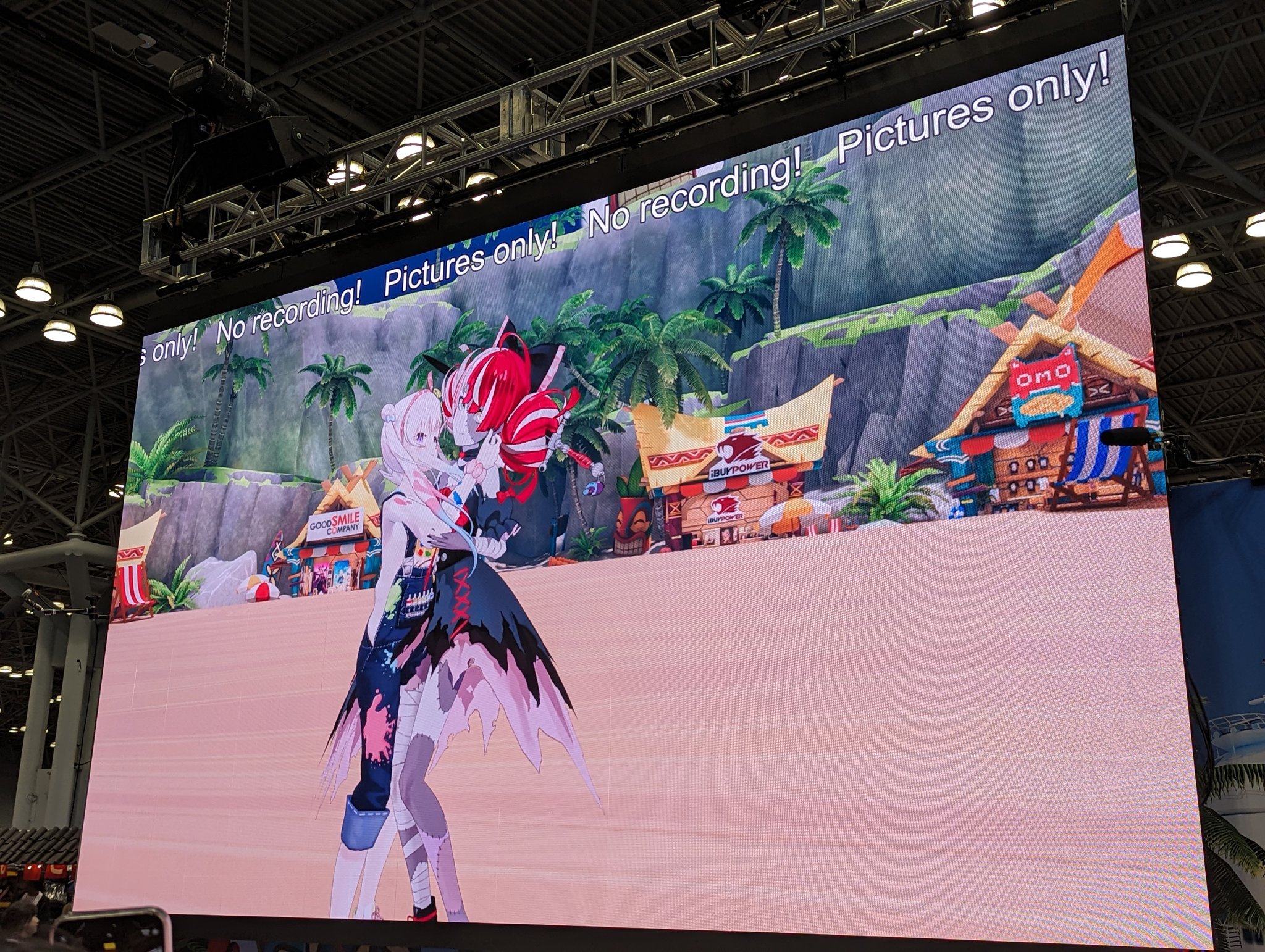
I could not view the FuwaMoco karaoke session, but I could definitely hear it. The highlight for me was getting to listen to their rendition of “Ojamajo Carnival,” the first opening to Ojamajo Doremi.
One big improvement over last year’s booth was that they elevated the screen to be high up and visible from a distance. However, the crowd that formed around it still took up a huge chunk of floor space and could make it difficult for passersby, especially because it ended up blocking the exits a little. If something could be done to fix that, it would be a boon to both the fans and the other attendees.
Merch
hololive merchandise comes in many forms. There’s the official stuff, the fanmade goodies, things from previous events and milestones, and limited edition convention items, among others. Pretty much all of this was available at Anime NYC 2023, no doubt because everyone knew hololive was going to have a presence there.
I have an ongoing mission to get at least one item related to every hololive member at some point, so this was a great opportunity for me to take a few steps closer:
I am very fond of the hololive Meet casual outfits, so I wanted to get something from that line. One of the big selling points is also that it had A-chan merch (a rarity, given that she’s not technically a “hololive” performer despite working for the company), and I count myself incredibly fortunate that I managed to get a button of her, as well as ones for Ollie and holoEN’s IRyS (the best singer in EN, in my estimation).
I also really had not expected to get something as amazing as an official canvas image of Inugami Korone in her Sonic the Hedgehog cosplay. I believe my life to be enriched by its presence.
Final VTuber Thoughts
The hololive experience at Anime NYC was unforgettable, and topped this year only by the fact that I got to see Connect the World live. I think it’s great that a convention so close to me gets VTubers in a major way. That said, I do have two hopes for future appearances.
First, I think it would be great for everyone if all these events could be announced sooner so that fans could save up and prepare. While I had the benefit of a press pass, in recent years, the cost for regular attendees has skyrocketed, and those who missed the opportunity for the already-low-number 3-day passes had to pay in the triple digits just to get Friday, Saturday, and Sunday. I know from experience that conventions sometimes simply can’t announce things as soon as they’d like, but anything to give fans more prep time would be great.
Second, Anime NYC has still yet to have proper meet-and-greets for VTubers—something that seems to be common at other conventions throughout the world. I have to wonder if there’s a space issue that prevents it at the Javits, though the fact that Anime NYC 2024 is going to use the entirety of the convention center might bode well for such a change. That all said, next year’s con is going to be moving from November to August, which will bring a whole host of uncertain variables. Whether this turns out to be a good move remains to be seen, but I hope it ends up being a net positive.
Whenever I get around to December, I begin to think about my annual tradition, where I post about my favorite characters of the year. I’ve had one in mind all year long, but there’s another who’s a bit of a late entry of sorts.
I’ve also been enjoying the heck out of the holoX 2nd Anniversary streams, especially La+’s (naturally). I highly recommend them all, but want to draw particular attention to La+’s performance with HimeHina.
Happy holidays to all my Patreon subscribers for December:
Influential Japanese author Sakemi Ken’ichi passed away on November 7 at age 59. Kio remarked that it was too soon. Sakemi won the 1st Japan Fantasy Novel Award in 1989.
Kio finds himself losing concentration more easily than he used to, and worries that he wouldn’t be able to do a normal serialization like he used to. He follows this by attempting to work at the speed he used to when doing monthly titles and succeeds, but doesn’t know if he could do the same the next day.
Kio saw The Birth of Kitaro: The Mystery of Gegege. He liked the detail that Kitaro’s dad is actually tall (normally in the series, Kitaro’s dad is only an eyeball on top of a small body.)
After seven years, Kio’s PC is starting to make funny noises. He had it just for making manga, but he’s considering getting something that can handle 3D, and that he can play games on.
I consider Space Battleship Yamato 2199to be perhaps the best franchise remake ever. Outside of legacy and possibly 2D vs. 3D animation preference for battles, it improves on the original Space Battleship Yamato in virtually every way. A more interesting and diverse cast of characters, greater complexity in the politics and messages, and a more cohesive narrative all come together with the benefit of decades of hindsight.
Space Battleship 2202 is the direct sequel, and is based on the second TV series, Space Battleship Yamato 2. It centers around the battle against a massive militaristic force from beyond the stars: the highly destructive Gatlantis, also known as the White Comet Empire. Per the title, it takes place three years after the Yamato’s desperate and harrowing voyage to the far-off planet Iscandar to obtain a technology that could restore the Earth’s environment.
Unlike with 2199, I have never seen the Yamato 2, and thus have no direct comparison for what 2202 adds to the story outside of what I can read online. As I started (or rather restarted) 2202, I had my worries. It had been around 10 years since I watched 2199, and due to numerous major world events, my philosophical beliefs have changed in various ways. Given that the series is literally about a gigantic Japanese battleship fighting aliens, might it carry some questionable ideas that I’d notice more easily now? As I kept watching, however, I found that 2202 assuaged these fears. Every time there was something that made me raise a proverbial eyebrow, the series would approach a topic with nuance, give no easy answers, but also criticize outdated ideas about things like race and gender.
The biggest example of the show taking on topics smartly is in its handling of the Wave Motion Gun, the ultra-powerful signature cannon of the Yamato that is capable of devastating entire planets. At the end of 2199, the crew of the Yamato made a promise to Starsha of Iscandar to never use it again. However, the greater Earth forces see things differently, and are revealed to have been building more vessels with Wave Motion Guns. And while the protagonist, Kodai Susumu, believes strongly in their promise to Starsha, keeping it in the face of an overwhelming enemy becomes increasingly difficult—especially when the lives of his allies and their loved ones are at risk. 2022 portrays the fact that this dilemma is anything but black and white, while also pointing out that even if such decisions can be justified, it can still take a mental and emotional toll on those who have to make them.
I also had concerns that Gatlantis, an alien civilization for whom the word “surrender” literally does not exist, might be portrayed as savage barbarians. But when they’re revealed to originally be created as pretty much military livestock—soldiers thrown on the battlefield to keep their masters safe—it’s clear that the Gatlanteans are themselves part of a cycle of victimhood and exploitation that has robbed them of their humanity. And far from treating this as the problems of others, 2202 also shows how the Earth is very capable of making the same terrible moves when they begin developing AI-powered armed forces.
And then, when the show tries to give more background on Desler, the former supreme leader of Gamilas and the main antagonist of 2199, I was worried that it might fall into the trap of redeeming an imperialist dictator just because he had a tragic past. Yet even here, 2202 avoids that pitfall. While we already knew from 2199 that the Gamilas homeworld was dying, we learn that based on the highly racist Gamilan culture (where the pure-blooded rule society under the assumption of inherent superiority), Desler made the decision to become a conquering force for a significant reason: he believed it was the only way his people would accept finding and migrating to another planet. It does not absolve Desler of his crimes, but it has parallels with Susumu’s struggles with whether to use the Wave Motion Gun.
My only complaint about the series is a very biased one: There wasn’t enough Niimi Kaoru, the bespectacled science officer from 2199. She makes a few appearances but is mostly a non-factor, aside from being a small part of a later plot point involving a special battleship and a weird plan to prioritize childbearing women in case of an emergency. Here as well, I was concerned 2022 might be pushing some sexist agenda about the importance of women as mothers, but even that panned out better than I feared.
Space Battleship Yamato 2202 ultimately ends up being a narrative centered around difficult ultimatums. At the same time, however, it also questions why sentient civilizations (whether terrestrial or otherwise) keep putting themselves in situations where people have to make such soul-crushing decisions—might the root causes be matters more systemic? Could something not be done about that instead? Much tragedy could be avoided if we cherished one another’s humanity.
When a Virtual Youtuber you like is mega popular, it’s not hard to get their merch. But when they’re not in the big leagues, it’s a different story. So when the chance came to support one of the smaller VTubers I follow—by buying instant curry, of all things—I decided to do just that.
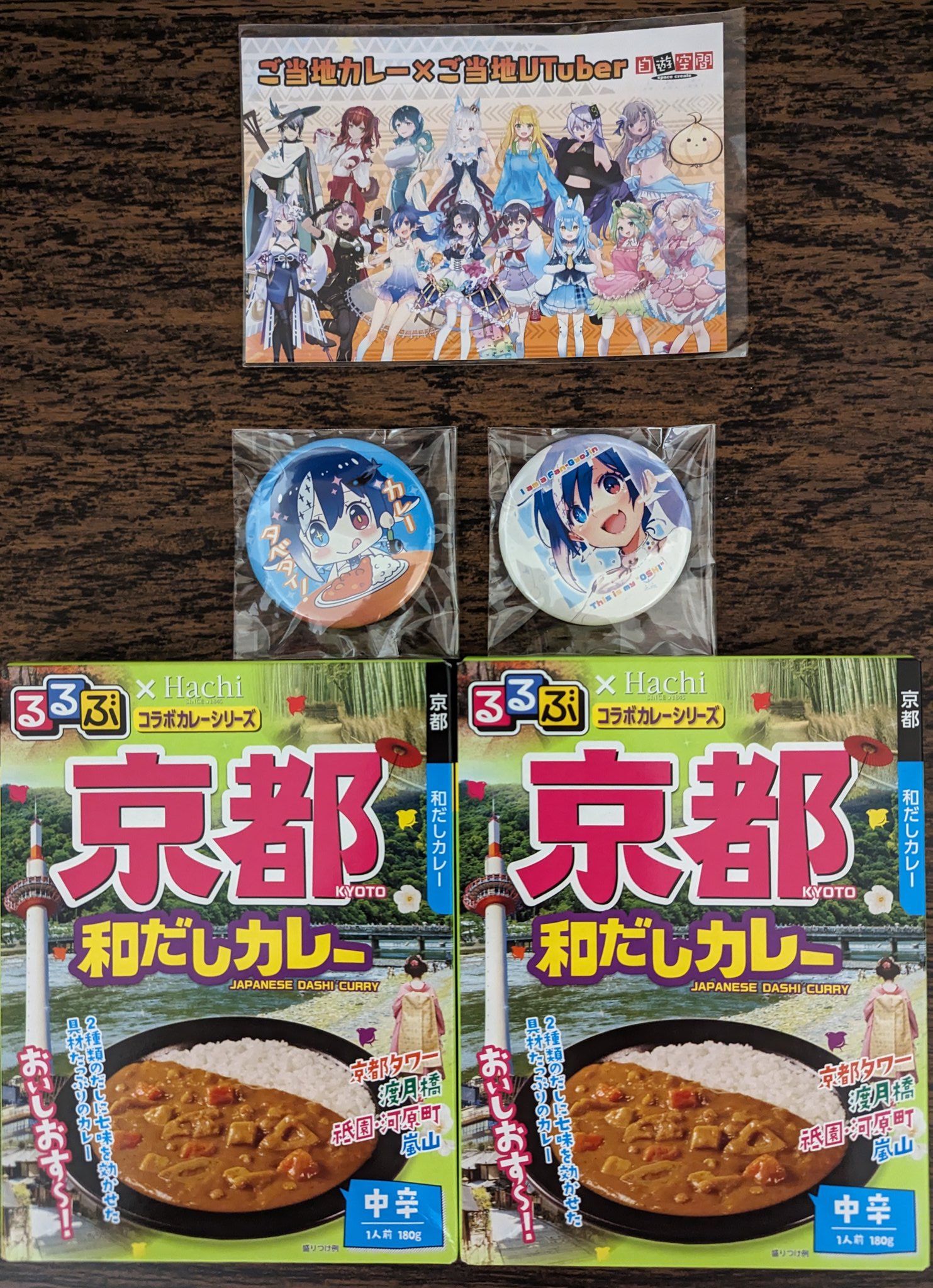
Sena Aimi (nickname: Ivy) is the last remaining member of Shiritsu Virtual Joshi Gakuin, a Japanese indie VTuber group. She loves to drink, enjoys Pokémon Unite, and has a strong Kyoto accent. So when food maker launched a collaboration with travel guidebook publisher Rurubu to sell instant curries based on regional styles, they decided to promote it using VTubers across Japan and have Aimi represent Kyoto Japanese dashi curry.
I imported the curry from their promotional website via a third party. The package contained two boxes (one serving each), along with two Aimi-themed buttons. The buttons are nice, though: One has official art of her with the words “I am a Fan-Gyojin” (the name for her supporters), and the other has a drawing by her with the words “I love curry!” As someone who indeed loves curry, this makes me realize that I don’t have enough paraphernalia declaring that fact. This is a start.
In terms of the actual taste, I was pleasantly surprised. I didn’t know what Kyoto curry was like, but if this is a good representation, I’d be eager to try more. It’s got a strong bonito flavor with a bit of a spicy kick (labeled “medium spicy” per tame Japanese standards) that I mostly felt in the aftertaste. Notable ingredients include tofu and lotus root, and according to the ingredients it uses beef and pork extracts. It’s definitely a cut above your typical instant curry of the pouch variety (as opposed to blocks).
I will not say that I paid a fair price for it because I definitely did not—I had to get it at a time when shipping options were limited. The campaign was also over by the time I received the curry, so this is a bit of a futile review on my end. Even so, the Kyoto Japanese dashi curry is solid, and I would eat it regardless of any virtual spokespeople. Given the opportunity, I probably would have sampled the other regional curries as well (and maybe discover some VTubers along the way).
And at the end of the day, that “I love curry!” button can’t be beat.
I occasionally picture myself old and gray and still writing Ogiue Maniax. You really never know what the future might hold, but tomorrow will be 16 years since I started, and it increasingly feels like that vision might come true.
Blogging this year has been more of a challenge through reasons somewhat beyond my control. I’ve considered reducing my posting schedule further, but I do worry that it’ll put even more pressure on me to make every blog entry some kind of refined masterpiece.
That said, I do think I might be imposing overly high standards on myself. Recently, I was recalling the earliest days of Ogiue Maniax, when I let just about anything escape my brain and end up in a post, and I’ve started to wonder if I should make at least a partial return to those days. I’ve positioned myself as someone with a degree of insight, but maybe I should be more comfortable having some mediocre opinions every now and then.
Funnily enough, what made me think about returning to the basics is the continued and active enshittification of Twitter. Over the past seven years or so, I decided to let my more off-the-cuff thoughts exist on Twitter while I devoted longer form things to the blog, but now that everything is on fire on Twitter, I might very well find myself spit balling right here. I’ve joined some alternatives like Bluesky, Mastodon, and Threads, but am still unsure of where I’ll land.
Ultimately, what Ogiue Maniax has become is not so much a career or even a life‘s calling, but something much simpler. It’s a place for me to question, be it myself, others, why I feel the way I do. It’s a place for me to anchor my passion. And sometimes it’s work, in a certain sense, but I’m really only beholden to myself and the notion that I can grow by writing. This is a home online I’ve been building for the last 16 years, and each post is another brick. Will I ever be done? Let’s see.







 OGIUE MANIAX