Looking at the Choice of Pokemon in “Pokemon Origins”

If ever there was a “nostalgia anime,” Pokemon Origins is it. An intentional recreation of the first Pokemon games, it limits its world to 151 Pokemon instead of the steadily climbing total count of later generations. There’s a lot to look at in terms of how it portrays a simpler time for the Pokemon franchise, but one thing I wanted to focus on is the main character Red’s team when he fights Blue for the championship, because it’s actually extremely deliberate and meant to reflect the experience of going through those first games, as well as the diversity of choices available to you along the way.

From left to right:

Scyther was a Pokemon exclusive to Pokemon Red and represents one half of the version exclusivity which helped to define the games and the necessity of trading to get all of the Pokemon. Being that the main character is named Red, the implication is that he caught this one in the wild.

Persian represents the other half of version exclusivity, being only in Pokemon Blue (or Green for the Japanese). This implies that Red at some point traded for it or its pre-evolution Meowth.

Lapras, unlike most of the Pokemon which are caught, evolved, or traded (or in the case of Porygon purchased), is a gift. In the games you receive it from an employee in the Silph Co. headquarters, so Lapras represents the “Pokemon by plot event,” and shows how he went through Silph Co. dismantling Team Rocket along the way.

Jolteon evolves from Eevee, a Pokemon which like Lapras you receive as a gift. Unlike Lapras, however, it also represents the act of the permanent choice: in the first games you were supposed to only get one Eevee (barring any creative glitches), and the choice of whether to evolve it into a Jolteon, Flareon, or Vaporeon was permanent, so the choice of Jolteon is meant to make you think, “Ah, so Red went with this one.”

Charizard is of course the Starter Pokemon, the first choice a player has to make in the game. Once again Red is Red, so the choice for which starter he’d go with is pretty obvious.

That leaves Dodrio. Its pre-evolution Doduo is available in both versions, is caught in the conventional manner, and also evolves in a normal fashion. However, the fact that Dodrio is common is what makes it special within the context of this team.

If you look at the rest of the battles in Pokemon Origins, you’ll find that the choice of Pokemon reflects this idea that the anime should give a sense of the progress Red has made. For instance, both Hitmonlee and Kabutops appear as Red’s Pokemon, and both are Pokemon whom you have to choose over others in the game (Hitmonchan and Omastar). Snorlax is a Pokemon you have to encounter because of the way it blocks certain routes, and a sign that the Poke Flute was used. Using the Legendary Birds against Mewtwo also shows how Red intended to go against it at full strength. Perhaps the most interesting decision of all, however, was having Pikachu appear only towards the end, to acknowledge its value to the franchise but to prevent it from overshadowing everything else or associating it too closely with the other anime.

Why I Like Eren Jaeger

In Episode 117 of the Anime World Order podcast, Daryl Surat, Gerald Rathkolb, and Tim Eldred briefly discussed the idea that, in order to modernize a classic, the creators of Space Battleship Yamato 2199 gave its protagonist Kodai Susumu a less gung-ho personality to match the current male audience for anime. Daryl pointed out that such heroes were the exception these days, and gave Eren Jaeger from Attack on Titan as an example of someone cut from an older cloth in terms of shounen main character tropes. I agree with the overall statement, but I also find that Eren works especially well as a protagonist in this current age because of the perspective it provides for his actions and personality.

The character of Eren Jaeger is essentially a boy who has dedicated himself to a singular goal in life, to wipe out the enemy Titans that destroyed his village and killed his mother. Characters in the series point out his immense drive and the willingness to work hard to accomplish his desires, and in this sense he exhibits the same qualities as many of the most famous shounen heroes. However, unlike Naruto whose overwhelming personality and “act before you think” approach is generally seen as a positive and the source of his series’ fundamental themes (heart is what’s important for instance), Eren Jaeger’s similar mindset is shown to have not only strengths but also critical limitations.

I see Eren as the kind of guy who makes people better than him feel worse for not accomplishing as much. Aside from his transformation, Eren is shown as not being particularly exceptional when it comes to fighting Titans, but he’s more willing to just go and do it, and not let his fears get the better of him. This is mainly what drives his relationship with Jean, as Jean is clearly smarter, wiser, and comparable in physical ability to Eren, but lacks his ability to throw himself into danger. On the other hand, Eren’s narrow-mindedness is the reason he can’t accomplish everything on his own, and that if he were a leader of men, for instance, he would probably send them all to their deaths just by being himself, as opposed to Naruto who’s supposed to become a leader with pretty much the same personality.

This is what drives the dynamic interaction between Eren, Armin, and Mikasa. Eren’s lack of forethought is tempered by Armin’s strategic insight and willingness to sit back and observe, but Eren’s fearlessness also helps keep Armin from overthinking things or succumbing to self-doubt. Similarly, although Mikasa lacks the vast dreams of Eren and Armin in terms of wanting more out of the world, her cool head and decisiveness help to keep both of them moving forward.

The fact that Eren has trouble transforming into his Titan form in one instance basically comes down to the fact that Eren has vision and drive but lacks perspective. When the Titans were simply an absolute enemy, someone who cannot be compromised with and who must be destroyed no matter the cost, it was easy for Eren to obtain the level of focus needed to become his Titan form, but when it turns out that his enemy is actually someone he considered an ally and a fellow human being, he cannot process this idea due to that same rigidity. It is ultimately his friends, who each see the world from a different place, who help him resolve this issue, and even that comes at the price of Eren having to throw away the basic love he has for humanity.

Critical Mass: Gatchaman Crowds

What is the best way to describe Gatchaman Crowds? Though I don’t think it’s valid to say that Gatchaman Crowds is Gatchaman “in name only”, it’s certainly nothing like the original. Whereas Science Ninja Team Gatchaman was Super Sentai before Super Sentai was a thing, a team of costumed warriors dispensing martial arts beatdowns and bird missiles, Gatchaman Crowds is far more conceptually driven series that brings up and explores a variety of ideas pertaining to heroism, human motivation, living within an interactive and digitally connected world, and the advantages and limitations of large and small-scale group efforts.

Gatchaman Crowds follows a team of warriors who have the ability to transform with slick armor and powerful abilities. Their newest member is main character Ichinose Hajime, a relentlessly hyper and comfortably honest girl whose sheer energy is simultaneously both exhausting and invigorating. Assigned to fight an alien menace, their efforts as heroes are contrasted by another character, Ninomiya Rui, whose social networking service GALAX brings people together to collectively solve problems, Rui’s ultimate goal being a world where people realize the inherent value in helping others. Two shades of optimism interact with each other, sometimes cooperating and sometimes conflicting.

Crowds was my favorite anime of the summer for a number of reasons. Its presentation is extremely slick, with character designs reminiscent of Kyousogiga and Heartcatch Precure!, and 3DCG work on the Gatchaman outfits that really brings out the individuality of each character. It doesn’t just present a wide variety of ideas pertaining to large-population interactions and moralism, but actively explores them from a variety of angles. Its characters are streamlined extensively, but in a way which supports the overall sense of an exchange of ideas.

In terms of the show’s ability to encourage an evaluation of how we perceive problems, there are two aspects of Gatchaman Crowds which impress me in particular. The first is that it says there’s a difference between criticism and cynicism. Often when a text or a work of fiction presents a “QUESTION EVERYTHING” attitude, there’s a sense that it wants you to feel as if the world is in a neverending death spiral and that trust is a fantasy. As Hajime demonstrates numerous times throughout the series, however, just because you’re optimistic doesn’t mean you’re unable to see a situation from a variety of perspectives, or unable to make informed decisions. The second is that Gatchaman Crowds actually makes an effort to show how there are problems in the world that are best solved without violence, without resorting to an overblown or shallow “killing is wrong” message, or that it’s just a matter of trust.

When the Gatchaman are fighting the MESS early on in the series, strange alien creatures resembling alien rubik’s cubes who take over inanimate objects, it’s Hajime’s ability to think outside the box which allows her to try and communicate with the MESS instead of constantly fighting it out like the rest of the team. However, with the other alien presence Berg Katze (loosely based on the antagonist from the original Science Ninja Team Gatchaman), Hajime realizes that Katze is different and dangerous. At the same time, Berg Katze is someone who can’t be defeated through force because of the way it turns the characters’ own fears against them, and so a different and more creative solution is needed.

Speaking of Berg Katze, I find Katze to be a powerful antagonist because of the way its most diabolical skill is attacking people psychologically, whether that’s creating chaos through deception, or by openly mocking a person’s efforts in the most grating way possible in order to compromise their self perception.

As for the role of heroes in a digital world, Gatchaman Crowds reminds me somewhat of Tiger and Bunny, but whereas that series explores the image of heroes with respect to mass media, Gatchaman Crowds explores it with respect to “media of the masses.” In particular, it looks at the concept of gamification, an idea that’s been gaining traction lately, which posits that much can be accomplished if you turn tasks and activities into “games” complete with points and high scores and such, from regular exercise to organizing files for your company. One of the key drawbacks of the concept of gamification is that it appears to imply that people are less capable of accomplishing something if there isn’t a carrot dangling in front, and Gatchaman Crowds asks the viewer to look at this from both sides. Rui’s desire to “update” the world hinges on an almost socialist view of the modern masses in which proletariat and capitalist are able to work together.

Overall, if you really want an anime that encourages you to think, then check out Gatchaman Crowds. It’s thoughtful without getting bogged down by the weight of its ideas, and even if you don’t agree with its conclusions, I think it’s still worth ruminating over what it has to say. You can watch the show for free on Crunchyroll.

Genshiken Second Season Episode 13 is the Ribbon

When it comes to the adaptation process of Genshiken Second Season as an anime, most of the time the changes ranged from minor to medium at best. Here at the very end though, we’re presented with an actual 100% original anime episode to wrap things up. As such, for the first time I’m going to be applying the level of detailed analysis I usually reserve only for the Genshiken manga to the anime.

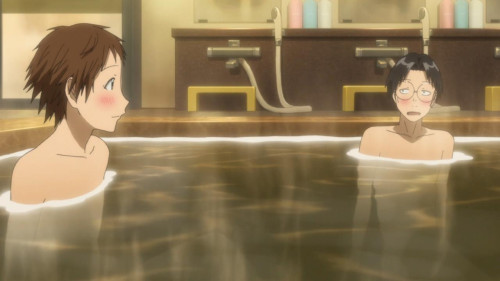
In the previous episode, Madarame revealed that he had decided to quit his job, and Hato has ended up blaming himself for this turn of events. Seeing that Hato has been avoiding Genshiken for weeks, the club invites Hato and Madarame to a hot springs so that they can relax and Hato can move forward, much in the way that Ogiue was able to have her own breakthrough. Hato, originally planning to stop crossdressing due to the perceived troubles it’s caused, gets some advice from Madarame: basically, just do whatever you want until you don’t want to, stop, then start up again if you feel like it. It’s no big deal. Hato decides to continue his ways.

On some level I think that this final episode is an attempt to finally get the Karuizawa arc (the point in the manga Ogiue finally learns to accept herself) into the anime. At this point, Ogiue is no longer really the focus of Genshiken, so it wouldn’t fit quite right to have them just devote around three or four episodes flashing back to the pre-Nidaime days, but it’s also such a significant part of Genshiken‘s story that its absence has been felt rather strongly both among fans and just in that something was missing from the anime the whole time. After all, for those who’ve stuck strictly to the anime adaptations, Ogiue somehow went from a frustrated and antagonistic individual to a somewhat gentle but still easily flustered mentor, and there was no explanation, at least until now. Even if it’s just a few brief glimpses, I’m glad to see part of Ogiue’s breakthrough animated.

With Ogiue’s desire to help Hato the same way that she was helped back then, not only do I see Episode 13 as a place for the Karuizawa storyline to make a “cameo appearance,” but I consider it to be a spiritual successor of sorts as well. In particular, Madarame’s advice to Hato resembles Sasahara’s words to Ogiue, that you can’t help what you like, only tailored to a less traumatic and dramatic situation. There’s no realization of love here, only the comfort of acceptance., andMadarame’s reached his own turning point in life, so he can look back and reflect for Hato. In addition, the discussions of collaborating on the next “Mebaetame” clearly point to the idea that Genshiken the club is a family of sorts, and a place for people to change through interacting with people both like-minded and otherwise.

Yoshitake’s presence in this episode is notable, as I think that as much as the show put Hato into the spotlight, Yoshitake (or should I say her voice actor Uesaka Sumire) has still ended up being a mascot of sorts for Nidaime. She’s that nerd you put out there to show how fashionable nerds can be, and I think just having a couple of scenes primarily of her geeking out over history from a fujoshi perspective is a part of the character’s position.

This is the first time that a Genshiken anime has seen fit to wrap things up with original content, though it makes sense because previously they had sort-of-okay stopping points and this time around if they had continued to just follow the manga, there would be no proper wrap-up for the series. The only thing viewers would get is more questions and perhaps the worst case of “READ THE MANGA” ever. Thankfully this isn’t the case, and even if I’m aware of the fact that there’s so much more material out there, this is a respectable bookend. Also, in what I’m sure is an intentional move, both the final episode of the anime and the latest chapter of the manga involve public baths, but the two are actually completely different in terms of narrative development and content outside of a more general theme of honestly expressing oneself, and so a comparison between them isn’t that useful.

This episode is also apparently a place for the people who made it to go wild with the references. A lot of the legwork was already done by the blogger Orezui, so I have to give ’em thanks.

1) “She’s not here! There’s no Hato-kun here!” is apparently a Patlabor: The Movie reference.

2) “Let’s go to the roof. I haven’t felt this angry in a long time,” is a line from the manga Salaryman Chintarou.

3) “But I can’t go [out] with a guy” is a direct reference to a line from Ogiue during the Karuizawa arc, also parodying the fact that Sue did something similar in Episode 1.

4) Sue’s obsession with taking pictures of everything related to the city of Tachikawa mirrors Yui and Mio’s initial reaction to London in the K-On! movie.

5) Kuchiki’s creepy run comes from Attack on Titan (that video above is highly recommended).

sue-chunli

6) Sue’s followup attacks are taken directly from Super Turbo-era Chun-Li from Street Fighter II. Specifically, the moves shown are Kikouken -> Jumping fierce -> Close standing fierce -> Senretsukyaku -> Tenshoukyaku.

7) Sue makes a Tomoko from Watamote face.

Obviously I know that this isn’t truly the end of Genshiken, and I hope those who’ve watched it are interested in following the manga to find out what happens next. In retrospect, the anime’s had its fair share of ups and downs, though mostly from the perspective of someone who notices subtle differences in tone and narrative timing, and I think that there’s something about the way Kio Shimoku frames each of his chapters and laces it with bits of characterization that I think gets increasingly lost as he continues to improve these already strong aspects of his work. At the same time, I think the anime generally captures what the new Genshiken is about, which includes an otaku generation gap, the complexities of gender and sexuality within the otaku framework, as well as the on-going process of change, development, and at least a bit of maturity that is college life. So if you’re still interested, stick around.

Besides, we still have that limited edition anime packaged with Volume 15 of the manga.

The Title is a Lie (Or Is it?): My Teen Romantic Comedy SNAFU

One of the most visibly obvious trends in anime in recent years is the extremely long and descriptive title. My Little Sister Can’t Be This Cute. Baka and Test: Summon the Beasts. More accurately, it’s the product of a tendency in the current light novel industry from which many anime are adapted, and with that verboseness comes a blessing of sorts. For those who want what a particular title has to offer, they need only look at the name, and for those who want to avoid specific shows at all costs it becomes equally useful. You can indeed judge these books by their covers to a certain extent, which is why I initially set aside My Teen Romantic Comedy SNAFU, considering it a low priority.

I have nothing against teen romantic comedies or SNAFUs, but the original Japanese title, Yahari Ore no Seishun Love Come ga Machigatteiru (translated also as, “My Youth Romantic Comedy is Wrong as I Expected”) seems to imply a lot of things which don’t exactly excite me. First, it seemed to hint at this strange cooler-than-school cynicism which you find in a lot of light novel protagonists that I find unappealing, a sort of counter-elitism of the same variety as “the geeks will inherit the Earth.” Second, even though it says the romantic comedy is “wrong,” it still implied some combination of harem/love triangle. When I finally got around to watching SNAFU, I realized I’d been wrong all along. While it contains some degree of the two elements I’ve described, it’s also a clever series which has at its core not so much a good ol’ harem comedy but a closer look at the combination of social and sef-perceptive tensions which can make life as a teenager mentally and emotionally taxing, especially for those who don’t quite fit in, and the help that can come from those who simply understand.

SNAFU centers around Hikigaya Hachiman, a cynical guy who quickly acknowledges how low on the social totem pole he is and how much he prefers to be there. Hikigaya is forced to join a club whose purpose is vaguely to help people out, acting as a last-ditch student-run guidance counseling of sorts. In the club, Hikigaya is joined by two girls with equally Stan Lee-esque names, Yukinoshita Yukino and Yuigahama Yui. Yukinoshita is extremely observant but a little too sharp-tongued for her own good, and Yuigahama is energetic and a little ditzy with a greater desire to try and fit in with her peers compared to the other two.

Just from my basic plot summary I think it’s easy to see why I was a bit wary (and potentially weary) of the show, but there are a number of things which give this anime some solid legs.

First, although Hikigaya is indeed quite the pessimist, and he does have the “screw the popular kids” attitude to an extent, he also shows that he’s aware of what he lacks. He knows that if you have the right attitude you can accomplish many things and reach out to a lot of people, but he doesn’t have that attitude and probaby never will. What his perspective does for him, however, is that it allows him to find people who are similar to him, and to figure out solutions that wouldn’t work for the “average” teenager, but are perfect for those who are below the bar. Similarly, Yukinoshita’s astute assessments make her able to understand a given social situation quickly, while Yuigahama’s propensity for tact and cheer becomes the grease to move the wheel where Hikigaya and Yukinoshita’s personalities would otherwise stifle it. SNAFU really does focus on the theme of helping people who feel ground down by the pressures of their social groups, and at places goes to some fairly dark (though not morbidly or horrifyingly dark) places.

Second, even though there is a love triangle element to the main cast, with Yuigahama clearly having feelings for Hikigaya due to a small event in the past, and Yukinoshita can be seen as gradually developing feelings for him as well, the friendship between the two girls is just as if not more important than the romance. Yukinoshita has no friends, while Yuigahama would traditionally try to ingratiate herself with other girls just to not be caught outside the circle, and so their growing bond becomes an important factor in developing them. It’s to the extent that, even if the series ends with one “winning” over the other by dating Hikigaya, it is highly doubtful that it would destroy the friendship they’ve built up.

Third, when it come to determining who might indeed end up with Hikigaya, the show gives a fair case for both of them. It doesn’t come across as woefully lopsided like in, say, Love Hina. And actually, when you look at the hormonal responses Hikigaya has to those he finds attractive, the strongest reactions seeem to come not from any girl, but from the incredibly effeminate male tennis club member Totsuka Saika. I’m pretty sure this is just another case of a Hideyoshi from Baka Test, a character so feminine in appearance that we’re supposed to take it as a gag, though in this case I suspect he also functions as a way to show how much deeper the connection Hikigaya makes with either girl will be.

I honestly think that this series ended up with a name as excessively long as Yahari Ore no Seishun Love Come wa Machigatteiru because someone told the author that everybody’s doing it. As a title, it’s actually quite deceptive, and somewhat ironically doesn’t help a person looking at it to understand what’s beneath the cover. I don’t think it’ll start any trends of intentionally obtuse light novel names, but at the very least it gives hope that if you’re willing to squeeze that lump of coal hard enough that it might turn into a diamond after all.

No guarantees with any other shows though.

Genshiken Second Season Episode 12 and the Fanservice You May Not Have Seen

Episode 12 wraps up the school festival. If you want to read my thoughts on the events of the episode, you’ll find them as part of my analyses on Chapters 81 and 83. At this point I’ll have to assume 82 will be covered in Episode 13 or just not at all.

So with all the cosplay this episode, particularly from Ohno, there was a hefty amount of fanservice in the most obvious sense. This was magnified by the fact that they combined two disaparate chapters together to make it an almost “cosplay-themed” episode, but amidst all that more overt fanservice the anime actually added a little something for the Ogiue fans in particular.

This image is actually an anime original, and though it’s just a single frame it communicates a lot of intimacy and perhaps even eroticism between Ogiue and Sasahara. Ogiue never ever, ever has an expression like that, with the wry and suggestive smile as well as the sideways glance towards Sasahara who’s more tacitly responding in kind. The message this image communicates is that Sasahara likes what he sees out of Ogiue, and Ogiue is pleased that he likes that. While you might think that this is me reading too much into it, given their interruption by Sue previously, there’s no doubt in my mind how we’re supposed to interpret it.

However, if you want something that I consider fanservice that probably no one else does, it would be another anime-exclusive moment:

A Go Go Curry parody!

As long-time readers of the blog might know, I am a huge fan of Go Go Curry, and what’s more, the very first Go Go Curry I ever ate at was one in Akihabara. Though there’s no way to tell if the one Madarame is at is the same one that introduced me to the wonders of Kanazawa-style curry, I’d like to pretend that it is.

Really though, Episode 12 of Nidaime actually combined two of my favorite things, Ogiue and Go Go Curry. On some level I have to rank it pretty highly, albeit at a fairly shallow level.

The Mawaru Penguindrum merchandise also helped.

Zankoku na Genshiken Second Season Episode 11

Now comes the other big moment of the new anime. Of course I’d have a lot of thoughts on what transpires this episode, which you’ll find in the equivalent manga analyses: Chapters 78, 79, and 80.

I think there’s little doubt that Madarame’s confession is one of the most significant events in Genshiken. I’ve felt sort of conflicted that it happened because it is possible for someone to move on from a former love without the confession and rejection you see so often in anime and manga, but the series makes it clear that Madarame was incapable of doing so, no matter how hard he tried. Looking back, the idea of “freeing” Madarame to some extent implies making it so that he’ll be open to others.

There’s a fairly significant mistranslation in the Crunchyroll subs, at the very end of the episode. After Kasukabe starts to cry, the translation has Madarame say, “Now I know that Kasukabe-san cries easily.” This isn’t quite right: what Madarame actually says is more along the lines of, “I already knew that Kasukabe-san cries easily.” It’s a reference to the events of Volume 4 of the manga (Episode 11 of the first anime), when Kasukabe accidentally starts a fire which gets the club into trouble. Though she put on a tough face, her guilt over the accident caused her to start crying. Essentially, Madarame’s line is supposed to reference how much he’s paid attention to Saki over the years.

It’s probably significant then that Keiko and Saki both notice how Hato pays a lot of attention to Madarame. Or is it?!

Some of the timing of the confession itself turned out different, and there isn’t quite as much impact from Madarame’s response to the line about the relationship that might have been, but I think the episode overall does an all right job of it. The manga devoted an entire chapter to just the two of them in the club room, mirroring previous chapters which did the same.

As for the actual confession and reaction, I could see how Kasukabe’s response could be interpreted as cruel, though I don’t necessarily think so. One thing anime viewers may not be aware of is that Kasukabe’s line about how a relationship with Madarame might have been a possible future is actually also a reference to another series by Kio Shimoku called Spotted Flower. In it, characters very (but not entirely) similar to Madarame and Saki, an otaku and his non-otaku wife who knew him since college, are married and expecting their first child. In fact, the title itself is a reference to them: Madara means spotted (which also explains the Naruto character), and Saki refers to the blooming of flowers. It’s a sort of holy emblem for Saki x Mada fans, but at the same time perhaps incredibly cruel itself for very nearly giving those shippers what they want before collapsing the entire thing like a house of cards.

Cruelty abounds.

Powerful Genshiken Second Season Episode 10

Mysteries melt away this episode! Covering chapters 76 and 77, it’s one of the more significant parts of the whole series.

In previous episode reflections (a better term than review I now realize), I mentioned how elements from the manga were cut and shifted, sometimes for thematic consistency within an episode, but more often because the Nidaime anime clearly has a particular end goal in mind. With Episode 10, we’re finally able to see whether or not this “cutting of the fat” has paid off, more or less. It already began with the previous episode to an extent, but this is when the revelations truly begin, and it’ll continue into the next episode too.

In this regard, I think that Episode 10 is probably the strongest one of the season so far. Whether it’s because of Mamiko’s excellent performance as Kaminaga, the portrayal of the way Hato’s denial/hiding of his inner self to others weighs heavily on him, Konno’s amazing facial expressions, or some combination of the three, I think that this episode communicates all of the complex emotions which make up Genshiken. The manga chapters were already great and enlightening, and the adaptation does them justice. In some cases, it even makes things clearer. One example is when Hato sees his brother driving with Kaminaga, with the clear implication being romance. In the manga, Yuuichirou’s expression is kind of ambiguous, but in the anime you can clearly see him smiling. It wasn’t necessary, but it helps communicate that information more overtly.

When I say good adaptation, though, I don’t simply mean that it’s accurate or 1:1 in terms of elements. The anime added an additional thing about Kaminaga moving in with Hato and his brother, but in the manga Hato lives on his own in an apartment far from the university so that he can maintain both his BL and crossdressing. They even visited it in one chapter, which was cut from the anime. The original manga also shows that Konno had dyed her hair in between high school and college, while the anime has always been brunette. It doesn’t impact the story much, but it is curious.

Yamamoto Nozomi also probably puts out some of her best Ogiue performance as well this episode. I still give the edge to Mizuhashi, but Yamamoto really displays a sense of Ogiue, particularly her delivery of Ogiue saying that turning your own boyfriend into BL material is “normal.” It really gives off the vibe that this is an area where Ogiue has not only a lot of experience, but a lot of history, while also showing how far Ogiue has come from her previous self.

I really like how the anime took the scene of Sue mimicking Rei from Fist of the North Star from the manga and added the after-images and laser lines from Fist of the North Star‘s anime. Basically, the anime adaptation of Genshiken enhanced its portrayal of a manga scene parodying a famous manga by utilizing the iconic effects from that famous manga’s own adaptation. The Crunchyroll subs do not make the reference obvious: Sue says, “Nanto Kyuukyoku Ougi!” and likely the translator either misheard or didn’t even hear the “Nanto” part.

One of the categories in the Fujoshi Files is “Fujoshi Level,” which is a not-so-serious way of describing just how polluted the mind of a particular character can be. While I actually don’t create specific rankings and try to give just a general impression in them, here you could see an obvious hierarchy: Kaminaga is off the deep end, Ogiue is right behind her along with Hato, and Konno and Fuji are definitely not as powerful. It makes me want to perhaps write up a full Fujoshi/Fudanshi Tier List one of these days.

It’s Been a While: Genshiken Second Season Episode 9

I’ve been away for the last couple of weeks so it’s time to do some catchup! Episode 9 covers Chapters 74 and 75. Also, there’s quite a bit of cosplay in this episode, and luckily for me a Japanese blogger Renko’s already laid out all of the references.

Sue = Meruru (Atelier Meruru)

Ohno = Asama Tomo (Horizon in the Middle of Nowhere)

Yoshitake = Inahime (Samurai Warriors)

Sawatari = Kunoichi (Samurai Warriors)

Fukuda = Okuni (Samurai Warriors)

Mimasaka = Leia Rolando (Tales of Xillia)

Yajima = Hirano Kouta (Highschool of the Dead)

Kuchiki = Matsudaira Katakuriko (Gintama)

The sheer amount of Ogiue content in this episode makes me happy, just as it did with the manga. You can really see her take center stage at least in the first half of the episode, and the sheer range of facial expressions that are not coming from deep anger and frustration is quite satisfying. There’s also something hilarious about Sasahara essentially roleplaying as a fictional version of himself.

Speaking of Sasahara, the new voices at this point are old news, but I have to remark that Sasahara’s voice really throws me off. It’s like his old voice was just the perfect shade of average that anything else sounds odd. Moreover, Sasahara doesn’t appear often enough for me to get used to him.

When it comes to adapting from manga to anime, I thought the decision to turn Yoshitake’s exposition into a Star Wars-esque text scroll was clever and properly captured the incessantly convoluted nature of her plot. The manga conveys this through the sheer amount of text in Yoshitake’s word bubble, but obviously that doesn’t fly in the animated format. Interestingly, when Yajima hits Yoshitake with the manga, you can see that it’s a Monthly Afternoon (the magazine Genshiken runs in), with its most famous and longest-running title Aa! Megami-sama on the spine.

(Seriously, Oh My Goddess! is still running).

Another thing I’ve been thinking about is the whole gendered pronouns thing (whether to refer to Hato as a “he” or a “she”), and while Japanese doesn’t typically use gendered pronouns the way English does, perhaps a comparison could be done between which characters refer to Hato as “Hato-kun” and which use “Hato-chan.” Those aren’t strictly gender-divided (guys can be referred to with -chan and girls with -kun), but it may speak to how they personally see Hato.

In the end, of all the things to happen in this episode, I especially hope people are enjoying the new characters’ old friends. Mimasaka comes across as the most shy and awkward of possibly any character in Genshiken (with her voice actor doing quite a good job showing this). You can also actually hear Yajima slipping into an accent when talking with Mimasaka, which is again a nice touch for the anime. I also have to wonder if Konno’s massive saucer eyes in the opening had people wondering just who she is. She doesn’t appear much, but she pretty much became my favorite of the new Nidaime characters just from her expressions. Given that Ogiue also had fantastic facial expressions, that might just be more indicative of my tastes than anything else.

As for Kaminaga’s debut, I find Noto Mamiko’s performance to be pretty spot-on with what I imagined.

The Changing Face of Takahashi Ryousuke

The Initial D character, not the VOTOMS director.

Takahashi Ryousuke, leader of the Akagi Red Suns, the White Comet, and the creator of Project D is one of the most prominent and important characters in Initial D and so inevitably he appears in every main Initial D anime. Now, each stage of Initial D has come out at different times, sometimes years apart, and even the art style of the original manga has evolved over the course of more than a decade. Character designs change according to the artist’s whim.

That still doesn’t explain how Ryousuke manages to look wildly different from one sequel to the next, while other prominent characters such as Takumi and Keisuke remain relatively intact.

Look at the guy. His face can’t stay the same size, his hair changes back and forth between blue and brown, his bone structure morphs as well. The only things that remain remotely consistent are his thick eyebrows and his full lips. Even his hair, which is roughly the same style until Fifth Stage, still undergoes some peculiar shifts. The closest he gets to looking similar is between Third Stage and Fourth Stage, and even that’s a bit of a stretch.

Anyway, I’m still trying to figure out why all of the anime have struggled to decide on a proper hair color for Ryousuke. Maybe it’s like how Raoh is blond in the manga but has brown hair in the anime?