Anime Secret Santa – Everyday Adventures of the Animest Couple: Acchi Kocchi

This review is a part of the Reverse Thieves’ 2013 Anime Secret Santa Project.

When anime fans throw around the term “slice of life,” they’re generally either enormously broad in its usage (anything that concerns non-fantastical events is slice of life!) or they’re talking about a certain type of slow-paced anime which due to the popularity of certain titles has become largely associated with a cast of primarily girls doing cute things. Acchi Kocchi falls more in line with the latter category, but where often such shows largely eschew the Y-chromosome, Acchi Kocchi decides that guys too can engage in relatively low-key hijinks without pillaging the secret garden of girlish innocence.

Acchi Kocchi follows a group of friends in high school, primarily a quiet, diminutive girl named Miniwa Tsumiki and her crush, a stoic boy named Otonashi Io. Though a lot of the show involves the characters doing silly things, the primary thrust of the humor is about highlighting the mutual feelings between Tsumiki and Io, and the seeming inevitability that they will become a couple (if they aren’t one by default already). Within this context, the gags can range from heartfelt to absurd, like a mix of Precious Moments cards and Roadrunner-esque slapstick. The humor never quite goes beyond the level it hits in Episode 1, so if you’re looking to experience increasingly powerful laughs it’s not going to happen but if you’re satisfied at that point you’ll remain content.

One thing of note is that the show enjoys making fighting game references. Not sure where that comes from but it’s appreciated.

Romance in this type of anime is not unusual, but it’s generally between two girls, and that’s even when putting aside the highly ambiguous shows which invite interpretation as yuri from the fans. Hidamari Sketch has Sae and Hiro, Kiniro Mosaic has Aya and Youko, Yuruyuri is…basically those combinations times ten. This is not a criticism of same-sex relationships in anime, more an observation about the perhaps surprising lack of heterosexual pairings, which Acchi Kocchi manages to not only include but accomplish in an entertaining and refreshing fashion.

I think that often the worry with a boy-girl romance in these shows is that one will act as the audience stand-in and the other will be the ideal (or ideally flawed) potential significant other, but Acchi Kocchi is more like if both of them were their respective anime ideals for the opposite sex. Tsumiki is small and cute, often portrayed with cat-like features, and is sort of like a fusion between Konata and Kagami from Lucky Star. While this is maybe more expected, Io’s low-key personality is less about being bland and generic and more about being an almost butler-esque bishounen. A lot of the gags involving Io involve him speaking with such natural and unconscious suaveness that the girls around him swoon. They’re quite the anime power couple.

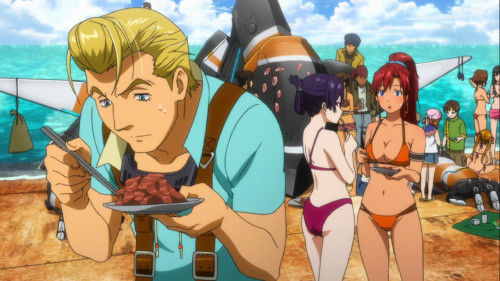
My favorite character by the way is the scientist Katase Mayoi. While I could say quite a bit about how her quirky personality appeals to me, I think this screenshot explains it well enough.

Overall, I definitely enjoyed the show, and while it never felt entirely fresh it wasn’t stale either. Pleasantly humorous with a unique take on familiar territory in a genre which thrives on familiarity, Acchi Kocchi can be a nice change of pace for those who enjoy their so-called slice of life shows but want a bit more variety.

Call from Mighty No. 9, a Focal Point of Projected Ideals

mightyno9-call-e

Given the success of its Kickstarter, it’s highly likely that you’re already aware of Mighty No. 9. The brainchild of Inafune Keiji, co-designer of Mega Man, it’s very much a successor to Mega Man, starring a robot with variable powers named Beck. While there are plenty of things to discuss when it comes to Mighty No. 9, one of the more fascinating topics is the “Roll” of the game, a female character named Call. Garnering enough fan support for a “Call gameplay stage” stretch goal to be reached, what is curious about Call is that her popularity was achieved well before we knew really anything about her.

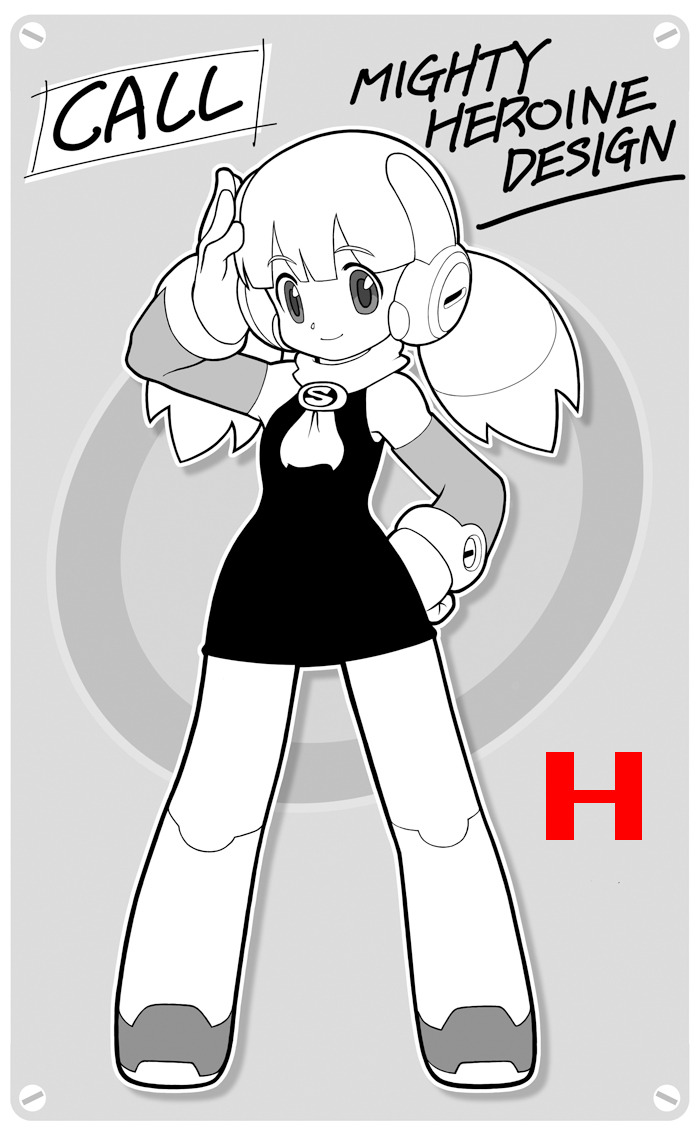
From the very beginning of the Mighty No. 9 project, it was announced that there would be this female supporting character. However, she had no definitive design (though a few possibilities were shown), no determined color scheme, and very little information about her background or personality. Even her actual name was a later addition to the campaign, while these were the only notes eventually provided about her:

  • Call is a female robot originally created by Dr. White’s friend, Dr. Sanda, to help assist him with his research; she somehow avoided being infected by the virus causing all the other robots to go berserk and has pledged to help Beck.

  • Call was not imbued with the human characteristics that make Beck unique, so she’s more of a pure robot — as you might imagine, this contrast can lead to some interesting differences and misunderstandings whenever they interact!

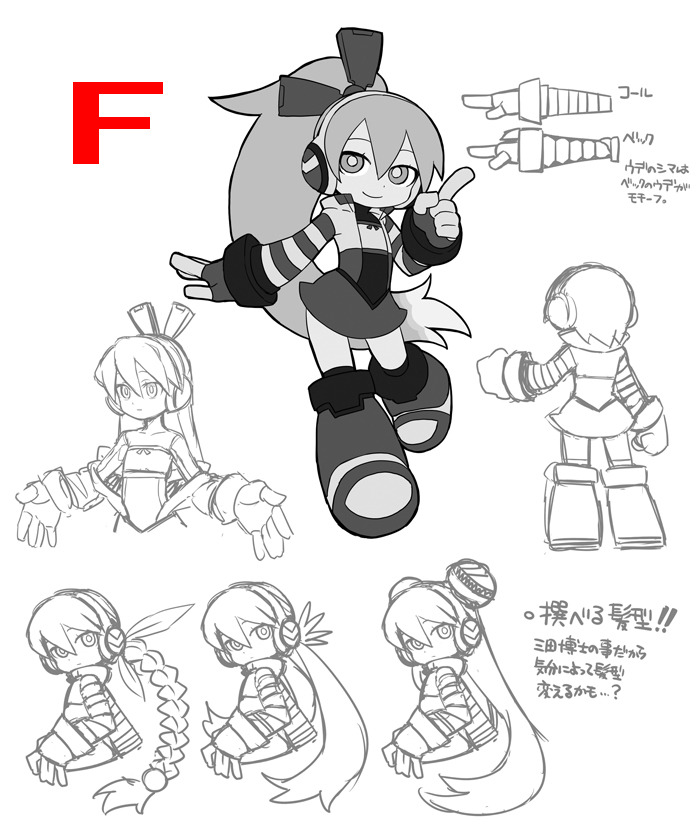
And yet, even with this utter lack of information about Call, she developed a fanbase, such that the vote to decide what will become her finalized look has become a big deal among Mighty No. 9 fans.

mightyno9-call-f

A common answer these days for this sort of thing involves referencing Hiroki Azuma’s database narrative concept in a reductive fashion by pointing to how disparate features such as blue hair or a tsundere personality act as patchwork parts to create characters appealing to otaku, but I don’t think you can even refer to Call’s initial concept as a “database character.” It was less of a database and more of a less-than-1kb .txt file, and I think Call’s popularity actually comes from something else entirely.

mightyno9-call-h

My own guess is that the reason Call gained fans before we really knew anything about her is that her basic position, as a female character in a new video game which has as one of its guiding principles heavy interaction with the community during development, made her an open canvas for fans’ perspectives. Whether fans see Call as someone to potentially relate to, or an opportunity to establish a strong female character who can go a step beyond Roll in Mega Man, or even just as “the cute girl,” Call’s initial lack of features combined with faith in Inafune and the staff of Mighty No. 9 allowed people to project onto Call their various ideals. In this prototype state Call fans see in her the very best.

The Fujoshi Files 87: Akai Ringo

Name: Akai, Ringo (赤井林檎)
Alias: N/A
Relationship Status: Single
Origin: Okami-san & Her Seven Companions

Information:
Akai Ringo is a high school student at Otogi Academy in Otogibana City, where she works for the “Otogi Bank,” a school organization which helps with student requests in exchange for future favors. Patterned after Little Red Riding Hood and ending all of her sentences with the syllable “no,” Ringo exudes an image of youth and innocence. In reality, Ringo is a “rotten apple” with a cunning and manipulative personality, albeit loyal to her friends.

Ringo is best friends with her fellow Otogi Bank member, the wolf-like Ookami Ryouko, while supporting Ryouko’s burgeoning relationship with the timid Morino Ryoushi. Her feelings towards Ryouko are somewhat complex in that she would be very comfortable with a romantic relationship, but does not desire her normally otherwise. Ringo is also the half-sister of Shirayuki Himeno, a poor but beautiful fellow student who cares for seven younger siblings.

Fujoshi Level:
Akai once created a fictionalized movie where Ookami, Morino, and she fight the three terrorist Tonda brothers. The story called for the pig-like brothers to do possibly indescribable things to each other as the result of a penalty game.

I Heart Ira x Mako

I’m not really a big “shipping” sort of person, but I love the idea of having the giant Gamagoori Ira and the hyperactive Mankanshoku Mako from Kill la Kill as a couple. So far, the show’s featured various interactions between them, and the surprising level of respect Ira shows for Mako as well as Mako’s own ability to catch Ira off guard makes them come across to me as “equals” even if you can’t call them opposites. They do both operate heavily on loyalty, so maybe they have some similarities after all.

If only Mako had kept her 2-star uniform and its delightful delinquent-ness, they’d be a pretty fearsome combination. Of course there’s always still hope for them to bring it back.

Though, don’t ask me how that masochism stuff is supposed to fit in.

Coppelion Anime, Smooth and Round

I’ve come to the conclusion that the Coppelion anime feels like the Coppelion manga with its edges filed down. I don’t mean just that they’ve removed all references to nuclear radiation, or that if you add up all of the elements of each version that one is more “serious” than the other, but that there’s a distinct difference in presentation.

Though the manga is more overt with its criticisms of nuclear energy, at least at first, it’s also wackier in a lot of ways. Amidst the tragedy, characters make wild and contorted faces almost like they’re One Piece characters, and there’s even more fanservice to boot. Aoi, who comes across as more cutesy in the anime, has a greater degree of comic relief in her in the manga, and I think it just has to do with that sense of exaggeration.

Here’s Aoi in the anime:

And here she is in the manga:

Also note the difference in Ibara’s facial expressions.

I think in some ways, this difference in feel does more to change the contents of Coppelion than even the censoring, like the wackiness adds a certain element of permeating ugliness to the story which helps to foreground the social and environmental issues a bit more. That might just be my personal preference though, and I find as the show gets into the second arc it starts to adapt the original material better.

On the Use of “Special Attacks” in Shin Mazinger

One of the defining traits of director Imagawa Yasuhiro’s adaptive works is the way in which he takes a large mass of disparate information pertaining to a particular work and organizes it such that the themes and concepts are strengthened and made more vibrant through cohesion and consistency. With Giant Robo, it’s an amplification of the history of legendary manga creator and Tezuka contemporary Yokoyama Mitsuteru. With Tetsujin 28 (also originally by Yokoyama) it’s  about highlighting Tetsujin 28 as a connection between post-war Japan and the militarism which had preceded this period. With G Gundam, in spite of the fighting tournament setting, it’s about the effects of continued conflict on the Earth. Shin Mazinger Shougeki! Z-Hen takes Mazinger Z’s iconic status as the super robot and shows just how much influence it’s had on the genre as a whole while also providing an argument for how Mazinger as a whole gives much food for thought if only one delves a little deeper.

What I find particular interesting about Shin Mazinger as an adaptation is the way in which Mazinger Z’s attacks themselves have been reorganized to strengthen the image of Mazinger. For example, take the Photon Energy Beam, Mazinger Z’s eye lasers. Generally they’re considered one of its weaker attacks, even often being the first and least-damaging move for Mazinger Z in the Super Robot Wars franchise. In Shin Mazinger, however, it is initially Mazinger’s strongest weapon When taking into consideration what Mazinger Z is supposed to be, a robot whose basic power comes from a combination of its Super Alloy Z (which the bombastic narration is very keen on making the viewer remember by deliberately repeating its name) and its miraculous Photon Energy power source. Tapping directly into the very thing that moves Mazinger Z only makes sense as a highly destructive attack.

When it comes to Mazinger Z’s arsenal and its cultural influence, however, there is nothing in all of the history of super robots with more imitators, successors, and homages than the Rocket Punch. What does Shin Mazinger do? For one, it makes the Rocket Punch the very first attack that Mazinger Z does in the show while giving it a fanfare worthy of the gods, but Imagawa doesn’t even leave it at that. He adds new elements to Mazinger Z so that the Rocket Punch, or a variation of it, is the greatest, most visually striking, and memorable thing that Mazinger Z can do. When Mazinger Z performs the Big Bang Punch, it literally transforms its entire body into a massive fist and becomes one with the Rocket Punch, such that Mazinger Z’s most lasting legacy (outside of the act of actually having someone control the robot from within) is also its most potent weapon.

Shin Mazinger takes Mazinger Z’s attacks and asks, “Why are these moves fun and exciting?” In doing so, it is able to play around with Mazinger Z as a cultural object and bring attention to not only what made it conceptually interesting to its fans in the first place, but also what potential still lies within it.

Kill la Kill = Exploitation + Empowerment?

Kill la Kill for all of its visual creativity is a pretty controversial show, if only for its main heroine’s outfit and how it’s used in the series.  Whether Ryuko’s uniform (or lack thereof) is a symbol of feminine power or yet another case of women being objectified in media is the point of contention. I find that it can be difficult to navigate the intersection between “exploitation” and “empowerment” in Kill la Kill, partly because when we think of those ideas we usually find them mutually exclusive to the extent that one can only grow at the expense of the other, whereas I actually believe Kill la Kill is honestly and genuinely trying to do both at once.

Kamui_Senketsu

One of the key examples of this duality is in Ryuko’s transformation sequence, which ends in the pose shown above. Her uniform is ridiculously skimpy, but her actual stance exudes power and confidence, sharing more in common with the type of posing done by a tokusatsu hero rather than the almost fashion model-esque poses common to magical girl shows (and also JoJo’s Bizarre Adventure). It’s showing her body off to the world at the same time it shows off her will and determination.

Outside of Kill la Kill, of all the series I’ve seen which attempt this combination the one that tries the hardest is probably Shinkon Gattai Godannar. There, the fanservice is arguably more extreme and pretty impossible to avoid in its own right, but I find that its ideas and themes resonate with a desire for women to be the heroes of their stories. With either Kill la Kill or Godannar, it’s possible to “look past” the sexualization (or not), but neither the image of exploitation nor empowerment are necessarily merely in service to the other, as if one is an “excuse” and the other is the underlying true meaning.

It’s easy to think of the people who made Kill la Kill as perverts, and it’s maybe even true, but I wonder if the show is actually saying something along the lines of, “Hey, perverts can be feminists too!” Whether this approach is okay or not is of course still up for debate, and differs from show to show, or perhaps even episode to episode. Personally, I’m pretty okay with it but recognize the potential, positive or negative, in combining this imagery in that it can be appropriate and used according to the viewer’s wishes.

6 Years Combined Blog Mars

This year’s blog anniversary actually snuck up on me by surprise. Every year before this I had the sense to notice that November was coming up and November means time to celebrate, but this time around was different.

For a long time I’ve been considering changing the banner up top, but I keep hesitating on it. I made it on the fly when I first started, and it was outdated from Day 1, but something about it has me feeling that it maintains the blog’s identity. Simple, to the point, Ogiue. Will it finally change this year? Who knows, but I do have an idea or two.

On the anime front, I never thought we’d get to see another Genshiken anime. This blog actually began in the middle of the Genshiken 2 run back in 2007 (not to be confused with Genshiken Second Season which aired this year), so in some ways it’s come full circle. I think the fact that it sort of coincided with the lifespan of Ogiue Maniax so far makes me realize just how much time has passed and indeed how much otaku culture has changed in its own ways.

Moving forward, though I do always want to keep blogging I get the feeling that the next year may bring some changes to the blog. Perhaps it’ll be just a once-a-week post schedule, maybe it’ll be fewer prepared essay-style posts and more near-stream of consciousness posts (like this one!), or maybe it’ll just be more sporadic posting. I can’t predict the future unfortunately. As someone who has tried his hardest to maintain the blog as both a place where I could relax and challenge myself at the same time, keeping at it week after week has been important to me, and if I can help it I’ll continue to do so.

I still have plenty of things to say, and to ask.

Pretty Good, Quite Fun: Chousoku Henkei Gyrozetter

Chousoku Henkei Gyrozetter is about a world where everyone can drive, including 8 year olds. Cars can also turn into robots called Gyrozetters. This technology comes from a prophetic tablet known as the “Rosettagraphy” which also contains a list of “chosen drivers,” kids with the attitude and will to drive the most “wicked cool” Gyrozetters in order to fight evil or corrupt fuel companies or whatever.

If it wasn’t clear from my summary, I think Gyrozetter is an odd show, but what I think is really strange is how typical it is without veering towards tedious or amazing or even average. Its mostly episodic format gives off “standard kids’ anime” vibes in spades, but it neither comes off as a refreshing take on the formula nor so rote as to be unentertaining. I find it difficult to talk about if only because I definitely enjoyed the show in a way which would have me looking forward to more, but it doesn’t feel quite special. People say that the hardest shows to talk about are the ones that are utterly mediocre, but when it’s “better than average, though not great,” a show like Gyrozetter poses its own review challenge. The robots/cars are fairly well-designed, the characters are fun and expressive, and both the episodic elements and the overarching plot work well enough together. I think the best I can do though is to talk about some aspects of Gyrozetter which I found fairly notable.

First, is the endings which are pretty much Precure-style dance sequences but done with giant robots. It’s eye-catching if anything.

Second, even though it’s a kids’ show it spends a lot of effort on attractive ladies. Apparently in some interview the director or producer said something along the lines of wanting to make the show “erotic” but I don’t know how seriously to take that.

Third, the villains are an appealing part of the show, and though they start off fairly serious they get increasingly Team Rocket-ey as the series progresses. Curiously, as this is happening the plot is also getting more dramatic so there’s this almost schizophrenic feel to Gyrozetter which isn’t offputting but gave me pause every so often.

Fourth, it’s a boys’ show which develops the relationship between the main character Todoroki Kakeru, who’s very much of the Ash Ketchum-type (or Satoshi if you prefer) and his would-be girlfriend Inaba Rinne to a surprising extent. He’s 10, she’s 12 (or somewhere along those lines), and it’s actually really close to if Pokemon had spent more time overtly pushing Ash x Misty as a thing instead of just giving the vaguest of hints. Maybe that’s what’s oddly refreshing about the show even though it’s so formulaic.

Fifth, Mic Man Seki, who is literally voice actor Seki Tomokazu. His job is to hype up everything ever, and he certainly does a good job of it.

Sixth, the Valentine’s Day episode.

Gyrozetter is a bit different from other giant robot anime because it’s not based on a toyline or pushing sales to nostalgic older fans, but comes from an arcade game where you’re supposed to drive around for a while collecting powerups and then transform into a robot for a 3-on-3 battle. Apparently the anime didn’t do well, and I wonder if it was partly because the show’s format (children of destiny use their car robots to save the world!) was too different from the actual game, and I did notice that towards the end they tried to actively foreground the arcade gameplay in the actual anime. However, it seems like the arcade game itself wasn’t terribly popular and is going away, so maybe there’s plenty of blame to go around.

From what I’ve been told (by Kawaiikochan author Dave), the arcade machine is the embodiment of rad as the giant cockpit-like arcade machine will literally transform into a battle mode as you shift gameplay modes and do so in the flashiest way possible. I have to wonder if maybe the game was too much, as a lot of the popular arcade games for kids seem to be the super automated games where characters dance or fight on autopilot based on a special card you use.

In terms of favorites, the best robot design in my opinion Rinne’s second Gyrozetter, Dolphine. Its curved design makes for a pleasing sillhouette and its figure skating gimmick reflects Rinne’s own interests (her dream is to be an Olympic skater) in an interesting fashion. I can’t pick a favorite character but I was fond of Kotoha the bridge bunny (the one in green and glasses), Haruka, who is shown in the shot of the villains above, and the secretary character Kouno Saki.

If I stretched even further, I think I could say some things about how the show addresses the concept of destiny through the later developments concerning the Rosettagraphy, but I’ve said a lot more about a show I find to be “not bad” than I was expecting. With that, I’ll just end with some final screenshots.

Scattered Thoughts on the View of Anime and Manga as Sexist

I’ve been thinking a lot about female characters in anime and manga recently (not exactly a surprise, I know), and it’s something where, even if I don’t have a fully formed argument or point to make, I feel compelled to write something down. Forgive me as I meander through my own thoughts in an attempt to piece it all together.

About a month ago I was reading the comments section on polygon.com in regards to the portrayal of female characters in video games. I can’t remember which game they were talking about, but one commenter said something along the lines of, “You shouldn’t bring up Japan when trying to show strong women in video games because it’s such a sexist culture. Just look at anime and manga,” and it made me bristle. I do think Japanese culture is sexist in many ways, but the idea that this perception of Japan as sexist made it impossible for Japanese fiction to have really good female characters in this person’s eyes bothered me because I’ve seen plenty from every period of anime and manga.

I know it was just one comment on a video game article, but it got me thinking more broadly about what people see in anime and manga, and to what extent the image of anime and manga as sexist is fueled by what people want to see. I recently saw a comment that criticized Heartcatch Precure! for encouraging girls to be stereotypically feminine by having the character of Itsuki, who normally dresses like a boy, express a desire to be more girly. While I know there are plenty of examples of tomboy characters who end up feeling like they need to dress like girls to attract their male love interest, Itsuki’s story is more about how she suppressed the side of her which enjoys cute things out of a somewhat misguided sense of duty and responsibility. Yet, rather than taking this as the message, it was like as soon as the person saw the rough outlines of the stereotype, surely it would play out the same as always.

There are most certainly a good deal of works which go out of their way to objectify women for male consumption, but I just find that there are also plenty of instances of well-portrayed women and girls in anime and manga. Whether it’s Princess Jellyfish or RidebackKekkaishi or Gowapper 5 Godam, it seems like these female characters get ignored because they’re, somewhat ironically, not as eye-catching as a Queen’s Blade or an I Wanna Be the Strongest in the World! There seems to be this idea that anime = sexism, and while even the works I mentioned as strong examples aren’t entirely devoid of sexism themselves, I also don’t think it’s as simple as just slapping the misogynist label on Japanese media as a whole. Messages regarding women in anime and manga can be so diverse and divergent.

At this point I’ve seen a lot of 60s and 70s shoujo, and I’ve noticed a clear trend of mischievous tomboy heroines from that time period. Even putting aside an extreme example such as Oscar from Rose of Versailles who was raised as a man to uphold her family’s proud military tradition, you have Candy from Candy Candy, who’s adventurous and constantly challenging the conceitedness of the upper class, and Angie from Petite Angie, who is portrayed as an extremely clever detective. You have Ayuko from Attack No.1, whose aggressive desire to win at volleyball inspires the rest of her teammates, and Yumi from Sign wa V! who initially plots to sabotage her teammates because of how much she despises volleyball. Hiromi from Aim for the Ace, Lunlun from Hana no Ko Lunlun, Masumi from Swan, the list goes on and on. All of these characters have their fair share of personal agency (even if it’s not always an ideal amount). Given that the trend of the strong, mischievous tomboy was clearly a “thing,” and I do believe it continued in some form well beyond the 70s (Utena is an obvious one, but perhaps Lina Inverse from Slayers counts too, for example?), I just have to wonder about the disconnect between that and the perception of anime and manga as inherently misogynistic and where it may have come from.

Is it a matter of age of these older titles, that if people were able to access the works these characters are from, that they would change their minds? Is it that shoujo doesn’t act enough as the “face” of anime and manga? Could it be that, as much as we’d like to think we’ve gone beyond the stereotype, anime is still viewed as essentially “porn or Pokemon?”  If the ratio were different, and there were just fewer fanservice titles or works where girls are basically a cheerleading squad for the heroes, would detractors be more charitable towards anime and manga, or is it inescapable as long as some titles are still like that? For that matter, to what extent does the western image of the submissive Asian woman affect and interact with how people see all female characters coming from Japan, and how does it differ from the similar stereotype as viewed by Japan (I can of course admit that it’s there too)?

What shapes people’s views of female characters in anime and manga? I guess that’s the question I want to explore the most.