Less-Than-God Voice

The other day I had the opportunity to karaoke again, and I took full advantage of it, singing anime songs from all decades and genres (but mostly giant robots). It had been, what, over a year? since I was last able to belt out some tunes and it felt pretty good.

Ever since the last time, I’d developed another favorite song to karaoke: “Tatakae! Reideen” from the 70s robot show Reideen, if only because there’s a part where you just start shouting aggressive words of encouragement.

IMA DA (NOW)! FIGHTO!

YUKE (GO)! FIGHTO!

TATAKAE (FIGHT)! FIGHTO!

And so on and so forth. Try it some time, it’s good for blood flow and for relieving stress.

Sadly I’m unable to provide a proper link for it at this moment, but at the very least you can see listen to its singer, Shimon Masato, and his most famous song ever, about a piece of Taiyaki which escapes into the ocean.

Would Fans of Superhero Comics Like Tiger & Bunny?

With its German-sounding location (Sternbild City), prominent use of English, and decidedly American superhero motif, Tiger & Bunny resembles something closer to the comics of Marvel and DC than it does Japanese-style costumed heroes, your Kamen Riders and Gatchamans and the like. At the same time, it’s not just a direct imitation of the superhero genre, and puts an interesting twist on the whole thing by making the heroes both celebrities and walking billboards for corporations, like if the fame and fortune-seeking Booster Gold (I know, he’s changed now but bear with me) was doing those old Hostess snack cakes advertisements.

Because of how Western Tiger & Bunny is in concept, though not necessarily execution, I’ve been wondering whether or not the show would be capable of reaching that English-speaking superhero comics fan community in any form, be it through the current Hulu stream  or dubbed and put on cable television. In considering how I would sell the series to superhero enthusiasts, I’ve pictured myself describing it as a somewhat more light-hearted Watchmen because of how it takes a critical, yet relatively optimistic view of heroes, but when I consider how many factors might make that comparison feel off for readers. They might find that the writing isn’t as airtight as Alan Moore’s and that I’m insolent enough to compare the two. They might feel unsure about the title itself (“‘Bunny?’ Do you really expect me to take that seriously?”), or that it’s still too anime for their tastes, or that the popularity of the show among fujoshi sours its reputation. They might not even like Watchmen and the comparison would have them want to check it out even less.

So I’d like to ask both superhero comics fans, anime fans, and fans of both to tell me what you think about selling Tiger & Bunny to the Marvel/DC crowd. From your experience, how do you think it would fare? If you’re a comics fan and you’ve never heard of Tiger & Bunny, what do you think of my basic Watchmen/celebrity comparison? If you have heard of it but chose not to check it out, what about it turned you away?

BUDDHA DISLIKES SUFFERING: The Buddha Film

I had the opportunity to see the Buddha animated movie recently, thanks to the New York Asian Film Festival. Based off of a manga by that one-and-only god of comics, Tezuka Osamu, it is meant to be the first part of a trilogy. I have no prior experience with the Buddha manga, so my reflection on it is not influenced by a comparison to the source material.

Following the life of Prince Siddhartha from birth to adulthood, the Buddha movie tells us about the life of Buddha. And by that, I mean it really tells us. Repeatedly, over the head, with a hammer gripped by two ham fists. Scenes which actually start out with some subtlety soon after get bludgeoned by the desire to make every message as clear as possible, whether it’s through excessive narration (literally telling and not showing), dwelling too long on certain details, or having an extremely overwrought musical accompaniment. I found myself at times getting into the movie, feeling for the characters in their lowest hour, and then in comes the music which really, really wants you to know that this is a sad moment. This turned out to be a recurring theme throughout the viewing.

To Buddha‘s credit, this meant that the film was continuously successful in pulling me in, but to its discredit the film would also drag me right back out almost without fail. In a way, the movie is its own worst enemy, and it is very clear that this film is meant to appeal to a wider, more mainstream audience, a summer popcorn flick that can’t seem to get its act together entirely. Siddhartha himself makes for a somewhat lackluster main character, not necessarily because he’s a religious figure and portrayed in the film almost without flaw, but because his “development” just feels like events plucked out of his life, all of which tell the same story. As a young boy, Siddhartha was naturally predisposed to disliking the death and suffering of others. A traumatic event causes him to dislike them even more. As a teenager, Siddhartha still is against death and suffering. Another traumatic event occurs to reinforce those feelings. As an adult, once again, death and suffering bad, here’s another thing to show that Siddhartha continues to be really against those facets of the human condition. His character never really develops, it just becomes much more of the same. This isn’t entirely bad, as I doubt any film like this would show Siddhartha’s “rebellious middle finger to the MAN stage” (and disliking war and violence and the Hindu caste system is technically sticking it to the man in this instance), but if this is just how it happens, then the film could have just been structured around that better.

There are other characters in the film as well, but their strengths and weaknesses are almost the same as Siddhartha’s, except for perhaps one twist in the character of a young peasant named Chapra, who tries to go against the caste system as well, in his own way.

Overall, I think Buddha was just okay, and that’s only because the good narrowly outweighs the bad, of which there is a lot. Again, the film is successful in becoming engrossing, but it continually undermines itself. What would have been much more powerful or poignant are cut off at the knees for the sake of removing ambiguity. Should the next sequel ever get made, I sincerely hope they realize that they have something, albeit mired in so much mud.

Mizuhashi Kaori and Tohoku-ben

Mizuhashi Kaori is one of my favorite voice actors, and not just because she’s the voice of Ogiue. Her range is quite impressive, and it often makes it difficult to initially figure out that a character is indeed her. As for her role as everyone’s favorite fujoshi character, Mizuhashi has talked before about how she had to learn and practice Ogiue’s Tohoku dialect, not being from that area.

This makes her recent role in Nichijou (aka My Ordinary Life) all the more interesting. Playing the angel character in the bizarre “Helvetica Standard” skits, in episode 9 she tries to teach a demon how to pronounce “chirashizushi,” a dish which is comprised of sushi rice (i.e. vinegared rice) with sashimi on top. Think of it as a pile of deconstructed sushi. Try as she might though, the demon slurs all of the syllables in a distince Tohoku-ben fashion, turning “chirashizushi” into “tsurasuzusu.” “Sushi” when spoken in Tohoku-ben sounds like “Susu.”

I have no idea if this influenced her hiring as the Helvetica Standard Angel, but I think it makes for an interesting circle, going from having to learn Tohoku-ben to successfully play a character with that accent to playing a character who is trying to teach another character not to speak in that fashion.

Ogiue

ka.

Hulu Says, “Watch Anime.” I Say, “Uhhh…”

For the first time in a long while I’ve been able to use Hulu, and naturally the first thing I do is go watch some cartoons. While watching anime on Hulu, I got an ad for…anime on Hulu. That’s nice, why not advertise your services? People might not know, and I assume that these ads aren’t just preaching to the choir and appear on other shows.

As I watched the 30-60 second ad (I don’t quite remember how long it was exactly), I came to an odd realization that the ad was not making me want to watch anime. If you haven’t seen it, it basically features various clips from anime titles on Hulu (Naruto, Soul Eater, School Rumble, etc.) to the tune of an instrumental version of the first Soul Eater opening. Something about it doesn’t sit right with me, and I think it has to do with how similar it is in spirit to ADV’s old anime advertisements which emphasize thie idea anime is action, giant robots, magical girls, comedy, straight from Japan, not kids’ stuff, etc. I even like a good amount of the shows used in the ad, but it’s like they took the most spastic and anime-ey scenes they could find and called it a day’s work.

I don’t have a solution to offer myself, for an advertising wizard I am not, but I can easily think of one example that I feel inspires people to watch anime. Back in the early-mid 2000s, Toonami would run ads for their shows, usually grouped together by a theme. They made anime feel grand and special in a way that wasn’t just drawing on kids’ desires to see something different (though obviously that was still a factor).

(It also doesn’t hurt that the narrator is Optimus Prime.)

The above video indeed feels like it’s promoting a lot of the things that the old ADV commercials and the Hulu one do, but so much more weight is given to themes that are explored through anime than to the flesh and spectacle of techno-oriental exoticism. If the Hulu ends up working out for Hulu and they get tons of new viewers, then more power to them, but I still think the ad could be something more substantial.

Mahjongs at Dawn

Friend, mahjong ally, and translator kransom is currently in Japan, and in a conversation online he mentioned to me the fact that Texas Hold ’em has a similar reputation in Japan that Japanese-style mahjong has in America. In other words, it has a small but devoted following where if you say to someone that you know how to play Texas Hold ’em, they’ll get really excited and invite you to play, possibly showing off their Real Authentic poker set in the process. Having a passing familiarity with Texas Hold’em and more of an understanding of mahjong, I can see why they would have a similar exotic and wild appeal. They’re both games where you have to manage your luck.

The only thing that’s missing for Japan is an Akagi equivalent, an intensely dramatic series that thrills you into loving poker. If such a thing could be produced in the US, then the circle would be complete.

Thinking about mahjong as a storytelling device however, I realize that there is an inherent “flaw” of sorts with the game that doesn’t quite exist in Texas Hold ’em, and that is mahjong’s inability to naturally come down to a one-on-one situation. That’s not to say that a 1v1 battle is impossible, but mahjong is inherently a four-player game, with a strange three-player variant if you’re one man short, but no long-standing rules for two players. As a result, mahjong stories have to go through great efforts to transform the game into a duel, whether it’s coming up with an entirely new (and untested) rule set (Ten, Shin Janki), pushing two of the players into supporting or even essentially non-existent roles, or modifying it into a 2v2 game. Texas Hold ’em however can start with a large group and as more and more players lose all of their money, the game can end up in a 1v1 with no wild changes made to the basic rules of the game.

So Texas Hold ’em has potential, though I think anyone who’s seen games knows that. Make it a series about female poker players who really enjoy each others’ company if you have to.

Speaking of, I realize that Saki prefers to have all four players in a mahjong game be their own characters, as opposed to lackeys for more prominent figures in the story, and is kind of an exception as a result. That route is, of course, also a good one.

Catching Hearts: A Response to Scamp’s Heartcatch Precure! Review

This post is in response to Scamp, aka The Cart Driver’s review of Heartcatch Precure! It goes way into spoilers, so be warned. If you want to read something significantly less spoiler-heavy, I suggest yesterday’s review.

Continue reading

Wonderful Dreams of True Friendship: Heartcatch Precure!

There’s something special, really special, about Heartcatch Precure!, so much so that I think the best way to properly convey its brilliance is to take the long, scenic route to introducing it. It’s a show whose strengths can be subtle yet obvious, and I want to really give the show its proper due as a noticeably strong piece of fiction which utilizes nearly all of its elements intelligently and artistically without ever losing its sense of fun.

The premise is simple and familiar. A heroic figure, Cure Moonlight, suffers a traumatic defeat, and in desperation sends two young fairies to Earth to find two individuals capable of taking her place. The first girl is Hanasaki Tsubomi, a young girl and recent junior high transfer student who loves flowers. Tired of her meek personality, Tsubomi sees the move as an opportunity to turn her life around. The second girl is Kurumi Erika, an aspiring fashion designer who immediately sees Tsubomi as a friend, but whose eagerness and hyper disposition exasperate and overwhelm Tsubomi. Together, they become Cure Blossom and Cure Marine, fighting against an evil group whose goal is to transform the Earth into a wasteland by feeding off the fears and doubts of humans.

Pretty typical on its surface, Heartcatch Precure! manages to go above and beyond through not just its technical execution but what I would actually describe as “heart.” One of the most prominent aspects of the show for me is the mature and helpful manner in which it discusses a variety of serious topics that not only kids but even adults can grapple with in their daily lives, and this complexity tempered by graceful simplicity extends to all areas of the anime as well. In terms of visual design, the character designs are less stiff when compared to typical Precure designs (or even anime characters in general) without being overly esoteric, and the pastel colors and free-flowing line work breathe a sense of vibrancy into them. This in turn makes both the show’s action and non-action scenes stand out in a manner reminiscent of Casshern SINS (no surprise given that they share the same character designer), trading the dreary, post-apocalyptic world of that anime for one whose messages of hope and growth are more apparent. The narrative is also bolstered by the visual aesthetics, as they are able to support the strong characterization found in the show through their sheer energy, whether they’re laughing or crying or just walking about.

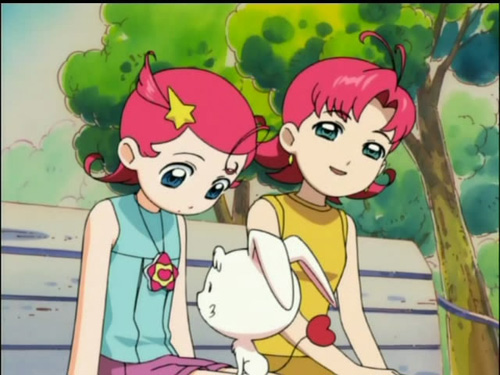
Right from the first episode, the characters are remarkably complex and their interactions dynamic and fun. Of particular note is Erika (pictured left), who I find to be an amazingly well-rounded character who complements Tsubomi well, and whose traits give her not only a lot of fundamental strength but also room to grow. While the Precure franchise has always been about the contrasting personalities of its main characters, Tsubomi and Erika are not so easily divided into opposing categories like “smart” vs. “athletic,” or “loud” vs. “quiet,” though they exhibit such differences to a certain degree. As the show progresses, rather than trying to make up for each others’ weaknesses, the girls learn from each other and deepen their friendship, and it’s a wonderful thing to see play out.

Going beyond the main two, the character Myoudouin Itsuki provides another interesting example. Itsuki, being the successor to her family’s martial arts dojo, crossdresses in order to represent her status as “next in line.” Unlike many other shows, however, Itsuki’s issue isn’t about whether she feels any bitterness towards having to act as a “man,” but whether or not the amount of responsibility and pressure she’s willingly put on herself is making her disregard her own feelings. This more thorough, yet still relatively simple, psychological exploration contributes to the show’s strong sense of characterization.

Perhaps the greatest strength of Heartcatch Precure! can be found in the way it shows that there is life beyond the immediate. Notable in this regard is the establishment of the character “Dark Precure” (the one who defeats Cure Moonlight at the start) as a powerful antagonist who completely outclasses the heroines and who continues to be a legitimate threat every time she appears. This is a rare feeling in previous Precure series, and part of the show’s draw simply has to do with seeing how the girls can manage to overcome this seemingly insurmountable obstacle, an adversary they are actually unsure of how to defeat.

By far the best representation of this broader perspective, however, comes from the fact that Heartcatch Precure! acknowledges the world past junior high. In every other Precure series, none of the main characters are ever older than 15. Once they hit the end of their third year in junior high(9th grade in the US and other countries), the show ends and nothing more is ever seen of them, and even when they appear in the crossover movies, they are always portrayed as still being in junior high. Heartcatch Precure! bucks that trend. Cure Moonlight is 17 years old. Tsubomi’s grandmother, who is in her late 60s, is actually a former Precure herself. These older figures not only guide the younger Cures through their experience, but also learn from the younger girls’ optimism and zest for life, making it less of a one-way street and more of a mutual growth which spans generations.

My fondness for Heartcatch Precure! is quite obvious at this point, but I do think there are areas where it falls short, and I feel that the best way to sum up my criticism is to compare it to Ojamajo Doremi, a similar magical girl show which actually shares much of the same staff. In that light, I find that the biggest flaw in Heartcatch Precure‘s is how “beating up the enemy” is too often the solution to a character’s problems, even in situations where fighting has little to do with the dilemma at hand. Granted, it’s certainly not the only show in the world to do this, but I know Heartcatch could have done better in this regard, especially given Doremi. In contrast, Doremi‘s most glaring problem, the blatant toy-pushing aspect of the show, is handled far more gracefully in Heartcatch Precure! Owing to the strong visual design of the show mentioned before, the transformation sequences and the special attack animations so typical of the magical girl genre almost never feel tiresome because of how lively they are.

Watch Heartcatch Precure! If you’re not that big a fan of magical girls, if you haven’t enjoyed the Precure franchise in the past, I think this is a really good place to start. It exceeded my expectations in almost every way, and it might do the same for yours. Just keep in mind to not expect too much to quickly and enjoy the show at its own pace.

Notes on Genshiken Volume 10 Extras

I recently received my copy of Volume 10 of Genshiken (aka Genshiken II Volume 1), and as anyone who’s read Genshiken in collected format knows, there are always little extras in between chapters. This time around it’s a combination of four-panel comics and profiles from the Genshiken club magazine Mebaetame, of which only one has been shown in-comic (Hato’s explicit one). The purpose of this post is just to jot down things I find interesting from those extras.

For the sake of convenience, here are all of my individual chapter reviews from Volume 10:

Chapter 56
Chapter 57
Chapter 58

Chapter 59

Chapter 60
Chapter 61

Ogiue’s Pen Name: Ever since it was first revealed, people had no idea how to actually say it. This time around though, Ogiue has given us a handy pronunciation guide, for which I am very grateful. So say it with me: OGINO NARUYUKI. Feels good, doesn’t it?

Majors: The coursework for the characters in Genshiken is something we’ve never learned much about, other than the fact that Kohsaka wasn’t in Computer Science but learned how to program anyway. Now though, we know that Ogiue is a 3rd-year Literature Major, Yajima is 1st-year Literature, and Hato is 1st-year Economics. The rest of them don’t bother mentioning it. I feel like knowing their majors gives some perspective on the whole thing in terms of seeing where the members are coming from, and it’s also interesting to compare to an American college anime club, where history and experience have taught me that a good chunk of them are indeed CS Majors.

Hometowns: For years we’ve known that Ogiue is from the Tohoku region of Japan, but nothing more specific than that. It turns out Ogiue is from Yamagata Prefecture, which of course means that she speaks specifically in the Yamagata dialect.

Yajima is from Tochigi Prefecture (Kanto) and Hato is from Niigata Prefecture (Hokuriku). Yoshitake doesn’t mention anything, and as we already know, Sue is from Massachusetts.

Yoshitake’s Ramblings: If you read my translation of Tamagomago’s post and got confused when he mentions Yoshitake talking about “oinking” (buhireru), it’s because it happens in Yoshitake’s profile, which is a long, long thing all about how she wants to see a manga or anime made out of a particular historical novel. This (and the huge word bubble in chapter 58) also makes it clear that Yoshitake is indeed a literary person.

Favorite Titles: Keep in mind that a lot of the titles are parodies of existing works. A lot of this is gotten with help from this site.

Ogiue: Haregan (Fullmetal Alchemist), Kujibiki Unbalance, Zenkoku no Kyojin (Shingeki no Kyojin [Advance of the Giants])

Yajima: Pakuman (Bakuman), Kintama (Gintama) , Ten Piece (One Piece), Menma (Naruto), Back-bared no Mago (Nurarihyon no Mago [Nura: Rise of the Yokai Clan)

Hato: Duarara!! (Durarara!!), Rebuild of Evingelion, Hetalila (Hetalia), Winter Wars (Summer Wars), Fuyume Yuujinchou (Natsume Yuujinchou [Natsume’s Book of Friends]), Sweets Basket (Fruits Basket), Koi to Kyuuso (Unsure of even the pronunciation), Metro no Inu (Chikatetsu no Inu), Kaburagi-san to Rokuhara-kun (Hori-san to Miyamura-kun), Femto (Fate/Stay Night according to that site), Tsukutsukuboushi no Naku Koro ni (Higurashi no Naku Koro ni)

What we can see is that Yajima sticks mainly with Shounen Jump (or “Shounen Champ” as it’s called in-story) and also that Hato has very diverse tastes, but we knew that already.

Ogiue Likes Sasahara Just the Way He is: Just wanted to point out that in one comic, Ogiue thinks about how Ohno didn’t mention Sasahara among the “weirdos,” but that she likes his unassuming personality.

Ivory Jaws

Note: This post discusses spoilers for Tiger & Bunny, A Certain Magical Index, and Hajime no Ippo.

In episodes 12 and 13 of Tiger & Bunny, the heroes of Sternbild City fight the powerful villain Jake Martinez. His telepathy allows him to read an opponent’s intentions and avoid getting hit. Out of the four heroes who face him, Jake only ever gets hit twice: Once by accident when Wild Tiger trips over himself, and then a second time when Barnaby is able to land a clean hit, but Barnaby’s attack is enough to defeat him.

Broken rib or no, one hit doesn’t seem like it should be enough to take down such a strong adversary, but Tiger and Bunny does a good job of making it obvious that Jake’s weakness isn’t just a glass jaw, but a side effect of his powers. Jake is so adept at using his NEXT abilities to avoid any and all attacks that he is simply not used to being hit, and so making contact shocks him not just physically but psychologically as well. Even Wild Tiger’s inadvertent flip kick has little force behind it and yet still gives Jake pause.

When I saw this, I immediately thought of another villain: Accelerator from A Certain Magical Index. Like Jake, he is the mid-series villain, and like Jake, he possesses a power which prevents attacks from reaching him. In Accelerator’s case, he can control vectors, so any punch or bullet thrown has its direction diverted or even reversed with little effort. In the face of Index hero Kamijou Touma’s ability-canceling abilities however, Accelerator’s face meets Touma’s fist repeatedly. Like Jake, he can’t take a hit.

I think there’s something a little satisfying about villains whose weaknesses are something so simple and basic that anyone could avoid them if only they were familiar. With both Accelerator and Jake, they rely a little too much on their abilities, so when those are negated they do not have the natural reaction time to make up for it. In a way, these antagonists are portrayed as members of a kind of ability-based ivory tower, where their privileged statuses make them vulnerable to the rest of the world, even if it’s not immediately noticeable.

Interestingly, Hajime no Ippo shows the other side to this trope, though without any use of true villains. In the world title match between Date Eiji and undefeated champion Ricardo Martinez, Ricardo lands a severe blow on Eiji, which he’s 100% confident will take Eiji down for good. To his surprise however, Eiji manages to recover from that punch, which leads Ricardo to conclude that the only reason Eiji could’ve possibly taken that hit is that he must have fought someone whose punches are as hard if not harder than Ricardo’s own. This, of course, refers to Eiji’s fight with the main character Ippo, who is characterized by incredibly brutal punches. Had Eiji not gained the experience of taking hits from Ippo, had the impact not been engraved into his body, the sheer shock from being hit in a completely new way would have finished the match with Ricardo right there.

Which is to say, in a Martinez fight, Jake definitely wouldn’t want to get hit by Ricardo.