Burning Out On Quality

A while back I wrote a post about mitigating burn-out when it comes to consuming anime and manga, advice that had the caveat of me never having actually burned out, which means that I’m either very qualified to talk about it or not qualified at all. Recently though, I was in a situation where I had trouble watching anime, and I feel like I learned a lot from it.

I’ve been watching a lot of science fiction-themed anime, series full of ideas about how the future can/will/should be, not necessarily heady stuff but enough to make a person think a fair amount. However, even though I like everything I’m watching, one day I just suddenly had this strong desire to not continue, like my brain and eyes were telling me that they would refuse to process that information meaningfully if I tried to watch more. I wasn’t sure what to make of it, until I could hear my own thoughts more clearly.

I need to watch something ultra dumb.

And so I did, not knowing how long it would be until I could restore my capacity to watch so much science fiction. In the end, it only took a day away from those shows for me to feel the urge to keep watching, but it taught me a valuable lesson that seems so obvious in hindsight: You can have too much of a good thing.

Often the picture of anime burn-out seems to be that someone who just watched too many bad shows and can no longer handle the bottom-feeding tropes which populate low-tier anime, but I think that a more fundamental aspect of such burn-out is just monotony. Much like eating the same food day in and day out with no variety, even the most delicious of meals can lose their flavor, especially if you’re not naturally predisposed to liking them. Also like food, the level of variation needed to keep things interesting varies from person to person. With anime, I find there are shows that I can become quite fond of with little effort, shows that I can watch just about any time, but for other shows, I find I need to put a bit of myself into the show. As a result, sometimes I find myself unwilling to watch another episode because I can sense that my mind is “exhausted” and will not give me an accurate impression, and just pushing and hoping to power through that mental blockade can end up doing more harm than good.

And so, I have much gratitude for ultra dumb shows. Sometimes they’re just what I need.

Ogiue Maniax Headed to Nishicon 2011

To partially sate my persistent curiosity about the anime fandom in the Netherlands, I’ll be attending Nishicon tomorrow, November 13, in Haarlem. As far as I know this is the very first Nishicon, and I’m interested in seeing how it debuts. The only other fledgling conventions I’d been to otherwise were New York Anime Festival and New York Comic Con, and those are quite different in scale for a variety reasons, one of which is that the NY cons are professionally run exhibitions.

In any case, I’ll be there for probably most of the day. You can find me by speaking Dutch and observing my blank stare.

The Evangelion Pilots, Represented in Combat

I’ve been revisiting Neon Genesis Evangelion lately and have come to appreciate it in ways that I hadn’t before. While I always found the show to be especially good at showing the deep-seated fears and emotions within the characters to the point that they feel almost tangible, I’ve begun to take note of how well the characters’ words and actions exemplify their personalities.

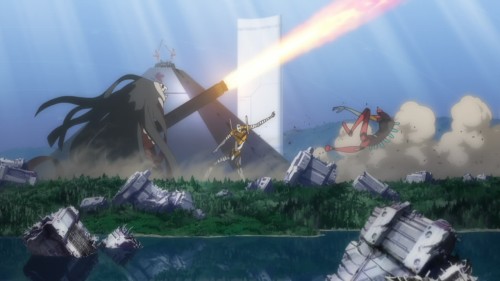
One example that stands out in my mind comes from Episode 19, the famous episode where EVA-01 goes berserk and eats the enemy angel, Zeruel. When Zeruel descends upon Tokyo-3, it is first met by a barrage of artillery fire from Asuka and her EVA-02, just weapon after weapon after weapon, with Asuka getting progressively angrier until she is defeated. Rei then appears, her EVA-00 missing an arm, and charges at Zeruel with a powerful bomb with the plans to detonate it at point blank range. Later, right before Zeruel can attack the staff of NERV, Shinji bursts through and engages in melee combat, then loses power, then goes berserk. What I’ve come to realize is that the way each character fights in that scene represents them incredibly well, acting as more than just a visual spectacle.

Asuka is always looking to prove her self-worth, particularly as a pilot and as compensation for her traumatic childhood, and her desperation mounts increasingly as more and more weapons are deployed by the EVA-02. This loud, brash display of firepower is Asuka.

From the way everyone else reacts to seeing Rei carry the N² Mine, it is clear that no one knew of this beforehand, which means that the idea is entirely her own. Rei, who constantly questions whether or not she is human at all, has very little regard for her own life.

Shinji fights with a form of desperation different from Asuka’s, and as one of his core traits is a vague sense of self-identity, Shinji’s close combat perhaps shows his desire to gain an identity through the piloting of EVA-01. This also differs from Asuka because Shinji is not looking to prove himself, but rather to find himself. It might also be possible to say that the berserk scene itself shows Shinji’s tendency to be pulled along, though I’m not sure about that one.

I think the best indicator for how much this particular moment in Evangelion represents the inner feelings of its characters comes from a comparison to the redone scene in the second Rebuild of Evangelion movie. In it, Mari replaces Asuka in EVA-02 for the film’s iteration, and the fight begins in a similar fashion, with EVA-02 surrounded by firearms which Mari initially uses one after the other. However, the scene itself feels remarkably different. Mari uses each weapon more slowly and deliberately, never really reaching the intensity that Asuka did in the TV series, and after only a few decides to run in up close with a melee weapon. The method Asuka used is something only Asuka can do; it would not reflect Mari’s character.

As for Rei and Shinji, their changes highlight more of a subtle shift in character, a fundamental part of the new films. Rei, just like the original, attempts to defeat Zeruel by detonating a bomb at point-blank, but in this version Rei takes the time to push Mari and the EVA-02 out of the blast radius while thanking her, showing that her actions do not simply stem from doubting her own humanity but from also affirming the humanity of others. Shinji’s fight is initially similar, but as I once mentioned in my review of the film, Shinji never loses control, the “berserk” EVA-01’s actions conscious and deliberate on the part of Shinji. While he still seeks his own identity, he is able to set that aside to save Rei, establishing a stronger identity in the process.

I’d like to actually end by talking about Mari once more, because as I was making this comparison I realized the role she plays relative to the others in terms of their relationship to the Evangelions. Asuka pursues self-worth, Shinji self-identity, and Rei a connection to humanity, but Mari seeks pleasure in the act itself. She revels in being an EVA pilot in and of itself, with no seeming underlying motivation except perhaps some strange desire to experience life to its fullest. Her “bestial” fighting style, even before she activates the actual “THE BEAST” mode, is indicative of this. That Evangelion is able to cut to the core of its characters in even its action scenes makes it truly impressive.

The “Nervous” Visual Style of the Boku wa Tomodachi ga Sukunai Manga

Last week I wrote a post comparing the Boku wa Tomodachi ga Sukunai anime and manga (neither of which are the original source material) and showed that I have a clear preference for the manga and its visual style. I gave image comparisons to try and show exactly what I meant, but while some readers got it, I noticed that others were still confused as to why I think the manga looks better, especially because of how “rough” the art is in comparison to the more “stable” designs of the anime. Because of that, I’m going to elaborate on why I find the visuals to be more interesting and more aesthetically pleasing so that even if people disagree with me, I think they can see where I’m coming from.

Let’s start with a visual aid, the first panel in Chapter 19. This time, I’m using an untranslated version of the manga because the points I’m making don’t have anything to do with what Sena is saying, nor does it have a mirror scene in the TV series. I want to emphasize that I do not think the anime should necessarily look just like the manga. This is just straight-up analysis of the manga without having to compare it directly to the anime. If you want more of that, you can check out JP’s response to my comparison.

Sena is cropped from the chest up in the panel, and we can clearly see that she has large breasts, but the thing that stands out most in the entire panel is her expression. She’s blushing heavily, her eyebrows are furrowed in an unusual manner, her eyes are to the side, and her index fingers are touching each other, all indicating that Sena is quite nervous. You can tell that as she’s talking, she’s in an uncomfortable position for whatever reason. That nervousness takes absolute priority over the fact that she has a nice body, and so it becomes the most noticeable thing about her in that panel.

While the line quality of the manga doesn’t approach Robert Crumb levels of jittery, it still creates an interesting sort of tension in the comic. The “sketchiness,” as I’ve seen some people refer to it, results in characters and environments that indeed make the art look “incomplete” if you associate completeness with firm inks and closer pursuit of anatomical correctness in the hands and such, but that mildly quivering line also makes the entire comic feel like everything does not quite fit comfortably within it. When it comes to a series all about people with generally very dire personality flaws,  the fact that the art looks somewhat uncomfortable in its own skin in itself contributes to the sense that the entire series is about people who have trouble making friends. Their nervousness bleeds from them, through the panels, and into the very “texture” of the comic itself. At the same time, it still sticks to fairly conventional character designs to emphasize the cuteness of the girls such that element is still definitely there. It’s just that some of the cuteness also comes from the “instability” in the art style because it shows that they themselves are a little (a lot?) unstable.

I hope this did a better job of helping people to understand my point of view, but if this has only made you more confused, don’t hesitate to ask me more questions in the comments.

The Fujoshi Files 29: Odango-chan

Name: Odango-chan (お団子ちゃん)
Alias: J-chan (Jちゃん)
Relationship Status: Single
Origin: Tonari no 801-chan

Information:
Odango-chan is a friend of 801-chan’s along with BL-chan and a regular attendee of their “fujoshi meetups.” Not much is known specifically about her taste in anime and manga or her personal life, except that she appears to not be quite as far down the rabbit hole as her fujoshi compatriots.

Like her friends, she can produce an alternate form representative of her true love for BL. Unlike the others however, that form has undergone more changes over time, most notably the symbol on her forehead, which resides in its current form as a “J,” but has previously even been blank.

Fujoshi Level:
Little is known about Odango-chan’s exact fujoshi level, except that she has definitely been in the game for a long period of time.

The Boku wa Tomodachi ga Sukunai Anime Could Be Better

Earlier this year, I started to read the Boku wa Tomodachi ga Sukunai manga.

I became an instant fan.

I really enjoyed the manga because of how it showed the difficulties of making friends when inexperience and considerably flawed personalities are thrown into the mix. It’s a decidedly otaku-oriented series that hits kind of close to home in a pleasant way. So when I heard that it was getting an anime adaptation I was pretty thrilled about it. I had my fingers crossed that it would be the anime of Fall 2011. Now, a few episodes into the TV series, I find it safe to say that I am fairly disappointed with the anime adaptation of Boku wa Tomodachi ga Sukunai.

On a basic level, the anime and manga are not that different from each other. They have the same premise, a group of people who are very bad at making friends trying to help each other to humorous effect. They have the same characters with the same personalities. They both have fanservice and their fair share of otaku references. But where I find the manga to pass with high marks using this mix of ingredients, the anime by comparison falls short of the manga’s success.

I think the best place for me to begin is the art, because the character designs for the manga and anime are drawn in markedly different styles. Whereas the anime has more of what I’d call a typical light novel/visual novel-esque style to it, the manga’s artwork seems more loose and fun. The manga doesn’t feel the need to stick to its template too closely, and perhaps because it doesn’t have to devote frames of animation to consistency, it makes the comic feel comparatively more energetic. Putting aside more abstract aspects of manga such as page and panel layout, decompression, etc. (things which I think the manga does quite well and do contribute to the quality of the series), even the smiles from the characters in the manga show a lot more emotion behind them. I feel like I can understand the inner workings of the characters and I’m pleased by that. The anime on the other hand, while its designs aren’t abysmal or anything, don’t seem capable of as much expressiveness, and in general the show feels a little stiff and wooden by comparison. I understand that the anime’s designs are closer to the original light novel’s but I still like them less. On that note, I have not read the light novels, so I cannot say if either is a faithful enough adaptation to the original, but the problem isn’t faithfulness so much as it is the particulars of execution.

Another major factor is the fanservice. By that, I don’t mean that the manga is devoid of fanservice which makes it somehow automatically better. In both cases, the girls are still cute, Sena’s chest is equally impressive, and they all have a tendency to wear attractive outfits. There’s nothing particularly objectionable about this. However, the anime has significantly more fanservice, to the point that I find myself saying, “The girls are already cute enough! You don’t have to do anything more with them!” The fujoshi character Rika has scenes showing her fantasizing in both versions, but the anime’s depictions tend more towards a climax in an eroge while the manga emphasizes the extent to which it leaves her flustered. The show also has a tendency to repeatedly linger on the female characters below the belt to a degree which exceeds the yuri mahjong anime Saki. The opening video itself seems particularly dedicated to showing off the girls’ bodies and ignoring the friend-making aspect of the show, and I find myself wishing it had been done differently, perhaps something akin to the Toradora! OP. To put it simply, there’s a difference between the girls wearing a sexy bikini that shows off her figure and a shot that draws specific attention to the underboob.

Now, I understand that the series has something of a harem vibe to it. It’s an unavoidable aspect of it, for better or worse, and it’s not like I have anything against a harem series which is designed to show off its girls. I once compared Infinite Stratos to Kore wa Zombie Desuka? and while I found the latter series better and more engaging overall I thought the girls of Infinite Stratos were more attractive with better designs. That approach is fine, if a little limited in its appeal. With that said, I find the key difference to be that, based on how the two adaptations approach the categories mentioned above, the expressiveness of the characters/aesthetics in general and the approach to showing off the attractiveness of the girls, the manga does a much better job of making me think of the female characters as people first and cute girls second. While I certainly don’t mind that the girls are nice to look at, what made me love the series in the first place was that it encourages a deeper understanding of the characters, particularly their awareness of their own personal flaws. With the manga, I feel that it gives a much stronger sense that these characters really do wish they could make friends in a way that outshines the fanservice, which I think gives it far greater ability to reach otaku and other readers with that bit of warmth. With the anime however, although that aspect is still there, I think it makes it more difficult to see past that simple harem exterior and into the meat of it (no pun intended for Sena fans).

I’m not going to accuse people who really like the show of having poor taste or think they’re simply unenlightened fools. I much prefer the manga and its style, but people may choose the anime’s designs over them for whatever reason. The girls are cute and it’s okay to think that they’re cute, to be attracted to them or even obsessed with them. Perhaps most importantly, while I find the level of fanservice in the manga to be more or less acceptable, I know there are people out there who would find that the cheesecake ruins the character portrayals in the manga. Even so, I just can’t shake the feeling that the anime’s approach to Boku wa Tomodachi ga Sukunai obscures its greatest strengths too much.

FATE/ZERO SPOILERS I FIGURED OUT BERSERKER’S IDENTITY

Gotta Stock ’em All

C: The Money of Soul and Possibility Control is a show that can ostensibly be described as Wall Street meets Pokemon. “Investors” are summoned to a mysterious “Financial District” where they use powered assistants called “Assets” to fight and take each others’ money. As I am not really familiar with how actual stocks and investing work, I cannot tell you how accurate the flow of money is within the show, other than to say that I looked up the word “mezzoflation” and that is definitely some made up mumbo jumbo original to C.

But when I think about it, what percentage of the population actually knows in great detail the ins and outs of stock exchange? We go on the news and hear about “NASDAQ rising” this or the “Nikkei Index” falling that, and while the information is out there for people to learn, it is so many levels removed from how people traditionally think of how to make money (i.e. perform a service and get paid for it) that it all begins to sound like some elaborate game involving smoke and mirrors and maybe juggling clowns.

Maybe I’m just an idiot when it comes to finances but with the sheer complexity and mystery of how the world’s finances work, it feels like a nation’s wealth might as well be decided by a Pokemon Battle, instead of the convoluted web that exists in reality.

The Fujoshi Files 28: BL-chan

Name: BL-chan (BLちゃん)
Alias: N/A
Relationship Status: Dating
Origin: Tonari no 801-chan

Information:
BL-chan is a good friend of 801-chan’s. Along with Odango-chan they often join together for “fujoshi meetups.” Though she originally declared that she can find true love because her true love is 2D, BL has been dating a younger man.

BL-chan shares similar tastes with 801-chan, such as a fondness for the Prince of Tennis musical, but will also disagree on certain aesthetic matters, such as how hairy the men should be below the belt (BL-chan prefers guys to be smooth). She is also more receptive to content that is a little more hardcore compared to her friends. Like 801-chan, BL-chan manifests her fujoshi side through the appearance of a small creature, though hers has what might be either bat wings or ears.

Fujoshi Level:
Upon being asked about her boyfriend, BL-chan responded by describing him as “a vulnerable uke (bottom) who thinks he’s a seme (top).”

Wonderful, Everything’s Wonderful: Cosmic Baton Girl Comet-san, Revisited

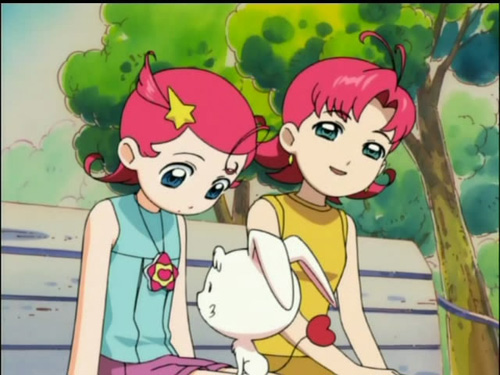
When I originally wrote my Cosmic Baton Girl Comet-san review, I mentioned that I had not finished the show simply because not all of it was available at the time. In the three years since I wrote that review though, I have been able to finish the entirety of the anime (sans subtitles), and so I want to make an update, bring some closure, and tell you if my opinion has changed since then.

Pretty much everything I said in the original review still holds true. The pleasant pace, the way it makes everyday life feel worthy of discovery and appreciation, the charming characters that make you want to smile, it’s still all there from beginning to end. Comet never stops growing, Meteor shows that there’s more to her than just snooty princess-type comedy. The way the characters interact with each other shows off their personalities so well that it’s hard to find many other shows that can manage this subdued sense of wonder.

The second half does indeed bring more plot, but Comet-san never stops being an anime that you can ease yourself into. The ongoing plot points build up slowly but surely, and it has what I find to be an appropriately satisfying ending.

In considering how this show might appeal to otaku who might not necessarily be into mahou shoujo, I might compare this show to slice-of-life, but I think that would perhaps be doing Comet-san a bit of a disservice. I like slice-of-life shows, don’t get me wrong. I eagerly await the new season of Hidamari Sketch and I’m a fan of Minami-ke, but those just cover the joys of everyday life. Comet-san does that, better than those shows, but it also shows the great things and bittersweet feelings that can arise from life slowly changing, until the everyday of today is not the everyday of two months ago.

It’s somewhat of a long series at 43 episodes, but I think it’s worth it. This show is really, really good. Ojamajo Doremi good. Heartcatch Precure! good. If you have the chance, and you want to see a simple but poignant show, check out Cosmic Baton Girl Comet-san.