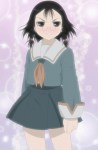
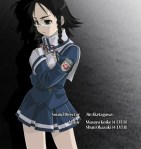
The Fujoshi Files 80: Rittoku Kanae

Name: Rittoku, Kanae (六徳カナエ)
Alias:
Kana (カナ), Ankoku Miko (暗黒皇子), Anko Kumiko (あんこくみこ)
Relationship Status:
Complicated
Origin: Fudanshism: Fudanshi Shugi na Seikatsu

Information:
Rittoku Kanae is a teenager attending Kentei Academy with a love for cosplaying as men, gothic lolita fashion, and visual kei. Believing that her developing figure prevents her from being the ideal image of a girl (something she derives from visual kei), Kanae tends to minimize the appearance of her very large breasts through the use of wraps and loose clothing. It is Kanae’s experience in this regard that allows her to immediately notice that the gothic lolita fujoshi “Amane” is actually a boy. Despite the fact that she harbors feelings for not only Amane but Amane’s true self (fellow classmate Miyano Amata), she does not realize the two are the same for a very long time.

Kanae’s hobby is to compose dark poetry on her website under the pen name Ankoku Miko, “priestess of darkness.” Her favorite band is Beni Kagerou, a two-man band featuring male crossplayers. She is also a fan of the anime Omakase Tentel, though not to the extent of her friends and acquaintances.

Fujoshi Level:
Rittoku is not an extreme fujoshi, as her other hobbies seem to hold higher priority in her life. On Miyano Tamae’s fujoshi rating system, she is a “Visual Kei (Bangya) Fujoshi” with a Delusion Power level of 2500 and an Economic Power of 200.

The Fujoshi Files 79: Morikawa Rion

Name: Morikawa, Rion (森川璃音)
Alias: 
Sohora (そほら), Gojappe (ゴジャッペ)
Relationship Status:
Single
Origin: Fudanshism: Fudanshi Shugi na Seikatsu

Information:
Morikawa Rion is a school nurse at Kentei Academy who, unbeknownst to her fellow stadd and even the otaku in the student body, is a famed BL doujinshi author. Better known as “Sohora” to all of her fans, she is the founder of the popular Ten x Miko circle Gojappe, and is a regular attendee of Comic Manga Market. It is with her direct help that Miyano Amata, brother of fellow Gojappe member Miyano Tamae, initially transforms into the gothic lolita “girl” Amane in order to work the desk at Comic Manga Market.

Whether as a nurse or as a doujin artist, Sohora is adept at caring for others and listening to their problems. She is a fan of the magical girl series Omakase Tentel, and also has a thing for seemingly opposite genres, the Salaryman and the shota. In her mid-20s, she is also the oldest fujoshi in and around Kentei Academy.

Fujoshi Level:
When Morikawa once found herself with a seemingly insurmountable writer’s block, she was able to use a simple experience talking to a couple of the students at Kentei Academy to overcome it. Tamae’s ranking system has her as a “Closet Fujoshi,” whose Delusion Power is at a somewhat low 700, but is bolstered by an extremely high Economic Power of 5000.

Genshiken Second Season Episode 7, Cutting and Splicing

Episode 7 of Genshiken Second Season covers Chapter 70 as well as parts of Chapter 7172, and even 73 of the original manga. You can read my manga analyses there, though keep in mind that the missing parts of 71 through 73 are likely going to appear in Episode 8, so you might want to avoid them for spoilers.

First thing’s first, I must fulfill the promise I made last time and explain each of the cosplays at the beginning of the episode. I’m sure everyone at least recognizes one or two, but just to play it safe I’ll lay them all out.

Sue is dressed as the ever-enigmatic Princess of the Crystal, from Mawaru Penguindrum (a show I would highly recommend).

Kuchiki is Mr. 2, the master of “Okama Kenpou” from One Piece.

Ohno is the titular character from the popular PS3 game Bayonetta.

Other references include Sue’s “Nu-nu-nu Piccon!” which comes from Ramen Saiyuuki (thanks Anonspore) and Ohno’s mention of “HTT,” or “Houkago Tea Time,” the main characters’ band in K-On! who have a tendency to sit around and snack on sweets.

As I continue to watch the anime, one of the things I find interesting about the Genshiken Second Season anime compared to the Genshiken 2 anime is that where the latter would create additional scenes which didn’t exist in the manga, the current series cuts and rearranges things, and that in both cases it was so each series could reach a specific stopping point. With the previous anime, you even had entire episodes devoted to topics which were only barely touched upon, like how Tanaka and Ohno started going out, or an extended 20-something minute look at Ogiue’s BL fantasies.

I’m beginning to wonder if this relatively sped-up Nidaime is having an effect on how the narrative plays out. In the process of hastening things to get to “key points,” I sometimes feel like the meat of Genshiken gets kind of lost, that the little comments and rambling conversations played out in full have a lot of details and bits of characterization which flesh out the psychology and complexes contained within the characters. In looking again at Episode 6 versus Chapter 69, the manga version puts a strong emphasis on Risa feeling like she’s at a crossroads. Even though she enjoys basketball that if she keeps down this path she’ll never have the opportunity to do other things, a problem I don’t think any other Genshiken character has ever had to deal with. In comparison, Risa in the anime seems a bit…abrupt?

Also, the way the show shifts things around so that each episode contains a specific focus as opposed to the relatively constant shifting of the manga makes for somewhat of a different experience. I do wonder if it makes the show feel even more Hato-focused than the manga. In any case, I may just be over-thinking things here, or valuing the manga in my head too much. If I had approached the anime without the prior knowledge, I obviously wouldn’t be able to make comparisons in this manner, though I don’t know if I’d still feel like something’s just a bit off anyway.

Some other things:

Seeing the show zoom in on Male Hato’s drawing made me really want to see an entire comic drawn in that peculiar style. Even if it isn’t “beautiful,” it could be something great.

In this episode the series once again references Ogiue’s past with the assumption that you’d already read the first series, though at least this time the anime’s provided some information in a previous episode about those traumatic events. I feel like there’s a small issue with the Crunchyroll translation in that scene: when Ogiue remembers her past collaborations with Nakajima it’s not that they “usually don’t work out” but that it largely didn’t work out for Ogiue in particular, referencing the fact that her last collaboration with Nakajima was the foundation of Ogiue’s eventual suicide attempt and years of psychological turmoil. It’s sort of nitpicking, but I think that the context is pretty important, and that the translation should reflect that more thoroughly.

As always, I also like to keep track of the voice actors for new characters, which in this case is just Yajima’s old friend from high school you see in the flash back. The mousey friend is voiced by Akutsu Kana, who hasn’t done a lot of work, but was Henrietta in Gunslinger Girl: Il Teatriano.

As for the lack of romantic experience with Yoshitake and Yajima, I think it sort of shows 1) why the club was initially intimidating for Yajima and 2) Yoshitake is extroverted and excitable but not a master of all things. As I did in the manga, I also liked Yoshitake’s statement that part of fashion is communication between girls, albeit in this case aggressive communication. It’s a small way of saying that girls don’t necessarily dress up to be attractive to the opposite sex, as is often assumed when looking at girls who do dress boldly.

Genshiken Second Season Japanese Blurays Exclusive Deal Until September 1st

NIS America announced last month that they have the rights to the Genshiken Second Season anime, and knowing their history of putting out deluxe box sets that are a little pricier but come with all sorts of doodads (an art book being the main one), anyone who’s a Genshiken fan would be satisfied with their Bluray release (though we don’t know what’s there yet).

The question is, would you be satisfied enough?

bd1_animate bd1_gamers bd1_toranoana

For the Japanese release of Genshiken Second Season, there is a special deal: If you preorder all 4 Bluray volumes before September 1st from one of three specific stores, you will get a 12-page illustration booklet AND a color print by Kio Shimoku. Order from Animate for Double Hato, Gamers for Yoshitake and Yajima, and finally Toranoana for Ogiue and Sue.

(To be a Hato you’ve gotta be strong, humble never braggin’.)

This is in addition to existing extras, which at least for Volume 1 include a 16-page illustration booklet and an animated extra entitled “The First Meeting to Discuss How a Girl This Cute Can’t Possibly Be a Girl,” as well as a “Post-Clubroom Rambling Discussion.” Whether that’s another animated feature or voice-only, I don’t know.

The only thing is, if you opt into one of these deals, you’re looking at roughly 30,000 yen for 13 episodes. Also keep in mind that a lot of these stores don’t ship internationally so you’ll have to find a way around that, which can cost you even more. You can get them cheaper through Amazon JP but then of course you wouldn’t get the extra extras.

I’ve pre-ordered the Blurays because I am an idiot. As you may have guessed, I went for the Toranoana version. I did not decide to get all three sets of Blurays because even I’m not that insane.

Honestly, unless you’re me, you’re probably better off sticking with the NIS America release as I’m pretty confident it’ll look good. The Japanese Blurays are a realm beyond, for those looking to collect every bit of Ogiue merchandise they can (there’s not a lot, you know).

Actually I’m going to buy the NIS America release as well.

The Fujoshi Files 78: Miyano Tamae

Name: Miyano, Tamae (宮野環依)
Alias:
Tamatan (たまたん), Tama-nee (タマ姐), Gojappe (ゴジャッペ)
Relationship Status:
Single
Origin:
Fudanshism: Fudanshi Shugi na Seikatsu

Information:
Miyano Tamae is a woman who, despite her youthful appearance, is actually a college student. When she falls sick and becomes unable to attend Comic Manga Market, her little brother Amata ends up being her replacement, which is also the origins of his crossdressing adventures as “Amane.” Initiating Amata into the world of the fujoshi, she also acts as a mentor for all things otaku-related.

Along with Morikawa Rion and Kawashima Moko, Tamae (under the name “Tamatan”) is a member of the popular doujin circle Gojappe, which specializes in the pairing of mascots Tentel and Mikoto (in that order) from the magical girl series Omakase Tentel. Gojappe is a popular circle, and even Tamae herself was originally a fan of the group before joining. Tamae is into guys with glasses, has a tendency to end her sentences with the syllable “yo,” and is so extremely knowledgeable about anime and manga as well as the culture surrounding it to the extent that she is able to explain even the subtlest distinctions to absolute beginners.

Fujoshi Level:
Tamae’s wealth of information on anime and manga naturally extends to yaoi and BL, acting as an encouraging older sister (both literal and figurative) for those less experienced in those matters. She also created her own comprehensive fujoshi rating system, where she categorizes herself as a “Music Game Fujoshi,” with a Delusion Power rating of 1000 and and an Economic Power rating of 800.

Just Go For It: Genshiken II, Chapter 90

In this month’s Genshiken the guys and girls are separated on the line to Comic Festival, but in both cases the topic is the same: Madarame, and the women (and man) who might love him. There’s also some cosplay, as the girls dress up as the cast from Bodacious Space Pirates.

Yajima as Luca, Yoshitake as Coorie

The real-life Comic Market upon which Genshiken‘s Comic Festival is based is traditionally seen as a space existing in a dimension separate from the realm of romance and general extroverted interaction. It’s a distinction acknowledged even by Genshiken itself (Madarame’s famous exclamation that having a tan at ComiFes is “embarrassing), but it’s also a series where relations are fostered (Sasahara and Ogiue). Even though the series does have a tendency to place those conventionally incongruous elements together, the juxtaposition between people discussing potential love interests while waiting hours to buy doujinshi is nevertheless still quite strong.

The boys’ discussion revolves around the four whom Kasukabe believes have something for Madarame, namely Angela, Sue, Keiko, and Hato. Although Kasukabe is the definitely the most socially perceptive character in the series she’s also not perfect (she thought Madarame fell in love with her well before he actually did), so it isn’t necessarily presented as the gospel truth aside from the extremely obvious Angela. Given her strong observational skills, however, it’d still be fun to discuss each of them in detail, not to pick the “best” one but to do some semi-intense character analysis.

Before we get into it, though, I do want to say that it isn’t that unusual for Madarame to be  a target of affection, and I don’t mean that in a “deep down he’s a good guy” sort of way. Not only is Madarame kind and intelligent, but he’s made major strides of the years to improve his sociability. That, and some girls are into the scrawny nerd type.

Angela,dressed as Misa Grandwood, Ohno in the background as Chiaki Kurihara

If you’ll recall, Angela’s interest in Madarame is actually a retcon from the second TV series (Genshiken 2, not be confused with Genshiken Second Season even though it’s totally easy to do so). The aggressive Angela enjoys Madarame’s passive demeanor, and what’s especially important about her perspective is that she isn’t thinking of this in a very romantic sort of way. While she wouldn’t mind seeing him long-term, she’s also definitely okay with a down and dirty one night stand. One thing I find interesting about Angela is that in her you have the portrayal of a woman who’s using every asset at her disposal to (literally) charm the pants off a guy. Even putting aside the aggression, if you look again at Chapter 66, you’ll notice that at the end of the day Angela switches from the outfit she was wearing in the morning to one with a short skirt and exposed cleavage.

Angela’s original appearance in the manga involves her, a non-Japanese speaking foreigner with a perfect body being very social, a form of kryptonite to the poor otaku Madarame. Personally speaking, there’s something hilarious about a rigid guy being with a sexually charged bombshell in that it’s fun to watch the layers of restraint and fear either melt away or intensify. For Madarame it’s more the latter, a response I find to be realistic for a nerd, though the fact that the unrequited love for Kasukabe is now a done deal changes the game. Her attitude frequently makes me wonder about what life is like for her most of the year, especially because she’s such a fearsome individual, able to notice Madarame’s pining for Kasukabe after just one or two brief ComiFes visits.

Sue as Gruier Serenity

While I’ve seen some Angelas in the American anime fandom, I’ve seen many more Sues, and I still find her to be surprisingly close to the kind of fans I tend to encounter at US anime conventions (although Yoshitake is actually pretty close too). Sue appears shortly after Angela in the original series delivering Asuka’s signature insult (“Anta baka?”), and it’s been interesting seeing her develop, from a non-sequitur gag machine with a penchant for making things awkward for those around her, to a fully fleshed-out character fluent in Japanese though still capable of intentionally generating the same awkwardness.

Sue’s feelings for Madarame aren’t as clear-cut as Angela’s, but Sue also frequently interacts with Madarame while appearing to enjoy it immensely. If she does like Madarame to that extent, it explains a lot of her actions with respect to him, like her remark that Madarame should “find a new love.” I also have to wonder how an actual relationship between the two would look. Sue is perhaps the only girl that can go toe-to-toe with Madarame when it comes to sheer obsession with anime and manga to the point of building up a seemingly endless wealth of quotes. There’s also something about their combined awkwardness that makes me imagine some of the interactions from Nichijou.

The thing I find funniest about Keiko is that years ago, when the original manga was still running in Japan, before there were these specific moments in Nidaime between the two to fuel the fire, there were already fans of the Madarame x Keiko pairing. If I had to reason why the combination has its supporters, it could be that in a way this would be the most “realistic” (read: cynical) couple, that image of the otaku whose average-looking girlfriend doesn’t quite understand his hobby and is a little too frivolous with cash. Perhaps the best reason is that Madarame was rejected by Kasukabe while Keiko’s affections for Kohsaka never went anywhere, comfort in mutual sorrow. Still, the reaction from Madarame and Sasahara is understandable (and also hilarious), as Sasahara basically pleads with Kohsaka and Hato to strike the very idea from the world. Watching the two guys basically not even consider her a factor is one of the best parts of the chapter.

The extras in Volumes 13 and 14 of Genshiken paint an interesting picture of Keiko. In Volume 14, Hato notices that Keiko has actually changed her makeup style to a more natural-looking one. One of Keiko’s visual characteristics since her debut in the manga has been her heavy makeup, and to forego it in favor of a lighter look implies that she’s aiming for a guy who might find that heavily dolled up look intimidating. On the other hand, a Volume 13 extra also shows that she has some interest in Hato, asking him if he’d be willing to have sex with a girl while still in drag. That 4-panel comic actually changed my perception of Keiko, and I wonder if her position in all of this is more complex than first expected.

Then there’s Hato, whose interactions with Madarame I’ve analyzed many times over and which you’ll find in numerous previous chapter reviews. Two things are clear: Hato is really complicated, and he pays a lot of attention to both Madarame and the people around Madarame. After all, he’s the one who noticed that Keiko changed her makeup. He’s also clearly very confused about what he does and doesn’t want, and you can see it in the way he went from needing to crossdress no matter what, to absolutely refusing to do so and trying to play the part of Average Joe Otaku. It sort of reminds me of when nerds who know nothing about sports (which includes myself to an extent!) try to discuss basketball or something: awkward, unfamiliar, clearly an act.

His past with Kaminaga makes it even more difficult to discern his intentions, as it isn’t clear whether he wanted her or wanted to be with her (or perhaps even both). However, if we assume that Hato does have feelings for Madarame, he then presents an interesting position in that he would see himself as a man who likes to crossdress and look at yaoi, but not someone who identifies as a woman and would therefore see a relationship with a man as heterosexual. If Genshiken then actually had him get together with Madarame, it would bring the entire manga to a whole other place.

The chapter ends with Yajima getting ready to say something to Hato, and amidst this strange situation their relationship is also something which has changed over time. Where once Yajima had been uncomfortable with Hato in drag, now she’s the opposite, mirroring Hato’s own feelings. I’m actually quite looking forward to how this develops next month. The “next chapter” reference, by the way, is Jewelpet Happiness.

One last vitally important thing to discuss: Ogiue’s cosplay is amazing. Somehow the series keeps finding great characters for her to dress up as, and even if the look doesn’t match entirely her intense expression makes it entertaining nonetheless. Ogiue cosplay is something special.

Ogiue as Quartz Christie

The Fujoshi Files 77: Konishi Nozomi

Name: Konishi, Nozomi (小西望)
Alias:
Nozomin (のぞみん)
Relationship Status:
Dating
Origin:
Fudanshism: Fudanshi Shugi na Seikatsu

Information:
Konishi Nozomi is a teenager who attends Kentei Academy and acts as the vice-president of the school’s manga club. A sincere girl who is quiet (but not necessarily shy), one year at Comic Manga Market she meets a gothic lolita girl named Amane. Over time, the two grow closer, though unbeknownst to Nozomi, Amane is actually her male classmate, Miyano Amata, the most popular boy in school. However, when Amata’s secret eventually comes out, Nozomi shows that she had already realized the truth at some point, and the two begin a relationship of sorts.

A versatile otaku, Nozomi is skilled in both drawing and cosplay, and is particularly a fan of the magical girl anime Omakase Tentel and the BL pairing of Tentel x Mikoto, the main character Yanami’s mascot companions. She also is the premiere shipper of manga club member Kiyokawa Atsumu with his best friend and manga club president Matsumoto Senri. Her favorite doujin circle is “Gojappe,” she prefers to cosplay as Yanami, and though she is strongly in favor of Ten x Miko, she also gets along with the Miko x Ten contingent of her club.

Fujoshi Level:
Nozomi can be absolutely overwhelmed by her intense fujoshi feelings. So powerful is this potential reaction that, once, after seeing a particularly erotic Ten x Miko drawing, Nozomi had to go to the nurse’s office at school the next day to see if something was wrong with her. In addition, according to Miyano Tamae’s rankings, she is a “Dreamy Maiden Fujoshi” with a Delusion Power level of 5000 and an Economic Power level of 800.

Genshiken Second Season Anime Initial Thoughts

The new Genshiken anime has begun airing, and with it comes not only a time skip over the conclusion to the original manga, but also a new cast of characters. Seeing as the anime is pretty much covering the manga panel-by-panel, and I’ve already reviewed the individual comic chapters along the way, there’s not much need for me to do a thorough analysis, but I do want to give some thoughts about the adaptation process at least. If you do want to see my thoughts on the events of episode 1 of Genshiken Second Season (or Genshiken Nidaime, or as I prefer to call it, Genshiken II), you can find them here and here.

By the way, the title of the first episode is a reference to the Japanese title for the Shinkai Makoto movie known in English as The Place Promised in Our Early Days.

While the anime is faithful to the manga so far, in watching the first episode I feel that the pacing of this newest anime is a good deal more frantic than what I’m used to seeing from Genshiken anime. While the series was never quite subdued moe comedy or Maria-sama ga Miteru levels of “slow,” there was always a kind of mellowness to them even in the sillier situations. Think of Saki talking to them about how Kohsaka (probably) watches anime while they’re having sex. The humor crescendoes, coming out gradually. With the new series, it feels like one gag after the other with little room to breathe in between.

The thing I’m not as sure about is to what degree this has to do with the adaptation itself by Production I.G. (and along with it the new voice actors), and to what degree this is because of the new cast of characters and their different personalities. Certainly as much as Madarame could get rather crazy in the old days, he’s no Yoshitake, whom Ogiue accurately describes as like Kuchiki, only with tact and sense. At the same time, I’ve re-read the manga recently and I didn’t get the impression that the pacing is different, even if some of the energy shown by its characters is.

If I had to pick out a major difference, I think it may have to do with the fact that the manga often presents varying pieces of information such as different dialogues and facial expressions at once, from panel to panel, while the anime presents the same stuff isolated from its connective moments. Of course, the fact that I’ve seen all of this already may also mean I’m more sensitive to this, and someone entirely unfamiliar with the new Genshiken might be taking in the crazy world of a girl-dominant Society for the Study of Modern Visual Culture first and foremost.

I do also want to say just a couple of things about the voice actors. First, although they’re fine (but will take some getting used to), I experience cognitive dissonance when hearing Yukana as Ohno. No matter what, I can’t shake Cure White from my head. The other thing is that, in addition to finding Yamamoto Nozomi’s Ogiue performance to be somewhat similar to Mizuhashi Kaori’s other non-Ogiue roles, her Ogiue is actually closer to how I first imagined the character’s voice back when she appeared in the manga. At the time, I heard her voice as just the tiniest bit high-pitched with an equally small amount of nasalness, which Yamamoto has.

Speaking of Ogiue, one thing that didn’t occur to me while watching but I realize may be an issue with the animated Nidaime is that, for someone who had stuck only to the anime adaptations previously, Ogiue’s character might come across as way different from what they remembered. Whereas the last time we left Ogiue she had a tendency to stare daggers into everyone she met, now she’s kind of good-natured and filled with a good deal more joy, and without the Karuizawa arc from the manga showing both what her traumas were and how she eventually overcame then, this contrast in her old and new personalities is potentially jarring.

Anyway, to end things off, here’s a fun comparison for Ogiue fans everywhere.

The Fujoshi Files 76: Masana

Name: Masana (雅奈)
Alias: Masa-nee (雅姐)
Relationship Status: Dating
Origin: Fujoshi Kanojo.

Information:
Office lady, writes BL novels. Has obscure tastes and doesn’t like when things go mainstream. She particularly has a thing for yaoi stories about businessmen. Has an eye doctor boyfriend who is really into audio equipment, and is not very understanding of her fujoshi hobbies, creating a good deal of tension in their relationship. Good friends with Yuiko and Sacchin.

An older office lady, Masana (“Masa-nee” to her friends Yuiko and Sachi) is an author of BL novels. Interested especially in stories concerning businessmen, she has obscure tastes and does not enjoy genres as much when they become too mainstream. Masana dates an eye doctor who is not very understanding of her fujoshi hobbies, which creates a good deal of tension in their relationship, especially because he seems unable to see that his obsession with audio equipment is just as strong as Masana’s passion for yaoi.

Fujoshi Level:
In a fit of anger, Masana once wrote fanfiction of her boyfriend being the uke to the wires and cables of his own audio equipment.

Humicane from Rotten Boy: Genshiken II, Chapter 89

As Yoshitake pressures Yajima into potentially revealing that she has feelings for Hato, Kuchiki sees a distraught Hato committing the worst crime of ComiFes: not enjoying himself. In a rare moment of clarity and benevolence (albeit still horribly awkward), Kuchiki teaches Hato that worrying what other people think about you goes against the otaku way. Hato, who suspects that his interest in Madarame may be a matter of him being interested in Madarame in particular and not guys in general, suggests that he hook up with Angela (who is of course likely eager to do so).

This month’s Genshiken II, titled “Festival Evol,” is a reference to the anime Aquarion Evol, which is appropriate in a number of ways. First, Aquarion Evol is the next generation of characters after the original Genesis of Aquarion, which is similar to Nidaime. Second, in the final episode of Aquarion Evol (SPOILERS), the titular robot turns into “Aquarion LOVE,” which is of course one of the themes of Chapter 89. You could maybe read something into the separation between boys and girls in that series too, but that might be going too far. The next chapter preview quote is also from another robot anime, Chousoku Henkei Gyrozetter, so it’s a good month for mecha references.

I find this chapter to somehow be incredibly straightforward but also quite complicated in terms of its developments, so I’m not entirely sure how to approach it. I guess the first thing I’ll say is that, I do know from personal experience that sometimes you think you like someone more than you actually do. I’ve had cases where I was interested in girls, and when they got significant others, my feelings were not jealousy or regret or forlorn heartbreak, but simply satisfaction and relief. In those cases, “what could have been” doesn’t really enter the equation, a personal realization that my own feelings weren’t that strong after all. Is this the case with Hato and his feelings towards Madarame? Something tells me “no,” if only because it only seems to be deflecting or delaying the problems surrounding him. I’m not sure if the BL genre’s classic “I don’t like men, I just like you!” line really works in “reality,” nor the reality Genshiken wishes to depict.

More generally, not understanding one’s own feelings is a recurring element of the otaku subculture, especially when it comes to human interaction. Not to fall into the stereotype of otaku and fujoshi having no social skills or sex, but it’s clear from previous chapters that their experiences with romance have been limited or marred with awkwardness. It only makes sense that not only Hato but Yajima seems to be either consciously or unconsciously denying something, even if it doesn’t necessarily go as far as sexual attraction. I find it both interesting and relevant to this chapter that both Hato and Yajima are the types to restrain themselves to a certain degree even when among their comrades.

The highlight of this chapter may be the fact that this is the first time we’ve seen Kuchiki successfully do something admirable. He’s tried in the past before, like when trying to stop the cosplay thief at the club recruitment fair, but that led to such disaster that it’s one of the first things mentioned in Genshiken II. While Kuchiki is obnoxious and doesn’t understand social problems, he does bring up the relevant point that Hato’s interests in and of themselves do not cause trouble for anyone, nor should they. It makes me think about the other classic annoying character of Genshiken who hasn’t appeared in forever, Haraguchi, and how different the two are. Unlike Haraguchi, Kuchiki is selfish and rude but too honest to be manipulative.

As for the possibility of Angela being Madarame’s first time, I actually really want it to happen now. I don’t particularly care if Madarame and Angela become a “thing,” and of course there’s the long-distance component in all that, but there’s something about Angela just getting the job done that I find potentially hilarious. Genshiken has never been big on valuing female virginity, going all the way back to Saki discussing her sex life with the club members, or the fact that Ogiue is at this point very much not one, but somehow Madarame the virgin is the bigger deal. Losing it in a brief fling where both parties are aware of the lack of classic romance as well as the time limitations would be appropriate and a subtle defiance of the “nerd guy gets the hot girl!” trope, without necessarily being sad, even if Madarame is portrayed as somewhat of a romantic at heart.

This month’s Genshiken also came with an extra comic by another artist, about one of the Genshiken Nidaime anime voice dubbing sessions. As previously discussed, the new anime has an entirely new voice cast, and it’s a lot about the director (who has worked on the previous Genshiken anime) instructing them on the nuances of the characters. Naturally, they don’t reference the previous actors, as that would compromise the legitimacy of the current cast. Probably the most interesting tidbit is at the end, when it turns out that a lot of the female voice actors are themselves fans of Genshiken, and were all asking Kio Shimoku for his autograph. Kio is reportedly a very private individual, which actually just makes me think of him as Madarame, secretly attractive.