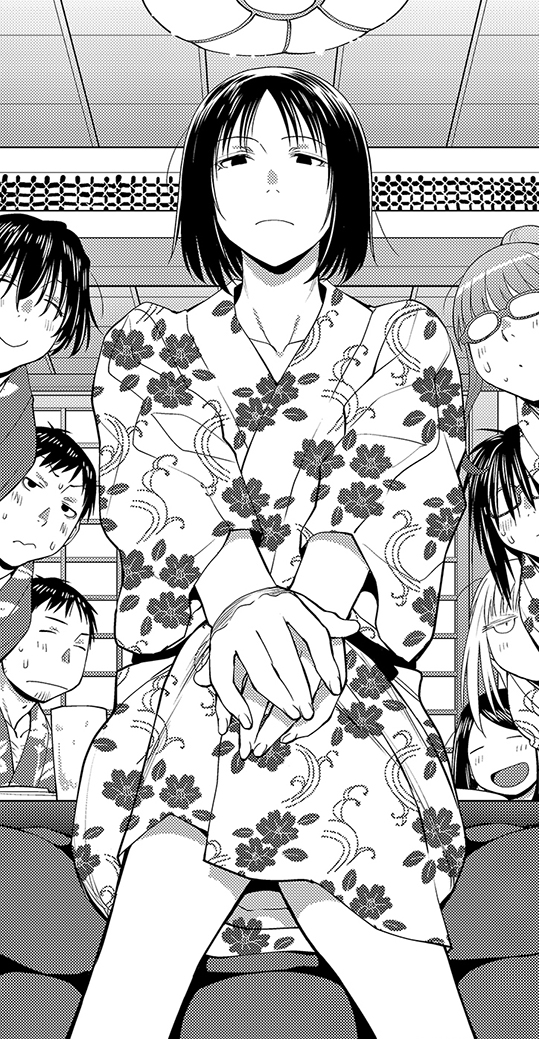
The moment has come in Kio Shimoku’s Spotted Flower: In the most recent chapter first published in June, the Wife (aka Not-Saki) confronts the Husband (Not-Madarame) about his adulterous actions with Asaka-sensei (Not-Hato). With a rather sparse publication schedule consisting of printer chapters and digital-only supplementals, getting to this point has taken many years. Now that we’re here, though, the confrontation really emphasizes the essence of this thinly disguised Genshiken alternate universe.
The Story Thus Far
A lot has happened since I last posted about Spotted Flower, so I think some brief catchup is in order. Note that I might not remember all details correctly because of how convoluted things have become:
Spotted Flower is about an otaku husband and his normie wife, both of whom were members of the same otaku club in college. At first, the story is about their very different tastes and behaviors, as well as the challenge of having a sex life while she’s pregnant and he suffers from low blood pressure that makes even morning wood difficult to come by. They occasionally meet with and talk with old friends, who are all suspiciously similar to other characters from Genshiken (though they’re not the same).
The Wife eventually gives birth to their daughter, Saki, and one consequence is that the Husband feels inadequate as a partner. Seeing his beautiful wife chatting with her Ex-Boyfriend (Not-Kohsaka), he panics and secretly solicits Asaka-sensei, their old college club junior who once regarded themselves as a crossdressing mane but has since gotten some feminization surgery and whose gender is less clear-cut. The Husband tries to start something, but can’t get it up. No problem, Asaka-sensei declares, and puts their penis up Not-Madarame’s butt.
The Husband is plagued with guilt and shame for cheating on his wife, and Asaka-sensei tries to keep the tryst a secret from everyone they’re close to, including their own partner and manga assistant (aka Not-Yajima). While the two have an open relationship, it’s still big news that Asaka-sensei banged their old senpai. But the truth slowly leaks out little by little, with different people learning at different points from different people. Eventually, the rumor reaches Not-Kohsaka, who decides to look into it on his own.
Of course, the Wife is a sharp and perceptive person, and had naturally suspected that something weird was going on. Eventually, in a moment of weakness, the Wife propositions her ex-boyfriend, but he refuses, despite the fact that he’s actually a serial philanderer. It’s not clear at this point what he’s planning, but we also learn a few things about him as well—namely, that he seems to have hidden feelings for Not-Sasahara, and at one point even kisses Not-Sasahara when he thinks the latter is asleep (He isn’t).
Speaking of Not-Sasahara, his relationship with Ogino-sensei (Not-Ogiue) takes an unexpected turn as she proposes a polygamous marriage between the two of them and her manga assistant (Not-Sue), with whom she already sleeps with. However, this is unlikely to turn into a threesome situation because Not-Sue hates Not-Sasahara for not letting her monopolize Ogino-sensei.
Most recently, the old club members have gathered together for a group getaway. And then, two chapters ago, as the guys and girls are hanging out in gendered groups, Not-Kohsaka casually tells all the boys about what happened between the Husband and Asaka-sensei. Not-Kuchiki, shocked by the news, rushes over to the Wife and blurts it out, asking if it’s true. Here, the Wife herself gets a weighty grin on her face and says, “So it’s finally public knowledge, huh?”
And Now…
That’s where things stand before this latest chapter, which starts with everyone in the same room. The Wife asks if being with her was really that awful, the Husband tries to explain that it’s been great, but that he thinks she’s a goddess residing in a realm on high, and he lives crawling in the mud in the world below. She doesn’t understand what this means, so the Ex-Boyfriend explains that this is an otaku self-consciousness thing. The Ex also explains that he couldn’t possibly be with the Wife because she actually hates his guts—a fact that Not-Saki herself didn’t even remember herself.
The Wife grills the Husband about the whole situation with everyone else (especially the fujoshi) listening intently. As the Wife explains, the guy tends to hide his feelings, so she wants him to be honest. From this, they learn that he couldn’t get hard, but that it actually felt kind of good to be on the receiving end (to the thrill of the fujoshi crew). Not-Saki then goes on about what a weird little otaku club they are: Otaku are supposed to be these innocent and naive people who don’t really know what sex is like, but the people here have sex while cosplaying, engage in threesomes (which Sue adamantly denies), and her own husband got it from behind by a crossdresser. They’ve all had the wrong idea about otaku.
The chapter ends with an ultimatum from the Wife to the Husband: He must get an erection for her, or their marriage is over.
What Does This Mean?
We won’t know what happens with the two of them for another few months, but regardless of how it pans out, there’s a lot to ruminate on already.
I think the biggest revelation from this is the fact that the Wife actually hates her Ex. What has previously come across as a fairly cordial “let’s just be friends” might have been something more serious and dramatic. We know that Not-Kohsaka sleeps around more than everyone else in Spotted Flower, but that a part of him feels empty inside. I had wondered if this was him still taking the break-up poorly, but maybe this behavior from the Ex was already a problem. Or perhaps his unrequited feelings for the Editor were there all along, and he wasn’t honest with himself. Whatever the case may be, I really think it changes the assumed dynamics of the characters, and by extension the story as a whole
I know Spotted Flower is controversial, and that some English-speaking fans of Genshiken have viewed it with derision. While I approach it as a kind of strange alternate universe, the fact that this is the only “new” material is understandably confusing and maybe even frustrating. But the way this latest chapter has played out, I have to wonder if there actually is light at the end of this tunnel for the readers who wanted something a little more wholesome. Granted, the tunnel is still of twists and jagged rocks, and a rock slide might close off the exit, but we’ll just have to see what awaits us.
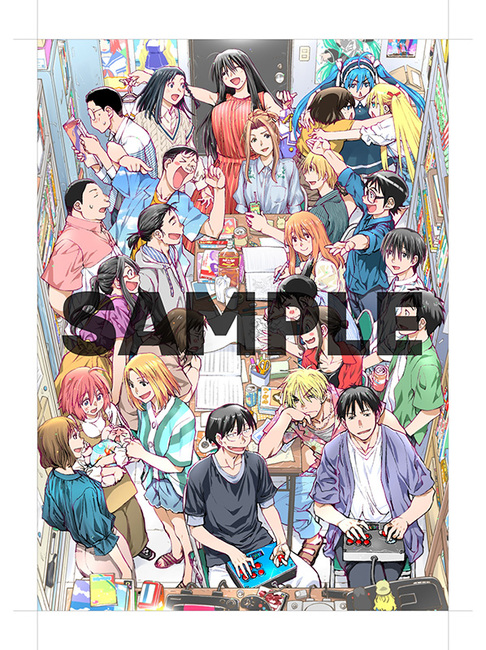
Today is the birthday of Ogiue Chika, the namesake of this blog and my favorite character from my favorite manga, Genshiken. In celebration of this, I have decided to finally write something about the author’s recent 30th anniversary artbook titled Kio Shimoku Gashuu: Mata Ashita, Bushitsu de(Kio Shimoku Art Collection: See You Tomorrow in the Clubroom).
First, this artbook is almost everything I hoped for: large illustrations from throughout my favorite manga creator’s career. Second, there’s an extensive interview at the end, and I’ve jotted down all the notes from it that I could. It’s actually the vast majority of this post!
Whether it’s his old analog paintings to his digital work, you get to see how his style has changed. This is especially the case with his Genshiken pieces, and a part of me does miss the look of those early works. Nevertheless, it all looks great, with high-quality reproductions of even things like DVD box sets. A lot of merch I never got, I can at least have their art. Kio actually re-scanned a lot of it!
The illustrations also include guest art for anthologies and such:
Horizon in the Middle of Nowhere
Gundam: The Origin
Ashita no Kyouko-san
Yuruyuri
FotoKura
Night on the Galactic Railroad Musical
Only thing that’s missing is Spotted Flower, though I’m sure Kio would have included it if he could.
So this is naturally highly recommended for Kio Shimoku fans.
And now, here are all my notes from the interview. It even includes comments about Kio’s wife, whom he pretty much never talks about!
Early Life and Family
Kio Shimoku was born in Shizuoka in 1974, and moved to Tokyo when he was two years old. He attended kindergarten in Kokubunji, Tokyo. In elementary school, he moved to Chiba Prefecture and spent a large chunk of his life there, to the extent that he strongly identifies with Chiba. He was in Chiba through high school and went to Tokyo after college, but then returned to Chiba.
Two of his manga, The Fourth-Year (Yonensei) and The Fifth-Year (Gonensei), are set in Kisarazu, Chiba because Kio went to college there and thought it’d make for easy reference material.
Kio’s dad worked for an insurance company, and didn’t really oppose him becoming a manga artist. His mom was a housewife but used to be an office worker. He has a brother who’s six years older, so there’s kind of a generation gap between them. A lot of the manga Kio read as a kid was his brother’s: Jump titles like Black Angels, Cat’s Eye, Ring ni Kakero. The manga that he bought himself were Captain Tsubasa, Dr. Slump, Hokuto no Ken, JoJo. The biggest title for him was Doraemon, and he remembers drawing doodles of Perman’s helmet.
Against expectations, he actually more of an outdoors kid. His dad did judo, and he lived in a rural area in Chiba. Kio’s activities included bug-catching and going to the beach. He also practiced judo himself in middle school, which has made it easy to depict characters that do the same (like Hato from Genshiken Nidaime).
But as active a kid as he was, Kio still liked to read and draw. He was there for the Famicom boom, and his #1 indoor hobby was Gunpla. His brother bought Gundam and Guncannon kits and gave the Guncannon to him. He played with the kits before he ever saw Gundam, which he eventually did when he saw the original movie trilogy. Kio wanted Gunpla so badly that he drew his own imaginary modeling store—not the model themselves but the store in which he’d buy them.
Some other titles he liked: Esper Mami (he was influenced by its SF flavor), Fujiko Fujio’s Land (he liked all the nude scenes), Bouken Gabotenjima, Scramble Egg (it was one of his brother’s books).
Another big one was Plamo-Kyoshiros, which was his “Bible,” especially with all the customized Gundam model kits it showed. He used all the tech he had available to him at the time on a Qubeley, and then stopped after just the one. Master Grades came out when he was in college.
Nausicaa of the Valley of the Wind was also a huge influence from elementary to high school. He would trace over Miyazaki’s art and tried to draw just like him, but found it difficult as a kid to the point of being discouraged, thinking, “I have no talent!” In middle school, though, Kiki came out and he found he could draw like Miyazaki a little better. Drawing and painting using watercolors, he thought he might have what it takes.
A friend of his asked if he wanted to make a manga together, and Kio agreed. That same friend is the one who taught him about manga tools, like nib pens. Kio volunteered to do backgrounds, and was inspired by Oga Kazuo and Yamomoto Nizou. He had an interest in fine arts, but it’s not like he never drew characters. There was a particular drawing of Elpeo Ple from Gundam ZZ next to a bicycle, with a seiso expression and wearing a beret, that he really liked. He’d focus especially on Ple’s face when trying to replicate it. He learned to do eyes from copying the artist who drew it, Kitazume Hiroyuki.
In his third year of middle school, Animage started releasing Roman Albums and Art of books, and it made him want to become an animator. However, he was sad to discover that you had to be at least 18, and gave up.
College Life and Becoming a Manga Artist
In high school, he seriously pursued trying to become a manga artist because by that time, he found that he could handle all aspects of manga making himself. He got so into making manga that he basically missed out on the entirety of the Super Famicom/Game Boy boom.
At 17, Kio got a newcomer award in Sunday magazine. As for why he submitted to Sunday instead of Jump, It was around middle to high school that he became more of a fan of the former. The first Sunday manga that caught his attention was Kyuukyoku Choujin R. Then there was Obi wo Gyutto ne by Kawai Katsutoshi, which actually showed fanart at the end of the collected volumes. His art was published three times, but he never managed to win an autographed signboard. But when he contributed to Kawai’s mook, he actually got the autograph, which made him really happy. Other big titles he read at the time were Ranma ½, Spriggan, Patlabor, Ghost Sweeper Mikami, and Ushi and Tora.
His first submission to Sunday was about a boy who worked at a secondhand bookstore, except the “secondhand books” were actually stolen goods. Kio thinks it was a pretty plain and unspectacular idea. He liked secondhand bookstores, and would go into them whenever he saw one. He also tried to draw manga of the adventurous kind in the vein of Studio Ghibli. There was one that got to 50 pages of the manuscript, but he never finished it. The thing really just consisted of whatever came to mind as he was making it.
When asked why he prefers to make more everyday life works than dramatic stuff, Kio says that while his artistic path began with Miyazaki anime, it’s the portrayals of everyday life in Miyazaki’s works that he built on.
Kio had worked with Sunday, but he never debuted with them. This is because he couldn’t keep working with his editor there. Kio was asked to do things like come up with 10 new ideas before their next meeting, and he just found it impossible.
If he had debuted with Sunday back then, he wouldn’t have gone to college. But he did while majoring in Nihonga (Japanese painting) at University of Tsukuba. At the interview to get into the university, he lied and said that he really wanted to become a Nihonga artist. He chose Nihonga because he thought he could transfer the brush skills he learns to making manga. Western painting tools like charcoal aren’t really used in manga. He worked on manga while also doing his college work.
He was in the dorms his first year but lived on his own in an apartment for years 2 through 4. He and his friends would go over to each other’s places and hang out and eat. There was really nothing to do at Tsukuba in the 90s. The Tsukuba Express didn’t even exist back then. Students would hear noises and swear other students were having sex. (Not much else to do otherwise, in terms of gossip.)
Kio had lots of good friends but not a group of otaku he was close with, like in Genshiken. However, he had one senpai he looked up to, who had a lot of esoteric otaku knowledge and was really mature. Tanaka is partly influenced by him.
There was a University of Tsukuba Society for the Study of Modern Visual Culture which is the name basis for Genshiken, but Kio only was a member for half a year. He did draw a sign for them as a first-year for a culture festival in autumn, but he doesn’t remember exactly what he drew.
He’s not a fan of huge gatherings and so what he mostly did was hang out with 3 to 4 people and play fighting games. Later, his editor at Afternoon said to Kio that it sure seems like Kio had a fun college life, to which Kio agreed that maybe he did.
Kio’s Early Manga
Kio is asked if the darkness in his early works from Ten no Ryouiki (his debut title) to The Fifth-Year was a reflection of his school experience, to which he replies that he’s not really sure. At that time, he would put everything he was thinking about into his manga, and his work reflected that. He is the type to dwell and ruminate on things to the point of self-loathing, and he thinks the way he approached the subject of romance came from that. He combined his own experiences with stories he heard from others, though he says he did not have a very active love life personally.
Kio did not originally plan to be a manga author who focuses on romance and relationships, and Kio Shimoku was meant to be a one-off throwaway pen name. He wanted to do action instead. Ten no Ryouiki was meant to be practice. Looking back, it actually turned out to be just that.
He wanted to do an entertainment-focused Eastern culture action series next in the vein of Shirow Masamune’s Orion or Fujisaki Ryu’s Hoshin Engi. But when he looked at his old rough manuscript for it, he’s glad he didn’t.
Genshiken was born out of wanting to make something with more entertainment value, and both Kio and his editor at the time felt like Genshiken could work. However, he didn’t feel particularly enthusiastic about it because he thought he’d end up getting bashed for it. In fact, up until serialization, he was trying to avoid it. He even drew the short manga Krakatit no Machi during that time.
The Town of Krakatit (a dark and obtuse work) is named after the novel Krakatit by Karel Čapel, and Kio thinks the book might have really struck a chord with him back then, or perhaps he heard that the novel was similar to his idea. He does remember being asked by another manga creator at an end-of-year party why in the world he decided to make a story like that. It was right before Genshiken’s serialization and Kio wanted to forget everything. He’s still not sure what he was feeling, but maybe it was a desire for total ruin.
Both The Town of Krakatit and The Fifth-Year have violent climaxes. Kio didn’t intend or want for The Fifth-Year to involve an attempted stabbing, but he felt that it had to go there based on how the story developed. For Krakatit no Machi, it was because he wanted to draw a more heavy-set character. The interviewer points out that Kio has drawn a lot of fatter characters over the years.
Genshiken and a Stylistic Change
In regard to his changing style, especially from the early works to Genshiken, Kio says it was a conscious choice to improve the entertainment factor of his manga. However, you can tell that it’s still in a transition period in Volume 1 of Genshiken based on the art. As for how exactly he tried to change his art style, Kio worked towards a more semiotic way of drawing, where the designs convey who the characters are. Kugayama was the earliest design.
Kio chose their characteristics by drawing random lots (kujibiki) and building from there—something he only rediscovered recently after finding an old memo. For example, with Madarame, he got “bowl cut” and “glasses,” and decided what he’d be like based on that. Of course, when finalizing the character, he didn’t leave it to chance. He feels that Madarame, Tanaka, and Kugayama are the most successful designs in terms of semiotics, but with Sasahara, he actually forgot to design him until the last moment. Sasahara ended up being made with no strong features because he was supposed to be the character who first enters the club.
The premise of Genshiken actually began with the love triangle of Madarame, Saki, and Kohsaka. Kio realizes that they’re basically Maeno, Takeda, and Kyouko from Ping Pong Club. It wasn’t intentional, but looking back, it was a dynamic he loved. Ohno was originally designed to be more cringey, but based on the trajectory Genshiken took, he decided to go for someone who would be more popular with readers. Now, he realizes she’s essentially just Kamiya from Ping Pong Club.
Kio is glad that people say his portrayals of otaku reflect the times. His starting concept was wanting to draw otaku as normal people. Genshiken is a work from the period after the one where otaku were getting bashed the hardest. Kio didn’t want to have messy relationship stuff in Genshiken, but couples ended up happening anyway. He thinks this makes things feel more real.
He didn’t do any research for Genshiken’s first generation, but for the second gen, he attended Comiket and interviewed circles that were aimed towards female audiences and even sat in circle spaces all day. He got to hear conversations between creators and customers as a result.
However, he has participated in Comiket as a creator before. This was because Ogiue was tabling at ComiFes in the manga, and Kio felt he needed to experience it firsthand. He considers himself an otaku, but he actually hasn’t gone to Comiket much. The reason is that he winds up buying too much other porn because he loves horny art. In fact, he originally bought a Mac instead of a Windows PC so he wouldn’t end up buying so much eroge.
In response to the unanticipated developments that came with Ogiue’s character, Kio says he never thought the story would go in the direction it did. He did create Kugayama as someone who draws, but he’s not supposed to be particularly good at it. Ogiue was created because the story had plenty of otaku-as-consumer characters but not otaku as creators. She was a challenge to work with, but it was incredibly fun.
Genshiken was planned to be a manga that ran in real time, so with a new chapter every month, a month would have passed in the series. However, with Ogiue’s arc, the timeline kind of went out the window and time had to pass at an accelerated rate in chapters 50 through 54 so that the series could end during graduation season. Some of the stories during that time ended up in the extras of the volume releases.
Into Kio’s Psyche
The interviewer points out that Kio has a lot of scenes of characters expressing fear at the prospect of revealing their true selves to others: Ogiue and Hato in Genshiken, but also in The Fifth-Year. Kio didn’t remember that he had a scene like that in The Fifth Year, but he believes this is something connected to his fundamental way of thinking. Even his erotic doujinshi Zenbu Sensei no Sei (and its sequel) feature a girl (and later her mom) learning about who they “really are.”
The interviewer also describes Genshiken as astory that began with entertainment in mind only to dig deep into people’s very beings, which seems to be a real Kio Shimoku–ism. Kio says that Genshiken is a work that even when trying to summarize it offers resistance. It’s also the work he’s re-read the most out of his own creations, first for Genshiken Nidaime and now occasionally for Spotted Flower. Kio believes that Genshiken was such a good thing for him that the rest of his life is just extra change.
In terms of the portrayal and exploration of sexuality, Kio didn’t intend for it to be indicative of the time. The belly band on the Japanese Volume 8 originally said “The Love of Otaku,” but Kio asked to change it because he wasn’t trying to show a normal portrayal of love. Rather, it was about exploring all the various characters’ individual ways of love. This idea later applied to Hato as well.
As for how the character of Hato came to be, he knew early on that he wanted Nidaime to focus on a mainly female cast, but that he wanted one male character. Kio had in mind two possibilities: a guy who looked like a girl (i.e. Hato) or a big but gentle-feeling dude, like Yamada’s dad in The Dangers in my Heart. He made two rough manuscripts, one for each character, with the former ending up going ridiculous places and the latter being pretty normal. But then, Kio learned that there are ways for men to change their voices to be more feminine, and it all clicked. Kio has at times kind of wanted to become a girl himself, so he put that in there too.
The interviewer thought Madarame would actually start dating Hato. Kio drew the Madarame romantic prospects thing to just see where it would end up, and he originally thought it would be that the guy gets with no one.
Kio and His Wife
Sex and love have always been a part of Kio’s work. His wife, Kami-san, described Genshiken as low-energy horny. Kio starts from the fundamental idea of “I myself am horny.” He actually was seen drawing porn in middle school by his family, and he thinks this trauma may have made him unable to draw erotic art for a long time. This repression may be what undergirds his work. His work might not be about sex but rather about masturbation in the sense of knowing what you individually desire. This is where the notion that “drawing manga is a form of masturbation” enters his thoughts. Masturbation comes up in multiple works of his, and Kio thinks it has to do with wanting to hide your real self.
Kio got married in 2000, and it’s a year he can recall with ease. It was a time when his manga wasn’t really selling, and he decided to get married without putting any thought into it.
He met his wife in college. She’s actually the first person he showed his rough manuscript of Genshiken, before even his editor. At the time, it was because he wanted to make a manga about otaku that appealed to normal folk, and she was the test case. Her impressions ended up in Saki to a degree as well, like the way Saki pronounces the word “anime.”
Kio showed his wife Nidaime early on, but can’t quite remember when it comes to Hashikko Ensemble. He did not show her Spotted Flower, but Kami-san did remark that it was probably just Kio and the Rakuen editor Iida-san doing whatever the hell they want.
Jigopuri wasn’t well received, but Kio felt that baby-raising was the only thing he could make manga about at the time.
Kio relates to characters like Madarame who feel like they never really grow up. He feels that even when he’s an elderly old man, he won’t feel like an adult.
Kami-san is into classical music, and took Kio to watch a men’s choir. Afterwards, she said to him that this could be good subject matter for something, though she was thinking about it more like BL involving working adults. Kio was working on a different plan at the time, but when he brought up the men’s choir idea to his editor, it got the okay, with the technical high school at the backdrop. This makes it different from all his previous college-set works.
Because he didn’t have much experience with the subject, Kio had to do a lot of research. To portray the singing, he employed various techniques like using different density of tones for high and low notes, employing gradients on lyrics, layering text when multiple people were singing, changing opacity levels, etc. He did all this with satisfaction.
Right now, he doesn’t have any new ideas he really wants to draw, or at least things he thinks he has time for. On a personal level, he did do Sister Wars lately. The idea for it actually came from his wife, who misspoke slightly and said “Si…Star Wars.” From there, they joked about how Sister Wars sounds like an eroge, that the Jedi would all be girls, and the Padawans would go, “Onee-samaaa!” Though it’s not as if Kio is a super-huge Star Wars fan.
The release of the art book makes him feel the full extent of his 30-year career in manga, even if it doesn’t include Spotted Flower.
Kio recently had a talk at Umeda Lateral, an Osaka-based live music house and talk venue, to celebrate the release of his new artbook. Below are my notes from watching it.
(Unfortunately, the VOD is no longer available. Also, screenshots are not allowed.)
There are three people: the host, Kio, and his editorial manager Moteki.
For the event, Kio drew special signboards featuring the Genshiken characters, one per character: Ogiue, Madarame, Sue, Ohno, and Saki.
Apparently, it’s normal for the hosts and speaker to drink on stage at this venue. Kio’s first order was draft beer.
He has been to Osaka before, for work and for sightseeing. Was on the train for 9 hours to get there.
The artbook was not his idea. It was Moteki’s, who brought it up because it’s Kio’s 30th anniversary. Kodansha wouldn’t do it themselves? Moteki actually reached out to him through Pixiv.
Kio wanted to reply, and he got motivated to actually make the book happen.
There were cases where Kio was looking through his old work and thought, “Did I draw this?”
Starting doing digital after Genshiken, starting with Jigopuri. At the time, he still scanned in his pencils, though.
Works prior to that transition were newly scanned for the artbook. He had a bit of experience doing it for the Shinsouban (the special edition that has new covers and changes the nine volumes of the original into five).
Kio admitted that he doesn’t actually remember much of his works before Genshiken. Moteki jokingly expresses concern that this pre-Genshiken period was eight years.
Moteki: Ogiue is a character who really takes the story places, but is there anyone from before Genshiken like that?
Kio: Nope, I don’t think so.
Kio actually doesn’t think Ogiue is that much of a driving force. Madarame was originally planned to be there from the start in some form.
Kio showed early concept notes about Genshiken. At the time, it was still written in kanji.
The original 3 characters were early versions of what would become Saki, Kohsaka, Madarame.
Saki (or her prototype) was the original protagonist. Prototype Kohsaka’s gender hadn’t been determined yet—the character was labeled “Hero (Heroine?)” One note mentions that he maybe looks like Squall from Final Fantasy VIII.
The school setting was based on Chuo University, just like in the actual Genshiken.
Kio wanted to make the series focused on character gags.
Prototype Madarame looked very different. Labeled as the “Rival.” Second-Year, otaku.
All the characters are listed with a specialized otaku genre. Proto-Kohsaka and Proto-Mada are both labeled as being into “everything.”
All the characters are labeled as virgins.
Prototype Kugayama was labeled as being a third-year, having a good personality, and also being a lolicon. Otaku genre: anime.
Another character with glasses specialized in games, and another shorter character has manga.
One unused design was a girl who was a second-year. She was a little unattractive, but with big boobs. (This might be the prototype for Ohno, but they look quite different.)
Kio does not actually particularly like kujibiki lotteries. But it is funny that Kujibiki becomes a plot device in Nidaime when all the girls are drawing straws for the order in which each girl has their date with Madarame.
Kio ordered octopus karaage next.
The first gunpla he built was probably the Guncannon. He built it right before the Gundam boom, when he was in elementary school. He has an older brother who was buying gunpla before him. Actually, it might not have been the Guncannon. Kio mentioned not having a good memory.
Did Kio have an inscrutable senpai like the original club chairman? He had senpai, but he wasn’t sure if they were quite like that. But Tanaka was based on someone Kio knew—a person who loved plastic model kits.
Kio used to build a lot of gunpla and kits, and broke them at the joints all the time. But with more recent models, he remarked that they really don’t break easily. He also compared the old days of gunplay that used polycaps to the improvements of modern kits.
For the scene in Genshiken with the gunpla, Kio tried to break the hip joint of a real model for reference, but it wouldn’t snap. But he wanted to do the scene, so he had to force a break.
He checked with Bandai if showing a busted gunpla would be okay, and they said as long as the break was shown to be by accident and not on purpose, it was okay.
Kujibiki Unbalance was made to be an original parody series because getting permissions for actual things was difficult.
Host mentions that he wasn’t a pure otaku, and it’s because of Genshiken’s numerous reference lines that he got to be one. Chapter titles are references, and Kio had to constantly rack his brain for them. Kio does not consider himself a high-information-retention otaku.
He had a desire to draw and write about the old-style 90s-era otaku of his own generation.
When Kio got Genshiken serialized, it made him feel like a real pro. When it got an anime he was ecstatic. “It felt like I had won at life.”
Kio was worried that if he tried to make a manga about the newest things, it would quickly feel dated, so that’s why the otaku stuff was more 1990s.
In that time, video tapes were still the standard, and official recordings of the anime were still done on tapes. He was okay with the work, but saw the struggles of the anime’s production in the anime, accepting that those are kind of inevitable.
The host asked about the OVA, believing that Kio wrote it himself, but Kio himself didn’t remember if that’s the case. He did work closely with Genshiken 2, as well as the original Kujibiki Unbalance anime.
Kio mentioned being involved with a scene involving Tanaka and Ohno, and the host instantly guessed correctly that it’s the spicy scene of them getting together. In response, Kio asked, “Why did you know what I was talking about?” It was later that he realized the scenes he drew for the fictional eroge Ohno made Tanaka play were just used straight-up in the anime.
Kio showed his actual old notebooks.
“It’s not your dark history.”
Kio: But it is.
Kio loved Famicom Detective Club, and made his own story based on Famicom Detective Club II.
He wanted to make a manga of Ghibli’s Laputa in middle school, so he drew one. Here, he showed it to the audience, page by page. He even did the title logo. However, as he turned each page, he would have his eyes closed because he didn’t want to look at them.
(It actually looks really well drawn for a middle schooler.)
Kio actually wanted to change the story partway through in a way that would make it more interesting, but he couldn’t quite decide on where to take things after they get to the fortress, so he stopped drawing it.
Another notebook is filled with his attempts to draw like Miyazaki, clearly copying famous Nausicaa images. He also feels embarrassed about these.
He also showed that he made lots of drawings of Elpe Ple from Gundam ZZ.
He didn’t watch Gundam as it aired, but he did keep up with Dunbine and L-Gaim in elementary school (4th grade, 6th grade, thereabouts).
Also showed a piece of fanart for Metal Armor Dragonar in there, along with a drawing of the Queen Mansa from Gundam ZZ.
Because Kio was clearly into fantasy-like settings as a kid, the host asks if he ever wanted to make manga along those lines. Kio says that he actually worked on a real manuscript from high school to college. “Any plans to announce it?” “None.”
After the break, Kio got a lemon sour. Host a highball. Moteki got another draft beer.
Host talked about how some people considered Nidaime to be like a fan sequel. After the first series ended, everyone tried to imagine what would come next.
Kio got back to drawing Genshiken after doing the art for a budget edition box set of the anime (the ones with the white cases), which led to the one-shot, and then he was asked by Kodansha if he could come back for a short run, like a single volume. (Nidaime ended up running for 11.)
Kio hadn’t planned to resolve Madarame and Saki. Couldn’t it have just ended at the school culture festival?
The second half of the talk was Kio answering questions they had received from fans.
Will Spotted Flower get an anime?
Kio: That’s not up to me.
There are also challenges to getting a story like that made into anime. If he had to say whether he’d want one or not, he’d say yes.
What was a gathering spot for otaku in your days?
Kio was only in a circle for half a year. But there had to have been a place where people gathered to draw.
Kio was in the art club in high school, but it didn’t have an otaku feel. Same for middle school. But the otaku in middle school did meet up after school.
Kio actually bought his own Neo-Geo machine! They reminisced about the massive cartridges.
What works are you into recently?
Manga: A current work in Harta magazine by the author of Hinamatsuri, Ohtake Masao, called J⇔M.
Doesn’t watch dramas. Closest is taiga historical dramas like Kimi Hikaru e.
Couldn’t decide for anime or movies (mainly watches anime movies).
If you drew Genshiken now, what would the characters be into?
VTubers, not that he knows much about them.
Moteki mentioned that Kio must have done research about fujoshi circles and slang for Nidaime, but Kio said he was doing it since the first series. He got some things wrong, though. In college, Kio was surprised to discover fan-derivative works and 18+ doujinshi in college (much like Sasahara).
How did you decide who Madarame would end up with?
Kio didn’t even know who it would be as he was drawing it. He was thinking of having it conclude with Madarame alone, but he actually said to himself, “Are you really going to end it this way?” Even he as the author couldn’t accept that.
Moteki: When it comes to The Fifth-Year and Genshiken with Ogiue, these characters realized about the kind of people they are, and it helped them decide on their feelings. But Madarame even to the very end did not have that self-awareness.
Also, lots of people thought it’d be Sasahara’s sister, because she’s so similar to Saki.
Kio: Yeah, even now. When you mention it, that pairing could’ve worked. But I wasn’t thinking about Saki (or Keiko’s similarities to Saki).
Kio-sensei switched to tablet in Nidaime. How was it?
Actually, Kio switched during Jigopuri. Back then, he still drew the manuscripts on paper and scanned them in before doing digital drawing over them. Eventually, he switched to all digital.
Is there something you feel about the Otaku of the 2010s and 2020s?
Based on what he sees with his daughter and her classmates, it’s almost like there’s not really a distinction between otaku and non-otaku.
Host: Even gyaru are into Frieren.
Kio: Maybe there’s no need for a series like Genshiken anymore.
Kio wanted to do Nidaime as a series where there were more members of the club who were like Ogiue and Ohno along with one new male character. However, he actually thought up a version with a more typically masculine guy, but thought it felt a little too normal.
Host: It’s like the barrier between otaku and non-otaku is gone.
What’s important to remember while making works?
Kio: I can’t really think of anything. Maybe, if you think of it too much like work, you’ll lose what makes it unique. Don’t try too hard to make a “manga-like manga.” Don’t focus on how things are supposed to go at the expense of making it interesting.
Genshiken wasn’t intended to capture the zeitgeist, but it ended up doing so.
Did you see the online reaction to Genshiken or the doujinshi during serialization?
Kio did not look at comments. The people at Kodansha looked at it though.
Kio bought all the doujinshi of Genshiken he saw. Didn’t have any problems with any content, knowing that it’s up to the doujin creators. He might occasionally check out the website of one of the artists.
He got some of them for the Genshiken 8.5 doujin project.
What was it like working for Afternoon?
Thought of Shounen Sunday first for Kodansha, but Kio remembers Parasyte being a big title. Minor no Pride, Major no something (a cooking manga).
In response to Ogiue is drawing for Afternoon in the manga: “It’s meta.”
What do you think of making H-manga?
Kio always wants to do it. He’s working on Part 2 of his doujinshi project, and the manuscript has gotten to 134 pages.
Moteki: What was the reaction to you announcing an 18+ doujinshi? Was it like, “Here we go!!!”
Not a particularly strong response, but when Kio posted it on Fanza (an adult site), some people who were fans asked him if it’s okay to do this at his age (he’s 50).
Can you do a live drawing?
He was unsure of his live drawing ability. Before the talk, Kio ended up putting a lot of time into the five signboard drawings at the talk, as well as the 30 that were included in specific copies of the artbook.
Host and Moteki tried to convince him, but no go.
Will there be more Genshiken merch?
It’s not up to him.
A lot of questions about how Kio decided who Madarame would be with, actually.
Are there any characters who acted in ways you didn’t intend?
All of them.
During the nose hair chapter (with Saki and Madarame), Kio planned to have a story about that, but went at it by thinking “What would the characters do in this situation?”
Before a manuscript, he’ll draw freely. For Genshiken, it’s like the ideas would just readily come. When drawing the characters, he would think about how they would behave. He compares figuring character’s lines to taking a dust cloth and wringing it tightly until the exact words drip out.
Moteki: In terms of characters moving on their own, Ogiue is a well-known example, right?
Kio had considered sticking her with Kuchiki as a kind of “mutually cringe couple.”
Kio is unsure of what he needs to do in serializations. With one-shots, in contrast, it’s harder to play around. He’s still not sure what to do.
At first, Kio didn’t use any assistants. But that’s when he was young. Now he’s 50 and he can’t do the same anymore.
Weekly serialization is the “territory of monsters.” Knowing what weeklies are like, he understands the need for assistants there. But if someone came to him asking if he could do one, he’d consider it and try to figure out a way it could work.
Kio worked as Takano Fumiko-sensei’s assistant, but for only one day.
What otaku works or genres have you been into recently?
He watched some of Usada Pekora playing Elden Ring. He’d have her on as background noise while working on manga.
He also listens to music while thinking up ideas and working on manga. When he’s doing tasks with not a lot of information, he uses ambient noise. When doing the initial drawings, he listens to stuff like J-Pop. After that, more editorial/critical Youtube channels.
What have you enjoyed recently?
Kio has a hard time thinking of anything, but he did travel to Gunma recently. He went to Ninja Gakkai, a ninja education camp.
Among your works, are there any scenes that stick out most in your memory?
The first thing that came to mind is the nose hair story, particularly when Madarame leaves the clubroom and is looking back at it from the outside across the courtyard, and you can see the light in the clubroom still on.
Moteki: Which character is your type?
Ohno, in terms of sexiness. The scene when she first appears in a mask is an example of her heroine appeal. Though Kio’s been told that the shifting heroine focus for Genshiken is unusual: from Saki to Ohno to Ogiue.
Having seen the anime movie The Colors Within, Kio points out how the images look euphoric and characteristic of director Yamada Naoko. There are also very few long shots, making the movie feel very personal and character-focused.
Kio describes being happy to discover that manga artist Nakano Deichi is able to make a work like h na h to A-ko no Noroi, which has a different feel from his previous works.
Fantasista mascot Sis-tan really likes Hashikko Ensemble, and shetells Kio why she likes the character Hachida Shinji so much (she also likes Orihara). Essentially, Hachida can’t seem to leave others alone, like when they’re going through hard times (e.g. Orihara, Masshy).
Kio replies that he pictures Hachida having an older sister who’s actually a yankii, and that he actually has a lot of experience with tough guys. Also, Masshy has light footwork, and knows how to interact with those who take singing very seriously.
Kio loves the Turn A Gundam novels so much, he’s read them countless times. He was originally shocked at where Tomino concluded the anime, so he was glad the novels show what happened after that. The fact that the series is all about the consequences of the foolishness of humanity is very “Tomino.” He has felt that this is the kind of thing he could not pull off as a manga artist. He also praises Turn A mecha designer (and legend) Syd Mead.
Kio did not tweet his own reaction to the death of voice actor Shinohara EMi, but he did retweet these drawings from Togashi Yoshihiro, author of Hunter x Hunter and husband of Sailor Moon creator Takeuchi Naoko.
He also had to gather a lot of old material for the talk, including work he finds embarrassing. He wonders if this is going to turn into a cringe session for him.
With summer ending and some work concluded, Kio is feeling that he should start something new. In the meantime, he declares that he will finish his doujinshi.
Kio read Volume 2 of The Kinks, a manga by Enomoto Shunji. While reading the serialized version Kio, always finds himself going “Well, that’s a first!”
The talk at Umeda Lateral also had a raffle for special signboards with art by Kio. The person who won Saki’s also happens to be an artist. Here’s Kio thanking him for some Saki fanart.
Kio Shimoku, author of Genshiken, recently announced that he’s going to be releasing an artbook collecting his work from across his 30-year career! It will also include an interview with him.
The book is titled Kio Shimoku Gashuu: Mata Ashita, Bushitsu de—Kio Shimoku Art Collection: See You Tomorrow in the Clubroom. It’s being released by Fukkan, a Japanese publisher that specializes in niche specialty books and reviving out-of-print titles.
While the book is available for pre-order on other Japanese sites, pre-ordering on Fukkan’s site will get you a set of A4-sized replica illustrations of Kio’s work. And if you do it by July 16 (JST), then you can enter to win an autograph from the man himself!
Unfortunately, Fukkan will only ship domestically, so if you live outside of Japan, you’ll need to use a third party. Just keep in mind that with the pre-order bonus, shipping might be pretty killer!
So it finally happened: I got my first case of COVID-19. I’ve been isolating, but I’ve also finally started testing negative, so I think I’m over the hump.
I already announced it on Twittter, but anyone who attended Anime Central 2023 should probably get themselves tested if they haven’t already. While I was masked for pretty much the entire time, I most likely had COVID-19 during the entire event, and it’’s better to be safe than sorry when it comes to the coronavirus.
While it might be too late for anyone who’s first reading about my COVID-19 case here, I still wanted to talk about it in this status update for a couple reasons. First, well, this is technically the “status of Ogiue Maniax.” Second, many people are afraid to admit they got COVID, worried that they might be looked upon negatively if they say anything, or feel a sense of guilt about how they put themselves and/or others in danger. But I think the more we publicly talk about it, the more we can reduce the stigma without downplaying the ongoing severity of the pandemic (it’s not just “the flu.”)
Thank you to my Patreon subscribers, who allow me to continue to indulge in this hobby of mine:
While Anime Central wasn’t ideal due to my condition, I did manage to conduct some interviews, and I think they all turned out well. Expect to start seeing them soon!
I find myself in a constant state of worry that I’m not doing enough with anime and manga. It’s not like I’m avoiding it entirely, but I think my very focused consumption of it has receded slightly both in an attempt to do things I’ve never tried before and to make up for time lost in other categories.
There’s an entire Breathof the Wild sequel coming out this month, and I’ve only just gotten the glider in the first game! I want to build my language skills in Japanese as well as in others. I worry about being the person chasing two rabbits, but at the same time am perpetually unable to pursue just one without regretting losing the other.
In the meantime, shout-outs to my Patreon subscribers, including a new supporter among the Sue Hopkins fans.
I’m actually going to Anime Central this month for the first time! I’m hoping to get to see Kubo Yurika (aka the voice of Hanayo).
And you probably have heard about this, but the Writers Guild of America has gone on strike to protest unfair wages from streaming and the threat of companies potentially trying to use AI to hamstring writers. Funnily enough, the last time a writers strike started was on November 5, 2007—the same month as the birth of Ogiue Maniax.
April is cherry blossoms in Japan, and their fleeting nature is associated with an aesthetic valuing of the ephemeral in Japanese culture. I normally don’t get all poetic about it, but recent events have me reminiscing and feeling the passage of time. One month after the death of Matsumoto Leiji, one of my favorite character designers, Kimura Takahiro, passed away. Ash Ketchum is being retired as the lead of the Pokemon after two decades. Not one but two VTubers are graduating: Heavenly King Mirai Akari and Pikamee Amano, one of the lights of the early COVID pandemic. And just today we learned that Sakamoto Ryuichi of Yellow Magic Orchestra passed on the 28th of March—the second member to go this year after Takahashi Yukihiro.
The end of last month hit with some tough news as the world learned that Matsumoto Leiji had passed away at the age of 85. I’m still thinking about what an end of an era that is, and I’ve been spending time with his works. In addition to finally watching more Space Battleship Yamato 2202, I decided to revisit my favorite anime of all time, 1979’s Galaxy Express 999. It’s as gorgeous as the day I first saw it.
This month’s Kio Shimoku tweets are a real treat, as he’s been posting a bunch of old Genshiken art without any text, including at least one piece that’s never been released widely see above)! Genshiken was also trending on Japanese Twitter thanks to being spotlighted on a TV show!
On Duck King’s birthday, Kio mentions that he used to play Duck King. He could do Duck King’s command throws from jumping or out of a block, but never from standing.
In response to a Kim Kaphwan player, Kio refers to Kim as a “demon.” Another commenter replies with “Obenjo Baby!” (Toilet Baby)—a mishearing of one of Kim’s attacks. Kio jokingly says he never could figure out what Kim was saying, so he’ll accept this interpretation
Kio bought a Playstation 5 and Elden Ring despite a lack of free time. He also wants to try SEKIRO.
A long-time fan asks him to please not die without releasing any new works because he was playing nothing but Elden Ring. Kio says he’ll be careful. (Others in the thread do not mind encouraging him to play more.)
Kio accidentally misplaced some parts for a model kit. Manga artist Ikuhana Niiro and Kio talk about how this sort of thing makes them grateful for the quality of Gundam kits.
Kio showing the parts he’s built. When asked if this is a garage kit, he says that it’s technically an action figure kit Kaiyodo used to sell, but it’s functionally a garage kit.
Kio built one of the kits from the box in this older tweet: Knight of Gold from The Five Star Stories. It turns out one of the parts that went missing earlier is actually for this.
Kio learns that Genshiken is going to be on the TV show Sukkiri the next week, on the segment “Hot Comic.” He’s excited about this, and naturally receives a bunch of congratulations from fans (too many to list in this post).
I will make an exception for this one person who says they love Ogiue and Sue. Kio responds “OgiSue! ……Or Sue/Ogi?”
Kio has been so busy with Spotted Flower and other things since the end of last year that he hasn’t had time to work on his ero manga project. Even though it’s the same amount of work that he had when doing a monthly series, it somehow feels unsustainable these days.
Kio posts this old drawing of Madarame and Jin, to which someone responds that they wish they could see both Genshiken and Hashikko Ensemble continue. Kio thanks them, and says he’ll continue to work hard on Spotted Flower.
Another older drawing, but this time someone shows Kio that they have the hot-spring bathing Ohno bust that came free with an issue of Monthly Afternoon. Kio calls it a fine product.
An Ohno fan says they loved Ohno so much, they ended up with a girl like her, and that Kio is responsible for this “severe” crime. Kio jokingly says that’s unforgivable.
A fan mentions that he used to be embarrassed to say the word eroge before Genshiken. Kio replies that they actually checked if there was any issue using it for the anime, and the response was “none at all.”
Kio finished watching Sukkiri. He jokingly equates hearing all the old lines he wrote 20 years ago to humiliation fetish play, and says he’s happy to see it regarded as a story not merely about otaku but about human beings.
Kio feels the depiction of otaku in media has changed since then.
Director Mizuhima Tsutomu (Girls und Panzer, Shirobako) mentions working as staff on the first Genshiken anime and the Kujibiki Unbalance stuff in there. He also worked on the Kujibiki Unbalance light novel as part of the group called “Yokote Michiko and Her Pleasant Companions.” (Yokote Michiko is a writer who’s worked on Genshiken.)
Singer Atsumi Saori talks about how if it weren’t for Genshiken, she wouldn’t have wrote the ending theme for it, “Biidama.” She’s grateful to the series for that reason.
Kio thanks her back, and talks about how he likes the fact that the song contains both happiness and sadness.
Manga creator Shikizawa Kaya describes Genshiken as if actual real people were chiseled and dug out for it. Spotted Flower uses an even sharper chisel, and results in something very thrilling. Kio responds with gratitude.
A fan didn’t realize that the name Genshiken Nidaime is in part a reference to the second club president. I.e. Madarame. Kio responds that this was one thing he considered when naming the series.
A Japanese model, Ikeda Miyuki (aka Michopa-san) said something along the lines of it being weird to experience works from an era before the concept of otaku had proliferated in the culture. Kio agrees.
Kio thanks the host of “Hot Comic” on Sukkiri, actor Okayama Amane, as well as the staff for talking about Genshiken.
He then promotes Spotted Flower by calling it “What-if after-story, or maybe a spin-off, or maybe a parallel world—even the author isn’t sure.” He then shows the above drawing of Not-Sue and Not-Ogi and says “Characters like these show up.”
The cover of Genshiken Volume 8. Also, it turns out that my Twitter mutual and fellow Ogiue fan Noori actually went to the spot referenced in the cover! Kio thinks that’s probably the place?
Kio responds with a “Nice!” to someone telling him that they grew up wanting a senpai like Madarame, and eventually found one after they started working.
Ritsuko from Kujibiki Unbalance in a school swimsuit, from the back cover of Genshiken Volume 2. When shown a sealed figure of the same character, Kio points out that the figure in question is based on an illustration by Yagumo Kengou (who illustrated the light novels, and was later in charge of the designs for the anime).
A commenter mentions to Kio that the Midnight Blissed version of Hydron (Nool) from Capcom Fighting Evolution is clearly based on Ritsuko from Kujibiki Unbalance, and not only does Kio know that, but the artist who made those drawings has also made a Ritsuko doujinshi.
Title image from Genshiken Chapter 9. Kio notices that the colors seem different on Twitter compared to how they actually are, and one commenter replies that it might be because they need to be converted from CMYK to RGB for viewing on screens. Kio realizes this is the case and proceeds to repost many of the earlier illustrations.
Kio bought a plastic model of Super Sasadango Machine, a wrestler from the comedy wrestling company DDT. He’s a parody of Super Strong Machine from New Japan Pro-Wrestling.
Kio explaining about how the first anime had a special addition with the Kujibiki Unbalance OVAs, and this is what led to Director Mizushima helming the TV series.
The cover art of Genshiken Volume 3. Kio also replies to a commenter talking about how he thinks the quality of the old Genshiken trading figures is really high for how small they are.




 OGIUE MANIAX