The end of last month hit with some tough news as the world learned that Matsumoto Leiji had passed away at the age of 85. I’m still thinking about what an end of an era that is, and I’ve been spending time with his works. In addition to finally watching more Space Battleship Yamato 2202, I decided to revisit my favorite anime of all time, 1979’s Galaxy Express 999. It’s as gorgeous as the day I first saw it.
This month’s Kio Shimoku tweets are a real treat, as he’s been posting a bunch of old Genshiken art without any text, including at least one piece that’s never been released widely see above)! Genshiken was also trending on Japanese Twitter thanks to being spotlighted on a TV show!
On Duck King’s birthday, Kio mentions that he used to play Duck King. He could do Duck King’s command throws from jumping or out of a block, but never from standing.
In response to a Kim Kaphwan player, Kio refers to Kim as a “demon.” Another commenter replies with “Obenjo Baby!” (Toilet Baby)—a mishearing of one of Kim’s attacks. Kio jokingly says he never could figure out what Kim was saying, so he’ll accept this interpretation
Kio bought a Playstation 5 and Elden Ring despite a lack of free time. He also wants to try SEKIRO.
A long-time fan asks him to please not die without releasing any new works because he was playing nothing but Elden Ring. Kio says he’ll be careful. (Others in the thread do not mind encouraging him to play more.)
Kio accidentally misplaced some parts for a model kit. Manga artist Ikuhana Niiro and Kio talk about how this sort of thing makes them grateful for the quality of Gundam kits.
Kio showing the parts he’s built. When asked if this is a garage kit, he says that it’s technically an action figure kit Kaiyodo used to sell, but it’s functionally a garage kit.
Kio built one of the kits from the box in this older tweet: Knight of Gold from The Five Star Stories. It turns out one of the parts that went missing earlier is actually for this.
Kio learns that Genshiken is going to be on the TV show Sukkiri the next week, on the segment “Hot Comic.” He’s excited about this, and naturally receives a bunch of congratulations from fans (too many to list in this post).
I will make an exception for this one person who says they love Ogiue and Sue. Kio responds “OgiSue! ……Or Sue/Ogi?”
Kio has been so busy with Spotted Flower and other things since the end of last year that he hasn’t had time to work on his ero manga project. Even though it’s the same amount of work that he had when doing a monthly series, it somehow feels unsustainable these days.
Kio posts this old drawing of Madarame and Jin, to which someone responds that they wish they could see both Genshiken and Hashikko Ensemble continue. Kio thanks them, and says he’ll continue to work hard on Spotted Flower.
Another older drawing, but this time someone shows Kio that they have the hot-spring bathing Ohno bust that came free with an issue of Monthly Afternoon. Kio calls it a fine product.
An Ohno fan says they loved Ohno so much, they ended up with a girl like her, and that Kio is responsible for this “severe” crime. Kio jokingly says that’s unforgivable.
A fan mentions that he used to be embarrassed to say the word eroge before Genshiken. Kio replies that they actually checked if there was any issue using it for the anime, and the response was “none at all.”
Kio finished watching Sukkiri. He jokingly equates hearing all the old lines he wrote 20 years ago to humiliation fetish play, and says he’s happy to see it regarded as a story not merely about otaku but about human beings.
Kio feels the depiction of otaku in media has changed since then.
Director Mizuhima Tsutomu (Girls und Panzer, Shirobako) mentions working as staff on the first Genshiken anime and the Kujibiki Unbalance stuff in there. He also worked on the Kujibiki Unbalance light novel as part of the group called “Yokote Michiko and Her Pleasant Companions.” (Yokote Michiko is a writer who’s worked on Genshiken.)
Singer Atsumi Saori talks about how if it weren’t for Genshiken, she wouldn’t have wrote the ending theme for it, “Biidama.” She’s grateful to the series for that reason.
Kio thanks her back, and talks about how he likes the fact that the song contains both happiness and sadness.
Manga creator Shikizawa Kaya describes Genshiken as if actual real people were chiseled and dug out for it. Spotted Flower uses an even sharper chisel, and results in something very thrilling. Kio responds with gratitude.
A fan didn’t realize that the name Genshiken Nidaime is in part a reference to the second club president. I.e. Madarame. Kio responds that this was one thing he considered when naming the series.
A Japanese model, Ikeda Miyuki (aka Michopa-san) said something along the lines of it being weird to experience works from an era before the concept of otaku had proliferated in the culture. Kio agrees.
Kio thanks the host of “Hot Comic” on Sukkiri, actor Okayama Amane, as well as the staff for talking about Genshiken.
He then promotes Spotted Flower by calling it “What-if after-story, or maybe a spin-off, or maybe a parallel world—even the author isn’t sure.” He then shows the above drawing of Not-Sue and Not-Ogi and says “Characters like these show up.”
The cover of Genshiken Volume 8. Also, it turns out that my Twitter mutual and fellow Ogiue fan Noori actually went to the spot referenced in the cover! Kio thinks that’s probably the place?
Kio responds with a “Nice!” to someone telling him that they grew up wanting a senpai like Madarame, and eventually found one after they started working.
Ritsuko from Kujibiki Unbalance in a school swimsuit, from the back cover of Genshiken Volume 2. When shown a sealed figure of the same character, Kio points out that the figure in question is based on an illustration by Yagumo Kengou (who illustrated the light novels, and was later in charge of the designs for the anime).
A commenter mentions to Kio that the Midnight Blissed version of Hydron (Nool) from Capcom Fighting Evolution is clearly based on Ritsuko from Kujibiki Unbalance, and not only does Kio know that, but the artist who made those drawings has also made a Ritsuko doujinshi.
Title image from Genshiken Chapter 9. Kio notices that the colors seem different on Twitter compared to how they actually are, and one commenter replies that it might be because they need to be converted from CMYK to RGB for viewing on screens. Kio realizes this is the case and proceeds to repost many of the earlier illustrations.
Kio bought a plastic model of Super Sasadango Machine, a wrestler from the comedy wrestling company DDT. He’s a parody of Super Strong Machine from New Japan Pro-Wrestling.
Kio explaining about how the first anime had a special addition with the Kujibiki Unbalance OVAs, and this is what led to Director Mizushima helming the TV series.
The cover art of Genshiken Volume 3. Kio also replies to a commenter talking about how he thinks the quality of the old Genshiken trading figures is really high for how small they are.
It’s been many years since the late-2000s peak of the tsundere archetype, when the girls with prickly personalities all but captivated anime and its fandom. I was no exception to this—while I don’t consider myself a huge tsundere enthusiast, many such characters are included among my favorites. But as their novelty has aged into a well-worn trope, I’ve found myself almost forgetting how potent they can be in terms of the emotional force they exert upon fans. What‘s more, the reminder I needed was to realize how much has changed in my own life.
In certain ways, I’m not who I was 15 years ago. Mentally and emotionally, I’m in a different place, no longer constantly doubting whether my social awkwardness would ever keep me from connecting to others. However, I can recall what that felt like, and the crushing fear that it might never be overcome. And I can also recall the amazement and comfort I felt seeing characters who had similar struggles. This is essentially what led me to becoming so fond of Ogiue Chika from Genshiken and naming this blog after her. Her fight with herself felt so very real, even if it wasn’t exactly what I was going through.
It’s arguable whether Ogiue is a tsundere, but one can think of tsundere as characters who face a similar conflict between what they feel inside and how they wish to express themselves, but also boiled down to a powerful essence. There is a difference between the old-school and new-school tsundere (a distinction that’s quite long in the tooth these days), but either way, it is an easily digestible personal trait that can be eminently relatable. To see a tsundere lash out is to see a character fight within in a clear and distinct fashion.
You might hear someone say “I wish I had a tsundere partner,” and they could mean that they want someone straight out of anime—a crystalization of a fetish. But they might instead mean “I want someone who understands me because they face similar challenges.” It’s in the ability to occupy both spaces that the tsundere is strongest.
I originally did not intend to bring up Ogiue, but the more I thought about it, the more it made sense. Not only does she skirt the kind of tsundere, but she’s also been portrayed as growing out of the inner turmoil she carried when she was first introduced. She is no longer the same person, and it’s reflected in her personality and even her visual design, but I still love the heck out of her character. Even though the severity of anger and awkwardness she carries has waned, the struggle was undeniably there, and its marks are noticeable. The tsundere is powerful because of how succinctly they capture a variety of heavy feelings in a digestible fashion, and it would behoove me to keep that in mind.
“Whether it was his art, his storytelling, or his characters, he poured his overwhelming passion into everything. I’m trying to find the right words, but I don’t have them…My deepest and heartfelt condolences for Miura-sensei in his passing.”
Kio watched a recording of The Professional: Anno Hideaki where Anno says, “I’m okay with dying for my creations.” This made Kio’s head spin. (Having come so soon after Miura’s death, it seems to have hit Kio extra hard.)
Otaku moments with Hasegawa, previously posted on the @hashikko_music account. She worries about having accidentally outed herself as an otaku, but when asked if she’s a fujoshi, Hasegawa responds, “That isn’t the setting this time.” Also, when Shion expresses interest in Miyazaki anime, Hasegawa considers going into the deep end: Horus: Prince of the Sun, Panda Go Panda, Heidi, 3,000 Leagues in Search of Mother, Anne of Green Gables.
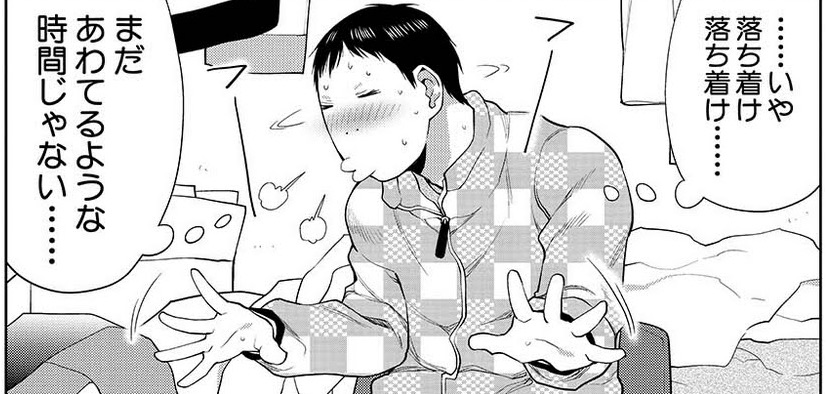
Kio explains that the “broken Gouf leg joint” incident from Genshiken wasn’t exactly based on reality, but he had a similar experience as a kid. In a later tweet, though, he realizes that the reason it happened to him is because model kits in those days didn’t use polycaps on ball joints, which made for a less maneuverable limb.
Spotted Flower is Kio Shimoku’s refracted-universe version of his hit manga Genshiken, but as the series goes on, more and more major differences crop up. Recently, I realized that one major change might be that a few characters are, in essence, fused together from different Genshiken characters.
Since her first appearances in Spotted Flower, there has been a certain character who looks and behaves much like Sue Hopkins from Genshiken. Outside of age—Spotted Flower characters are all far into adulthood as opposed to being roughly college age—the major difference between Sue and Not-Sue is that the latter has much wider hips and larger breasts. From the neck down, she’s much closer to Angela Burton, the other Genshiken American character.
I originally chalked up Not-Sue’s physical qualities to just being another way to slightly bend the details of Genshiken to make it “different enough,” but a recent side chapter of Spotted Flower, 35.5, makes me think that the merging of characters might be a recurring aspect of the series.
In it, Not-Sasahara racks his brain over trying to interpret Not-Sue’s signals, and the possibility of a threesome. As he’s trying to shake off the mental image of Ogino-sensei (aka Not-Ogiue) and Not-Sue together nude, he has an expression that is very uncharacteristic of Sasahara but makes him look just like Kuchiki, the annoying guy from Genshiken who has issues with boundaries. The resemblance to Kuchiki is further enhanced by the character’s hairstyle. This leads me to believe that Not-Sasahara might actually be better described as a kind of “Kuchihara,” though mostly dominated by the Sasahara side in terms of personality.
Endou, the “original character” who’s actually closer to Yoshitake than anyone else is probably not a fusion, but she feels like she belongs in a similar territory. In her case, it’s almost like she’s a mix of Yoshitake and a Genshiken character who never made it off the drawing board.
Not every character in Spotted Flower is a mash-up, as plenty map onto their Genshiken characters pretty comfortably. However, I’m keeping my eye out for any potential combos from now on.
Another month of Kio Shimoku tweets is here! The guy has finally learned how to thread tweets, which makes things easier for me. A lot of the month was promoting his books, as well as other titles in Rakuen: Le Paradis, where Spotted Flower runs.
Crossover Images Featuring Genshiken, Hashikko Ensemble, and Spotted Flower
“Stand like you’re being held by a string from the sky!” [a way to teach proper posture for singing]
“It’s normal for me to be hunched over, you know. *mutter*”
A duo who will never see eye to eye.
Image 2:
“So what was like in high school?”
“Well, it was pretty ordinary. I was in an otaku club…and I had long hair…”
“Ahh, Hashi Tech has one of those too. It’s called the Society for the Study of Modern Visual Culture.”
“……Huh?”
I find this amusing because I sort of think of Jin and Madarame as similar characters, but they’re actually quite different. Jin is almost like if you mixed Madarame and Kohsaka.
Also, it turns out that teenage Madarame, Tanaka, and Kugayama doppelgangers (in an actual Genshiken club) actually did make a cameo in Hashikko Ensemble!
Old drawings from the @hashikko_music Twitter. In the first, Hasegawa is commenting that Sue has a nasty expression. In the second, Himari is about to make the same comment about Ogino-sensei, but is struck by their similarities.
Kio recalls a moment from 10 years ago, where a stray cat was curiously poking at the tortoise as the latter slowly tried to scuttle away. He remarks that, amazingly, this is the same tortoise who now actively rams the window asking to be let in.
Thanking Taniguchi Jun’ichirou for his animation work on Genshiken. This includes Nidaime and the original series, where Taniguchi and Mizushima Tsutomu (who would later go on to direct Nidaime) worked on the infamous “nose hair” episode.
In one of the biggest pieces of Genshiken-related news to come out in a long time, author Kio Shimoku finally has a Twitter account, @kioshimoku1!
He’s genuinely new to the platform, as he seems to not even understand how to thread tweets. He also doesn’t really respond to fan tweets. Even so, it’s become a great place to learn things about the man that were previously unknown. But in recent years, he’s been willing to open up more (and has even done a coupleinterviews), and now he’s providing valuable creator insight and even a bit of personal history.
While I would love to translate everything, I don’t have the time for such a time-consuming endeavor. Instead, what I’m thinking of doing is just sharing some highlights from Kio’s account once a month or so.
Here’s one group of noteworthy tweets, as well as a summary below.
After having watched the Professional episode on Anno Hideaki, Kio reminisces about past Anno works, like Nausicaa of the Valley of the Wind [where he was an animator] and Nadia: Secret of Blue Water. Aim for the Top! he couldn’t watch as it was coming out because it was an OVA, and his family only had Betamax, so he couldn’t rent tapes. Years later, after winning the Afternoon Four Seasons Award for manga while in college, he used his prize money to buy a VCR.
Kio believes he first heard of Nadia from the very first info about it in Animage, and thinks (but isn’t certain) that he knew Anno’s name at that point. Kio was all about Miyazaki Hayao’s anime at that time, and believed anime should be all about big adventures, so he recorded Nadia on Betamax every week. He certainly did notice the production issues that anime faced, though.
After trying to remember if he drew any Nadia fan works at the time, he remembers that one of his drawing submissions was actually published in Animage. [Note: I wonder if we could find his drawing…] He’s also pretty sure he drew some Nadia doujinshi, but can’t remember what it was about (other than it was not pornographic).
Kio is reminded by his Twitter followers that he not only drew a Nadia fan comic in 2012 as part of an anthology, but that he made the exact same response of having drawn doujin but having no recollection of the contents.
Hasegawa Kozue, first-year Architecture and Construction major at Hashimoto Technical High School.
She was introduced unceremoniously to Hashikko Ensemble, but she has such a powerful presence that she became one of the central characters. She became the group’s conductor so easily that she feels broken.
She’s the only one who can fight Sue toe-to-toe.
Despite being only a 1-dan in Judo, she can toss her 2-dan older brothers (and others of that level) around with ease.
She sometimes acts as the author’s avatar.
Ogiue! Kio practiced drawing Ogiue in an older stylefor the Twitter introduction image at the top of this post.
ご挨拶絵のために練習した荻上。大して絵柄変わってないだろうと思ってましたが、ん~~案外変わってますかね。
でもご挨拶絵はむしろ昔っぽいな。 https://t.co/cB8vIhYrut— 木尾士目 『はしっこアンサンブル』第6巻3月23日発売 (@kioshimoku1) March 30, 2021
Kio Shimoku has historically been a very private person, not even revealing his face until 2018. Shockingly, the Genshiken author had his very first audio interview, and it was by a Virtual Youtuber to boot! Luis Cammy is apparently a big fan of Kio’s work, and talked with him for a whopping 80+ minutes.
Translating the whole thing would be a whole endeavor in itself, but you’ll find all the notes I’ve taken from the interview. There’s a lot of it that’s all-new information and insight into Kio’s creative history.
Note that Kio has a remarkably deep voice. Personally, he reminds me a bit of Kugayama from Genshiken.
Also, as a final disclaimer, it’s possible I misunderstood some of the things spoken about. If anyone has corrections, feel free to leave comments!
Introduction and Miscellaneous
Luis has been a fan of his work since Gonensei (“The Fifth Year”), an early Kio manga and dark sequel to his prior work, Yonensei (“The Fourth Year”).
As part of their collaboration, Luis sang a cover of the Kujibiki Unbalance opening, and Kio provided drawings of Luis cosplaying as Ritsuko Kübel Kettenkrad for a music video. The video
It’s meant to resemble late 1990s to early 2000s galge/dating sim intros. Luis looks like Saki from Genshiken/Ritsuko already, so it was a challenge to differentiate her.
Kio learned about VTubers from manga author gatherings. He doesn’t watch YouTubers much, let alone VTubers.
When asked if he knew how popular his work was at the time, Kio said he didn’t really look at comments online, but felt he rode the wave of the era.
The very beginning of Genshiken was Kio wanting to draw otaku as normal people. He want to madk what he himself wanted to read.
Luis mentions that otaku and their status have changed drastically since the days of Genshiken (when otaku were picked on and persecuted), like how there are light otaku now. Kio says his daughter is in middle school right now, and to her, she doesn’t get the whole otaku-as-negative thing. A group of popular kids in her class have Demon Slayer: Kimetsu no Yaiba merch. Kio responds, “Times have changed, huh?”
Luis talks about how even regular folks say they like her, and it’s like the wall between normies and otaku isn’t there. Madarame has become a popular representative of otaku (to the extent that he’s Kio’s visual stand-in for this interview).
Kio talks about how, in the very earliest planning stages, the first idea he sent to editorial was about the relationship between Madarame, Kousaka, and Saki. The love triangle was inspired by Ping-Pong Club, the nose-hair chapter in particular. That scene was thought up very early on, back when Genshiken was a mere chick. In a sense, Madarame and his romantic relationships were a part of Genshiken from the start.
Luis talks about her mahjong teacher, Saito Go (a professional player and mahjong VTuber), likes Genshiken. He especially remembers that scene with Madarame and Saki eating sushi together, and then not talking afterward on the train ride home.
Luis points out that Kio likes to use silent panels, which Kio agrees with. However, he thinks overdoing it with those types of panels isn’t good either. The nose-hair chapter ends in silence too. Luis says a lot of information can be conveyed in such panels. Kio says it can convey a sense of realism.
Luis points out that the recording was the day of Saki’s birthday!
When creating character profiles for the compiled manga volumes, Kio had to come up with birthdays. He actually used Gundam Horoscopes to think them up. [This has been mentioned in other sources before, like the Japan-only Genshiken Official Data Book.] Actually, it was sort of like a backwards horoscope, in that he picked a mobile suit that would fit Saki well, and decided the birthday based on that. Sasahara is a Ball.
Personal Questions and Family Life
Kio is into Gunpla. He got into it when he was a 6 thanks to his bigger brother. Plamo-Kyoshiro (the 1980s precursor to Gundam Build Fighters) was his “bible.” He would categorize himself as a plastic model otaku above all else. He still wants to continue it as a hobby, but he’s busy. In Plamo-Kyoshiro, the way they used cardboard boxes in the manga really sparked his imagination as a kid.
Luis asks if Kio’s daughter ever says, “Why is our home filling up with more [otaku] stuff?” Kio says that his workplace is different from his home, so it’s his workplace that gets filled up instead. Doesn’t think his daughter is an otaku, but can’t say for sure. Luis jokes about Kio’s daughter showing up on the live recording and telling him not to say so much. Kio mentions that she doesn’t know about this, so Luis responds that she could come in saying, “It sounds like you’re doing a broadcast with someone from Nijisanji.” Kio comments that she might actually know what VTubers are.
Kio’s daughter has always walked in while he’s drawing manga, so she’s been reading manga for a long time. Kio still reads current manga. Luis says that manga has become like a “communication tool” these days, like, “What? Do you know this title?” as a conversation starter.
Genshiken More In-Depth
Luis describes the first Genshiken as being about ancient otaku. She asks Kio, if there was a Genshiken Third Generation, would it have VTubers and stuff in it? What kinds of characters and what sort of content would it include?
Kio concurs that they’re ancient otaku. His thinking was, “If I try to draw something totally new, it’ll quickly date itself. But if I make them feel older, than it’ll age better.” He doesn’t consider himself to be on the cutting edge. Genshiken came from whatt he personally wanted to draw. As it continued, it progressed into fujoshi stuff.
As for VTubers, once they become old, maybe then they’d show up in Genshiken. Kio says that plenty of current manga have VTubers in them already.
Luis asks if Kio is happy to have ended Second Generation when he did, and Kio says yes. “It felt like, ‘That’s about where it should stop.’” He explains how the sequel started out as a one-shot, but he’s not good at doing extra stories and the like, so he kept on working on it. Kodansha editorial (the publisher of Genshiken) said he should do enough to fill one volume. It was originally supposed to be a short serialization.
Kio began with the thought of “How would Ogiue and the others continue the club?” and of course, it would end up with a bunch of fujoshi. But would it be all girls? What about guys? Hence, Hato.
Kio really went back and forth about whether or not to include a character like Hato. When he was drawing the manuscript, he kept having the feeling of “Is this really okay?” Coming up with the idea of Hato purposely using a more feminine voice is when he finally thought he could make it work. Fujoshi and otoko no ko (boys who dress convincingly as girls) are the main aspects of Second Generation. Kio didn’t want to put Hato through so much hardship, but as the story progressed, he felt that’s what should happen—though he did worry over it.
The original Genshiken was supposed to be in real time, and things moved quickly. But it stopped being that way during the Ogiue story at Karuizawa. At the time, Ogiue was a “problem child” when it came to drawing the manga, as he didn’t know if he could resolve her backstory. It’d be difficult to do that and still maintain the “real-time” thing, and he would’ve selfishly wanted to end the series in the Spring if it had stuck to being in real time. But it took multiple months to get through the Ogiue story.
The series was supposed to end at Volume 8, but then there were plans for the second special official doujinshi [the first one was included with Volume 6]. Because of that, they decided to continue the series up to Volume 9. The original Genshiken features Ogiue’s turmoil, and Second Generation features Hato’s turmoil.
Luis comments how there are the Ogiue fans, and then there are Hato fans. Kio responds, “The Ogiue fans really are somethingl…” and then trails off. [Ogiue Maniax note: I feel attacked.]
Spotted Flower
There are things that were hard to put into Genshiken, like sexual stuff. That’s where Spotted Flowercomes from. From here, the two jokingly pussyfoot around Spotted Flower’s similarities to Genshiken.
Luis talks about how Spotted Flower is a different world (tongue-in-cheek), but it has kind of a crossover feel. Kio responds that they’re ostensibly different characters. Luis replies that the series is like a “what-if” universe (if-sekai in Japanese).
Kio says it’s not supposed to be them, but through it, he can do what he couldn’t in Genshiken.
Luis says, “What-If Madarame has a ‘Why youuuu!’ feeling.” Kio laments the husband as well.
Spotted Flower was supposed to be just a few short pages for Rakuen: Le Paradis magazine. The resemblance to other characters was originally not planned, but is actually something he noticed after the fact. He didn’t explain the meaning of the title to them when he submitted it [madara means “spot” and saki means “bloom”], so they probably didn’t realize at first. So he figured, “Why not keep going?” and it developed along the way.
“And now there are four volumes,” says Luis..
Kio’s feelings: “It’s not a book that comes out often, but if it interests you, I’m grateful.”
It was one thing when it was just the husband and wife, but then he added the Hato-like character, and the Kousaka-like character, and so on. He still can’t really say for sure that it’s them.
Hashikko Ensemble and Kio’s Overall Career
Luis finds the Hashikko Ensemblemain character Akira cute. Kio says that he began with the idea that Akira would have that gap between his very deep voice and his shy personality.
Volume 5 of Hashikko Ensemble should be coming in September.
Kio says he’s been in the manga business for 25 years. Luis thinks all his works are great, in terms of information provided, emotion, and atmosphere all being wrapped up in them. “It’s no small stuff.” To Kio, he sees all the things she mentioned as his shortcomings Luis comments that she enjoys seeing Kio reflect on his work.
Kio is the type to regret not saying this or doing that. Luis remarks that this is a live broadcast—is Kio okay?
Kio doesn’t recognize his own voice when recording. Luis said she never thought of her voice as anything special but the fans would say it’s cute. Luis compares Akira’s voice to Kio’s. Kio never had any experience with singing or choruses, but figured, why not give Akira a deep voice like himself?
He thinks people who can come up with characters purely from imagination are amazing.
Hashikko Ensemble a story of the passion of youth, but Kio didn’t originally plan it that way. Like Genshiken, he wanted the story to be something ridiculous and fun, and landed on “chorus club high schoolers.”
Luis loves stories about the passion of youth (seishun), like Yowamushi Pedal and Big Windup. Kio replies that he’s never drawn manga in that vein—like Chihayafuru—but thought, “If I put all I had into it, could I draw one?” The characters in Genshiken are all pretty mellow. He wasn’t that good at drawing the kind of youthfulness that appears in Hashikko Ensemble, at first.
Luis makes the argument that the original Genshiken is a “passion of youth” story, because it’about figuring out what club to join and what to do? Like, Kugayama’s waffling on whether or not to draw, or Ogiue’s decision to go, “I guess I’m gonna draw.”
The kinds of “passion of youth” stories Kio enjoys are a little strange—not so much “hot-blooded stuff.” Luis describes Madarame as a hot-blooded otaku. As for being a passion of youth story, what about that story with Saki mentioning Madarame looks good in his new glasses?
Originally, Genshiken was supposed to be a club that doesn’t put anything out. One of the things that made Ogiue tricky is that she wanted to draw herself, so Kio had no choice but to make a story about her trying to get into Comic Festival [the Genshiken in-universe equivalent of Comic Market].
Doujinshi???
Luis says Genshiken is what made her want to attend Comic Market as part of a circle. She asks Kio if he ever participated as an artist. Kio says yes!
Kio released a doujinshi at Comic Market in 2003 (Luis points out that 2004 was the year of the first Genshiken anime, which Kio totally forgot about).
Kio did not use the name “Kio Shimoku” for Comic Market. He sold 200 books, which impresses Luis. For reference, Luis says that 100 is considered a lot, and she herself sold 50 copies of her own doujinshi at a Comitia [a major doujin event primarily dedicated to original, non-fan works].
The doujinshi was indeed pornographic, and an original work. It bears resemblance to Kujibiki Unbalance and Genshiken.
Luis talks about how big sister loves Kujibiki Unbalance, to the extent that she put out a pornographic doujinshi starring Ritsuko. Luis helped her a lot with it, including stapling it together.
“Putting out a Kujibiki Unbalance-esque doujinshi yourself is like actually being in Genshiken,” says Luis.
Kio also participated at Comic Market a second time—in 2010. It was a doujinshi based on a “certain space opera that uses Episodes,” flipping around the genders of the character roles involved. The inspiration was that with some wordplay, the title resembled the phrase “Sister Wars.” He drew what was supposed to just be a manuscript based on Episode 1, but it ended up being 350 pages. Kio wanted to draw up to six.
“Please complete it!” Luis says.
“But I wouldn’t be able to sell it!” Kio replies.
[Ogiue Maniax note: One of Ogiue’s characteristics is prolific output, just like Kio here.]
Luis asks if there’s anything he’s watched lately, old anime or new anime. Kio doesn’t have anything, and Luis says his free time to just sit down and watch without moving must have decreased. Kio agrees.
Kio wants to absorb more shows, but just doesn’t have the time.
Questions from Kio for Nijisanji
As future reference for manga, Kio asks if VTubers wear sensors to track movement. Luis responds that it uses 3D tracking. She quickly “corrects” that the animated figure you see is the real her.
Luis says that Kio’s participation in Comic Market makes his manga feel more real.
The two talk more about the Kujibiki Unbalance music video they collaborated on. Kio says it’s like a doujin-style fan work. Luis talks about how she has Genshiken and Kujibiki Unbalance merch. Luis has the Kujibiki Unbalance Ritsuko school swimsuit clear file drawn by the light novel artist, Yagumo Kengou. Kio mentions that the image was a request from him [Ogiue Maniax note: Not 100% sure about this last sentence].
Kio mentions that he gets some harsh comments, but others will say “That’s the kind of author he was all along!” But he doesn’t want to remember himself from the Gonensei era.
What an Interview!
There’s a lot to unpack in this interview. I hope to follow up with an analysis.
Also, I can’t believe there’s a Virtual Youtuber who’s into Genshiken, Kio Shimoku, and mahjong! It’s like someone designed a VTuber especially for me.
I guess the Ogiue Maniax VTuber pantheon is now Sugomori Tenkomori and Luis Cammy.
Spotted Flower has long been a bizarre, twisted version of Genshiken, but a couple of side chapters posted (temporarily) for free on the Rakuen: Le Paradis website reveal an extra wrinkle to its story. Portraying two groups of parents, it shows their actions inadvertently corrupting their children.
In Chapter 33.5, the wife (not-Kasukabe) is trying in vain to get her infant daughter, Saki, to raise her head. When the husband (not-Madarame) drops his phone by accident and it shows an old picture of him getting his necktie pulled (much like that famous moment in Genshiken), Saki’s eyes go wide with excitement. When the husband picks his phone back up, Saki’s head follows, and voila, she’s able to lift her head up under her own power. In that one moment, a fujoshi is born.
Then, in Chapter 34.5, not-Ohno has put her two kids, Shin (three years old) and Yuu (one year old) to bed alongside her. On her other side, however, is her husband (not-Tanaka!!), and she’s in the mood for some intimacy.. Not-Tanaka notices that she’s actually wearing pantyhose from a Kakegurui cosplay, which clearly shows that she’s been wanting this, but when she also tries to put on a Yumeko wig, he nixes that idea. The mini-chapter ends with them having sex off-panel, with Yuu being woken up and then lulled back to sleep by the sound of his parents knocking boots next to him.
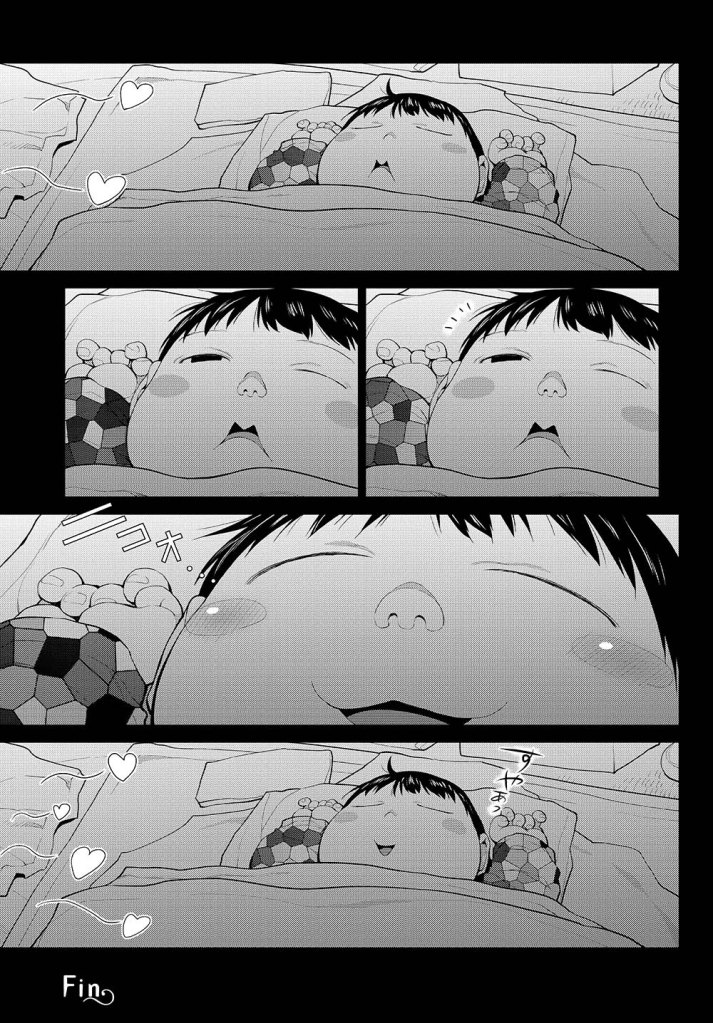
The idea of seeing these geek parents influencing, even if accidentally, the next generation of degenerate pervy otaku is an intriguing one. What makes it all the more…special…is specifically that it’s the Spotted Flower characters doing this instead of the Genshiken ones. What will the future hold for these kids…?
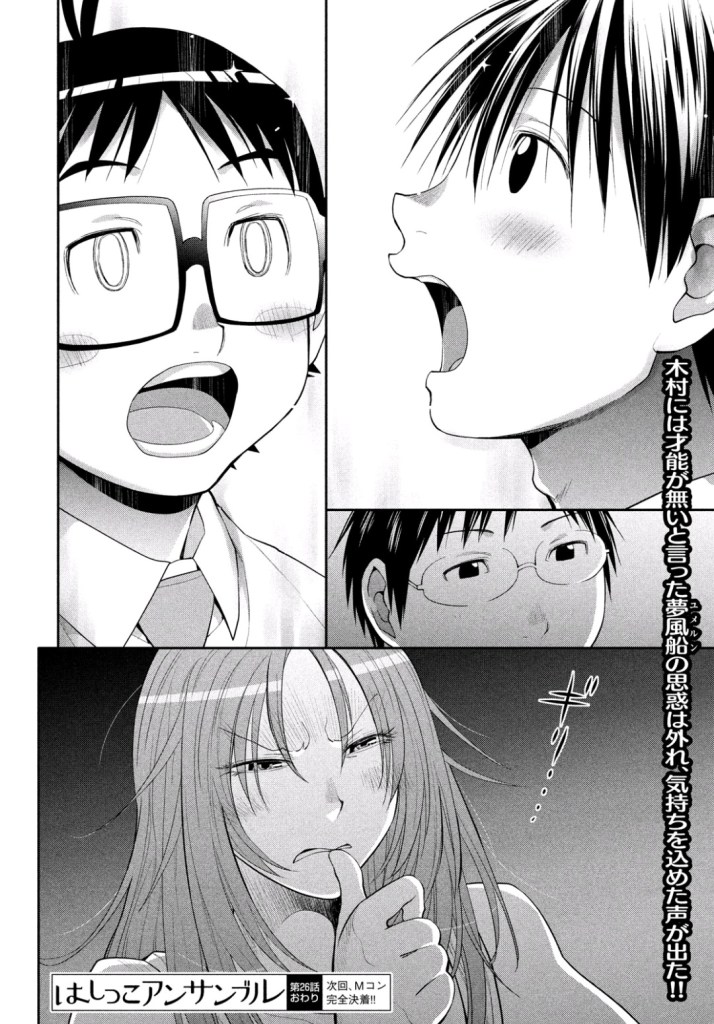
Jin reveals an important part of himself while Akira shows his kind heart in Chapter 26 of Hashikko Ensemble.
Summary
It’s the Hashimoto Chorus Appreciation Society’s turn at the M-Con competition, but before they go up, Jin has a question for Akira: how does Akira interpret the lyrics to “Miagete Goran Yoru no Hoshi o” (Behold the Nighttime Stars)?
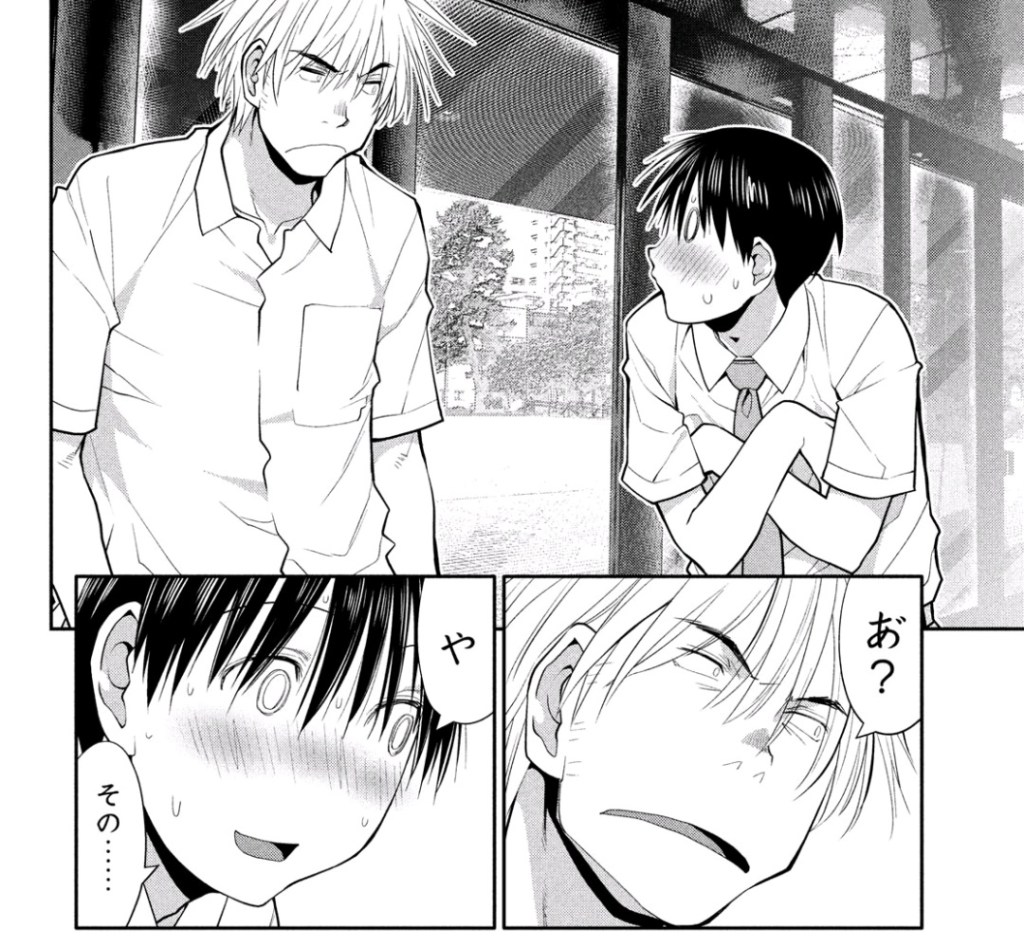
It turns out that while Jin can read up on the history of a song to understand what went into it, he can only ever understand lyrics at face value. After some hesitation, Akira explains in private to Jin that he picked the song while thinking about Kousei, who lost his little brother when they were young. To Akira, it sounds like a song of prayer—an explanation that seems to awaken something inside of Jin. Right after, Jin blabs to Kousei, causing some embarrassed tension, threats of violence, and teasing accusations of Kousei being a tsundere.
That little moment resolved, the guys start their performance, with Kousei drawing the most attention with his delinquent attitude in this more formal concert hall space. As they sing, they impress one of the judges in particular, but in the stands, Yumerun (Jin’s childhood friend) looka extremely annoyed for some reason.
Is Jin Neuroatypical?
Jin has always come across as a huge nerd who’s really into music as a kind of scientific phenomenon. However, based on what we’ve learned over the past two chapters, I’m genuinely starting to wonder if Jin might be somewhere on the autism spectrum, or is perhaps neuroatypical in some other way.
Not only have we learned that he has trouble with making his singing feel more expressive, but now he’s explained that he’s basically incapable of interpreting lyrics on his own. I’m not very familiar myself, but I’ve known people who have Asperger’s, and from what I understand, people on the autism spectrum often have difficulty grasping the emotional meaning behind how things are said, or even sarcasm and the like. Hashikko Ensemble itself hasn’t said anything explicit, but I think it would explain a lot about the character, including how he approaches social interaction.
Akira and Kousei
The fact that Akira showed such concern for Kousei further fleshes out his character. There’s something about his trying to help Kousei out, as well as his interpretation of the lyrics, that reminds me of his childhood friendship with Himari and his love of children’s picture books. Akira is a kind soul, and I increasingly like him as the central protagonist of this manga.
Yumerun’s Anger
Part of the imagery of Yumerun grinding her teeth is that it “rhymes” with the panel of Shion doing the same out of frustration over not being able to play the accompanying piano. But beyond that, I really can’t seem to figure out why Yumerun is expressing some dismay over seeing Jin sing there. Their mutual past might be even more complicated than I first thought, and I wonder if maybe Yumerun is actually there on behalf of Jin’s mother. If not, maybe Yumerun sees chorus singing as somehow painfully common. I’m sure there’ll be more information in the coming months, but for now, this has me fascinated.
Songs
It’s just “Miagete Goran Yoru no Hoshi o” by Kyu Sakamoto again this time, but given that it’s front and center in this chapter, I think it’s worth it to go into greater detail about it.
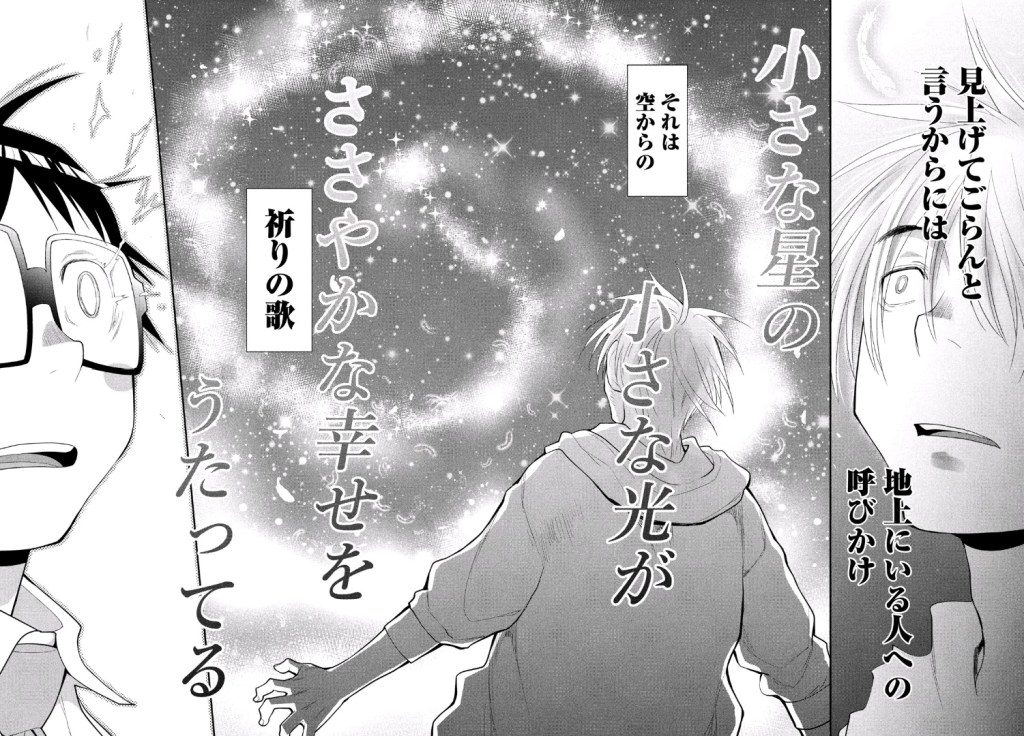
As Jin explains, the song in question was written after the Great Kanto Earthquake of 1923 when the lack of light pollution made the starry sky visible. The stars are a metaphor for people’s souls, and the song itself functions as a song for repose of the soul. Akira’s interpretation as a song of prayer approaches it from a different angle. To him, the lyrics seem like they’re calling out to the souls of those who have been lost, but the second half makes the name of the song sound like a comforting call to those left on Earth.
Final Thoughts
If Kio Shimoku is indeed writing Jin as having some sort of neurotypical mind, it would be new ground for him. Genshiken has a lot of eccentric characters, but that series always came across as just a bunch of fanatical dorks who really like anime and manga. Jin’s obsession with music seems driven by something different.