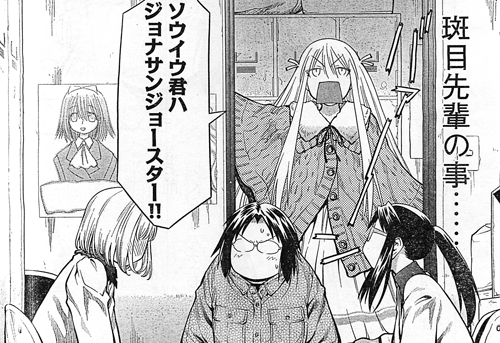
Chop Chop Chop, Judo Flip: Genshiken II, Chapter 86

Genshiken II, Chapter 86 looks to possibly be a turning point. We’ve had quite a few of those already though. Also, next month there might be more news about the upcoming anime! It’ll be a long 30 days or so.

Sue visits Hato’s place, using Janglish to ask if he likes Madarame. Hato denies, but is clearly hiding something. After a tussle pitting Hato’s judo training against Sue’s freestyle which ends in a win by submission for the American, Sue discovers Hato’s secret Mada x Hato (in drag) drawings. Hato, who is increasingly confused about his feelings for Madarame (he feels that at this rate he might actually start liking Madarame), decides to just stop crossdressing and go back to being “a normal otaku.” This clearly makes Yajima uncomfortable despite her previous objections to Hato’s crossdressing.

With this chapter, I think I finally understand one of the big overarcing themes of Genshiken II. Yes, there’s the generation gap and the otaku/fujoshi distinction, but even more fundamental to the manga is a concept I’d describe as “the complexities of personal perceptions.”

The foremost example is Hato. He is getting to the point where he likely feels something for Madarame. I want to point out, however, the fact that Hato had no problems showing his “Hato x Mada” art to Sue, declaring that it was just the realm of fiction, but for some reason he also felt it necessary to keep his “Mada x Hato” hidden. I think the distinction between the two pairings is extremely important because it indicates a denial of clear-cut narratives about sexuality in describing otaku.

“What’s fiction is fiction, and what’s real is real” is a clear and concise argument. So is “what you’re attracted to in fiction can influence your real life preferences (and vice versa).” The former argument is used by Hato, while the latter was suggested by Kaminaga. With Hato and his feeling towards Madarame, however, it might actually be the case that his yaoi delusions are separate from his real feelings, but he began developing feelings for Madarame anyway due to their growing friendship, and that this manifests as Hato x Mada vs. Mada x Hato. I wonder if this is the case just because Mada x Hato for some reason apparently has to involve Hato crossdressing, as if to say the idea does not “make sense” to him otherwise.

In anime and manga about (or including) fujoshi, often there is significant time spent explaining how important the orders of pairings are important. “It’s like saying ‘curry on rice.’ No one says ‘rice on curry!’ says a character from the 4-koma series Doroko. This is generally played for laughs while trying to introduce to the reader the “mysterious” mind of the fujoshi, to allow the reader to say, “Oh fujoshi, you’re so lovably wacky.” I think that with Genshiken, Kio is trying to discuss that mindset a little more seriously.

I predict Ogiue is going to start playing a bigger role in this, just because Hato looks like he’s trying to run away from his current situation at all costs. Ogiue is more than familiar with this situation, is aware of how much trying to deny oneself can generate a festering wound of self-loathing, and just how complicated the real/fiction distinction can get. I think, or perhaps I simply hope, that Ogiue will manage to be Hato’s mentor, like how Ohno was there for her. Also, Hato says he’s “going back” to being a normal otaku, but was he ever a normal otaku? He discovered yaoi in junior high, so it’s been with him for a long time, which makes me think that Hato is trying to simply act like how a “normal otaku” is supposed to without truly direct experience, somewhat like how Ogiue sometimes tried to approximate a “non-otaku.”

If the Hato example is a little too crazy, I think Yajima in this chapter also provides an interesting case of personal perception. Clearly the reason why Yajima blushes at the end is because she still associates male Hato with the time she accidentally saw him naked, in addition to just the fact that he’s a guy. She doesn’t react this way so much to Hato in her female guise, which means that the wig and dress is enough to “trick” Yajima psychologically so that the first thing she thinks about is Hato’s clean-shaven personal area. What Yajima thinks of Hato is of course its own puzzle having at its origin her own self-image and her lack of experience interacting with men.

I don’t know if Sue counts towards this as well, but I do find it interesting that Sue’s embarrassment over kissing Madarame has nothing to do with him and everything to do with the fact that Kasukabe saw her doing it. On some level, I feel like I can really understand that distinction. Somewhat like that famous scene in His and Her Circumstances when Miyazawa accidentally runs into Arima while out of her “perfect student” guise,” there are people you feel like you can be a fool around and people you don’t. I also continue to think that it’s kind of brave of Kio to give Sue a larger role, as semi-fluent foreigner is not the easiest thing to pull off without reverting to very basic stereotypes. Sue is many things, but “basic” isn’t one of them.

By the way, there’s something I find really impressive about Sue and Hato’s fight scene, particularly the panel where Hato drags her and sweeps the leg. It captures that one moment so incredibly well, while allowing it to transition into the next set of panels. It actually makes me want to see Kio draw an action series.

To end, I want to ask a simple question: Sue x Hato, what are your thoughts? If this were a more popular series, I’m sure that neck-licking thing would have people talking.

Jaoh Shingan: Genshiken II, Chapter 85

It’s back to basics in Genshiken II, Chapter 85 as  Sue, Yoshitake, and Yajima revive the old Genshiken tradition of spying on club members who think they’re alone. When it looks like Hato is getting unusually close to Madarame. Right when things seem to be getting to the point of no return, in comes Keiko, who quickly deduces that Madarame’s decision to quit his job comes from a desire to regress back to his old self now that he’s been rejected by Saki. When Keiko suggests that Madarame come to her Cabaret Club to “get dirty,” Sue interferes and inadvertently makes it known that they were being watched. An embarrassed Hato runs home, only to be met by Sue as the chapter ends.

The more I write these reviews, the more I worry that my constant references to the old chapters may be unfair to the new series. Perhaps if I engage the current Genshiken on its own terms, I’ll be able to do it justice. At the same time, I do actually feel that many of the ideas being explored in Genshiken II have their roots in the original manga, and that the new characters allow for a more complex elaboration.

Back when Ogiue’s own main storyline resolved, the message was one of acceptance. So what if others find your tastes weird? You’re who you are. While such a conclusion fit perfectly for Ogiue’ character, the question of whether the border between fantasy and reality is airtight or porous wasn’t answered to any great length. Not that it needed to be, but if we accept acceptance and remove moral and value judgments from the equation, how complex can that interaction be? This, I believe, is what is happening with Hato and his interactions with Madarame. Hato can go where Ogiue never could.

Hato is clearly emotionally confused in the current story, where everything he thought he knew about himself is being thrown into question. I don’t get a sense of a fear of homophobia from his situation, but that he is having trouble establishing the distinct barrier between his male self and female guise and that it means he doesn’t understand himself anymore. The breakdown hints at the power of imagination, of how we see and define ourselves, and invokes the idea that, while sexuality isn’t a learned behavior, that learning provides additional information for reflection.

Once again, if we go back to Ogiue, she once stated that the Sasahara of her yaoi fantasy is clearly different from his real self, but she also clearly enjoys and is even turned on by Sasahara when he role plays his imaginary “Strong Seme” self. For Hato, who not only includes a form of Madarame in his yaoi fantasies but is also becoming increasingly good friends with him, he almost provides a powerful thought experiment whose solution can’t be as simple as “he’s gay,” even if he turns out to be.

Something I find particularly interesting about Madarame’s portrayal in this chapter is the focus on his neck. The current Madarame looks different from when he was in college, and this is shown most overtly in his change in hairstyle, but when viewed up-close from behind, he still looks the same as he always had. Given that in this chapter he basically admits to wanting to regress, and the fact that Sue, Yoshitake, and Yajima did the old spying trick, I can’t see this callback as unintentional.

Keiko continues her role as a kind of substitute Saki in her own unique way. By that, I mean that where Saki has a natural pragmatism about her that Keiko lacks, Keiko seems to make up for it with sheer (mistake-filled) experience. I almost get the impression that her experience working at a cabaret club is actually increasing her perception skills far beyond what they already were, which even back when she was still attending college were still quite sharp (she’s the one who immediately noticed the sexual tension between Sasahara and Ogiue). I really can’t tell if Keiko is actually into Madarame or not, though the reveal that she’s been purposely mispronouncing his name as “Watanabe” the whole time says something. Even if Keiko is curious about Madarame, though, I can only see her interest being short term, even more than Angela’s.

As for the general idea of the “Madarame harem,” I think that it’s only a name. Take Sue, who both this chapter and last chapter was caught blushing in front of Madarame. The most obvious interpretation is a crush, but why did Sue stand back and watch when it looked like Hato was putting the moves on Madarame, but interfere when it looked like Keiko was about to do the same? For that matter, why did Sue interfere with Angela back when she was trying to get into Madarame’s pants? Given her appearance at Hato’s door at the end of the chapter, we’re probably going to find out more, but wish fulfillment fantasy with Madarame at the head this is not.

I am curious as to where Sue (who was super cute this chapter) is going. Is she going to get some real character development? She did start off as a kind of larger-than-life super fujoshi from another country, and to humanize her may either be an amazing decision or a terrible mistake. I have faith, though.

The last thing I want to point out is the significance of the Children’s Literature Society member we see in this chapter. In the past, that club was clearly on good terms with Genshiken given the whole spying thing, but I got the impression they were not exactly into anime and manga. The fact that this particular fujoshi chose to be part of the Children’s Literature Society in spite of the presence of not only Genshiken but also the Anime Society and the Manga Society (which has a large fujoshi contingent) has a connection with the recurring theme of  the generation gap between otaku that primarily manifests in the mainstreaming of the otaku and the rise of the fujoshi. The otaku are not limited to the clubs that are meant for them, which I think says a lot.

As for Ogiue ending the spying thing, it only makes sense given that she was already the victim of it in more ways than one.

If Only There Was an Angela Burton Spinoff

While I’m naturally excited about the new Genshiken anime that’s been announced recently, there’s one thing I wish could happen but most likely never will: a spinoff about Ohno’s American friend Angela Burton. I feel like it would be fun to see some of the quirks of American anime fandom accurately and painfully conveyed.

One big element of American fandom that for the most part doesn’t exist in Japan would be the convention scene, with its fan panels, industry Q&A, and AMV competitions, providing a unique venue and experience compared to the chapters about Genshiken‘s Comic Market analogue, Comic Festival, but also giving it a similar treatment concerning scale and impact. The huge otaku that she is, it would be no surprise to see Angela attending multiple conventions as a cosplayer, especially Anime Boston given that she’s from the area.

The Angela spinoff I’m picturing would have the same strong sense of characterization as Genshiken proper, giving the same sort of loving but at times harsh portrayal to the personalities that tend to crop up in college anime clubs in the US. I also see Angela herself making for an interesting main character, despite the fact that she has a fairly minor role in Genshiken because of her forward personality and her undeniable love of anime and manga.

One potentially serious topic could actually be the whole “fake geek girl” thing, as I can imagine Angela being subject to it fairly often. Angela is not only portrayed as extremely attractive to the point of being able to make guys nervous, but also as someone with relatively liberal views on relationships and sex (she doesn’t think one-night stands are that big of a deal) that might cause people who didn’t know her better to accuse her of not being “real.”

Incidentally, in reading Japanese comments about the new anime, it’s clear that the concept of the “fake geek girl” exists in Japan as well. There, it’s tied to the whole Densha Otoko boom and the “mainstreaming” of Akihabara, which at least a few commenters claim the Genshiken manga is reflecting.

Sketch in Celebration of the New Genshiken Anime + More

The Current Genshiken Club Members

The Hokuto Brothers (I think Toki turned out the best)

Yoshimori and Tokine from Kekkaishi

Nonowa etc.

Drifting Clubroom: Genshiken II, Chapter 84

Before we jump into the chapter, I have to make sure you’ve heard the news.

ATTENTION:

NEW GENSHIKEN ANIME!!

YOUR EYES DO NOT DECEIVE YOU

You’d think after the Madarame/Saki climax from a few chapters ago that Genshiken would let up for a while, but Chapter 84 is an intense one.  In the previous chapter, Madarame revealed that he was going to quit his job near the school (implying he would be unable to visit the college as often as he used to), despite Saki’s advice not to do so. As Madarame appears to feel increasingly alienated from the current club’s atmosphere (and Yoshitake tries to convert him to the church of BL), Hato is having trouble of his own as his emotions become a mystery to even himself. As Ogiue asks him to contribute to a “Tiger & Bonny” doujinshi, Hato begins to wonder about his relationship with Madarame, and the seeds of doubt Kaminaga placed in him about his heterosexuality begin to sprout.

Meanwhile, Sue of all people seems to have feelings for Madarame as well, though her character might mean it’s stranger (or simpler) than that.

I do not think that the change in demographic in Genshiken is the root cause per se for Madarame’s decision. Rather, my suspicion, based on my own experience, is that Madarame’s connection to the actual Genshiken as an on-campus club is starting to weaken. I had a similar group of nerd friends back in high school, and for the first three years after I graduated I would visit the school often to maintain that experience. Eventually, however, everyone who I even had a loose connection to graduated, and I lost any compelling reasons to continue. I’m still friends with a lot of the people I knew from that time, but our friendship has in a certain sense transcended the physical location, and I could see Madarame feeling like the clubroom itself is no longer that important.

That said, I’ve noticed, based on some of the response to the new Genshiken anime, that there are fair amount of readers both Japanese and non-Japanese who feel a bit alienated or even betrayed by Genshiken II, and I think Madarame is meant to embody that feeling to some extent, being the character who most embodies that classic otaku personality. Perhaps the deal with Madarame’s character is that he’s caught in a state of limbo, where he’s not yet fully integrated into adult living but at the same time his old haven away from reality, Genshiken, is starting to fade away.

The more that Genshiken focuses on Hato, the more I realize that he is probably the most psychologically complicated character in the entire manga (though I get the feeling that there’s something up with Nakajima that might be even more complex). Ogiue is one thing, as her story cuts to the bone, but Hato’s situation is such that you can’t even explain it as simply “he’s realizing he’s gay.” There’s a good chance that’s what’s happening, but based on the specifics of the chapter and of his history, doubting his own sexual orientation doesn’t seem to be the only thing going on.

In the chapter, Hato tries to shoo away the suggestions of his imaginary counterpart, only to have the female Hato replaced by Kaminaga, who echoes the real Kaminaga’s statement that the crossdressing likely facilitates the potential homosexuality of Hato. In that scene are a lot of things to take into consideration, starting with the fact that the Stand (i.e. Hato’s inner thoughts?) transforms specifically into Kaminaga. Based on previous chapters, it’s still not clear what his feelings towards her are. Does he want her? Does he want to be her? Does he perhaps desire both? Even the fact that the transition from Stand Hato to Kaminaga is a little hard to spot at first if you just skim through the chapter is indicative of the fact that Stand Hato continues to resemble Kaminaga, despite the fact that Hato has undergone an image change by semi-permanently switching to the shorter wig, as if to show that she specifically continues to influence him. It’s a weighty past and a convoluted present for Hato.

As for Sue, the easiest connection to make in regards to her blushing is the kiss she placed on Madarame’s cheek at the school festival as a sort of prank. Putting aside the notion of “Madarame: mack daddy of American fujoshi,” I’m starting to realize that Sue pretty much functions in Genshiken the same way the penguins do in Mawaru Penguindrum, bringing into the very foreground some of the “hidden” elements of the characters’ relationships at the time. I also think it’s quite appropriate for her to quote Dio Brando, and to have it be not one from the more popular Part 3 Stardust Crusaders story but from the original Phantom Blood.

There’s not much Ogiue this chapter, but there’s probably going to be another chapter at least partly focused around her soon, given the impending Comic Festival, though I imagine it won’t be until at least another three or four chapters.

THAT’S RIGHT, NEW GENSHIKEN NIDAIME(?) ANIME

The newest issue of Monthly Afternoon has revealed that a new Genshiken anime is in the works. This calls for a celebration:

I’ll be honest: even with the serialization of Genshiken II (aka Nidaime aka Second Season), I never expected it to get another anime adaptation. I wished for it, of course, given that the anime never even resolved Ogiue’s arc, but I thought its time had passed, and the reception to the manga sequel has been mixed, with a number of fans both inside and outside of Japan feeling alienated by the new setting.

Of course, this development begs quite a few questions. First and foremost, will the new anime actually cover the remaining parts of the original Genshiken, or is it actually just an adaptation of the second series? Would it be half and half? Would they speed through the remaining parts of the first series in order to get to the new characters? How many episode will it be? For that matter, will it even be a TV series?

Second, who is going to animate this new version? The first Genshiken anime was by the now-defunct studio Palm, while the OVAs and Genshiken 2 were done by Studio ARMS. Responsible for Queen’s Blade and currently Maoyu: Maou Yuusha, ARMS brought a bit of a perverted slant to Genshiken, and given the presence of not only Hato but also a very aggressive Angela I could imagine them going hog wild, for better or worse. I don’t exactly have a dream studio I’d like to see work on it, but the resulting product could definitely be a tad unexpected depending on who gets it.

Third, what about voice actors? We have all of these new characters, with Hato especially presenting a challenge. Do you go the route of having one of the “masculine” female voice actors vary her voice, or do you find one of rare male voice actors who can successfully do a female voice? I would actually suggest Ishida Akira as Hato, if he weren’t already playing Kuchiki. As for the other characters, maybe they’ll go for a curveball, like Kugimiya Rie as Yajima. In any case, it’ll be good to hear Mizuhashi Kaori’s Ogiue again. Over the course of the anime, Mizuhashi’s conveyance of Ogiue’s blunt and awkward personality improved tremendously, and I’m wondering how it might have changed in the 4-5 years since she last played this blog’s favorite fujoshi.

There’s plenty to think about and anticipate, and I’m sure I’ll do even more when the next bit of info is out, so I’ll just conclude with the following words.

BANZAI!

OGIUE BANZAI!

OGIUE-KAICHOU BANZAI!!!

She is Loco, I Said: Genshiken II, Chapter 83

Ohno is worried about her job prospects, when Tanaka mentions that he’s willing to do whatever it takes to provide for Ohno. Misinterpreting his words as a criticism of her for not being able to support herself, however, Ohno decides that a career selling cosplay photo CDs might be in her future. During the photoshoot, Tanaka manages to clear up the confusion, and in the process even implicitly proposes to Ohno when he says that he wants to create costumes for her for the rest of his life. Ohno, who had downed a whole bottle of liquid courage in preparation for the photoshoot, decides to maybe stay another year in school (unfortunately).

Meanwhile, Madarame’s quit his job.

Chapter 83 feels very significant to me, a culmination of multiple threads but in a way different to the climax of the Saki-Madarame storyline. There’s the big plot development with Tanaka’s tacit proposal to Ohno, of course, but Ohno’s plight of employment (whether she brings it upon herself or not) has been around since before Genshiken II even began (and after Genshiken finished, technically, because it was first brought up in the Kujibiki Unbalance manga extras). Here, it finally takes center stage and we also get to see where Ohno and Tanaka have gone since they began dating so many years ago.

This chapter is definitely full of fanservice, particularly in how we get to see Ohno completely topless in private with Tanaka, but rather than just pointless titillation, I find that whole scene and its portrayal of (albeit obscured) nudity to speak of both the increasing maturity of not only the relationship portrayed but also of the Genshiken manga itself. The scene is portrayed with a strong sense of comfort and familiarity between Ohno and Tanaka, the kind where two people are just close enough with each other to bare it all without having it be an event. And while the nudity isn’t quite to the level of Spotted Flower, it still gives a sense that this is an adult’s world, at least emotionally and physically. Though not “canon,” for those who’ve seen the Genshiken 2 anime this chapter is a stark contrast from that episode portraying how Ohno and Tanaka got together in the first place, where Tanaka felt overwhelmed by his own inadequacies and awkwardness.

Even Tanaka’s “proposal” shows the level their relationship is at, as he naturally talks about a future with her moments before realizing what he had said (but still sticking to it). I also actually really love the change Tanaka made to his own words. As he realizes just how much Ohno has impacted his life, as he realizes that he was able to pursue his dream of working in fashion because Ohno was the perfect model and companion for him, he goes from having an attitude of sacrifice to holding onto his dreams no matter what. When he says he’ll find whatever means he can to keep making costumes for her, he includes Ohno in those dreams as a vital component, and I find the whole thing rather beautiful.

Seeing this sharp focus on the employment situation of so many characters, focused on Ohno and Tanaka but also giving us glimpses of Ogiue, Madarame, and even Kuchiki’s lives beyond the university, I feel that Genshiken more than ever has this real sense of life moving forward, even if people aren’t ready for it. Certainly it’s not an old or unfamiliar idea in the manga, with Sasahara especially getting some serious page time as he struggled to find a path for himself, but with Chapter 83 and Genshiken II in general I find that there are not only significant differences in the challenge each character faces in terms of work, but that with the new characters in Genshiken II you can really see a spread of values from people just entering college to people looking at marriage and the future, and how the former can turn into the latter but still seem just as strange. Genshiken has always been a seinen manga, but here I think it really starts to reach at an older seinen audience, beyond just the folks for whom college is a fairly fresh memory.

How Kio Shimoku Got His Groove Back

Genshiken II‘s been running for a while now, and every so often I go back and look at the earlier chapters of the new series (would you expect me to do otherwise?). Upon a recent revisit, it hit me just how much the artwork had changed between the inaugural Chapter 56 and its immediate followup in Chapter 57.

For comparison, here is Ogiue in Chapter 56 on the left, and 57 on the right.

There’s a clear difference between the two versions of Ogiue (or any other character) that can’t be chalked up simply to the gradual evolution of art style that happened throughout the original Genshiken. This change, given just how drastic it is, was more abrupt, though one has to keep in mind that the real life gap between 56 and 57 was almost a year (Chapter 56 was originally a one-shot that got turned into the start of a new series).

Because of how much softer and more cutesy Chapter 56 Ogiue is portrayed, my suspicion is that Kio’s style was affected by his time working on Jigopuri. Indeed, Chapter 56 of Genshiken actually came out in the middle of his run on Jigopuri.

In fact, if you look at one of the characters in Jigopuri, the little sister Kaname (pictured left), she looks pretty close to the Ogiue of Chapter 56. What’s also kind of funny is the fact that Volume 1 of Jigopuri features an Ogiue cameo on the inside cover, and it’s clear that the Jigopuri style hadn’t fully taken over Kio’s artwork yet at the time he drew it.

I think it’s interesting how an artist can get so influenced by how they’ve been drawing that it makes it difficult to shift gears back to a different kind of story. It’s different depending on the artist of course, but I have to wonder how much effort Kio put into switching into a less moe-type art style. Something tells me it wasn’t easy.

Sexualization Without Objectification in Spotted Flower

When it comes to debates regarding how women are portrayed in media and entertainment, one recurring trend is the way that sexualization gets conflated with objectification. Whether it’s comics or not, Japanese or not, often times the two are presented as one, so it’s no surprise that there are readers who see them as one and the same and argue from a stance that reducing or removing certain depictions of women means a puritan-like removal of sexuality itself from media. While I don’t have the same problems with objectification that others might, it’s still an issue because this misunderstanding begets many other misunderstandings. It’s for this reason that I’m impressed by how the manga Spotted Flower handles the female body, and I think it gives a very clear case of how it is possible to draw sexual characters who aren’t necessarily sex objects.

A manga by Genshiken author Kio Shimoku, Spotted Flower is about an otaku husband and his pregnant non-otaku wife, and the small challenges they face as their lives enter a new stage. With a title referencing Madarame and Saki from Genshiken (Madara refers to spots—take note Naruto fans—and Saki means “bloom”) but clearly pointing out that the characters are not them, much of the manga revolves around how being an otaku can influence the relationship in certain ways. The other prominent theme, and the one I’m more concerned with for this post, is that of the pregnant wife’s sexual frustration. The problem the wife faces is that even through pregnancy she still wants sex and wants it badly, but it’s difficult for the husband to overcome the misconception that pregnant women are entirely different from sexual women (despite the act that it takes to get them that way). This makes sense, as depictions of pregnancy tend to focus on their motherly qualities and ignore the woman’s sexuality.

Spotted Flower does not draw that line in the sand. Much like his work on Jigopuri (about raising an infant), Kio doesn’t play it safe. He draws nudity. He draws bare breasts. He doesn’t shy away from showing sex and the desire for sex as very physical, mental, and emotional, but at the same time also doesn’t reduce pregnancy into a simplistic fetish or kink that you would find in some adult manga. He expresses the wife’s frustration in such a way that, even if she does not have the ideal body or the easy appeal of the “virgin” or the “nympho,” there is a kind of sexual attractiveness to her, an undeniable sensuality radiating from her which has little to do with the woman as object of desire and more as a person who desires.

As is obvious at this point, Spotted Flower is rather unusual in a number of ways, but it is also a series of possibilities and potentials. It pushes boundaries which probably shouldn’t be boundaries in the first place, and does so with a strong sense of characterization fans of Kio Shimoku have come to appreciate.

Blink-801: Genshiken II, Chapter 82

“Just once in my life I’d like to grow a penis!”

-Yoshitake Rika

Yes, it’s that kind of Genshiken chapter.

Yajima’s birthday has just passed, and noticing that Yajima has never engaged in a truly candid discussion with fellow girls, Yoshitake tries to get the straight-laced Yajima to open up moe. When the two discover a strange object in the club room, Yoshitake immediately assumes it to be an enema plug, and as the two let their imaginations run wild, the two narrow down the most likely owner of the plug to be Hato. As Hato and Yoshitake give their belated presents to Yajima, it becomes increasingly difficult to ask him about the enema. However, it turns out that Hato knows nothing about it, that it’s actually Ohno’s, and that it’s simply a small accessory from one of her cosplay outfits.

That Yoshitake and Yajima believed the owner of the “enema” had to be a guy is very telling of the ways in which yaoi has influenced their imaginations. Rather than simply limiting it to fujoshi psychology, though, I feel like the characters this chapter are showing more delusions run rampant, as if BL was more a key to a forbidden kingdom of the mind. It’s interesting how this contrasts with the predominantly male Genshiken of old in that awkward expression of sexuality has been a part of Genshiken since the very first chapter, and was something of a constant throughout the series, but it usually took the form of professing doujinshi or character preferences. It was certainly never to the level that the guys would wonder aloud about genitalia, and in hindsight it lent a good deal of realism to the series, both in the fact that they all had their own quirks and kinks, and that they were embarrassed about it and kept things understated.

When I think about it, the female characters have always been the ones to discuss sex and relationships more directly. Whether that’s Kasukabe describing her “friend’s” doggy-style with her boyfriend, Kasukabe asking Ohno if she and Tanaka had done it in cosplay, or even Ohno and Ogiue’s tough heart-to-heart discussions, the girls have done a lot less tiptoeing around the subject of sex. It’s even clear from this chapter that Yajima is pretty open with Mimasaka as well, relatively speaking, even telling her all about seeing Hato naked.

Yoshitake, however, takes that prospect to an all-new extreme, and I don’t know if that’s because she’s a social fujoshi of a younger generation, or if it’s just because she’s weird. Either way, the manga portrays Yoshitake as a character who at least wants to be unafraid of taboos, and the fact that she almost manages to ask Hato directly about the “enema plug” shows her as a person who can overwhelm whatever fear of awkwardness might still linger within her. Also, as this chapter and previous ones have shown, get a little alcohol in her and all bets are off. The quote at the beginning of this review is followed by Yoshitake declaring that anyone interested in BL has to wonder about having a penis, a line which certainly blows Ohno’s famous “There’s no such thing as a girl who hates homos!” straight out of the water.

One thing I like about Genshiken is the way in which details are not forgotten and can come up again in later parts of the story. One example is Yoshitake’s hair, which had more of a wavy look in the earlier chapters and then became much straighter down the line, which was explained previously as Yoshitake perming her hair to look good at the start of the school year but being unable to keep up with it. In this chapter, the detail which caught my eye was Hato’s present to Yajima, a basket of skincare products. Back when the first years originally all hung out in Yajima’s apartment, the manga showed how Yajima had a complex about her poor skin condition when compared to Hato’s meticulously kept complexion. It’s unclear whether Hato’s realization of this came from some implied off-panel moment or if she picked up on it way back, but the gesture is clear that she wants to help Yajima look better and feel better. Speaking of, in the image above of Mimasaka you can really see how she is perhaps held back by her own lack of fashion sense, similar to Ogiue in the old days.

The previous chapters with their heavy focus on Madarame and Kasukabe casted a fairly large shadow on the newer characters, but I think this chapter shows how well the new characters can hold up on their own side of things. They’re different from the old crew in many ways but there’s still a sense of relatability to them, and they’re interesting characters in their own right. Next chapter though looks to be focused on Ohno, who actually has never gotten a whole ton of coverage in the manga. I wonder if it’ll have anything to do with her tendency to put off getting a job and entering the “real world.”