My Personal Challenge: Deciding What Language to Work On

Whether by circumstance or choice, I’ve had the benefit of knowing, learning, and at the very least being exposed to multiple languages. I’m native in one, grew up with a second, and work extensively with a third (Japanese). I love learning about languages. However, as I try to improve my understanding, I keep running into a couple of issues where I feel that I probably know the answers but am afraid to fully open my eyes.

First, what language(s) should I be focusing on? One connects me to my background and culture. Another helps me professionally. And then there are a few others I’ve been exposed to over the years that I’d like to at least get a grasp on.

Second, if I want to get to a point of fluency in a language, what do I need to do? For that matter, what kind of fluency am I looking for?

From my having studied Japanese, I’m aware that there is a point at which a language will just click into place. I have vivid memories of having spent time there after taking classes back home, and one day just being able to understand so much more, as if my brain finally “got it.” So the best solution to start with is probably to stick with one language until it entrenches itself in my mind, because outside of head trauma, you can’t ever fully lose it.

I also know this because my second language is something where I have an intrinsic connection. My parents have spoken it all my life, though I haven’t always reciprocated in kind. I’ve spent much of my life in a situation where I can often understand what is being said to me but can’t always find the words on command, and my reading ability is subpar at best. When it comes to really complex topics or idioms, I am out of my depth. Even so, I can tell that it’s in settled deep in there. My specific dilemma here is whether I should be satisfied with only that much.

So the specific goal depends on the language because I have different degrees of familiarity with each. When it comes to Japanese, I would seek a greater mastery so that I won’t get caught off guard by unusual words or phrases, be they extremely archaic or all too modern. For my parents’ tongue, I’d like both literacy and enough of an expanded vocabulary so as to not sound like a child even well into my adulthood. And as for other options, I’d really just like to be able to read comics in a target language so I can appreciate them more.

The hard pill for me to swallow is that the best thing to do, almost without a doubt, is to concentrate heavily on one so that the neural connections can form. Be as active as possible about it too, consuming all the media I can, and maybe even seek out language partners or take classes. From there, once I feel comfortable with one, I can maybe consider trying another. 

However, there are some barriers, mostly having to do with time and mentality. While I’m very fond of language learning, it’s not my only hobby or even my primary one (see: this anime and manga blog). Also, whenever I stray away from a language, I end up feeling guilty about neglecting it—even if it’s to work on another one! Despite knowing full well that learning new languages is hard, I feel stuck in limbo, worried that I’m simultaneously spending too much and too little time and effort. If I can overcome that block, I can probably make greater strides instead of moving forward bit by bit.

My intent is not to become a polyglot. I don’t have a goal of wowing my friends with all the languages I can possibly speak. If I were to achieve such skill, I’d surely be happy about it, but it’d be just one more tool I could utilize to explore the world and its stories better than ever. Now, if only I could make sense of my jumbled thoughts.

The Advent of Pitch Accent: Pronouncing FuwaMoco’s Names Correctly

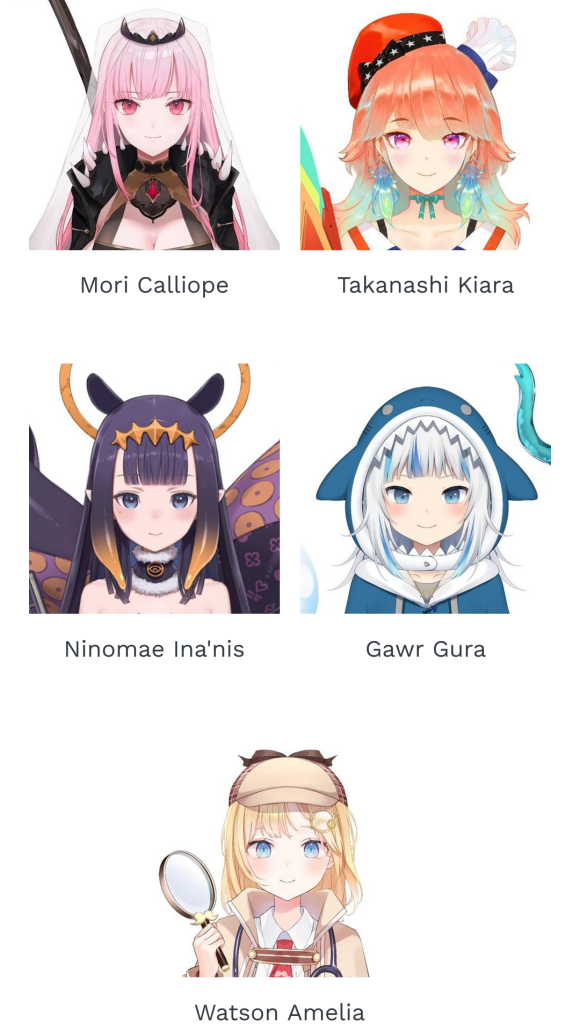
The new Hololive English generation, HoloAdvent, has made their debut after more than two years of waiting. Among the five Virtual Youtubers are actually a pair of twins—the Abyssgard sisters Fuwawa and Mococo, collectively known as FuwaMoco. And while there is a lot to potentially talk about (including the fact that Fuwawa is a Genshiken fan!!!), I want to focus on one thing: The pronunciation of their names.

During their inaugural stream, Fuwawa and Mococo made some requests to viewers about their names. First, their last name isn’t pronounced “a-BYSS-gard” but rather A-byss-gard.” Second, their first names are “FU-wa-wa” and “MO-co-co,” and not fu-WA-wa” and “mo-CO-co.” With those specifics, FuwaMoco has brought overseas Hololive fans back into the realm of “pitch accent,” a prevalent element of the Japanese language.

The Pitch Accent Rabbit Hole

Much has been said about Japanese and pitch accent already. Multiple language-learning Youtubers, such Dougen and Yuta, have dedicated videos to the topic. Use of pitch accent can differentiate meanings of words, but more often, hitting the correct pitches can make your Japanese sound more natural and easier to understand for native speakers. 

In the realm of Hololive, it’s one of the things that makes Inugami Korone’s regional accent so distinct. As heard in the above video, her pitch accents are very different from those of the more standard Japanese spoken by Murasaki Shion.

It’s even to the point that native Japanese speakers can have trouble with Korone. However, because pitch accent is hard to teach from a textbook and not as prominent in English, it can be a challenge for those going from English to Japanese to even pick up on the differences. Even in those Korone videos, there are comments from people saying that they can’t really hear the difference.

Nailing FuwaMoco’s Names

Incorrect pitch accent isn’t necessarily a deal breaker when it comes to learning Japanese, and how much you want to devote to it is a matter of personal priority. Is sounding closer to native speech more important than learning a wider vocabulary or memorizing kanji, for example? But if your goal is to pronounce FuwaMoco’s names correctly, then you can start from there.

Let’s first look at their family name, Abyssgard. While technically it’d be “Abisugaado” in Japanese, for our purposes, we can ignore those particulars (and in fact, FuwaMoco do the same.)

When focusing on the “Abyss” part of it, the incorrect pronunciation is “a-BYSS” and the correct one is A-byss.” When wrong, it sounds more like the English word “amiss,” while the right one is closer to how you’d say “pumice.” 

“Pumice Guard.”

“Abyssgard.”

You can then carry that distinction to their given names, Fuwawa and Mococo, because those follow a similar pattern: FU-wa-wa and MO-co-co.

Going Forward

Keep in mind that the above guide is not a universal rule or anything. If you continue to study Japanese pronunciation, you’ll definitely find plenty of words that don’t follow those specific pitch accents. Also, regardless of whether you can say their names perfectly without effort or you find it to be a struggle, it doesn’t make you less of a fan.

And in the meantime, let’s enjoy their singing.

Hololive EN and Multilingual Fluency Among Virtual Youtubers

Virtual Youtubers continue to be a tour de force, reaching beyond Japan to worldwide recognition. Given this success, as well as the crossover appeal of certain English-fluent VTubers (such as Fujima Sakura, Pikamee, and Kiryu Coco), it was only a matter of time before one of the big VTubers agencies would try to make an active effort to court an English-speaking audience. Thus is born Hololive EN, and with it five new streamers.

The tricky thing with something like Hololive English is striking the right balance in terms of audience desire and accessibility. Speaking in the target demographic’s native tongue does wonders for directly engaging with viewers, and offers an experience closer to what the Japanese viewers typically enjoy. Rather than Inugami Korone’s amusing struggles with English, little gets lost in translation. However, it’s also possible that part of the appeal is the existence of a culture gap—that there’s an element of exoticism found in both the language barrier and the moe idol aesthetic. Veering too far in one direction might alienate certain fans.

The route that Hololive English appears to have taken is to feature VTubers with decent degrees of spoken Japanese fluency—enough to interact with the Japanese fans as well. Their true identities remain unknown (as is standard), so it’s unclear if they’re natively multilingual or if they achieved it through study, but the result either way is that there isn’t a complete disconnect with the Japanese origins of Hololive. The style of English seems to differ from one to the next, whether it’s the cutesy affectations of Gawr Gura or the more natural-sounding speech of Mori Calliope. I think this probably a good way to hedge their bets in terms of figuring out what will garner the most fans, though I don’t know how intentional that is.

While all of them are able to speak Japanese fairly well, written fluency varies significantly between the Hololive English members (unless it’s somehow all an act). Case in point, Takanashi Kiara’s language skills are very strong to the extent that she self-translates, Ninomae Ina’nis appears to have a solid handle, and Amelia Watson can struggle with the basics. Kiara’s advantage is obvious, but I think the ones who are less fluent actually have a certain appeal themselves. Not only do they resonate with those of us who grew up speaking our parents’ languages but never became properly literate, but they’re also relatable to those currently learning Japanese or who want to learn Japanese—no doubt a common occurrence among Virtual Youtuber fans. 

For now, I don’t really have a favorite, but I wish all of them the best of luck. If they find success, I wonder if other Vtuber groups will push harder to have an active international presence.

This post is sponsored by Ogiue Maniax patron Johnny Trovato. You can request topics through the Patreon or by tipping $30 via ko-fi.

Hip Hop Manga: “Change!” and “Wondance”

Whether by chance or perhaps some broad editorial intent, it’s a curious thing that hip hop culture would be a prominent theme in two currently serialized Kodansha manga in Japan. Change!, running in Monthly Shounen Magazine, is the story of a Japanese poetry-loving girl named Shiori who ends up being drawn into the world of rap battling. Wondance, from Monthly Afternoon, focuses on an athletic boy with a stutter who discovers hip hop dance as a way to express himself. Each series, almost by necessity, takes a very different approach to their respective subjects, and juxtaposing the two highlights the power each work possesses.

Change! naturally places great emphasis on verbal dexterity as a series about Japanese rapping, and there are certain aspects to the language that make it differ from English rapping. Japanese has fewer vowel sounds, which means that many more things in the language can technically rhyme, which in turn means that the rhymes that do occur can be even more varied yet precise aurally. The heavy emphasis on syllables also gives Japanese a certain sense of rhythm, especially because extending those sounds can change the meaning of a word entirely.

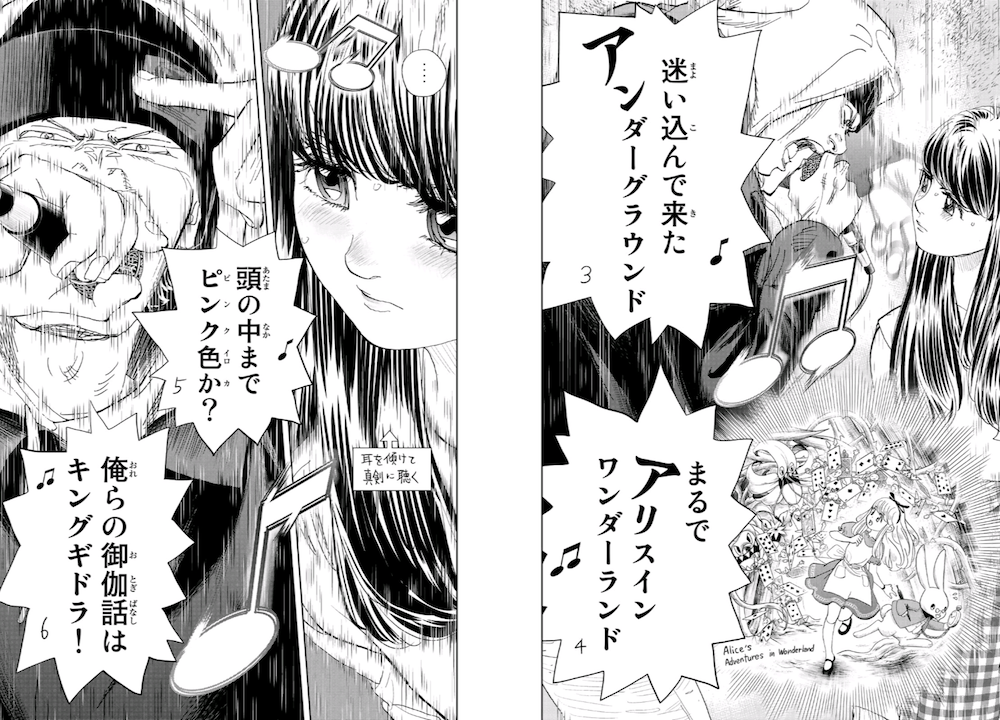
All of this needs to be effectively conveyed in the manga, and the approach Change! takes is to place more emphasis on word balloons than most manga. Words and syllables can appear larger or more erratic in order to highlight what key words in one line are being correlated with in the next line. The classic staple of many manga, furigana to aid in the reading of difficult kanji, take on added importance due to both the sheer number of homonyms that exist in Japanese and to make sure the reader keeps track of what’s being said syllable by syllable.

In the images above, the male rapper connects the word “underground” with “Alice in Wonderland,” working off the fact that andaaguraundo and Arisu in Wandaaraando both start with an “a” and have the similar raundo vs. rando. He then follows up on the next page with Atama no naka made pinku iroka? / Orera no otogibanashi wa Kingu Gidora!, or, “Is even the inside of your head the color pink? / Our fairytale is King Ghidorah!” Pinku iroka lines up perfectly vowel-wise with Kingu Gidora, and the talk of fairy tales follows up to his comparison of Shiori as being as out of her depth as Alice is in her story. While the passionate expressions and the metaphorical imagery shown contribute to the atmosphere and to hammer home the meanings behind the words, the actual word balloons do a great deal of heavy lifting.

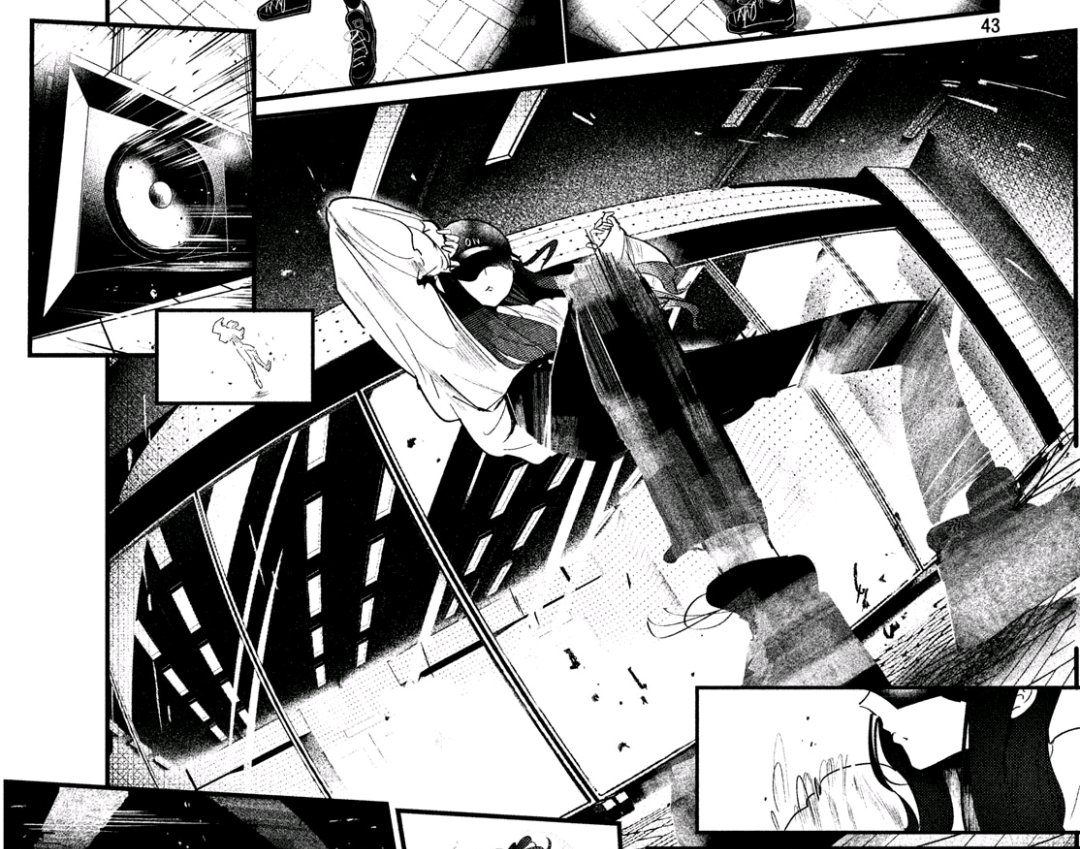
In contrast, although Wondance can be fairly wordy at times, when it comes to dancing, the manga is very much in the “show, don’t tell” category. Characters move with grace and intensity, and panels highlighting their steps litter the pages, turning them into virtual collages that practically crackle with energy. Text is sparse, and primarily brief glimpses into how the characters are thinking in the heat of the moment.

In the pages above, the main character and Hikaru—the girl who brings him into the world of dancing—are dancing together in a class. The paneling supports the character artwork, emphasizing a sense of the two as a duo in sync with each other on some deeper level. This visual approach calls to mind the elaborate paneling of 1970s shoujo manga such as Swan, where panels cascade and climax in beautiful ways. The drawings capture not just the dance but the emotions of the dancers as well, making their moves the central vehicle for storytelling. In a sense, one doesn’t even need to know Japanese (or have a translation handy) to get the essence of Wondance.

Thus, on the one hand, you have a series where the words are of the utmost importance and another where images hold the power. However, they both draw upon the visual language of comics and especially manga in fundamental ways through their particular emphases. Change! and Wondance capture some of the magic of hip hop culture itself as a multi-medium, multi-angle fusion of various ingredients.

What Does Marie Kondo’s “Spark Joy” REALLY Mean?

Japanese tidying and organizing guru Marie Kondo (aka Konmari) has a new Netflix show out where she helps people around the United States unclutter their spaces and, potentially, their lives. Predictably, the series has generated mixed opinions, as those who love having “stuff” are resistant to the notion that throwing things out could lead to happiness. One particular point of contention comes from Konmari’s core idea that we should only keep things that “spark joy.” This has been especially controversial among book lovers, as the notion that one should only keep books that “spark joy” is viewed as antithetical to the purpose of books.

https://twitter.com/AnakanaSchofiel/status/1081089683159838720

This actually isn’t the first time this backlash has occurred. Back when Kondo’s book first came out in English, it was received with similar skepticism.

However, is sparking joy—that is to say, “create a feeling of comfort and placidity—really what Konmari is trying to say? What I’ve found is that the phrase “spark joy” is a somewhat narrow translation of the original Japanese. Instead, in the original language, Konmari uses the terms tokimeki and tokimeku (the meanings of which I’ll explain below), and knowing this can potentially change how one views her Konmari Method.

(Note that this is not meant to be a scathing criticism of the book’s English translation so much as it is a lesson in the difficulties of translation and localization that are inherent to the whole process).

Tokimeki in Japanese means “throbbing” or “palpitation,” but is probably better translated as “heart-pounding excitement.” If you follow Japanese anime, manga, and video games, you might see the term pop up quite often: Tokimeki Memorial, Tokimeki Tonight, etc. Tokimeku is a verb form of this—”to induce heart-pounding excitement.” While that overlaps somewhat with “sparking joy,” the two can carry very different meanings, and tokimeki doesn’t necessarily hinge on a sense of bliss or unabashed happiness that the word “joy” can imply. Things, including books, can disturb and perturb and still create excitement.

In fact, the Japanese title of her first book (The Life-Changing Magic of Tidying Up in English) translates literally to Life’s Heart-Pounding Cleaning Magic. In other words, tokimeki is a part of the title itself.

Personally speaking, I can’t go all in on the Konmari Method, as I love collecting things, on top of also believing in having a strong library for both reference purposes and personal satisfaction. However, when it comes to books in particular, I’ve recently thought over how I view books and their importance. The purpose of a book is to be read, and whenever I finish a book, I find myself wondering, “Is this book better off on my shelf within arm’s reach, or being out there in the world for someone else to find?” There’s never a consistent answer, but I find it’s an important question to ask myself. Those who think letting go of their books is an inherent problem might consider how books that don’t excite them might find a home with someone else.

Little Witch Academia Translation Trickery

Little Witch Academia has been out on Netflix since last year, and it’s a wonderful show worth everyone’s time. Having watched it with English subtitles, I’ve noticed a few hiccups here and there when it comes to the translation. These are not deal breakers, but it does speak to how translation is more art than science, and it’s worth looking into the fact that translating for anime and manga comes with its own share of unique pitfalls.

One unusual aspect of the translation that even non-Japanese speakers might notice is a tendency to avoid repetition despite it being present in the original Japanese. For example, a character might say, “Witches.” Then another character would ask “Witches?,” in response. In the subtitles, the first character would still say “Witches,” but the second might respond, “What are you talking about?”

This has partly to do with the fact that using the same word over and over again is not necessarily considered bad writing in Japanese, but in English (which is famous for its sheer amount of synonyms), this can make dialogue sound extremely awkward and unnatural. Changing up the vocabulary for English not in itself a bad idea, but it can run the risk of introducing ideas or words into a character’s speech that might not reflect who they are or what they would say. It creates room for inaccuracy even as it ends up sounding a little more natural, and it’s a tricky balance to maintain.

What’s worse is that sometimes the desire to make the English sound good can backfire. Anime and manga come out on a pretty constant schedule, with little lead time between chapters and episodes. Japanese as a language thrives on context to shape meaning, and terms or phrases are often left intentionally ambiguous, becoming clearer as the series goes on. Sometimes a phrase can be so awkwardly ambiguous when translated directly that a translator might feel compelled to massage it, only for it to bite them in the ass down the line. For example, a character whose gender is unknown can get away with never being referred to by gender in Japanese pretty naturally, but someone who doesn’t know this is an important plot point might assign a gender because gender-neutral pronouns in English are not entrenched into the language.

In Little Witch Academia, to a certain extent, one of the series is a quote from the character Shiny Chariot, which translates literally as “A believing heart is your magic.” It sometimes appears in the show itself, in English, so a simple solution would have been to use that directly, but it does sound a bit clumsy. The translator decided to go with “Believing in yourself is your magic.” Initially, this makes sense, as what exactly the heart believes in is unclear, and the heroine Akko uses it as a refrain to keep soldiering on. However, by the end of the series, this turns out to be somewhat inaccurate; it’s not necessarily that Akko believes in herself, but that she is able to believe in what’s possible.

Given that Little Witch Academia was released all at once on Netflix, there was the potential to go back and fix this, but I don’t blame the translator for not doing so. I don’t know what the schedule or system is like for subtitling on Netflix. It’s just a strong case of why translating is a tricky beast.

Half-Truths as Roadblocks in Language Improvement

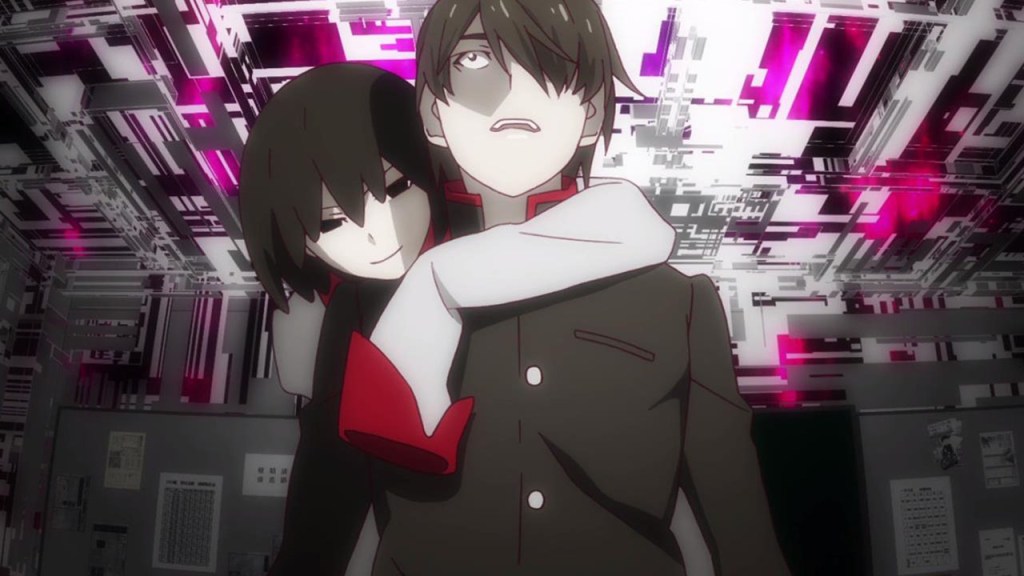
On occasion, I’ve noticed fans of Japanese pop culture to take statements at face value when they shouldn’t. This is not to single out anime fans over any other groups, but in threads online discussing the ambiguous gender of Monogatari character Oshino Ougi, it’s often pointed out that Ougi has said, “I’ve always been a boy,” even though Ougi is portrayed as highly deceptive and loves to twist words. While there might be a number of reasons that mistakes like this happen, from simple misreadings to not understanding characters to even possibly mental conditions such as autism, what I think is a significant factor is also how experiencing something in another language can make it difficult to assess lies.

When learning a language, or taking in information in a way that requires extra attention, I’m considering the idea that the more advanced you are, the more you are able to correctly understand nuances in context and presentation. Take for instance the idea that sarcasm in English is something conveyed through voice. However, if one does not understand the cues by which sarcasm is supposed to be voiced, or it’s a statement that’s written rather than spoken, the desire to convey sarcasm can get lost. Thus, it’s not surprising that Oshino Ougi’s manipulative language and behavior might not come through either, especially because people were already discussing the character prior to Ougi’s appearance in the anime, and had only either Japanese light novels or unreliable fan translations of said novels to work from.

Perhaps it can be said that learning a language requires a level of truth to be established. When learning basic vocabulary and rules of a language from square one, it probably wouldn’t help to pack your statements full of lies. While simplification can be important (you don’t want to inundate someone with all the exceptions first), setting in stone a stable foundation comes hand in hand with making sure that what someone learns is how to express things. Only once at least a rudimentary base is established should playing around with the language happen, and eventually from there the possibility of creating statements that essentially mean the opposite of what they are, which can only be gleaned from context and prior knowledge. At least, that’s one idea. I do not profess to being an expert at this topic.


To Japan! Ogiue Maniax Status Update for May 2016

This month I will be flying to Japan to do some sightseeing and meet with some old friends! I actually haven’t been to Japan in 11 years, so I’m curious as to how it’s changed. It’s also an opportunity to see how my Japanese has improved (or degraded) in the time since I’ve been gone!

I have posts planned for the weeks that I’m gone, so you’ll still be able to enjoy my posts in the meantime.

As for this month’s special Patreon sponsors:

General:

Johnny Trovato

Ko Ransom

Alex

Diogo Prado

Sasahara Keiko fans:

Kristopher Hostead

Yoshitake Rika fans:

Elliot Page

Hato Kenjirou fans:

Elizabeth

Yajima Mirei fans:

Machi-Kurada

Following up on last month’s poll about reviewing the new manga series Kimi xxxru Koto Nakare (or Kimi nakare for short), I decided to go with the good ol’ fashioned blog format. It’s where my strengths lie, and while I’m open to challenging myself by making YouTube videos and such, I’m just the kind of person who best expresses himself in writing. You can read the first chapter review here, but if you can either read Japanese or at least want to follow along visually the manga is actually free.

That being said, I’ve considered making videos just to help me practice and get better at speaking, which is more of a holistic quality of life change than anything else. I made a couple a while back but I just haven’t kept up. Though, I did just recently appear on the Veef Show podcast to talk about Gundam: Iron-Blooded Orphans.

This month’s Genshiken review is the first after the conclusion of the Madarame Harem story, and it’s basically a prelude to a new school year. I loved this chapter because of all of the fantastic Ogiue presence in there, but I might be a tad biased.

Other articles that I think readers should check out are my look at the volleyball manga Shoujo Fight and its stylistic similarities to what is sometimes call “OEL manga,” as well as a sponsored post discussing the Popularity of Plushies among anime fans. Actually, Shoujo Fight reminds me that I never finished The V Sign, which is a classic volleyball title, and I really should get back to it.

I’ve also begun participating in a site called senpai.co as a reviewer. While Ogiue Maniax is my main focus, and Apartment 507 is my opportunity to try and reach a different audience, senpai.co is a convenient place to give some quick thoughts about recent anime that has a greater sense of permanence than Twitter.

Last topics for this month:

  1. I’ve been considering changing my blog design to something that doesn’t look quite so outdated. What do you think?
  2. I want to revive Gattai Girls. Is there any series people really want to see discussed?


When the Nakama Are Feeling FRUSTRATION: Translation and Use of Foreign Words

One of the big bugaboos of Japanese to English translation has been the use of untranslated words. Whether it’s senpai (“upperclassman”) nakama (“comrade”), or the utterly fictitious zankantou (“colossal blade”) the question of whether words should be left as is or fully adapted to English rages in arguments between fans, translators, and everything in between. Of course, there are no solid rules, and determining where in this spectrum your translation should fall is very much a case-by-case basis. However, what intrigues me about this debate is that, when you look at the Japanese language and how it’s used in anime, advertisements, and more, there is a very intentional sprinkling of foreign words with the clear idea that they are used for their exoticism.

The show that actually got me to think about it was, of all things, Show By Rock!! Here are the first lines of the opening:

Ren’ai inochi VERY VERY HAPPY!
Yuujou inochi hajikeru JUMPING!
Bouken inochi dokidoki OK?
Seishun ouka COM’ON READY? LET’S GO!

I’m leaving it untranslated just to show the clear use of English vs. Japanese. They didn’t have to use English words but they did. Similarly, let’s look at the popular One Punch Man opening:

ONE PUNCH!
(THREE! TWO! ONE! KILL SHOT)
Sanjou!   Hisshou!   Shijou saikyou
Nan dattenda?   FRUSTRATION   Ore wa tomaranai

One concession is that a lot of these words are very simple, like “HAPPY” and “JUMPING.” They’re not terribly complex and don’t carry a great deal of cultural baggage like senpai (though one might argue that ren’ai (romantic love) being originally a concept introduced from Europe to Japan falls into that range). However, I think where the actual big cultural difference comes from is that Japan has been open to receiving a lot of foreign words and maintaining them as emphatically foreign, as opposed to fully integrating them into the language. So while English has its fair share of Japanese loan words, from sushi to karaoke, they don’t maintain as much of their exoticism. It’s just a very different environment for sentences and words themselves.

What’s funny is that English wasn’t always this way, especially when it was not the lingua franca of the world. Prior to World War II, French was the most dominant language in diplomacy, and (correct me if I’m wrong!) throwing in French words with the expectation that only a few would understand it was not uncommon among the educated. Of course, this is different from the use of “HAPPY” and “JUMPING,” but I do think that the English language’s ubiquity leads to the sense in us users that it doesn’t have to bend to the will of others.

Translating to English often assumes that English is important. That sounds like a no-brainer, but what I mean specifically is that English speakers value their own native language so highly that it comes across to some extent as a rejection of foreign influence. France today for example is known for trying to keep foreign words out of its language, preferring to take existing French words and modify/combine them accordingly to eschew the need for new loan words.

I’m not saying translators who do not use senpai or whatever are imperialists anymore than I think that using nakama means someone is fetishizing Asian culture. Moreover, the exotic aspects of English usage in Japan come with their own sets of considerations and concerns. Rather, the seeming need for everything to be transformed into English might say something about how we as English speakers look at ourselves, and that this differs depending on how we individually approach that self-reflection.

JoJo’s Bizarre Adventure, Gone with the Wind, and Translation

1367560000

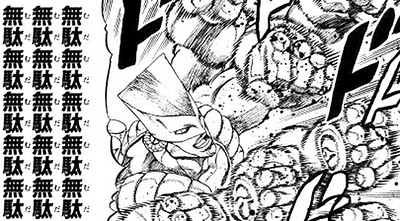
A few months ago on Twitter, a number of manga translators and readers threw their hats into the ring to discuss the persistent issue of “authenticity” vs. “localization.” The central point of argument was whether the fact that the English translation of the JoJo’s Bizarre Adventure manga kept antagonist Dio Brando’s signature catch phrase untranslated (MUDA MUDA MUDA MUDA / USELESS USELESS USELESS USELESS) is a sign of faithfulness, Japanophilia, or something else entirely.

There’s no real right side to all of this. As the Reverse Thieves explained well, there are many facets to consider, and translation is more an art than a science. For example, people who argue that translations should be as localized as possible so as to remove the sense that it comes from another language would assume that the primary audience is a broad, general readership. What if it isn’t, however? Academic translations for instance tend to be filled with footnotes and marks and other things because you’re supposed to be fully explaining the nuance of meaning through translation.

What’s even more fascinating, however, is seeing the problem of translation from the English to Japanese side, and the challenge that is posed to English translators in Japan. For example, let’s look at one of the on-going controversies within this greater Japanese to English translation debate: whether or not to include Japanese honorifics in English translations. After all, while “-san” might be already known to fans of Teenage Mutant Ninja Turtles and other similar works, for the most part it’s the realm of the manga fan, so to speak. When the decision is made to remove them, a translation either has to compensate for the loss of immediate information pertaining to how two characters relate to each other through a more liberal translation, or ignore that aspect entirely.

What about English to Japanese? From that perspective, the problem is completely flipped around. Suddenly you go from a language with no honorifics to one where they’re a part of everyday life. Let’s take a movie like Gone with the Wind. How would you translate Rhett Butler’s speech? The official translation has him use “Ore,” possibly to show that he’s both masculine and skirts standards of politeness and pomp. Is that the right decision?

If you were in charge of translating Gone with the Wind to Japanese, what honorifics would Rhett have to use when talking to other characters, if any? Would they change over the course of the movie? The change or removal of honorific usage to determine the progression of a relationship between two characters is a classic trope of manga and anime, and something English translators have to be constantly wary of (as is switching from last name to first name), but here with Gone with the Wind it’s potentially something that the translator has to build into the story where it once did not exist. The decision could be made to ignore honorifics specifically, but then a lot still has to be done to adapt characteristics and speech patterns to particular personalities. Rather than having to subtract, the English to Japanese translator has to consider additional components if they want to go for a “natural”-sounding language. Or do you just get rid of them all because it takes place in the US, or to show again that Rhett doesn’t have much use for politeness?

Of course, that’s not to say that Japanese to English translators also don’t have to create what ostensibly isn’t there to get the meaning of a line across. In both cases, there are things to be gained and lost in the decision to interpret lines in certain specific ways.

There are even multiple different translations of Gone with the Wind, each of them taking different liberties. Rhett’s famous “Frankly my dear, I don’t give a damn,” has been variously translated as 「俺には関係ない」(Ore ni wa kankei nai, “This has no relation to me”) and 「俺の知った事か」(Ore no shitta koto ka, “I have nothing to do with that”). Notably, both do not bother to preserve the cultural meaning of “damn,” nor the “Frankly my dear” part. The frankness is in the lack of formality and the general implied rudeness of the sentence construction.

Suffice it to say, translation isn’t easy, and the decision to keep or remove cultural elements is a unique challenge that perhaps few other fields have to contend with. Whether you’re a translator or just a reader, it might be helpful to express how you feel about the work that goes into translating.

If you liked this post, consider becoming a sponsor of Ogiue Maniax through Patreon. You can get rewards for higher pledges, including a chance to request topics for the blog.