
Otakon 2009 was punctuated by a number of personal differences and changes in my life, not least of which were a new method of travel, as well as a variety of new travel buddies. It was also my first year at Otakon as a member of the Press (thanks to the existence of this blog), and while I can’t say that it was as rockin’ as last year’s Otakon, I can tell you that it was a fine experience where I never felt like there was too little to do.
My trip began Thursday afternoon, where while on the bus to Baltimore and then on the city bus to Downtown Baltimore we argued about moe in all of its forms, seeking to wrestle the elusive beast to the ground with mixed results. Baltimore that day was a breezy 93 degrees Fahrenheit, the kind of weather perfect for strolling through the city carrying luggage. Dropping off our belongings at the hotel, we went off to dinner at the Cheesecake Factory and met up with esteemed guests such as Patz, Ed Sizemore, and Clarissa from Anime World Order. A variety of fine topics were discussed, such as the joys of showing little kids the Real Power Rangers and the deliciousness of beef (conclusion: it is very delicious).
Upon returning to the convention center to get our badges, we realized that there was a line still snaked around the building that normally would not be based on past experience. I luckily had my badge waiting for me at Press Ops, but many were not so lucky. It was yet another sign that this year’s Otakon was Different. The lines would continue throughout the weekend.

The Pre-Registration Line for Otakon 2009
I also had dinner with people on Friday and to a lesser extent on Saturday, meeting the rest of the AWO crew, Erin from Ninja Consultant and others who I can’t quite remember because the table was quite long. If you’re willing to sit down and relax, the downtown Baltimore area is good for food, and if you’re able to travel further out there are also some excellent restaurants. If you want fast food, that’s also available, and if you want to save money on food I recommend Grape Nuts and Parmalat. Grape Nuts is a dense cereal in a small box and is very filling and nourishing. It has the Ogiue Maniax seal of approval.
Food aside, there were so many events each day that they’ve started to blur in my head, and instead of discussing what happened chronologically I’m going to talk about things more categorically.
Industry and Otakon-related panels I attended were the Funimation panel and the Opening Ceremony panel. Funimation, as you might know already, announced some big-deal shows, namely Casshern Sins (which I reviewed here), Eden of the East (one of the best shows of last season), and the “Dragon Box” master edition remastering of Dragon Ball Z just like the one the Japanese have.
The opening ceremony also marked the second year that Madhouse animated a special opening for Otakon, akin to the Daicon IV opening of legend. This year’s animation incorporated the entire Otakon staff and had numerous references both eastern and western. If you wanted to see the Enterprise duke it out with the Yamato, this was your chance. Unfortunately, we were given the news that the director of the Otakon 2009 Opening Animation, Endou Takuji, had died the week prior, and our condolences go out to a man who reached out to American fandom so readily. Endou was also the director of Record of Lodoss War, a show which many fans in America consider vital to their beginnings as otaku.
As you might guess from the title of this post, guests this year were remarkably good in their decision to not constantly dodge questions and defer to others, though it still happened occasionally when it had to.
Yamamoto Yutaka, aka Yamakan, dropped down answers to questions which clearly showed him putting in some genuine thought and not just defaulting to stock answers. One person asked him how he got to be a director, and his response was that he wanted to be an animator but then couldn’t draw so he had to pick something else that would let him work in anime without drawing talent. To follow up, I asked what he thought of Takahata Isao, director of Grave of the Fireflies, because Takahata is also a director who cannot draw. Yamamoto answered that Takahata is one of the two directors who inspired him to get into anime, and that he considers the Anne of Green Gables anime directed by Takahata to be pretty much THE finest example of an anime TV series and how to tell a story in that format. Sadly, he would not reveal the second despite prompting.
I also asked him about Tonari no 801-chan’s anime debut, and he said that the original author asked him personally to do it, and that he felt destined to do it. Other highlights from Yamakan include his belief that what’s most important in animation is having characters stay “in-character” (and anyone who’s seen Tsugumi in Kannagi can attest to him putting his money where his mouth is), his desire for fellow anime creators to be capable of being creative with each other so that they may grow and improve, and his belief that today’s anime creators lack strong enough personalities akin to Miyazaki, Tomino, and Anno. As you can tell, he was not a “normal” Japanese guest and I am grateful for that.
Oh, and as for his definition of moe: If you like it, it’s moe for you.

Frederik L. Schodt
Frederik L. Schodt (apparently pronounced “Shot”) meanwhile revealed very good knowledge of the scanlation scene and an understanding of its appeal, as well as being good at handling the audience at his Astro Boy panel. At his Q&A panel, I asked him about instances where either American culture values in Japanese comics made them unapproachable by an American audience and vice versa. For the manga example, he pointed out how works are still censored to an extent, and that some companies are forced to claim the girls in their media are 18+ when they clearly are not given the context of the story, and that most of the genres of manga in Japan never come to the US, such as mahjong manga. His answer for American comics that were deemed not appropriate for a Japanese audience was even more interesting.
Schodt had accompanied the great Wil Eisner of all people to Japan, as Eisner was interested in publishing his works there and and there was a Japanese publishing company which published non-Japanese artists. However, when shown the work of Eisner, the company said that he had to rework it to flow more like a Japanese comic and have it read right to left. Eisner, who was over 80 years old at the time, naturally did not want to entirely redo one of his comics which had sold successfully internationally for decades and so the deal was off. He also talked about how much he likes The Four Immigrants Manga by Japanese immigrant Henry Yoshitaka Kiyama, a comic from California in 1927 which is written in a sort of simultaneous Japanese and English (thus requiring knowledge of both to read properly), and is arguably the first existence of a comic book in America, as well as predating Tezuka’s debut by a number of years. After the panel, I got Schodt to autograph my copy of Dreamland Japan.
While I did not manage to score any one-on-one interviews, I did attend some very informative press conferences. There was a sudden press conference with Maruyama Masao (head of Madhouse), Ishiguro Noboru (director of Macross and Legend of the Galactic Heroes), Kikukawa Yukio (producer of Legend of the Galactic Heroes), and Matsubara Hidenori (character designer for the Ah! My Goddess anime), which started off with Ishiguro and Maruyama deciding to just sit in the audience and act like they were members of the press. At this point we had some fun interviewing the translator in the room, asking him throwaway questions such as, “Who are your translating influences?” and “What made you decide to become a translator?” When the press conference actually began, as it were, it turned out to be one of the most informative hours of my life. This press conference will most likely appear online in its entirety at some point so you don’t have to worry on that front, but there are a few highlights I’d like to mention.
 From left to right: Kikukawa, Maruyama, translator, Ishiguro, Matsubara
One interesting set of answers was everyone’s response to the anime they would love to make if they could. Matsubara said he would love to adapt the Tezuka manga Dororo into an anime, and even has the support of Maruyama. Maruyama meanwhile said that there were so many he’d like to have made and that’s why he makes them. Ishiguro wants to make a story set in Tokyo in 1948 that he’s been wanting to make for 30 years and even has the entire story plotted in his head. Kikukawa’s dream anime is to adapt the Darkover series of science fiction novels by Marion Zimmer Bradley.
Another interesting answer was one to my own question, where I asked Ishiguro to talk about his experiences with the deceased Nagahama Tadao, creator of Combattler V, Voltes V, and Daimos, as well as one of the directors of Rose of Versailles. Nagahama, as it turns out, was actually in puppet theater of all things before he became an anime director. Also, when working as a director he would act out every part, male and female, in the script to give a better idea to his staff as to how the story should go. Finally, because he had no talent for drawing, whenever he wanted to make corrections to a key animation (and he inspected every single one), he would write a detailed description on the back as to what needed changing. Nagahama is not terribly popular in the US even among old school fans so this was an amazing bit of information to find out. I personally cannot wait to ask Tomino this question at New York Anime Festival.
While the other press conference I attended with MELL was not nearly as informative, what I found was that MELL opened up to us much more than I would expect from a musical guest. We found out that, despite the heavy use of English in her songs she was never good at it in school, she had her first band at around the age of 15 or 16 where she sang for a college band, and that she mistook a guy for a girl due to his elaborate cosplay of a Victorian era character.
MELL was also one of the concerts I attended at Otakon, the other being the Tamura Naomi concert, and both were beyond my expectations. I am no music expert and my music vocabulary is entirely lacking, but I will say that MELL and her band knew very much how to perform and keep the audience in the mood. She sang songs from Black Lagoon and Rideback, and showed off why she’s well regarded among fans.
Sunday’s concert with Tamura Naomi showed how incredibly powerful her voice can be, as she demonstrated that the notes she hits in those opening themes she sings are notes she can hit in a live performance. Highlights of the concert include her own rendition of the Jackson 5’s I’ll Be There, and her Rayearth songs, namely Yuzurenai Negai (1st series opening), with which she ended her concert.
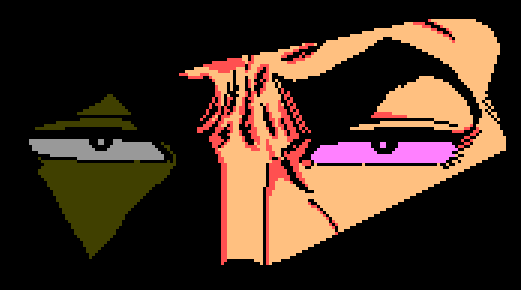
I also held my own concert on Sunday where I sang the theme song to the Golgo 13 NES games. In case you didn’t know, the song actually has lyrics!
My dealer’s room experience was also a most pleasant one as I managed to get everything I was looking for, specifically Ogiue-related…merchandise… as well as the recently released Revoltech Souther from Hokuto no Ken, or, as he’s known on the box, “Thouzer.”
On the fandom side of things, while I did not pay much attention to cosplay I was glad to see a good variety of costumes. While you had your endless Sora from Kingdom Hearts and the general love for Naruto and Bleach you usually expect, I also got some pleasant surprises, such as a cosplay of Kitarou and Nekomusume from Gegege no Kitarou.

Something I did not approve of was the near-total lack of Tainaka Ritsu when it came to K-On! cosplay. I like Mio too and all, but the ratio of Mio to Ritsu was unacceptable. I’m just saying.
The fan panels I attended were all well-run and had people who at least to some extent knew what they were talking about. The Neo-Shounen panel run by Daryl Surat succeeded in its goal of showing how Shounen as a concept changed over the years, mainly in its desire to appeal to both male and female readers, and the Lost in Translation panel was a good beginner’s panel for those interested in seeing some of the difficulties of translating from Japanese to English. The Mecha Appreciation Panel had knowledgeable panelists, but the format was a little haphazard and could have used some focus. If you ran this panel, I was the one who said “King J-Der” for coolest Gaogaigar robot.
I also went to the Anime Recruitment panel by the Reverse Thieves, which provided very good advice for how to get people into anime without scaring them off, offering tips such as, “If your first attempt fails, don’t press the issue. Instead, give them time to cool off, like three weeks or however long it takes.” I’ve spoken before on how difficult I find recommending anime to be, so I will take this advice to heart.
I had a personally vested interest in attending the Otaku TV and Genshiken panels, both run by Viga the Otagal, and was curious as to how these panels would go. Overall, they did a good job of showing the audience what these shows are all about, though I think Viga was a little too spoiler-friendly and it could scare off people who would want to see these series otherwise. Still, I was very glad to see such significant attendance for Genshiken-related panels. After the Genshiken panel, someone in the audience actually greeted me as a reader of Ogiue Maniax and asked to take my picture. Whoever you are, that made my day and I thank you.
Viga said in her Genshiken panel that she believes “The Psychology of Ogiue” would provide enough material for an entire panel, and I am inclined to agree. Keep on the lookout for that.
Overall, I have no serious complaints about Otakon this year, as I feel that the events I would have complained about I simply did not attend, such as the apparently misleading title of the “Sailor Moon’s Influence on Hentai” panel. The fact that Daryl Surat’s Anime’s Craziest Deaths got shut down because no one actually knew what Apocalypse Zero was disappointing, but I’m sure both sides will know how to better handle it next year. As a member of the Otakon press, I also would have felt better if I was told in advance that I would not be getting any interviews, rather than being left dangling. However, because this year’s Otakon was so packed with activities and intriguing and intelligent guests, I can say that this was one of my finest convention experiences, and everyone I traveled to Otakon and back with agreed wholeheartedly.


 OGIUE MANIAX