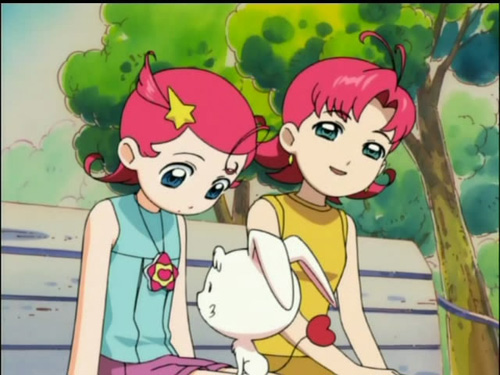
The Ups and Downs of Suite Precure

With Smile Precure set to debut it’s a good time to look at Suite Precure. I’ve seen the series lambasted a fair amount, and while I believe Suite Precure to be a flawed series and perhaps one that in the end couldn’t quite overcome a good deal of its problems, I find that a good deal of these criticisms kind of miss the mark as to what exactly went wrong, conflating one mistake for another kind. Thus, I intend to give a fairly thorough assessment of the series, especially in terms of characterization and character development.

I will not just be comparing it to Heartcatch Precure! (which is unfair for most shows in the first place), nor will I be trying to ask Suite to be any more than the children’s show that it was meant to be.

Also, this post is FULL OF SPOILERS.

When the previews for Suite Precure started coming out, they advertised the series as being about a couple of girls who have to fight together but have trouble getting along due to being total opposites. While the franchise has always dealt in contrasting personalities, it was never quite to this degree, and the premise stood out to me. And so begins the first episode, where we’re introduced to Hibiki the energetic athlete and Kanade the organized and studious baker, former friends who have since grown apart. Inevitably, they gain the ability to transform into the legendary warriors known as Precure (Hibiki as “Cure Melody” and Kanade as “Cure Rhythm”),  help the good guys (Major Land) defeat the bad guys (Minor Land), and begin to mend their friendship, though not without some trouble.

Hibiki and Kanade’s personalities start the series with a fairly interesting dynamic, and at first it’s fun to see their little clashes here and there. Once the show decides that they’ve become good enough friends, however, the two seem to forget their past tension almost entirely, like it had never happened at all. As the show progresses, the way it irons out the “wrinkles” in relationships once development has occurred turns out to be a major recurring flaw in Suite Precure. This problem is most apparent with the villainous cat Seiren, whose turn to the side of good  as “Cure Beat” is a satisfying story arc, but who suddenly turns into an almost entirely different character afterward.

That is not to say that the show is devoid of strong and consistent characterizations. Kanade, for one, seems to hold onto her personality much more tightly. In addition, there is the character of Ako, who is revealed in the second half of the show to be not only the mysterious “Cure Muse” but also the princess of Major Land. While Seiren had the more powerful story arc leading up to her reveal, Ako’s revelations manage to build on her existing character rather than rewriting it, resulting in a character who not only sensibly knows more about fighting the enemy (being the princess of the land from which the Precures derive their power), but also works hard to make up for the age difference (at 10 years old when the average Precure heroine is 14, Ako is the youngest Cure ever). She also acts as a potential wish fulfillment character for the younger girl audience.

A special mention needs to be made for the mascot character Hummy, whose ditzy and optimistic personality sets her apart from other previous magical companions in the franchise, and honestly makes her one of the more entertaining parts of the show (something I probably would’ve never expected). Still, the fact that this more thorough and long-term characterization was unable to extend to all of the characters, especially Hibiki (who is the lead of the series), remains a problem.

The Precure franchise for the most part has never had “overarching narrative” as its strong suit and Suite is certainly no exception, but past titles were able to use memorable characters to make the plot feel more involving even when its story is paper-thin. The biggest side-effect of the way character resolution in Suite Precure induces selective amnesia is that the characters’ personalities sometimes end up either under-developed or insufficiently defined, which then results in less emotional investment in the characters’ struggles. As such, towards the end when Hibiki as Cure Melody begins to act the role of a serene savior who expresses the idea that music is better for comforting sadness than eliminating it outright, it feels like an abrupt development in Hibiki’s character that just can’t be explained sufficiently by what had happened up to that point. It is certainly possible for a sudden display of maturity to make sense*, but that wasn’t quite the case here.

Overall, Suite Precure is a series that is capable of both good characterization and good character development, but can’t seem to bridge the gap between them. When it tries to, it often ends up compromising both. Because of the way it seems to not have a firm grasp on its own characters, the buildup of the series towards its climax feels weaker, and I think it makes for a show that, while okay, could have been much stronger had it simply been able to maintain a better long-term memory.

———————————

*Episode 40 of Ojamajo Doremi # concerns Doremi’s little sister Pop wanting to play the piano, only to find out that the family had sold theirs years ago. During the episode, we find out that their mother was once a concert pianist whose career was ended by an injury, and whose her lingering regrets ended up making Doremi reject the piano when she tried to learn it. Rather than being against Pop playing piano though, the normally wacky Doremi not only gives Pop the chance the opportunity to practice, but also brings a piano back into their household. Doremi’s mature attitude about the whole thing definitely stands out as unusual for someone who is typically more of an airhead, but comes across as “uncharacteristic” rather than “out-of-character.”

Creamy Mami, All Right In the End I Guess

A few months ago when I decided to write my mid-series thoughts on the 80s magical girl anime Mahou no Tenshi Creamy Mami, I expressed some dissatisfaction with the show. With a story centered around a young girl who gains the ability to transform into an older version of herself, and who becomes a beloved pop star as a result, the fault I found in Creamy Mami is that did not do enough to convey its main character Yuu as a normal girl. All of her friends around her age were boys somehow romantically linked to her, and she seemingly never had a normal environment such as as school setting which you could contrast with her adventures.

Shortly after I published that post, I went into the second half of Creamy Mami and lo and behold, the anime now featured her attending classes and talking to female classmates. Seeing as it’s highly unlikely that my thoughts somehow traveled back in time and influenced the production of Creamy Mami, I can only imagine that similar criticisms were brought up at the time, and that at the half-way point they decided to do something about it. At the same time, the show was also clearly successful enough to hit that 6-month mark and continue (and I know there are OVAs and such as well).

While they eventually resolved some of the issues with Creamy Mami, I have to say that it’s the kind of show where even though it gets better, it takes so long to do so that I can hardly expect anyone to stick around, even if it concludes well. Overall, it’s mostly a cute fluff kind of show, which can be nice, but you can also get cute fluff and some more substance from other shows.

Actually, if you want to know the best part about Creamy Mami, it’s probably the second ending theme, Love Sarigenaku. It’s catchy, and kind of a far cry from the rest of the songs in the show, in a good way.

Wonderful, Everything’s Wonderful: Cosmic Baton Girl Comet-san, Revisited

When I originally wrote my Cosmic Baton Girl Comet-san review, I mentioned that I had not finished the show simply because not all of it was available at the time. In the three years since I wrote that review though, I have been able to finish the entirety of the anime (sans subtitles), and so I want to make an update, bring some closure, and tell you if my opinion has changed since then.

Pretty much everything I said in the original review still holds true. The pleasant pace, the way it makes everyday life feel worthy of discovery and appreciation, the charming characters that make you want to smile, it’s still all there from beginning to end. Comet never stops growing, Meteor shows that there’s more to her than just snooty princess-type comedy. The way the characters interact with each other shows off their personalities so well that it’s hard to find many other shows that can manage this subdued sense of wonder.

The second half does indeed bring more plot, but Comet-san never stops being an anime that you can ease yourself into. The ongoing plot points build up slowly but surely, and it has what I find to be an appropriately satisfying ending.

In considering how this show might appeal to otaku who might not necessarily be into mahou shoujo, I might compare this show to slice-of-life, but I think that would perhaps be doing Comet-san a bit of a disservice. I like slice-of-life shows, don’t get me wrong. I eagerly await the new season of Hidamari Sketch and I’m a fan of Minami-ke, but those just cover the joys of everyday life. Comet-san does that, better than those shows, but it also shows the great things and bittersweet feelings that can arise from life slowly changing, until the everyday of today is not the everyday of two months ago.

It’s somewhat of a long series at 43 episodes, but I think it’s worth it. This show is really, really good. Ojamajo Doremi good. Heartcatch Precure! good. If you have the chance, and you want to see a simple but poignant show, check out Cosmic Baton Girl Comet-san.

Suite Precure Transitions

I’ve been keeping up with Suite Precure since it began last February, and while it isn’t quite the masterpiece that Heartcatch Precure! is, it’s still enjoyable enough. We’ve hit roughly the middle point of Suite Precure, and quite a few things have happened along the way, including the reveal of a new Cure or two.

I’m going to discuss some of my feelings on these current episodes (as well as previous Precure series), so if you don’t want to be spoiled, turn away.

Continue reading

Super-Expressive Faces

I’ve been reading the manga Coppelion lately, about three teenage girls who are genetically engineered to be immune to radiation in a post-nuclear apocalyptic Tokyo. One of those girls is Fukasaku Aoi, whose most prominent feature is that she has an incredibly expressive face compared to the other characters around her. It kind of makes her an endearing character even when she complains (which she does often), and I feel like she can really liven up scenes as a result. She shares this trait with Kurumi Erika from Heartcatch Precure!, and as is evident from previous posts, I like Erika quite a bit as well.

I find myself wondering about the candidness of such characters and why they can be so appealing, particularly when they’re grouped with characters who, while not necessarily reticent, still don’t have quite the range of expressions that someone like Aoi or Erika does. In thinking this through, possibly the best explanation I can find is not from manga or anime but from bande dessinée, Franco-Belgian comics. Though all sorts of things have been written about the expressive nature of eyes in manga, I think I might be best served by The Adventures of Tintin.

At the Belgian Comic Strip Center museum in Brussels, there is a Tintin exhibit which features profiles on all of the major characters. Among them is Haddock, a ship captain and friend of Tintin. Like Erika and Aoi, one of his most distinguishing features is his capacity for making wild facial gestures, and a display in the museum talks about the relationship between Captain Haddock and Tintin, who is usually much more calm in his demeanor. I don’t quite remember everything it said, but it mentioned something about how the visual contrast between the two makes for an ideal scenario where both characters complement each other with their respective approaches and make the comic better as a result.

If that’s the case, then taking that idea and applying it to the three-character structure of Coppelion‘s central cast, I have to ask myself what purpose does that middle character serve, the one who is less expressive than the Haddock but more expressive than the Tintin. My initial thoughts towards this is that the middle character, who in the case of Coppelion is its protagonist Naruse Ibara, is that if you think of the three characters as a spectrum to gauge the direness or excitement of a situation, the point at which Ibara starts to get facial reactions close to par with Aoi’s is when you know things are really getting serious. If it gets to the point where the third girl Taeko is freaking out, then it’s doubly so. Proper use of characters with different capacities for strong facial expressions can potentially control the level of excitement in a comic while also distinguishing the characters for variety.

I get the feeling that much of what I said was pretty obvious, but I still wanted to write it all down.

Kitchen Sinking: Pretty Cure All Stars DX 3

Pretty Cure All Stars DX 3: To the Future! The Rainbow-Colored Flower that Connects Worlds celebrates the 10th anniversary film of the series, with eight TV series and a whopping 21 Magical Girls featured. Three franchise-wide crossover films. Three instances of combined attacks. Three opportunities to focus on everyone working together, because as the number of Precure shows increases it becomes increasingly difficult  to actually have any breathing room or down time in these things.

The plot is that of every big crossover movie ever, where the girls have to join forces to defeat a powerful opponent. This time it’s Black Hole-sama, an amalgam of all of the evil energy from all of the defeated final bosses so far. Its minions are villains from the various Precure movies. Aware that being a Precure means having strong teamwork, the villains split the Cures up from their respective partners to limit their effectiveness, while pursuing the “Prism Flower” which connects all of their worlds together, like a cosmic treadmill.

These types of movies simply have no time to develop any real plot, so the main appeal is generally to show all of the characters interacting with each other and appealing to fans of the franchise. I found the splitting up of the various Cures to be an interesting mechanic to accomplish this, and though it’s been done to an extent in the previous films, this time around it’s done thematically. The first group is comprised of the leaders, the second group is comprised of the smart and supportive ones, and the third group is best described as a mishmash of the rest. Very quickly, the leader group finds that while everyone is good at taking charge, they don’t exactly understand each others’ dynamics, while the secondary group thinks before they act but realize they’re accustomed to having someone else act first. The third group is the most balanced, and seem to have the least trouble overall.

That said, even within those similar groups, the character’s individual personalities highlight a number of differences among the similarities. Among the leads, Cure Black is the first to try and come up with a plan, while Cure Blossom is a little more thoughtful. Cure Marine is more headstrong than the other “cool blue” characters, which makes her the catalyst to inspire the others in the second group to not give up. Cure Berry is a little more devious than the other cool Cures. In the third group, Cure Lemonade is the most serendipitous, whereas Cure Moonlight is the most mature. It all works pretty well.

Speaking of Heartcatch, I’ve noticed that in these crossover movies, the heavily stylized character designs have to be toned down to fit in more with the rest of the series, which removes some of their charm but is also necessary in a way. The only time you get to see the “proper” style is when they’re fighting a Heartcatch villain.

A crossover also means big fights, and the movie both delivers and doesn’t. One notable scene involves the various teams doing what would normally be stock footage special attacks, but in fact are newly animated. Rather than doing what’s expected for example, Cure Black and Cure White deliver a Marble Screw while running in unison. On the other hand, with the final combined attack, it just uses the familiar poses and footage, and the attack itself just combines into a rainbow-colored beam. It’s a pretty good looking beam, but given the variety of attacks, it feels kind of lacking because it fails to live up to the potential for a truly epic combination attack. Part of the thrill of seeing a Final Dynamic Special is seeing how all of the finishing blows interact with each other.

One problem in the previous crossover film, Precure All Stars DX 2, was that it didn’t give enough respect to the rookies at the time, which was Heartcatch Precure! Blossom and Marine often looked weak and ineffectual, and it diminished their appearance. This time around the newbies are the girls from Suite Precure, and they feel nice and strong, still the most inexperienced by far but also clearly able to hold their own. They might take it too far though, as some of the more emotional scenes seem odd when they’ve only just begun doing this.

This film also has millions of mascot characters, and that can be a difficult thing to watch for people. The audience-interaction magic wands (the kids in the theater are supposed to wave them to power up the girls) are also back.

Since the first crossover, these films have felt like they’ve been phoning it in a good deal, but it’s overall acceptable. Obvious this movie is for existing fans, and is not really recommended for people unfamiliar with Precure, as it again doesn’t really bother to have a cohesive story and is only really decent for fans who understand the existing character dynamics. A fun watch, but try the first crossover first.

Catching Hearts: A Response to Scamp’s Heartcatch Precure! Review

This post is in response to Scamp, aka The Cart Driver’s review of Heartcatch Precure! It goes way into spoilers, so be warned. If you want to read something significantly less spoiler-heavy, I suggest yesterday’s review.

Continue reading

Wonderful Dreams of True Friendship: Heartcatch Precure!

There’s something special, really special, about Heartcatch Precure!, so much so that I think the best way to properly convey its brilliance is to take the long, scenic route to introducing it. It’s a show whose strengths can be subtle yet obvious, and I want to really give the show its proper due as a noticeably strong piece of fiction which utilizes nearly all of its elements intelligently and artistically without ever losing its sense of fun.

The premise is simple and familiar. A heroic figure, Cure Moonlight, suffers a traumatic defeat, and in desperation sends two young fairies to Earth to find two individuals capable of taking her place. The first girl is Hanasaki Tsubomi, a young girl and recent junior high transfer student who loves flowers. Tired of her meek personality, Tsubomi sees the move as an opportunity to turn her life around. The second girl is Kurumi Erika, an aspiring fashion designer who immediately sees Tsubomi as a friend, but whose eagerness and hyper disposition exasperate and overwhelm Tsubomi. Together, they become Cure Blossom and Cure Marine, fighting against an evil group whose goal is to transform the Earth into a wasteland by feeding off the fears and doubts of humans.

Pretty typical on its surface, Heartcatch Precure! manages to go above and beyond through not just its technical execution but what I would actually describe as “heart.” One of the most prominent aspects of the show for me is the mature and helpful manner in which it discusses a variety of serious topics that not only kids but even adults can grapple with in their daily lives, and this complexity tempered by graceful simplicity extends to all areas of the anime as well. In terms of visual design, the character designs are less stiff when compared to typical Precure designs (or even anime characters in general) without being overly esoteric, and the pastel colors and free-flowing line work breathe a sense of vibrancy into them. This in turn makes both the show’s action and non-action scenes stand out in a manner reminiscent of Casshern SINS (no surprise given that they share the same character designer), trading the dreary, post-apocalyptic world of that anime for one whose messages of hope and growth are more apparent. The narrative is also bolstered by the visual aesthetics, as they are able to support the strong characterization found in the show through their sheer energy, whether they’re laughing or crying or just walking about.

Right from the first episode, the characters are remarkably complex and their interactions dynamic and fun. Of particular note is Erika (pictured left), who I find to be an amazingly well-rounded character who complements Tsubomi well, and whose traits give her not only a lot of fundamental strength but also room to grow. While the Precure franchise has always been about the contrasting personalities of its main characters, Tsubomi and Erika are not so easily divided into opposing categories like “smart” vs. “athletic,” or “loud” vs. “quiet,” though they exhibit such differences to a certain degree. As the show progresses, rather than trying to make up for each others’ weaknesses, the girls learn from each other and deepen their friendship, and it’s a wonderful thing to see play out.

Going beyond the main two, the character Myoudouin Itsuki provides another interesting example. Itsuki, being the successor to her family’s martial arts dojo, crossdresses in order to represent her status as “next in line.” Unlike many other shows, however, Itsuki’s issue isn’t about whether she feels any bitterness towards having to act as a “man,” but whether or not the amount of responsibility and pressure she’s willingly put on herself is making her disregard her own feelings. This more thorough, yet still relatively simple, psychological exploration contributes to the show’s strong sense of characterization.

Perhaps the greatest strength of Heartcatch Precure! can be found in the way it shows that there is life beyond the immediate. Notable in this regard is the establishment of the character “Dark Precure” (the one who defeats Cure Moonlight at the start) as a powerful antagonist who completely outclasses the heroines and who continues to be a legitimate threat every time she appears. This is a rare feeling in previous Precure series, and part of the show’s draw simply has to do with seeing how the girls can manage to overcome this seemingly insurmountable obstacle, an adversary they are actually unsure of how to defeat.

By far the best representation of this broader perspective, however, comes from the fact that Heartcatch Precure! acknowledges the world past junior high. In every other Precure series, none of the main characters are ever older than 15. Once they hit the end of their third year in junior high(9th grade in the US and other countries), the show ends and nothing more is ever seen of them, and even when they appear in the crossover movies, they are always portrayed as still being in junior high. Heartcatch Precure! bucks that trend. Cure Moonlight is 17 years old. Tsubomi’s grandmother, who is in her late 60s, is actually a former Precure herself. These older figures not only guide the younger Cures through their experience, but also learn from the younger girls’ optimism and zest for life, making it less of a one-way street and more of a mutual growth which spans generations.

My fondness for Heartcatch Precure! is quite obvious at this point, but I do think there are areas where it falls short, and I feel that the best way to sum up my criticism is to compare it to Ojamajo Doremi, a similar magical girl show which actually shares much of the same staff. In that light, I find that the biggest flaw in Heartcatch Precure‘s is how “beating up the enemy” is too often the solution to a character’s problems, even in situations where fighting has little to do with the dilemma at hand. Granted, it’s certainly not the only show in the world to do this, but I know Heartcatch could have done better in this regard, especially given Doremi. In contrast, Doremi‘s most glaring problem, the blatant toy-pushing aspect of the show, is handled far more gracefully in Heartcatch Precure! Owing to the strong visual design of the show mentioned before, the transformation sequences and the special attack animations so typical of the magical girl genre almost never feel tiresome because of how lively they are.

Watch Heartcatch Precure! If you’re not that big a fan of magical girls, if you haven’t enjoyed the Precure franchise in the past, I think this is a really good place to start. It exceeded my expectations in almost every way, and it might do the same for yours. Just keep in mind to not expect too much to quickly and enjoy the show at its own pace.

Now I Know What It Feels Like to Be Cardcaptor Sakura

Cardcaptor Sakura is by far one of my favorite anime, and I am quite fond all of its characters, which includes its main heroine, Kinomoto Sakura. Back when I first watched the series though, one thing about her struck me as rather odd. In an early episode, Sakura decides to treat herself with some money she’s saved up. You begin to think, is she going to get a doll, or maybe some kind of dessert or candy? How about a nice dress? But no, Sakura’s gets pancakes. And not even pancakes at a restaurant or something, but pancake mix, and she actually gives away some of her pancakes.

I remember thinking, wow, Sakura, you sure have no idea what it means to indulge yourself.

But recently, I’ve been feeling a bit pressured by impending deadlines, and as I struggle a bit to get my work done, I sometimes think of treating myself. Do I go to a restaurant, maybe get a nice bowl of noodles? Or maybe take a trip out to another city, perhaps even another country? No, instead I say to myself, “I’m going to buy some ground beef!” which as you know is like pancake mix, only made of cows. Sometimes it’s chicken breast.

So there I am, thinking that a delightful reward for myself is food which takes time to prepare and even more time to cook, though thankfully I don’t have an older brother’s friend whom I have a crush on who’d be getting like half of my cheeseburgers.

Sorry, Sakura. I understand you a little better now.

Madoka Magica and…Sacrifice?

Puella Magi Madoka Magica has come and gone, and it’s going to be a subject of much discussion. Part of it may simply be that the delay caused by the earthquake in tsunami Japan magnified the anticipation for the finale even more than the already huge expectations for the show, but I think this anime is going to stick in people’s minds for at least the near future. Though the show has its flaws, overly expository dialogue and some contrived twists to name a couple, I found it to be an overall strong show and indeed an interesting twist on the magical girl genre that understands what magical girls are about.

I’m going to be discussing the show and its ending in depth, so take this as the Spoiler Warning.

Continue reading