E3 is next week, and I’ve been trying to finish Super Robot Wars T so I can devote my full attention to whatever Smash Bros. Ultimate shenanigans Nintendo has waiting for us. I wonder if I can get really into a third ridiculous crossover franchise and go straight over the edge.
Before, I get into Ogiue Maniax highlights from the past month, I’d like to thank my supporters on Patreon and ko-fi.
In this chapter, we see our first school outside of Hashimoto Tech! How will these students react to the eccentricities of the main cast?
Summary
The Chorus Appreciation Society is running into a few walls. This is partly because so many of its members lack experience, partly because of clashes in personality (especially between Orihara and Shinji), and partly because Mimi-sensei herself doesn’t know much about music. Thanks to the reluctant help of music teacher Takano-sensei, however, the Chorus Club gets a chance to do some inter-school practice. They visit Nishigafuchi Private High School, a strong music school with numerous accomplishments in competition and automatic entry into the elite Nankan University. It’s the Hakone Academy of choruses, in Yowamushi Pedal terms, perhaps.
The Nishigafuchi students are surprised at the wildly varying appearances and demeanors of the Hashimoto students. The Hashimoto students split off into their respective vocal sections, but when Akira goes to meet the other bass vocalists, he’s recognized by a student from his middle school days, Kidamoto, who asks what he’s doing there.
Pronunciation 101
There’s an interesting demonstration of some tongue exercises led by Jin. Namely, he shows how while Japanese people are typically taught vowels in the order of “A, I, U, E, O,” the more natural and comfortable order for the mouth would be “I, E, A, O, U.” I rather like how the manga drops bits of knowledge like this, as it both lends an air of authenticity while also making a kind of narrative sense given Jin’s scientific approach to music.
Too Many (?) New Characters
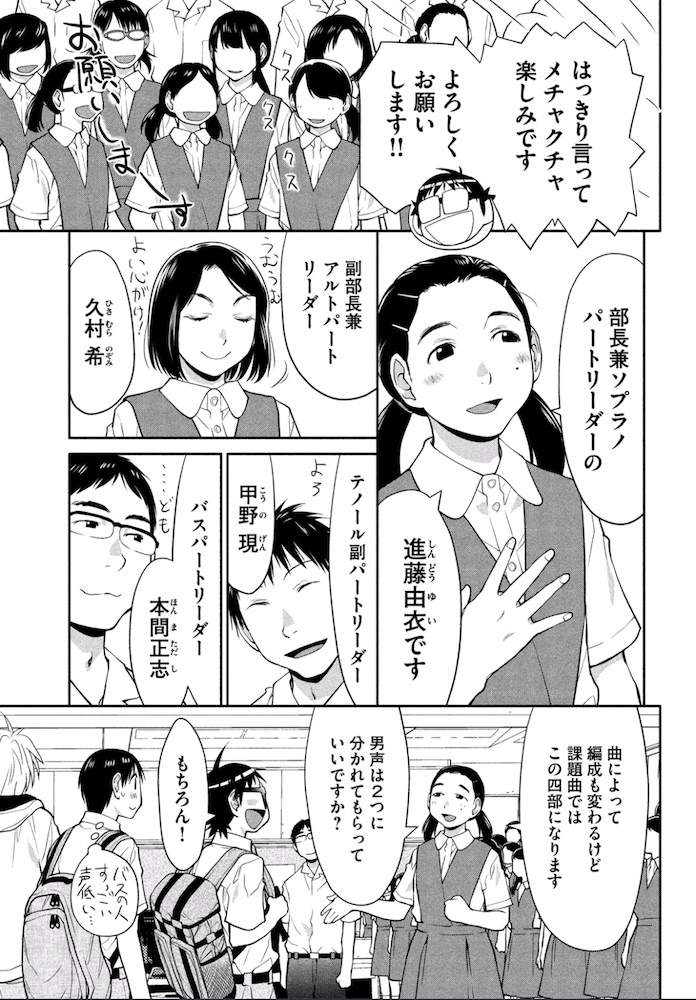
A lot of characters are introduced in this chapter, namely students at Nishigafuchi. Because there are so many, including the leaders of each of their club’s chorus section, I wonder which of them will be important down the line. It’s hard to tell with Hashikko Ensemble, given how we already have some minor characters ascend. I get the feeling that the bass leader, Honma Tadashi, will play a role in helping Akira improve.
As for Takano, she reminds me of the characters from FLCL, and not just in terms of her full lips and pouty face. She has a kind of laid-back slyness that feels like a mix between Haruko and Mamimi.
Kidamoto
Possibly the most important new character is Kidamoto. While he doesn’t stand out at first blush, but I do like how Hashikko Ensemble is utilizing him. At the very beginning of the chapter, his face shows up in one panel (see the top image), but his level of importance is still unknown. Then, when Hashimoto Chorus Club arrives, he reacts to someone’s appearance but it’s not immediately clear who he notices, creating a bit of anticipation in the story. Is it Jin, who’s presumably somewhat infamous in local music circles? Is it Shion, who competed in piano? The fact that it turns out to be Akira is both surprising and intriguing.
So what is the relationship between Akira and Kidamoto? Is it just that Kidamoto knows about how Akira pretended to sing in middle school during class performances? I’m looking forward to getting the answer, as well as seeing how this challenges Akira.
Character Humor Deluxe
There’s a lot of excellent humor this character-based humor in this chapter that I enjoyed immensely. One is Hanyama (the bald student) expressing his sudden urge to join the Chorus Club just from watching Mimi-sensei’s adorable conductor practice. Another involves one of the students at Nishigafuchi wondering if everyone from Hashimoto is going to be delinquents (on account of it being a technical/vocational school), only to have her expectations simultaneously subverted and affirmed by the contrast between Jin and Orihara.
My favorite of all, however, is seeing Shion constantly get distracted in class by Takano-sensei’s piano across the hall. As mentioned by Takano herself, her specialty is the violin, so even as a music teacher she’s not going to be impeccable on the ivory. Seeing Shion jerk her head at every flub Takano makes (summed up entirely in one panel) is such a perfect little character moment for Shion. It not only speaks to her own piano skills, but also hints at the same personality underlying her attitude towards the Chorus Club in the earlier chapters.
Overall, much of Chapter 15 emphasizes what an eclectic hodgepodge of people are at the center of this story. I expect to see Jin upend the Nishigafuchi students’ expectations with his vocal range, as well as other similar surprises.
Songs
The song they’re practicing for competition, “Miagete Goran Yoru no Hoshi o” (Behold the Nighttime Stars) by Kyu Sakamoto, appears again in this chapter. It’s to be expected moving forward.
Another song, one that Shion decides to play on piano (and thus not helping with practice) is Friedrich Bürgmuller’s 25 Études faciles et progressives, Op.100 (25 studies for piano) L’Arabesque. It’s part of a series of pieces designed to help young pianists improve their skills.
Final Thoughts
I often wonder if I’m actually doing this manga justice. There are a lot of little details in the panels that can seem frivolous but also add a lot to the core character dynamics that fuel the series. Hashikko Ensemble grows in fits and starts, but that’s also what makes it so appealing.
With the first season of The Promised Neverland anime over, and having personally caught up to the manga as it’s throwing around major revelations, I thought it would be a good time to write about why I think Emma is one of my favorite protagonists in recent memory. I’m going to keep details vague to avoid spoilers for both anime viewers and manga readers, so hopefully everyone can enjoy.
By virtue of being a female protagonist in a Weekly Shounen Jump manga, Emma is an exception in a magazine that is, at least on the page, overwhelmingly male-dominated. In this position, it would be all too easy to make her a passive character who supports others, but what she contributes to The Promised Neverland makes her the heart and soul of the series.
Emma’s character is cut from a more traditional shounen hero cloth: she’s idealistic, compassionate, prefers actions over words, and is unusually good at making friends. But while this attitude is often a surface point for a lot of characters, Emma’s attitude runs directly into the central conceits and challenges of her own series. To believe in “helping everyone” in a harsh world can seem hopelessly naive, yet that conviction is what gives her strength.
The important thing, however, is that as much as she seems to possess a “have your cake and eat it too” puppies and rainbows mentality, she’s not unrealistic or devoid of pragmatism. She understands that her path isn’t the easy one, but at the same time believes that being all too ready to sacrifice others “for the greater good” leads down a much darker path. In maintaining this view, she brings those who would otherwise dwell in the murkier areas of humanity into the light.
Because of her outlook, she somewhat reminds me of Eren from Attack on Titan, albeit with a relatively cooler head on her shoulders and less proclivity for violence. Emma, like Eren, prompts and motivates others to go beyond their comfort zones through her actions. Unlike Eren, however, Emma is motivated less by anger and more by love.
Emma doesn’t do the impossible. Rather, by pushing her own limits and maintaining her compassion, she makes clear to herself and everyone around her that their perceived boundaries (whether internal or external) can be challenged. In a world seemingly made up of constant dichotomies, she strives to find a third, fourth, or even fifth path.
Whether by chance or perhaps some broad editorial intent, it’s a curious thing that hip hop culture would be a prominent theme in two currently serialized Kodansha manga in Japan. Change!, running in Monthly Shounen Magazine, is the story of a Japanese poetry-loving girl named Shiori who ends up being drawn into the world of rap battling. Wondance, from Monthly Afternoon, focuses on an athletic boy with a stutter who discovers hip hop dance as a way to express himself. Each series, almost by necessity, takes a very different approach to their respective subjects, and juxtaposing the two highlights the power each work possesses.
Change! naturally places great emphasis on verbal dexterity as a series about Japanese rapping, and there are certain aspects to the language that make it differ from English rapping. Japanese has fewer vowel sounds, which means that many more things in the language can technically rhyme, which in turn means that the rhymes that do occur can be even more varied yet precise aurally. The heavy emphasis on syllables also gives Japanese a certain sense of rhythm, especially because extending those sounds can change the meaning of a word entirely.
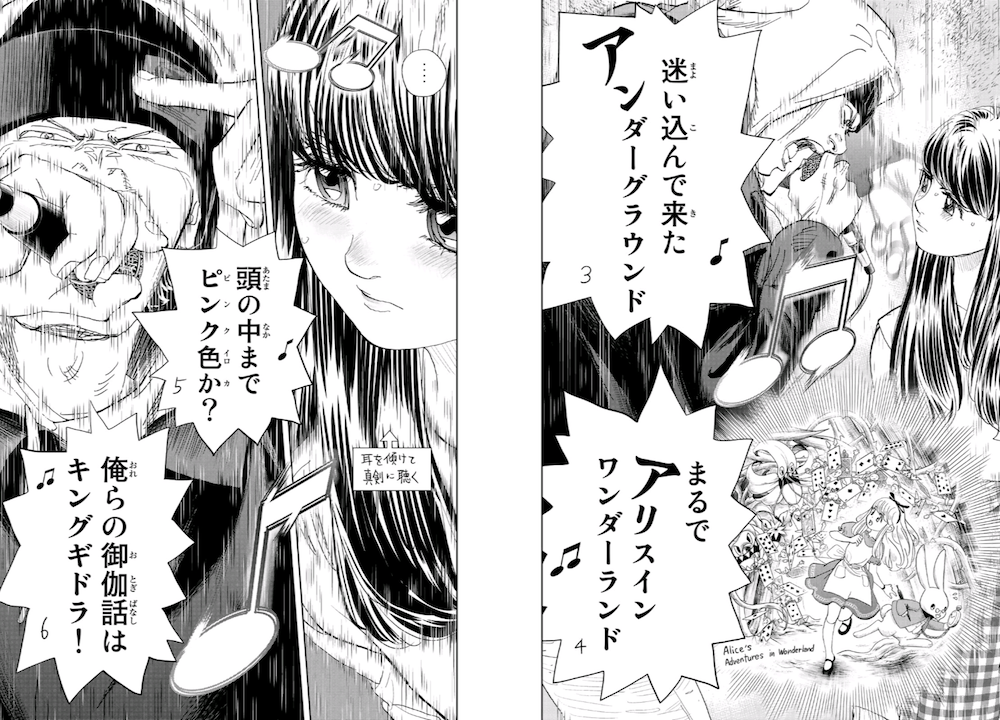
All of this needs to be effectively conveyed in the manga, and the approach Change! takes is to place more emphasis on word balloons than most manga. Words and syllables can appear larger or more erratic in order to highlight what key words in one line are being correlated with in the next line. The classic staple of many manga, furigana to aid in the reading of difficult kanji, take on added importance due to both the sheer number of homonyms that exist in Japanese and to make sure the reader keeps track of what’s being said syllable by syllable.
In the images above, the male rapper connects the word “underground” with “Alice in Wonderland,” working off the fact that andaaguraundo and Arisu in Wandaaraando both start with an “a” and have the similar raundo vs. rando. He then follows up on the next page with Atama no naka made pinku iroka? / Orera no otogibanashi wa Kingu Gidora!, or, “Is even the inside of your head the color pink? / Our fairytale is King Ghidorah!” Pinku iroka lines up perfectly vowel-wise with Kingu Gidora, and the talk of fairy tales follows up to his comparison of Shiori as being as out of her depth as Alice is in her story. While the passionate expressions and the metaphorical imagery shown contribute to the atmosphere and to hammer home the meanings behind the words, the actual word balloons do a great deal of heavy lifting.
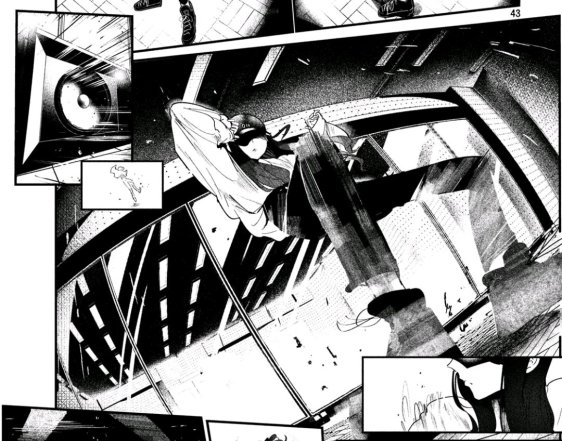
In contrast, although Wondance can be fairly wordy at times, when it comes to dancing, the manga is very much in the “show, don’t tell” category. Characters move with grace and intensity, and panels highlighting their steps litter the pages, turning them into virtual collages that practically crackle with energy. Text is sparse, and primarily brief glimpses into how the characters are thinking in the heat of the moment.
In the pages above, the main character and Hikaru—the girl who brings him into the world of dancing—are dancing together in a class. The paneling supports the character artwork, emphasizing a sense of the two as a duo in sync with each other on some deeper level. This visual approach calls to mind the elaborate paneling of 1970s shoujo manga such as Swan, where panels cascade and climax in beautiful ways. The drawings capture not just the dance but the emotions of the dancers as well, making their moves the central vehicle for storytelling. In a sense, one doesn’t even need to know Japanese (or have a translation handy) to get the essence of Wondance.
Thus, on the one hand, you have a series where the words are of the utmost importance and another where images hold the power. However, they both draw upon the visual language of comics and especially manga in fundamental ways through their particular emphases. Change! and Wondance capture some of the magic of hip hop culture itself as a multi-medium, multi-angle fusion of various ingredients.
April 12, 2019 marks the five-year anniversary of a momentous occasion: the day of the final and most important love confession in the manga The World God Only Knows. There’s a lot that’s special about this particular ending, not least of which was the internet’s powerful reaction to it, best encapsulated in the image below, which collects before and after reactions toward the reveal. For those who want to avoid spoilers about this series, or those who would feel offended by typical 4chan speech, it would be best to turn back now. For those who want to stay, I hope you like hearing me wax nostalgic about what makes this conclusion so great.
ComicsGate, or what remains of it, has been a thinly veiled campaign to bully women out of comics, and the “movement” itself is hardly worth talking about as anything more than unjustified harassment. However, I find that it pulls its energy from a profound change occurring in readers of the superhero genre: the ever-increasing presence of women as both readers and creators, and with it, a change in how the comics-reading community determines what is worthy of praise. I’ve seen it on a personal level, as I went from understanding comics fandom as a boys’ club filled with casual sexism and jokes about Hal Jordan’s punches to one where a mutual understanding and acceptance of such things can no longer be assumed.
I previously wrote a blog post exploring the interaction between canon, fanon, and headcanon, and in it I used those terms the way one would when talking about narrative continuity. However, I think the contrast between those concepts still exists if we use the other definition of “canon”: the commonly accepted masterpieces of a given medium. The challenging of “canons” and “fanons” in that sense is what I’ve seen as a result of the changing demographics of superhero and comics fandom. Over the course of many years, women and girls have come in with their own ideas about which artists to respect and what ideas should be taken away from a given comics, and those deeply entrenched in the older ways feel the ground shifting beneath them. Guys like that can be vulnerable to a smooth-talking neckbeard snake whispering to them, “They’re changing the rules. They’re outsiders. What happened to the things that matter?” Losing the place they belong can be more important to some than trying to address political issues in communities.
Fandom is built in partly on passion, partly on accruing knowledge and experiences. This combination lets fans both embrace that which they love—be it a book, musician, film, or anything else—and perhaps even take it to places that the work by itself would never travel. Fandom creates communities and communication, and it encourages fans to pool their resources together and establish some common ground. But when that common ground is challenged, or finds its foundation shaken by newer generations eager with different preconceived notions of what’s good or acceptable in both people and works, it can create schisms between fans.
In a way, it reflects the world’s politics at large, as previously established majorities have seen their numbers slowly dwindle in ways where numbers alone will not let them hold onto power, and a loss of influence can be downright frightening for those accustomed to always being on top in their own universes. Even if there’s an intellectual understanding that the actions of today are meant to address certain past injustices, it can be a bitter pill for those who assumed a stable foundation in their comics fandom.
The original intention of this blog post was to review Ikeda Riyoko’s Claudine, a scandalous and emotionally intense look at a man born in a woman’s body and the complications it brings. It provides an interesting contrast to Ikeda’s most famous work, The Rose of Versailles, whose protagonist, Oscar, is raised as a man but is ultimately a woman inside.
However, as I tried to shape my thoughts on Claudine, I began to worry about whether or not I was the right person to be writing about a transgender-focused manga, never mind that Ikeda herself, as far as I know, isn’t transgender either. It’s not as if I haven’t written about similar topics before, but I’ve been increasingly self-conscious about it. My concern with writing about Claudine was that I do not know how actual transgender people might experience its narrative. Is the dominant tragic aspect of the manga considered a step backwards?
Then something dawned on me. While I consider my constant desire for knowledge a strength, this pursuit of expertise has its downsides, one of which is an inner need to say things from a place of authenticity that isn’t necessarily in reach. I expect myself to be able to understand everything eventually on a deeper level, but in some situations, as with the transgender experience, there’s only so far I can go. While there are many ways I don’t match up to the ideal male image society upholds, I don’t know what it’s like to feel uncomfortable in my own skin to that degree—to feel like who I appear to be on the surface isn’t who I am.
What I’m realizing is that it’s okay that my knowledge will forever be limited to a certain degree. I don’t need to try and be an expert in everything; I can listen to the voices of those with direct experience and those who dedicate their lives to the pursuit of equality. Support when I can, guide when I can, and learn when I can: that’s the way to approach life, especially as I grow older.
PS: I’m well aware of the irony of me taking what should have been a review of a manga about a member of a trans man and making it all about me realizing the limits of my emotional knowledge when it comes to trans people. I hope you’ll forgive me.
In 2016, I found out about Rokudou no Onna-tachi, a new manga that was a fresh and interesting take on the well-worn harem genre. As I continued, my opinion of it only grew. Even now, I find myself regarding Rokudo no Onna-tachi more highly than ever. There are many aspects of this series that contribute to its success, but fundamental to all of it is the portrayal of its protagonist, Rokudou Tousuke, as a true underdog. In a sense, he’s the Krillin of the series, but Rokudou no Onna-tachi is a story where Krillin is the main character, and he succeeds because he’s not the strongest, or the toughest, or the smartest.
To recap, Rokudo no Onna-tachi is about Rokudou Tousuke, a meek high school kid who casts a spell on himself to be more popular with girls. However, what he didn’t know was that the spell was very specific: it only attracts delinquents and “bad girls.” Most notable among them is Himawari Ranna, the strongest and most terrifying brawler in town. It turns out that bullies are a lot friendlier when your ostensible girlfriend can shatter concrete with her fists, but Rokudou is the last person to want to encourage violence, so he actively tries to prevent Ranna from sending every person they meet to the hospital. Along the way, Rokudou manages to befriend an eclectic group of people and through a combination of friendship, guts, and kindness, accidentally becomes the “shadow boss” of his school.
I call Rokudou no Onna-tachi a delinquent harem work, but it leans much more toward the former descriptor than the latter, and I think the series is all the better for it. While there is a romantic aspect of sorts, as the series has progressed, a majority of the focus has been on Rokudou’s shounen protagonist-esque ability to win over his antagonizers with or without the attraction spell (which he can’t get rid of, no matter how hard he tries). And even when it comes to the delinquent girls who fall head over heels for him. What’s more, “being hot to bad girls” doesn’t give him much of a leg up in a fight, so his ability to stand up to bigger and bigger threats speaks more to his qualities as a human being than anything else.
And yet, while romance doesn’t define the series, the central relationship between Rokudou and Ranna is still interesting and vitally important to the tone of the narrative. If Rokudou is indeed a Krillin, that sort of makes Ranna the Android 18 of this story in that she’s the more powerful of the two. However, her role is arguably closer to that of Goku, or even Saitama in One Punch Man. She’s an unstoppable force in a fight, and many physical conflicts in Rokudo no Onna-tachi are a matter of anticipating the carnage to come as soon as she gets where she needs to be. She’s not a heroine with a tragic backstory or a brash amazon with a hidden soft side, and even those moments of loving infatuation toward Rokudou humorously highlight a central tenet of Ranna’s being: violence is everything. That dynamic of contrasting personalities between Rokudou and Ranna fuel both the comedic and the dramatic parts of the manga, and it’s all the better for it.
If Rokudou no Onna-tachi had just stuck to pure silliness, making jokes about how an endless parade of nasty girls were getting googly-eyed over a tiny loser, then it would have worn out its welcome far too quickly. But if it had swung too deep into the serious and dramatic, then I believe it would have had a harder time standing out from the pack. It’s because Rokudou can be portrayed as this unlikely hero, and that the series can swing between silly and serious so effectively by using his constantly being out of his depth, that the manga is such a rewarding and enjoyable experience.
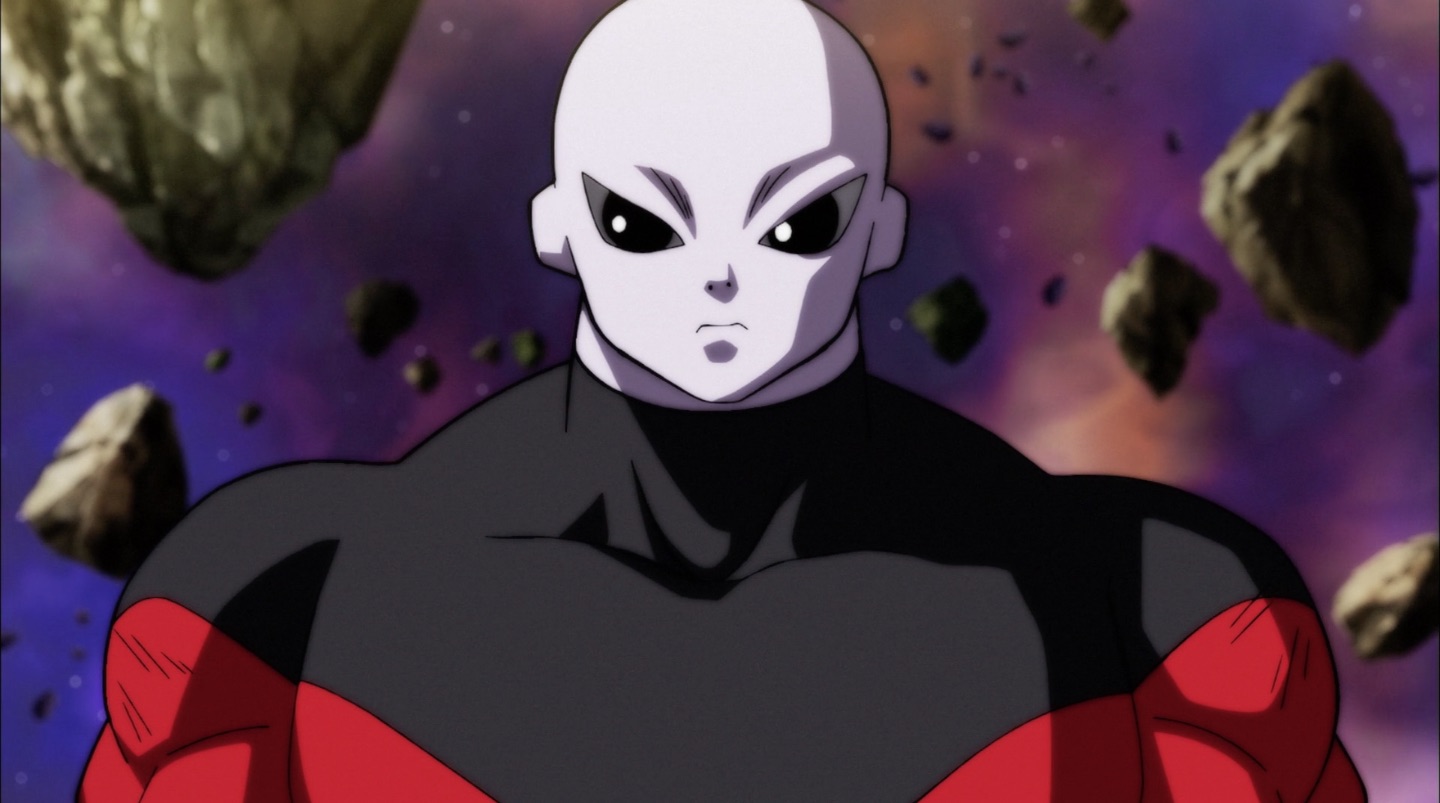
The Dragon Ball franchise is famous for many things, and one of them is its gallery of iconic antagonists. Piccolo, Vegeta, Freeza, and Cell are some of the big names Goku has faced over the years, and they each make a lasting impression. The recent Dragon Ball Super series introduced a major antagonist in its multiversal “Tournament of Power” arc, a mighty warrior from another universe named Jiren. But unlike the others, Jiren is considered by many fans to be a disappointingly generic villain. It’s an argument I can see, but in the end one I don’t quite agree with.
Indeed, if you take Jiren as a villain, he seems to just be generic in his obsession with power and sacrifice–just another big body for Goku to overcome. However, this approach to Jiren’s character isn’t quite accurate: Jiren may be opposing Goku, but he’s not a villain. He’s a hero of his own world, one he presumably has defended from threats comparable to the ones Goku has faced, and he gained his power through the circumstances and decisions that comprise Jiren’s experience.
The crucial difference between Goku and Jiren is that the latter’s life is full of pain and loss that made him choose a life of isolation and rejection. Where Goku would defeat and befriend those he faced, Jiren would destroy. Where Goku attains power for self-improvement and new experiences (i.e. fight stronger opponents), Jiren does it almost out of a sense of obligation or duty. Where Goku is goofy, Jiren is dead serious. What Goku has to overcome when fighting Jiren is not some evil machinations or even a chaotic force like Majin Buu, but a different in philosophy borne from a universe that did not have a Goku.
Put another way, Jiren could have been the protagonist of his own anime or manga, one where suffering and cynicism dominate. Perhaps you can think of a couple of titles that fit the bill. But just like how Goku embodies certain values as the core of Dragon Ball, Jiren would be the center of his own narrative and all that such a scenario entails.
So Jiren might come across as “uninteresting,” and he might not necessarily be as compelling a foe as the most well-known villains of Dragon Ball, but he acts as a different kind of foil. If ever he shows up again, there’s plenty of room to explore his character.






 OGIUE MANIAX