
The Current Genshiken Club Members

The Hokuto Brothers (I think Toki turned out the best)

Yoshimori and Tokine from Kekkaishi

Nonowa etc.

The Current Genshiken Club Members
The Hokuto Brothers (I think Toki turned out the best)
Yoshimori and Tokine from Kekkaishi
Nonowa etc.
Before we jump into the chapter, I have to make sure you’ve heard the news.
You’d think after the Madarame/Saki climax from a few chapters ago that Genshiken would let up for a while, but Chapter 84 is an intense one. In the previous chapter, Madarame revealed that he was going to quit his job near the school (implying he would be unable to visit the college as often as he used to), despite Saki’s advice not to do so. As Madarame appears to feel increasingly alienated from the current club’s atmosphere (and Yoshitake tries to convert him to the church of BL), Hato is having trouble of his own as his emotions become a mystery to even himself. As Ogiue asks him to contribute to a “Tiger & Bonny” doujinshi, Hato begins to wonder about his relationship with Madarame, and the seeds of doubt Kaminaga placed in him about his heterosexuality begin to sprout.
Meanwhile, Sue of all people seems to have feelings for Madarame as well, though her character might mean it’s stranger (or simpler) than that.

I do not think that the change in demographic in Genshiken is the root cause per se for Madarame’s decision. Rather, my suspicion, based on my own experience, is that Madarame’s connection to the actual Genshiken as an on-campus club is starting to weaken. I had a similar group of nerd friends back in high school, and for the first three years after I graduated I would visit the school often to maintain that experience. Eventually, however, everyone who I even had a loose connection to graduated, and I lost any compelling reasons to continue. I’m still friends with a lot of the people I knew from that time, but our friendship has in a certain sense transcended the physical location, and I could see Madarame feeling like the clubroom itself is no longer that important.
That said, I’ve noticed, based on some of the response to the new Genshiken anime, that there are fair amount of readers both Japanese and non-Japanese who feel a bit alienated or even betrayed by Genshiken II, and I think Madarame is meant to embody that feeling to some extent, being the character who most embodies that classic otaku personality. Perhaps the deal with Madarame’s character is that he’s caught in a state of limbo, where he’s not yet fully integrated into adult living but at the same time his old haven away from reality, Genshiken, is starting to fade away.
The more that Genshiken focuses on Hato, the more I realize that he is probably the most psychologically complicated character in the entire manga (though I get the feeling that there’s something up with Nakajima that might be even more complex). Ogiue is one thing, as her story cuts to the bone, but Hato’s situation is such that you can’t even explain it as simply “he’s realizing he’s gay.” There’s a good chance that’s what’s happening, but based on the specifics of the chapter and of his history, doubting his own sexual orientation doesn’t seem to be the only thing going on.

In the chapter, Hato tries to shoo away the suggestions of his imaginary counterpart, only to have the female Hato replaced by Kaminaga, who echoes the real Kaminaga’s statement that the crossdressing likely facilitates the potential homosexuality of Hato. In that scene are a lot of things to take into consideration, starting with the fact that the Stand (i.e. Hato’s inner thoughts?) transforms specifically into Kaminaga. Based on previous chapters, it’s still not clear what his feelings towards her are. Does he want her? Does he want to be her? Does he perhaps desire both? Even the fact that the transition from Stand Hato to Kaminaga is a little hard to spot at first if you just skim through the chapter is indicative of the fact that Stand Hato continues to resemble Kaminaga, despite the fact that Hato has undergone an image change by semi-permanently switching to the shorter wig, as if to show that she specifically continues to influence him. It’s a weighty past and a convoluted present for Hato.
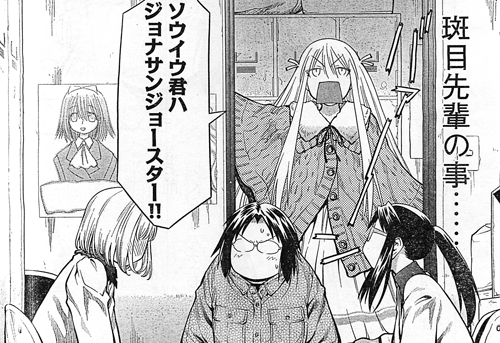
As for Sue, the easiest connection to make in regards to her blushing is the kiss she placed on Madarame’s cheek at the school festival as a sort of prank. Putting aside the notion of “Madarame: mack daddy of American fujoshi,” I’m starting to realize that Sue pretty much functions in Genshiken the same way the penguins do in Mawaru Penguindrum, bringing into the very foreground some of the “hidden” elements of the characters’ relationships at the time. I also think it’s quite appropriate for her to quote Dio Brando, and to have it be not one from the more popular Part 3 Stardust Crusaders story but from the original Phantom Blood.
There’s not much Ogiue this chapter, but there’s probably going to be another chapter at least partly focused around her soon, given the impending Comic Festival, though I imagine it won’t be until at least another three or four chapters.


Name: JUNE-chan (JUNEちゃん)
Alias: N/A
Relationship Status: N/A
Origin: Tonari no 801-chan
Information:
A doujin event friend and acquaintance of 801-chan, JUNE-chan’s name is a reference to the earliest BL manga magazine, which also reflects JUNE-chan’s tastes. As such, JUNE-chan creates doujinshi in that vein, which is a source of friendly disagreement between her and 801-chan.
Fujoshi Level:
In addition to the creature she transforms into upon having her yaoi interest piqued, JUNE-chan’s fondness for an old-school type of yaoi sets her apart from many of her peers.

Name: Moe-chan (地ちゃん)
Alias: N/A
Relationship Status: N/A
Origin: Tonari no 801-chan
Information:
Chi-chan’ is one of 801-chan’s friends. She is knowledgeable about Akihabara, and her name may reference her abilities as a tour guide. She appears fond of the maid cafe Schatzkiste.
Fujoshi Level:
Nothing is known, other than that she is a fujoshi.
Manhwa, or Korean comics, are something I am relatively unfamiliar with. I can spot the similarities and obvious influences from manga in modern manhwa, and I’ve looked at a few titles here and there, but I have neither the knowledge of history nor the personal experience to say I have a firm sense of how manhwa “is.” Given that my expertise (if you can call it that) is primarily in manga, however, I found it quite interesting when a manhwa title I’ve read recently, Dragon Who, takes elements clearly inspired by manga but cross-pollinates them in a way which normally never happens among Japanese comics.
A title from 2009, Dragon Who is about a dragon boy named Roa Coatl who travels to South Korea to find the descendant of Quetzacoatl to make her his bride so that they can prevent an impending global disaster. In other words, it’s a shounen-esque school comedy/romance/action title that probably wouldn’t feel too alien to manga readers aside from the decidedly Korean names for most of the characters. Given that comfortable familiarity I think one would expect certain stylistic approaches, and indeed Dragon Who looks the part of a shounen manga to a good degree, but take a look at this image:

(By the way, for those unfamiliar, manhwa reads left to right.)
The character designs look quite shounen, perhaps even closer to late 90s shounen titles, but the use of blooming flowers in the foreground to introduce a character (and this is the main heroine Go So-Ahn’s first appearance) is an element straight out of shoujo. When combined with the fact that So-Ahn herself is designed to be fairly normal as opposed to strikingly beautiful, looking closer to a best friend character than a main character herself, it makes for an almost defiant combination of visual elements: a shounen title with a shoujo-esque heroine with shounen heroine looks.
Not only that, but Dragon Who has its own fair share of attractive guys, and while the title is neither harem nor reverse harem, the following image can give a certain impression as to how the title skews.

At this point, I think it would be easy to chalk it up to the popularity of shounen titles among female reader inside and outside of Japan (and I would have to assume Korea as well), and the titles which are designed to appeal to girls in Japanese comics to varying degrees such as Black Butler and Kuroko’s Basketball, but I’m not so sure that explains it. For one thing, Dragon Who is still keen to include elements like beefy muscular guys who aren’t all lithe bishounen, as well as fanservice for male readers.
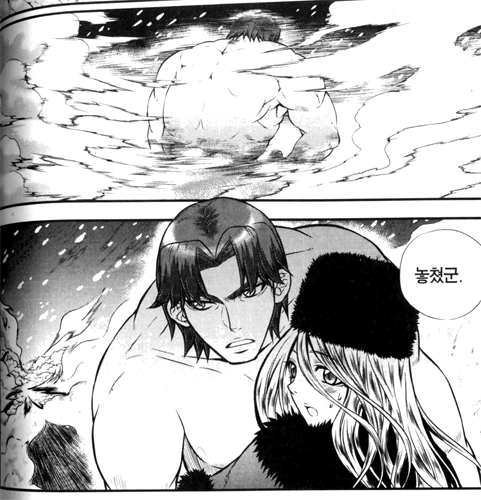

Just to be clear, this is not a matter of manhwa looking “enough” like manga or not, but rather seeing how the manhwa inspired by manga doesn’t have to play by the rules (or at least plays with chunks of rules from four different places). To me, it feels more like Dragon Who is the product of authors taking aspects and visual language from manga regardless of genre or intended audience and putting them all in one place, or like if a shoujo writer were paired with a shounen artist. It’s a crossing of assumed boundaries which can show how thin and permeable those walls can be if only we’d allow them to be.

There’s a scene in the old Nintendo Power comic based on The Legend of Zelda: A Link to the Past, where Link and Zelda are finally facing off against Ganon himself, the primary antagonist of the Zelda series. As Ganon has Link and Zelda nearly beaten, Zelda says a prayer and desperately fires a seemingly plain wooden arrow at Ganon, only for the arrow to transform into the legendary Silver Arrow mid-flight and slay the pig demon. The whole notion of the Silver Arrow as Ganon’s one weakness is taken from the video games, but as anyone who has played Link to the Past knows, you don’t need one Silver Arrow to defeat Ganon, but four. Essentially, while there are a number of approaches that could have been taken, in this case the comic dramatizes the impact of the Silver Arrow by having its singular appearance act as the climax of the story in order for it to function better as a narrative.
If the Link to the Past comic is a case of taking a gameplay element and transforming it into a plot point, then the Super Robot Wars games, especially the recent ones, are a strong example of the opposite. Based on the idea of taking robots from actual anime and having them fight together, the SRW franchise is all about the conversion of story elements into gameplay, but the early games were limited by an emphasis on statistics. The result was that certain characters and robots became less useful because they lacked effectiveness in the game itself. There have been attempts to mitigate it, such as creating an original upgrade for one of the robots, such as the relatively weak Mazinger Z into the mighty Mazinkaiser, but recent SRW games, particular the Z series, have sought to remedy this discrepancy by completely prioritizing dramatic impact over a sense of logic. Thus, not only are the most powerful weapons transformed into attack options, but the most powerful moments in the original anime are given a gameplay function.
Thus, what you see is not simply the robot Godmars’ strongest technique, but a recreation of the moment when Godmars and its pilot Takeru draw upon the last of their energy to deliver a final blow to the main antagonist of their story. The “Super Final Godmars” technique is meant to carry the same weight as Zelda’s Silver Arrow in the comic, only it’s made repeatable throughout the game so it also functions as the Silver Arrow from the video game.
This approach even transcends specific moments in a series, as is shown when looking at how the characters in those robot series are themselves given unique properties to show off their individuality. Lelouch, protagonist of Code Geass, is meant to be a strategic mastermind in his story, and so the game gives him the ability to boost allied units in specific ways which make him best suited for staying out of the front lines and for issuing commands.
What I find interesting about this transformation of plot point into gameplay elements is that the actual end goal of such a function is to invoke intangible qualities by way of tangible mechanics of intangible moments. In other words, in order to give players the feeling of re-enacting those climaxes from anime, the SRW games look at those dramatic moments, figure out how it should impact the game in terms of requirements/damage/etc., but then has to arrange those numbers to best replicate the feelings created by those original scenes. This is probably what makes the original robots which appear in SRW games to have such over-the-top animations compared to the robots with actual source material; they have to add another step to try and convince players that they should be just as into their (at the time) ahistorical designs as they are the robots straight from anime.
BEST MALE CHARACTER

Nishimi Kaoru (Sakamichi no Apollon: Kids on the Slope)
When it comes to Kids on the Slope characters, an excellent series, I get the feeling that the rugged-yet-sensitive Sentarou would be the most popular one. Indeed he is a great character, but there’s something about Kaoru which impresses me more. More plain-looking and less-outgoing than Sentarou, the ups and downs of Kaoru’s life and the process by which he gradually opens himself up to others gives Kaoru what I find to be a real sense of humanity, warts and all. What’s especially important is that the story doesn’t portray Kaoru as a purely passive figure who just benefits by association, but as someone who becomes a best friend and perfect foil to Sentarou. That scene at the school where the two make amends by playing a duet of piano and drums is one of the best moments in anime I’ve ever seen.
If anything, whether you pick Kaoru or Sentarou as a favorite, it’s difficult, perhaps nigh-impossible to talk about one without the other. Overall, it’s that friendship through the good times and the bad which makes Kids on the Slope and its characters so memorable.
BEST FEMALE CHARACTER

Yanagin (Daily Lives of High School Boys)
To explain my pick this year, I would like to take a quote from an episode of The Simpsons titled “A Star is Burns”:
Homer Simpson: Barney’s movie had heart, but Football In The Groin had a football in the groin.
2012 was actually full of excellent female characters in contention for the title. There was Mine Fujiko, whose own spinoff series explored not only her history but also the question of what it means to be “Fujiko.” There was also Urabe Mikoto, the Mysterious Girlfriend X, who comes from one of my favorite manga and whose eccentric personality I always enjoy. Takakura Naoko, the vice principal from Tari Tari, had adult charms and adult struggles which won me over. Cure Sunny (Smile Precure!), Senomiya Akiho (Robotics;Notes), Aria (Saint Seiya Omega), I could rattle off a dozen names, and yet, I just couldn’t forget Yanagin, whose shrill, trauma-inducing cry kept cutting through the competition like a football in the groin.
There isn’t much to Yanagin. No inspiration, moe, attraction, character development, depth, nothing like that. All it boils down to, is that she makes me laugh like no other character could in 2012.
Final Thoughts
It really wasn’t easy pickings this year in either category, and that has a lot to do with an overall strong year of anime. 2012 brought us strange and experimental shows in the form of things like gdgd Fairies and The Woman Called Mine Fujiko, and it delivered shows which both reinforced and defied their supposed lineages such as AKB0048. Along the way there have been many approaches to characterization, stemming from various beliefs as to what the role of characters are, from rough templates which activate creative imagination to ones meant to reflect a sense of reality or realism whether physical or emotional. Even though this contrast is nothing new, I think this year is especially good at showing how there isn’t a dichotomy at work, that these areas are not so rigid that one precludes the other, and that notions of character (as well as Ito Go-style kyara) are much more fluid. In other words, anime continues to show its potential.

Name: Moe-chan (萌ちゃん)
Alias: N/A
Relationship Status: N/A
Origin: Tonari no 801-chan
Information:
Moe-chan is a friend of 801-chan’s whom 801-chan has tried to get to watch Uta no Prince-sama Maji Love 1000%. She has a peculiar laugh, “Puukusukusu.”
Fujoshi Level:
Little is known about Moe-chan’s fujocity, other than her ability to manifest into a little “fujoshi” creature with ram horns and her association with 801-chan.

Ohno is worried about her job prospects, when Tanaka mentions that he’s willing to do whatever it takes to provide for Ohno. Misinterpreting his words as a criticism of her for not being able to support herself, however, Ohno decides that a career selling cosplay photo CDs might be in her future. During the photoshoot, Tanaka manages to clear up the confusion, and in the process even implicitly proposes to Ohno when he says that he wants to create costumes for her for the rest of his life. Ohno, who had downed a whole bottle of liquid courage in preparation for the photoshoot, decides to maybe stay another year in school (unfortunately).
Meanwhile, Madarame’s quit his job.
Chapter 83 feels very significant to me, a culmination of multiple threads but in a way different to the climax of the Saki-Madarame storyline. There’s the big plot development with Tanaka’s tacit proposal to Ohno, of course, but Ohno’s plight of employment (whether she brings it upon herself or not) has been around since before Genshiken II even began (and after Genshiken finished, technically, because it was first brought up in the Kujibiki Unbalance manga extras). Here, it finally takes center stage and we also get to see where Ohno and Tanaka have gone since they began dating so many years ago.

This chapter is definitely full of fanservice, particularly in how we get to see Ohno completely topless in private with Tanaka, but rather than just pointless titillation, I find that whole scene and its portrayal of (albeit obscured) nudity to speak of both the increasing maturity of not only the relationship portrayed but also of the Genshiken manga itself. The scene is portrayed with a strong sense of comfort and familiarity between Ohno and Tanaka, the kind where two people are just close enough with each other to bare it all without having it be an event. And while the nudity isn’t quite to the level of Spotted Flower, it still gives a sense that this is an adult’s world, at least emotionally and physically. Though not “canon,” for those who’ve seen the Genshiken 2 anime this chapter is a stark contrast from that episode portraying how Ohno and Tanaka got together in the first place, where Tanaka felt overwhelmed by his own inadequacies and awkwardness.
Even Tanaka’s “proposal” shows the level their relationship is at, as he naturally talks about a future with her moments before realizing what he had said (but still sticking to it). I also actually really love the change Tanaka made to his own words. As he realizes just how much Ohno has impacted his life, as he realizes that he was able to pursue his dream of working in fashion because Ohno was the perfect model and companion for him, he goes from having an attitude of sacrifice to holding onto his dreams no matter what. When he says he’ll find whatever means he can to keep making costumes for her, he includes Ohno in those dreams as a vital component, and I find the whole thing rather beautiful.

Seeing this sharp focus on the employment situation of so many characters, focused on Ohno and Tanaka but also giving us glimpses of Ogiue, Madarame, and even Kuchiki’s lives beyond the university, I feel that Genshiken more than ever has this real sense of life moving forward, even if people aren’t ready for it. Certainly it’s not an old or unfamiliar idea in the manga, with Sasahara especially getting some serious page time as he struggled to find a path for himself, but with Chapter 83 and Genshiken II in general I find that there are not only significant differences in the challenge each character faces in terms of work, but that with the new characters in Genshiken II you can really see a spread of values from people just entering college to people looking at marriage and the future, and how the former can turn into the latter but still seem just as strange. Genshiken has always been a seinen manga, but here I think it really starts to reach at an older seinen audience, beyond just the folks for whom college is a fairly fresh memory.

Name: Yoshizawa, Eri (吉沢えり)
Alias: Eri (えり)
Relationship Status: Dating
Origin: Fujoshissu!
Information:
Yoshizawa Eri is a member/current vice-president of the manga club at Ryouhoku High School, where she writes original doujin prose fiction and spends time with her best friends, Aoi Yuki and Satou Megumi. Ridiculed all her life for her overactive and eccentric imagination, her unusual but passionate stories were the catalyst for her friendship with Megumi in junior high. Extremely fashion-conscious with a large appetite, Eri views Megumi’s statuesque appearance with some envy, failing to realize that Megumi herself sees Eri’s round features and petite figure as much cuter than her own. Eri is a fan of many series, including Sengoku Basara and its hero, Date Masamune.
Eri is the last of her friends to enter a relationship, dating her younger brother Kenta’s friend and classmate, Mizoguchi Shigeyuki, though her initial reluctance to reveal her fujoshi side complicated matters. Though older than her boyfriend, Eri is also significantly shorter, creating a strong contrast between the two. She also has a very close, if at times typically raucous, relationship with her younger brother.
Fujoshi Level:
Eri gets easily lost in thought and fantasy while at “work,” the words flowing out of her fingertips with little effort. Though she is able to restrain her mindset in more general settings, she is most comfortable letting her imagination run wild along with her friends’.

