The Fujoshi Files 40: Yoshitake Rika

Name: Yoshitake, Rika (吉武莉華)
Alias: N/A
Relationship Status: Single
Origin: Genshiken: The Society for the Study of Modern Visual Culture II

Information:
Yoshitake Rika is a student at Shiiou University who, despite her youthful looks and demeanor, actually entered college at the age of 20. She initially joined the Society for the Study of Modern Visual Culture (Genshiken) after seeing a particularly appealing drawing of Sengoku Basara characters by Genshiken president Ogiue Chika at the club fair. As a member, she quickly befriended everyone in Genshiken, especially her fellow freshmen, Yajima Mirei and “fudanshi” Hato Kenjirou. Yoshitake has a younger (but taller) sister named Risa who is also an otaku, and has bought doujinshi for Risa, who is typically unable to attend events due to her obligations to her basketball team.

Her sense of fashion, forward personality, and willingness to break a few rules in the name of fun (like convincing her slightly underage friends to drink) belie a person who is more comfortable in social settings that the average fujoshi might not be. At the same time however, Yoshitake has a capacity for expounding endlessly on BL-related topics, which allows her to strike up conversation with her fellow fangirls just as easily as she would non-otaku. Yoshitake’s taste in media is also very diverse, going from classic literature to anime and manga to live-action films.

Fujoshi Level:
Yoshitake is able to combine both the wide breadth and depth of her interests with her fujoshi mindset, and consider the pairing and yaoi potential of a range of works far greater than the average fujoshi. Notably, she believes that the judo novel Sugata Imatarou is excellent in part for the emphasis on sweaty men forging close bonds with one another.

Maybe I Don’t Read Enough Manga

Given the fact that I dedicate an entire blog to anime and manga, it might be strange for me to think that one of my problems is that I don’t read enough manga. Many burned-out bloggers cite the activity of blogging itself ends up taking a chunk out of their actual enjoyment time with the stuff they love, but that’s not really what I’m feeling here. My posting rate is consistent but light enough for me that, while I do sometimes feel the pressure of thinking of something to say, I don’t treat it as a chore.

Part of it may have to do with the fact that, although I can read Japanese, I do have my limitations and one of them is speed. I just can’t read fast enough. That’s only a part of it, though. Instead, I have this strange sense that I don’t quite have a proper pulse on manga as it currently is, and by extension manga as it has been. When I’m reading a bunch of manga in the same genre or for the same demographic, I get this strange sensation that I’m continuously boxing myself in too much, that I need to keep expanding my horizons. And so I do, I keep reading more, I keep trying new things out, but it’s like I can’t try them fast enough. I want to feel everything manga has to offer, to understand it as well as I possibly can, but somehow it’s just not enough, like I’m losing my connection to it.

What I’m experiencing may be somewhat the opposite of burn-out, though not in the way that you feel when you initially dive head first into a new obsession, where you have to consume every little bit that you can possibly find, good or bad. Rather, it’s this unusual melancholy where instead of feeling like way too much, it feels like not enough.

Ogiue, Club Ace: Genshiken II, Chapter 74

The latest Genshiken is big, but in a rather narrow way that requires some clarification. Nothing climactic really happens, and what it sets up for the following chapter(s) is quite significant, but more than that, Chapter 74 is the most Ogiue-heavy chapter we’ve had since the manga’s revival.

This month sees Ogiue personally working to help Hato overcome his wardrobe-based artistic barrier. After a suggestion from Sue (who interrupts some rather personal fun between Ogiue and Sasahara), Ogiue decides that the best thing to do is to literally sit next to Hato and watch him draw to see what exactly goes awry in the process. Though Yoshitake wishes to watch as well, Ogiue decides that this has to be a one-on-one affair, especially because Yoshitake wears her corrupted intentions on her sleeves.

After much deliberation, which includes narrowly avoiding bringing up Hato’s shocking (?) high school love story and Ogiue admitting how impressed/jealous she is of Hato’s skills, Ogiue determines that as a man, Hato confines himself mentally so that when he does draw as a woman, his desires all come out at once and lead to yaoi. Acting as both wise upperclassman and as club leader, Ogiue instills confidence in Hato’s drawing abilities—which he believed to be fake as a result of what seems to be copying the style of a fujoshi he once knew (again, “high school love story”)—by basically saying, if you can draw like this, then you can draw manga as well.

Hato passes the test, drawing a character in a panel without having it descend into outright homoeroticism, but when his old “friend” from the student government comes barging in with another council member, the (imagined) fiery passion between the two compels Hato to draw some BL of them on the spot, essentially undoing much of the progress he and Ogiue had just made.

The chapter closes out by revealing the fact that pretty much everyone from the old guard will be around to attend the school festival this year, and that this includes both Madarame and Kasukabe (with Kohsaka). It’s a recipe for danger, or just a whole lot of mumbling and awkward glances as a result of unrequited love.

Normally I try to come up with a post title which references both the chapter itself and something nerdy, which is also how the actual Genshiken chapter titles work, but even though I don’t expect to win, this time around I can acknowledge a complete loss. Chapter 74 is “Itten Toppa Ogin-Lagann.” I can’t top that. But let’s put that aside.

Even though I said that this chapter is chock full of Ogiue content, my summary can make it seem like it was really a Hato chapter. It wasn’t. Sure, he had his own development, but here, we really get to see Ogiue as a central focus in a manner similar to the second half of the original series. In addition to the Ogiue we’re familiar with, it even ends up showing a couple of sides to her that hadn’t been revealed previously, or to put it more accurately, have developed since.

The chapter actually begins with Sasahara and Ogiue in her room, where Sasahara is shown actually praising Ogiue’s manga draft for the school festival, something we almost never have the privilege of seeing because these “editor review sessions” seem to typically lead to a lot of tension. The room and especially the couch, however, hold significant meanings for the two, and we get to see Ogiue actually tease Sasahara in that restrained “you’ll have to meet me half-way because it’s kind of embarrassing and it’s kind of fun” fashion. Specifically, Ogiue asks Sasahara if it’s okay that she might be in a room alone with another guy (Hato), to which Sasahara replies that it’s fine. Ogiue, on the other hand, was trying to bring out the “strong seme” side of Sasahara which she has a thing for, and which Sasahara picks up on almost immediately after. It’s similar to when Sasahara and Ogiue were alone in the clubroom in the last chapter of the original Genshiken and Ogiue hinted that it would be a good time for a kiss, but here their increasingly red faces combined with their comparatively comfortable (though not entirely awkward) body language show that they both know what’s really going on, and that is a very comfortable familiarity. They want each other, and even though Sue ends up interrupting before anything actually goes down, it’s still a sweet and beautiful sight to behold.

On top of Spotted Flower, this whole sequence tells me that Kio Shimoku has gotten better at portraying romantic relationships. Keep in mind that I already thought he was quite talented at it, perhaps as a result of being so good at character interaction in the first place, but there’s the keen sense of how intimate moments in a relationship really happen, in those quiet lulls where both parties can sense mutual desire.

The meat of the chapter though is the drawing session with Hato, and Ogiue’s thoughts and character fill that scene as well. When Hato shows the inadvertent BL that he made out of Ogiue’s characters, she has an epiphany: “Is this what it would be like if my manga had doujinshi made from it?” Though I may be reading into it too much, I feel like, in that moment, Ogiue has just begun to cross that threshold between the amateur creator and the professional, that realization that perhaps somewhere out there is a fan who’s creating work inspired by her own. Of course, as an artistic fujoshi herself, Hato’s “fanart” creates some complex feelings as well, where she’s turned on by yaoi of characters she created herself, even if they weren’t made expressly for that purpose.

That look of satisfaction on Ogiue when her advice ends up working out has a lot behind it as well. It’s really powerful, not just because it’s coming from Ogiue the older, more experienced otaku and yaoi fan which we’ve seen already in previous chapters, but the way the advice clearly comes from Ogiue’s own experiences in overcoming her own psychological blocks pertaining to drawing and being a fujoshi. Ogiue had to wrestle extensively with her personal demons in order to begin moving past them, and the words of encouragement she offers Hato are ones from the heart, and from knowing that it’s not only important to accept oneself, but that it’s more than possible to do so. I think this is one of the reasons the chapter starts off with Sasahara in the first place. It acts as a reminder of what happened with Ogiue and how far she has come with his help, and how even though the trauma doesn’t seem as dire, that process continues.

With that, I’ll end by mentioning that we even get to learn the name of Ogiue’s manga: Getsu Gankyou. It means something like “Lunar Glasses” or alternately “Lunar Insight.” Chuuni-byou indeed.

Eh, let’s throw in one more Ogiue image for good measure.

The Fujoshi Files 39: Ageha

Name: Ageha (アゲハ)
Alias: N/A
Relationship Status: Single
Origin: Fujoshi no Honkai

Information:
Ageha is a highly fashionable 15-year-old girl who actively hides the fact that she is a fujoshi. Fearing that her secret would ruin her relationship with her friends, she goes out of her way to hide in plain sight, creating decoy cellphone wallpapers and even disguising her BL books as fashion magazines. Ageha was originally antagonistic towards her classmates and fellow fujoshi, Takako and Shu Mei, but eventually became good friends with the two of them.

Ageha is a fan of the Nanairo no Shacho series along with Takako and Shu Mei. She is also particularly fond of Fujiko Fujoo A’s Ai Yue series, having been moved to tears upon meeting her, but is not aware of the fact that the author is actually a teacher at her school. Ageha strongly values having one solid BL pairing in a series over having many different ones.

Fujoshi Level:
So seriously does she take her fujoshi life that Ageha once broke up with a boyfriend in order to celebrate her favorite character’s birthday.

Superhero Comics and Being Sexy on an Individual Basis

Introduction

When it comes to the controversial approach to sexuality in superhero comics, probably nothing is more exemplary than the oft-seen exaggerated pose where a female character twists her torso such that both her butt and her breasts are facing at the reader directly. Known as the “brokeback,” the pose is frequently the target of criticism as an example of sexualization gone wrong. Generally, the criticisms concern the fact that, as action-based stories, the pose is a completely impossible and extremely impractical thing to do in fighting. The idea is that, by showing them as such, comics communicate the idea that when it comes to female characters the T&A is more important than their identities as heroes or characters in general.

The point at which I might diverge from other opinions is that I believe strongly in freedom of artistic expression and think that such works have a right to be drawn and a right to be enjoyed by readers on a sexual level. While I think that the disparity in idealization between genders can definitely be too much, something has to be said for the fact that the visual arts in general can make the impossible happen in the first place. If people are literally physically incapable of contorting themselves into the “brokeback” pose, then mediums such as comics are the only places where it is possible at all.

I also think people have the right to admire a character while simultaneously desiring her or the pose that she’s taking. Again, the fact that forms of fiction such as comics make it more than possible for the portrayal of a female character to be an effective fighter while doing the least physically sensible thing possible is not an inherent negative, as long as we’re being honest about the fact that it is indeed done for sex appeal. No matter how much we’re able to point out that those contorted positions would shatter someone’s spine, or that other poses come straight out of pornography, they successfully generate sexual attraction. Individual tastes may vary, but they’re also called “porn poses” because they work, and at the end of the day pornography drawn or otherwise does not automatically turn people into misogynists.

But while the act of making or consuming such products causes no harm in and of itself, when the brokeback pose becomes the default method for portraying sexual attractiveness, it creates two major problems in particular. First, while anyone has the right to enjoy any type and degree of sexualization, if the goal is to try and attract a larger female readership, then no one should be surprised when such portrayals lessen their desire to pick up superhero comics. Second, and what will be the primary concern in this article, is that by having that style of sexualization be so ubiquitous, it creates a singular image of how a female (character) is supposed to look when they’re being “sexy.”

Sex as Character

Over the month of February, comics news and editorial site Comics Alliance published a series of articles on sex in comics. One of the articles discussed Adam Warren’s Empowered, where writer David Brothers argues that, even though Empowered is more sexually explicit and has more overt fanservice than regular superhero comics, it still approaches the topic of sex in a much healthier and more mature fashion.

Although a majority of commenters have voiced their understanding of David’s points and explanations, there are a few dissenting responses which I found interesting for what they imply. The recurring criticism, which not only appears in David’s article on Empowered but also many of the other posts, basically calls out the writers for having a double standard, praising the portrayal of sex in indie comics, while lambasting the presence of sexuality in superhero comics, in something of a high art, ivory tower, porn vs. erotica-type argument. Another criticism leveled at Empowered in particular, is that its crass displays of actual sexual content and juvenile-sounding dialogue make it worse than the other superhero comics to which David compares it.

I think David actually addresses this well in the article itself when he describes the primarily sexual relationship in Empowered, that of the main heroine, Emp, and her ex-henchman boyfriend, Thugboy:

Empowered‘s eponymous heroine is a superhero with issues. Her costume is too skintight and ineffectually fragile, and neither her teammates nor her nemeses respect her. She gets tied up way too often for her liking.

They both get different things out of the relationship, aside from just sex. Thugboy clearly loves Emp, and expresses that in a way that’s both a little paternal and a lot touching. He gets her issues with her body and career, and when she doubts herself, he’s there to point out how wonderful she is. He supports her, and the reverse is true, too.

More important than that, though, is the fact that she’s comfortable expressing her insecurities to him.

The thing to take away from their relationship is that when Emp has sex, it’s not simply a display of sex but rather shows the specific scenario of “sex with Emp.” It takes all of the various bits and pieces of her characterization and doesn’t forget them even during moments of titillation. The trouble with how sexuality is frequently visualized in superhero comics then, assuming the goal is to show female characters in a sexual manner in the first place, is that this level of specificity doesn’t exist in most portrayals. Rather than a female character making a sexy pose, it becomes a female character conforming to a sexy pose template, no matter her personality, history, or quirks. When combined with the way that superhero comics can grow and reinforce bad ideas, we end up in the current situation where this approach to sexuality generates an entrenched position that causes people to staunchly defend it as if it is simply the way that comics communicate “sexy,” as if there is little alternative.

The issue of posing isn’t confined to just “bad” artists, as the above example from Jim Lee demonstrates. Taken from his famed X-Men run in the 90s, the image is well-drawn and the women are idealized without necessarily going off the deep end, but aside from Jubilee (front) all of them are taking the same sexy stance. Psylocke (left), Rogue (center), and Dazzler (right) all have very different backgrounds and personalities, so it seems strange that they would all be in the same pose. This goes double when you compare them with all of the male characters, each of whom showcase their individuality in the way they’re standing or sitting, or Jubilee once more, whose “attitude” comes across in her slouched position.

Again, there’s nothing wrong with showing attractive girls in exaggeratedly attractive poses in and of itself, nor is there any fault in enjoying them, but superhero comics are in the business of creating unique, iconic characters. This is why they have different origin stories, different costumes, and different powers. The goal is to be able to see how a particular character stands out from the rest, and if sexuality is involved, then comics can benefit from making sure that the erotic is also made to fit the characters.

Alternatives from Anime and Manga

I’m going to steer away from superhero comics and take a look at anime and manga, a territory I’m much more familiar with, and one which I find provides some strong examples of works where the sexuality of their characters is both emphasized and individualized. This is not to say that anime and manga are devoid of sexism, or that any of the examples shown below are perfect in their portrayal of women. Instead, I want to show how these works go out of their way to portray their characters’ sexuality in ways which also reflects their unique characteristics, and to point out how the issue with pushing just one type of sexuality can be an issue even when the goal is to portray characters in a sexual fashion.


Senjougahara Hitagi (above) and Kanbaru Suruga (below) from Studio SHAFT’s Bakemonogatari/Nisemonogatari

The first title is Bakemonogatari (and its sequel Nisemonogatari), which features a number of attractive and highly-sexualized female characters. The characters depicted above are both the same age and both attracted to the main character. However, Senjougahara’s seductive body language is fed by her sardonic personality, whereas the athletic Kanbaru, a self-admitted pervert and an exhibitionist, shows a more forward and aggressive approach. What isn’t as clear from these screenshots is that the show banks on their sex appeal being highly individualized down to the very way that conversations happen.

Left to right: Ran, Madoka, and Muginami, from Rinne no Lagrange by Studio XEBEC/Production IG

Next is the recent Rinne no Lagrange. The three main characters depicted above are all clearly meant to be attractive, but in addition to having varying styles of dress which set them apart at the same time that they emphasize their figures, the three girls also literally sit differently. Just having them relaxing on chairs in unique manners suggests the differences (as well as differences in physical appeal) between them, and I might even go so far as to say that a person could get a rough idea of their personalities based on this image alone.

What of the brokeback itself, then? Is the pose forced to contain only one connotation, such that it cannot become a characterization factor? I believe the answer is that any way of posing a character, even the brokeback, does not automatically void its own potential to be a factor in showing a character and their particulars. The easy answer here is that if some seductress character wanted to stand that way to entice men sexually (and I’m assuming heterosexuality here mainly because that is the site of this debate), then it would make sense, but it doesn’t require that the character herself to be hypersexual, provided that it does not take over her overall portrayal or the view of sexuality in the comic itself.

Akashi Kaoru (right), heroine of Zettai Karen Children by Shiina Takashi

In these pages from Zettai Karen Children, we have its main heroine Akashi Kaoru standing in a way that emphasizes both her chest and her rear. It’s in the context of “stretching for a run,” which lends some practicality to it, but as I said in the introduction, I find arguing from a point of realism as if to say that once you undermine the physics of the pose, you break its spell to be a flawed one, somewhat like arguing that Superman shouldn’t fly with one arm out because that would just create unnecessary wind resistance. Instead, the reasons I see Kaoru’s pose as being be different on some level compared to the typical broke back are that first, the twist of the torso isn’t quite as exaggerated, and second, it is shown to be just one pose among many within these two pages, let alone the rest of the book. Her stance is neither the primary display of athleticism nor the primary display of Kaoru herself, and on top of that she contrasts with the other girls shown.

To re-emphasize, my goal with these examples isn’t to assert some kind of general superiority of manga over American comics, but to say that the problem with having the brokeback and what it represents be the default for comics in general is problematic for more reasons than simply “sexism.” Comics and other media don’t necessarily have to go so far as to possess the highest quality of characterization, nor do they have to be the most tasteful or thought-out. Rather, if the goal is to create unique characters, then that uniqueness shouldn’t be subsumed by some generic template, sexual or otherwise.

Conclusion

The topic of poses and how they emphasize female sexuality in certain ways almost inevitably leads from the action of the body to the body itself. That is, the idea of “defaults” and “templates” can also encompass specific body types, and even a cursory glance at superhero comics shows that certain proportions on women are far more prominent than others. To address the issues of “body” and “body image” would make for an entire essay (or several) in and of itself, so I won’t touch on it except to acknowledge it, and to state that, like the brokeback for poses, the “big-breasted porn star” look isn’t inherently valueless, but it can be abused. Instead, the real problem lies not in the porn poses or the porn star bodies in and of themselves, but in their sheer ubiquity, as the singular image of sexuality that they create winds up narrowing the overall perception of beauty and idealization in comics. However, by broadening the approach to sexualization and showing that different forms of “erotic” exist, it is possible for even female characters with extremely similar bodies to show a greater degree of variety as characters, and can help to expand the number of ways a woman’s sexuality can be portrayed.

Peter Parker, Make a Contract with Me

Have you read Spotted Flower? It’s a comedy manga by Genshiken creator Kio Shimoku, about an otaku and his pregnant wife. Actually, the premise isn’t that important for this post, other than to say that it made me realize something recently.

Let’s look at this page from Chapter 4:

Pretty funny and bizarre moment. But let’s modify it a bit.

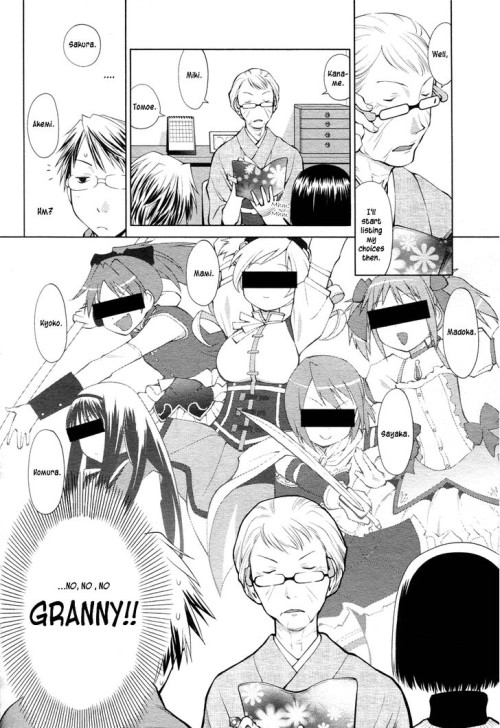
Basically, thanks to Spotted Flower, I realize now that all of the girls’ names inMadoka Magica are unconventional in that they’re actually two first names strung together, a convention that I primarily associate with American superhero comics.

That’s all, really. Maybe I’ll actually talk about Spotted Flower some other time.

The Fujoshi Files 38: Shu Mei

Name: Shu Mei (シューメイ)
Alias: N/A
Relationship Status: Single
Origin: Fujoshi no Honkai

Information:
Shu Mei is a 15-year-old exchange student from Taiwan. Though she was able to satisfy her desire for BL back home, the harsh environment of Taiwan (age restrictions, titles being canceled part-way through despite continuing publication in Japan) prompted her to study abroad in order to gain access to the full range of otaku merchandise. In Japan, she befriends a fellow fujoshi in Takako, as well as a fashionable closet fujoshi named Ageha. Like Takako and Ageha, she is a fan of Nanairo Shacho and delights in discussing pairings with her friends.

Shu Mei is an unusually sharp girl for her age, not only able to read people’s intentions down to the letter but also able to choose her words carefully enough to achieve a desired effect, whether it is comfort or agitation or subtle manipulation. She is also skilled in sewing damaged dolls back together.

Fujoshi Level:
Back in Taiwan, Shu Mei would often send her older brother to buy yaoi manga for her so that his innocent awkwardness in interacting with the male store clerk would provide fuel for her fujoshi mind.

Lovely Charming: Genshiken II, Chapter 73

When you ask a group of fujoshi (+1 fudanshi) for personal stories of high school romance, you get anything but. That’s Genshiken II, Chapter 73.

Chapter 73 of Genshiken II opens up right where the last chapter left off. In an effort to both have a story that can complement Hato’s drawing style and to also get out of her own creative rut, Ogiue is looking to write a shoujo manga with a high school campus festival setting. However, just as Ogiue is unable to draw on her own experience to write the story (“Actually, I didn’t even have any friends,” as she bluntly states), the only thing she gets from the freshmen are tiny pockets of sadness.

First up is Yajima, who recalls a boy who used to insult her drawings and then rub salt in the wound by actually being a better artist than her. The closest this gets to anything resembling “romance” is that the guy originally came up with a bizarre and insulting nickname for her (Hetakuso (Crappy) -> Hetappy -> Tappy) but eventually stopped using it. As Yoshitake points out, that seems more like bullying than anything else.

Second is Yoshitake, who went to an all-girls’ school and spent all her time in the history club. There, she debated history through the lens of a fujoshi. While plenty of girls in her school had boyfriends, Yoshitake certainly did not.

Last is Hato, who also claims that nothing happened with him. He’d never confessed to anyone, he was never confessed to, and talking about high school makes Hato increasingly nervous. Yajima tries to stop Yoshitake from prodding further by reminding her of what Hato said about being bullied, but this triggers the inner detective in Yoshitake. According Yoshitake, Hato’s difficulties in high school couldn’t possibly just be the result of revealing his interest in yaoi, but that romance was a factor. Before Yoshitake can pressure Hato into telling everything though, Kuchiki comes in and inadvertently rescues Hato from the interrogation through the power of his embarrassing awkwardness.

The chapter ends with Kuchiki revealing that unlike the rest of them, he actually had a girlfriend in high school (though it only lasted a day), and the shock is so great all-around that any remote chance of continuing the discussion fizzles out entirely. Ogiue declares that the high school romance idea is to be scrapped, and that she’ll be writing the cheesy overwrought stories (chuunibyou, or something an 8th grader would find deep) she usually does. Somehow, this whole fiasco may have inspired her to work again after all.

So at the end of the last review, I predicted that Sue would be the one to stun everyone with a tale of teenage love, but it turned out to be Kuchiki. I don’t think I was that far off, so I’m giving myself partial credit. And who knows, maybe we’ll still learn something about her in an upcoming chapter.

I’ve written a good deal about the generation gap that exists between the old and new Genshiken but seeing Yajima and Yoshitake’s respective pasts makes me feel that as much as things have changed, they’re still quite familiar in terms of the social troubles of being an otaku. Neither of them have had anything even closely resembling a relationship, and while you can chalk up some of the bullying to the fact that Yajima isn’t exactly the prettiest girl out there, it’s interesting to see that Yoshitake had to learn something about fashion along the way. If we compare Yoshitake’s style in high school to her sister Risa’s current look, there’s a noticeable difference, even putting aside their extremely different heights, faces, and body types.

At first I thought that the guy from Yajima’s past bore some resemblance to Risa (in the guise of “Rihito”), and that her initial attraction to the latter was somehow influenced by her experience with the former, but when I look at them side-by-side, I’m not sure if they’re similar enough to warrant that comparison. Perhaps if you consider the fact that they’re both tall and have bangs parted to the side, “Rihito” ends up looking like a more handsome version of that guy. Whether or not there’s a direct connection though, altogether I think it puts Yajima’s unease in the presence of the opposite sex into perspective.

While it’s kind of difficult to interpret the behavior of Yajima’s “friend” as him being attracted to her, I think this scenario is essentially the truth behind Hato’s own hidden teenage years. In the chapter, Sue points out that just as Yajima was mentioning the guy being better at drawing than her, Hato’s face turns a shade of red that would make a certain Zaku II Commander Type look subdued. There’s not much information to go on at this point, but I get the feeling that Hato’s inability to draw well when not in women’s clothing is a product of his failed high school romance, and that telling everyone about it may be the key to resolving his art problems. Perhaps he tried to get closer to a girl he liked by showing her his BL drawings, and his talent made her feel small by comparison.

And then there’s Kuchiki, who I think probably comes from the same lineage as Kimura from Azumanga Daioh. Both are extraordinarily creepy individuals, but they have perks in their lives that make the people around them feel worse. For Kimura, it’s a lovely wife and daughter, and for Kuchiki it’s having had a girlfriend at all, as well as having a well-paying job lined up after college thanks to nepotism.

The last two things I want to talk about are kind of small, but I feel the need to point them out.

First, the above panel is actually the first time we’ve seen the high school iteration of Ogiue in an actual chapter, and the second time we’ve seen her in a Genshiken book at all (third if you count Ogiue’s disguise at ComiFest). If you’re wondering about that other time, open up Volume 6 to the first page, and look kind of carefully.

Second, there are of course a number of references strewn throughout. Ohno mentions “HTT” or “Houkago Tea Time,” the band from K-On! Upon seeing Kuchiki, Sue says, “Hyoro-kun?”, a character from Chihayafuru (translated in the Crunchyroll subs as “Retro-kun”). Finally, the next chapter preview quote this time is “Next time, the Culture Festival draws near! That’s not what happens, but look forward to it anyway!” This is actually a reference to gdgd Fairies, which I reviewed previously. Now if you listened to me and watched the show, then you would’ve gotten the joke.

Probably.

The Fujoshi Files 37: Takako

Name: Takako (タカコ)
Alias: N/A
Relationship Status: Single
Origin: Fujoshi no Honkai

Information:
Takako is 15 years old and a fan of the Nanairo no Shacho series. Being the younger sister of a fellow fujoshi, Takako has had the benefit of growing up with her older sister Takayo’s vast BL archives, though Takayo’s decision to move in with her boyfriend (and to take her collection with her) leaves Takako having to fend for herself.

Takako is very comfortable talking with fellow otaku no matter their age, and believes that the best approach to being a fujoshi is to have as many cherished pairings as possible. She is good friends with Shu Mei, a Taiwanese exchange student and fellow fujoshi, and also eventually befriends the closet fujoshi Ageha. Together, they delight in having conversations about anime and manga, as well as pairing a couple of their fellow classmates who greatly resemble the characters of the Shacho franchise.

Fujoshi Level:
Owing to her sister’s influence, Takako has been a fujoshi since birth. While playing with dolls at the age of 4, Takako would wed her male dolls to each other.

The Adventures of Tsunacon 2012 ~New Wings~

This year was my second time at the Dutch anime convention known as Tsunacon. As a one-day event I won’t have a ton of things to say about it, but there were some significant differences this year, not least of which is the move from the town of Sliedrecht over to the more well-known city of Rotterdam to make room for the ever-growing con attendance numbers.

Naturally, the first difference was transportation. Whereas last year required me to transfer to a rather small and adorable train, Rotterdam is one of the largest cities in the country and so took only one train to get there (getting back was a different story, but more on that later). This also means that for other people living around the country, there is a far likelier chance that the trains will be relatively more convenient for them as well. But unlike in Sliedrecht where it took only a short walk from the station to the convention, going to the new location required an additional bus or tram. Well, you could still walk but it would probably take you over an hour, and if you’re like me and European cities and streets confuse you, then it would take you about twice that amount. The trams and buses are both very close to the train station though, so it isn’t really a hassle.

The actual site of the convention this year was the Social Sciences building of Erasmus University, and it was, as promised, significantly larger than the old place. With three floors available as opposed to just one, and a significant amount of space per floor, it seemed just the right size for the convention, providing enough room for people to move around, but not being so spacious as to dwarf the crowd and make the place seem barren. Cosplayers were naturally everywhere, and as is common here, the dealer’s room is combined with the artists’ alley, with dealers and artists all mixed together. Overall, the university was lacking some of the charm of the old location in terms of its coziness and warmth, but I think it was a fair (and of course necessary) trade.

One major difference with the new location was the way in which food was handled. The spot in Sliedrecht was something of a fitness and recreation center, so it had both a small bar in the main area, as well as a bar with seats where karaoke had taken place. One of the most vivid memories for me at my first Dutch con was seeing a fairly large crowd chowing down on cup noodles like they were the best thing ever made (a claim that is supported to some extent by the fact that it has its own museum). This year however, cup noodles were practically a thing of the past, as Tsunacon saw it fit to serve actual bentou and bowls of ramen straight out of Naruto (with signs saying “Ichikaru Ramen” hanging above the serving area). Though the lack of a bar limited the food options (no bitterballen or Japanese beer as far as I could tell), this did not seem to bother the patrons at all, because the line was gigantic.

Even though I passed by the line repeatedly over the course of many hours, not once did the line ever die down, as if the people’s desire for ramen was insatiable. Honestly, I can relate, because unless you live in Den Haag, Rotterdam, or Amstelveen, it can be quite difficult to get a half-decent bowl of Asian noodle soup in the Netherlands, whether it’s ramen, wonton noodles, or pho. I know it’s a hunger that never fully dies down, and maybe on a different day I would have joined them.

There’s some obvious advice for you: serve Japanese food at an anime convention and you’re sure to be a smash hit. Think Pocky is the talk of the town? Why not hit them with some udon?

The larger space also allowed for something new this year: panels. Whereas last year the closest thing you could get to a panel was a cosplay/AMV competiton or an arts and crafts workshop or two, Tsunacon dedicated a room to the endeavor. Seeing as the panels were in Dutch, I couldn’t exactly get the most of them, but I did attend the one panel I could actually follow along with: Name that Anime. Divided into categories such as “openings,” “action scenes,” and “traps” (yes, that kind of trap), the panelists showed footage from a large variety of anime. As far as I could tell, most of the anime were from the last decade or so, with a sprinkling of Ghibli as the primary representation of anime 20 years and older. As I wasn’t sure of the exact nature of the panel going into it, I didn’t participate for fear that my inability to speak or comprehend Dutch would hold me back, but I might try next year. Overall, the panel was 90 minutes, which might either be too much or not enough for this kind of “game show,” but it seemed like it was on a good track to improvement for next year.

The last thing I did at the con was go to the karaoke room, as anyone who knows me is aware of the fact that I enjoy singing anime songs even though I can’t sing. It’s also fun to see people really get into the songs they love, which ranged from Vocaloid tracks to the popular shounen titles to the English Pokemon theme, which seems to be universally popular among singing anime fans. I spoke about this last year, but the people responsible for karaoke at Dutch cons have an entire fancy system set up to mimic a proper set. With a monitor displaying words in-sync with the song, just about anyone can follow along if they know the basics of the song, something that not even Otakon has. As for myself, I recognized a lack of burning passion in people’s selections, so I went with the go-to song for both me and one Astro Toy columnist: Kanjite Knight. Though quite off-key, the crowd was still nice enough to applaud my endeavor.

When I look at the attendees at these conventions in the Netherlands, I get the feeling that, while tastes are largely similar between the US and Dutch fans, there seem to be some major differences as well. Most notably, One Piece seems to be more well-loved among the Dutch anime fans. Does anyone else get this impression? People sang One Piece songs at karaoke, One Piece merchandise seemed to be popular in the dealer’s room, and I even saw a Garp cosplayer, which is something I have never seen at an American con (though I may have just not been paying attention). How popular is Monkey D. Luffy and his merry band of pirates among Dutch otaku, anyway?

In any case, cosplay:


(To the cosplayers above who asked me to send you this photo, my apologies as I seem to have lost your card!)


The famous combo of Chii & Stocking

I would have stuck around longer, but by 4pm noticed that it had began to snow. As I have learned during my time here, snow + Dutch trains = not fun, and what was once a 30-minute trip turned into 2 hours. Obviously, that’s no fault of the convention itself, and in hindsight I can only imagine how much worse the delays would have been going to and from Sliedrecht. In spite of those troubles, it was overall a fun convention where people just enjoyed being anime fans.