“Broad Appeal?”

Whenever I see an article or post about how anime is declining because of a focus on an increasingly niche, otaku audience, I’m a little taken aback. This is not only because the most commonly given solution, i.e. “make things with broader appeal” is easier said than done, but that the very idea itself doesn’t actually seem to be what its most adamant proponents truly mean or want.

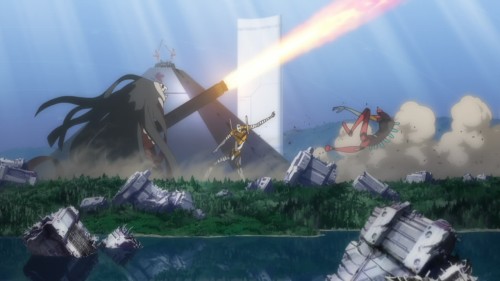
Take Redline for instance, which is touted by a number of people as a sort of magic bullet that has the potential to blast away years of anime-related stigma. Certainly it’s a fantastic film on a number of different levels, but I have a hard time believing that it qualifies as “broadly appealing,” unless your definition of “broadly appealing” is limited to geeks with a penchant for thrills and visual spectacle, or alternately, anime fans from previous decades, especially from when “anime” was closely tied to “science fiction” in their eyes. Don’t get me wrong, I’ll be the first to argue that the storytelling in Redline is excellent, and that it’s far more than just pretty explosions, but something like Redline will be not judged by a more general audience unfamiliar with anime based on the subtle nuance that exists in its otherwise extreme characters. It’s full of violence and has a sprinkling of nudity, and while that sells for some, it’s also an instant turn-off for others.

“Anime with broader appeal.”

“Anime that the average person will enjoy.”

I believe these to be obtainable goals, but I find that when people talk like this, they don’t necessarily want something for a wider audience, they want anime that is closer to what they enjoy most, that possess the qualities they think are most essential to great anime, or at least acceptable anime. Certainly, wanting more of what you enjoy only makes sense, but it results in conflating “broad appeal” with the tastes of the individual. Rather than something like Redline or Cowboy Bebop, maybe the answer will be the anime equivalent of The Big Bang Theory or Hannah Montana or something else far-removed from the aforementioned anime titles. Which is to say, if anime in whole or in part transformed itself to really aim for that bigger audience around the world, the result may not be what we might be expecting.

This somewhat reminds me of all of the manga creators that have been revisiting their older work. Even putting my beloved Genshiken aside, you have GTO: Shonan 14 Days and Rurouni Kenshin, among others. All of them have certain expectations associated with them because you have the original creators working on them, but when you think about it there’s no guarantee that the work will actually be all that similar. After all, artists can change given time and experience. Macross: The First is a retelling of the first series by the original character designer Mikimoto Haruhiko, who is praised especially by a certain generation of anime fans as being one of the best character designers ever. They might point to his work and say, “There, why can’t anime characters look more like that, instead of what we’re getting today?”

The only problem is, Mikimoto’s own artwork today doesn’t look like his work from the 1980s. For that matter, if you look at his stuff from between the original Macross and now, it also looks quite different.

Expectations shattered?

The Barrier to Mahjong is the Self

I haven’t been playing as much mahjong lately, due to a combination of lack of time and a desire to distance myself from it for a little bit, but every so often I decide to sit down for a couple games. When I do, I inevitably get clobbered, unable to handle the assault of my fellow tile slingers. To some extent, I know that this is due to rust on my already meager skills, but I think that there is another factor involved. When I stop playing mahjong for a while, my mind becomes unaccustomed to some of the psychological rigors of the game, and it takes a while to adjust back to normal. In this period, I’m especially vulnerable, so if I just come back to the game every few weeks I end up never quite leaving that mindset.

“So why not just keep playing until you get back to where you were?” you might be asking. I ask myself this too. The “problem” however, is that mahjong can be an incredibly nerve-wracking game in a way that few others are. The combination of luck and skill, where everyone is planning something and you can’t quite tell where luck ends and decisions begin, and the fact that the difference between winning and losing can come down to one unfortunate dealing of a tile, makes for an intense and mentally exhausting game, especially when you’re playing on the competitive Tenhou ladder and people mean serious business.

That tense do-or-die feeling is also why mahjong is fun in the first place, so the dilemma at hand is simply this: do I devote that amount of energy to playing it, knowing that while it’s a great way to really challenge myself and test my ability to handle luck and the machinations of others, it can also be a very powerful source of frustration?

The Potentially Positive Influence of Public Relationships in the Starcraft 2 Pro Scene

The release of Starcraft 2 last year has caused something of a boom in competitive video gaming, referred to in the community as “ESPORTS.” More and more, professional gamers around the world are becoming stars, and along the way the fact (or impression) that they’re “nerds” is celebrated; to be a nerd is to be smart and talented and even handsome. Made prominent is the idea that nerds can be attractive to the opposite sex, that these (mostly male) keyboard athletes have an appeal attached to their passion and drive for victory.  This is not a new concept, as is evident in the gigantic Korean Brood War scene and the fact that based on the screams of the audience you might assume that it’s John Lennon playing from that soundproof booth. However, a major difference is that while Brood War shows its players as owners of large female fanbases, competitive Starcraft 2 is showcasing couples far more prominently, both inside and outside of Korea.

Whereas Brood War pros will avoid answering the question of significant others (or will mention girls they once dated), Starcraft 2 pros seem much more willing to admit that they are seeing someone. Moreover, Starcraft 2‘s has what can be described as “power couples,” well-publicized relationships where both individuals are a part of the scene. Evil Geniuses captain Geoff “iNcontroL” Robinson and Miss Oregon 2011 Anna Prosser, Startale captain Kim “RainBOw” Sung Je and his fellow teammate Kim “aphrodite” Ga Young, player/caster Trevor “TorcH” Housten and WCG Ultimate Gamer Rachel “SeltzerPlease” Quirico, Terran Emperor Lim “SlayerSBoxeR” Yo Hwan and actress Kim “Jessica” Ga Yeon, all are major examples of the public relationships that populate the Starcraft 2 community.

Part of this may simply have to do with the higher average age of Starcraft 2 pros vs. their Brood War counterparts. Where 20 might be considered an aged veteran in Brood War, some of the most talented and well-known Starcraft 2 players are approaching or even past their 30s, and with that comes possibly a sense of maturity and stability. It is also well-known that dating is frowned upon for Brood War pros for fear that it might distract them too much from the game, and no such taboo exists for Starcraft 2. While there are prominent married figures in Brood War such as Choi “iloveoov” Yun Sung, BoxeR’s former teammate and one of the most dominant players of all time, and Kim “January” Ga Eul, manager of the team Samsung KHAN, neither of them were active players when their significant others were made public. The “sex appeal” of the young Brood War player seems to be more along the lines of a K-Pop star whose relationship status is intentionally ambiguous to draw in more fans.

The reason that I am pointing all of this out is not to foster gossip about who’s dating who or to draw attention away from the games themselves, but to posit the idea that perhaps that seeing these relationships can potentially promote a different kind of lifestyle image for the nerds of the world. Rather than being a hit with the ladies, the professional nerd can be a hit with the woman of his life. You, yes you, can find a woman who will not only condone your geek lifestyle but will understand and actively support it. More than just an aspiration, the power couples of Starcraft 2 provide concrete examples that this is an attainable goal.  What is also clear, especially from the examples given above, is that these couples are not together solely because of an individual’s skill when it comes to their game of choice, but because of their character. In this way, progamers may act as role models in more ways than one.

Year 4 of the Blogging Experiment

Today marks the 4-year anniversary of Ogiue Maniax, and I thought I’d use this opportunity to reflect on a topic that’s been on the back of my mind for a while.

As those of you who keep up with this blog probably know, I began an academic career focusing on manga last year, and part of the reason I was able to do so is that I’ve honed my ability to talk about anime and manga through my blogging. Now though, the question I have for myself is, has my time in academia affected my blog posts in a way that shows an academic influence?

Seeing as I’ve never tried to write a full-on scholarly essay on Ogiue Maniax with footnotes and elaborations on methodology and the like, I don’t think I’ve changed my fundamental posting style in that regard, but I have to wonder if there are any more subtle changes that have to do directly with academia. The fact that I post much less than I used to and make longer posts in general is probably more attributable to my desire to avoid mental fatigue, but I don’t think it really bleeds into the writing itself. I can’t really think of anything major. At the same time, I’ve found myself less willing to make posts with incomplete thoughts like I used to, which may be a sign.

From my own admittedly biased self-examination (as if there is any other kind), I wonder if I don’t let my academic influences enter into my blogging enough. Sometimes I argue things primarily out of passion, and I find myself making assumptions every so often that would probably get hit with a flurry of criticisms in a more rigid setting, which makes me ask if I shouldn’t be reining it in a little bit, researching more vigorously for my blog posts. That’s not to say that every post should be that way (the Fujoshi Files for instance wouldn’t work in that regard), but maybe I should be holding myself to a higher standard.

So I want to ask my readers who’ve been with me for a while, do you find my writing has changed in a manner which reveals my increased academic leanings? If so, do you think it’s something to watch out for, or perhaps something worth encouraging? Is there something about the blog that you like more now, or perhaps something you miss and would like to see more of?

In any case, thank you for these four years. It’s been great walking with you.

Thoughts On the Pervasiveness of 4chanspeak

Since its inception, 4chan has generated a peculiar set of vocabulary. The term “weeaboo,” now synonymous with “japanophile” and “wapanese,” was born out of a word filter designed to mitigate usage of the term “wapanese.” Often times extreme and intentionally insulting, 4chan is also known for appending the suffix “-fag” to almost every word possible, to the point that its origin as a homosexual slur almost becomes a generalized slur. How else would you explain the usage of the term “straightfag” to denote someone who is annoyingly heterosexual?

Though it is convenient and perhaps comforting to think of terms such as “weeaboo” and “moralfag” as isolated elements of the 4chan userbase, 4chan-isms have permeated the internet to the extent that people who have never even loaded a 4chan page are using these phrases. I saw one such thread on a reddit video games thread, where after throwing around a bunch of classic 4chan terms, proceeded to ask what /v/ is  (the video games board on 4chan).

Personally, when it comes to my writing and even my online chatting, I prefer to keep the usage of 4chan-isms to a minimum, because I feel that they 1) have too much baggage that requires unpacking and 2) are overly broad when I tend to prefer a bit of precision in my sentences. I also prefer that other people do the same, though I don’t mind seeing it pop up every so often, especially for flavor. On the other hand, overuse of 4chan-isms to the extent that thoughts are conveyed using almost nothing but them can not only be difficult to read but causes my mind to kind of gloss over what they have to say.

However, given the sheer amount of 4chanspeak users out there, I find it increasingly difficult to write off what people have to say solely because of their excessive 4chan-sisms.  After all, if it has become so ubiquitous, if there is an entire generation of internet users who think this to be the normal way to speak online, then it is more than likely that very smart and insightful individuals who communicate primarily through such terms exist. While I can criticize them for using terms which probably have better alternatives, I cannot deny the possibility that smart things can be said in a “inarticulate” fashion. Not only that, but if someone feels most comfortable describing their feelings using 4chanspeak, who am I to judge? If someone says, “I got NTR’d and might become a suicidefag,” and actually means it, then maybe I have to just understand that sentence as being their way of expressing a hurtful situation and to take that seriously.

Burning Out On Quality

A while back I wrote a post about mitigating burn-out when it comes to consuming anime and manga, advice that had the caveat of me never having actually burned out, which means that I’m either very qualified to talk about it or not qualified at all. Recently though, I was in a situation where I had trouble watching anime, and I feel like I learned a lot from it.

I’ve been watching a lot of science fiction-themed anime, series full of ideas about how the future can/will/should be, not necessarily heady stuff but enough to make a person think a fair amount. However, even though I like everything I’m watching, one day I just suddenly had this strong desire to not continue, like my brain and eyes were telling me that they would refuse to process that information meaningfully if I tried to watch more. I wasn’t sure what to make of it, until I could hear my own thoughts more clearly.

I need to watch something ultra dumb.

And so I did, not knowing how long it would be until I could restore my capacity to watch so much science fiction. In the end, it only took a day away from those shows for me to feel the urge to keep watching, but it taught me a valuable lesson that seems so obvious in hindsight: You can have too much of a good thing.

Often the picture of anime burn-out seems to be that someone who just watched too many bad shows and can no longer handle the bottom-feeding tropes which populate low-tier anime, but I think that a more fundamental aspect of such burn-out is just monotony. Much like eating the same food day in and day out with no variety, even the most delicious of meals can lose their flavor, especially if you’re not naturally predisposed to liking them. Also like food, the level of variation needed to keep things interesting varies from person to person. With anime, I find there are shows that I can become quite fond of with little effort, shows that I can watch just about any time, but for other shows, I find I need to put a bit of myself into the show. As a result, sometimes I find myself unwilling to watch another episode because I can sense that my mind is “exhausted” and will not give me an accurate impression, and just pushing and hoping to power through that mental blockade can end up doing more harm than good.

And so, I have much gratitude for ultra dumb shows. Sometimes they’re just what I need.

The Evangelion Pilots, Represented in Combat

I’ve been revisiting Neon Genesis Evangelion lately and have come to appreciate it in ways that I hadn’t before. While I always found the show to be especially good at showing the deep-seated fears and emotions within the characters to the point that they feel almost tangible, I’ve begun to take note of how well the characters’ words and actions exemplify their personalities.

One example that stands out in my mind comes from Episode 19, the famous episode where EVA-01 goes berserk and eats the enemy angel, Zeruel. When Zeruel descends upon Tokyo-3, it is first met by a barrage of artillery fire from Asuka and her EVA-02, just weapon after weapon after weapon, with Asuka getting progressively angrier until she is defeated. Rei then appears, her EVA-00 missing an arm, and charges at Zeruel with a powerful bomb with the plans to detonate it at point blank range. Later, right before Zeruel can attack the staff of NERV, Shinji bursts through and engages in melee combat, then loses power, then goes berserk. What I’ve come to realize is that the way each character fights in that scene represents them incredibly well, acting as more than just a visual spectacle.

Asuka is always looking to prove her self-worth, particularly as a pilot and as compensation for her traumatic childhood, and her desperation mounts increasingly as more and more weapons are deployed by the EVA-02. This loud, brash display of firepower is Asuka.

From the way everyone else reacts to seeing Rei carry the N² Mine, it is clear that no one knew of this beforehand, which means that the idea is entirely her own. Rei, who constantly questions whether or not she is human at all, has very little regard for her own life.

Shinji fights with a form of desperation different from Asuka’s, and as one of his core traits is a vague sense of self-identity, Shinji’s close combat perhaps shows his desire to gain an identity through the piloting of EVA-01. This also differs from Asuka because Shinji is not looking to prove himself, but rather to find himself. It might also be possible to say that the berserk scene itself shows Shinji’s tendency to be pulled along, though I’m not sure about that one.

I think the best indicator for how much this particular moment in Evangelion represents the inner feelings of its characters comes from a comparison to the redone scene in the second Rebuild of Evangelion movie. In it, Mari replaces Asuka in EVA-02 for the film’s iteration, and the fight begins in a similar fashion, with EVA-02 surrounded by firearms which Mari initially uses one after the other. However, the scene itself feels remarkably different. Mari uses each weapon more slowly and deliberately, never really reaching the intensity that Asuka did in the TV series, and after only a few decides to run in up close with a melee weapon. The method Asuka used is something only Asuka can do; it would not reflect Mari’s character.

As for Rei and Shinji, their changes highlight more of a subtle shift in character, a fundamental part of the new films. Rei, just like the original, attempts to defeat Zeruel by detonating a bomb at point-blank, but in this version Rei takes the time to push Mari and the EVA-02 out of the blast radius while thanking her, showing that her actions do not simply stem from doubting her own humanity but from also affirming the humanity of others. Shinji’s fight is initially similar, but as I once mentioned in my review of the film, Shinji never loses control, the “berserk” EVA-01’s actions conscious and deliberate on the part of Shinji. While he still seeks his own identity, he is able to set that aside to save Rei, establishing a stronger identity in the process.

I’d like to actually end by talking about Mari once more, because as I was making this comparison I realized the role she plays relative to the others in terms of their relationship to the Evangelions. Asuka pursues self-worth, Shinji self-identity, and Rei a connection to humanity, but Mari seeks pleasure in the act itself. She revels in being an EVA pilot in and of itself, with no seeming underlying motivation except perhaps some strange desire to experience life to its fullest. Her “bestial” fighting style, even before she activates the actual “THE BEAST” mode, is indicative of this. That Evangelion is able to cut to the core of its characters in even its action scenes makes it truly impressive.

The Difference in Variety in the New Genshiken

In the past, I’ve written a number of posts in response to some of the backlash that the new Genshiken receives, particularly in regards to the new cast of characters. Whether it’s pointing out how Genshiken changes throughout its run (for the better), or that the general perception of otaku has changed just enough that some are happily willing to be labeled as such, my goal has been to show that the series has never stopped being “real,” and that it most certainly still reflects otaku life. There’s nothing wrong with or invalid about liking Genshiken while disliking Genshiken II (the comic does feel somewhat different, after all), but I just find the criticism that the characters are somehow less developed to be one I can’t agree with.

So when I see the criticism that the new characters in Genshiken lack variety, I was surprised. Upon seeing the reasons, I was confused.

The argument is that the new characters are all into BL, whereas once you had a guy who was into model kits and cosplay (Tanaka), a guy who was ostensibly into drawing (Kugayama), a guy who fought hard for Otaku Life (Madarame). This supposed lack of variety potentially even labels all female otaku as BL-hungry fujoshi, a mistake that many make both in and out of the world of fiction. At first, I considered arguing from the fact that the Genshiken old guard all had fairly similar tastes in erotica and doujinshi, some more extreme than others. I realized, however, that taking such a stance wasn’t really answering the question of variety, and that it’s true that the older characters seemed to have a wider array of otaku hobbies. Among the current members, most of them are indeed into yaoi, many of them like to draw, and their conversations often lead to discussions of pairings and such. That said, there is an important difference between the old and new Genshiken in that the approach to diversity has changed.

It is true that Sasahara and the rest all have different interests as otaku, and together they show a variety of colorful personalities in part due to those interests, but at the same time they’re all different types of Awkward Nerd, Kohsaka with his good looks and upbeat personality being the only real exception. Kasukabe and Sasahara’s sister Keiko of course aren’t even otaku at all, and instead provide a very clear point of comparison, the normals as opposed to the nerds. With the current iteration of the club however, while just about all of them are into similar things like BL, they actually have widely varying degrees of awkwardness. While Hato’s crossdressing can create awkwardness, he himself does not necessarily exude it, and Yoshitake is almost impossible to label as such. Whereas once Kohsaka was the major exception, his approach to being an otaku, while not quite yet the rule, resembling this current generation more than the one before it. Moreover, between Hato’s judo training and the younger Yoshitake sister’s years of basketball you even have now, of all things, athletic individuals devoid of the physical awkwardness that is prevalent in so many portrayals of otaku.

As is explored in Chapter 58 (the drunken party chapter), part of Yajima’s character is that she feels caught in the middle of this transition. In her mind, otaku are supposed to be weird, inept people who look and possibly smell less than ideal (I’m paraphrasing), but all of the girls (and at least one guy) around her in Genshiken seem to be smart, beautiful, talented, and confident. In this regard, she is somewhat alone, her type and level of awkwardness greater than the rest, but with her ability to comfortably interact with all of them even she is a sign of the ever-changing times and identity of “otaku.”

While the new Genshiken may indeed be populated by yaoi fans (and we’re not even sure if Risa’s thing for shota is necessarily also a BL thing), it has a level of variety in characters and personalities that was previously only achieved on a much more extreme scale, one that had to even include non-otaku. Their hobbies may not be as varied, but they themselves are comprise a diverse cast of fully formed otaku-as-characters in a world where awkwardness, social or physical, is not a prerequisite.

Ogiue Maniax on the Veef Show

I recorded a podcast over at the Veef Show just this past weekend with Andrew of Collection DX fame, and it is up for your listening pleasure.

We talk about a number of topics, but it mainly focuses on things like space travel, the state of anime, and philosophizing about that most sacred of subjects, mecha anime. For reference, my Code Geass post that we mention is this one.

Apologies for the background noise on my end. If you’re curious, that’s the sound of Leidens Ontzet.

So in summary, this:

Plus this:

Explaining Decompression in Comics

“Decompression” has been a hot topic in the American comics community for a number of years now. Characterized by a high panel count with each individual panel being relatively “light” on information, it is noted as being the primary mode of panel progression in manga as well as an increasing presence in American comics. Among superhero fans however, it seems to garner a particularly adamant resistance, one that goes as far as to champion “compressed” storytelling in contrast to it.

A cursory investigation on the topic of decompression on comics sites and blogs results in far greater instances of harsh criticism aimed at decompression than ones defending it, with the criticisms usually pointing out a lack of paneling efficiency or an unsatisfactory amount of story development within a given chapter. Because of the thin, monthly format release traditional to superhero comics, decompression is thus characterized as being a waste of not only time and (page) space, but also money. “Why show in five panels what you could easily show in one or two?” is the question lobbed at manga and decompressed comics in general.

Panel efficiency, and for that matter storytelling efficiency in general, is important. A story which gives the impression that it is wasting a reader’s time is a story that will probably never finish for the reader, but what is most fascinating about the criticisms directed towards decompressed storytelling is how it reveals the priorities and values of the American comics community. Consider the following comment from 2004:

Amazingly, at a time when new comic titles are lucky to survive beyond 12 issues, we are seeing comics where an entire month is devoted to the protagonist talking to his girlfriend. Most of us have had relationships that didn’t last that long. It is only a matter of time before we will see a superhero title get cancelled before the hero even makes his first appearance in costume. Imagine “Superman” getting the axe just before the rocket lands in Smallville.

No wonder it now takes five issues for Spider-Man to beat the Green Goblin nowadays.

As well as this one from 2007:

It’s a city in the future (a bagel breakfast cost 9 dollars, some futuristic cars and ad scrolls, the parking meters, the coffee cup disintegrates before it hits the ground).
The main character is black and looks like Avery Brooks, as someone pointed out to me when issue #6 came out. (Sorry, I can’t remember who it was.)

Umm … yeah, that’s it. Four panels for that???? If you found this comic page floating along our hypothetical street after someone in a fit of pique after spending 3 bucks on this ripped it out and hurled it to its fate, you would know absolutely nothing about this comic book except that it’s set in the future. That’s it. Would that make you want to buy the book?

They make a fair point. You don’t want a story with so little content that it becomes completely forgettable. However, from the above statements, you can begin to see how the concept of “content” is defined by the American superhero comics community. Content is a superhero getting their first costume. Content is Kal-El’s ship crashing in Smallville, Kansas. Content is Spider-Man foiling the Green Goblin. In other words, “content” consists of crystallized plot points within a story, things you can point to in a summary however large or small to say, “these are the moments of importance.” What content is not, apparently, is the silent expression of a moment in time or an entire month devoted to a main character and his relationship with his girlfriend. That those elements are considered to be superfluous to what “really matters” is, I think, the root of major misconceptions when it comes to understanding decompression or manga-style paneling.

If you were to go up to a manga author and say to them, “Your manga wastes the vast majority of its space,” they would probably look at you incredulously, because efficiency in page layout is actually very important for manga creators. If you then pointed to a Silver Age superhero comic as an example of brilliant economization of panels, they would probably react with still more disbelief, amazed at how much the page seems to be weighed down by its own contents. This is because the concept of “panel efficiency” is defined differently between the American superhero comics tradition and Japanese comics tradition. The difference can be summarized to some extent as the contrast between efficiency defined as the greatest amount of “stuff” packed into the smallest amount of space possible and efficiency defined as a slick, streamlined experience, but that doesn’t quite tell the whole story.
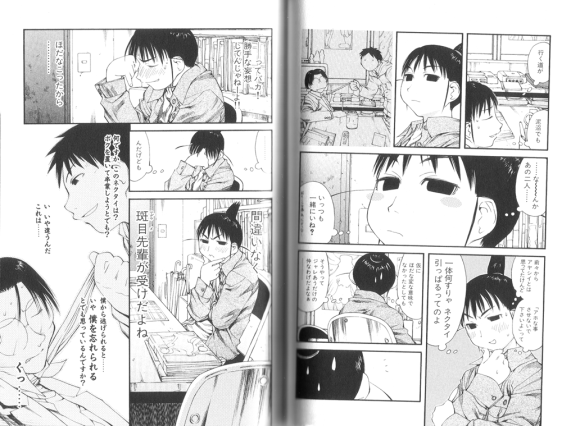
Above is a scene from Genshiken, a comic about a group of nerds who hang out together. It’s one of my favorite moments from my favorite manga about my favorite character, to the extent that I use it for the Ogiue Maniax banner. In it, Ogiue, the girl with the “paintbrush” hair and this blog’s namesake, has just witnessed a frivolous argument between two guys in her club, and is using that as fuel for an elaborate fantasy involving the two guys as romantic partners. Partway through, she tries to curb her imagination, but it’s so futile that she seamlessly transitions back into the fantasy.

Looking at those two pages, this moment is expressed in 11 panels. While you could make this scene more “efficient” in the American comics sense and just drop it down to maybe three or so panels—one for her beginning to fantasize, one for her trying to stop, and one for her continuing—it would change the very nature of this scene. It wouldn’t necessarily be a “worse” depiction, but the emphasis would be different. In panel 2, you see a closeup of Ogiue’s face with no text. From it, you can sense that the gears in her head are beginning to turn. Then, in the subsequent panels, the thought comes to life, growing slowly as if it has a pulse and rhythm all its own. The panels show Ogiue from different angles with varying expressions on her face, punctuated every so often by a brief pause, allowing the reader to see into her mind, not just in terms of what she’s thinking, but the process by which her thoughts unfold. So while the broad arc is “fantasize, pause, fantasize,” it is the “decompression” of that moment which gives it strength as a moment of characterization.

You may be thinking that the reason I like these pages are because of the fact that Ogiue is in them, but it’s actually quite the opposite. Moments like these are why I grew to like Ogiue in the first place.

Decompression in comics is not the same as having “natural-sounding dialogue” or having a moment feel more “realistic.” While those end up having a presence in many decompressed comics, especially in many of the American comics which have been in that vein, they’re not the reason decompression happens. Instead, decompression is about giving moments in a comic room to breathe, to show that those spaces in between the “major points” are important in their own way, or perhaps just as, if not more important. The result is that it affects everything else in the comic, from characterization to page design.

A “decompressed” comic packed into the same space as a “compressed” comic can have just as much content depending on how you define “content.”

That is not to say that decompression can be used as a default excuse to defend the pacing of a comic. A comic which meanders, whether it’s manga or a superhero comic, can be enormously frustrating, but there is a big difference between “being slow” and “being directionless,” and the idea that “nothing is happening” may actually just be based on a pre-existing valuation of certain traditional elements within American comics that was less emphasized in Japanese comics. It is also important that decompression not be considered automatically a better form of comics expression, because the artistic tradition that has grown out of superhero comics is just as valid as any other. The rich “information density” of a “compressed” comic is its own sort of adventure, and you can even find some manga that utilize it to a certain degree, such as the work of Shirow Masamune (Ghost in the Shell, Appleseed). On that note, it would also be a mistake to say that a comic of purely decompressed panels is better than one consisting of entirely compressed panels. This is because not only is it impossible to truly achieve both (even the most “decompressed” panels involve some compression and vice versa), but also because individual execution and personal preference play enormous roles at that point. Perhaps some of the trouble brought on by the presence of decompression has less to do with the properties of the concept and more to do with the growing pains that have come from transitioning and adapting it into the American superhero comics culture.

Sometimes I think “decompression” is both the right and wrong word to describe this style of storytelling in comics. On the one hand, it does a good job of bringing to mind the “room to breathe” concept, emphasizing the lingering, undefinable inner emotions of a character or growing tension or the blow-by-blow impact of a fight scene. On the other hand, it also implies that the “significant” portions of the story are being pushed further apart from each other, when what is really happening is that the “small” moments are being regarded as anything but.