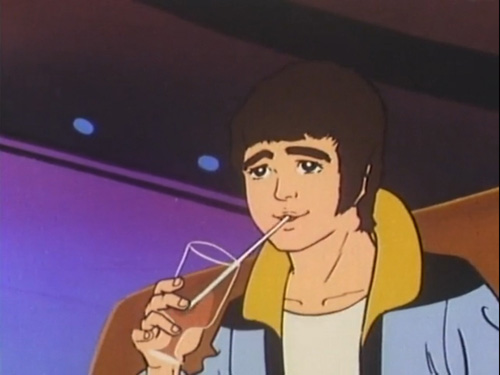
Busou Renkin, a Good Manga but a Bad Shounen Fight Manga

After attending Kurosaki Kaoru’s Otakon panel on her husband, Rurouni Kenshin author Watsuki Nobuhiro, I felt compelled to read more of his stuff, though perhaps unexpectedly I gravitated towards Busou Renkin, a manga that I had no idea about beyond having some girl with a scar on her face. Now, after having read all of Busou Renkin, I find it to be a rather interesting work in that its strengths and weaknesses like distinctly along the lines between what is “conventional” in shounen fighting manga and what is not.

In the end-of-volume notes in Busou Renkin, Watsuki writes about how this title is his attempt to make a straightforward shounen fighting manga along the veins of Dragonball and its ilk, but even if he had never said anything this would have been completely obvious. Busou Renkin has a typical high school guy protagonist Kazuki who encounters a mysterious power which gives him a cool weapon to fight villainous creatures and evil organizations with the help of a girl who is more experienced than he is but has less overall potential. It’s about as established a structure for a manga as it gets, but what’s especially fascinating is that Watsuki pretty much fails to execute that basic premise well, and we’re left with a kind of hodge podge of shounen-esque elements which either do not have enough oomph to wow aesthetically (like in the weapons for instance), straightforward payoffs which aren’t really satisfying, and just a lack of connective tissue to hold it all together. I think it’s often easy to characterize the shounen fighting manga as simpler or even easier and therefore less worthy of merit, something that should be child’s play for the creator of Rurouni Kenshin, but Watsuki’s mixed success with Busou Renkin reminds me of something said in Bakuman, which is that because it’s the most reliably successful formula, it also gets the most scrutiny.

Just as the series doesn’t quite deliver within the established structure it purposely stepped into, however, it also impresses when it comes to elements of itself which are not conventional shounen. A lot of it is in the small gags, but the main example is the female character referred to above, Tokiko. Her relationship with Kazuki is the absolute highlight of the series, and seeing them grow closer while giving each other strength makes the whole thing just so much more enjoyable than if it were solely about the fight against increasingly powerful enemies. It’s not even that Tokiko is a strong female character (which she is, and which I’ll get to in a bit), but that there’s an active interaction between equals when you see her and Kazuki together. It’s kind of telling that the final chapter (albeit a final chapter which technically followed the intended final chapter which then followed the original end of the manga which got canceled, it’s confusing I know) is about advancing the romance between Kazuki and Tokiko, and about Tokiko’s past and personality.

When I look at Tokiko, particularly in regards to that last chapter, she gives me the impression of being a kind of proto-Mikasa from Attack on Titan. They share a similar kind of intensity and desire to proect, and neither are slouches when it comes to being able to fight. Both are less squeamish than their male counterparts about a number of things, and both are willing to resort to extreme violence to get the job done. Tokiko can be so vicious that she’s eviscerated someone from inside out, and her catch phrase is actually, “I’ll splatter your guts!” like she’s somehow distantly related to the guy from the Doom comic. It’s maybe no surprise that she ended up being the most iconic and memorable part of Busou Renkin, not just for myself but seemingly everyone else.

As a shounen fight manga, you’re probably better off reading Akamatsu Ken’s UQ Holder, which seems to be doing most of what Busou Renkin tried to do but better and more consistently. However, judged on its less upfront merits, Busou Renkin is really strong, and if you’re a fan of Mikasa from Attack on Titan I think the character of Tokiko will hold immense appeal.

Spring 2013 Mecha Anime Retrospective (Majestic Prince, Gargantia, Valvrave)

Last spring marked an unusually robot-heavy season of anime where three mecha shows, Gargantia on the Verdurous Planet, Ginga Kikoutai Majestic Prince, and Valvrave the Liberator, took three different angles each of which had their own unique appeal. I originally wrote about them as a package, so now with all three shows finished (aside from the fact that Gargantia has another series on the horizon) I figure it’s best to look back on them all at once.

Ginga Kikoutai Majestic Prince, which had a strong tokusatsu or even 90s anime feel to it, ended up progressing almost as expected, but without it being tedious or losing something in the process. In shows like Majestic Prince, there’s usually some sort of humble beginnings, in this case the main heroes being the “losers” of their class, and comedy gives way to a more serious story as the narrative progresses until it ends up in a giant space battle. It’s par for the course, but while I can’t say Majestic Prince will change the way we think about giant robot anime, I do find that the show is a little bit of everything, nothing in particular that screams, “Wow, this is amazing!” but lots of minor things done well which make for an overall satisfying experience, and a more consistently forward-moving story compared to Gyrozetter. It’s a popcorn anime, something you might show to an anime club or a group of friends to relax, where you find yourself gradually more invested by the final string of episodes. Because of this, Majestic Prince is the show I simply have least to say about, though I do want to point out that it has one of the most memorable death lines ever. You’ll know it when you hear it.
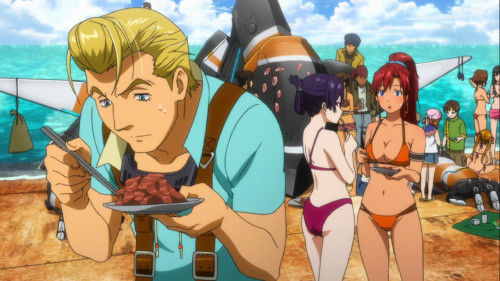
Although Majestic Prince isn’t a show I can talk about too extensively in terms of conceptual or thematic depth (it skims the surface of topics like genetic engineering and human behavior at the very mosy), Gargantia on the Verdurous Planet is the strongest of the three shows in terms of both its ideas and how it presents them. Its initial format, where Ledo, a boy from another galaxy who knows only war, is exposed to the everyday lives of the Earth characters and their concept of family, acts as a part of the science fictional exploration of its world and which become the backdrop for the show to reveal its secrets was somewhat of a source of disagreement and controversy. As people wondered how the story would turn out, there were both complaints that Gargantia spent too much time focusing on the daily lives of characters and that it too much time on its narrative drama. Personally, I think it ended up striking a very nice balance, as we got to learn about the culture of Earth away from the galactic war which they were ignorant of (perhaps for the better), but when it came time to get “serious,” the show effectively used the context it established to make the circumstances and solution directly connected to the characters’ “everyday.”

Significantly, the series did not do the predictable thing and “bring the war to the people.” Instead, it brought the philosophy and ideas which came out of the eternal state of war in which mankind out there in space had become accustomed to, and challenged the people of the Earth (as well as the lead Ledo) to confront and address them. The everyday lives of the characters became the very “weapon” by which they could defy the way of thinking imposed by the world Ledo comes from, and I think there’s a lot to think about in that regard.

Out of the three anime, however, I suspect Valvrave the Liberator will, if not be the most memorable show, stick around the longest in the overall consciousness of anime fandom, though not necessarily for the best reasons. The rape scene in Valvrave is going to remain infamous, and it’s something which is impossible to ignore but also shouldn’t define the entire show. I really think the creators of the show wanted to use it for dramatic purposes but didn’t quite understand what they were getting themselves into, evidenced by the fact that they eventually just drop the subject after some questionable followups. Whether that’s better or worse than keeping at it, I’ll leave you to decide that, but one thing I will say is that having the victim still be in love with her attacker doesn’t inherently make for a bad or “harmful” story, as Watchmen manages to deftly incorporate something similar into its narrative and point out the difficulties associated with such a circumstance.

I was once asked why I kept up with Valvrave even though the show has a lot of odd and nonsensical twists to it, and I explained that the appeal of the show for me was about seeing if Valvrave was trying to celebrate the power of youth or criticize it. Even within the same episode it became difficult to tell if the show was saying, “Kids are the future, a source of new ideas and ideals,” or, “Kids are so damn stupid! Man, I can’t believe we let them touch anything!” I think by Season 2 it leaned more towards the former, but never entirely, and to its credit I think the second season was a huge improvement on the first, as its ridiculous qualities were focused down into a clearer direction while still remaining just as strange. Overall, I think the show turned out okay in the end even with the issues mentioned, if only because it managed to use its social media aspect to great effect, and shows a kind of tempered idealism. It also has a more satisfying conclusion than the Gundam 00 movie despite being fairly similar, but I’m not really sure why I feel that way.

It’s difficult to judge the effect of having so many mecha shows close together has had on anime, if any at all, but it is true that a number of new giant robot shows premiering in 2014, from Captain Earth to the bizarrely named Buddy Complex. I think what I liked most about having each of these shows is that even through their ups and downs, Majestic Prince, Gargantia, and Valvrave all manage to maintain their identities as shows, with developments, characters, endings, and themes which keep the mecha genre from feeling like “more of the same.” None of them are really similar in any way, and I hope this trend continues.

A Message from Another Time: Genshiken Nidaime OAD

Volume 15 of the Genshiken II manga came out in Japan recently, and with it a limited edition featuring an OVA (or OAD as they call it) where they animate a couple of chapters from the original Genshiken. Covering Sue’s stay over at Ogiue’s apartment and the group’s new year’s shrine visit, it’s a part of the story that should be completely familiar territory to Genshiken fans, and watching it has made me want to both consider its role or purpose as the first Nidaime OAD and think a little about the story itself.

When you think about it, this OAD didn’t have to be the new year’s shrine visit, but it is in many ways the most appropriate given Nidaime. Ogiue’s trauma and the trip to Karuizawa would have been too long and arguably too heavy for this. The graduation in the last chapter of the original Genshiken would have been nice but is of course more of a finale than anything else. The no-dialogue chapter would have been an interesting part to adapt, but that would negate the entire new set of voice actors they’ve brought in. With the new year’s shrine visit, however, you get various threads which lead directly into Nidaime, particularly what’s been covered by the anime. Ogiue shows her softer side, which plays into her role in the second series. Sue expresses her desire to study in Japan, thus setting the stage for her increased prominence. The forlorn romance of Madarame is in full swing here, expressed almost painfully in its silence. Though Genshiken is in a sense full of turning points, this is a pretty major one in hindsight.

In terms of adaptation from manga to anime, I find it interesting that the characters were made to look like in the original series. It seems like a no-brainer but they had to do things like switch to older hairstyles and even styles of dress in order to capture the visual sense of how different the club was back then. In fact the entire mellowness of the OAD really stands out, and I imagine for anyone who watches it after having only experienced Nidaime, they would notice first and foremost the relative lack of bombastic energy. Even the references are from a different period of otakudom (“Sit, Nekoyasha!”).

One minor but noticeable change has to do with the fact that Ogiue has her default Series 1 hairstyle in the OAD, which is subtly different from the hair she wore to the shrine in the manga. There, instead of having the horizontal “antennae” on the sides of her head, Ogiue has more pronounced tufts of hair over her ears, and most likely creating another set of character design sheet just for this one-off Ogiue hair would have been too difficult or time-consuming. What’s important is that this specific hairstyle was not a fluke or a shift in judgment in the manga, as Kio Shimoku specifically drew Ogiue with that hair on the the limited edition cover of Genshiken Volume 15. Given her dress-up for Sasahara’s graduation a few chapters later, I feel like the purpose of this hairstyle was to show Ogiue trying to pretty herself up a bit (which in turn extends from a longer trend of her getting more fashionable after talking to Kasukabe).

If there’s one thing I really took away from  watching this, however, it would be a case of self-reflection, so I hope you’ll forgive me as I indulge in some introspection.

When Ogiue is drying Sue’s hair, she talks about how she’d like to be more like Sue, who isn’t afraid to be an otaku and to just be herself, which Ogiue has been trying to learn. This process Ogiue undergoes in the series is part of why she’s my favorite character, and it’s something I’ve tried to live by as well, to my benefite even, but as I get older I increasingly feel this pressure to not display my otaku-ness so openly. It’s not something I try to hide, but I realize that it’s important to know that sometimes other people won’t quite understand, and explaining who you are and why you love the things you do requires a certain sociability and deftness with words which often escape me. On some level, I worry that the essential advice of “be yourself” is something I’ve begun to creep away from even though it’s been so important to me.

Also, because I’ve managed to become more social and more comfortable over the years, I think what I basically am afraid of is becoming the very person I swore I never would, that person who passes judgment on others for being weird or socially awkward, not because I want to but because I might have lost touch with that feeling. That said, if I’m actively concerned about this, then that’s maybe for the best because it means I haven’t forgotten that idealism even if it doesn’t work out, well, ideally.

Anime Secret Santa – Everyday Adventures of the Animest Couple: Acchi Kocchi

This review is a part of the Reverse Thieves’ 2013 Anime Secret Santa Project.

When anime fans throw around the term “slice of life,” they’re generally either enormously broad in its usage (anything that concerns non-fantastical events is slice of life!) or they’re talking about a certain type of slow-paced anime which due to the popularity of certain titles has become largely associated with a cast of primarily girls doing cute things. Acchi Kocchi falls more in line with the latter category, but where often such shows largely eschew the Y-chromosome, Acchi Kocchi decides that guys too can engage in relatively low-key hijinks without pillaging the secret garden of girlish innocence.

Acchi Kocchi follows a group of friends in high school, primarily a quiet, diminutive girl named Miniwa Tsumiki and her crush, a stoic boy named Otonashi Io. Though a lot of the show involves the characters doing silly things, the primary thrust of the humor is about highlighting the mutual feelings between Tsumiki and Io, and the seeming inevitability that they will become a couple (if they aren’t one by default already). Within this context, the gags can range from heartfelt to absurd, like a mix of Precious Moments cards and Roadrunner-esque slapstick. The humor never quite goes beyond the level it hits in Episode 1, so if you’re looking to experience increasingly powerful laughs it’s not going to happen but if you’re satisfied at that point you’ll remain content.

One thing of note is that the show enjoys making fighting game references. Not sure where that comes from but it’s appreciated.

Romance in this type of anime is not unusual, but it’s generally between two girls, and that’s even when putting aside the highly ambiguous shows which invite interpretation as yuri from the fans. Hidamari Sketch has Sae and Hiro, Kiniro Mosaic has Aya and Youko, Yuruyuri is…basically those combinations times ten. This is not a criticism of same-sex relationships in anime, more an observation about the perhaps surprising lack of heterosexual pairings, which Acchi Kocchi manages to not only include but accomplish in an entertaining and refreshing fashion.

I think that often the worry with a boy-girl romance in these shows is that one will act as the audience stand-in and the other will be the ideal (or ideally flawed) potential significant other, but Acchi Kocchi is more like if both of them were their respective anime ideals for the opposite sex. Tsumiki is small and cute, often portrayed with cat-like features, and is sort of like a fusion between Konata and Kagami from Lucky Star. While this is maybe more expected, Io’s low-key personality is less about being bland and generic and more about being an almost butler-esque bishounen. A lot of the gags involving Io involve him speaking with such natural and unconscious suaveness that the girls around him swoon. They’re quite the anime power couple.

My favorite character by the way is the scientist Katase Mayoi. While I could say quite a bit about how her quirky personality appeals to me, I think this screenshot explains it well enough.

Overall, I definitely enjoyed the show, and while it never felt entirely fresh it wasn’t stale either. Pleasantly humorous with a unique take on familiar territory in a genre which thrives on familiarity, Acchi Kocchi can be a nice change of pace for those who enjoy their so-called slice of life shows but want a bit more variety.

AdviceFujoshi: Genshiken II, Chapter 94

Hato is back home in order to try and sort out his feelings. Kaminaga and Hato’s brother Yuuichirou are there too, and though Kaminaga (who now insists of being called “sister”) does her best to give advice to Hato about Madarame, her fujoshi brain interferes with her words and intent quite a bit. Eventually, thanks to a meeting with Konno and Fuji, Hato realizes that his feelings for Madarame mean he doesn’t want to leave Genshiken, and resolves to head back to Tokyo.

Chapter 94 is the first time in Genshiken that we’ve actually seen a character’s hometown life elaborated upon to this extent. Sure, there have been flashbacks, like Ogiue in junior high or Madarame discovering doujinshi for the first time, but ask yourself this: how many of the characters’ parents have we seen? The answer is just Hato’s.

Hato’s thought process shows that part of his turmoil is his desire to try and justify his own feelings, to try and compartmentalize everything internal into a consistent emotional map. It doesn’t appear to be a matter of latent homophobia, and if I had to venture a guess it might have more to do with trying to defy his past reputation when gossip spread about him reading yaoi and his classmates constantly made reference to how gay he is. It reminds me of a documentary I watched recently where a girl raised by two gay men talked about how she spent most of her life strongly insisting she was 100% heterosexual as a way of fighting back against the people who assumed that gay men would inevitably raise gay children, but eventually realized she was bisexual. Of course, I don’t know if Hato’s situation is quite the same, but I sense similarities. Kaminaga’s advice to essentially not sweat the small stuff, albeit filtered through her fujoshi self, is perhaps the moral of this chapter.

Kaminaga has grown on me more with this chapter. Her new hairstyle (did she dye it or un-dye it?) gives her a real “classical Japanese beauty” look reinforced by panels like the one above, which then clashes heavily with her ever-“rotten” personality. It’s an interesting contrast, and when I think more about it, the fact that Kaminaga is the way she is but has married (or is about to marry? it’s not entirely clear) a super normal guy in Yuuichirou speaks to something a bit different from the other relationships in Genshiken, even Kohsaka and Kasukabe’s. I think it’s because Yuuichirou and Kasukabe are different kinds of “normal.” One is a straight and narrow type, the other is socially successful, and it speaks to how “normal” is a kind of spectrum in itself.

Being Konno is suffering. Her own feelings for Hato turn this into a kind of love triangle, but Hato doesn’t even realize she likes him, and the fact that her advice of “if it’s causing you so much suffering, why not leave the club?” actually helps Hato realize that, yes, he does like Madarame after all. Not too long ago I wrote that a common form of moe we see is a normal life filled with a series of tiny tragedies, and I think that describes Konno’s situation quite well. I can only imagine how Konno would slide further into despair if she knew the person Hato likes is a guy. After all, when Konno originally learned about Hato’s crossdressing, she assumed that her responsibility as the root of all the gossip that had spread about Hato in high school had actually turned him gay, in turn sabotaging her own chances at romance. Of course, this isn’t resolved yet and Hato x Konno might actually become a thing in the end.

The best moment of the chapter in my opinion comes at the very end. We find Kaminaga drunkenly watching Yuuichirou and his old judo club buddies grapple each other under the influence of alcohol, clearly enjoying the fantasies inspired by reality. It’s unclear to what extent the redness of her face is due to alcohol versus perversion. Juxtaposed on the page next to a reference to a Whisper of the Heart reference (for Hato) and a Samurai Troopers reference (for Kaminaga’s own entertainment), it encapsulates her character pretty much perfectly, the manga panel equivalent of a bumper sticker saying “801 Fujoshi 4 Life.”

For any enterprising business folk, that one’s for free.

Speaking of business, Kio’s comments this month are about how Sue is a DLC skin for Akihabara’s Trip, a game where you search through Akiba and find witches by stripping them. Questionable qualities of the game aside, Sue is somehow incredibly appropriate for this, and would probably make the proper Those Who Hunt Elves and Doki Doki Majo Shinpan! references to boot.

The Ending of The Legend of Korra Season 2, or Let’s Talk About Setup

With the recent conclusion of season 2 of Avatar: The Legend of Korra, I’ve seen a number of complaints that a lot of the finale seemed to come from “out of nowhere.” Notably, the two aspects fans appear to take issue with involve Jinora and Korra herself. While I have my own issues with the writing, characterization, and pacing of the series, I find that Korra set up the pieces in fairly obvious ways which make me find it so surprising that people are accusing the show of employing Deus Ex Machinas.

Before I go on, obviously there’s a spoiler warning here.

First, in regards to Jinora, she was shown throughout the second season to have a strong connection to the spirits. When Tenzin rescues her, she disappears as a spirit separated from her body, then reappears during Korra and Unalaq’s fight still as a spirit, and uses her strong affinity for the spiritual realm to locate and draw out Raava’s diminished being from Vaatu where Korra (who is not as spiritual as Jinora) could not. There’s no need for an elaborate explanation as to “how she did it,” except perhaps that one needs to remember that neither Raava or Vaatu can truly destroy each other and that there must always be the tiniest fragment of one in the other. Yin and yang and all that.

Second, when it comes to Korra I find that people think that Korra as a giant blue spirit somehow didn’t make sense or work as a part of Korra’s narrative. When Tenzin explains to Korra that before people bent the elements, they bent the energy within themselves, it’s a callback to the The Last Airbender and how Aang learns how to energybend from the last lion-turtle. Korra’s spirit has become imbued with that very same energy, and it’s no coincidence that the shade of blue that Korra’s spirit becomes in order to fight Vaatu is the same blue that can be seen within Aang when he takes someone’s bending away.

The other crucial component of Tenzin’s explanation is that Korra needs to find within herself not Raava but her own spirit, the very core of who she is. This giant spiritual form of Korra wears her standard outfit instead of the coat she came in, showing that this is her default self-perception, but what’s even more notable is the way that Spirit Korra fights. Rather than doing any sort of elaborate bending moves or showing any signs of formal training, Korra is a brawler at her roots, and there’s probably nothing more indicative of this than the fact that giant blue Korra performs an Argentine backbreaker on Vaatu/Unalaq. Korra from the very beginning of her show is portrayed as a very direct, confrontational individual, and though her spiritual side is lacking, by the end she is able to connect to it in a way that suits her, a way which strengthens her identity.

I think the other elements of The Legend of Korra Season 2 are more contentious, but I hope that people critical of those two aspects of the show look back and see that they were not so sudden after all.

Pretty Good, Quite Fun: Chousoku Henkei Gyrozetter

Chousoku Henkei Gyrozetter is about a world where everyone can drive, including 8 year olds. Cars can also turn into robots called Gyrozetters. This technology comes from a prophetic tablet known as the “Rosettagraphy” which also contains a list of “chosen drivers,” kids with the attitude and will to drive the most “wicked cool” Gyrozetters in order to fight evil or corrupt fuel companies or whatever.

If it wasn’t clear from my summary, I think Gyrozetter is an odd show, but what I think is really strange is how typical it is without veering towards tedious or amazing or even average. Its mostly episodic format gives off “standard kids’ anime” vibes in spades, but it neither comes off as a refreshing take on the formula nor so rote as to be unentertaining. I find it difficult to talk about if only because I definitely enjoyed the show in a way which would have me looking forward to more, but it doesn’t feel quite special. People say that the hardest shows to talk about are the ones that are utterly mediocre, but when it’s “better than average, though not great,” a show like Gyrozetter poses its own review challenge. The robots/cars are fairly well-designed, the characters are fun and expressive, and both the episodic elements and the overarching plot work well enough together. I think the best I can do though is to talk about some aspects of Gyrozetter which I found fairly notable.

First, is the endings which are pretty much Precure-style dance sequences but done with giant robots. It’s eye-catching if anything.

Second, even though it’s a kids’ show it spends a lot of effort on attractive ladies. Apparently in some interview the director or producer said something along the lines of wanting to make the show “erotic” but I don’t know how seriously to take that.

Third, the villains are an appealing part of the show, and though they start off fairly serious they get increasingly Team Rocket-ey as the series progresses. Curiously, as this is happening the plot is also getting more dramatic so there’s this almost schizophrenic feel to Gyrozetter which isn’t offputting but gave me pause every so often.

Fourth, it’s a boys’ show which develops the relationship between the main character Todoroki Kakeru, who’s very much of the Ash Ketchum-type (or Satoshi if you prefer) and his would-be girlfriend Inaba Rinne to a surprising extent. He’s 10, she’s 12 (or somewhere along those lines), and it’s actually really close to if Pokemon had spent more time overtly pushing Ash x Misty as a thing instead of just giving the vaguest of hints. Maybe that’s what’s oddly refreshing about the show even though it’s so formulaic.

Fifth, Mic Man Seki, who is literally voice actor Seki Tomokazu. His job is to hype up everything ever, and he certainly does a good job of it.

Sixth, the Valentine’s Day episode.

Gyrozetter is a bit different from other giant robot anime because it’s not based on a toyline or pushing sales to nostalgic older fans, but comes from an arcade game where you’re supposed to drive around for a while collecting powerups and then transform into a robot for a 3-on-3 battle. Apparently the anime didn’t do well, and I wonder if it was partly because the show’s format (children of destiny use their car robots to save the world!) was too different from the actual game, and I did notice that towards the end they tried to actively foreground the arcade gameplay in the actual anime. However, it seems like the arcade game itself wasn’t terribly popular and is going away, so maybe there’s plenty of blame to go around.

From what I’ve been told (by Kawaiikochan author Dave), the arcade machine is the embodiment of rad as the giant cockpit-like arcade machine will literally transform into a battle mode as you shift gameplay modes and do so in the flashiest way possible. I have to wonder if maybe the game was too much, as a lot of the popular arcade games for kids seem to be the super automated games where characters dance or fight on autopilot based on a special card you use.

In terms of favorites, the best robot design in my opinion Rinne’s second Gyrozetter, Dolphine. Its curved design makes for a pleasing sillhouette and its figure skating gimmick reflects Rinne’s own interests (her dream is to be an Olympic skater) in an interesting fashion. I can’t pick a favorite character but I was fond of Kotoha the bridge bunny (the one in green and glasses), Haruka, who is shown in the shot of the villains above, and the secretary character Kouno Saki.

If I stretched even further, I think I could say some things about how the show addresses the concept of destiny through the later developments concerning the Rosettagraphy, but I’ve said a lot more about a show I find to be “not bad” than I was expecting. With that, I’ll just end with some final screenshots.

Nattodan: Nattou in the Netherlands

Out all Japanese foods there are two I feel particularly attached to. The first is curry rice, which is an extension of my general love of curry. The second is the more divisive fermented soybean product known as nattou. I ate it a lot when I lived in Japan, and it’s a food which I find fulfilling in a way few others are.

Nattou is often times considered one of those culture shock foods, the thing that’s served to scare foreigners away, and although it’s not on the same level as, say, durian or surstroeming (SPELL CHECK), nattou is indeed generally an acquired taste. The problem with that, of course, is that, even if people want to try it and potentially grow to aprpeciate nattou, there may not be many opportunities to do so. In the Netherlands there are Japanese communities such as the one in Amstelveen, but it may be inconvenient to travel there.

Amazingly, I’ve discovered a company which produces and delivers nattou in the Netherlands. Nattodan is a company interested in spreading nattou as a health food, and is actually capable of shipping nattou directly to your door step (provided you live in a Dutch town or city of course). I just recently received my first delivery, which costed me 32 euros for 900 grams’ worth. It’s fairly steep, especially compared to prices in Japan or even a larger city with a decent Japanese population like New York City or Los Angeles, but it does have that delivery convenience in its favor, and it does come with a freezable gel pack which I’ll probably keep for future use for other things.

In terms of taste it’s definitely nattou. I’ve been told that I’m a poor judge of whether an exotic food is safe for normal people to consume, but if I had to describe why I like nattou it’s because it has this combination of a savory and nutty flavor which mixes tremendously well with rice. It’s somewhat known for its smell, being a fermented product and all, but I know that Nattodan has taken efforts to make it less pungent compared to the nattou you’d normally be able to find in Japan. I enjoy the smell so it doesn’t bother me either way, but keep in mind that the scent isn’t entirely gone. The delivery also didn’t come with the bit of spicy mustard and soy sauce which usually accompany Japanese-made nattou packs. It’s not necessary, but it’s one of those things that can make eating nattou more pleasant for some.

If you’re living in the Netherlands and you’re just curious about nattou and its many mysteries, give it a shot. Due to delivery costs it’s not “worth” it to only buy one or two packs, but of course it’s not a food people are guaranteed to like. So, my advice is to hold a party or something, possibly themed around Japanese foods, and just order some so you and your friends can all try it out. Call it a dare, call it a culinary adventure, but see if nattou is right for you.

Choosy Nerds Choose…: Genshiken II, Chapter 93

It’s winter break. After the old guard of Genshiken (+ Kuchiki) discuss Madarame’s sudden romantic prospects from their old school otaku perspective, Madarame finds himself being visited by Yoshitake and Yajima. Of the four potential partners (Hato, Keiko, Angela, Sue), Yoshitake recommends Keiko for Madarame due to her similarities with Saki. The chapter ends with the image of Hato visiting home, where he meets his brother Yuuichirou and Kaminaga, who are pretty much married now if not already so.

A lot of previous chapters have been some sort of closure, whether that’s with Madarame and Saki, or Hato’s feelings, but this one feels like a transition. Between the mention of Yoshitake’s sister Risa taking college entrance exams and Ogiue and Hato visiting back home on top of everything Madarame is going through, it gives me an impression of a change coming almost on the level of Ogiue’s appearance and the shift in focus over to her. Given how many chapters Genshiken II has run already this kind of makes sense, as Ogiue appeared at a similar point.

I’m really impressed with how the manga portrays Madarame handling suddenly being the center of romantic attention, because I find that his concerns and his thought process make complete sense for his character. When given time to dwell on the idea, he imagines a simultaneous arrival of all four at his doorstep, like a scene straight out of Infinite Stratos, because anime and manga are his primary “harem” imagery even more than just straight up pornography. When Madarame hesitates in choosing, his explanation is that it is such an unfathomable situation because he expected attracting even one member of the opposite sex to be a miracle, and given his self-image his words rings with the familiarity of truth. At the same time, I don’t think he’s being entirely honest because if he was really okay with any girl, he would have had some wild times with Angela (who’s gone back to America) already.

In Madarame’s situation I think we can see both the exploration of the otaku or geek mind when it comes to romance, as well as an investigation of the harem genre. Madarame’s attitude towards women is initially a kind of passive desperation, a case of “anyone will do” because just that prospect of romance is so out of reach based on his self-image. When given a choice, however, his mind has to adjust because desperation is no longer the driving force because now he has to take the others into account, as well as what he really wants. Obviously he doesn’t really want a harem ending or just sex based on his actions (or more accurately inaction), and I think he’s realizing that there’s more to consider about a love life than just whoever says “yes” first.

If you’re having trouble relating to Madarame, imagine that it’s about being unemployed (which Madarame is!) rather than about romance. In a situation where someone is unemployed for ages, there’s an increasing desperation for finding a new job, to the point that eventually anything will do. Then, one day a bunch of job offers appear and they’re all actually good jobs. Instead of it being about getting paid, there are now a bunch of new variables to consider. Which job pays the best? Which job seems the most enjoyble? Which one is best for long-term planning? Which one is a once-in-a-lifetime opportunity? If not unemployment, then college also works. Which is the best school? Which is the most affordable or convenient? Which has the subject you want to study the most? There’s a lot more to think about, and of course it’s literally impossible to choose all of them.

All of this puts the typical harem or pseudo-harem anime complaints into a different light. You might hear people say, “Why is the harem lead such a wuss? If I were him, I’d have a go with everyone.” Although many harem leads are generic and neutral characters and that lends itself to that ambiguity, I think generally harem series deep down operate under a moralistic frame which some see as over-valuing virginity or passivity, but which I find to be about not being able to fully escape a sense of empathy (this is why fans tend to have a “favorite pairing”). In order to maintain the fantasy in harem series this aspect typically isn’t terribly prominent, but with the greater realism of Genshiken it comes more to the forefront.

The rest of the chapter reinforces this feeling as well. When the guys are huddled in Madarame’s apartment reading doujinshi, Kugayama brings up the idea that even most otaku who are all into the 2-D girls and such aren’t actually against being with real women, which references an older conversation back in the earliest days of Genshiken when Saki asked about this same topic. Being between all otaku men who are aware of this, however, the conversation becomes more about that otaku image in flux. The battle lines drawn a few chapters ago between virgins and non-virgins comes up again here, as Tanaka with his steady relationship and Madarame with his new circumstances seem to flutter beyond the horizon where otaku are not supposed to reach and yet clearly have. Genshiken has become about how the concept of otaku is in flux, but we rarely get to see it from the older generation’s perspective, so I appreciate this.

Although the chapter is mainly about Madarame, it’s also a Yoshitake chapter in that she’s very prominent in the latter half of the chapter. Yoshitake’s nerdish vibrance is on full display here, whether that’s obscure history references, her now-familiar knowing glances at Yajima, or the fact that at the end of the day she’s still that girl who ignored the opposite sex in favor of debating history from a fujoshi perspective with her friends in high school. Her reaction towards Madarame’s decision and assuming he really wants a harem is maybe the highlight of the chapter as her head tilts all the way back in shock. This chapter also made me realize how differently Kio uses Yoshitake’s glasses compared to, say, Madarame, as their variable transparency helps to give Yoshitake that sense of energy and slyness.

I sometimes see people complain that Genshiken spends too much time on Hato and not enough on Yoshitake and Yajima. While I think it’s a valid criticism for the most part, I find that one of the reasons this is an issue is because even though the other two don’t get as much focus they’re still portrayed extremely well in their moments and interactions. For example, one of the most significant parts of Yoshitake’s advice is strongly hinted at in this chapter, which is that she’s watching out for her friends in suggesting Keiko as the right choice for Madarame, as she doesn’t want to hurt Yajima. Moments like these make you want to learn more about them, because if they were boring or uninteresting no one would care. Nobody ever asks about Kuchiki’s backstory, after all.

As for Yoshitake’s recommendation, I know there have always been fans of Madarame and Keiko, even going back to the days when the original Genshiken series hadn’t even finished and there was no real inkling towards this pairing. I gave my thoughts on this pairing previously, but Yoshitake’s logic that Keiko is the most like Saki in that she’s able to talk candidly is pretty interesting, especially because from what little we’ve seen of Keiko’s love life (in that she has one at all), her communication with her boyfriend at the time was pretty poor in comparison to how she talks with “Watanabe.” Madarame’s mental mix-up of Keiko and Saki aso makes me think that it may not only be a matter of personality but that she also resembles Saki in the way Keiko carries herself. If that’s the case, I wonder if this is simply down to “similarity” or if Keiko is supposed to be someone who’s actually emulating Saki. Kio’s mention of his other ongoing series in the side bar then makes me wonder if indeed Keiko x Mada is the Real Spotted Flowers.

As for Hato, he strikes an impressive figure at the end of the chapter as he works to shovel the snow off of his family home’s rooftop. There’s something about him exuding such a “masculine” aura that feels unfamiliar due to the fact that most of the time the manga shows him as crossdressing. Hato’s interactions with his brother and Kaminaga will be the focus of the next chapter. We see that Kaminaga’s changed her hairstyle, and I wonder if it has anything to do with finding out that Hato basically has a wig matching hers.

In all honesty though, what I really want to see is the other visit home mentioned this chapter, which is that Sue has accompanied Ogiue back to (I assume) her hometown in Yamagata. Not only is there something potentially wonderful about Sue interacting with Ogiue’s family, but we’ve never actually seen Ogiue’s relatives at all. The best we’ve gotten is that Ogiue once mentioned having a little brother, but it was part of a hasty explanation after being outed as a fujoshi, so we don’t even know if this little brother actually exists.

I hope we find out.

Not Just a Fujoshi: Tora to Ookami

When it comes to manga oriented around a fujoshi main character, there are two big trends.  First, they tend to come from pretty unknown authors in fairly obscure magazines. Second, the story typically revolves heavily around how their love of yaoi impacts the heroine’s relationships. Often there’s a romantic bent to this, where the girl’s fantasies directly impact her interactions with the guy she’s into. Even titles I adore such as Genshiken and Fujoshissu! possess these qualities in part, and while the fujoshi heroine subgenre is not exactly big, it’s produced a lot of similar works.

This is why Tora to Ookami is such a fine oddity. Having ran in Betsuma, which has been home to other popular titles such as Lovely Complex and Aishite Knight, what’s even more interesting is its creator, Kamio Youko. Fans of shoujo might recognize her as the author of Boys Over Flowers, a title which is spoken of in the same breath as other big shoujo works such as Nana, and has been adapted not only into anime but multiple live-action dramas around the world in different languages. In a certain sense, this title is quite a leap for fujoshi-themed manga, skimming along the mainstream even if not directly a part of it.

What I find especially impressive about Tora to Ookami, however, is how it addresses the second trend. A lot of times fujoshi characters, whether they’re in the spotlight or on the sidelines, are fujoshi first and foremost. Their hobbies revolve heavily around anime and manga if not yaoi outright. They’ll throw out random lines from an anime, most often Gundam or Glass Mask, or just have a one-note gimmick (constant pairings or glasses, for instance). They either have, or have had in the past, personalities and appearances which tend towards the image of the shy and nerdy girl. With Mii, the heroine of Tora to Ookami, however, you get a stronger sense of a well-rounded individual where she’s certainly into yaoi but it doesn’t dominate her life, nor her approach to interacting with others.

While Mii writes BL fiction, she’s also a chef who works at her family’s small restaurant, and that aspect of her plays a much more significant role in Tora to Ookami than her googly eyes over seeing her two love interests interact with each other. She may be a fujoshi, but she’s also a strong-willed person who’s more than willing to sacrifice her social life in order to help her grandma maintain their restaurant because it’s what she cherishes. Liking BL is just a natural facet of her among others, and because Mii’s fujoshi identity isn’t the central focus of the manga, her romance is able to develop in a way where the outcome isn’t simply determined by who can accept her for being a fujoshi. Although her fandom pops up occasionally in her interactions with her love interests, especially the titular Tora and Ookami, it’s pretty much never about wanting them to act more like characters from BL manga, nor does it involve confusing fantasy with reality.

I don’t know how well Tora to Ookami did in Japan, but six volumes is a fairly decent run, and at the very least it shows that fujoshi heroine manga don’t have to be limited by the fujoshi “gimmick.” As much as I enjoy the stories which do utilize the recurring fujoshi manga trends, Mii’s character is rather refreshing because of how she has more to her than yaoi, but also doesn’t trivialize that aspect of her. She’s believable as a fujoshi, but also believable as a human being.