Emotion, Intelligence, and the Comics Ambassador

In writing my two responses to the Christopher Handley case, I worked very much from my own feelings and thoughts on the whole situation. However, when I read Newsarama writer Jeff Trexler’s blog entries about the Handley case, particularly his post titled Handley, Comics and Obscenity, I began to think about my approach to talking and writing about censorship and obscenity in regards to comics.

While I do put emotion into my writings, particularly the two Handley posts, I know that I come across as emphasizing the logical and the intellectual, trying to use my own knowledge in conjunction with my desire to increase my understanding of the situation. However, as Trexler puts it, this can be considered a case where I am seen as a “liberal outsider” who is simply not understanding the fundamental truths as perceived by, say, an Iowa jury. I want to be able to convince not just the people who think in the same fashion as me, but also those whose value systems and deeply rooted beliefs stand much further away. I want to be able to change my writing style accordingly, but I don’t think it’d be a surprise to anyone literate in any language in the history of man to say that changing one’s writing style as well as one’s mode of thinking can be extremely difficult. The way this post is going so far should tell you that already: I’m trying to reason out how to write in a way which appeals to the heart rather than the head; irony in itself.

I’ve mentioned what I’m about to say when I previously talked about the Geek Logical Fallacy, but we as people often run into situations where the values we subscribe to in trying to make sense of the world or convince others of an important truth that are seemingly irreconcilable. No more does this arise than with the topic of religion, especially on the internet. A believer and a non-believer enter into an argument about the existence of a higher power, and both can be dense in their own ways. The believer will quote his religious text, which he deems as the source of Truth with a capital T, and that clearly everything comes from this Truth. However, to the non-believer these are all irrational beliefs full of contradictions and appeals to emotion. The non-believer meanwhile will start trying to use his self-proclaimed intellectual and logical superiority to lord it over the believer and show through this “logical” progression that everything the believer believes is false and wrong. Of course, the believer will take this as a direct attack and will stand his ground. The non-believer is trying to convince the believer using intelligence, while the believer is trying to convince the non-believer using logic, and both parties regard the others’ core value as being less important than the one they themselves emphasize.

This is part of the reason why so-called “Intelligent Design” has been able to make in-roads at all into harming the teaching of Science in public schools. The people in charge of the movement know their target group, and they are able to prey on their fears and prejudices. When Scientists representing Science come in and go, “Well that’s not how Science works you see, I have these facts to support my claim,” it can all come across as white noise, it’s not hitting the people where it matters because Science thinks it can logic its way to victory.

And that may be the situation manga and comics as a whole may find themselves in. Sure, comics are not exactly science, and there is a very emotional aspect of them, but in any future cases similar to Handley’s that may pop up, we may end up in situations where the people we’re trying to convince cannot be convinced in the way that we normally would convince our peers. A scientist can convince another scientist using science, but it takes something more to branch out to the rest of the world.

What we basically need are Ambassador of Comics, Comics versions of Carl Sagan, if you will. Though I would not even begin to presume I can fill this role, I write now to try and see if I can’t help just a little bit.

Christopher Handley’s Guilty Plea and its Implications

Christopher Handley has plead guilty for possessing obscene manga. While on the surface it seems a simple matter, the implications are enormous and complex, and to tell the truth I’m not sure I can get around to everything that I feel is worth saying, but I will at the very least try to get people to think about the causes and effects and consequences of this decision.

Handley was threatened by the government through a variety of means. While it is legal to have obscene materials in the privacy of your own home, they tried to get him on charges of having obscene material shipped across states, which it was because it came from Japan. However, that material was never meant for others, it was Handley’s personal pornography, and it involved no actual people, only fictional characters, concepts in a story. Of course, that’s not how the government prosecution wants you to see it.

The whole matter comes down to underage pornography. While there is the matter of the government never being too specific on the manga that caused Handley to be charged in the first place, ultimately they want you to think that it’s child porn even if it isn’t, even if all the characters are well over 18 and have adult proportions, even if they mistake Gaogaigar for lolicon. That’s where this discussion will take place.

A minor in the United States is someone under the age of 18. I am perfectly fine with that number. It’s different in other countries, sometimes higher and sometimes lower, but 18 is fine. It is fine, that is, when applied to real people, and that’s what the law should be about. However, anyone would be daft to believe that teenagers under the age of 18 do not have sex. Legally, it would be ideal if this did not really happen, but it is the truth and it is reality, and fiction should have every right to depict an aspect of reality while not being completely beholden to it or the law. In other words, if fiction were to be forced to depict a world where everything is legally okay or turns out that way, fiction would die. Imagine Death Note without murder. Imagine Kare Kano without sex between its high school-age characters. Both are possible, but both are enriched by these acts which can be deemed wrong by some, and while both are not considered “obscene” normally, when you start to hack away at the “obscene titles,” what you might not realize is that you’re also chipping away at more “innocent titles.”

Luckily, the US is not controlling all fiction. Shows about teenagers dating and having sex have been a staple of television since the 90s, the most prominent example probably being Beverly Hills 90210. And sure, they eventually grew up and become full-fledged adults, but the start was always the sexualization of teenagers, even if those teenagers were played by adults. Here we are in America, sexualizing teenagers while also saying that it’s wrong. Again, I am perfectly fine with the law saying that a guy who is 30 should not be fooling around with a girl who is 16 along as this law is for real people and not fictional characters where that huge age gap and all the implications behind that age gap can possibly factor into the story. And it seems like for a lot of entertainment in America, the government understands this, but something is particularly dangerous about comics.

I have to wonder if the the idea of comics being “for kids” has influenced this perception in any way, that comics should not have the ability to go that far when in fact it might be more suited to taking things a step further than perhaps any other form of media or art or entertainment. Purely text fiction would not so nearly incur the wrath of the government or normal people as the potential for obscenity requires some digging; it is not as immediate as visual imagery. I do not ask comics to be like literature or high art, but what I do hope is that comics, comic creators, and comic readers as a whole can achieve all of the possiblities of the medium without having to worry about their ideas being considered too “obscene” or “wrong.”

If you think the material is bad, you are allowed to say so, but it should not be possible to run to the government and tell them on someone with whom you disagree, even if the “you” I mentioned IS the government.

I understand that not everyone is as closely connected with the world of fiction as myself or others, and they may see this guilty plea and its consequences as being very cut and dry, very black and white. “What does it matter that there are a few less stories out there,” one might say, “If it protects people from getting hurt?” But the “matter” is that ultimately these are ideas put on paper, and you are trying to protect people from harm that may or may not happen based on a fictional work where the motive of the work may fall entirely out of step with the perceived harm that it could potentially generate. It is thought crime, and while the term thought crime is bandied about and misused constantly, this is a very valid example and I ask that you consider the idea that your own private thoughts, thoughts which may exist only in your head and in a diary or journal in your home, could be turned against you without there being any actual evidence of intent to carry it out in reality.

As a final note, I want to talk about the manga Ressentiment. It is a title where people have the ability to have virtual sex with virtual girls, and the main virtual girl is depicted and designed to be around high school age, and it’s all designed to be a part of the story. It can be offensive, but it’s all there aesthetically to give the reader a sense of disgust or sadness. When she’s naked, or put into an obscene position, she is a fictional virtual minor. Who is harmed by this? Can the law extend so far as to protect a character who is part of the fictional world of another fictional world, and punish those who read about it?

Capturing the “Spirit” of a Work

When I first saw the trailers for the new Star Trek movie, a movie designed to be a continuity reboot of sorts with a young Kirk and young Spock, I was worried. On the movie theater’s screen was a whole lot of action and explosions and intense moments all while the trailer implies what a big coming-of-age story the whole thing will be. I felt that while it could still be a sgood movie, there was a risk that it would not be faithful to the spirit of Star Trek. Having seen the movie, I can say that I was thankfully wrong about it. It’s still full of action and is basically a coming-of-age story, but the core of Star Trek felt intact.

Now, this might be hard to believe based on everything I said in the above paragraph, but I am really not that much of a Star Trek fan. I may have caught a few episodes on tv here or there, particularly The Next Generation, sat through parts of the Star Trek original series marathons that would crop up on tv now and then, watched Duane Johnson Rock Bottom Seven of Nine, and know what the hell a Jem’Hadar is, but it’s not something that has consumed my attention like say, Gundam has. I am not speaking from the perspective of a diehard Star Trek fanatic. That said, the core of Star Trek, I feel, lies in its “How far could we go, if only we got along?” message. To extend it further, I feel that Star Trek is an “intelligent” series, not in the sense that you need to be smart to watch it, but that the focus is mainly on the exchange of ideas, be it between friends of the same race or enemies from different planets, and it’s something I think the new Star Trek film accomplished successfully.

I said something similar about Dragonball Evolution about the need for an adapatation to really capture the “spirit” of its source material, something that, for example, I felt the recent Iron Man film also was able to do. However, what I found in speaking about my concerns regarding Star Trek and any other movie where I feel that an adaptation of an existing work may not be adapting “properly,” is that I had a hard time describing what I consider the “spirit” of a work to be, what an adaptation must successfully bring over from the source material to make it truly an adaptation. After some thinking, the answer I’ve arrived at is something like this.

I believe that the necessary ingredient for an an adaptation is respect for the source material. Incidentally, it’s also something which I consider to be essential to the study of anime as well. It’s not about liking or disliking a work, or perhaps even the production quality, but the people doing adaptations must be able to see what at the core of these works made them special, what made them successful, what is it that gives these works their uniqueness, and using that as a foundation to build upon. It’s okay if you want to make it look less “cheesy” or update some outmoded concepts, but don’t completely throw out what made this idea good or effective in the first place.

Bad Writing vs Bad Translation

The Eureka Seven manga was released by Bandai Entertainment alongside their anime release. For those of you who haven’t read the manga but have seen the anime, it’s a different take on things with I think less solid storytelling but still has its good points. However, the dialogue in the English language version was often very awkward-sounding. It didn’t sound like people actually talking. Lines which were supposed to be “cool” or “dramatic” ended up landing with wet thuds. I had read a bit of the manga in Japanese prior, but as I finished it up with the English release, the flow of language in it continued to bother me. I had to wonder then, was it the translation, or was the original writing simply that stilted and it was my lack of complete Japanese fluency that didn’t notice it originally?

Whenever I read a translated manga where the dialogue seems off or unusually poor, I have to wonder where the blame lies, seeing as how there are so many people and factors involved. You have the original writer, writing in their native language, coming from their own culture, and then you have the translator, adapting to their own native language, keeping their own culture and readership in mind for just how much they change or allow to remain “as is.”

Is it that the translation is bad? Or is it that the writing wasn’t so great in the first place? And if the writing is bad, do you massage it until it becomes fine and readable English prose? It sort of goes beyond the literal accuracy vs spiritual accuracy argument when you have to factor in a source which may not be regarded as the pinnacle of literary talent. And it’s something that without proper research can be difficult to detect, aside from a few obvious examples where you can just tell the translator was struggling with a very Japanese-sounding sentence. “The burning passionately me now challenges you to a duel!” That sort of thing.

And then you throw money into the mix.

Let’s say that you’re a translator (and who knows, maybe you are!), and you’re giving the script to some work with achingly bad dialogue, like say, Government Crime Investigation Agent Zaizen Jotaro, and as much as you think there are definitely better works out there, you’ve been handed this and your company’s supposed to make a profit off of it. Do you try your best to salvage the bad writing and make it presentable? Or do you show it for what it is? And if so, are you prepared for idiots like me to accuse you of doing a poor translation?

The Thing Which Makes You Think, “Ah Yes, This is an American Comic”

In the comments section for kransom’s translation of Takekuma Kentaro’s lecture on Miyazaki, a lot of talk is brought up regarding styles and trends according to where the artist is from or where the artist draws their inspiration from. Specifically, the comments center around Miyazaki’s style being similar to that of European artists. Commenter JBR states, “Nausicaa is very similar, in many ways, to the European avant-guard [sic] comics of the 1970’s/80’s, which also emphasize densely-constructed panels and attention to background detail.”

So if the emphasis on European comics is on these “densely-constructed panels and attention to background detail” (something that rings true even for comics that aren’t avantgarde), and the priorities for Japanese story comics is in having the panels be “easy to read” with respect to how panels flow into each other and other aspects, I had to ask myself, “What is the primary feature of American comics, specifically comic books, that makes it stand out?” What, in other words, is the aspect that artists and fans can draw from to make a comic feel very American?

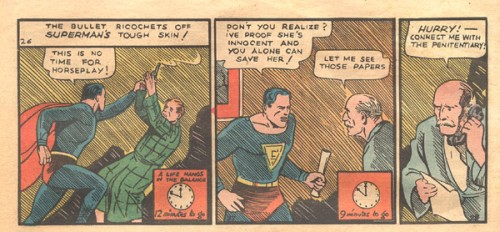
Thinking it over, I’d have to say that I believe that traditionally, the primary feature of American comics is the desire to convey a complete amount of information in a single panel, to really inform the reader that, yes, this is going on right now exactly as you see it. Characters’ poses and actions in relation to text and background all work together to provide a sort of storytelling clarity that some might even regard as overly busy. You know where that foot is going. You know exactly what the characters are doing. You know what is going on in a given scene, as if every panel were an incident in and of itself. Some might say this is the problem with American comics, but I think that wanting to present information in your comic in complete chunks has its merits, in the way radio dramas of yesterday and cd dramas of today do. Of course, I say “traditional” because as comics artists from all over the world interact with each other these differences start to recede, but I think you can still see them in today’s comics.

I’m well aware that there are comics that do not do this, and that even in the comics that do there are plenty of panels which are more for conveying a mood or some other function. I’m also aware that all the visual examples are from superhero comics, and that there’s an entire indie comics scene out there, and famous artists such as Dave Sim, Robert Crumb, Chris Ware, Art Spiegelman, and even Brian Lee O’Malley who do not abide to this “rule” if you can call it one. However, I do feel that this is the aspect of American comics which people remember the most, whether they’re long-time fans or new readers, these panels designed to exist on their own if they have to, but also function as part of a whole.

Idea: A Comprehensive Guide to Essential Episodes

Mazinger Z. Galaxy Express 999. Ranma 1/2. Astro Boy. There are a lot of anime out there that are considered classics (and rightfully so), but the problem with getting into them is that they can be very, very long with anywhere from forty to two-hundred episodes and beyond. Because of this, trying to experience what made these shows great becomes a daunting task, especially when not all of them are “serial,” and instead have large chunks which are simply episodic and, while perhaps decent episodes, are not the ones that can really grab people by the heart and the lungs.

What I am proposing then is that a guide to these long shows be made, pointing out the episodes which are considered, while perhaps not “necessary” to the viewing experience, to be the apex of the show. That way, anybody who just wants to sample the show but in a meaningful way (not just watch the first episode or two and be done with it) can do so and fully understand the reasons that show is called a classic.

But I can’t do it alone.

When the main focus is to be absurdly long shows, no one person can watch everything to make sure that all bases are covered. I would need help. Possibly, I would have to get one or two people watching any given show and have them report back to me what they consider to be the “big” episodes, and then check it out myself to see just how good they are. Something like that.

Maybe this can apply to manga too.

I don’t have any episode lists to recommend at the moment, but I-

Wait, maybe I do.

LEGEND OF THE GALACTIC HEROES
RECOMMENDED EPISODES: 1-110

(Seriously, watch the entire show)

My Response to Tamagomago’s “Otaku Girl Moe”

Yesterday I posted my translation of Japanese blogger Tamagomago‘s post about the moefication of the “Otaku Girl.” This is my own follow-up to it, and how I feel about the various themes and ideas put forth by Tamagomago.

While I think the threat of otaku confusing reality with fantasy is not that likely for the most part, I do see how “Otaku Girl Moe” is different from most other types of moe, with the possible exception of “Imouto Moe, ” though that mistake can be quickly dispeled by interacting with real little sisters. Otaku Girls actually exist in the real world and are in a sense closely related to Otaku Guys, so the line between fantasy and reality can blur quite a bit. It’s sort of like how most people probably wouldn’t realize that a model’s photo was airbrushed, or that the situations that occur in porn have very little chance of actually happening, but because we associate those things with “reality,” e.g. photos are realistic, we as people can be susceptible to their illusion.

Basically, while I don’t think there’s an immediate danger involving confusing the Otaku Girls in Anime with Otaku Girls in real life, there is a sort of precedent.

I of course also agree with the notion that as strong a character and as realistic as Ogiue is, she’s still just a character in a story. Though I can still hope…!

Another interesting point Tamagomago talks about is what I translated as the “exceedingly shaky” foundation upon which otaku build their preferences for women. I mentioned an earlier example of confusing fantasy with reality, but this one is particularly interesting as it’s almost an inverted example from the one above.

What we have is a situation where an otaku will take a realistic goal, i.e. finding a girl that can relate to them, and using their doubts and fears to transform it into an impossible dream. In other words, they’ve taken what is real and confused it for fantasy, something not talked about quite as often in these conversations about moe we have on this internet.

Of course, the part that generated the most conversation was where Tamagomago said that the act of calling someone moe is “violent” because it strips them of their individuality. Perhaps it was my translation not being completely clear, but the point that Tamagomago was trying to get across was that real people are not anime characters. It’s kind of an obvious thing to say, but within the context of moe you’re using a term associated with fiction and fictional characters and attaching it to real human beings with real depth and personalities. Let’s forget the word moe for a second, and instead imagine that I was talking about one of my female friends and I said, “Her character development is excellent!” It’s still a compliment, but it’s kind of bizarre to use that kind of language with an actual girl.

One more note, I don’t really think calling girls fujoshi is that bad, especially as it’s taken on this specific meaning of “yaoi fangirl.” Words in languages are malleable things as much as some would like to disgree, and the word “otaku” is a perfect example of this as its negative properties have fluctuated over the years. It’s like, I know that the word decimate originally meant “reduce by 10%.” Do I care? Not at all.

So in conclusion, I can’t wait for Hirano Kouta to knock down Tamagomago’s door for daring to say that there’s no such thing as Otaku Guy Moe.

Lady Boobsalot and the Gluteus Gladius

With American comics and animation you’ve got Vampirella, Lady Death, Heavy Metal, and Witchblade.

With Japanese manga and anime you’ve got Ikkitousen, Queen’s Blade, Grenadier, …and Witchblade.

All of these titles and more center around buxom ladies kicking ass and taking names but always being just on the other side of emasculating so that we as guys can picture them in our fantasies, if that’s the sort of thing we’re into.

I can throw around all sorts of descriptive terms, like fanservice, cheesecake, girls in metal bikinis, girl power, but is there a specific name for this genre?

If not, I propose a few.

“Swordcake”

“Tit Fighter”

“Action Cleavage Boobs Fest”

Or perhaps, as one friend suggested, “Softcore.”

Deceptive Marketing and Copywriting

“In the future, boys will be boys and girls will be robots!”

“A story of love, dreams, and perseverance.”

“Slowly, Satou comes out of his reclusive shell, and his hilarious journey begins, filled with mistaken identity, Lolita complexes—and an ultimate quest to create the greatest hentai game ever!”

The above quotes are taken from an ad for Chobits, an ad for The Story of Saiunkoku, and the official synopsis of Welcome to the NHK, respectively. And while they’ve all got a certain catchiness or punch to them, anyone who’s seen these shows will tell you that, while the words in each are on some level true, they don’t really convey the complete appeal or feel of their stories.

I’m not exactly sure how I feel about this, other than the general sense that companies advertise their own anime and manga poorly, but maybe that’s merely by my own standards. I do fear that there is always a very real chance that because of the misleading advertising that it might lead some people to miss a show they might otherwise watch, or might lead to misunderstandings when a show doesn’t do well. To use a non-anime example, Avatar: The Last Airbender was marketed as if it were for young kids, but the story was sophisticated enough that it would at the very least be more suitable for young adult viewers. And, surprise, that’s where a lot of its hardcore fanbase is. First Gundam also had a similar problem where its initial run in Japan was not successful but when it caught the attention of older (as in older than 10) viewers, it picked up steam.

Is it all right to, in some sense, trick people into reading your book or watching your show? Is it simply a case that if you told most people that Saiunkoku was like, political shoujo, that it would turn most people away? Is this why Honey and Clover appears in Shoujo Beat when it’s targeted towards older female readers?

In that respect, does this sort of thing actually work? Is it actually pulling in new people who would be turned away from these works normally? Or is it perhaps turning people away who would otherwise be interested in reading the somewhat depressing story of a drug-abusing shut-in who feels his life is all but worthless?


This Has Nothing to Do with Nissan

So after  submitting my entry for NYAF’s mascot competition, I’ve been looking around at the other entries. Regardless of age, talent, creativity, whatever, I can really feel that everybody who submitted a design put effort into their creations.

I don’t think anybody plagiarized or stole from anyone else (though there’s a few questionable designs copyright-wise), so I find it interesting to see what recurring themes there are among the entries. I mean, there’s only so many things you can positively associate with New York, and I’m certainly not the only one who decided to approach it from the subway angle. What I find particularly interesting though is the large number of entries that somehow incorporated the Manhattan Skyline into their mascots, especially in the clothes. The reason I find it interesting is that it had not occurred to me at all to associate New York with the skyline.

I’m a native New Yorker, born and raised in Brooklyn and Queens, and have spent much of my years in Manhattan, be it for school or to be with friends. With that in mind, I have to wonder if maybe growing up in NYC I’ve simply gotten too used to the number of tall buildings around. It’s easy to forget that there are places that aren’t like this, or that this feature of NYC would stand out in people’s minds.

As someone who grew up in New York, as someone who used the subway daily for years on end, I felt a more tangible connection to the underground than to the skies above, and it was something I could embrace and appreciate more, hence Chika’s design and the vague hints at her personality I gave in her information.

Second place for interesting recurring themes was taxis, which I also did not associate with NYC for similar reason to the skylines, but I’ve been told by certain people that NYC is apparently the only place you can just wave down a taxi. You learn something every day!