The Aggressively Passive Protagonist

There’s a general trend I’ve been seeing with male anime protagonists from light novels, or more specifically anime adaptations of light novels. In many of these titles, the main characters tend towards having passivity as a defining trait, sometimes to the point of “aggressive passivity.” Not to be confused with someone who’s passive-aggressive, or even someone who’s mostly passive and occasionally active (like Shinji in the Evangelion TV series), the aggressively passive protagonist is someone whose passivity is almost a badge of honor, either in the form of a passive special ability, a self-image in which passivity practically defines them, or a reputation for passivity.

Let’s look at a brief list.

  • My Teen Romantic Comedy SNAFU: Hikigaya Hachiman persistently mentiones how the real world is harsh and unforgiving and how it’s best to kind of just coast through it with little ambition.
  • Mayo Chiki: Sakamichi Kintarou has the nickname of “Chicken Tarou,” indicating what a pushover he is, which he tries to fight.
  • A Certain Magical Index: Kamijou Touma, though not truly passive, operates on an extremely loose philosophy of “do the right thing, I guess.” In addition, his ability is a defensive one which neutralizes other superpowers.
  • Monogatari Series: Araragi Koyomi helps others out, but his abilities as a vampire mainly manifest in his ability to endure pain and injury, and even his method of active help comes across as essentially philosophically passive.
  • Ookami-san: Morino Ryoushi, Ookami’s partner, is someone who can only help fight from the shadows, as he fears direct confrontation.
  • Suzumiya Haruhi: Kyon, though he eventually enjoys it, starts off talking about how much he’d rather not be having strange and crazy adventures.

If you look, you’ll also find such characters in non-light novel anime. This is somewhat different from the classic milquetoast harem lead, whose averageness is taken as a way to make him the everyman and the avatar of the reader, because often-times with these aggressively passive characters a lot of time is spent talking about just how average they are and how being average/passive is the way to be.

I’m not sure why this is the case, but I suspect it may have something to do with the “herbivore men” concept that has taken hold in Japan. Herbivore men are defined as guys who shun the life of wealth, success, sex, and family, the classic symbols of masculinity, and embrace a more passive lifestyle which shirks society’s expectations. This trend gets tied to a number of things by those curious as to why it’s occurring, such as the poor Japanese economy driving down ambition towards employment, and it’s possible that the protagonists described above are a product of this environment, that the people reading (and perhaps even writing) these light novels and watching their anime adaptations also see the traditional path of Japanese men to be fraught with lies and deception.

Of course, in many of these cases, it’s not like the characters sit back and do nothing, but that passivity on some level becomes a part of their characters, either as something to be celebrated or something to be worked on. If anything, even the sampling of titles above speak towards a broad range of viewpoints as to what passivity is and whether or not it’s something to be embraced or to be worked on.

This trend is actually why I think Kirito in Sword Art Online has become such a popular hero for anime fans both male and female. It’s not that the aggressively passive hero is inherently bad, but that in this environment an aggressive protagonist stands out that much more. In SAO, Kirito is an extremely skilled fighter who helps the downtrodden, attracts women left and right, and has a powerful reputation among those inhabiting the world, while also being gentle, considerate, and devoted to those he loves. He becomes the exemplary light novel hero for those who’d rather not have a passive protagonist.

Not Just a Fujoshi: Tora to Ookami

When it comes to manga oriented around a fujoshi main character, there are two big trends.  First, they tend to come from pretty unknown authors in fairly obscure magazines. Second, the story typically revolves heavily around how their love of yaoi impacts the heroine’s relationships. Often there’s a romantic bent to this, where the girl’s fantasies directly impact her interactions with the guy she’s into. Even titles I adore such as Genshiken and Fujoshissu! possess these qualities in part, and while the fujoshi heroine subgenre is not exactly big, it’s produced a lot of similar works.

This is why Tora to Ookami is such a fine oddity. Having ran in Betsuma, which has been home to other popular titles such as Lovely Complex and Aishite Knight, what’s even more interesting is its creator, Kamio Youko. Fans of shoujo might recognize her as the author of Boys Over Flowers, a title which is spoken of in the same breath as other big shoujo works such as Nana, and has been adapted not only into anime but multiple live-action dramas around the world in different languages. In a certain sense, this title is quite a leap for fujoshi-themed manga, skimming along the mainstream even if not directly a part of it.

What I find especially impressive about Tora to Ookami, however, is how it addresses the second trend. A lot of times fujoshi characters, whether they’re in the spotlight or on the sidelines, are fujoshi first and foremost. Their hobbies revolve heavily around anime and manga if not yaoi outright. They’ll throw out random lines from an anime, most often Gundam or Glass Mask, or just have a one-note gimmick (constant pairings or glasses, for instance). They either have, or have had in the past, personalities and appearances which tend towards the image of the shy and nerdy girl. With Mii, the heroine of Tora to Ookami, however, you get a stronger sense of a well-rounded individual where she’s certainly into yaoi but it doesn’t dominate her life, nor her approach to interacting with others.

While Mii writes BL fiction, she’s also a chef who works at her family’s small restaurant, and that aspect of her plays a much more significant role in Tora to Ookami than her googly eyes over seeing her two love interests interact with each other. She may be a fujoshi, but she’s also a strong-willed person who’s more than willing to sacrifice her social life in order to help her grandma maintain their restaurant because it’s what she cherishes. Liking BL is just a natural facet of her among others, and because Mii’s fujoshi identity isn’t the central focus of the manga, her romance is able to develop in a way where the outcome isn’t simply determined by who can accept her for being a fujoshi. Although her fandom pops up occasionally in her interactions with her love interests, especially the titular Tora and Ookami, it’s pretty much never about wanting them to act more like characters from BL manga, nor does it involve confusing fantasy with reality.

I don’t know how well Tora to Ookami did in Japan, but six volumes is a fairly decent run, and at the very least it shows that fujoshi heroine manga don’t have to be limited by the fujoshi “gimmick.” As much as I enjoy the stories which do utilize the recurring fujoshi manga trends, Mii’s character is rather refreshing because of how she has more to her than yaoi, but also doesn’t trivialize that aspect of her. She’s believable as a fujoshi, but also believable as a human being.

Robotech, Voltron, Nostalgia

When the Robotech/Voltron crossover comic was announced a few months ago, my immediate response was, “Why?” Of course the answer is “nostalgia grab,” but there’s something strange about both of these works and their continued presence in the geek public eye (and perhaps even beyond that). Unlike Transformers which not only has a huge variety of toys both old and new, as well as a long history of cartoons both from America and Japan (not to mention the live action films), both Robotech and Voltron do not really renew themselves, aside from the occasional thing like the The Shadow Chronicles or The Third Dimension.

Though this speaks more about the people I associate with, I can’t say I’ve ever talked to anyone, online or offline, who is hardcore into either Robotech or Voltron. I know that there’s a Robotech community of course (they even have an official site for it), though I have little interest in it. With Voltron, I know people who have fond memories of it, myself included, but the foundation that Voltron has in geek culture seems not only deeper than Robotech‘s but to the extent that, when you say cool giant robot with a signature finisher, Lion Voltron is just the default, or it shares that spot with the Megazord from Power Rangers. It’s like Voltron as a source of nostalgia goes so far beyond itself that the vague perception of it exceeds the influence of the actual anime. 

What’s funny about a show like Voltron and its emblematic presence in US geek culture as de facto super robot is that the process of dubbing and adaptation that turned the anime King of Beasts Golion and Armored Fleet Dairugger into Voltron: Defender of the Universe happened with different anime in different countries to similar effect. In the Philippines, Voltes V exploded with popularity. In France and Italy, UFO Robo Grendizer captured attention as Goldorak and Goldrake respectively (with success in the Middle East to boot). In Brazil, Gloizer X became O Pirata do Espaço, the country’s first real exposure to giant robots. While it’s possible say that this was all a matter of timing and that they’re all interchangeable in that respect, I do think that the specific properties of each show had a major impact on how each country perceived giant robots from that point forward (I’m less sure about Gloizer X so if any Brazilians want to help, feel free to leave a comment).

One thing that I do believe plays a role in how these series become more specific in their nostalgic output is the level of support the original works have in Japan. I visited France recently, and when I went into the comic stores I would regularly see displays of Grendizer merchandise. Whether it was the Super Robot Chogokin or the Soul of Chogokin or a chibi version, it was all straight from Japan, sitting prominently in the store. Grendizer has enough cultural presence in Japan that it can continue to get these toys and even a fairly stable presence in Super Robot Wars, whereas Golion has had to content itself with just one Nintendo DS appearance. In lieu of support from Japan, Voltron‘s had to carve its own place, and often times it’s not even from the company World Events which holds the Voltron license but from fans conjuring it up in their own minds. And while Robotech is an utter legal mess due to the way it stifles the presence of Macross in the US, if you put that aside part of Robotech‘s prolonged presence comes from the fact that its fans want new Robotech to constantly feel like old Robotech, whereas Macross changes according to the whims of its dark lord Kawamori Shouji.

Actually I wouldn’t mind at all if Voltron got a revival with a solid piece of fiction to support it which doesn’t rely too much on nostalgia. I know we got Voltron Force, but the less said about that the better.

Non-Seduction of the Innocent

I’ve come to notice that there are few female characters in anime with seductive personalities.

There are characters who are physically good-looking, characters who are proud of their appearance, characters who are in love, and characters who try to get closer to the person they’re interested in. Rarer is the type of female character whose mannerisms ooze fiery passion in such a way that their sexuality is more than simply their physical design.

Here’s a character who I think qualifies: Fuwa Aika from Blast of Tempest.  Good-looking but not to an incredible degree, you can sense in her interactions with her boyfriend Yoshino not only the way she focuses all of her charm on him, but also the strong physical and emotional response that Yoshino has to Aika’s desire. It’s difficult to capture this impression in a single image.

Another lesser example comes from a few years ago in Macross Frontier. The character of Sheryl Nome is more sexy than seductive normally, but in one scene both she and Ranka Lee are trying to out-sing each other in order to demonstrate their interest in the protagonist Alto and why he should choose one over the other. In that moment, both Sheryl and Ranka exude strong desires which fill the space they’re in.

In thinking about this, I’m reminded of an old post on Heisei Democracy, in which Shingo states that lips aren’t moe. The argument is that lipstick denotes an assertive un-moe character, while lips in general are a sign of active sexuality which is counter to moe’s ostensible image of innocence. I don’t quite agree with that premise, and my discussion of characters isn’t limited to just those who would be considered “moe,” but I do feel like there’s something relevant in Shingo’s argument. There’s this rough idea that moe characters, even when they are attractive or overtly sexualized, at most tend towards conflicted expressions of desire (e.g. tsundere) or displays of innocence even in less “innocent” moments. If you then move the idea to being about the difference between sexual/seductive, maybe it’s not so unusual for seductive characters to be a rarity.

The Title is a Lie (Or Is it?): My Teen Romantic Comedy SNAFU

One of the most visibly obvious trends in anime in recent years is the extremely long and descriptive title. My Little Sister Can’t Be This Cute. Baka and Test: Summon the Beasts. More accurately, it’s the product of a tendency in the current light novel industry from which many anime are adapted, and with that verboseness comes a blessing of sorts. For those who want what a particular title has to offer, they need only look at the name, and for those who want to avoid specific shows at all costs it becomes equally useful. You can indeed judge these books by their covers to a certain extent, which is why I initially set aside My Teen Romantic Comedy SNAFU, considering it a low priority.

I have nothing against teen romantic comedies or SNAFUs, but the original Japanese title, Yahari Ore no Seishun Love Come ga Machigatteiru (translated also as, “My Youth Romantic Comedy is Wrong as I Expected”) seems to imply a lot of things which don’t exactly excite me. First, it seemed to hint at this strange cooler-than-school cynicism which you find in a lot of light novel protagonists that I find unappealing, a sort of counter-elitism of the same variety as “the geeks will inherit the Earth.” Second, even though it says the romantic comedy is “wrong,” it still implied some combination of harem/love triangle. When I finally got around to watching SNAFU, I realized I’d been wrong all along. While it contains some degree of the two elements I’ve described, it’s also a clever series which has at its core not so much a good ol’ harem comedy but a closer look at the combination of social and sef-perceptive tensions which can make life as a teenager mentally and emotionally taxing, especially for those who don’t quite fit in, and the help that can come from those who simply understand.

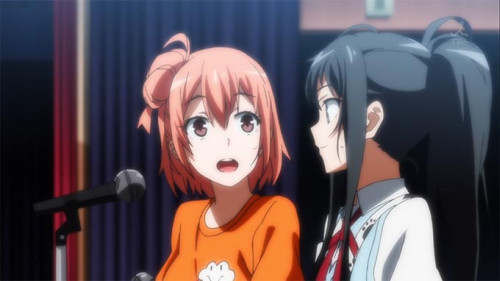
SNAFU centers around Hikigaya Hachiman, a cynical guy who quickly acknowledges how low on the social totem pole he is and how much he prefers to be there. Hikigaya is forced to join a club whose purpose is vaguely to help people out, acting as a last-ditch student-run guidance counseling of sorts. In the club, Hikigaya is joined by two girls with equally Stan Lee-esque names, Yukinoshita Yukino and Yuigahama Yui. Yukinoshita is extremely observant but a little too sharp-tongued for her own good, and Yuigahama is energetic and a little ditzy with a greater desire to try and fit in with her peers compared to the other two.

Just from my basic plot summary I think it’s easy to see why I was a bit wary (and potentially weary) of the show, but there are a number of things which give this anime some solid legs.

First, although Hikigaya is indeed quite the pessimist, and he does have the “screw the popular kids” attitude to an extent, he also shows that he’s aware of what he lacks. He knows that if you have the right attitude you can accomplish many things and reach out to a lot of people, but he doesn’t have that attitude and probaby never will. What his perspective does for him, however, is that it allows him to find people who are similar to him, and to figure out solutions that wouldn’t work for the “average” teenager, but are perfect for those who are below the bar. Similarly, Yukinoshita’s astute assessments make her able to understand a given social situation quickly, while Yuigahama’s propensity for tact and cheer becomes the grease to move the wheel where Hikigaya and Yukinoshita’s personalities would otherwise stifle it. SNAFU really does focus on the theme of helping people who feel ground down by the pressures of their social groups, and at places goes to some fairly dark (though not morbidly or horrifyingly dark) places.

Second, even though there is a love triangle element to the main cast, with Yuigahama clearly having feelings for Hikigaya due to a small event in the past, and Yukinoshita can be seen as gradually developing feelings for him as well, the friendship between the two girls is just as if not more important than the romance. Yukinoshita has no friends, while Yuigahama would traditionally try to ingratiate herself with other girls just to not be caught outside the circle, and so their growing bond becomes an important factor in developing them. It’s to the extent that, even if the series ends with one “winning” over the other by dating Hikigaya, it is highly doubtful that it would destroy the friendship they’ve built up.

Third, when it come to determining who might indeed end up with Hikigaya, the show gives a fair case for both of them. It doesn’t come across as woefully lopsided like in, say, Love Hina. And actually, when you look at the hormonal responses Hikigaya has to those he finds attractive, the strongest reactions seeem to come not from any girl, but from the incredibly effeminate male tennis club member Totsuka Saika. I’m pretty sure this is just another case of a Hideyoshi from Baka Test, a character so feminine in appearance that we’re supposed to take it as a gag, though in this case I suspect he also functions as a way to show how much deeper the connection Hikigaya makes with either girl will be.

I honestly think that this series ended up with a name as excessively long as Yahari Ore no Seishun Love Come wa Machigatteiru because someone told the author that everybody’s doing it. As a title, it’s actually quite deceptive, and somewhat ironically doesn’t help a person looking at it to understand what’s beneath the cover. I don’t think it’ll start any trends of intentionally obtuse light novel names, but at the very least it gives hope that if you’re willing to squeeze that lump of coal hard enough that it might turn into a diamond after all.

No guarantees with any other shows though.

The Changing Face of Takahashi Ryousuke

The Initial D character, not the VOTOMS director.

Takahashi Ryousuke, leader of the Akagi Red Suns, the White Comet, and the creator of Project D is one of the most prominent and important characters in Initial D and so inevitably he appears in every main Initial D anime. Now, each stage of Initial D has come out at different times, sometimes years apart, and even the art style of the original manga has evolved over the course of more than a decade. Character designs change according to the artist’s whim.

That still doesn’t explain how Ryousuke manages to look wildly different from one sequel to the next, while other prominent characters such as Takumi and Keisuke remain relatively intact.

Look at the guy. His face can’t stay the same size, his hair changes back and forth between blue and brown, his bone structure morphs as well. The only things that remain remotely consistent are his thick eyebrows and his full lips. Even his hair, which is roughly the same style until Fifth Stage, still undergoes some peculiar shifts. The closest he gets to looking similar is between Third Stage and Fourth Stage, and even that’s a bit of a stretch.

Anyway, I’m still trying to figure out why all of the anime have struggled to decide on a proper hair color for Ryousuke. Maybe it’s like how Raoh is blond in the manga but has brown hair in the anime?

Evangelion 3.33: You Can (Not) Redo as Response, Criticism, and Renewal

WARNING: HEAVY SPOILERS AHEAD

In an essay by Evangelion creator Anno Hideaki found in Gundam: The Origin Volume 1 (Aizouban Edition) titled “Celebrating the Revival of Gundam as Tale,” Anno argues that anime narratives in recent years have moved away from being “Tales” like the original Gundam. “Audiences have come to need work only as an escape from reality, as a comfortable dream, judging everything on the criterion of moe, while creators’ intellectual paucity and the jumble of trivial touches have encouraged that structure.” Referring to current anime and manga as “stagnant,” Anno laments the loss of the Tale in anime and manga, hoping that it can make a return, and even blames himself for contributing to this current state of anime. Thus, when considering the new Evangelion movies as “rebuilds,” I began to suspect that the films might be an attempt to bring the “Tale” back into Evangelion after its influence had broken down the concept in the first place. Although I was not aware of this perspective of Anno’s when I saw the original two movies, after viewing Evangelion 3.33: You Can (Not) Redo I find that the Rebuild of Evangelion films, while not attempting something so simple and shortsighted as turning back the hands of time in order prove the superiority of Tales, are still revisiting Evangelion in such as a way as to try and address the differences between older and newer anime narratives, create a Tale appropriate for contemporary culture, and respond to current criticisms of youth culture.

At the beginning Evangelion 3.33, we see protagonist Ikari Shinji waking up 14 years in the future, in a time when much has changed. Shortly after Shinji’s revival, a fight breaks out and it turns out Shinji is aboard a ship called the Wunder, an airship with a powerful laser cannon powered by Shinji’s iconic robot, the EVA-01. As the battle ensues, a combination of characters we’re familiar with and characters entirely new shout about the status of the enemy, which weapons to use, and what strategic options are available, all while Katsuragi Misato stands at the bridge as a stoic and hardboiled captain ready to give orders at just the right time. Although this somewhat resembles depictions from previous films and the television series with the organization NERV and Shinji’s father Gendou at the helm, what this resembles even more is the most classic Tale in all of anime, Space Battleship Yamato. Substitute the EVA-01-powered laser for the Wave Motion Cannon and Misato for Captain Okita, and you more or less have a fight that wouldn’t look out of place in Yamato. Shinji is thrust not just into the future, but into what appears to be a completely different anime story structure.

Rather than simply making it the Tale of Shinji experiencing the simpler world of a Yamato-esque goal and the pieces surrounding it, however—Yamato was about traveling to a distant planet to retrieve an item which would help remove the radiation that had turned the Earth into an inhospitable husk—Evangelion 3.33 complicates the issue. While both Yamato and Evangelion 3.33 take place on a devastated Earth, for the latter it turns out that Shinji’s actions in the previous movie, when he finally stood up for himself and gained the self-activation he never had before, were the very cause of the planet’s current dire situation, the Third Impact. Shikinami Asuka Langley, who was injured in the last film when Shinji had control of his own EVA forcibly taken away from him, is alive and piloting, but shows absolute disdain for Shinji. Even the one goal he had set out to accomplish, rescuing Ayanami Rei from being absorbed by the enemy Angel, turns out to be a failure, as Rei’s body was never found, most likely absorbed by EVA-01’s cockpit after the two had fully synchronized with the EVA. Instead, what Shinji gets is a clone of Rei devoid of memories, an almost-unthinking soldier who can only follow orders.

This clone Rei in the third film (although technically all of the Reis are clones) is a strikingly powerful presence, acting as a strong argument against the classic criticisms of Ayanami Rei and the characters she has inspired. Typically, Rei is seen as an almost doll-like fetish object, an attractive girl with pale features and no personality whom men can sexualize as the “perfect” passive woman entirely subject to their desires. Here, in Evangelion 3.33, we get the truly subservient version of Rei, a character who is so passive she cannot even read a book without being ordered to do so, and the disturbing nature of this iteration of the character actually highlights just how much characterization and personal will is present in the base character of Ayanami Rei. “You don’t know what’s missing until it’s gone,” as the cliché goes, and the fact that a truly doll-like Rei is so bizarre and alien underlines the fact that Rei is defined not by her loss of humanity but by her pursuit of it. Rei ends the film seeing a gigantic grotesque version of herself and asking, “Is that me?” The titanic Rei acts as an uncanny juxtaposition and jars Rei into becoming self-aware, becoming the potential seed through which she can gain independent thought and conscience. Rei, who is arguaby seen as the classic example of a character whose various visual and narrative components appeal to the “database” mindset which Azuma Hiroki argued back in 1999 was increasingly common in a postmodern Japanese society, re-gains the ability to become part of a Tale which isn’t, a cohesive work which is at the same time complex and contradictory.

This is the narrative space in which Evangelion 3.33 takes place, and the result is that even though this film may appear to be another case of how nothing Shinji does ever goes right, it is not the same sort of internal trauma and pessimism which classically characterizes Evangelion. The depression Shinji suffers and shows in this film does get the closest to the type of introspection that Evangelion is famous for, but given not only the context of the previous films which feature a cast of characters more willing and able to communicate their pain to each other but also the difference in setting the 14-year shift provides in this film even those signature abstract angst moments take on a different set of meanings. Most notably, Shinji’s psychological paralysis is not the result of some indescribable fear or internal agony, but because of his own guilt. This can be seen in the bonding scenes with Nagisa Kaworu, the tragic character whose role in all previous versions of Evangelion has been to connect with Shinji on a level no other character had previously been able to before dying at Shinji’s own hands. Kaworu and Shinji’s relationship takes on a somewhat different dynamic, as Kaworu helps to bring Shinji to a place of conviction already familiar to him from the previous film.

Instead, a different tragedy occurs, as Kaworu’s plan—to co-pilot the new EVA-13 with Shinji in order to fix the world ravaged by the Third Impact—is undermined by the fact that NERV and Gendou have replaced one of the key items capable of restoring the world, instead leading it to a further apocalypse. Kaworu realizes the difference and tries to stop Shinji, but Shinji is so intent on correcting everything that he fails to register Kaworu’s hesitation and he ends up falling for Gendou’s plot. The scene again looks to be another case of Shinji failing, but given everything else shown up to this point, I find that it draws attention not so much to Shinji’s individual suffering, but to the world around Shinji. Whether Shinji follows his own will or whether he listens to others, he still creates disaster, but this Shinji is, again, a more active Shinji whose problem is not that he’s “unwilling” to help, but that his surrounding environment has forced him into unwinnable situations. Appropriately, this time around Kaworu dies, but not directly because of Shinji.

Shinji’s plight in Evangelion 3.33 mirrors the recent criticisms used against youth culture by media appealing to older generations. Whether inside or outside of Japan, the current generation is seen as a group of selfish good-for-nothings who want and expect everything handed to them, instead of knowing the value of sacrifice and hard work. Whether they’re referred to as “NEETs” or “Generation Me,” Shinji and Evangelion 3.33 bring to attention the idea that, while we can place blame on them, the previous generations are not absolved of blame; the world the children inherit is the world given to them.

Ultimately, I find that the Rebuild of Evangelion films are trying to create a Tale similar to Yamato and Gundam, but in a way which is consciously trying to take into account the era in which we live. At the end of Evangelion 3.33, Shinji is once again emotionally distraught and paralyzed over the horrible consequences of his actions, when Asuka literally drags him out of his cockpit and tells him that he can’t simply sit still. Rei joins them. The previous two films had already established that the characters were able to bridge the emotional gaps they were unable to overcome in the original television series, and though the space of 14 years after the Third Impact had bred in Asuka a deep resentment and anger towards Shinji, that one scene shows how the connection is still there. My prediction for the “Tale of Evangelion” as expressed by the four films is thus: A 14-year-old boy estranged from his father and suffering deep personal agony is thrust into a situation far greater than him, and though he is told to sacrifice himself for the greater cause, through the connections he makes with his peers he finds that he would lose too much in the process, including his own identity. This prioritization of the self and what he finds valuable in life does not come without its own consequences, but it becomes the potential ground for him, and those like him, to find their own solutions to the problems of the world. Of course, the fourth film has yet to debut, so we’ll see if I’m right.

Scenes Cut from Genshiken Second Season Episode 2

I might be calling this an episodic review in the tags, but that’s kind of a misnomer. Instead, I’d like to talk about Genshiken Second Season episode 2, or rather, what’s missing from it.

The manga equivalents of this episode would be Chapters 58, 59, and 60, but if you look at Chapter 59 you’ll notice a rather important Madarame story being cut from it. Now, this might be them cutting it out entirely, or it might be a pacing issue or something where they’d prefer to explore the new characters before putting the spotlight on the old guard again. That’s why, for now, we’ll leave it aside and assume it might actually appear in the anime at a later date, and focus on another curious cut. For those who are sticking to the anime, be warned that Chapter 59 is potentially pretty spoilery for you.

In Episode 2, Yajima, Yoshitake, and Hato all go over to Yajima’s place to create their profiles for the club magazine, Mebaetame. Prior to this, they go to buy some drinks, during which Yoshitake talks about her fantastic metabolism. What the anime did not include, however, is the fact that Yoshitake was trying to buy alcohol to liven up the party. The scene was originally a way to show how Yoshitake is as free-spirited as Yajima is straight-laced (her objection is mainly that they’re below drinking age), especially when Yoshitake ends up getting the beers anyway. Curiously, whereas in the manga they pass out due to drunkenness, in the anime, they simply got tired.

Here’s what I’m wondering: Was this cut due to time constraints, or was it cut in order to avoid showing underage drinking?

I don’t know enough about Japanese television censorship or censorship laws to determine if this is the true cause, but I do know I’ve seen plenty of manga to anime adaptations play it safe in roughly similar ways. The Bokurano anime, for example, turned a rape and exploitation storyline from the manga into something much less extreme. Genshiken does not even begin to approach that territory, but maybe for this show it’s still something they’d like to avoid.

Another thing, though not exactly a cut, is a loss of context. The moment when Ogiue slams the door on Ohno is a visual reference to the time Ogiue invited Sasahara over alone. That part of Genshiken isn’t animated, so the connection is lost.

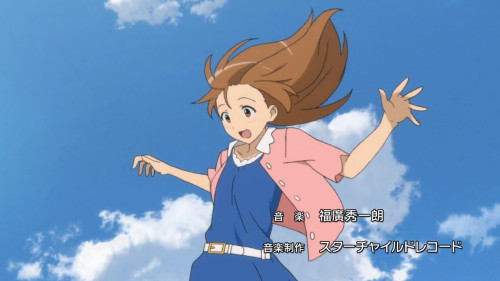
The opening is kind of interesting. It has quite a bit of information about what’s going to happen (including the appearance of a certain saucer-eyed character and her friend), but what I find most interesting about it is that it makes it very clear that Hato is the focus of the new series, something which wasn’t always immediately obvious in the manga. Also, Sue as Koujiro Frau from Robotics;Notes is about as perfect as it gets. That’s something that wasn’t in the manga but fits Sue’s character so amazingly well that I wish it had been. There is precedent for anime stuff to make it into the original manga, though, so hope is not lost.

Comparing Manga with the Otaku Guy + Popular Girl Theme: Otaku Riajuu vs. 3D Kanojo

Recently I read two manga with very similar conceptions, I’ll Make You into an Otaku, So Make Me into a Riajuu and 3D Kanojo (also known as “Real Girl.”) Both are based on the concept of an otaku guy and a fashionable girl forming a friendship (or something more), but the messages they convey, at least from what little I’ve read, are significantly different. In particular, the way Otaku Riajuu handles its female lead is pretty embarrassing, and highlights a lot of things wrong with whatever mindset produced the story, and for which 3D Kanojo provides a better alternative.

First things first, there are some differences in the setup of each. Unlike 3D Kanojo, which is about the budding romance between the otaku guy and the fashionable girl, Otaku Riajuu is similar to Toradora! in that the two leads are at least initially trying to help each other to get together with someone else. Other similarities include the fact that the girl is tiny and feisty, much like Taiga. Toradora! is pretty great, so that’s not so bad in and of itself, but there’s more to it.

In Otaku Riajuu, the girl, Momo, has a reputation for sleeping around a lot. The guy, Naoki, upon becoming aware of this, basically wants nothing to do with her. He thinks of her as a “bitch” (in Japanese context, the term veers closer to “slut,” see Panty in Panty & Stocking with Garterbelt for a prime example), and therefore wants nothing to do with her. A pretty messed up opinion to be sure, but then when he find out she’s actually uncomfortable around guys and clearly can’t be the bed crusader the rumors make her out to be, then he gets along with her a lot better.

Think about it: Naoki doesn’t like her when he thinks she’s a slut, but when he finds out otherwise everything’s “okay.” I’m not one to throw out the term “slut-shaming” liberally, and in fact this is the first time in the history of the blog that I’ve even used it, but it is literally the main character looking at a girl with disdain for being sexually active. The fact that we’re supposed to think Naoki the poor closet otaku is a Good Guy for changing his opinion of her after he learns the truth makes it even worse.

3D Kanojo on the other hand establishes that its female lead, Iroha, actually does sleep with a lot of guys, but doesn’t make the concept itself an inherent minus other than the fact that she has to deal with a lot of angry former lovers. Here, although the male character Hikari, being an awkward otaku virgin, is uncomfortable with the way Iroha is, the series seems to be more about their budding romance both in spite of and because of their differences. Hikari is also a nice guy in that he tries to save Iroha from a couple of angry suitors and gets so nervous when she invites him to have sex that he ends up avoiding it, but it’s clear he sees her as a person neither in spite of or because she’s sexually active.

I think a lot of the reason for this difference is just the intended demographic. Otaku Riajuu is based on a light novel, and aims for that male otaku market. Although not always the case (and not something exclusively otaku or Japanese), a valuing of virginity and purity by way of moe aesthetic is very clear and obvious here, and the strange idea the manga has about what it means for a guy to be “nice” likely stems from this. 3D Kanojo however is a shoujo manga, and this can be seen in the male lead who has a smattering of “gentle, ideal boyfriend” in him. He’s awkward around girls, but that’s what makes his attempts at heroics all the more charming. It also goes a long way in explaining why Iroha is written in a more well-rounded manner.

I’ve only read a bit of each, so I can’t say for sure if my opinions of either title would change down the road, but for now I’d have to say that 3D Kanojo is clearly the better title. The differing approaches to the popular girl character used by it and Otaku Riajuu do not form the entirety of my reasoning for recommending one over the other, but I think they give a good indication anyway.

Free Comic Book Day Netherlands 2013

fcbdnl2013-allcomics

May 4, 2013 marked the second anniverary of Free Comic Book Day in the Netherlands. An American institution which I’ve participated in for over a decade now, I was amazed last year to see it brought over to other countries as well.

This year the full selection of free comics was raised from 7 to 10, far less variety than what was offered in the US, but at the same time had many of the charms and stylistic tendencies associated with European comics (even if they may not have been made in Europe!). The comic book store owners I did talk to all seemed to make it a point to tell me that they lose money participating in Free Comic Book Day, and urged me to buy something alongside. In my opinion, this kind of goes against the spirit of Free Comic Book Day in the sense that it isn’t supposed to be a guilt trip, but it might just be a difference in population/costs/other factors which make it not as sustainable as the American FCBD.

Sadly I am mostly illiterate in Dutch so I can’t really talk about the quality of narrative, but I can at least talk about some of the comics which caught my eye, or which most likely would catch yours.

fcbdnl2013-gameofthrones

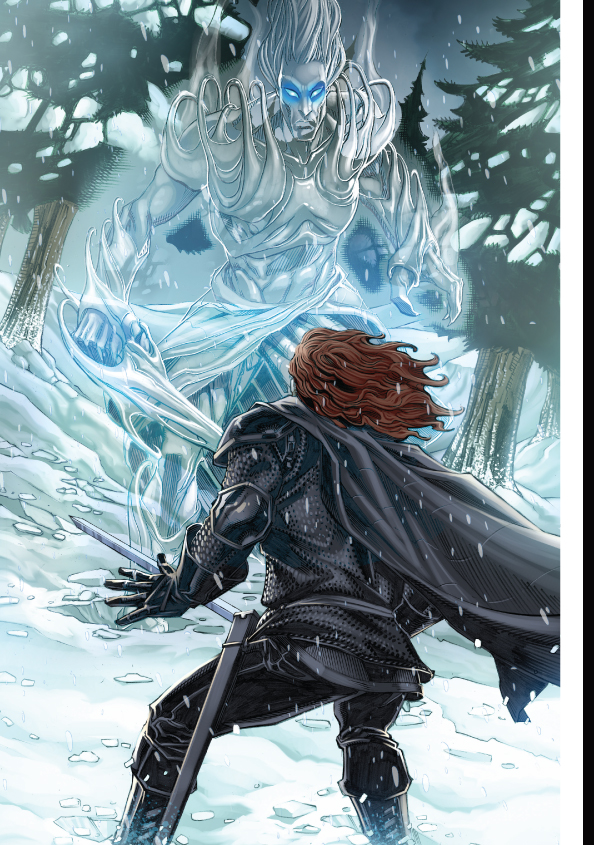
Probably of greatest interest to people would be the Game of Thrones comic, adapted by Tommy Patterson, and actually available in English. I have not read A Song of Ice and Fire, nor have I seen the HBO Game of Thrones, so in terms of accuracy or spirit I can’t really say anything. At the very least the art is vibrant, and I like it way more than Patterson’s previous work on series like Grimm’s Fairy Tales.

Next is Sienna, by Desberg, Filmore, and Chetville, about a female government agent. “Sexy women of action” as far as I’ve seen is quite a popular genre here, at least in terms of comics made, and this one takes a more mature and dramatic angle. The art is quite nice, and there’s plenty of violence and (I assume) conspiracy. You can see a small preview here.

De Verborgen Geschiedenis (“The Hidden History”) by Pécau, Kordey, and Chuckry stands out immediately just because of the camel on the cover. As far as I can tell (and please correct me if I’m wrong), the comic appears to mainly be about what its title implies: some mix of conspiracy and secrecy spanning decades. Like both Sienna and even Game of Thrones, it goes for a more serious art style. There’s also a prominent English (?) female military officer in this issue whose name I can’t find. With a prominent scar on her face, she  toes the line between sexy and legitimately frightening (more the latter), as her expressions go from cold to menacing throughout the comic. Overall, she comes across as like a female Golgo 13, especially because one scene has her casually waking up surrounded by a pile of naked bodies both male and female.

fcbdnl2013-delegendariers

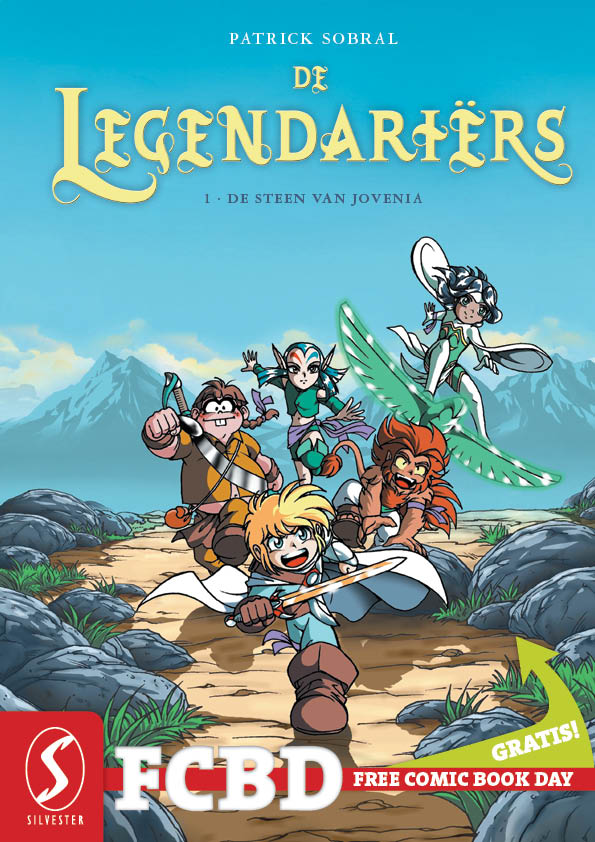
The last one I want to point is De Legendariërs by Patrick Sobral, due to its overt stylistic influence from anime and manga. Unlike the other three, this one has much more light-hearted feel. Its super-deformed characters and fantasy setting give me the impression of a pre-Playstation Japanese RPG. In fact, the characters look more like a late-80s/90s anime characters instead of current ones anyway, which really harkens back to that era. Anyway, the villain is named “Darkhell.”

So that’s a (very) cursory view of Free Comic Book Day 2013 in the Netherlands. Take my opinions with a grain of salt here, as I can’t give you a true impression of any of them.

And I must ask, for those of you who can read French or Dutch and picked some of these up, which ones impressed you the most?