River City Girls is a new game in the aged genre of the side-scrolling beat-em-up, and a role reversal of the classic damsel-in-distress story. As friends Kyoko and Misako, the player sets out to rescue their boyfriends by clobbering everyone in their way. As suggested by its title, it’s a sequel of sorts to the classic NES game River City Ransom, which is itself a heavily localized version of the Japanese Downtown Nekketsu Monogatari from the Kunio-kun franchise. Because River City Girls aims to be a successor to both River City Ransom and Downtown Nekketsu Monogatari, it takes cues from both the former’s American-esque “dudes with attitudes” style and the latter’s Japanese “yankee delinquents” presentation, resulting in a fascinating mashup of both aesthetics.
Rather than lean in one direction or the other, River City Girls mixes things up. The game takes place in “Cross Town” (from River City Ransom) but the boyfriends’ names are “Riki” and “Kunio” instead of “Ryan” and “Alex.” Japanese street gang figures (banchou) roam the street at the same time as cheerleaders. Kyoko wears a letterman jacket on top of a school uniform while Misako’s takes cues from Japanese fashion, and they both kind of resemble Powerpuff Girls in a way that calls to mind the anime adaptation Powerpuff Girls Z. A story cinematic shows the girls in an American-style school cafeteria.
Some Double Dragon characters even make cameos (Double Dragon was originally developed from the original Kunio-kun engine but with more international appeal). While those games always took place in the US, River City girls specifically uses the Double Dragon Neon versions of the characters, a game that was much more American-facing than Japanese.
The result is that Cross Town comes across in the same vein as Big Hero 6’s “San Fransokyo” and Hurricane Polymar’s “Washinkyo”—a place that’s both Japanese and American at the same time. I can only guess at the reason behind this decision, but I imagine it has to do with the fact that both River City Ransom and Kunio-kun are beloved in their respective regions. There’s a certain generation of Nintendo fan that holds the game River City Ransom in high regard. One part beat-em-up, one part adventure RPG, there really wasn’t much like it back in 1990. Kunio-kun, in turn, has starred in many, many games over the years, and he was a company mascot for Technos Japan. River City Girls aims to please both audiences, and maybe even poke fun at those bygone days of extreme localization.
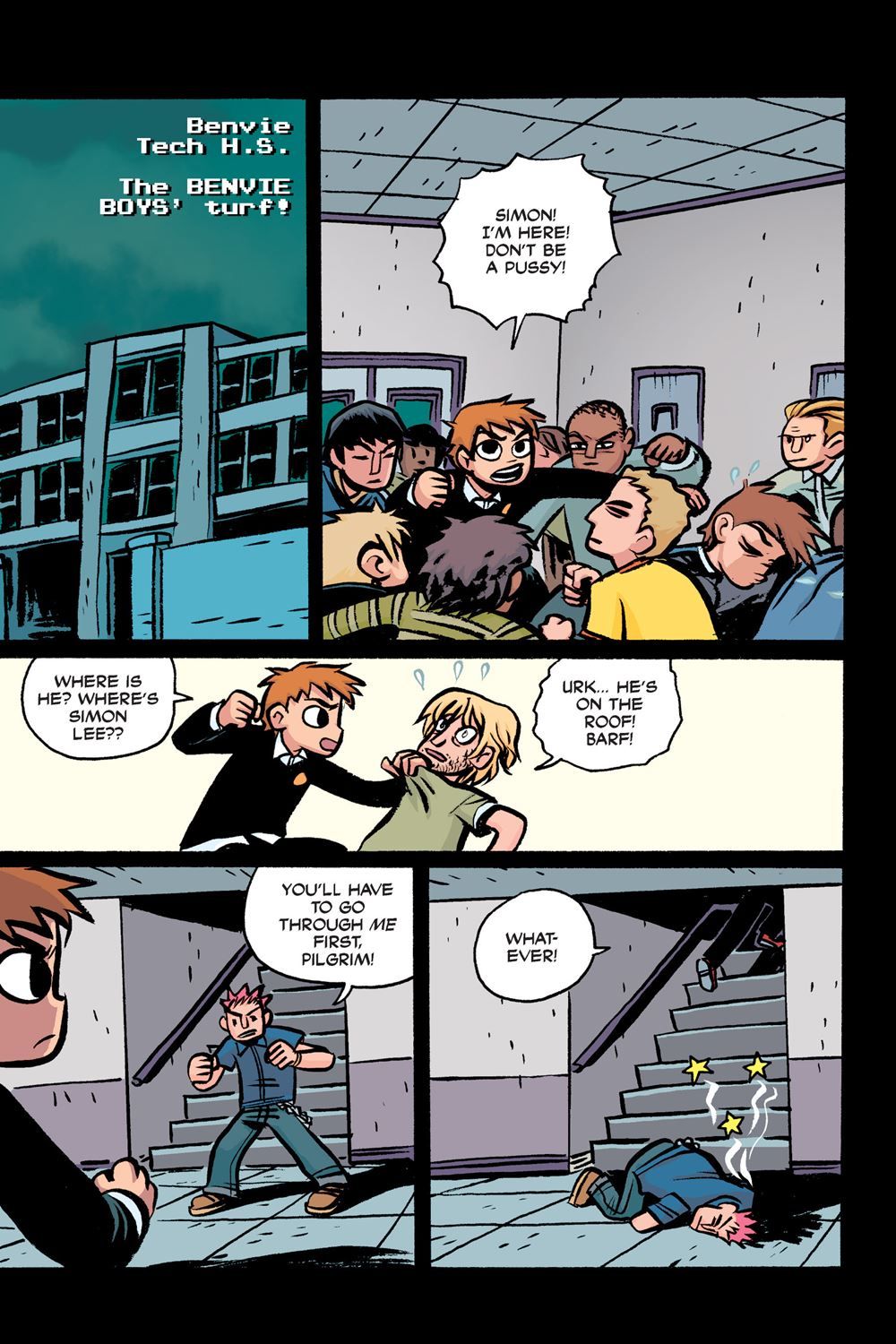
Because River City Girls is this deliberate combination of Japanese and American, it also begs comparison with another piece of media heavily inspired by manga and retro gaming: Scott Pilgrim by Bryan Lee O’Malley. In fact, Scott Pilgrim is itself heavily influenced by River City Ransom, as indicated by one of the comics’ characters crying “BARF!” as they’re hit, and the Scott Pilgrim video game being a beat-em-up. The senses of humor found in River City Girls and Scott Pilgrim, while not wholly identical, are similar in their irreverence and fourth-wall breaking one-liners. There’s even a boss fight in River City Girls against a musician just as there’s one in Scott Pilgrim. At the same time, enough time has passed that Scott Pilgrim (itself a love letter of sorts to the NES era of gaming) is old enough to be a nostalgia trip for fans of comics, video games, and other media. That, in turn, makes River City Ransom an even more distant memory in the collective video game and pop culture fandom.
River City Girls is an entry into a genre whose heyday has long since passed that uses 2D sprite graphics and playful animations. In taking from the late 1980s of both Japan and America, and filtering them through a contemporary lens in an age where “anime-influenced” works are more common than ever before, RIver City Girls ends up feeling somehow both extremely current and incredibly nostalgic, instantly dated yet also timeless. It’s an aesthetic I can get behind.
It’s a testament to the longevity and popularity of Pokémon and its characters that a game could come out where you collect not so much the Pokémon themselves, but their trainers. Whether it’s Sinnoh champion Cynthia or Pewter City Gym Leader Brock, the humans of the Pokemon world have garnered their own fanbases, and the mobile game Pokémon Masters takes advantage of this by bringing them all into one convenient place.
While I find the game itself fun, though not without its problems and quirks, I want to focus one one particular aspect of Pokémon Masters I find interesting. Specifically, it’s the ability to summon player characters from multiple generations of Pokémon as non-player characters that catches my attention because it means Pokémon Masters has to create personalities for them when they were previously empty shells.
Within the main games, only Red (the hero of the first generation) has made multiple appearances as a computer-controlled character, and his personality can be charitably described as “strong and silent.” The only thing he ever says in any game is “…” as a reference to that being the only thing you could say in link battles on the original Game Boy. After that, while certain characters may have had personalities established in adapted material like anime or manga, many liberties end up being taken that causes those narratives to differ significantly from the games. For example, in the anime, May (a character based on the female player character in the third generation games) is the daughter of the Gym Leader Norman. But in Pokémon Masters, it’s Brendan (the male player character) who is Norman’s child. While there’s nothing necessarily “canon” about Pokémon Masters, it still means the developers had to decide how these player avatars behave without a player.
As a result, fans of Pokémon may potentially view these old characters in a new light. Rosa, the heroine from the Gen-5 Pokémon Black 2/White 2, is expressive and quirky, garnering many fans in the process. Brendan appears eager and energetic. Kris, from Gen 2’s Pokémon Crystal, is kind yet feels she needs to improve. Without any real meat to go on, I have to wonder how the developers decided to give which traits to these old player characters. Will these become their established personalities moving forward in the games, or is it a one-off thing only for Pokémon Masters? Personally, my hope is that they end up sticking. The only question left is what’ll happen to the actual player characters of Pokémon Masters in the future—what qualities will the two of them have if/when they show up elsewhere?
The fourth Super Smash Bros. Ultimate DLC character has been announced, and it’s SNK posterboy and fighting game icon Terry Bogard from the Fatal Fury franchise. The overall response was mixed, from die-hard SNK fans cheering at his arrival to comments to the effect of “I’ve never even heard of Terry Bogard.”
While I understand that not everyone has had exposure to Terry’s games or even the three Fatal Fury anime that came out in the 1990s, a part of me still feels perplexed at the latter reaction. It’s as if I unconsciously consider awareness of Terry Bogard to be the most common and natural thing, like hearing the name “Frank Sinatra” and at least knowing vaguely that he was a famous singer. The logical side of me gets that Terry isn’t a household name, especially for the younger generations of gamers, but the emotional side of me asks, “But why not?”
In terms of what Terry Bogard brings to Super Smash Bros., he’s clearly not the most iconic fighting game character ever. That would be StreetFighter’s Ryu, who’s already been in the game since Smash 4. Still, Terry matters a lot. He represents SNK, the company behind the Neo-Geo. He represents both the Fatal Fury games and the King of Fighters games, and unlike Street Fighter’s relationship with its offshoot franchises, FF and KoF are both majorly important, with the latter reaching heights of popularity in Latin America and Asia in ways few series ever did. Terry Bogard is a symbol of a company, a console, and two connected video game franchises. He’s like Sonic and Ryu rolled into one.
Terry is one of the coolest, most charismatic fighting game–and video game–characters ever. Even if you don’t know his backstory, he just exudes a kind of charm and attitude that make him hard to forget once you’ve seen him in action. Even his signature victory pose, where he turns his back to the screen and tosses his cap in the air while exclaiming, “OK!” screams personality, whether it’s 1990 or 2019. When you learn about his quest to avenge his dead father by defeating evil corporate tycoon/martial arts master Geese Howard, who’s equally amazing as a character, it just makes everything better.
My image of Terry is also no doubt shaped by the Fatal Fury anime I watched as a kid. In a time when the golden rule was “all video game anime are terrible,” the Fatal Fury 2 OVA was a stark exception. Watching it on fansub repeatedly back in the 1990s (shout-outs to S.Baldric), Terry’s story of hitting rock bottom after losing to the mysterious German warrior Wolfgang Krauser only to crawl his way back up by rediscovering his love of fighting is simple yet memorable.
Even in terms of meme culture, Terry Engrishy quotes are a staple of old fighting game forums. “Pawaa Wave!” “Pawaa Geezer!” [Geyser] “Are you OK? BUSTAA WOLF!” “Hey, c’mon, c’mon!”
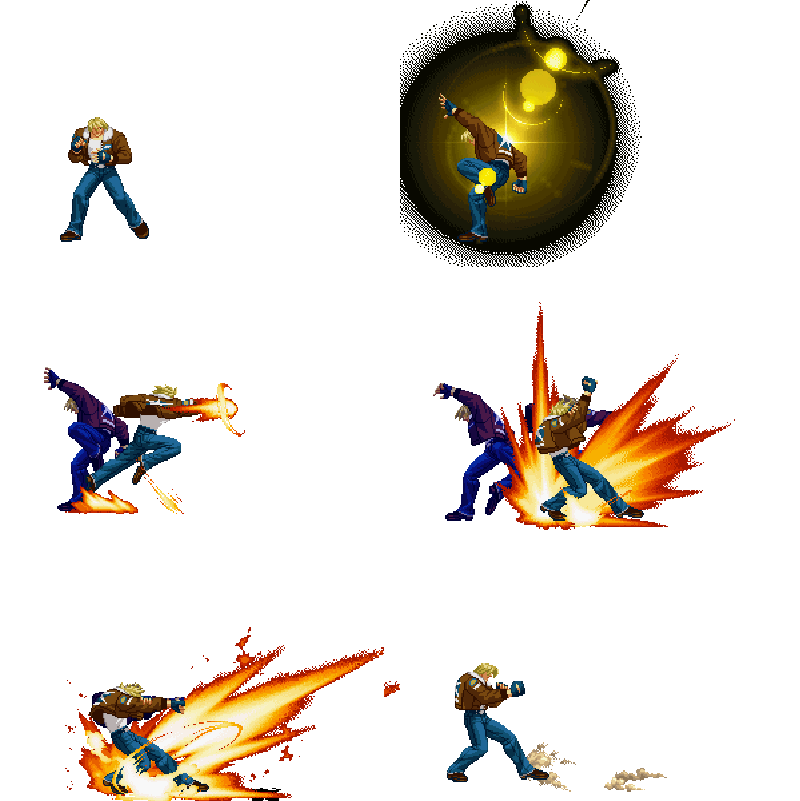
As for how Terry will play in Smash, I assume he’s going to be like Ryu and use command inputs, but he’s also perfect for Smash in that his special attacks map perfectly to B moves. Neutral B has to be Power Wave, Side B Burn Knuckle, Up B Rising Tackle, and Down B Crack Shoot. He’s already a very mobile character, and that fits in well with a platform-fighting game in ways that Ryu and Ken never could.
November isn’t that far away, but it still seems like forever. I’m looking forward to Terry Bogard balance debates and all they entail. Also, I saw someone on Twitter suggest an Obari Masami-style costume for Terry based on his look from the anime, which I’m all for. Between that and Mark of the Wolves bomber jacket Terry, and we have a heck of a presentation.
Whether it’s me getting older or my priorities shifting, I don’t play quite as many video games as I used to. So when I’m asked by Johnny, a Patreon sponsor, about what my favorite Nintendo Switch games are, I actually don’t have a lot to choose from. The other side of this is that I’ve played the few games I do own fairly extensively, speaking to their longevity.
The first game I have to mention is Super Smash Bros. Ultimate. The single-player story mode, World of Light, drags a little at the start, but by the time I reached the endgame, I fell in love with it. The multiplayer successfully finds a balance between the pace of Melee and the desire to make even more complex areas of the game accessible. With all of the new characters announced and the clear love and care that goes into them, Smash in a way transcends the act of gaming itself and enters a realm of shared memory, interacting with nostalgia and the thrill of discovery (learning about new characters you never knew about) to become a phenomenon.
Splatoon 2 is pretty much what I expected—a refinement of the first Splatoon—and it makes for a fun and diverse game where I’m eager to try out whatever the game tosses at me. The simple idea of weapons that both attack and claim territory makes Splatoon as a whole always refreshing, and the weakening of the special moves to put more emphasis on the basics is smart. I recently beat the single-player mode as well as the Octo Expansion DLC, and it provided some of the most engaging (but also frustrating) boss battles ever.
The last game I want to mention is Super Robot Wars T, the first SRW game for the Switch. It’s not especially different from previous entries that I’ve played, but the thrill of seeing my favorite characters from anime working together, as well as the challenge provided as the story grows on a cosmic scale, makes it hard to get tired of. Having Magic Knight Rayearth in an SRW game is like a dream come true, and I’m hyped that they’re actually bringing SRW V and SRW X to the Switch as well. Who knows? I might end up liking this more.
I’ve been thinking that it’s time for me to play more Switch games, and this might be the impetus for me to do so. I wonder if this list would change in any major way in a year’s time.
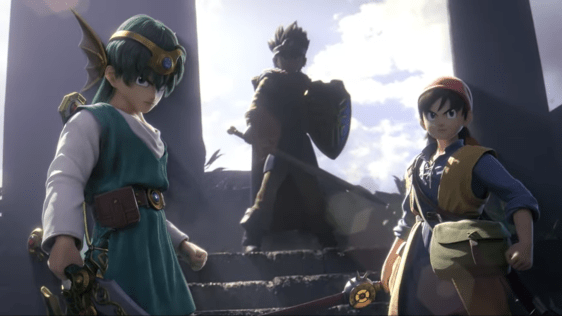
When the Hero from Dragon Quest was first revealed as a playable character in Smash Bros. Ultimate, there were hints as to how the character would function, but few were able to predict that the character would be so volatile. Because the Hero has not one but multiple random mechanics that can make him both inconsistent and unpredictable, part of the conversation surrounding the character has revolved around whether the character’s “luck” elements hurt competitive Smash Bros. There’s even talk, however small, about the possibility of banning the character outright.
The Hero has smash attacks that can randomly trigger critical hits (effectively double damage). He has a spell menu the contents of which are random every time you open it. He even has a spell inside the spell menu that gives random results. So the fear is somewhat understandable—especially given the scene’s general dislike toward and removal of spawning items (i.e. a major random element) from tournament play.
While there are many arguments to make for why banning the Hero is a bad idea—the character is simply too new to understand his impact on high-level play, for one—I want to make a different case about his merits. Specifically, I believe that the Hero and his special mechanics provide new and interesting tests of skill that revolve around managing randomness without the major downsides and stigma of items-on play.
Skill and Luck Are Not Opposites
Before this argument can move forward, it is necessary to try and dispel an idea that has plagued competitive Smash since the earliest days: the false dichotomy between skill and luck. On a surface level, randomness interfering with skill makes sense because a coin flip, for example, can’t be modified through talent and effort.
But competitive scenes exist for games with heavy elements of chance, and in these environments, the question of how to navigate, take advantage of, and cope with random chance is ongoing.
Magic: The Gathering
People complain that their opponent topdecked their only out the turn they needed it, but do not realise that often their own poor play either gave their opponent more turns to draw the out or overcommitted turning the eventual out into one in the first place. —“There’s No Such Thing as Luck.”
Japanese mahjong (plus poker)
Poker players think a lot about how to maintain a strong table image…. [I]t’s going to be a lot easier to get lucky if the other players aren’t gunning for you because they’re afraid you’re too strong for them. When I’ve played Mahjong with him, Sarukawa maintains a fierce table image and it definitely makes me think twice about declaring reach even with a strong hand, thus increasing his chances of getting lucky and decreasing mine. —Nagare, Luck, or whatever you want to call that crap
There’s even a very good video from Game Developer’s Conference 2017 by designer Skaff Elias all about the false dichotomy between skill and luck.
Those who think that they have unfairly lost a Smash Bros. match due to a Mr. Game & Watch Judge 9 would likely fall into a coma if confronted by some of the agonizing probability-based losses that Texas Hold ’em players have to go through. But whereas Smash players have historically shunned randomness, other games use randomness as an opportunity to test two things: how well you can take advantage of good luck and how well you can mitigate bad luck. While complete randomness with no opportunity to interact doesn’t provide much room for interaction, good games of chance give players plenty of opportunities to show how they can roll with the punches.
Although it’s early on, I feel that the Hero provides enough avenues for both the user and the opponent to manage the character’s random elements. This, in turn, is what makes him different from turning on items—which, for the record, I am also not against, but I’ve learned long ago that trying to convince Smashers to play with items is a losing battle. Still, I think there’s hope for the Hero.
Random Factor 1: Critical Hits
Let’s first look at the Hero’s smash attacks. They are quite strong in terms of sheer power; forward smash can kill a Pichu at the ledge at around 50%. But there’s also a 1 in 8 chance to land a critical hit, which turns a roughly 20% damage attack into a 40%+ monster capable of KOing opponents close to 0%. There is no way to prevent or induce a critical hit artificially once an attack lands, so neither the Hero or the opponent can control when they happen.
The only way to guarantee not getting blasted by a critical hit is to avoid getting hit at all. But while that sounds ridiculous at first, there are a couple of limiting factors: the Hero has to actively choose to use a smash attack, and the actual moves have numerous flaws that make landing hits easier said than done.
The Hero’s up smash is similar to Marth and Lucina’s—a vertical stab straight up into the air—but unlike theirs, the Hero cannot hit anyone standing next to him. In fact, the horizontal range of the smash attack is so narrow that the opponent has to be virtually right on top for it to connect. Down smash is fairly quick and hits both sides, but is the weakest and unlikely to KO without the power of a critical hit. Forward smash is the best one, but it’s relatively slow and doesn’t reach quite as far as one might expect. Outside of the critical hit factor, all three are lacking.
And much like Mr. Game & Watch’s Judge hammer or Luigi’s Green Missile, the Hero’s smash attacks have to be deliberately chosen. They do not just happen randomly without anyone’s control, as if they were Bob-ombs spawning into a player’s attack. So the critical hits are random and they are extremely powerful, but they’re locked behind slow, somewhat unreliable moves that leave the Hero vulnerable.
Every smash attack is a roll of the dice, except those dice are cumbersome gigantic novelty ones and the table you’re rolling on is a toddler’s high chair. While they don’t have any random negative side effects like Judge, they’re inherently risky. Most importantly, the Hero player has to actively make the decision when and where to take those swings—they don’t just happen automatically.
Random Factor 2: Command Selection
Hero’s down B special is Command Selection, in which the Hero pulls up a menu of spells and special strikes, and it’s the other area of contention in regards to fairness because of how multiple layers of randomness are built into the move. First, only four spells can be displayed at a time, and it will change every time the menu is re-opened. Second, the order in which the spells show up is also inconsistent. Third, two of the spells—Whack and Thwack—have a probability of instantly KOing an opponent; the higher their damage, the more likely they’re toast. Fourth, the spell Hocus Pocus is literally a spell that randomly triggers either a move from the existing list of commands or additional modifiers both beneficial and detrimental. Although highly unlikely, it is actually possible for the Hero to hit down b, blindly pick Hocus Pocus, have Hocus Pocus trigger Thwack, and kill an opponent at 0%.
While there’s no doubt that getting destroyed by such an unusual chain of events could tilt just about anyone, I think focusing on those edge cases would be more a symptom of focusing too much on isolated results in the short term rather than consistency in the long term. Moreover, while the spell list is random, it doesn’t remove skill. Rather, it tests the players’ ability to assess what is worth using every time it opens, and to act accordingly.
Above, I mentioned games like Yu-Gi-Oh! as examples where players must randomness into account when strategizing. When it comes to Command Selection, this comparison is especially apt, because opening up the menu is not unlike drawing cards in a TCG. While there is an element of luck, it’s the responsibility of the player to be able to adjust their approach–to sometimes turn lemons into lemonade. There’s also a common mechanic in trading card games called a “mulligan,” where a hand that’s sufficiently terrible can be discarded and replaced in its entirety. The Hero essentially has the ability to mulligan his hand at any moment, but with the caveat that the opponent can see what the Hero’s options are, and that he can’t keep any of the “cards” he doesn’t use. A good Hero has to be able to build upon the tools available to him in a given moment, and just because it’s uncommon in competitive Smash doesn’t mean it’s not a skill worth testing and valuing. The ability to improvise on the fly and be effective at crisis management in the face of external forces somewhat beyond the players themselves is good.
Conclusion
Luck can bless the Hero, or it can curse him, but there are multiple caveats that make him a worthy character who should be welcomed in tournaments. First, he has to be in a position to test that luck in the first place, and most if not all of his random-outcome moves are telegraphed or announced in some way. Second, just because he gets a lucky or unlucky move doesn’t mean the match ends there—both Hero and opponent have to be able to make the best of a situation. The result is a character who works to find chances and has to adjust on the fly to external forces, and those who master this are the likeliest to find success built not on favorable fortune but the ability to seize opportunity.
On Sunday, Geoff “iNcontrol” Robinson passed away due to a sudden illness. A beloved figure in the StarCraft community, his gregarious nature and sense of humor did a lot to push and keep StarCraft in the limelight for many years.
The news hit me in a way I wasn’t entirely expecting. I enjoyed his work, but I haven’t been avidly following StarCraft for a few years now. Still, I remembered all the times I would stay up late to listen to a State of the Game podcast or leave a match on in the background just to hear the entertaining banter between him and the other casters, and I realized what an impression he had left on me. When I did check in on what he’d been doing as of late, it seemed like the world was open to him. He had so much potential left.
33 years old. Damn it, that’s much too young. While jokes are made in esports that anyone over 30 is a relic, iNcontrol always looked like the picture of health. To say his passing was unexpected is an understatement, and it saddens me in a profound way that I can’t fully describe or understand.
iNcontrol leaves behind a hell of a legacy. He was a major figure in the early days of non-Korean Brood War. He helped to bring esports to renewed prominence in the early days of Twitch streaming and being a positive force in his community. I can tell his impact because I find myself impacted by him, and my deepest condolences and respect for those near and dear to him.
By now, many sharps minds in the Smash Bros. Ultimate community have analyzed the trailer for the new “Hero from Dragon Quest” DLC character and have noticed a couple of interesting properties. First, the Hero appears to have much more than four special moves, and unlike the case with the Mii Fighters, he does not appear to have a customizable move list. Second, at one point he’s shown pulling up a menu of magic spells, and the ones displayed on the menu aren’t the only spells he uses in the trailer.
This has led to speculation that the Hero might have more available special moves than any other character in Smash Bros. history—possibly up to 16! What this means is that the character has a diversity of options unlike any other. But characters aren’t only designed with advantages. What could balance out this strength?
The most obvious drawback of the Hero’s wide array of spells is that he has an MP gauge: if he doesn’t have enough MP, he can’t use a spell. There’s no word yet as to how the Hero might gain back MP, so that could be another mitigating factor. However, there’s another potential flaw in how the Hero plays that is largely unseen in Smash: the risk of completely telegraphing what special move he’s about to use.
The only characters who come anywhere close to having such a weakness are Shulk and Olimar. Shulk’s Monado Arts clearly display which mode he’s in, and thus roughly what the opponent should be looking out for. Olimar uses his Pikmin in the order they’re plucked, and can only change which Pikmin is used next by either attacking or using his whistle. In Olimar’s case, identifying which Pikmin he’s trying to use (and therefore what attacks to be wary of) is also easier said than done due to their small size. But even Shulk’s giant “this is the Monado I’m using” tell is not the same as having literal menus pop up that show what move the Hero wants to use next—menus the opponent can easily see as well. There’s no clear indication of any shortcuts, either.
With a character that’s not even out yet, it’s impossible to accurately say how good or bad a character is going to be. However, based on this potential prospect—the unique strength of 16 (?) spells tempered by the unique weakness of showing your cards—I’m looking forward to both the strategy and counterplay that will develop with the Hero. I can’t wait for him to be available.
The dual Smash Bros. Ultimate character reveals of the Hero(es) from Dragon Quest and Banjo and Kazooie have gamers abuzz with excitement. While I didn’t quite get the DQ villain I wanted, I’m no exception when it comes to riding the hype train. However, seeing some of the negative reaction among English speakers online over the Hero’s entry into Smash makes me realize something: a lot of fans care less about video game history as a whole and more about their own video game history.
This is not unexpected, nor is it inherently bad. The games we grow up on and love are going to get a stronger reaction than things we only have a more academic understanding of. Nostalgia is a powerful thing, and when people engage in hype, they’re not necessarily engaging their intellectual side. Even the Japanese fans who are freaking out over Dragon Quest are doing so because of emotional attachment. DQ crosses generations and is an indelible part of Japanese pop culture on a scale that few things can compare to. If Banjo-Kazooie fever is a combination of 1990s gaming nostalgia and the return of a prodigal icon, then Dragon Quest in Smash is just plain nostalgia for a perennial favorite, transcending gaming and any specific time period. It popularized the RPG as a genre in Japan, and its simple gameplay made it accessible to audiences young and old in ways few games ever have.
Where I take umbrage with some of the reactions I’ve seen from some vocal Smash fans is a combination of entitled behavior and the seeming inability to engage that intelligent side of their brains that can allow them to appreciate things that aren’t necessarily connected directly to them. Just because there’s no deep, emotional bond doesn’t mean it’s not worthy of attention or fanfare. Smash Bros. is in many ways a celebration of video game history, so to see fans willfully reject that history is sad to see.
Dragon Quest has the potential to expand the reach of Smash Bros. far beyond what anyone has seen. Few characters can reach literal sixty-year-old Japanese businessmen the way DQ can. World-famous manga artists like Kishimoto Masashi (Naruto) have written about their experiences with the RPG. Toriyama Akira (Dragon Ball) has been responsible for the art since the franchise’s inception!
Banjo-Kazooie and Dragon Quest are both important new titles for Smash Bros., and I hope as many people as possible appreciate that.
PS: The Japanese trailer for Hero actually has him saying the names of his spells, so a silent protagonist he is not. I wonder if this might change the impression people have of the character if this difference sticks.
When a series gets into a Super Robot Wars game, for the first time, it’s a momentous occasion, especially when the game in question is one of the “mainline” iterations. The mecha (or even spaceships these days!) can be from old and obscure works, cult favorites, and even the new hotness. When playing through the recent Super Robot Wars T, however, I noticed that there’s a significant dearth of recent series, and I’m using that term loosely—out of every anime included, only two are from the past 13 years.
Even that number doesn’t tell the whole story. One of the anime referred to above is 2018’s Mazinger Z: Infinity, a film sequel to the original Mazinger Z anime franchise. While technically “modern,” it’s meant to be a nostalgia work. That leaves only Expelled from Paradise, a 2014 film. The next one after that is Gun x Sword from 2005. It’s not inherently a bad thing, and there are a number of welcome surprises in SRWT like Magic Knight Rayearth, Cowboy Bebop, and Captain Harlock. In a Famitsu interview, the director, Terada Takanobu, mentioned that one of their decisions for including new titles was a desire to have something for every age group. So in the sense of newcomers alone, it’s a pretty even split. However, the heavy lean towards the old is still noticeable, and I think a number of factors go into this.
First, as the years go by, what is considered an “old” title vs. a “new” one widens. Second, mecha anime just isn’t the bustling industry it once was, at least not in the same way. Third, I think that, as much as they tried to pull in fans of all ages, their core demographic seems to be working adults somewhere around 25-39, given both the themes of the game and the title selection itself.
For many younger anime fans, a span of five years might very well cover their entire fandom, let alone the now five decades that have elapsed since the original Mazinger Z anime debuted. For Super Robot Wars, this goes double, as it often takes quite a few years for a hot new mecha title to get the spotlight. Back in the early 2000s, Gaogaigar (1997) and Shin Getter Robo Armageddon (1998) were considered fairly young upstarts when they appeared. Now, in Super Robot Wars T, they’re grizzled old veterans. Outside of Super Robot Wars specifically, it’s always fascinating to see a title like Cowboy Bebop (1997 debut but aired on Adult Swim in 2001) go from being the hot new thing in the US to being a virtually canonized masterpiece that’s sometimes more discussed than viewed.
The relative oldness of the entries in SRWT is in part a consequence of how giant robots are simply not the industry juggernaut that they once were. Long gone are the endless number of children’s mecha shows, and the robot anime that do remain know that their audience will often skew older. Super Robot Wars, given its nature as a crossover celebration of what is increasingly a niche genre, is sort of tailor-made for nostalgia, compounding the sense that its appeal does not lie in attracting newer, younger anime fans, but those with a lot of experience watching and loving mecha anime. There are newer titles to pull in, but will they have the same draw as these assumed childhood/youth favorites?
In that sense, it’s interesting to note just where the nostalgia hits hardest for SRWT. Many of the titles are squarely in the 1990s without being made as sequels or reimaginings—Cowboy Bebop, Magic Knight Rayearth, Nadesico, G Gundam, Gaogaigar, and Might Gaine—while plenty of other titles are late 80s or early 2000s. Director Terada mentioned that international fandom was a consideration for which titles to include, and while not the case with every country, I think that the 90s is an especially strong time for fan nostalgia now—or at least the 90s anime they may have seen years later because anime distribution wasn’t nearly as speedy back in the days of VHS tapes and Real Media Player.
It’s also telling that the gimmick of the main heroes is that they’re salarymen, i.e. full-time working adults around ages 25 to 39, instead of teenagers. In some sense, it works as a gimmick, but when past original characters have been decidedly less mundane in their basic premises, the idea of “loyal company employee” stands out. There’s something to be said about how the notion of the salaryman as the default position for adults in Japan has been shattered for many years now, but I won’t go much into it except to say that while a heroine who just really likes a steady paycheck might have seemed like the most milquetoast thing once upon a time, in our current global economy, that idea almost borders on escapist fantasy.
Or maybe the teamjust really wanted to do a story with Jupiter as a focal point. Between Shin Getter Robo Armageddon, Nadesico, Crossbone Gundam, Aim for the Top!, Gaogaigar, and Cowboy Bebop, the fifth planet from the sun gets major play.
There’s one last possible reason the series is lacking anime titles from recent years: they’re saving them for a direct sequel. While there’s no news yet of a true follow-up to Super Robot Wars T (as opposed to just another game with a completely different cast and universe), there are enough loose threads in this game that a continuation would not be surprising.
I’ve been playing the heck out of Super Robot Wars T (available via import in English for the Nintendo Switch and PlayStation 4), and as always, I’m into the loving fanfictional goodness that the franchise always entails. When you have all of these different giant robot heroes in the same universe, the interactions are an endless source of amusement and head-nodding affirmation.
Of the many crossover moments little and big, however, there is what I believe to be an unspoken story element that significantly alters the course of one particular series: King of Braves Gaogaigar. This might be mere fan speculation on my part, but I think it also makes total sense.
In the original 1997 Gaogaigar TV series, the main character Shishioh Guy uses an attack called Hell and Heaven to finish off monsters. A little into the series, however, he discovers that using the attack too much does severe damage to his cyborg body, and that overusing it could lead to death. In response to this, his team (known as GGG) creates a new, alternative finisher called the Goldion Hammer, which becomes his default decisive blow through most of the series. It’s only in desperate times when the Goldion Hammer isn’t available that Guy will resort back to Hell and Heaven.
But in Super Robot Wars T, when you meet Guy, the Goldion Hammer is nowhere in sight, despite the story being well past the point in the anime where he was supposed to get the Goldion Hammer. And yet, Guy shows no signs of excessive use of Hell and Heaven. On one level, this is likely a gameplay pacing decision, to keep Gaogaigar from having its strongest attack early on, but I think there’s also an in-story explanation: he simply didn’t have to use it as much in the SRWT universe.
Whereas Gaogaigar and GGG alone fought against EI-01 and the Zonders in the anime, in the game, they occasionally received help from Watta and Tryder G7 (from Muteki Robo Tryder G7), as well as Maito and Mightgaine (from The Brave Express Mightgaine). In other words, in SRWT, Guy had enough assistance in his many battles that, by the time we meet him in-game, he isn’t anywhere near as overburdened as he is in the anime.
It’s considerations like the above which make Super Robot Wars T (and Super Robot Wars in general) such a treat. I’m looking forward to seeing whatever other crazy moments are in store.

 River City Girls is a new game in the aged genre of the side-scrolling beat-em-up, and a role reversal of the classic damsel-in-distress story. As friends Kyoko and Misako, the player sets out to rescue their boyfriends by clobbering everyone in their way. As suggested by its title, it’s a sequel of sorts to the classic NES game River City Ransom, which is itself a heavily localized version of the Japanese Downtown Nekketsu Monogatari from the Kunio-kun franchise. Because River City Girls aims to be a successor to both River City Ransom and Downtown Nekketsu Monogatari, it takes cues from both the former’s American-esque “dudes with attitudes” style and the latter’s Japanese “yankee delinquents” presentation, resulting in a fascinating mashup of both aesthetics.