Love Live! Sunshine!! and the Complexities of Anime Tourism

Love Live! Sunshine!! Real Escape Game in Numazu

Love Live! Sunshine!! is a media-mix property whose purpose, apart from pushing its stars and profiting from a match of anime fandom and idol fandom, is to promote tourism to the region around the city of Numazu in Japan. What I find fascinating about its approach, however, is that it not only encourages people to visit Numazu, but also reflects and tries to address many of the problems facing Japan in terms of the link between sustaining population, community, and business.

There are three main issues brought up in terms of population in Japan in recent years. First, and the one that gets the most attention, is declining birth rates. Whether it’s “herbivore males” or the difficult choice many women have to make between starting a family and having a career, theories abound as to why fewer Japanese people are having children. Second is the post-3.11 decline in tourism; a nuclear meltdown scares off not just international visitors, but those from within Japan as well. Third, and perhaps the most familiar to people around the world, is people moving out of rural areas into urban ones, leaving the old towns a shadow of their former selves with little new blood coming in.

Flying Witch

The ways in which anime have been used in response to these problems are myriad. Famously, the popularity of the anime Lucky Star led to people visiting the very shrine featured in the show, Washinomiya Shrine. The first Love Live! School Idol Project anime had a similar effect on Kanda Myoujin Shrine in Akihabara, where the character Nozomi works. But there are also anime which try to show the splendor of Japan whether directly or not. I don’t think it’s a coincidence that Flying Witch was made into an anime a few years after 3.11 when Japan was trying to revive tourism to the affected Tohoku region. Taking place in Aomori (a prefecture in Tokyo), Flying Witch features lovingly crafted shots of picturesque landscapes as if to say, “This area is lush with life.” The studio P.A. Works used the series Hanasaku Iroha to create the fictional “Bonbori Festival” and then bring it into the real world. Their more recent work, Sakura Quest, is an anime explicitly about trying to deal with a declining population in a small town through tourism and promotion.

Official Love Live! Wish Board from Kanda Myoujin Shrine

Love Live! Sunshine!! takes place in the small town of Uchiura, near Numazu. Much like the first franchise, the main characters’ school is threatened with closure due to declining attendance rates. The girls, inspired by the group known as μ’s (from the original Love Live!) attempt to replicate the latter group’s success in saving their own school, and form their own idol group called “Aqours.” Already, it’s clear how Love Live! Sunshine!! touches upon issues of population movement and tourism, but it’s especially notable when comparing the series to its predecessor.

Consider where the two properties take place. The μ’s girls of the original Love Live! are centered around Akihabara, which is both the spiritual center of otaku in Japan and, as a result, already a popular tourist destination. The Aqours girls of Love Live! Sunshine!!, on the other hand, are situated near Numazu, which has a population of under 200,000 as well as a recent history of absorbing nearby towns—a major plot point in Sakura Quest and a potential future for Uchiura. Unlike Akihabara, Numazu is hardly world-famous. And yet, if Love Live! had started differently—if it had decided to go with Numazu from the start—then I don’t think it would’ve reached its original success. Much like AKB48, it relied on the notoriety of Akihabara to build itself up, and is now paying it forward, in a certain sense. Love Live! used tourism, and now tourism is using Love Live!

Love Live! Sunshine!! can be seen as another arm of the “Cool Japan” concept, which uses Japan’s fame as a symbol of cultures both traditional and popular to promote itself at home and abroad. It appears to be succeeding, at least in the short term. In fact, over at Apartment 507 where I also write, one of the most popular posts is a guide to visiting Numazu. But as Gundam director and Anime Tourism Association chairperson Tomino Yoshiyuki has warned, short term success is not enough; permanent change is necessary, even if it’s to come from anime. The fact that Love Live! went from being supported by pop culture to being a pop cultural influence that can potentially make a change is a big deal, and I’m curious to see if this experiment has any long-term impact that goes beyond the cute idols of Aqours.

Save

Save

The World is My Canvas, and Competition is my Art: Splatoon 2 Thoughts

The video game that has most occupied my attention lately is Splatoon 2. This comes as no personal surprise, seeing as I loved the hell out of the first one. The gameplay is mostly similar to its predecessor. The changes are mostly about quality of life. But even though both games are so similar, for some reason I find myself experimenting with the different weapons more in Splatoon 2.

My preferred weapon hasn’t changed since the first game: the N-Zap, modeled after the classic Zapper light gun from the NES. For me, t’s gone from a tool for Hunting Ducks to a jack-of-all trades tool whose relative lack of power can be made up for with smart movement and positioning. It’s also just accurate enough for me to effectively focus my fire, while still being forgiving enough to compensate for the fact that my aim is not that great. In Splatoon 2, the ability for it to quickly ink the ground synergizes well with the Ink Armor special, which temporarily lets the entire team take a few extra hits and survive. The N-Zap lets me support allies up close and from afar, and it fits like a glove. Finding the right weapon is just plain satisfying.

But much like characters in a good fighting game, the variety of weapons available, many quite different from each other, is part of the allure of Splatoon 2. Even if some weapons feel counterintuitive, there’s a certain thrill to trying to get into the right mindset for any given tool. When you’re using the Sloshing Machine, a bucket that launches spiraling volleys of ink, the focus is on using its overwhelming power and arching property to quickly kill, er, “splat” your opponent in unexpected places. Dualies are relatively short-range John Woo pistols that allow for unique evasive maneuvers. The Splat Brella is like a shotgun with as defensive shield, allowing players to pick off opponents while guarding allies.

Even weapons of the same class can be wildly different. The Dynamo Roller is the equivalent of trying to Falcon Punch everyone all the time, while the Carbon Roller focuses on mobility and turf coverage at the expense of battle strength. Sometimes using a different weapon means almost playing a different game, and every time I turn My Splatoon 2 on, I think, “Do I stick with the familiar, or try to transform my mind with another item?” Both ways are fun, doubly so when patches try to make everything worth using.

One of the major changes between Splatoon and Splatoon 2 is that the new special weapons–super moves, in other words–are significantly weaker. Where once they could flip a game upside down due to their sheer power, now they influence games in subtler, less pronounced ways. I think this might end up putting more emphasis on the main and sub weapons themselves, which contributes to weapon experimentation also being more fun.

In the end, gameplay is great, and all the modes are worth playing. My only complaints are shoddy Wi-Fi on the Switch (a common problem for the console), and the lack of the Squid Girl promotional outfit from the first Splatoon shirt.

No, really, give me my Ika Musume threads.

[New York Comic Con 2017] Mashima Hiro Panel Thoughts

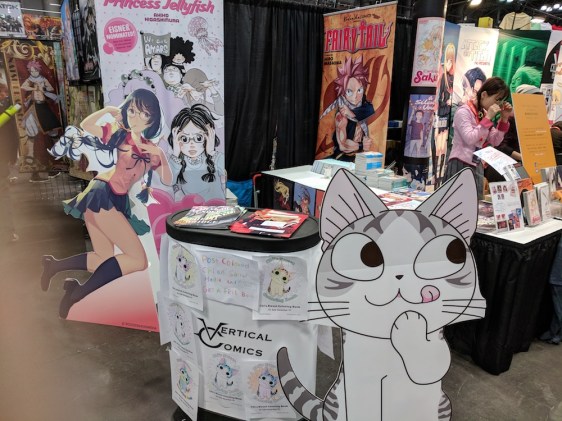
New York Comic Con 2017’s biggest manga and anime guest was, without a doubt, Mashima Hiro. Mashima came to NYCC after concluding his most famous series, the hit shounen manga Fairy Tail, and he sat down for a couple of panels. While I only have a passing knowledge of Fairy Tail, I attended his Saturday retrospective panel at the Hammerstein Ballroom. An hour later, I came away with the sense that Mashima Hiro might be closest to the mindset of anime and manga fandom than other creators.

Because NYCC had another major shounen manga guest last year in Naruto creator Kishimoto Masashi, and because Mashima himself mentioned during the panel that he considered Kishimoto his “rival,” I can’t help but compare the two. Listening to both of them explain their motivations painted two very different pictures. Kishimoto talked about how, at some point, Naruto became a story of redemption, while his becoming a father during the course of his manga’s serialization also influenced the messages he wanted to leave behind. Mashima, on the other hand, seemed to thrive on the simple yet effective premise of “what would be cool?” Fairy Tail was apparently powered by questions such as “Who would win in a fight?” and “What kind of magic would be awesome to see?”

Combined with the greater amounts of fanservice in Fairy Tail—it seems as if, after a certain point, every panel in the series of a girl is pinup quality—it just seems like a series that didn’t have especially lofty goals, not that there’s anything wrong with that. It’s a certain kind of purity, and has in its basis much of what makes shounen manga so popular in the first place. It’s part power fantasy, part adventure. The kinds of ideas floating around in Mashima’s head seem to be cut from the same cloth as much of the fandom, especially when taking into account Western fans. Fairy Tail in Japan is no match for One Piece, but I always get the impression that they’re much closer in popularity at least in the US. I feel like this fan space, where crossover dream battles are practically the potatoes of online discussion (the meat is “who do you ship?”), is one where Mashima’s mindset can thrive.

The Fujoshi Files 174: Mejiro Juon

Name: Mejiro, Juon (目白樹音)
Alias: N/A
Relationship Status: Single
Origin: Princess Jellyfish

Information:
A popular yaoi manga author, Mejiro Juon lives in Amamimizukan, a girls-only shared home occupied by nerds and geeks. Due to her social anxiety, she never reveals her face to others, and instead communicates purely through written notes. She was not always in BL; in her younger days, she even drew shoujo manga.

Compared to her housemates, Mejiro adheres most strongly to Amamizukan’s “No Men” policy.

Fujoshi Level:
Other than the fact that she is a published author of BL works, nothing specific is known about Mejiro Juon’s fujocity.

Save

Chouchou and Body Confidence in Boruto

I’ve been enjoying Boruto: Naruto Next Generations quite a bit, even to my own surprise. The series is quite different from Naruto, akin to how the transition from Avatar: The Last Airbender to Avatar: Legend of Korra involves fundamental changes to the world. It’s a new era in the Hidden Leaf Village, and this is reflected in not just the setting, but how the newer generation of characters behave. One of my favorites in this regard is Chouchou, especially because of her body positivity.

As a daughter of the Akimichi clan, Chouchou is a heavyset character just like her father. However, unlike Chouji in his younger days, who was extremely sensitive about comments to his weight, Chouchou barely bats an eyelash to those who would call her fat. She’s confident in her lifestyle, and to anyone who points out how much she eats, she responds that it’s necessary for an energetic girl like herself. She may be larger than her peers, but it’s anything but a negative for Chouchou.

One of the biggest indicators that Chouchou is not meant to be your stereotypical fat character is that she lacks a “fat voice.” It’s very common in anime for overweight characters to have a rounder, deeper voice that is meant to accentuate their size. Instead, Chouchou sounds perky and fun to be around.

That being said, the “fat voice” does appear in an episode with a different character, a film actor who was fired because he put on too many pounds, so it’s not as if Boruto is entirely without fault in regards to its portrayal of fatness. Even so, Chouchou is still a step in the right direction.


Save

Why the Term “Toxic Masculinity” is a Double-Edged Sword

“Toxic masculinity” is an extremely useful term. It describes a recurring problem with men and boys, which is that the societal pressure to appear and act “manly” can often harm not just others, but the guys themselves. Even the most naturally hyper-masculine individuals can benefit from awareness of this concept because they can at least know that crying, or not being confrontational all the time isn’t a sign that they’re not men. It’s also good for pointing out when media, be it films, video games, anime, etc., reinforce harmful notions of what being a “man” is. Unfortunately, the men who suffer most greatly from toxic masculinity, are likely least receptive to it. I believe the reason for this is that, ironically, the term “toxic masculinity” doesn’t sound masculine enough.

Many phrases that have come out of feminism, or have been embraced by feminists, take on a certain tinge that brings feminists to mind. This isn’t inherently a problem, but whether it’s due to association of just the word choice, it can come across as something concocted in a feminist lab (whatever that might be); perhaps it’s a little too clinical and, well, “feminine.” Part of coming  across as a “man’s  man” is one’s vocabulary, and I believe that the perceived feminist quality in “toxic masculinity” as a phrase prevents more men from using it.

On some level, I want to say, “Get over it and just embrace what the term is trying to say,” but I also understand that it’s not always so easy. Masculinity, toxic or otherwise, is tied to one’s identity. That being said, I think there already exists a phrase that embodies much of what “toxic masculinity” implies that is, for better or worse, more palatable to men concerned about maintaining their image of manliness: “When keeping it real goes wrong.”

Coming from an old Chappelle‘s Show skit, “When keeping it real goes wrong” is used to describe people who refuse to back down in even the most trivial or disadvantageous scenarios, which then leads to dire (and hilarious) consequences. Essentially, it communicates the idea that trying to be “real” 24/7 is a recipe for disaster because the need to have the world see oneself as a proper man who won’t take guff is going to, at some point, end in tragedy.

Do I think “When keeping it real goes wrong” should supplant “toxic masculinity” as the dominant phrase to describe the harmful aspects of male performance? Not really, as it’s kind of unwieldy and doesn’t match 1:1, but I think it has its place. The irony would be that using it could help more men understand the notion of toxic masculinity while also subtly reinforcing it.

[APT507] Doremi’s Unexpected Successor: Why You Should Watch Little Witch Academia

It’s likely you already know and love Little Witch Academia, but I went and wrote a post over at Apartment 507 about the positive similarities between it and Ojamajo Doremi. Check it out!

Save

The Precarious Balance of Tradition and Progress: Sakura Quest

For years, the raison d’etre of the anime studio P.A. Works appeared to be creating intetesting settings as a pretense to showcase cute female characters. Whether it was True Tears, Hanasaku Iroha, Tari Tari,  or something else, they appeared to focus on personal relationships above all else. A more careful look, however, will reveal another major theme permeating many of their works: the declining population of rural Japan, and the complicated effects of tourism on this situation. Now, P.A. Works has doubled down on this idea in their new anime, Sakura Quest.

Koharu Yoshino is a young woman struggling to find work, when she’s been asked specifically by name to come work in the small, virtually forgotten town of Manoyama. Desperate for employment, she takes the offer, only to discover that it was a mistake. But the contract’s been signed, so now Yoshino—along with a group of other young women—are tasked with helping to revive Manoyama.

Much like one of their previous hits, Shirobako, the main cast of Sakura Quest is notably all adult-aged women as opposed to high school girls. When I interviewed P.A. Works at Otakon 2016, they expressed that they’d been wanting to do that as early as Hanasaku Iroha, but trends and the need to make a profit pushed them to stick with the reliable teenage formula. Now, with two series bucking that trend, it looks like they’re eager to challenge that status quo—at least in part.

The use of attractive girls to anchor Sakura Quest means that the series does not fully escape the market forces of young, attractive heroines, but in many ways it also does not pull its punches. Yoshino and the rest of the core cast, consisting of both those new to Manoyama and life-long residents, are confronted with difficult decisions that often leave their best plans only half-formed and arguably doomed to failure by the many considerations they must account for.

Central to this conflict is the contrast between valuing the traditions of Manoyama and its people, and when those traditions stifle the potential for the town to adapt and evolve. Trying to make tourism and local promotion work in a long-declining town is portrayed as a struggle where the gains are few and the solutions are rarely cut-and-dry, if available at all. The series is not necessarily a cynical one, but any progress comes in small steps.  This can be frustrating at times, but it grounds the show in more realistic expectations. After all, if the solution to the rural decline of Japan were easy, we’d probably have seen it by now. It also highlights the idea that, while gimmicks can boost tourism, this is a serious double-edged sword.

Sakura Quest is not one of those gripping anime that keeps you in suspense, or has you falling in love with the girls so hard that you feel compelled to buy their merchandise. It’s a pretty slow burn, and the characters will repeat their mistakes on more than one occasion. However, it’s a very satisfying work in its own way, as it challenges viewers to think about one of Japan’s major problems today, and the myriad factors that complicate it.

Save

Save

Changin’ My Life: Ogiue Maniax Status Update for October 2017

October is going to be a special month for me from this point forward.

That’s because something big has happened, something I once thought impossible: I got married.

Seriously.

I won’t go into too many details, but I’ll just say that my wife is a very special person to me, who’s stuck with me through thick and thin. This even includes my time abroad in the Netherlands. I actually met her thanks to Ogiue Maniax, though I wouldn’t recommend writing anime blogs as a way to find relationships.

So I want to give a very, very special thanks to my Patreon members this month, because your continued support lets me pursue this blog as a passion project.

General:

Johnny Trovato

Ko Ransom

Alex

Diogo Prado

Viga

Sue Hopkins fans:

Serxeid

Yoshitake Rika fans:

Elliot Page

Hato Kenjirou fans:

Elizabeth

Yajima Mirei fans:

Machi-Kurada


In other, non-matrimonial news, I recently did a series of manga recommendations on Twitter. Check out the thread!

Also, here are my favorite posts from last month:

Tomino Yoshiyuki’s “Big Picture”: WHy the Gundam Creator Can Be So Hit or Miss

Recently, I got to thinking about Tomino and all his eccentricities. Here’s my hypothesis on the “Tomino style.”

Fighting Evil By Moonlight – Heartcatch Precure!: The Novel

I reviewed the Heartcatch Precure! novel, which ostensibly focuses more on Cure Moonlight than the anime.

Beyond the Brokeback Pose: Don’t Meddle with My Daughter

A look at the idea of superheroine sexualization and fetishism as a kind of cultural export, through the lense of the manga Don’t Meddle with My Daughter. It actually got retweeted by the author!

Return to Genshiken

Return to Genshiken: Volume 5 – Pride and Fujo Justice

Part 5 of my Genshiken re-read. Ogiue starts her journey here, but it’s Sasahara who really grows.


Patreon-Sponsored

My Favorite Light Novel Anime

Self-explanatory, but a fun topic all the same.

Closing

Here’s to an exciting new life!

Save

Save

Save

“Every Game Has to Be Entertaining”

I’m happy to live in a time where large numbers of people can watch competitive video game competitions. I love that fans can appreciate the skill, effort, and thought that is present in both the games themselves and the players who are vying to be #1. I’ve even grown fond of Twitch chat as the English equivalent of Nico Nico Douga’s scrolling text, for the way that it can provide a shared experience for esports enthusiasts. However, there inevitably comes a time when whatever is on streams is deemed “boring” by its viewers, and the chat starts to turn against the game. If done often enough, it can drag down the spirits of others, including those invested and excited in what’s going on who might start to be convinced by the Twitch chat that what they’re watching is indeed better suited for chronic insomniacs. What I find is that it creates this culture of expectation that demands that all competitive matches be super entertaining or else.

To be clear, some games are less exciting than others, or at least do not require as much investment into a game to get hooked on or appreciate its adrenaline-pumping qualities. Some games are more prone to slower paced matches. Almost all games will at some point have bad players fighting against other bad players, and when two players clam up and don’t do anything, then it becomes boring. However, I find the need for constant excitement to be rather unfair to esports as an entity. If we look at traditional sports, even big, exciting things like basketball or soccer, not all games are going to be nail biters, or have people jumping out of their seats.

In some cases, I think the demand for immediate gratification in terms of excitement also causes viewers to actively prevent themselves from enjoying what might be an interesting and engaging match that’s not as overtly electrifying. The Simpsons once even made a joke about this:

Compared to high-pace, high-scoring games common in the US, soccer might seem slow and full of people doing “nothing,” when in fact the strategy, as well as the ebb and flow of moving the ball back and forth across the field is something that can appeal to soccer fans who understand the game. Of course, some soccer games will also be more or less exciting than others, especially if you factor in the personal investment or national pride of something like the World Cup, but I still don’t believe that people expect every single game to be action-packed.

I think good commentary can play a significant role in helping people to appreciate both those games that are actually just boring, and those that are exciting provided you understand what’s going on. For the lower-level matches where the players aren’t quite skilled enough to show a game at its best, commentators can (and the best often do) highlight the depths of these games that these inexperienced competitors could be accessing if they brought up their skills. For higher-level matches where two titans (or groups of titans in some cases) are coming up against each other, conveying the fast-paced, involved decision-making and physicality of a match can only do good things.

Fighting game commentators should be praised in this respect, because I find that the best have been able to accurately convey tense situations that might not appear to be exciting on the surface. The best example I can think of is Grand Finals of Ultra Street Fighter IV at Canada Cup 2015. Commentators UltraChen work to emphasize that the simple act of walking back and forth in Street Fighter at the highest levels is filled with intensity:

That said, people will think what they want to think, and trying to convince them that a game is actually exciting might not necessarily mesh with how they view the very idea of “excitement.” At the end of the day, this isn’t inherently a bad thing—people should be able to hold opinions of their own on what they enjoy and don’t enjoy. This also isn’t to say that commentators should just fake hype all the time in the hopes of deceiving someone into believing that a game is exciting all the time, and in fact I believe that potentially adds to the culture of demand for excitement. Rather, what I simply want to see is everyone who loves a game, from fans to commentators, strive to grow appreciation for a game in various forms while resisting the ravenous need for action and excitement (without necessarily abandoning those factors).