Purity in Anime Isn’t So Simple

clannadafterstory

When the words “purity in anime” come up, I think the typical association is with sexual purity. Between past stories of fans being angry at individuals both fictional (Nagi from Kannagi) and real (Suzumiya Haruhi seiyuu Hirano Aya) for not being virgins, to the idol industry’s forbidding of relationships for its stars, there is a valuing of chastity that is often tinged with the desire for someone’s virginity to be in a state of limbo: always on the cusp of losing it, but never going to do so. At the same time, however, while sexual innocence is one form of purity, it’s not the only kind, and often it takes the form of a “naive perspective,” a “pure heart,” or a “child-like desire.”

Chichi_20goku_20married

To shift the discussion away from female characters, I’d like to talk about perhaps the most famous character in all of anime: Son Goku. Suffice it to say, he needs no introduction, but one recurring trait of the character is that he is pure-hearted. It’s what allows him to ride Kintoun (Flying Nimbus). When confronted with the Devilmite Beam, an attack that turns one’s negative thoughts into damage, Goku is completely unaffected. Even as he fights planet-crushing adversaries, has two kids, and generally grows into an adult, Goku is still portrayed as innocent of mind. His love of fighting is genuine, and even sex doesn’t really change him.

Looking at more recent titles (unless you count Dragon Ball Super), a character like Nagisa in Clannad is supposed to be an epitome of innocence and purity, but by the time of After Story she’s married and is no longer a virgin. Even though her tragedy quotient shoots way up (as tends to happen in Key works), Nagisa is much like Goku in that sex doesn’t actually impact the sense of purity her character exudes. In terms of child-like desire, Haruka in Free! views the act of swimming similar to to how Goku approaches fighting. It’s not about winning or losing, it’s about the simple joy of the activity itself, whether that’s swimming to feel the thrill of the water regardless of competition, or wanting to test one’s strength against strong opponents. It’s as if the ultimate purity is one that maintains itself no matter the circumstances.

I can’t forget that there is a double standard when it comes to sex. Girls, be they fictional or real, are subjected to the issue of being “ruined” or considered “sluts” in a way that goes well beyond the limited world of idols where both sexes are subject to scrutiny. Nevertheless, I have to wonder if it’s possible for a character to be viewed as pure yet also sexually promiscuous? I don’t think it’s impossible. Perhaps even the enjoyment of sex can be portrayed innocently, even if that might not necessarily be realistic. That said, the degree to which people would be able to accept something like this is probably small in the grand scheme of industry and audience reactions, but maybe that’s not such a bad thing either. One question I wonder is how fans can reconcile a desire for purity in some cases with a strongly sexual presentation at the same time, but it might just have to do with having the option to shift responsibility, especially in the 2D realm of anime and the 2.5D realm of idols.

Parasyte_Migi_2

In the first paragraph I mentioned Hirano Aya and her fall from grace due to the idea that she had sex with her band mates. The backlash essentially sent her from being the top otaku idol to only working in anime sparingly, but ultimately it’s my opinion that this has made her voice acting career better than ever. No longer is she pushed into roles that are tailored towards keeping her as that “goddess of anime.” She can be Migi, the alien symbiote in Parasyte. She can be Paiman, the weird panda-like hero in Gatchaman Crowds. She can be Dende, guardian of the Dragon Balls in Dragon Ball Super. It’s possible to look at her full CV and see that her acting is not limited to that which is most sexually thrilling or geared towards otaku appeal qualities. By de-coupling her from the very idea of virgin purity, her acting is arguably purer than ever before.

This post was sponsored by Johnny Trovato. If you’re interested in submitting topics for the blog, or just like my writing and want to support Ogiue Maniax, check out my Patreon.


Godhood is Fleeting: Power in Video Games and Super Smash Bros.

Fire_Mario_Artwork_-_New_Super_Mario_Bros

Mario nabs a fire flower, instantly transforming into an engine of destruction. Enemies that previously gave the plumber pause are dispatched with ease as Mario rains hot death upon them. Yet Mario is in a rather fragile position, and brushing up against a single enemy will instantly revert Mario back to a lesser state. Even so, for that brief moment Mario experiences an exhilarating sense of power.

Mario appears in another game: Super Smash Brosfor Wii U. Here, the fireball is a permanent fixture of his arsenal. He cannot “lose” his fireball. However, what he can do is combo his opponent repeatedly, using a variety of quick moves to keep them pinned down and begging for mercy. However, when he’s ready to finish off his opponent, many of his combos are no longer as feasible, and he has to take risks to achieve the KO, changing the power dynamics of the character.

How does the feeling power influence how we play and perceive games?

When the Good Outweighs the Bad

In recent years, the Super Smash Bros. series has arisen to be a very popular competitive franchise. The most current game, Super Smash Bros. for Wii U (aka Smash 4) is generally considered superior to its predecessor, Super Smash Bros. Brawl, but not everyone agrees. PK Blueberry, a Brawl Lucas player, contends that Lucas in Smash 4 is less satisfying to play with because the character is less pleasing to control and fight with. Brawl Lucas had a lot of tricks up his sleeve, such as “Zap Jumping”–a technique that could double Lucas’s jump height. “But wait,” others might ask. “Wasn’t Brawl the same game where Lucas would get demolished by characters like Marth, whose grab release infinite made the matchup virtually unwinnable for Lucas? Didn’t this basically sabotage Lucas’s competitive viability in a major way?”

The rebuttal is that, while that is all true, Brawl Lucas was still more satisfying to play. Praxis, the developer of the Smash Pad app, has frequently likened Brawl to a wine with a strong, unpleasant flavor but an amazing aftertaste. The idea is that, once you got past all the nonsense, the crazy things you could do in Brawl were amazing and made it more complex and satisfying. Thus, while there are a lot of ridiculously unfair things that can cripple your character, having just small moments and situations where you can feel immensely powerful is considered by some to be more valuable than just being consistently “okay” and lacking any debilitating weaknesses. Other characters fall into this category as well: players of Ganondorf and Jigglypuff (two of the weakest characters in Brawl) who made the transition to the newest game will sometimes lament the loss of certain amazing attributes or techniques, even though their power levels are closer to the rest of the cast in Smash 4.

Will Power

Another game in the franchise, the immensely popular and competitively long-lived Super Smash Bros. Melee, is one where players, when sufficiently skilled, feel like they can do anything (provided they use the best characters). For example, Fox McCloud is so versatile and powerful that some players and commentators have started using the term “Fox Privilege” to describe the range of strong options available to the game’s best character. Recently, two members of the Smash community have made efforts to describe what Melee‘s feeling of power is like relative to other games, and their descriptions work very well together.

In the video above, ESAM, a top Smash 4 player who’s also skilled in Melee, says that Melee is a game where most matchups come down to how well you can implement your character’s tools against the opponent’s, whereas Smash 4 is more about learning how to fight against characters by avoiding their strengths. In other words, Melee is how much you can do to your opponent, and Smash 4 is how much you can prevent them from doing stuff to you.

Similarly, in an an episode of The Scar & Toph Show, Melee player and commentator Scar compares Melee to Ultra Street Fighter IV, describing Melee as a game where you can easily impose your will upon the game and the opponent unless playing at the very highest level. However, Scar mentions, trying to do the same in Street Fighter is impossible, and that learning to respect the opponent’s options and play that mental game against them is a requirement for even basic competitive play. In contrast, Melee is a game where you can do decently without having to truly “think” unless you play the best of the best.

Together, ESAM and Scar paint an interesting picture of Melee as a game where the player is almost like a force of nature that can only be stopped by colliding with an even greater force. This sense of power is visually evident whenever you watch a game of Melee, and I think this goes a long way in explaining why the game has developed such a diehard fan base. When you play Melee, you enter the realm of the five gods, so to speak, or at least you end up feeling that way.

Desiring Power

In a conversation about fighting games with Dave Cabrera, creator of Kawaiikochan Gaming no Corner, he brought up the idea that while combos are often perceived as something that “top players do,” in terms of game design they offer much more to mid-level players. He quoted an interview with a game designer, who basically asked, “What’s harder to do, successfully performing a complex and intricate combo, or sweeping Daigo ten times in a row?” The latter is about the most mechanically simple thing to do in a fighting game, “down + button,” but one can only achieve it against a player of Daigo’s caliber by being similarly strong. Difficult combos, on the other hand, can grant a feeling of power to even those who lack it, because they can give a sense of accomplishment that motivates players forward. There is a more clear-cut feeling of reward. Without being able to grant power to lower-level players, they very well might stop playing at all.

Conclusion

It would be no understatement to say that Melee and Brawl are actually very different games to their competitive communities, and yet the two games share something in common, which is how they are often perceived relative to Smash 4. Again, while Smash 4 is praised by many as a superior game to Brawl, a frequent criticism of Smash 4 from players of previous games is that the characters lack “teeth.” Even if it is a more balanced game, in the Wii U iteration character power levels (and the range of options and techniques available to players through them), are unsatisfying to some players. Of course, there are plenty of players (including myself) who love the power dynamics of Smash 4, but as I hope is clear, a satisfying level of power in games is very much a personal thing.

Not every player who seeks power does so in the same way, or to the same extent as others. For certain players, power is at its best when constantly generated, especially when the opponent is of similar make. For others, memories of even the most dire of lows can be overcome with even the briefest of highs, such as when their character controls in such a way as to make them feel vibrant and overwhelming. Power can be self-centered, ignoring the opponent almost entirely. Power can be interactive and dynamic. Like water, power is a versatile “substance” that manifests as two immense waves crashing against each other, or the ebb and flow of the tides. How we gain satisfaction from power through games depends on a lot of factors, but when it is considered insufficient, even a mechanically solid game can be perceived as lacking “soul.”

[Apartment 507] Honoka Kosaka vs. Chika Takami: Differences in Motivation

takamichika

Love Live! Sunshine!! is a thing, and while it’s a bit premature to do a full comparison between the old and new guard, I wanted to write a little about an observation I had regarding the franchise protagonists. Take a look, and tell me if this is perhaps the second coming of To Heart vs. To Heart 2.

The Fujoshi Files 158: Seira Noa

Name: Seira, Noa (聖羅乃亞)
Alias: N/A
Relationship Status: N/A
Origin: Happy Fujoshi: Fujoshi no After 5

Information:
Seira Noa is a fujoshi who joins her fellow “Randy x Gerdt” pairing fans for karaoke after a doujinshi event. At karaoke, she sings heavy metal, and asks for another attendee to draw in her sketchbook.

Fujoshi Level:
Little is known about Seira’s fujocity, other than that she joins in with her comrades in pairing not only Randy and Gerdt, but two karaoke joint employees who remind them of those two characters.

My Visit to the Genshiken University

chuo-curve

A geek voyage to Japan typically involves trips to the various otaku mecca strewn across the country. From shopping areas such as Akihabara and Den Den Town to sites found in anime such as Lucky Star and Inari Kon Kon Koi Iroha, otaku pilgrimages are a special way to appreciate Japanese pop culture (and support them financially through tourism in the process). For me, there was one place that I needed to pay my respects to on a trip to Japan: the university campus upon which Genshiken is based.

Before proceeding, I have to thank this site for the information on how to get to the university, as well as showing important spots in the first place. The photos they took are also much better than mine, so if you want really good reference material that’s the place to go.

chuo-animeclub

While the actual Society for the Study of Modern Visual Culture is based on a club at Tsukuba University in Ibaraki, the actual campus of the fictional Shiiou University is based on Chuo University’s Tama Campus. This is made immediately obvious by the Chuo University sign adorning one of the campus’s buildings.

chuo-outside

The real main event is the club area, where the Genshiken club itself would be located if it were real. The building is constructed in an interesting oval shape with an open court in the center, which gives it a distinct appearance. The windows of the two sides of the club building face each other, which is how the members of Genshiken set up their doujin traps to break down willpower in their new members, and how they first noticed Ogiue jumping out of the Manga Society window.

chuo-hallway

Upon entering the club building, it is immediately noticeable how well-worn it is as an environment for students. Remnants of flyers new and old adorn the walls, and produce a strong sense of history. Given my club experience back in undergraduate, I wish we had a place like this to share in the club experience. Though the building was fairly empty at the time, there were definitely signs of life. The first thing I heard was the wails of a death metal vocalist in training, which I assumed came from a Heavy Metal Research Society or something similar.

chuo-posters chuo-mangasociety

chuo-folkdanceclub

chuo-mangacreationclub

chuo-senkisociety

Looking at the flyers themselves showed just how spread out otaku interests could be. From what I could tell, the many clubs included a Animation Research Society, an Anime and Manga Research Society, a Manga Research Society, a Manga Creation Research Society, a Voice Actor Appreciation Society, an Idol Appreciation Society, and an Idol Games Research Society. Many clubs also utilize cute manga characters such as the Folk Dance Research Society and the War Chronicle Research Society. Signs advertising different circles for different doujin events could also be found throughout the building.

chuo-genshikendoor

I eventually arrived at the door where I believe Genshiken’s club room would be located. Though I anticipated some kind of signage to indicate this fact, there was nothing of the sort. The only things that could be found were scraps of paper taped to the wall, with no clear marker as to what club might currently be using the room.

Though I think this shows that Genshiken is nowhere near as big as, say, Love Live! or Lucky Star, and I do wish that it was known enough that some kind of signage would be present to point fans of the best manga series to its source material, it is perhaps for the best. The club building at Chuo University’s Tama Campus still has the feeling of truly being used and handed down by generations of students, which is now an even more solidified theme of Genshiken with Nidaime currently being published.

On a final note, back in 2005 when I originally visited Japan, I went to the Tama Zoo. located near the Tama Campus. Not long after I left Japan, Sasahara and Ogiue had their first date at a zoo. I strongly believe that the Tama Zoo is where they went, though I of course at the time could not know that it would become a pilgrimage site for Genshiken fans; I couldn’t predict the future, after all! However, I am taking the liberty to consider this a retroactive visit to an important Genshiken locale, partly because it makes me feel better.

If you liked this post, consider becoming a sponsor of Ogiue Maniax through Patreon. You can get rewards for higher pledges, including a chance to request topics for the blog.

Just Enough Magic: Flying Witch

flyingwitch-poster

When it comes to stories about witches, it’s quite common (and perhaps even expected) to have magic be prominent. Whether it’s American sitcom classic Bewitched, Archie’s Sabrina the Teenage Witch comic, or an anime and manga like Witch Craft Works, the influence of spells and sorcery is, if not grandiose, at the very least quite large. The anime Flying Witch is a much mellower series in comparison. As a show where just the lightest of touch of the supernatural appears, it makes for a most delightful series.

Adapted by J.C. Staff from the manga by Ishizuka Chihiro, Flying Witch follows the daily life of Kowata Makoto, a teenage witch who moves in with her cousin Kuramoto Kei’s family as part of her coming of age. Residing in Aomori Prefecture in the Tohoku region of Japan, the people there still have a fairly strong connection to nature, and just going back and forth from school is enough to take in the greenery. For the most part, magic doesn’t make much of an impact, but when it shows up it’s just enough to make their world feel a little bit more unusual, and a little bit more wonderful.

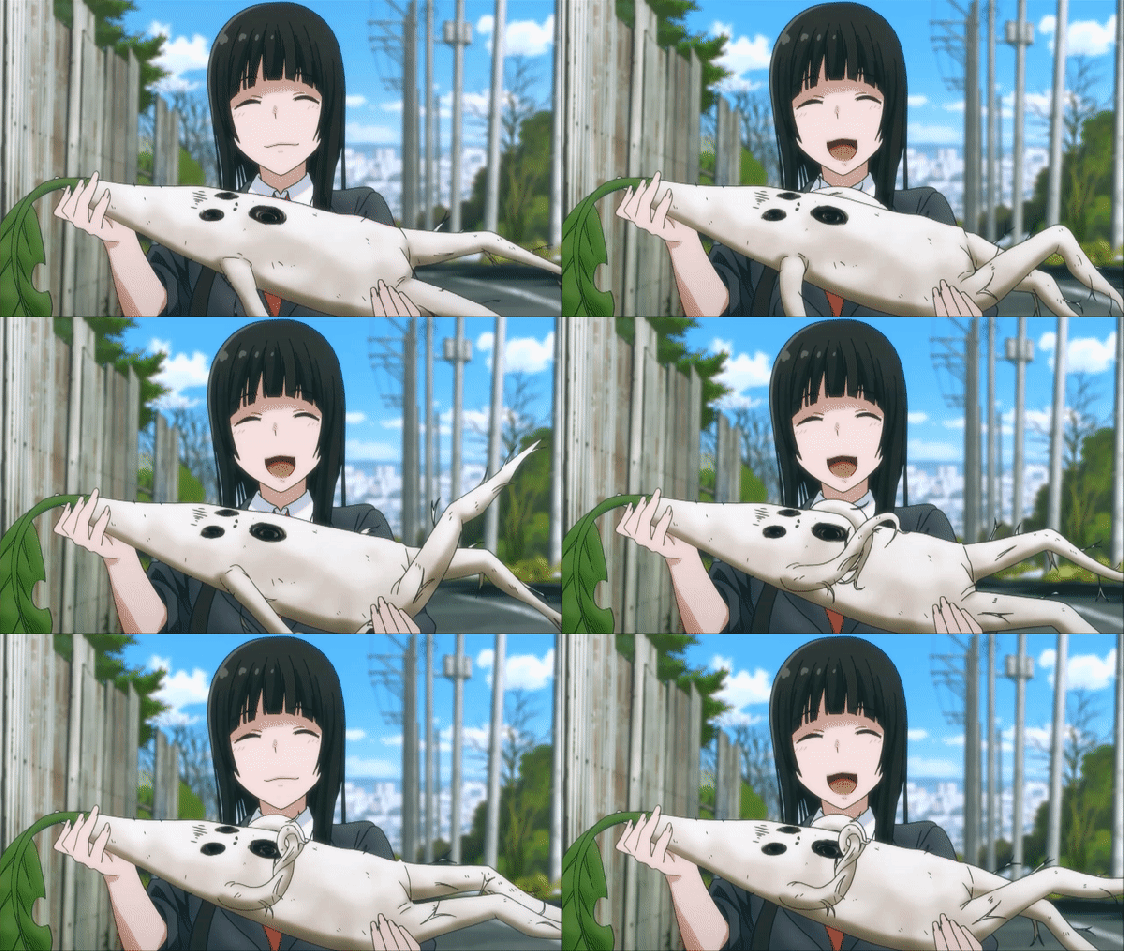
Though the show consistently succeeds at its sparse but effective interaction between the human and witch cultures, the most memorable example has to be in the very first episode. Makoto is walking home from school with her new friend, Nao, when she sees an unusual plant. For anyone who’s familiar with stories about witches and wizards this is a red flag. Sure enough when she gives it a hard tug a mandrake pops out and gives its shrill cry.

flyingwitch-mandrake

As Makoto cradles the demon plant, she cheerfully explains to an aghast Nao that it’s a good thing that they found a young Mandrake because an adult one can literally send people to the hospital or worse. The anime doesn’t stop being this fairly laid-back series, but the result is that the tiniest bit of magic feels that much more amazing.

What also helps Flying Witch is that all of its characters, guys and girls, are extremely charming. Makoto’s older sister Akane is a more experienced witch whose penchant for mischief contrasts delightfully with her younger sibling. The Kuramoto family is entertaining all around, whether it’s the dad’s thick Tohoku accent being indecipherable for Makoto or Kei trying to get his little sister Chinatsu to try more vegetables.

The fanservice in this show also has a deft touch akin to its use of magic, to the point that it might not even be right to call it fanservice. Just to be clear, generally speaking the female characters in this series are all extremely attractive, but Flying Witch never goes out of its way to show them off. When it focuses on Makoto or anyone else, the anime just lets the audience see how nice they look without lingering or leering.

flyingwitch-scenery

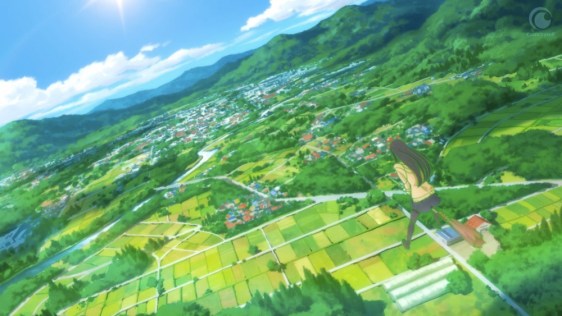
Another notable aspect of Flying Witch is its focus on Aomori, because it at times feels like a promotion for the prefecture. In fact, it makes me wonder if this is one of the reasons it was adapted from manga to anime. The Tohoku region has in recent years been known more for the Fukushima disaster, and a lot of effort has been put into reviving the region in terms of agriculture, tourism, and more. A series like Flying Witch might be just the thing to really get people to visit Aomori and Tohoku again.

Overall, because of how delightfully mellow yet powerful the show’s humor and characters are, Flying Witch has become one of my favorite anime of the year. When I get the opportunity, I’m definitely going to pick it up, possibly in multiple formats. If you want to check it out, you can find the entire anime on Crunchyroll, and Vertical Comics is releasing the manga in 2017.

If you liked this post, consider becoming a sponsor of Ogiue Maniax through Patreon. You can get rewards for higher pledges, including a chance to request topics for the blog.

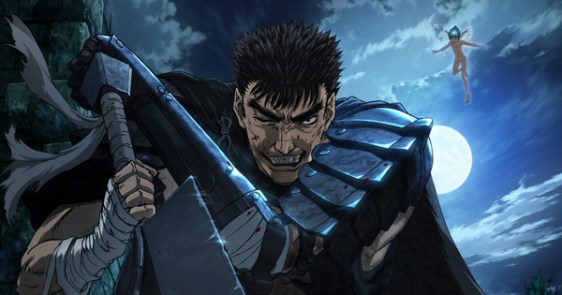
[Apartment 507] Berserk is 27 Years Old

berserk-new-visual

Just some thoughts on how much has changed since Berserk first debuted.

Charge Ahead!: Ogiue Maniax Status Update for July 2016

Don’t forget, the Ogiue Maniax Love Live! Contest ends this Saturday!

With that out of the way, let’s get back to our regularly scheduled monthly blog update.

As always, much thanks to my Patreon sponsors:

General:

Johnny Trovato

Ko Ransom

Alex

Diogo Prado

Sasahara Keiko fans:

Kristopher Hostead

Yoshitake Rika fans:

Elliot Page

Hato Kenjirou fans:

Elizabeth

Yajima Mirei fans:

Machi-Kurada

A special thanks to Diogo in particular for giving me an amazing present: Volume 1 of the Brazilian edition of Genshiken!

genshiken-brazilian

A new season of anime is on the horizon, and I’m looking forward to checking out as much as I can. I’m most looking forward to Love Live! Sunshine!!, which started airing just this past weekend. Unfortunately, I tend to watch many more shows than I have time to write about, so often some of my favorite series don’t end up getting blog posts dedicated to them. I’m considering doing something about that, but it’s always a small struggle between writing about the anime and manga that no one’s looking at to get them more exposure and talking about the things I like that people already have some familiarity with so that there’s an easier connection to be made.

I think that, due to a lack of time, my posts have started getting a bit shorter again. I believe that there are strengths and weaknesses to larger and shorter entries, but it also means that Ogiue Maniax might feel more like the scratchpad for my thoughts that it originally was in the first place. What do you readers think of this, and is there any kind of preferred ratio for you?

June’s post of the month has to be the review of Genshiken Chapter 125. I know, I know, Genshiken is a highlight every month, but I think this is a real case of the manga zagging when you thought it would zig, and it more than anything else reminds me of how wonderful a series Genshiken is.

I also have more reports from my trip to Japan, including my visit to two different Love Live! events, and a look at Comic Store Wonderland in Osaka, which is home to a ton of amazing autographs from famous manga artists. The Hanayo bag I bought at the doujin event is quite possibly my favorite piece of merchandise from Japan. Taketayo~

Another highlight is my review of the new Cardcaptor Sakura manga. CLAMP is back! I mean, they’ve never left, but I just lost interest after years and years of Tsubasa and XXXHolic. This new CCS really feels like a return to form, and I’ve already got plans to get each issue of Nakayoshi as it comes out in Japan.

Lastly, I wrote a post about Mystic Archives of Dantalian, as requested by Patreon sponsor Johnny Trovato, where I explore the show’s intersection with the idea of chuunibyou.

As always, if you’re interested in having me write about something, you can make a pledge through Patreon.  And if you’ve ever wondered why that tier is so high, it’s actually because I really want Ogiue Maniax to still be a space where I share and explore my thoughts, and so having the blog just be about fulfilling requests isn’t what I really want. However, because I’m also always eager to broaden my horizons, I invite the opportunity to make me watch or read or talk about something I might not have thought of otherwise.

I hope you all have a great July. I’ll be spending the month getting panels ready for Otakon in August. If any of you are going, I look forward to possibly seeing you.

Over Half the Movie is Tank Battles: Girls und Panzer der Film

girlsundpanzerderfilm-anglerfish

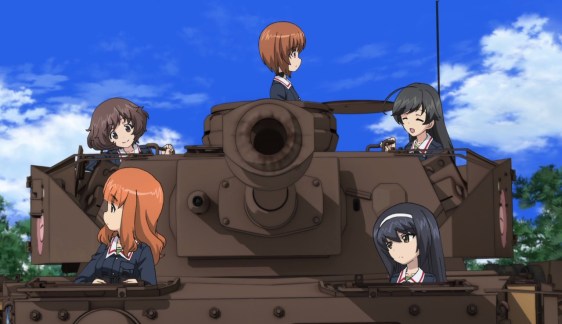
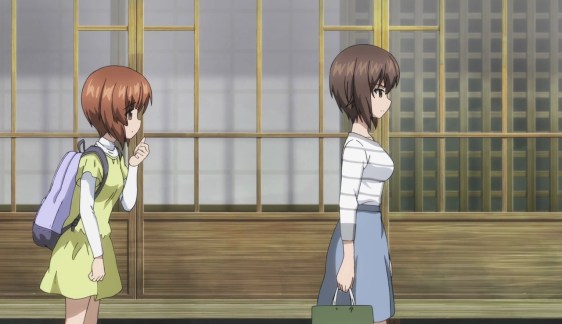
Girls und Panzer is quite upfront about what’s in it: you have the cute girls, and you have the tanks. In spite of its seemingly vapid approach, however, the TV anime is actually quite robust, and I rate it very highly. But a television anime is different from a film, and a major question about the film sequel, Girls und Panzer der Film, is whether it can succeed similarly in spite of the new format. In this respect, I find Girls und Panzer der Film to be a very strong work, but one which is not as adept at drawing in skeptical or uninitiated viewers as its TV prequel.

Synopsis

Taking place right after the original TV series, Girls und Panzer der Film follows tactician Nishizumi Miho after she has led the ragtag rookies of Ooarai Academy to become the champions of competitive tank sports. Having defeating her former school in the grand finals, their efforts were supposed to save the school from being shut down, but because of a legal loophole their work isn’t done yet. With the help of old friends and foes alike, Miho and Ooarai Academy continue to fight for their school.

Television vs. Film

When it comes to the TV anime, I don’t believe it is absolutely necessary to be a fan of both cute girls and tanks. The show sports strong narrative and characterization as well as celebration of military hardware (as well as war simulation as competitive sport), such that a lukewarm reception of one aspect could be saved by the other. Because the series was more structured and more adept at its dramatic progression, it ends up being more enjoyable than other shows of its ilk.  It’s only when either one or both elements together create wariness in a viewer (dislike of moe designs, fear of the show’s potential role as military propaganda) that the anime doesn’t really work.

Girls und Panzer der Film makes no concessions. The film immediately starts with a tank battle and ends with a tank battle. In contrast to many anime, films, etc. where we see either multiple small battles without any real sense of connection between them, or the focus is on a single duel, the last fight is a continuous 50-minute campaign. It showcases elaborate strategies on both sides, lovingly introduces new tanks to the story, and brings together characters in battle that had previously never joined forces. This film is made for people who love Girls und Panzer, and while it happens to have a solid and enjoyable story overall, newcomers are clearly not its target audience.

Slim but Effective Character Narratives

girlsundpanzerderfilm-nishizumis

The battles themselves are fantastic. It’s rare in even the most action-packed shows and movies that a single battle will go for nearly an hour, especially one where you have a strong sense of where all the pieces are positioned and how they influence each other. Girls und Panzer der Film accomplishes just that. However, I have to re-emphasize that the concluding battle is so long that you have to enjoy tank combat at least a little bit. Either that, or you have to be so invested in the characters that seeing them develop and grow gives you great joy, even if it’s amidst the explosion of tank shells.

That’s not to say the film meanders needlessly, or that it doesn’t know how to tell a story. Girls und Panzer der Film, despite its enormous cast of fan favorites, keeps its narrative nice and focused. Perhaps nothing is more surprising than the fact that fan favorite Akiyama Yukari does not take over the film, but that’s because it isn’t really about her. While considered a possible weakness of the original TV series, the light characterization of Girls und Panzer (where characters are defined either in groups or from a few simple and easy-to-grasp qualities) works in the movie’s favor because one can easily grasp many of the girls’ motivations in only a few minutes. Seeing Miho reunite on good terms with her sister Maho (the commander of the team she defeated in the championships) was a joy. Even my favorite character, Anzio’s squad captain Anchovy, makes an appearance, and shines in her own special way.

Girls und Militarism

The elephant in the room (though not really because I already mentioned it), is to what extent Girls und Panzer der Film promotes militarism. While it’s easy to write Girls und Panzer off, either as a series that is clearly designed to get Japanese men to enlist in the Japanese Self-Defense Forces or as simple fluff that shouldn’t be overthought, I don’t think it’s so simple.

When it comes to the question of whether Girls und Panzer glorifies war and militarism, the answer is yes and no. I know that sounds like a cop-out, but let me explain. On a surface level, the appeal in this respect is obvious. Get people to fall in love with the girls, associate them with tanks, and you might see some otaku driving them once they hit enlistment age, and while the anime isn’t quite that simple, that initial impression carries a lot of power. That being said, if you watch the series, tank combat is presented as a sport akin to archery or soccer, and it presents a world where tanks are no longer weapons that take millions of lives but rather tools for friendly competition. Is this whitewashing history, or is it presenting a kind of utopian alternative? I think cases can be made for both, which is why it’s more complicated than what is evident at first glance.

So where does Girls und Panzer der Film fit into all of this? I argue that, even as it celebrates tanks and tank combat, the film makes a rather prominent criticism of patriotism. In the movie, a new school is introduced call Chi-Ha-Tan, where the girls try to make up for their lack of skill with sheer fiery gusto. However, they’re also constantly sabotaging themselves because of the members’ desire to preserve their “honor.” When comrades are taken out, they believe that the best solution is to charge the enemy and fall in glorious combat. They despise turning their backs to the enemy, because they need to make up for everything. Unlike Saunders Academy (the American school), who believe in overwhelming force as a strategy, they have no actual strategy, and are instead merely victims of their own zealousness.

In other words, the science of senshadou (way of the tank) reigns, and foolhardy aggression (the kind of thing encouraged in Japanese citizens during World War II) is a mistake.

Conclusion

Girls und Panzer der Film deftly balances its two extreme components through efficient storytelling, compelling action, and overall cleverness. It’s not as newbie-friendly as the TV series, both in the sense that it’s a direct sequel and because the tank combat is much more important, but it also doesn’t let the desire for fanservice (both technological and girly) get too much in the way of a solid narrative. It even adds an interesting new angle on the image of itself as a work that promotes militarism. Girls und Panzer der Film does a lot in two hours, and leaves a lot to contemplate, even if the movie might seem pretty light on thoughtful content otherwise.

If you liked this post, consider becoming a sponsor of Ogiue Maniax through Patreon. You can get rewards for higher pledges, including a chance to request topics for the blog.

Save

Save

Save

The Fujoshi Files 157: Mahoron

Name: Mahoron (まほろん)
Alias: N/A
Relationship Status: N/A
Origin: Happy Fujoshi: Fujoshi no After 5

Information:
In addition to being a fan of the “Randy x Gerdt” pairing from an unnamed series, Mahoron is a doujinshi fiction writer who focuses on her favorite pairing. She looks up to Yuzu, who she considers to be the best the genre has to offer, giving her a copy of her book at their karaoke event.

Fujoshi Level:
Mahoron listens to conversations between guys on the train and imagines them as lines for Randy and Gerdt.