Drifting Along: Ogiue Maniax Status Update for December 2015

Whenever I think of Christmas and anime, my mind immediately goes to Initial D: Third Stage. Does that count as a Christmas anime? I’m going to say yes, and try to make it official.

Here are this month’s Patreon supporters. As always, I’m happy that they have my back.

General:

Ko Ransom

Alex

Anonymous

Yoshitake Rika fans:

Elliot Page

Hato Kenjirou fans:

Elizabeth

Yajima Mirei fans:

Machi-Kurada

We even have a new Yajima fan aboard! Seeing as how the character’s been developing in Genshiken as of late, I wonder if more will join.

It’s a pretty subtle change, but one thing I’ve been trying to do over the past month is put out content three times a week. I used to do at least two posts a week, with a Fujoshi File every other week, but I felt that it wasn’t quite enough.

Speaking of the Fujoshi Files, at the moment they’re on a brief hiatus as I use that time to indulge in my love of Super Smash Bros. After the recent announcement that Cloud Strife is going to be a playable character (!), I’ve gone back to an old love of mine and have been designing movesets for what-if Smash characters. So far I’ve done Pitfall Harry from Pitfall and Zoma from Dragon Quest III, and there will be at least a couple more on the way.

I have more reviews this month, though as always they toe the line between review and analysis. Of course, there’s the requisite Genshiken chapter, and if you’re a Sue fan this is the one for you. I also wrote something about the use of kanji and words in Aquarion Logos, and then there’s my review of the new Digimon anime. If you haven’t heard about that last one, it’s actually a sequel to the original, with all of your favorite characters in high school. If you like giant robots, I also appeared on the Cockpit podcast to talk about Gaogaigar. I even made a new 1 Minute Review to celebrate the release of Girls und Panzer der Film!

As with every month, if you’re interested in requesting topics for me, it’s a reward for those who pledge $30+ on my Patreon. I of course don’t mind coming up with my own topics (and in many ways it’s actually kind of easier),  but I do miss being “forced” to look at something I might not have otherwise. In the meantime I’ve replaced the Ogiue Maniax Skype group reward at $2.00 with a new feature: I will include a link to whatever you want (within reason) in a special section in my sidebar. Remember, if you’re pledging already, you already have access to this, so send those requests my way!

The last thing I’d like to talk about is the whole social media thing. In the past, I’ve tried to make it so that each site I used had a different specialty. My tumblr, for example, was mainly for video clips. However, I realized that many people only look at their favorite social media platforms and rarely venture outside of them. That’s why I’ve been getting a bit more redundant with posts across different sites, to reach more people. My question is, are you someone who sticks to just one, or someone who sees different value in Twitter, tumblr, Facebook, etc.? I’d like to have a better idea of how to interact with my readers, so that I can foster interesting or even delightfully frivolous discussion.

 

How Important is Consistency of Character Design Across Genders?

In a 2013 podcast interview, Paul Dini, creator of the DC Animated Universe, described how a stubborn refusal to move away from traditional marketing tactics spelled the end for the popular and beloved Justice League cartoon. Esssentially, because Dini had given the female characters of Justice League equal prominence and strong character development, the higher-ups who had planned their marketing around appealing to boys told the staff to cut it out. Girls should be on the sidelines, and never as good as the boys, because boys were supposed to buy the toys and merchandise, dagnabit. It’s a sad fact that proper marketing, trying to find the demographic that’ll give you the most bang for your buck, can often lead to things like happening, especially when so much money has been invested into a project and having things go not according to plan is seen as a nightmare scenario. Gendered marketing has been around for centuries, and it likely isn’t going anywhere soon.

I began thinking about this idea relative to anime, if only because anime and manga are known for gendered marketing. While anime does on a number of occasions portray strong female characters such as in the Precure franchsie, the primary audience is indeed young girls, even if a sizable male audience is willing to shell out some big bucks to get some DVDs and nice figures. However, there’s another side of anime marketing I’ve seen, one that seemingly both defies and reinforces gendered marketing, by placing idealized male characters for women and idealized female characters for men in the same space.

One such title I reviewed for an Anime Secret Santa a couple of years back: Acchi Kocchi: Place to Place. In it, I described the main couple as consisting of the small, moe girl and the tall, quiet bishounen, resulting in a combination of two popular yet often disparate archetypes in one relationship. Series such as Aquarion EVOL and Tytania have different artists on duty to design the male and female characters separately for maximum appeal/pandering. Perhaps nowhere is this more extreme than in the currently-airing Show By Rock, which takes the cute girl/handsome guy incongruity of Acchi Kocchi to a whole other level:

Screen Shot 2015-05-23 at 11.10.10 AM

(This isn’t even taking into account the fact that Show By Rock is already a rather eclectic mishmash of styles that also includes CG cute animal anthropomorphs playing in rock concerts.)

So you have these series with various creative forces involved—Okada Mari (Lupin III: The Women Called Mine Fujiko) wrote Aquarion Evol, while Tanaka Yoshiki (Legend of the Galactic Heroes) is the original author of Tytania, for example—which means that different philosophies and beliefs are involved on various levels of production. Marketing is still at work, the creators are overall looking for you to buy their anime, and if not that, then to buy their products. Focused marketing, gendered marketing is still happening. And yet, why are these anime willing to try and bridge the gap so at least within a single work there are elements that actively appeal to men and women, boys and girls, even if it’s for the sake of hitting some basic desire buttons on the audience? And if the argument is that the merchandise is designed to reflect those gender differences as well, then why were the people responsible able to produce goods in such a way that the executives behind Justice League could not?

Of course, one recent example of a franchise that has tried to appeal to both men and women within the same films has been the Marvel cinematic universe. Thor and Captain America both have looks and personalities that garner admiration from men and women, heterosexual and homosexual, and marketing has capitalized on that. At the same time, there’s also been a bit of an uproar over the fact that what should have been a Black Widow toy became instead a Captain America one. If this were Japan, there would certainly be some figures of Black Widow, but there’s also a fair chance that those examples wouldn’t be targeting girls.

If you liked this post, consider becoming a sponsor of Ogiue Maniax through Patreon. You can get rewards for higher pledges, including a chance to request topics for the blog.


Zoma for Super Smash Bros.

smashbros-zomamoves-small

Previous Characters:

King K. Rool (Donkey Kong Country)

Princess Daisy (Super Mario Land)

Geno (Super Mario RPG)

Great Puma (NES Pro Wrestling)

Pitfall Harry (Pitfall)

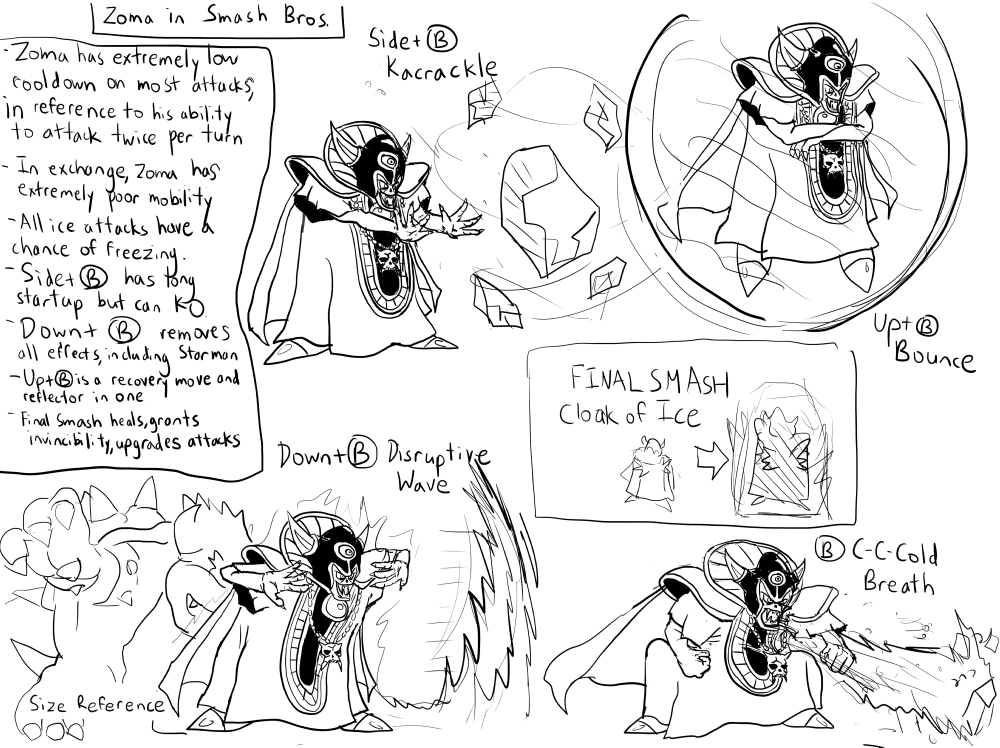
In celebration of Cloud Strife’s reveal as a new Super Smash Bros. for Nintendo 3DS & Wii U character, I have once again been drawing movesets and concept art for how famous icons of video games might work in Smash Bros. This time around, it’s Zoma, the final boss of Dragon Quest III, aka Dragon Warrior III.

Square Enix began as two rival companies, Square (later Squaresoft) and Enix. If Square’s flagship title was Final Fantasy, and its greatest success story Final Fantasy VII, then Enix’s was Dragon Quest, and its crown jewel Dragon Quest III. Having sold over 1 million copies on its first day of release in Japan in 1988, which included many students deciding to cut class just to buy it, it is one of Japan’s most beloved RPGs. Amazingly, once you beat it, you find out that it was in fact a prequel to the very first Dragon Quest, and your player character becomes the legendary hero whose equipment must be collected in the first game.

However, instead of just going with Loto (or Erdrick) as a counterpart to Cloud, I believe it would be more interesting if Enix could be represented by arguably its greatest villain. Zoma, like all Dragon Quest monsters, is drawn by Toriyama Akira of Dragon Ball fame, and strikes an imposing figure. A demon lord who rules over the land of Alefgard, according to Dragon Quest IX he actually went there because he’s extremely popular with other monsters and is trying to get away from his fans. Zoma is shown to be much larger than the heroes, but like Bowser there does not seem to be much consistency with his scale, so I figured he’d best be a large, heavy target similar to other super heavyweights. However, where Zoma differentiates himself from the rest is that his attacks are not only powerful, they’re very quick to recover.

If you’ve fought a character like Mario in Smash 4, you find that he can move very quickly out of key attacks (Up Smash, down air, back air), and that it makes him difficult to punish. Zoma would be similar. While some of his attacks would have long wind-ups, such as his Side-B Kacrackle (the strongest ice spell in Dragon Quest), it is difficult to take advantage of him if he misses, as he can quickly transition into something like a jab or a forward smash. This is meant to reference the fact Zoma is actually able to attack twice in one turn in his source material.

To balance this out, Zoma would have by far the worst mobility in the game, like if you weighed Ganondorf down with bricks. He would have decent jumps in terms of sheer distance, but would be extremely slow in terms of acceleration and max speed. His walk speed would be awful, and he wouldn’t even have a true dash. Instead, he would get a mini-teleport that still has all the restrictions of a dash. Think of him as being somewhat like Slayer in Guilty Gear.

All of Zoma’s attacks come straight from his battles across various games (he’s been a guest boss in a number of titles), and many of them are capable of freezing. C-C-Cold Breath is a super-charged version of the Ice Climbers’ Down B, and Disruptive Wave can remove status changes (both positive and negative) and even stun opponents very briefly. In one-on-one situations you won’t be able to capitalize on it, but it does travel far and is good for shifting momentum back into your favor, especially given once again how difficult Zoma’s moves are to punish. Bounce is a reflector and stage recovery move combined, making it useful for getting past projectile-based edgeguarding attempts, but is otherwise below average for a recovery, traveling far but very slowly. It is also impractical as an on-stage reflector. Kacrackle is both a powerful damage dealer and a way to seal stocks early, but can be difficult to land. At the same time, it can be thrown out similar to Meta Knight’s forward smash as a read in neutral.

Zoma’s Final Smash is a reference to the fact that Zoma originally covers himself with a protective ice barrier in Dragon Quest III that greatly augments his abilities. The only way to remove it is to use the Orb of Light, and seeing as no one has it in Smash Bros., I figured it would be better as a temporary measure.

Perhaps most important of all, Zoma would have all of the signature attack sound effects from Dragon Quest.

So that’s Zoma, one of the most infamous of JRPG villains. If anyone wants to design a Loto as well, by all means be my guest. As for the next character, it’ll be “the one I’m waiting for.”

If you liked this post, consider becoming a sponsor of Ogiue Maniax through Patreon. You can get rewards for higher pledges, including a chance to request topics for the blog.

Kiss Kiss Fall in Love: Genshiken II, Chapter 118

It’s finally time to see Sue and Madarame’s date, which apparently involves ring tosses and ultra obscure references. After Hato comes by and advises Sue to express her feelings not in anime quotes but in her own words, Sue finds an opportunity to say what she really thinks of Madarame.

This chapter is all Sue x Mada all the way, and makes a rather strong argument for why they seem to fit together. Madarame is the only one high-level enough to not only immediately get Sue’s anime and Japanese pop culture callbacks, but also to build on them. What really stands out about their time together, however, is that we finally get to learn the truth behind Sue’s peck on the cheek during the school festival.

You might recall that it was a move to get Madarame to jump out of hiding so that Hato would notice that Madarame’s looking out for him after all, and that Saki saw the whole thing. When next we saw Sue, she would blush profusely whenever looking at Madarame, while denying any feelings towards him. The reason, as Sue explains, is that she herself thought she was just teasing Madarame, but having someone like Saki witness it made her self-conscious of the fact that the only reason she can mess with Madarame is because Sue views him differently. To Sue, Madarame is special. That’s why she can call him Nekoyasha and then ride on his shoulders. That’s why she can be so comfortable around him.  That’s why she can finally confess to him, and be the first of the potential four love interests to do so.

I think it makes sense. Genshiken is full of otaples at this point, and a Sue and Madarame relationship would be at the top of the food chain. Not only that, while “I’m comfortable around you” can seem like the most generic of non-reasons to fall for someone, we see how their interactions play out. To some extent, Sue’s able to behave similarly with Ogiue, and even make jokes about Ogiue being her “wife,” but there’s a certain understanding that it’s all a friendly joke. That’s how Sue was with Madarame, but now Madarame’s open-ness and existence as absolute embodiment of nerdery have transformed into a strange attractiveness. Moments when characters realize their feelings are always highlights of Genshiken, whether that’s Madarame and the Saki nose hair incident or Ogiue seeing Sasahara smile, and this one seems to shout, “kindred spirits.”

Visually, Chapter 118 is unsurprisingly the Sue Show. As a character that doesn’t talk much, her facial expressions carry a great deal of weight. Combined with her sharp yet wistful eyes and exaggerated further by her pale features, light-colored coat, and knee-length blonde hair, it’s like her nervousness and emotional tension either take over the entire page, at least whenever Sue herself isn’t being put side by side with Madarame and his darker features (mainly his hair). Nowhere is this more apparent than at the moment when Sue says, “Madarame, I like/love you.”

I almost didn’t want to include this image, just so it could be a surprise to even those who read this review before the chapter itself. However, I think it makes too striking a statement to leave out, especially when considering the fact that Sue purposely prevents Madarame from responding, as Hato hasn’t had his chance yet.  Also, there is arguably an even better moment at the end of 118, and I think I’ll leave that for you, the reader, to discover.

In the end, what I find interesting about all of the members of Madarame’s “harem” is that they connect to him in different ways. Angela’s attraction is physical, and while that might seem shallow she’s the one who brings to the forefront the idea of Madarame as a sexual being. Keiko is somewhere between physical and psychological, and her strategies reflect this. Hato has the closeness of being a guy, the intrinsic understanding of how Madarame might be thinking of a situation. Sue is as awkward as Madarame in many ways, one of their many similarities.

Next up is Hato, and this, perhaps, is where the show really begins.


If you liked this post, consider becoming a sponsor of Ogiue Maniax through Patreon. You can get rewards for higher pledges, including a chance to request topics for the blog.

Growing Up in a World of Monsters – Digimon Adventure tri. 1: Reunion

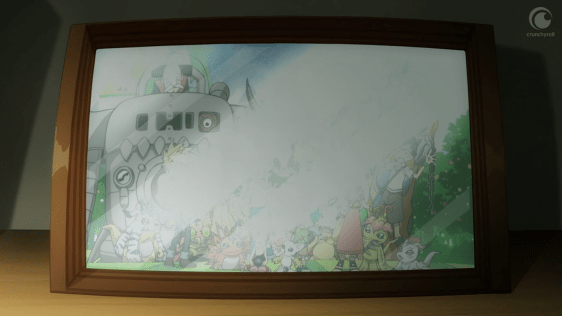
Screen Shot 2015-11-23 at 8.05.03 AM

Digimon Adventure, known around the world as simply Digimon, is an anime that helped to define a certain generation of fans. For many, it was either the anime, or the the other anime, relative to its thematic rival, Pokemon. Where Pokemon was about traveling in a world where monsters and humans co-exist, and the stakes were generally about winning tournaments, Digimon was about traveling to an alternate digital world of monsters and saving the world. Where Pokemon generally had a core cast of three, Digimon had over twice that amount. Perhaps most important for our purposes, where Pokemon‘s characters seem to remain eternally young, Digimon‘s characters would age.

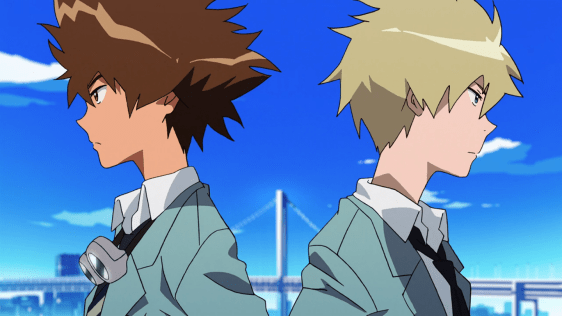
This brings us to Digimon Adventure tri., a direct sequel to the original two Digimon anime. Taking place with its main cast now older and in high school, main character Yagami Taichi (Taichi Kamiya in English) and the others have long since lost contact with their old Digimon friends as they transition from childhood to adulthood. Suddenly, Digimon start appearing in the real world, prompting the old team to reunite with the Digital World.

Screen Shot 2015-11-23 at 8.08.46 AM

Digimon Adventure tri. is very intentionally a more mature series than its prequels, though not in the sense that it’s supposed to be “darker.” Rather, between the more subdued character designs, a general aesthetic that’s closer to the Hosoda Mamoru-directed Digimon movies than the TV series, a new version of its beloved theme song Butterfly featuring hints of melancholy, and just the portrayal of the subtle turbulence that comes with being of high school age, Digimon Adventure tri. is aimed towards the young fans who are now adults themselves (or close to it). The series says, “We’ve grown up with you, and we know what it’s like.”

For example, Kido Joe, the straight-laced and responsible one, is now being consumed by college entrance exams, and Taichi himself feels like he can no longer charge ahead like he used to when he was the de facto team leader of the Chosen Ones (“DigiDestined”). This is not to say that the new series is a total downer, stripped of any of the joy and wonder of the original anime. What I think they’re going for, instead, is a kind of rediscovery of those simpler and more magical times, while grounding that kind of experience in the process of becoming adults.

Screen Shot 2015-11-23 at 8.07.27 AM

Screen Shot 2015-11-23 at 8.18.24 AM

Digimon Adventure tri. actively works to maintain a strong connection with the original series, and a lot of attention is paid to continuity as a result. Whereas Taichi and the older kids have their original DigiVices, the portable tools based on the original hand-held Digimon virtual pet, the younger Hikari and Takeru (“TK”) have different ones, a nod to their continued battles in Digimon Adventure 02. Somewhat similarly, the story is set very intentionally not in 2015 but somewhere in the mid-2000s, as reflected in the technology. Most cell phones are flip phones with number pads, and no smart phones are in sight. It’s not like failing to do these things would have made it a worse series, but it shows that, to a large extent, Digimon Adventure tri. aims to evoke strong feelings of nostalgia for both for the franchise itself and for those who know what it’s like to be a teenager.

Screen Shot 2015-11-23 at 8.15.02 AM

Screen Shot 2015-11-23 at 8.15.51 AM

There are a couple of notes that I feel the need to point out for the die-hard fans (I know you’re still out there). First, if you watched this series dubbed in English (or perhaps other languages, I’m not sure), the lack of dialogue and constant banter might seem unusual or even off-putting. The original Japanese versions of Digimon had a lot more “dead air,” that is to say long moments of silence, and adding music or dialogue to fill space is an old American television tactic that you could also see in the dub for Pokemon. Digimon Adventure tri. uses even larger periods of silence and its unsteady atmosphere (perhaps all the better to convey that feeling of becoming adults), so it’s something to expect going in.

Screen Shot 2015-11-23 at 8.12.33 AM    Screen Shot 2015-11-23 at 8.19.23 AM

Second, you should know that the plains of the shipping wars are revived and more serious than ever. While the previous series had some hints of romance (or maybe more if you count the controversial time-skip ending of Digimon Adventure 02), relationships are nearly front and center in Digimon Adventure tri. There’s a clear love triangle between Taichi, Sora, and Yamato (probably the site of the most fierce battles). Koushirou (“Izzy”) clearly has a powerful crush on Mimi. Takeru and Hikari tease each other about their mutual popularity among the opposite sex. If you had any stake in these old battles, the series might very well draw you in like honey.

As of this first movie (split into 4 episodes on Crunchyroll), it’s clear that Digimon Adventure tri. won’t give viewers the same experience as the original anime from over a decade ago. Unlike Pokemon, which tries its best to maintain the same constant feel (though to be fair there have been subtle changes in that series over the years), Digimon Adventure tri. wants you to know that the characters have grown, that their inner and outer (and perhaps even digital) worlds have changed as a result, and it’s inviting you back to take a look. The next film/batch of episodes won’t be out until March 2016, so you’ll have plenty of time to catch up.

Screen Shot 2015-11-23 at 8.04.51 AM

If you liked this post, consider becoming a sponsor of Ogiue Maniax through Patreon. You can get rewards for higher pledges, including a chance to request topics for the blog.

Pitfall Harry for Super Smash Bros.

smashbros-pitfallharrymoves-small

With the surprise announcement of Cloud Strife in Super Smash Bros. for 3DS & Wii U, as well as the upcoming mysterious December Smash Bros. special report, I felt inspired to start up a new line of Smash character what-ifs. You can see the previous ones I’ve made below.

King K. Rool (Donkey Kong Country)

Princess Daisy (Super Mario Land)

Geno (Super Mario RPG)

Great Puma (NES Pro Wrestling)

Thinking about how 3rd-party characters in Smash tend to be ones from influential or important games (Cloud), or representative of entire genres (Ryu), I decided to create a moveset and design for Pitfall Harry, the hero of the classic Atari 2600 game Pitfall. If you don’t know who Pitfall Harry is, that’s probably not surprising, as 1) the game is from 1982 and 2) even if you know the game Pitfall Harry doesn’t have much of a presence. After all, this is what he looked like:

4136802-image.num1308669893.of.world-lolo.com

Pitfall is significant in that, to my knowledge, it’s the first horizontal multi-screen platform game, and in terms of its implementation on the Atari it is a technical marvel, like creating boeuf bourguignon out of leather shoes and ketchup. Because of this, I think Pitfall Harry could reasonably have a place in a pantheon of gaming icons, however unlikely.

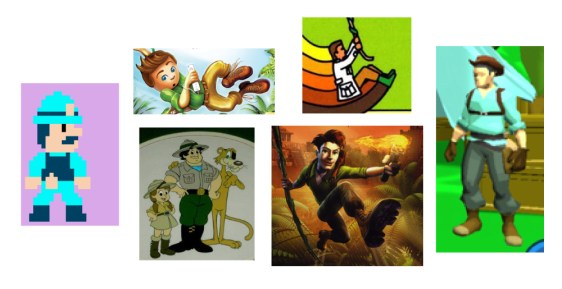
However, the first challenge that presented itself is the fact that Pitfall Harry has no consistent design. In addition to the fact that his original sprite (although amazing for its time) has no real identifiable features, Pitfall Harry across adaptations and sequels changes size, hair, clothes, musculature, personality, and more from one iteration to the next.

pitfallharries

Possible Costumes?

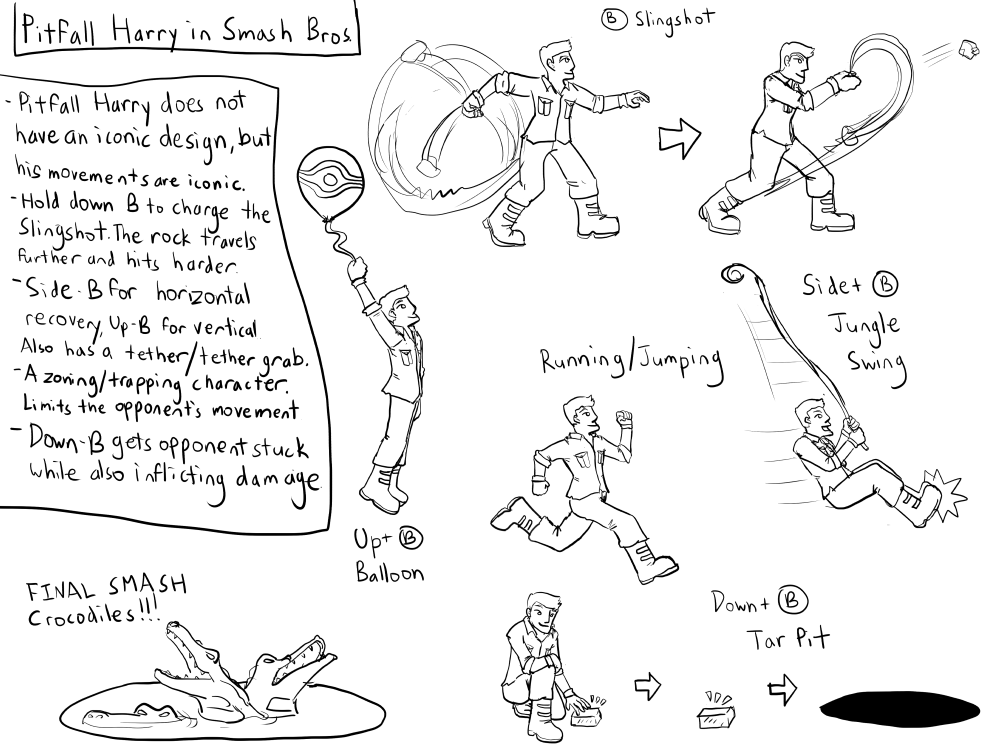
As mentioned on the image itself, I decided to prioritize Pitfall Harry’s movements, because they’re what’s iconic about him, while trying to keep his silhouette closer to the original sprite wherever possible. If he can for the most part capture the animations of the Atari 2600 sprite in Smash, then his identity should come through. This should also be reflected in the audio. When he jumps, he should make that distinct Atari noise (or a higher-quality version of it), and when he does his Jungle Swing Pitfall Harry should yell out like Tarzan.

As for the attacks themselves, I feel that Pitfall and Pitfall II are where most of the game franchise’s influence comes from, and so they should be prioritized. His Final Smash is his “deadliest enemy, the crocodiles,” his Balloon recovery move comes straight out of Pitfall II (and is super vulnerable so only useful as a last resort), his Tar Pit trap references both the treasure and hazard aspects of Pitfall, and the Jungle Swing is iconic. The main exception is the Slingshot neutral special, taken from Pitfall: The Mayan Adventure and other sequels. If his son can use it, I’m sure Harry can as well.

Gameplay-wise, I picture Pitfall Harry as being average in weight, average in ground speed, a little above average in air speed, and below average in racking damage and KO power. He’s not that much of a fighter (unlike Mario, jumping on enemies just kills Harry), so he would function primarily as a zoning and trapping character who controls space with his specials, but doesn’t have as much sheer recovery power as Smash 4 Villager. If anything, he’d be closer to Duck Hunt. However, his trapping game is not to be underestimated. Tar Pit works like a souped-up version of a burying attack, both getting the opponent stuck and dealing damage over time. It would also be unblockable, which somewhat makes up for his tether grab. The caveat is that it is very obvious where it is located, with the big glowing gold bar to indicate the trap, but this also means that the opponent best steer clear of the location. Essentially, Harry could cut off a portion of the stage, such as Smashville’s platform or Battlefield’s top platform, and manipulate the opponent to get hit by a Jungle Swing or a smash attack (which would mostly involve fists).

Overall, Harry would emphasize cunning and ingenuity. To succeed as Pitfall Harry requires a clear understanding of space control, as well as adapting to a somewhat unorthodox neutral game.

So, who do you think I’ll be showing next time? I’ll leave you with a hint. “Japan shut down.”

If you liked this post, consider becoming a sponsor of Ogiue Maniax through Patreon. You can get rewards for higher pledges, including a chance to request topics for the blog.

Hammer Connect!: Ogiue Maniax Discussing Gaogaigar on the Cockpit

As a long overdue follow-up to our discussion on Brave Police J-Decker, I was invited along with the Reverse Thieves‘ Kate to talk about King of Braves Gaogaigar on Space Opera Satellite’s “Cockpit” series. Many have called it the best show in the Brave franchise, and it’s been 10 years since I first finished Gaogaigar, when that sentiment was at its strongest.

For your reference: Silverion Hammer

The real question is, why are there so few King J-Der toys?

Characters, Caricatures, and Stereotypes

What is good character design?

Different people will have their own ideas about what helps the design of a character (including myself), but over the past few years I’ve begun to consider more how the elements often described as contributing to character design are a kind of double-edged sword.

Take the idea that a character should have a unique look achieved through simple yet elegant means, and that they shouldn’t be mistaken for anyone else in the cast. This is ideally achieved through stylization, and to some extent exaggeration. For example, I find the character designs in Heartcatch Precure! to be fantastic, and part of this is achieved because the girls are varying heights, and that their distinct personalities come across very clearly in the way they look. However, that same dedication to simplicity and really conveying a character’s particular characteristics through their appearance are the same tools that can be used to, for example, create harmful stereotypes. How do you make a character look more Asian? Give them squinty eyes and buck teeth, because that will immediately communicate their Asian-ness.

Of course, there’s a significant difference between making a character that expresses their uniqueness through their design, and drawing to conform a character to a general stereotype in that one is about individualizing and the other is about generalizing, but I think that the two ideas exist on the same spectrum. Take for example a political cartoon mocking a particular politician through the use of symbols and signs meant to represent that individual. A large hooked nose in this case might become the symbol of a racism against Jewish people in another context. The very tools artists use to express ideas of love, equality, and growth can also be used to spread hatred, discrimination, and regression.

I am pro-freedom of expression, so I do not believe in restricting even the more negative and harmful uses of art, but I do understand that a price is paid as a result. Images persist that can strip young people of confidence, make them feel as if they never have a chance in the world. While one way to combat it is to provide even more positive images, the inevitable difficulty is helping them to navigate all of the disparate messages without necessarily forcing them to be blind to everything that’s out there. When the strategy to helping others out is to block their access to material that might change them, then that itself can become a problem.

I myself don’t entirely know the point I’m trying to get at, but I believe it’s something along the lines of “artists have a lot of responsibility.” Whether you use your art to fight for a cause, against one, or just want to draw things that are cute, cool, gruesome, even actively traumatizing, that is a decision to be made, and to be felt, and you it is good to be prepared for the consequences that arise.

If you liked this post, consider becoming a sponsor of Ogiue Maniax through Patreon. You can get rewards for higher pledges, including a chance to request topics for the blog.

Nendoroid Tomoyo, Champion of the Universe

nendoroidtomoyo-sutekidesuwa

Daidouji Tomoyo from Cardcaptor Sakura is one of my favorite characters ever, from one of my favorite anime ever, and if you’re not a fan of Tomoyo… what’s wrong with you? Whereas normally I would hesitate to buy even some of my most beloved heroines, Nendoroid Tomoyo was a no-brainer. Upon seeing it go up for pre-order, I hit purchase and looked back with zero regrets. Sakura merchandise is common, but Tomoyo much less so, and I couldn’t let this sort of thing pass me by.

nendoroidtomoyo-sakuradistant

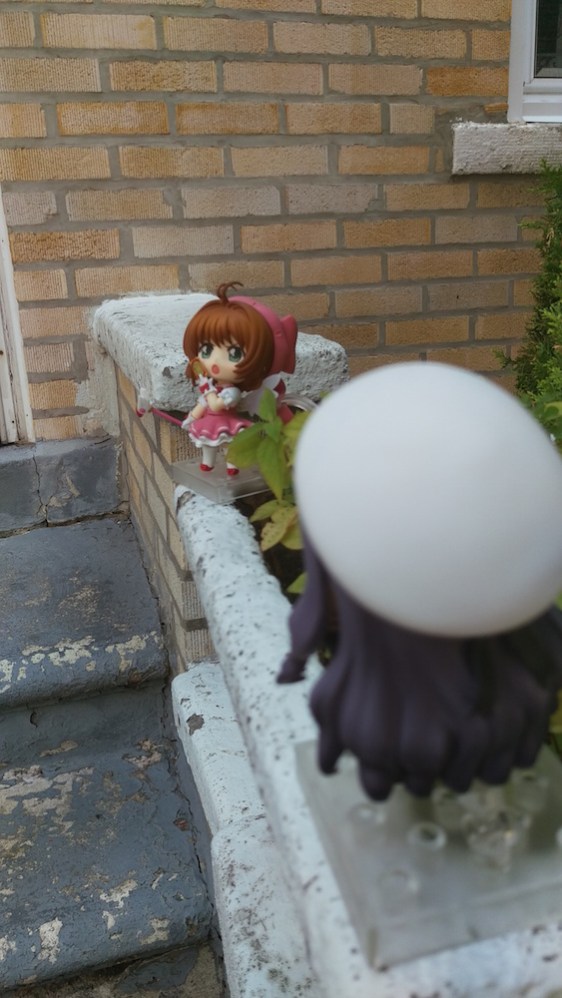
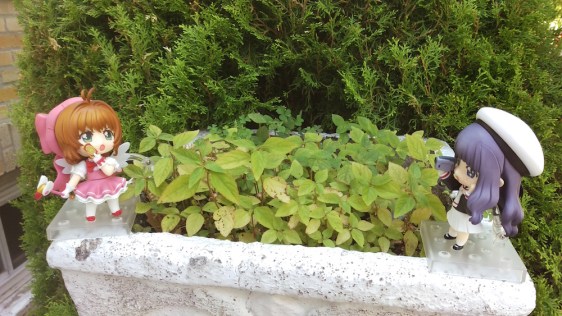
I don’t own a lot of Nendoroids. In fact, my first one was a Kinomoto Sakura (seen above) that I received as a birthday present. Quite smartly, my friend purchased it because he (correctly) expected that I would not hesitate to pick up Tomoyo. Thus, I don’t have a lot to compare to, and I’m extremely biased, so I’ll call this less a review and more of a celebration.

nendoroidtomoyo-closeup

Nendoroid Tomoyo is mostly based on her anime design, as opposed to the softer shoujo look of the Cardcaptor Sakura manga. However, one thing that they did bring from the manga was a hint of Tomoyo’s lavender hair; in the anime it’s more of a gray. When I think about it, rarely do figures try to replicate the look of shoujo manga, likely due to how complicated and not designed for 3-D they are. At least with anime, you can rely on more solid colors.

Tomoyo comes in a standard Tomoeda Elementary school uniform, and has a choice between a hat or a hairband, as well as smiling and ecstatic faces. I’ve gone with the hat + sparkly eyes combo for these photos in order to achieve maximum radness, but what really takes this figure over the top is the inclusion of her signature camcorder.

Remember kids, this anime was made in the early 2000s, before mobile phones could take HD-quality video. Back in her day, Tomoyo would have to walk 20 miles uphill both ways in the snow in order to film her lovely Sakura-chan and add to her massive archive of Cardcaptor Sakura footage in her private viewing room inside of her mansion, under watch by her squad of lady bodyguards.

nendoroidtomoyo-withsakura

It’s supposed to have a swing-out screen, but a small missing part makes it impossible to attach. I’m not sure if it was defective or if I had simply lost it while taking it out, that’s how tiny the connecting piece. The other flaw is that the giant head is rather unwieldy, especially with the hat, and sometimes moving it around can cause Tomoyo’s noggin to fall off.

Overall, it’s a fine addition to the collection, and when I think about it, I am fortunate that the characters I like tend not to get a ton of merchandise. That’s what I would say…if I didn’t get into Love Live. That’s for next time.


Aquarion Logos Has a Way with Words

Wordplay has always been important in the Aquarion franchise. Generally set in a world where love reincarnates thousands of years in the future, many solutions across both the original Genesis of Aquarion and Aquarion EVOL literally come out of transforming words in order to access a plethora of elaborate giant robot attacks. Even as far as those series go, the latest incarnation, Aquarion Logos, takes this love of language manipulation to a whole new level, positioning it as the most prominent factor. For a lover of puns such as myself it makes for a fascinating series, not only because it’s often quite clever, but because Aquarion Logos looks at the very way in which people perceive words.

In the original Aquarion, the Japanese title was Sousei no Aquarion, where sousei (創聖) means “construct” and “holy.” Hence, its English translation is “Genesis.” When characters combine their robots, they say, “Sousei Gattai,” or Genesis Combination. Already this is where Aquarion Logos takes a different angle. In that series, sousei is written with the Japanese kanji for “construct” and “voice” (創声). Translated into English as “verbalism,” it represents the fact that the main pilots in the series all have a talent for bringing words into reality. Whether they’re aiming to be a politician, a comedian, or indeed a “savior” as the main character Kaibuki Akira does, they believe in the power of language, and can almost literally walk the walk by talking the talk. When characters shout “Sousei Gattai” in Aquarion Logos, it thus takes on a completely different meaning.

The ways in which words are used becomes the central conflict of at least the first half of the series. The villain, a man named Kenzaki Sougon, is able to travel into the very world where words exist and transform them into creatures called “M.J.B.K.” Pronounced mojibake (literally “word monsters”), these enemies of the week (again, giant robot show) devour the words on which they are based, manipulating their presence in reality. Because of the way kanji works, many other ideas are eradicated as well. For example, in Episode 1 the M.J.B.K. is created from the word maki (巻), which means “roll,” causing things to get twisted into knots, but it’s also the word used to mean “volume” as in “volume 1 of a manga,” which causes that concept to disappear as well.

Sougon believes that people have sadly lost their connection to the origins of words, that the power of words comes from the desire to communicate what exists. Words are in service to reality, and forgetting that means words become useless. In contrast, Kaibuki Akira goes the opposite direction. He draws on the creative potential of words as a way to construct reality. The key example of this is the fact that Akira frequently refers to himself as a “savior,” and tries his best to just constantly save people. When asked why he’s a savior or why he’s so hung up on the idea, it turns out that there’s no particular reason. He takes the meaning of the word itself and makes it into reality through his actions, fulfilling its potential. The Japanese word for savior, kyuuseishu literally means “one who saves the world,” and that’s what Akira aims for.

In Episode 13 the team fights a particularly dangerous M.J.B.K. that represents Mu, or nothingness. Written as 無, perhaps people might recognize it as the symbol used by Gouken in Street Fighter IV. Sougon uses it because the power of nothingness is able to consume other words and concepts, but Akira responds by saying that nothingness also means endless possibilities. At this point, he and his co-pilot Maia utilize the signature attack of the Aquarion franchise, the Mugenken, or “Infinite Punch.” Mu is one half of the word for infinity. At another point, as the world risks being reduced to that nothingness, the word “savior” carries the potential for recovery, as it consists of the characters for “help,” “world,” and “person.” What else is needed to start over other than these concepts?

Aquarion Logos is both a powerful and silly anime, and intentionally so. It’s potentially a difficult series to watch because of how prominent kanji is, making it a bit obtuse for those unfamiliar with Japanese, particularly because English and other languages don’t necessarily utilize symbols in the same way. So far, many of the references are to the original Aquarion, but Episode 13 drops a possible callback to Aquarion Evol, so it’ll be interesting to see how things develop now that the second half has been under way.