To Be the Hero

aidariko-blue

I’m a fan of characters who support. Whether it’s Dominic Sorel in Eureka Seven, who stands by the long-suffering Anemone or Aida Riko in Kuroko’s Basketball, who coaches and manages the Seirin High School Basketball Team, often times my favorite characters are those who care less for being the “hero,” and who try to make a difference in their own way. Generally speaking, I’m of the belief that there are many ways to make a difference, and that you don’t need to be the one chopping the monster’s head off, nor should we fault others for not aspiring to be that mighty warrior. Indeed, even more recent main characters like Kuroko Tetsuya in Kuroko’s Basketball and Onoda Sakamichi in Yowamushi Pedal are protagonists whose powers are primarily based on “support.”

However, I find that, as much as I enjoy that character type, they potentially are a source of complacency, and one might even argue that they teach people to settle for less. Case in point, while I think Riko does a lot for her team and is just a great character in general, she derives from an archetype that is basically a sideline cheerleader. They’ll either be the newbie who needs things to be explained, or the informative expert who does the explaining, but when the chips are down their purpose in the story is to stare longingly as the hero goes into action. There’s some sexism historically at work here, with female characters being created to serve the male leads, but I don’t want to make the issue purely about sex and gender, especially given all of the work that’s been done to play with and expose those tropes, like how Witch Craft Works essentially genderswaps the typical shoujo heroine and shoujo ideal love interest. I also don’t want to deny the ability for a “sideline cheerleader” to be an interesting character in their own right. Rather, it’s more about the idea that “everyone is the hero of their own story,” and how there are positives and negatives to it.

On the one hand, the notion that everyone is the main character in their own lives, be it reality or fiction, can be a self-fulfilling prophecy of confidence, where one imbues oneself with agency and ambition, and accomplishes their goals. At the same time, it might cause people to seek out “glory” without necessarily finding their own definition for the word, instead conforming to what their society (or what readers supposedly think) are parameters for success.

On the other hand, if one believes in supporting others, this might afford them a point of view that could go unnoticed otherwise. Glory for oneself is unimportant, because what really matters is doing what one can. However, this same mindset carries the risk of encouraging passivity to the point that people might inadvertently lose opportunities to better themselves. Perhaps it even becomes an excuse for why they remain in their rut.

Obviously these are in a way two extremes, and that there is a full spectrum between light and shadow, to borrow a phrase from Kuroko’s Basketball. Characters like Riko and Dominic essentially work in opposite directions towards a center, with Riko coming from the manager character and Dominic defying what it means to “rescue the girl.” There’s a lot of interplay and room for interpretation, and it opens up paths for artists, be they professional, amateur, and/or fan, to explore and defy what they’re told is “normal.” I just find myself thinking about how simply saying that I prefer support characters can carry a lot of implicit meaning.

The last thing I want to leave off with is a scene from Game of Thrones, when Tywin Lannister, the patriarch of the powerful House Lannister, asks his grandson what makes a good king. When the grandson replies correctly with “wisdom,” Tywin is ecstatic and explains that wisdom comes in part from knowing what you don’t know, and heeding your advisers who are experts in their fields. In this case, though the king is supposed to be the one with all of the glory, is it the case that being a king is perhaps the biggest support position of all?

And Then Came Comic Con: Ogiue Maniax Status Update for October 2015

September I feel was kind of an exciting month, and I think I’ve put out some of my best articles in a while. Chief among them are my review of Love Live! The School Idol Movie and a monthly sponsored Patreon post, “The Rise and Fall of Saimoe.” In fact, even though it’s against the rules of my Patreon, I want to extend my gratitutde to Johnny Trovato, who while no longer a patron was the first to take me up on my offer to write posts based on topics chosen by my patrons. Thanks, Johnny.

Over the past month I’ve introduced a new type of pledge, where you can pledge a certain amount based on your favorite Genshiken character. In all honesty it’s just an excuse for me to make bad puns, so that’s why the amounts are all over the place. Of course, this also means that there are now different categories for sponsor shout-outs.

This month’s special Patreon sponsors are:

General:

Ko Ransom

Alex

otarsus

Anonymous

Yoshitake Rika fans:

Elliot Page

Kyubey Bryant

Hato Kenjirou fans:

Elizabeth

I haven’t gotten to all of the Genshiken characters yet, but if there’s one that you really want to see (Kaminaga? The younger Yoshitake? Ohno?), then speak up! It’ll be interesting to see which characters are still the fan favorites after all this time.

As for what’s on the horizon, New York Comic Con is this week, and I’ll be attending all 4 days! Of course I’ll have a con report for everyone to read, and you’ll be able to (most likely) catch me at a number of panels. Of course, given the hectic nature of NYCC, there’s no telling for sure!

Thu. Oct. 8
5:30 – 6:30 pm
VIZ Media Presents: An Evening with Masashi Kishimoto, Creator of Naruto
Location: Main Stage 1-D Presented by AT&T
Panels & Screenings
Fri. Oct. 9
8:00 – 9:30 pm
Love Live! School Idol Project
Location: Room 1A05
Panels & Screenings
Sat. Oct. 10
11:15 am – 12:15 pm
CBLDF Presents: Comics Censorship in 2015
Location: Room 1A05
Panels & Screenings

A Beginner’s Guide to Understanding the “Neutral Game” in Fighting Games

Introduction

If you ever look into the world of competitive fighting games, people will throw out terms such as “neutral,” “advantage,” and “disadvantage,” all of which appear to be (and are) key terms to understanding fighting games on a deeper, fundamental level. Often their meanings can come across as obtuse and rather abstract, and what exacerbates this confusion is that people make the mistake of trying to explain neutral before explaining advantage/disadvantage. This is why I’ve written this article. Advantage/disadvantage are much easier ideas to understand compared to neutral, and once you get those two down, the concept of “neutral” follows along more naturally.

Advantage, Disadvantage, and Neutral

So, imagine you’re in a fight. Would you rather be punching someone in the face, or getting punched? Most likely you’d prefer the former, a position where you’re at an advantage.

However, this idea extends more to than who’s getting hit. Would you rather be backed into a corner, or backing someone into a corner? Would you rather be standing with your back towards the edge of a cliff, or forcing someone towards the edge?

All of these positions involve someone who has fewer options available to them. The guy with his back to the cliff or the wall can’t go backwards, of course, so he has to fight his way out or somehow get around. However, this also makes him relatively more predictable. In contrast, the person forcing the opponent towards the edge can attack if he chooses to, or walk back. He has the luxury of more choices.

One person is in an advantageous position, the other is in a disadvantageous position. “Neutral,” then, is when neither person feels like they have an advantage or disadvantage. Neither one is getting hit, neither has their backs to a wall or has to worry about a 500-ft drop. Both fighters are fully in control of themselves, and their goal is to get the other one into a disadvantageous position.

“Footsies”

You’ll often find characters who are considered to be great at neutral, and these are generally characters that have more or better weapons at their disposal when trying to gain an advantage. In this respect, you might see people throw out another common but also confusing fighting game term: footsies.

The idea of footsies derives from what kids would do at a lunch table. One kid tries to kick another kid’s legs. If a kid misses, then the other kid is free to kick that extended leg. Fighting games are kind of similar. If one character tries to punch another, but he misses, his arm is now extended forward, and his opponent can “punch his punch” back. Or, if he anticipates a punch is coming, he can hit more quickly, preventing the attack from happening in the first place (see also Bruce Lee’s original concept of Jeet Kune Do, the “Way of the Intercepting Fist“). When combined with the threat of a cliff or a wall, two opponents will try to trick the other into overextending or doing something predictable, and retaliating accordingly.

Neutral and Psychological Damage

You’ll also often see people say a character in a game is “bad at neutral,” and sometimes they’re right, but take the statement with a grain of salt because a lot of people don’t understand what neutral really is. They think it’s just about who can more reliably get the first hit in, and then whose attacks can lead to more combos, but neutral is just as much about potential damage as it is about actual damage.

Let’s go back to the example with two people fighting. They’re both in “neutral,” standing at the center of their fighting area. However, both want the opponent to be at the edge of the cliff, because as great as it can be to throw 20 punches at someone, it’s even better to throw one punch that knocks them off the edge of a cliff. The potential for greater advantage, and the fear of getting hit, become tools just as important as who actually successfully connects.

Leaving Off

Neutral is often touted as the most important aspect of a fighting game, because it’s where the game begins, where the mind games originate from, and is the most basic area where it’s necessary to understand yourself, your opponent, and the tools each of you have at your disposal. I hope in reading this that you have a stronger understanding of how you can use it in your own game.

If you liked this post, consider becoming a sponsor of Ogiue Maniax through Patreon. You can get rewards for higher pledges, including a chance to request topics for the blog.

The Fujoshi Files 146: Chuuguu

Name: Chuuguu (中宮)
Alias: N/A
Relationship Status: Married
Origin: Moehime

Information:
The wife of the Emperor of Japan, Chuuguu runs an inner circle where members share stories they’ve written. Due to her own preferences, most of these stories involve men having relationships with other men. At one point, hearing of her skills,  Chuuguu asks a writer named Tomoe, a distant acquaintance, to write a story for her, with the qualification that Tomoe will become part of her inner circle.

Fujoshi Level:
The story that Chuuguu requests is one where the Emperor himself is in a homosexual relationship; in other words she is not only pairing off her husband but also the divine ruler of Japan.

One vs. Many: Gatchaman Crowds Insight

Warning: Some spoilers for Gatchaman Crowds Insight, many spoilers for the original Gatchaman Crowds

Gatchaman Crowds was an incredible work of fiction. Even going beyond the immediate realm of anime, Tatsunoko’s remake of their 1970s classic was incredibly clever, intelligent, and challenging. Presenting a story and world that asked how an age of social media, crowd-sourcing, and gamification might affect the very ideas of heroism and altruism, the mix of sociopolitical commentary and vibrant visual presentation made it unforgettable. Back when they announced the sequel, Gatchaman Crowds Insight, I was excited but also skeptical as to how they could possibly follow up on the original. After all, this isn’t the kind of series where you can just set up a new villain to fight or upgrade the characters’ powers, and the finer details of its philosophical ending was such that further scrutiny might benefit its messages less than just leaving it open ended.

Whether or not Gatchaman Crowds Insight is an improvement on the original is debatable, it turns out to be a worthy successor, taking the ideas of the original series and expanding them into, of all things, an examination of the danger of overvaluing a “harmonious” society, as well as an exploration of the conflict between the concept of direct vs. indirect democracies.

Gatchaman Crowds was a series featuring five unique transforming heroes who use their special powers to defend Japan, but the arrival of a program called GALAX that could enable ordinary citizens to gain superhuman abilities and help out in times of trouble changed things. By the end of the series, GALAX had gone under trial by fire, its strengths and weaknesses forcefully put on display, with a controversial decision based in faith in human decency being the outcome.

By the start of Insight, GALAX creator Ninomiya Rui has joined the Gatchaman team, allowing his perspective to influence the team, but soon after arrive two important individuals: a new Gatchaman member named Misudachi Tsubasa, and an alien named Gel-Sadra. A being that can sense mood, Gel-Sadra believes that, if everyone’s minds are united and in agreement with each other, then conflict would end. Underlining all of this is a new attempt to bridge the modern age with democracy, full-on popular voting via smartphone, which inevitably has both its advantages and problems, including fostering conversation and the threat of mob justice.

Altogether, the series takes that idea of social media and heroism and pushed it further to examine the challenges of political power and reform. What makes this anime especially impressive is that, similar to the first series, the solutions that come out carry a great deal of nuance that encourage you to think. In fact, that is probably the core value of Gatchaman Crowds Insight, to step back and really consider how words such as peace, harmony, and more embody so many meanings that are capable of both empowering and manipulating people, even if there is no conscious intention.

As with the original Gatchaman Crowds, the linchpin of this series is its main heroine, Ichinose Hajime. She is perhaps even more important to this newer series even as she seems less prominent overall. One potential criticism of Insight is that it goes overboard with positioning its characters as representatives or mouthpieces for various beliefs (the series goes as far as to have characters recite lines of philosophy on occasion), but Hajime’s inquisitive nature that amazingly combines both skepticism and optimism presents her intellectualism in a way that is fun and accessible. While intellectualism is usually thought of as being wordy and philosophical, in the case of Hajime it’s the way she employs the Socratic Method through her fairly limited vocabulary that becomes that ray of light in the shadow cast by the tyranny of the majority. The visual emblem associated with Hajime and only one other character in the series, a gray speech bubble derived from Gel-Sadra’s alien powers, and the truth of its meaning, are key to understanding Gatchaman Crowds Insight and its critical nature.

Nowhere is Hajime more representative of the series’ values than in her relationship with the previous series’ terrifying antagonist, Berg Katze. At the end of the first Gatchaman Crowds, it is revealed that Berg Katze is now inside of Hajime’s body. Every other person was consumed by their doubts because of how Berg Katze brought out their very fears, but Hajime is somehow able to keep him in check. In this situation, many works would have had her suffering at his constant and unyielding presence as the most dangerous kind of devil on the shoulder. Alternatively, they might have made it a metaphor for some internal conflict. Instead, Insight uses it to show just how powerful Hajime’s way of thinking is. Rather than ignore Berg Katze, she is willing to engage in dialogue with the alien, somehow gleaning useful information from someone who’s actively antagonistic towards her and shutting down the conversation when she needs to. To a lesser extent, she can be seen doing the same thing all of the other characters, especially Tsubasa, whose “get-it-done” attitude contrasts with Hajime’s nature, and it overall shows how much Gatchaman Crowds Insight values that questioning of not only established norms but the very formation of them as they happen.

Given Japan’s history with internal propaganda from World War II (deliberately mentioned in Insight) and the more recent controversy over the decision to expand Japan’s military applications on a global scale (a vote made by Japan’s parliament in spite of polls showing that over 50% of the Japanese people were against this), Gatchaman Crowds comes out an especially relevant time. It has a lot to chew on, and I would hope that not just anime fans but people of all backgrounds and interests take a look at this series. Its views are complex and perhaps difficult to digest as a result, but its overall theme, encouraging us as people to think and understand conflict and harmony as being both beneficial and harmful depending on the circumstances, is not to be missed.

If you liked this post, consider becoming a sponsor of Ogiue Maniax through Patreon. You can get rewards for higher pledges, including a chance to request topics for the blog.

Do Not Pursue Sue Bu: Genshiken II, Chapter 116

The truth comes out in more ways than one in this chapter of Genshiken. Not only does it turn out that this entire trip was an elaborate way to help Madarame towards finally making a decision about his love life (much to Kuchiki’s chagrin; it was supposed to be his graduation trip after all), but now Yajima knows that Hato is aware of her feelings for him. Within all of this is… the potential for yuri?!

I should be clear about that last point. Thus far in Genshiken outside of Hato and Madarame and the magical fictional world of BL, same sex relationships haven’t really been a factor. The closest thing we’ve seen is Sue being very attached to Ogiue in a way that makes it unclear whether she’s using otaku and manga references to assert her friendship with Ogiue in an odd way (Ogiue wa ME no yome!) or if there’s something more. Sure, there are yuri fans who ship certain pairings (Ogiue and her old middle school classmate/friend/bully Nakajima for example) but here even I who normally forego donning a pair of yuri goggles saw a few things that caught my attention. One was of course intentional by Kio, when Ohno comes onto Ogiue to make Kuchiki jealous (it’s complicated), but then you have a moment like this:

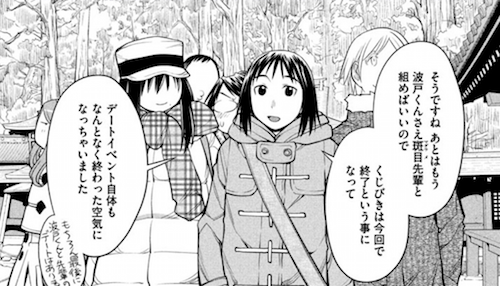
Actually, it almost feels like a “yaoi” moment using female characters. Has anyone done a study of how interactions are portrayed in yaoi vs. yuri? There’s also significantly more Ogiue in this chapter compared to the previous ones, but more on that later.

What I find especially fascinating about this whole Nikkou trip as a way to move Madarame forward is just the idea that he (and perhaps anyone) should not be able to let his relationships stagnate. As Evangelion has taught us, staying in the same place unable to move forward can be a crippling experience that appears comforting when it is seen as avoiding pain. While it could be seen as them pushing Madarame unnecessarily, his passive personality likely means that nothing would ever happen, and it would hurt everyone on all sides if it persists. Of course, there’s still a chance that Madarame will probably still come out of it indecisive because that’s just how he is, but the very fact that Genshiken is having its characters try to constantly prevent the “series of misunderstandings” that can occur when too many secrets are kept gives me the sense that everyone wants the best for each other.

Probably the biggest surprise of this chapter is everyone’s accepting attitudes towards Sue potentially ending up with Madarame, including the other girls interested in him. I mentioned in the previous chapter review that Yoshitake’s comments about Nikkou being a fake-out meant to draw attention away from Tokugawa’s real grave might be meta-commentary on the statuses of the others gunning for Madarame, and it looks like it’s panned out. Hato and Keiko have gotten so much attention, and Keiko even commented on how Sue is unlikely because of her personality, but here Keiko is in Chapter 116 saying that she won’t interfere with Sue like she does the others because that’s the one other person she’s okay with.

Given the cunning with which Keiko has competed, does this mean that she sees something special between Sue and Madarame that doesn’t exist with the other potential partners, including herself? Perhaps the fact that no one wants to interfere with Sue x Mada is because they understand both of their personalities, and that Sue in particular has her own battle to fight regarding her own feelings. Maybe it’s the fact that everyone other than Sue appears to be using wits and charm to pull Madarame towards them (or at least Keiko believes Hato to be doing this), and that if Sue turns out to be the one, that she’s “won” in more than one sense of the word. Again, suddenly Sue looks increasingly likely when she had previously been dismissed, turning everything upside down.

Kuchiki, in his jealousy, argues a version of a  point that I’ve mentioned before, that Madarame has shown how his 2D and 3D tastes don’t necessarily line up. While he has mentioned that Sue is exactly the kind of person that matches his favorite anime archetype, there’s also no denying his lost love for Kasukabe. At the same time, Genshiken Nidaime plays significantly with the blurring of real and fictional interests, or rather the reveal that the difference between them is possibly fairly porous even if the two aren’t the same. However, there’s another possibility, which is that Madarame and Sue’s connection goes well beyond looks, and that, other than possibly Hato, Sue is the only one who match him blow for blow when it comes to otaku power levels, creating a truly ultimate “otaple.”

As I mentioned above, Ogiue has gotten more attention in this chapter than every other one in this “Nikkou Arc,” though not enough to make her a particularly important character for this story. However, it does give us many glorious Ogiue faces.

A lot could be said about Hato and Yajima, but it seems like they’re saving the big guns for next chapter, alongside Sue & Madarame’s Excellent Adventures. Until then…!

If you liked this post, consider becoming a sponsor of Ogiue Maniax through Patreon. You can get rewards for higher pledges, including a chance to request topics for the blog.
Could “My Love Story” Be a Positive Influence on “Nice Guys?”

My-Love-Story-Episode-9

My Love Story!! (aka Oremonogatari!!) is a twist on the reliable yet well-worn tropes of shoujo manga and anime. A manga and recent anime adaptation, it features many of the warm, fuzzy feelings that come with seeing a likable protagonist fall in love, only the main character is a hulking mountain of a man who looks like he stepped out of a manga bout gangster and delinquents instead. Takeo is portrayed as a goofy, lumbering, yet well-meaning guy who’s able to win the heart of a girl he meets through a selfless act, but is slow to realize it because he believes girls can never fall in love with him because he lacks the typical appearance of an attractive guy. When I see My Love Story!! and the message of hope it has for those guys out there who feel like girls will never see them as anything more than a curiosity, I wonder if the series is better suited for our current environment, or if it might have made more of an impact 10 years ago.

What I mean by that is not so much that the show feels older or outdated, but rather that the early to mid 2000s were when sites like 4chan and its Japanese predecssor 2channel truly showed how much they could mold significant parts of how internet culture viewed nerds and how nerds viewed themselves. 2005 marked the drama adaptation of Densha Otoko and the idea that “otaku are in,” Web 1.0 was making way for Web 2.0, and stories about being “forever alone” abounded. There has been the controversy over the “nice guy,” who has symbolized both women’s failure to date the right men and the sexism of men who expect sex just for treating girls nicely. If My Love Story!! had come along to show the difference between genuine compassion and a slick veneer, would it have altered many a nerd’s viewpoints? This is what I’m wondering.

Then again, between harassment of women working in and around video games, an increasingly vocal sense of chauvinism and false victimization over how men are treated, and a variety of other elements in our current media environment, it might be just the right time for a show like My Love Story!! to exist. Maybe now that these aspects are more visible, and now that “nerd culture” and “mainstream culture” are more integrated than ever, the positive messages this series sends are what people need to hear. Another factor in all of this that might complicate the issue is that, at the end of the day, even Takeo is not the handsome prince, he still has numerous qualities that play into the typical image of manliness, and his sheer strength might potentially overshadow his personality with all of its little quirks and moments of weakness. He’s certainly not a “nerd” or “otaku” in the typical sense, after all.

What do you think? Is My Love Story!! the show for today’s anime-watching audience, or could it have actually influenced on the confidence in guys and sense of respect for themselves and for others more greatly if it had been a part of the fabric of our cultures sooner?

If you liked this post, consider becoming a sponsor of Ogiue Maniax through Patreon. You can get rewards for higher pledges, including a chance to request topics for the blog.

The Rise and Fall of Saimoe

This post was sponsored by Johnny Trovato. If you’re interested in submitting topics for the blog, or just like my writing and want to be a patron of Ogiue Maniax, check out my Patreon.

Who is the greatest moe anime character?

That’s the question that the Saimoe (literally “Most Moe”) Tournament set out to answer, and its long history of competitions, dating back to 2002, are a reflection of not so much the state of anime fandom over the past 13 years, but rather how internet anime fandom has grown, changed, and even arguably moved on past the concept of moe in both the US and Japan.

516Q9A2AX3L

If there’s one fact I always find interesting about Saimoe, it’s that its original winner was Kinomoto Sakura of Cardcaptor Sakura. There’s something just so appropriate about her being the first champion, given how beloved she is among anime fans of all stripes. However, Saimoe is also often a snapshot, a look into the zeitgeist of at least a corner of anime fandom, and in that same tournament it might come as no surprise that its silver medalist was Osaka from Azumanga Daioh. These days Azumanga Daioh is viewed as a relic of the Early 2000s, an excellent show for sure, but not as timeless as its fervent fans (of which I am included) would have hoped for.

Other than Sakura, who has stood the test of time as Saimoe champions? It’s okay if you don’t remember who has won Saimoe before, as anime fandom as a whole has a tendency to burn briefly yet passionately for its favorite characters, where in the moment it seems as if her fame will last forever, the sheer memetic popularity of a Suiseiseki (Rozen Maiden) or a Takamachi Nanoha (Magical Girl Lyrical Nanoha) blinding fans from seeing the long-term. That’s not to say that characters such as Aisaka Taiga (Toradora!) and Rosemary Applefield (Ashita no Nadja) are forgettable or bad, but that the otaku mind can be a fickle thing.

Among these titles, it seems as if Madoka Magica‘s popularity still endures, giving a kind of strength to previous winners Madoka and Mami, but one factor that also has to be considered is that the numbers for Saimoe participation rose rapidly in the mid-2000s, and then declined sharply afterwards. To give an idea, for final-round votes, Sakura won in 2002 with 580, Suiseiseki won in 2006 with 2306, and most recently Saki and Nodoka from Saki tied each other at 187. This can be explained by the fact that the mid-2000s were when Saimoe truly opened up to international participation, but also that the idea of “moe” no longer carries as much subcultural weight.

This is perhaps best exemplified by that Suiseiseki victory. It was during that time that fervent fans on 4chan and other communities figured out how to vote for their favorite characters, and whether they were genuinely voting for who they believed was “most moe,” were backing their favorite characters, were trying to push a running gag forward, or they wanted to rally behind their chosen girl, Suiseiseki embodied all three. She was the center of the DESU DESU DESU meme, Rozen Maiden was generally popular among hardcore fans, and her character does have distinguishable moe qualities overall. The heyday of Saimoe was indeed also the heyday of 4chan, and while it’s questionable as to whether Saimoe had ever been more than a popularity contest, when looking at the “rise and fall” of Saimoe, so to speak, what comes out of the other side isn’t so much as a return to the idea of “moe” from the earlier days when Cardcaptor Sakura won it all, but something new and different that I can’t quite fully describe.

Let’s compare the winners of Saimoe 2012 and 2014, all of whom come from the anime series Saki. 2012’s champion was Onjouji Toki, a character who is strictly moe by all conceptions of the often-nebulous term. Toki is a sickly girl whose ability to peer into the future to win at mahjong set her up as a tragic figure that overshadowed even the protagonists of her story (the ending theme to Saki: Episode of Side A, “Futuristic Player,” is actually a reference to Toki). It’s hard to describe her as anything but “moe.” In contrast, while there are cutely tragic elements to Saki and Nodoka, their dual-victory in Saimoe carries a very different set of meanings. First, it can’t be ignored that Saki dominated the overall bracket, to the extent that it could be argued that the fans who care most these days about “moe” overlap significantly with Saki fans. Second, and I think this is more important, Saki has a major yuri component, and I believe that is the true meaning behind the tie. In fact, Toki, Mami, and Madoka also all attract yuri fanbases.

saki-and-nodoka

Yuri to some extent has been a factor in people’s views of characters as moe (see Nanoha and Fate’s popularity), but the role that the cute girl plays in the aspirations and fantasies of anime fandom seem to have changed. Moe as an idea was arguably overwhelming and overpowering at its height, but now it seemingly has begun to secede, and in its place is a network of interests of which yuri is a part. I put it that way because I don’t think “yuri” supplanted “moe” as if that would even be possible. After all, yuri as a vocabulary word predates the solidification of moe by at least a couple of decades, so if anything moe was the young upstart terminology. Rather, moe may have gradually melded itself back into the fabric of anime’s iconic characters, to the extent that trying to ask who is the “moest” has become a more difficult and less directly appealing proposition overall.

Ogiue Maniax Talking Love Live! The School Idol Movie on The Anime Now Podcast

iVukfxy

Following a previous appearance on The Anime Now Podcast to talk about the Love Live! The School Idol Project TV series, I was invited back to discuss the recent movie alongside Bamboo of Anime News Network fame and Host Bradley Meek. Find out which of us is the biggest Love Live! fan, and see our mutual thoughts on some of the more interesting quirks of the film.


The Fujoshi Files 145: Wife

Name: N/A
Alias: Wife (奥様)
Relationship Status: Married
Origin: Happy Fujoshi: Oku-sama wa Oekaki ga Osuki

Information:
This fujoshi originally hesitated on getting married because she was worried that it would interfere with her Comic Market schedule. When her fiancee (now husband) agreed that she would be allowed to continue her hobbies even after marriage, he did not quite realize how all-encompassing her fujoshi lifestyle could be. She maintains a consistent work-life balance between her company work and her hobbies that originally made her husband feel left out, but he soon realized that it makes her happier and thus makes their marriage happier as well.

Fujoshi Level:
In high school, she was a member of the art club, where she shipped French painters Van Gogh and Gauguin based on Van Gogh’s “Bedroom in Arles” because of the one bed with two pillows.