The Fujoshi Files 121: Buchou

Name: N/A
Alias: 
President/Buchou (部長)
Relationship Status:
N/A
Origin:
Fudanshifull!

Information:
The president of the middle school Kentei Academy manga club after Matsumoto Senri, she is friends with Muryou and hopes to join Matsumoto’s high school manga club when it’s her time to graduate. She is a fan of the Tentel x Mikoto pairing from Omakase Tentel, as well as the pairing of Matsu x Kiyo, Matsumoto and his best friend, Kiyokawa Atsumu.

Fujoshi Level:
Although clearly a fujoshi, her inexperience navigating Comic Manga Market may indicate that she has not been one for very long, or at the very least has not attended very many doujin events.

The Mystery of Stocking’s Virginity (or Lack Thereof)

The idea that otaku over-value virginity is prevalent. This sexism is not limited to otaku or even just Japan of course, and there are equivalents around the world in different forms, but whether it’s people getting mad over their favorite anime characters having had past relationships, or scandals over Japanese idols secretly dating, it’s become a valid point of criticism for otaku subculture. At the same time, I wonder if that mindset isn’t so cut and dry. Just as girls do not fall under a simple virgin/slut dichotomy, I think it may be faulty to view otaku as liking only one or the other.

The main title that has me looking over the otaku preference thing is actually Panty & Stocking with Garterbelt. It’s well-established, based on sales of merchandise both official and unofficial, that the sweets-loving goth Stocking is much more popular among Japanese fans than the sex-crazed Panty. This seems to fall in line with the general rhetoric that otaku hate non-virgins, as Panty as a character is defined by the sheer amount of sex she has. She has extremely shallow standards for men, possibly spends more time having sex than not, and will even have important conversations in the middle of sex with people other than the guy(s) she’s with. The image of otaku’s preferences would work out perfectly, if not for the fact that the show states that Stocking is also sexually active.

Stocking mentions during the series that she also has a love life. It’s not even that she’s only had long-term relationships, or is merely a non-virgin still hesitant about sex even after having it. Though she’s more selective than Panty in terms of men, she establishes that she’s been with multiple guys, and will candidly discuss with Panty that some were great in bed and others weren’t. In light of this, why do the fans prefer Stocking to the point that her figures will go out of stock while Panty’s will get discounted heavily due to lack of sales?

One possibility I’m considering is pretty much a matter of relativity. Within the context of individual shows, it becomes easy to categorize characters in comparison to each other. In a show where everyone is small and cute, the character with any sort of bust becomes the “big-breasted” one, whereas in a show where all the character designs are leggy supermodels there may be a different standard among fans. Because Panty’s head is filled with sex (as the opening shows us), and Stocking is not so preoccupied with the same subject, it becomes a matter of Stocking being preferable by contrast even though she probably has more sex than your typical female anime character?

Another possibility is that it just comes down to character design, that Stocking’s gothic lolita look and Panty’s blonde hair and cocktail dress are the main ways in which they’re judged regardless of what happens in the show. Or maybe it’s that, at a cursory glance, Panty’s sexual activeness is extremely visible (the first thing we see of her in Episode 1 is her crawling out of bed with a guy), whereas Stocking’s love life is not so prominent? Only by watching the show do you learn that Stocking is no stranger to the opposite sex either, but it’s possible to understand this about Panty from the anciliary material.

If you have any thoughts or opinions on this, feel free to leave a comment, as I don’t feel like I quite have the answers. I’m not really sure myself, but I get the impression that Stocking’s relative popularity shows that things aren’t as simple as otaku liking either only the “pure” or the “promiscuous.” There are other examples as well, like how Akihabara idol Momoi Halko married and had a child but is still beloved. I have to wonder then if there’s another factor at work, like an inside/outside-group dynamic (and I don’t mean strictly in the Japanese culture sense) which dictates that allows some girls, fictional or otherwise, to be okay no matter what while others are judged more harshly.

Best Anime Characters of 2014

BEST MALE CHARACTER

Iori Sei (Gundam Build Fighters)

Much like last year’s winner, Armin Arlert, Iori Sei is a character whose skills come from forethought, patience, and preparation. Unlike Armin, however, Iori Sei is in fact the protagonist of his own series, reflecting a more general trend as of late where those who would normally be considered side characters are entering the limelight. In this respect, Sei’s talents, designing and building exquisite plastic Gundam models to use in holographic simulated battles, are best seen when his designs are utilized in the hands of his teammate Reiji. His gentle personality both contrasts with and complements his dedication to honing and refining his craft, and while he eventually becomes a skilled “pilot” as well, it feels like a very natural progression. Also, his innocent romance with Kousaka China is adorable.

BEST FEMALE CHARACTER

Kiryuuin Satsuki (Kill la Kill)

The main rival in Studio Trigger’s popular series of 2013-2014, in order to understand Satsuki’s strength as a character it’s necessary to also be aware of the surface impression that Kill la Kill often first creates. The main motif of Kill la Kill is clothing and nudity, and Satsuki herself is no exception as early on in the series she dons her Kamui Junketsu, a sentient battle uniform, and proceeds to fight in an extremely skimpy and revealing outfit. At many points in the series, her body is on full display, and it is portrayed as very sensuous in its own right. However, when thinking of the character Kiryuuin Satsuki, what first comes to mind is not what she’s wearing (or not wearing), but her commanding presence, her ambition, her radiant confience, and ultimately her redemption. One of the strongest moments in the series has to be when Satsuki apologizes, taking a deep bow that humbles her yet also elevates her to even greater heights as a human being of iron-clad will and determination that nevertheless has room for love and compassion.

BEST DUO

Andy and Frank (Yowamushi Pedal)

Andy and Frank (pictured left and right) support, advise, and push Hokane Academy’s 1st-year sprinter Izumida Touichirou to strive for victory. Developing their strength throughout his training, one has to wonder where Izumida would be without the help of Andy and Frank; it’s almost impossible to picture him without them. Though they seem quite similar, what’s also remarkable is how each of them have their own unique yet complementary personalities. It’s what makes them such an incredible team.

Final Thoughts

While there’s nothing that clearly links these characters together (though Andy and Satsuki might have something in common), I found that my choices this year were surprisingly not that difficult. Especially in the case of Satsuki, while there are plenty of great female characters this year, such as Anetai Toyone from Saki: The Nationals, Koizumi Hanayo from Love Live! School Idol Project, or even her fellow Kill la Kill characters, Satsuki’s sheer presence dominated them all in my mind. Perhaps the most notable thing is how different Sei and Satsuki are in terms of personality, and that their paths during their series lead them in what might be called opposite directions. Sei, though talented, learns confidence, while Satsuki learns humility and the value of friendship. At the same time, both remain true to themselves and their convictions.

A Flying Pussyfoot or Two: Genshiken II, Chapter 107

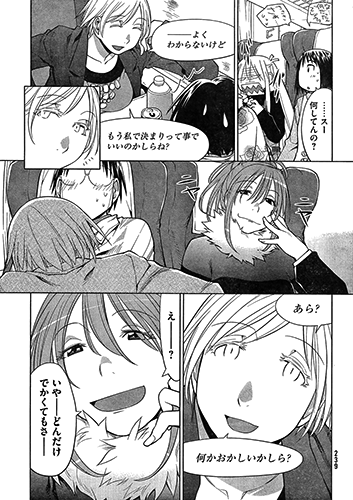
Chapter 107 of Genshiken II mostly takes place on a train. Unlike Baccano!, there is no trail of dead bodies, thanks mostly to Yoshitake.

The crew is traveling to Nikkou, a popular domestic and foreign tourist destination, which happens to be located near Yajima’s hometown. As Kuchiki feels that his spotlight has been stolen by Madarame and the women who love him, Yoshitake placates his (somewhat justified) anger by playing with him various classic school trip games, like UNO UMO, at the same time she tries to encourage Madarame towards a romantic conclusion. Before arriving at Yajima’s place, Yoshitake reveals that she deliberately split off Kuchiki and Madarame into their own hotel room to keep boys and girls separate, except also intentionally failing to mention that Hato is considered one of the girls in this instance.

Genshiken can generally be considered something of an ensemble series, with a rough protagonist in each part. First it was Sasahara, next it was Ogiue, now it might be considered Hato. However, if you were to take just this chapter by itself, and define protagonist in the conventional sense as the character whose actions move the narrative forward, then Yoshitake is clearly the hero in this instance, setting the characters on their paths, or at least trying to do so. That, or she’s like Satan, purveyor of half-truths, hiding her ulterior motives by giving reasons that appeal to her targets’ senses. For Madarame, pushing him towards altruism by bringing closure to his harem woes and preventing any potential fractures in the club hide her simple desire to see her friends end up happy.

Not that I dislike Yoshitake, but rather, as Japanese blogger tamagomago once said, Yoshitake is very good at being the glue that holds a group together. Here she demonstrates that ability to full effect using her silver tongue, managing to set up two different groups that take on different dynamics depending on which guy is placed within them. Madarame surrounded by Angela, Keiko, and Sue is pretty self-explanatory, but as soon as he shifts over to Yoshitake, Yajima, and Hato, it becomes an opportunity to see how Hato and Madarame react to each other. At the same time, Kuchiki being with the other girls lets him somewhat fulfill his harem fantasy, if only in the most bare-bones manner.

Of course, the other characters get their own moments too. While Yoshitake is the one moving things about, it’s the others’ lives that are the concern. Angela makes her appearance after a long while, and in a few moments she gets tied directly into the developments of the previous chapters. Specifically, she has a duel of confidence with Keiko, which references the close call that Madarame had with her, and she gets her breasts fondled by Sue, who is still mad about Madarame’s comment about breast size. Despite being so far away, she still perhaps has a “chance.”

Another character makes her return in Mimasaka, Yajima’s old friend, only this time she has tiny hearts literally emanating from her being. Previously I had considered the possibility that her affection for Yajima might merely be platonic (or at least something like what Sue feels towards Ogiue), but this little detail changes things.  For one, it makes for a complex chain of romance where a girl likes another girl who likes a boy who dresses like a girl who likes a guy who recently had his heart broken and is currently popular with the ladies. We also get to see Yajima’s mother, who clearly resembles her. The chapter mentions something about genetics in terms of appearance, but I do find it interesting that Yajima’s mom is so much more cheerful than her daughter. Obviously their lives and circumstances are different, but it does make me a bit curious what her home life was like.

Ogiue literally took a backseat this chapter, staying out of the storm while on the train. One notable moment is that you can see her internal speech is still Tohoku-ben (Watashi wa zutto Sue to issho nandabeka…).

As for next chapter, the preview mentions that it’ll be centered around the Yajima household. I for one am curious when that Angela-centric chapter will happen. It’s really on a matter of when.

One last thing to mention: a new volume of Genshiken came out in Japan, and once again it comes with different store exclusives. This time, they’re Christmas-themed, and they feature Sue, Hato, and Angela, as well as a group shot.

The Fujoshi Files 120: Koujiro Frau

Name: Furugoori, Kona (古郡こな)
Aliases: Koujiro Frau (神代フラウ), FRAUKOJIRO, Frau Bow (フラウ・ボゥ)
Relationship Status: Single
Origin: Robotics;Notes

Information:
Furugoori Kona, better known by her internet handle “Koujiro Frau,” is the genius hacker and programmer of the popular mecha battle game Kill-Ballad. A hikikomori who tends to use internet lingo in real life, Frau is also obsessed with yaoi and erotic games, and will make frequent mention of them in everyday conversation, provided she’s talking to anyone in the first place. She is also known for her distinct laugh: duhuhu.

Unbeknownst to most, Frau is also the daughter of the director of the giant robot anime Gunvarrel, though her mother mysteriously disappeared after the show was abruptly canceled. Though reluctant at first, Frau eventually becomes a part of the Tanegashima High School Robotics Club, where her expertise helps the club to not only create a second prototype of their life-size giant robot, but also aids them in unraveling the elaborate conspiracy responsible for her mother’s disappearance.

Fujoshi Level:
In addition to her constant playing of yaoi games, Frau also frequently exclaims her desire to see her male club mates go at it, with her continued ramblings giving increasingly elaborate detail along the way. Frau is not only a fujoshi, but also one with very little filter.

10 Tips for Using Mega Man in Smash Bros.

megaman-greenwhite

I’m not a super high level player, but I’ve dedicated a good amount of time to learning the intricacies of Mega Man as a character in Super Smash Bros. for Nintendo 3DS & Wii U. For those of you curious about Mega Man, or looking to use him as your primary character, here are ten tips you might find useful.

1) Mega Man is more durable than he looks

Mega Man may be small, but you might be surprised how much he can survive. He’s actually among the fastest-falling characters in the game, and above-average in terms of weight. This means he’s slightly harder to kill off the top of the screen than Ganondorf, and harder to kill off the sides of the screen than Mario. Combined with his tiny frame, it means that Mega Man can live for a pretty long while, and in this game the higher damage you’re at, the more knock-back your attacks have (this is often referred to as “rage”).

2) Mega Man is extremely maneuverable in the air

Mega Man moves very similarly to how he would in his source games, and it means that Mega Man is very “wiggly.” If you’re just using Mega Man exclusively you might not notice it, but pick a character like Marth or (especially) Little Mac and try to move back and forth in the air. It can feel like molasses compared to Mega Man. Because he also has a crisp second jump, the ability to act out of his Up Special, and high fall speed, it means Mega Man can quickly weave in and out while in the air. When combined with his heavy array of ranged weaponry, it can be a strong way to keep the opponent guessing.

3) Mega Man is a mid-range fighter, not a long-range one

The first thing you probably notice when using Mega Man is how many projectile-based moves he has. They occupy approximately 50% of his moveset, while other melee attacks such as the down tilt (Slide) and dash attack (Top Spin) are also designed to hit from afar by moving Mega Man forward. However, if you think you can stand on the other side of the screen and throw stuff at the opponent all day long, you’re in for a rude awakening. Not only do some characters out-range Mega Man (Link and Toon Link, for example), but his projectiles do relatively little damage. Instead, they’re best used as a means of getting close to the opponent, getting the opponent off of you, or covering your retreat, depending on what’s needed at any given moment.

4) Mega Man is about patience and slow, gradual damage

Related to the previous point, Mega Man is not a combo-oriented character, nor is he generally a heavy hitter. If you get too eager or brash with your movements, you will suffer because Mega Man doesn’t have as many tools for fighting at close range compared to other characters. Wear the opponent down with projectiles, grab and throw them as they’re trying to shield to get them in the air, and then, rather than expecting Mega Man to be able to immediately follow up with some ridiculously strong attack or long combo, use this time to improve your physical position relative to the opponent’s, or to gain a small lead. For example, slide into them as they try to land.

5) Pellets are your friend

Mega Man’s jab, forward tilt, and neutral air attack all mimic his basic attack from the Mega Man games, and while they do not pack much power they are extremely versatile. Pellets are very quick to come out, can neutralize most projectiles (including those reflected back at you), and can halt head-on approaches. It can also cover up some of his other weaknesses. When Mega Man uses his Up Special (Rush), for instance, he usually suffers some kind of cool-down upon landing that renders him vulnerable. One way to cover for this is to land while shooting, which offers you some projection. When fighting a character like Peach who possesses a strong ability in her signature float, you can shoot at her to keep her at bay, to damage her as she tries to retreat. Just keep in mind, again, that the range on the pellets is relatively short compared to your other projectiles.

6) Mega Man has only a few KO moves

Unlike a lot of characters, relatively few of Mega Man’s attacks are meant for outright finishing the opponent off. However, the few he does have can be extremely potent as long as you understand their strengths and weaknesses. Up Tilt (Mega Upper) is basically a shoryuken from Street Fighter: it’s quick to come out and can KO very early, but leaves Mega Man wide open to an attack if he misses. Back air (Slash Claw) is quick and reliable, but really only works as a final blow if the opponent is near or off the ledge. Down Smash (Flame Burst) is very strong but has a very small window of opportunity combined with long start-up and cool-down, which means it’s best used for punishing the opponent’s attempt to roll behind you. Up smash (Spark Shock) is quick, but lacks range and for a KO move is pretty weak. As for the last notable attack…

7) When it comes to Mega Man’s forward smash (Charge Shot), quality is better than quantity

I know that it’s tempting to use Mega Man’s charged forward smash to try and hit the opponent from a distance, but it’s actually not good for this purpose. The opponent can generally see it coming from a mile away, especially because it travels further the more it’s charged, and if you miss you’re very much a sitting duck. Instead Mega Man’s Charge Shot is best used intelligently. For example, use Charge Shot to catch an opponent rolling back, if they’re trying to recover after being knocked off the stage, or if they’re trying to land. This last one is especially important, because in this game if the opponent tries to air dodge too close to the ground they become vulnerable for a brief moment, perfect for a giant energy blast to connect with their face.

8) Mega Man is good at keeping his KO moves at full power

Smash Bros. has a system called “stale moves” where the more you use an attack the weaker it becomes, and the way to restore the power of your attacks is to use different moves. This is another area where Mega Man’s pellets shine. All of his basic Arm Cannon attacks all do low damage already so they are less affected by this system, and all it takes is a few rounds of fire to bring your other attacks back to their maximum potential.

9) Mega Man’s air attacks are great for air to air combat, but terrible for air to ground combat

Mega Man’s air attacks are all very potent against airborne opponents. Forward air (Flame Sword) and back air (Slash Claw) are both quick to come out, do not count as part of Mega Man’s body, and Slash Claw can even KO at decent percents. Up air (Air Shooter) and down air (Hard Knuckle) both count as projectiles and can finish the opponent off early in certain situations. However, with the notable exception of his neutral air mentioned above, all of Mega Man’s air options have long landing lag, which means that if he lands while performing an attack, it will leave him vulnerable. If you try to hit the opponent with a Flame Sword and they shield, for example, they can generally retaliate without you being able to do anything about it. This doesn’t mean you should never use them against a grounded opponent, but it should be as a punishment after they’ve whiffed an attack, or if you’ve tricked them into not shielding.

10) Metal Blade has  a ton of uses

This point could probably be expanded into ten different sub-points, but it’s important to understand just how versatile Mega Man’s Neutral Special (Metal Blade) can be. It counts as an item, which makes it unaffected by Stale Moves. It has different properties when fired as a projectile and when thrown, including damage (higher if thrown) and range (can travel eight directions if fired but only four if thrown). It can be used while Mega Man is running away. If you’re coming in from off-stage, you can fire Metal Blade to keep your opponent from coming after you. If held as an item, Metal Blade can be dropped instead of thrown; try using this against an opponent recovering onto the stage from below. Perhaps best of all, while the opponent can steal it from you, it means that as long as they’re holding the Metal Blade they don’t have access to their regular attacks, thus limiting their options.

I hope that this helps out you aspiring Mega Man players, either to look more closely at the character either or to start you off on your quest to defeating all of the proverbial Robot Masters around you. Keep in mind that these tips provide a fairly general overview of Mega Man, and that each point can be elaborated upon in much greater detail. I didn’t even really talk about the other special moves! Most importantly, don’t forget to have fun playing.

Anime Secret Santa: Plastic Nee-San

Once again I’ve participated in the Reverse Thieves’ Anime Secret Santa, where various bloggers, podcasters, etc. anonymously recommend anime to other people. This year, the show I will be reviewing is Plastic Nee-san (aka +Tic Elder Sister) a comedy series that somewhat defies description.

plasticneesan-armwrestling

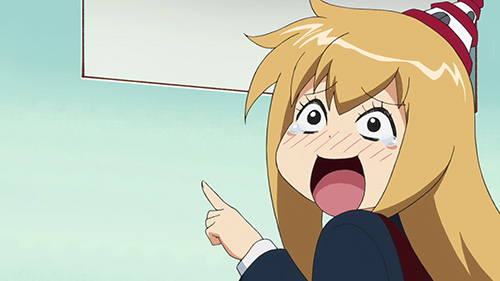
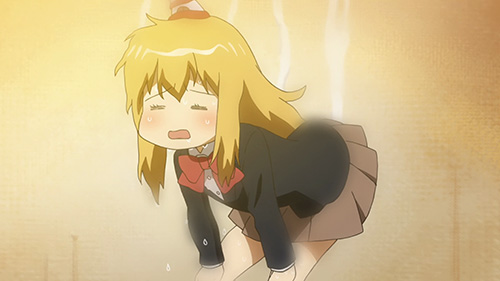
Ostensibly an anime about three cute girls in a high school plastic model club, Plastic Nee-san thrives on being utterly bizarre yet just familiar enough to make it difficult to label it as simply “wacky.” Even as the girls eviscerate each other physically and mentally, it can be difficult to predict where the show will go next. Episodes are extremely short, amounting to about two minutes each, and the jokes are rapid-fire while never overstaying their welcome.

plasticneesan-mochi

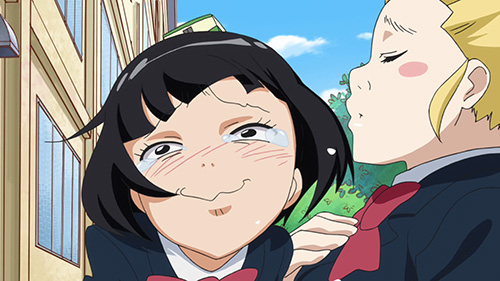
Of all the anime and manga I’ve seen, the show that comes closest to Plastic Nee-san is probably Ai-Mai-Mi! Both series utilize their settings as the absolute loosest of pretenses to engage in strange, often non-sequitur humor, revel in watching their characters suffer while generally deserving it. The key differences between the two would be that Ai-Mai-Mi! goes places that Plastic Nee-san doesn’t even dream of (Plastic Nee-san at least tries to keep things in and around their school), and that Plastic Nee-san gets more over the top with its facial expressions.

plasticneesan-pointlaugh

plasticneesan-sweating

plasticneesan-laugh

plasticneesan-soldier

On the Kurumi Erika scale of amazing faces, Plastic Nee-san is clearly a 10 out of 10.

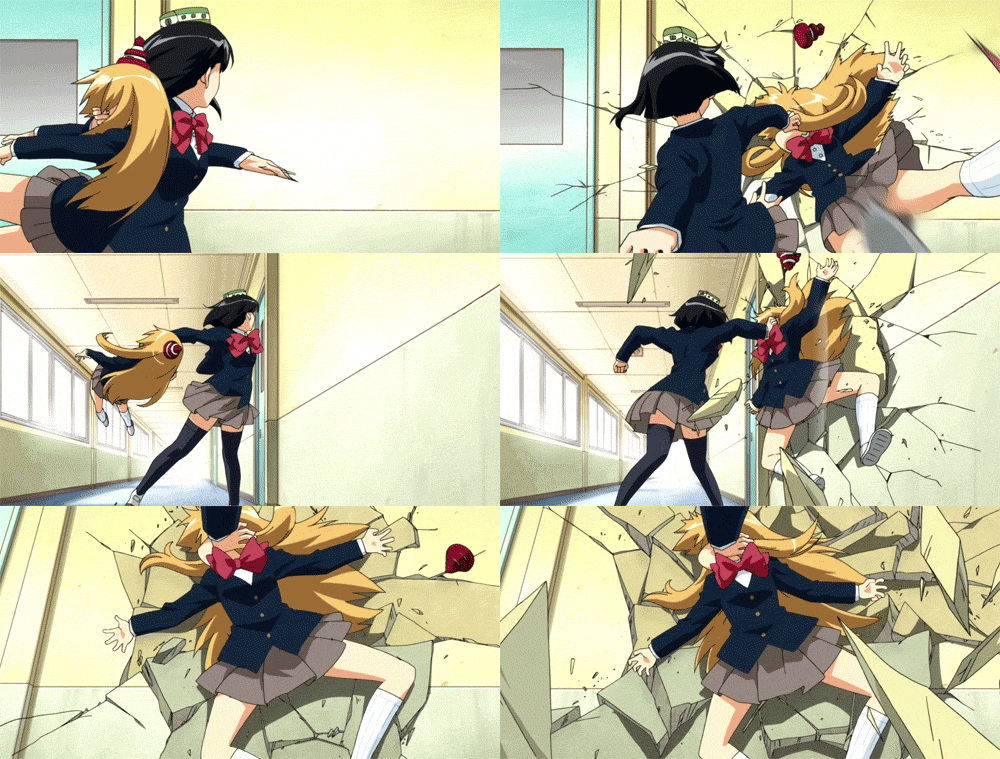
Another show that Plastic Nee-san is Nichijou, particularly in terms of the Kyoto Animation adaptation. At some point on your internet travels, you may have come across the following animated gif:

plasticneesan-slam

This lovingly animated moment is from Plastic Nee-san. In fact, this is how an episode starts. While the rest of that episode isn’t quite so violent, it still does a brilliant job of building from that initial shock to leave you dazed, confused, and asking for more. This is what makes the anime, strangely enough, very accessible to even those unfamiliar with anime, as the impact of the humor is unforgettable. Even if they don’t know the name of the series, it will inevitably go down as “that crazy anime you showed me.”

The last thing I want to point out is that while a number of shows have super cute girls doing obnoxious things, in the case of Plastic Nee-san this is greatly improved by the fact that just about every individual in this series gets what’s coming to them quickly and mercilessly. Unlike other series where characters never get their comeuppance and continue to expand their irritating and annoying personalities (which I know can be a deal breaker for some), Plastic Nee-san rains slapstick vengeance on them like there’s no tomorrow. In some cases, characters don’t even realize that they’ve paid their price, which makes things all the better. In this respect, it’s like Nichijou with all of the warm, heartfelt moments excised.

In short, if you were to watch Plastic Nee-san and Ai-Mai-Mi! in the same day, you’ll probably either solve world hunger or doom the planet to an eternity of plagues.

The Fujoshi Files 119: Saotome Haruna

Name: Saotome, Haruna (早乙女ハルナ)
Alias: Paru (パル), Great Paru-sama (グレート・パル様 Fictrix Comica (漫画製造者)
Relationship Status: Single
Origin: Negima! Master Negi Magi

Information:
Originally a middle school student at Mahora Academy, Saotome Haruna is at that point already been working as a doujin artist under the pen name “Paru.” Though she shares a close friendship with her classmates Ayase Yue and Miyazaki Nodoka, she is originally unaware of the fact that her 10-year-old teacher, Negi Springfield, is actually a powerful magician because her friends are afraid that Haruna’s gossipy nature would reveal Negi’s secret to the world. After eventually finding out, she enters a magical contract with Negi (as do many of the girls in their class) and gains the ability to bring her drawings to life as golems (a magical artifact known as “Imperium Graphices”), also earning the title “Fictrix Comica.”

Haruna is a talented artist whose skills bring her much success in unusual ways. In one case while trapped in the magic world she introduces manga to their world and earns enough money to buy a large goldfish-shaped airship and names it after herself. In her adult life, she becomes one of the most popular and best-selling BL manga creators ever, her work enjoyed by both magic and non-magic users alike.


Fujoshi Level:
In addition to becoming a best-selling BL manga artist, Haruna also regularly attends doujin events as both an artist and a customer.

Shoujo Face, Bishoujo Body

I’ve been reading one of Crunchyroll’s latest manga, Watashi ga Motete Dousunda (aka Kiss Him, Not Me) by Junko, which is premised around a fujoshi who loses a ton of weight after her favorite anime character dies and so inadvertently gives herself a makeover that attracts all the guys. Given the idea that the main character Serinuma Kae is supposed to be absolutely gorgeous, I find it interesting how this is expressed, because it’s somewhat unconventional for shoujo manga.

When looking at characters in manga, one can generally get a sense of who the artwork is trying to attract based on how characters’ sexual features are drawn. In manga for girls, even when a character is supposed to have large breasts, they tend not to really stand out compared to how they’re portrayed in boys’ manga. This is quite noticeable, for example, when looking at the difference between how the character Maya looks in the Survival Game Club anime vs. the manga. Another example is when a work depicts its female characters wearing unrealistic shirts that look practically painted on. You rarely if ever see this in a shoujo series.

Kae has what I would call a face that is fairly typical for beauty standards in shoujo manga, but her body is closer to what you would find in a bishoujo series, that is to say a manga for guys all about attractive ladies such as Love Hina, making her a hybrid of sorts between the two styles. Moreover, while the clothing isn’t so unrealistic so as to basically be super spandex, there are times when Kae’s figure is accentuated and her clothing clings to her chest. Again, this would not be so surprising to me if it were in a series that ran in, say, Dengeki Daioh, but Watashi ga Motete Dousunda is definitely a shoujo series, as evidenced by the fact that so much effort is made to portray the guys themselves as various degrees of angst, handsomeness, and dream-boatitude.

Watashi ga Motete Dousunda is not the only series to do this, though maybe there’s something to be said (about me or manga more generally) about the fact that the first example that immediately came to mind was another fujoshi-themed manga, Mousou Shoujo Otakukei (aka Fujoshi Rumi) by Konjoh Natsumi. Like Watashi ga Motete Dousunda, Konjoh’s series portrays its guys as tall, attractive fellows in that way you’d more typically see out of shoujo manga, but the girls, especially the character Matsui Youko, are given a kind of physical attractiveness that is more in line with guy-oriented stuff.

In his introduction to his book The Moe Manifesto (a collection of industry, scholar, and fan interviews about the subject), Patrick Galbraith makes mention of how Azuma Hideo, the “father of lolicon,” created his cute girl characters by combining the expressiveness of shoujo characters with the bodies more in the style of manga pioneer Tezuka Osamu. It could be said that Watashi ga Motete Dousunda is going for a similar effect, though of course calling it lolicon wouldn’t quite be accurate, even if one were to take into account how the definition of that term has changed over time, as it seems to be less about the intersection between youth and adulthood, and more about expressing a new type of ideal.

A Very Belated 7th Anniversary Blog Post

November 20 is the birthday of Ogiue Maniax, and while I’ve forgotten it before it was never quite to this extent. All I can say is, whoops! It’s not really that big a deal in the grand scheme of things, but an annual look back is one of the traditions of this blog, and it’s one I like to keep up. So, here we are.

Of course the biggest change this year for me and the blog has been moving back to the United States. In light of this, I’ve considered maybe doing something new for it. Perhaps a new banner? Maybe a new series of posts? Then again, the Gattai Girls and Fujoshi Files are still going on, and especially with the former I can only get a new post out once every few months. I also tend to drop a lot of ideas after bringing them up for no other reason than lack of inertia. Switching back to the old daily posting schedule is also a possibility, but at this point it might not be so feasible like it was four years ago.

At the same time, I’m still devoted to posting at least twice a week, though this has come with its own challenges. A few years back, in an effort to not fall behind when I was extremely busy, I started writing a number of posts in advance so I could keep up a consistent schedule. It’s worked, but one side effect is that often-times I’ll have ideas that I should be posting sooner when a show or whatever is fresh in people’s minds, but then I delay it because I have so many. What happens then, if I have a huge archive of drafts such that I don’t have to write anything for a while, is that I start to feel a bit disconnected from anime, manga, games, and even myself. It’s a weird feeling, like somehow I’m engaging less with this stuff (even though I’m still watching and reading plenty). However, if I start posting all of them at once, I get nervous about running out of a supply. I still have posts from like two years ago that I finished and just never published because the timing never seems right, and some I’ve gotten rid of because they just didn’t feel right.

I don’t know if I’ll ever get rid of this feeling, even if this blog magically became my job and I could live off of its profits (fat chance). In fact, that might make me feel even more pressured which might result in Ogiue Maniax losing some of its identity. That’s not always a bad thing, but still something I probably wouldn’t do. I know it sounds like I’m not enjoying the blog anymore, but that’s not the case at all. It’s still my favorite place for talking about the things I love.

To end off, I want to use this post to give a eulogy to my old Tenhou account. Though I managed to reach 4-dan a while back, my own neglect resulted in me failing to log in during the 3-month grace period, and so it’s been suspended with no way to bring it back. I now have to start again from the bottom, though of course that’s not actually the case, seeing as I’m re-starting with a lot more experience behind me.