The Price of Art: Miyazaki Hayao’s “The Wind Rises”

It’s been a few weeks since I took the opportunity to see Miyazaki’s The Wind Rises. For personal reasons I’ve been unable to write about it until now, which makes me a little sad since my memories of the movie are no longer as fresh. Nevertheless, the film made such an impression on me that I can still remember its effects on me, the mild trembling and near-existential crisis I experienced after leaving the theater that I feel compelled to write about it. This is because while other Miyazaki films have been beautiful, profound, poignant, heart-warming, and intelligent, The Wind Rises is challenging.

I’m going to spoil quite a bit. If you haven’t seen it, I highly recommend this movie.

The Wind Rises is a highly fictionalized account of the life of Horikoshi Jirou, inventor of the “Zero,” the most famous Japanese plane of World War II. We first see him as a child in love with the idea of flight, though sadly unable to ever truly take to the skies due to his terrible eyesight. Instead, in a dream where he meets Caproni, a famous Italian aeronautical engineer, he realizes that if he can’t fly the planes, then at least he can build them. The movie is thus the story of a man with a passion that stays with him throughout his life. The main issue is that he lives in the 1930s, and Japan already has an alliance with Nazi Germany. We know what Jirou’s passion will lead to, and this aspect of his story is how The Wind Rises confronts its audience with difficult questions.

There is a sort of romantic image surrounding the artist who lives for his craft, and over and over again the movie shows how Jirou would rather not think of anything but the plane itself. However, The Wind Rises juxtaposes this quality in Jirou with the era in which he lives. Given the imperialist and militaristic nature of Japan at the time as depicted in the film, it is clear where Jirou’s inventions will eventually take him, and yet given the context of his society, it’s also the only opportunity he really has to fulfill his dream. He makes the best of his situation, pursuing his life-long goal using the means available to him, and though on a personal level this can be seen as the emblematic of the adaptability of the creative human mind, it also comes at a very real cost of millions of lives, claimed essentially by Jirou’s imagination. At the end of the movie when Jirou returns to his dreams of the sky and we see the clouds in the sky transform into his greatest invention, there’s a clear sense of tension on the screen between the beauty of the Zero and the ugliness inextricably tied to it. This is why when I see people accuse this film of being militaristic, I feel as if they did not bother to actually see what was happening in the film.

Can art truly be made for art’s sake? This is one of the central questions of the film, and The Wind Rises answers that this passion, as much as we might want to bottle it and isolate it from the world, is nevertheless still a part of it. Even the refusal to compromise ends up being a type of compromise in itself, and the film makes this point clear not only through Jirou’s profession but also his personal life. Falling in love with a woman suffering from tuberculosis in a time when there was no cure, throughout the movie they make sacrifices between their immediate and future happiness. When ultimately they decide to live together despite knowing that this will shorten her lifespan, the parallel is clearly established that, whether it is at home or in another country, Jirou’s passion in a sense destroyed lives. And yet, it is impossible to see Jirou as a “villain,” or as morally reprehensible. There is no guarantee that we would not have done the same thing, living in the here and now while hoping for a brighter future. Jirou’s choices cannot simply be divided into “right and wrong.”

The very fact that Miyazaki himself is an artist making some of the most successful animated films ever makes the ideas of The Wind Rises feel both self-critical and targeted toward society at large. One of the more interesting decisions for the movie was that Anno Hideaki, creator of Neon Genesis Evangelion, animator on Miyazaki’s Nausicaa of the Valley of the Wind, and otaku extraordinaire was cast as the voice of Jirou. Anno is no voice actor, and it shows in his amateurish performance, but I think this was a deliberate choice because Anno is also a “passionate person” as an otaku. Evangelion was Anno’s attempt to tell otaku to get out there and confront the world, and in certain ways the opposite happened, so I believe that Anno in the role of the protagonist speaks to the idea that otaku are generally considered obsessive people in some sense “cut off” from society. There is an earthquake at the beginning of the film, and when the ground begins to crumble and shake, it looks like the old Gainax style more than that of Ghibli, and I have to wonder if it was animated in this way to call attention to the otaku. As with Jirou, the question would be if we can call otaku a pocket of society, a subculture, or if that passion should be contextualized. It’s a confrontation with both otaku and non-otaku.

I saw this movie at a period in my life where many things are in flux. The future often looks uncertain, the present looks frightening, and more than a few people I’ve known have become ill or worse in recent years, and this movie hits me hard in those areas. Moreover, as someone who has spent his life in creative endeavors, whether it’s art or writing, I feel as if this movie peered straight into my soul, asked me about my life, and forced me to ask myself what a human being really is. In spite of this—or perhaps because of this—however, The Wind Rises may very well have become my favorite Miyazaki film ever (which has been Laputa: Castle in the Sky for the longest time). In fact, when I think about it, the last time I felt this profoundly affected by any anime was the masterful Turn A Gundam. If I had to summarize my thoughts on the film in three words it would be: beautiful, deep, painful. 

The Fujoshi Files 99: Shiina Mafuyu

Name: Shiina, Mafuyu (椎名 真冬)
Alias: N/A
Relationship Status: Single
Origin: Seitokai no Ichizon

Information:
Shiina Mafuyu is a shy and demure girl who often has her face buried in a video game. So addicted to video games is Mafuyu that she will bring multiple home consoles and portable systems with her on long trips. Though open to diverse genres, Mafuyu mainly plays visual novels, for which she creates internet guides.

Along with her older sister Minatsu, Mafuyu is a member of the Hekiyou Academy student council, voted in by her fellow students. There, Mafuyu participates in the idle discussions which characterize the student council, and has a tendency to pair the only male council member, Sugisaki Ken, with another male student named Nakameguro. She is also somewhat antagonistic towards Ken’s younger sister as the two have “overlapping characters.”

Fujoshi Level:
Mafuyu describes herself as “half-games, half-Boys Love.” She believes being able to fantasize about a pen and a pencil together is a fundamental skill.

Chocolat à la Folie: Genshiken II, Chapter 100

Can you believe it’s finally Chapter 100? Genshiken has come a long way, and you’d expect a manga to make a pretty big deal out of something like this, but this month is actually fairly low-key in spite of it being about Valentine’s Day. Perhaps that casual approach is the most appropriate way to celebrate Genshiken.

I get the feeling most people reading this will be familiar with the distinction between giri (platonic) and honmei (romantic) chocolates in Japanese Valentine’s Day, but I’m pointing out the distinction here just in case.

The women of Genshiken are buying chocolates for Valentine’s Day, though in the spirit of cooperation and camaraderie they’ve decided to buy their chocolates together, and for everyone to buy each other chocolates. Or rather, that is the plan on the surface, as it’s really an opportunity for everyone to buy chocolates for their respective crushes and make it look like an egalitarian affair. Yajima appears to chicken out at the last second and just buys a box of chocolates for everyone to share, but this too is revealed to be a ruse. Kuchiki comes in and is (somewhat justifiably) angry that no one remembered to give him chocolate, and Yajima gives the chocolates meant for Hato to Hato but only so that he can offer them to Kuchiki to quell his nerd rage. In the end, Hato (with Sue) goes over to give him some honmei chocolate, which causes Madarame to blush profusely.

The title of this chapter—”Is it the birthday of the Van Allen Radiation Belt?—is a reference to Kyuukyoku Choujin R. It’s also been the source of a lot of Sue’s quotes, and reminds me of Tamagomago’s post on the difference between Genshiken and R. As mentioned there, Genshiken used to be compared a lot to R, but their approaches to the generation gap between club members is different. I’ve pointed out the contrast between the old and new era of Genshiken, though at 45 chapters into Nidaime it’s at the point where the Ogiue-led Society for the Study of Modern Visual Culture has been its own thing for almost 4 years now. Even though the connections pop up still, I’ve gotten the feeling that the manga has been trying to move away from that disparity between “young” and “old,” and more towards this incarnation of the club having its own rhythm. That sense that the “fujoshi-laden Genshiken” is unique has always been there, but in this chapter it really comes through.

Genshiken has never really done Valentine’s Day, and while at first that seems kind of unusual given how long the manga is, it makes sense that it would happen only after 1) the club went from being mostly guys to mostly girls (Valentine’s Day is a holiday in Japan where girls give chocolates) and 2) after romantic feelings are front and center in the story. The chapter purposely makes note of the fact that the way the Genshiken members go about celebrating Valentine’s Day doesn’t quite match up to the way things go in anime, but at the same time it still kind of falls into the same parameters. All of the twists and turns in the plot summary above are basically attempts by the girls to Trojan Horse honmei chocolates as giri chocolates, making for something as complex as the political machinations of some royal nobility. I do find it funny that Ohno, having spent some time in the US, gives the “I wish it were more like anime!” vibe like you’d expect out of her fellow Americans.

Always lurking in the proverbial background (and let’s face it, also the foreground) is the fact that this collection of fujoshi (+ fudanshi) for the most part have rather limited and awkward experiences with romance. Even a “veteran” such as Ogiue is still relatively new to the whole girlfriend thing; as the title page mentions, this is only her second time ever celebrating Valentine’s Day with Sasahara. Sue still uses the “Ogiue is me wife” defense mechanism and both  Yajima and Hato are smack dab in the middle of a love dodecahedron. Even though Yoshitake is not directly involved, I generally get the feeling, based on her willingness to dispense advice on even a subject as unfamiliar to her as love, that she would probably handle romance worse than Yajima. It’d be the perfect culmination of all those times Yoshitake has gotten Yajima to do embarrassing things. Of course, even better than a punchline is  Yoshitake and Yajima actually punching each other, in this casebecause of the former’s “schemes” and the latter’s “cowardice.”

A while ago, I read a review on Anime News Network for Genshiken that was mostly positive but criticized the manga for an overwhelming use of word balloons that supposedly detracted from the visuals. I disagree, not because I think there aren’t a lot of word balloons or that I believe them insignificant, but rather because they add to the experience of looking at manga, guiding the eyes from one significant element to the next while also giving the sense that the characters are chitchatting pretty constantly. Genshiken is sort of an atmospheric manga, but that aspect is minimized most of the time only to let the moments of total “silence” have that much more impact.

As for Madarame’s blushing, I’m not going to say that Hato x Mada is impossible (unlikely, yes), but I think it’d be wise not to read too much into Madarame’s reaction. Once again, we’re talking about a character who is the quintessential super otaku. Even if he finds himself surprisingly popular at the moment, and not so long ago was told that maaaaybe he might have had a chance with the girl of his dreams if circumstances had been different, this is the first romantic Valentine’s Day chocolate he’s ever received from anyone, guy or girl. It can be a lot for a guy. Then again, Nidaime relative to Madarame has partly been about how that classic otaku type is not static, but is rather subject to change due to the influences around him.

If there is anything marking this chapter as a milestone, it might be Ogiue’s behavior. Ogiue was originally a very intense and blunt person with a lot of personal emotional pain inside of her. Here in Chapter 100, Ogiue is rather sharp-tongued, but in a way that really contrasts with her old self. Whether it’s telling Ohno that she can’t play the “recently returned to Japan from abroad” card, or pointing out that Ohno took another year to graduate, there’s a strange kind of serenity to Ogiue’s verbal jabs. Ogiue’s always been a character with a lot of interesting and complicated facets, but subtlety in her words was never really one of them. Maybe it comes from becoming a professional manga creator, or maybe it’s just part of her growth in general. The fact that she’s the spotlight for the title page in spite of not being the focus of the chapter shows her overall importance to Genshiken. Though she’s no longer really in the spotlight, Ogiue continues to be the best character.

By the way, Genshiken Volume 16 is on sale June 23rd. I hope they don’t mess with me again and have a special edition and exclusive editions at Japanese stores!

Diving Straight Into Your Heart

nicoknee-cropped-small

Not Quite Knight Rider: Girl and Car on the Beat

Manga Box is a nice digital manga app for just checking out some strange and obscure titles. A lot of the titles on it are not especially experimental, and probably won’t be the next Attack on Titan, but often these works are short and fun. One of my favorite titles on Manga Box is Girl and Car on the Beat, and as the early issues of Manga Box gradually go away, I think it’d be a shame if more people didn’t read it. In fact most of the chapters are unavailable currently, and I regret not posting about this sooner.

girlandcar

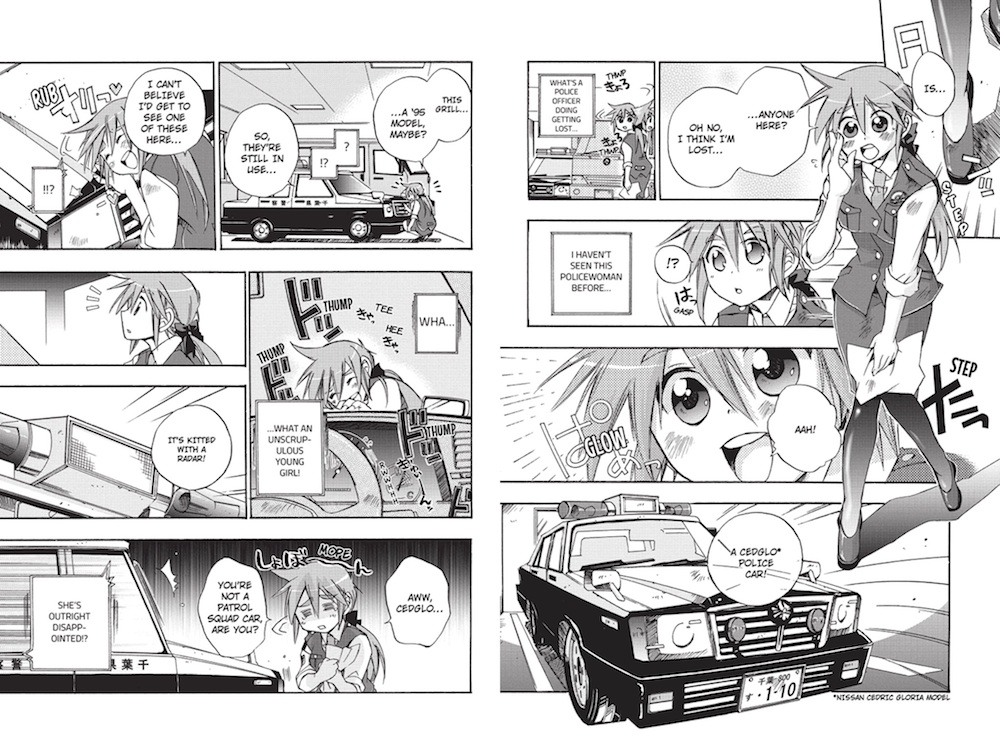
Girl and Car on the Beat is about an old police car with the personality of a worn-out veteran and a rookie female officer who loves its rugged old appearance, and the humor in the series comes from the girl’s ridiculous enthusiasm for mundane aspects of police life juxtaposed with the police car’s “experience.” Though the car can’t “talk” the way K.I.T.T. would in Knight Rider, there’s still a strange and charming interaction between the two, especially because the girl is pretty much the only one left who has any respect for it. Each chapter is short, and at just 12 chapters total Girl and Car on the Beat is a quick read overall. It won’t blow any minds, and it’s not quite as hilarious as Rookie Female Police Officer Kiruko-san, but reading it is a nice way to spend an afternoon or a lunch break, and I think one of the better titles on Manga Box overall.

A Susanna Hopkins Hug Pillow…?!

I can’t say I’m entirely surprised that a Genshken hug pillow would exist some day. Kio Shimoku once drew a fake Ogiue hug pillow, and it’s not even that farfetched for the pillow to be Sue of all characters. When I think about it, though, isn’t Sue pretty much the polar opposite of the typical “hug pillow” character? She’s not just an awkward otaku, she’s an awkward otaku who actively makes others feel awkward, as opposed to some ideally flawed character. Or has the popularity of Tomoko from Watamote changed the dynamic and now this sort of girl is “in?”

I’m honestly curious as to who’s going to end up buying this. I get the feeling it’ll require a very specific and special type of fan.

news_large_genshiken2-suomote news_large_genshiken2-suura

The Fujoshi Files 98: Takaide

Name: Takaide (高出)
Alias:
Mikoten Trio (みこてんトリオ, Manken Three (漫研三人組)
Relationship Status:
Single
Origin:
Fudanshism: Fudanshi Shugi na Seikatsu

Information:
Takaide is a teenage student at Kentei Academy, who along with her closest friends Azumi and Nakajima comprise the Mikoto x Tentel pairing faction of the school’s manga club. This puts her in friendly contention with the Ten x Miko fans. Like her friends, she also pairs manga club president Matsumoto Atsumu with his best friend Kiyokawa Atsumu, in that order. Takaide is friends or at least acquaintances with Matsumoto Setsuna.

Takaide watches Omakase Tentel every week with Azumi and Nakajima in the hopes of seeing Miko x Ten win out over Ten x Miko. In addition to drawing and publishing Miko x Ten doujinshi, Takaide is also into construction tool personification yaoi, an interest she shares with Setsuna.

Fujoshi Level:
On a trip in Osaka, Takaide laments the fact that Miko x Ten is much more popular there, and wishes that she would be able to live there someday.

Shiftylook’s “Wonder Momo” Anime is Straight Out of the 90s

wondermomo-wonderhoop-small

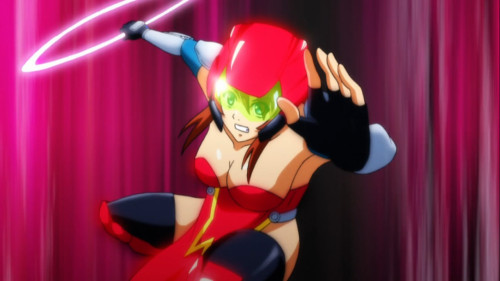
As part of a move to briefly revive some of their old and beloved properties, Bandai Namco commissioned a comic based on the old Wonder Momo franchise, which was subsequently adapted into a short anime. At five episodes total and seven minutes per episode, it’s not much of a time commitment so even though it didn’t impress me at first I decided to just watch through the whole thing.

Here’s my verdict: The show looks fine, the actors (aside from Akihabara idol legend Momoi Halko) are clearly inexperienced. Overall, Wonder Momo is like a 90s OVA adaptation of a 90s anime fanfic. Let me explain that last point.

In the 80s and 90s, anime had a curious reputation in the United States. Aside from the idea that it was mostly porn and gore, the fact that a lot of the anime that came out were more long commercials for existing manga or video games resulted in the notion that anime was big on visuals but short on narrative. Stories didn’t make sense (and I don’t meant that they were boring, I mean they felt like nonsense), series ended at odd moments, and details like “who are these people” were glossed over readily because they expected you the fan to fill in the blanks. The Wonder Momo anime feels very similar in this regard, in that everything is a bit rushed and there’s no real sense of conflict.

The other thing is that a lot of the humor feels like it came straight out of 90s US anime fandom, like someone had taken inspiration from all of those Ranma 1/2 fanfics of the era and said, “Yes! This is what comedy is, you bakas!!!” While  the Wonder Momo anime is done in Japanese and so there’s no Janglish to speak of, it’s kind of surprising that it doesn’t devolve into a flurry of sweatdrops and chibis. I suspect it has to do with its webcomic source material, but I haven’t read enough of it to judge.

In a sense, Wonder Momo answers a long-standing question: what would it look like if the 90s US fandom’s idea of anime got made into an actual anime? In that regard, I find it to be more a proof-of-concept than anything else.

TONIGHT IS THE NIGHT: Free Pay-Per-View Event Featuring Kefka vs. Illidan Stormrage

Lately, I’ve been a fan of Video Game Championship Wrestling. It’s where you watch AI-controlled video game characters duke it out in a WWE game.

Tonight s “End Game 7,” the finale to the latest season of VGCW. I recommend that people turn in, as End Games tend to be the hypest of hype, rarely if ever disappointing. Whether it’s Phoenix Wright fighting his alternate-universe evil doppelganger, Little Mac coming back from the lowest of lows to bury Dracula in a casket match, or Kefka using the power of the Dragon Balls to become a god, there’s always something crrrrazy to look forward to.

Me personally, I’m looking forward to Kefka vs. Illidan, if only because there’s the possibility that Kefka will re-obtain his divine powers to fight Mr. Stormrage Winged Purple Beast to Winged Purple Beast.

You can check it out at the official VGCW channel at 6PM Eastern, 11PM UK, 12PM Central European.

Robotech Fans Wish They Had Yamato 2199

I recently finished Space Battleship Yamato 2199, the outstanding remake of the original Space Battleship Yamato. It’s a series deserving of an elaborate, detailed review to explain all of the thing they did to update the series and why the work, but this isn’t that review. Maybe it’ll come in the future, but what I’d rather talk about is a small revelation I had after I finished the series: Yamato 2199 is basically what Robotech fans wish they got.

The long-standing Robotech fandom is notorious for an obsession with minutiae. Every little detail in the series is scrutinized. Things are renamed to sound more “high-tech.” Every mistake in script and animation in the source anime (Macross, Southern Cross, Mospeada) is either ignored, retconned, or mentally transformed into something which makes technical “sense.” A whole slew of supplementary material exists to explain in a satisfying way to an audience who enjoys harder science fiction some of the sillier moments that come from the original anime.

While Yamato 2199 doesn’t go quite that far, it does accomplish a lot to smooth over some of the narrative and hazy science fictional bumps which littered the original version. Case in point, the ridiculous-sounding device that the crew of the Yamato must travel to Iscandar to pick up to save the Earth, “Cosmo Cleaner-D,” is rechristened the “Cosmo Reverse System,” and is given a technical explanation as to how it’s supposed to work. Moments in the original Yamato which were more for dramatic flair than anything else keep the drama but also add sounder technical elements. Aspects of the show barely touched upon originally receive elaboration in Yamato 2199, and where the old series at times looked like it was still trying to find what it really wanted to do, the new series has the benefit of hindsight to cleanly and efficiently aim for its narrative and thematic goals.

As far as I can tell, what Robotech fans really want is just Robotech as it was back in the 1980s with minor adjustments, and this is what really makes Yamato 2199 the ideal template for Robotech fans. Yamato 2199 is about 90-95% the same as the original in tone and feel, even though it is updated for the modern era to take into account social developments in the past 40 years and the character designs are a little more modernized. It’s this formula which something like The Shadow Chronicles does not appear to achieve, though it also helps to have a substantially higher budget and cleaner animation like Yamato 2199 does, to accomplish its goals.