Pokemon and Color

The depiction of race and culture in Pokemon over its nearly 20-year history has been a work in progress. Much of this has to do with the very Japanese origins of the game and their exportation to the rest of the world. A mostly assumed Japanese cast of characters suddenly wasn’t, like when the character Sakaki was renamed Giovanni to evoke the image of an Italian mob boss. At the same time, Pokemon with seemingly innocuous elements within Japan such as Jynx became a legitimate concern against the increased awareness in the United States of the history of discriminatory visual depictions of black people. Since then, thanks in all likelihood to its international success, Pokemon has taken considerable steps to try and be more culturally sensitive and inclusive, mainly through the depiction of characters with different skin tones and features. In some cases, the characters have more definite racial features, and in others they’re left vague, and the question of whether or not an “ambiguous brown” is for the better becomes an especially difficult question that is nevertheless worth exploring.

124Jynx_OS_animeJynx

The change to include characters who are neither vaguely white or Asian in appearance began with Pokemon Black and White, a series which I would argue not-so-coincidentally takes place in Pokemon universe equivalent of New York City, one of the most ethnically diverse cities in the entire world. Unlike the regions of Kanto, Johto, Hoenn, and Sinnoh (all based on areas of Japan), the Unova region (Isshu in Japan) would not reflect the NYC influence properly if everyone was of the same skin color (what sometimes gets referred to as Friends syndrome).
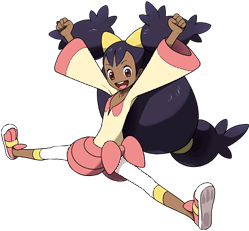
Black_White_IrisBlack_White_MarshalBlack_White_Lenora_2

Iris, Marshal, Lenora

Major characters of color were introduced during these games, such as the Gym Leaders Lenora (Aloe) and Iris, as well as the Elite Four’s Marshal (Renbu), all of whom are bosses one must face before eventually challenging the final opponent, the Pokemon League Champion. All three of these characters are shown to be strong trainers, and Iris even featured prominently in the Pokemon anime. At the same time, all three possess varying degrees of ethnic identifiers. Iris is difficult to pinpoint, Marshal has features which indicate black, and Lenora is undeniably black to a possibly stereotypical fault. Originally wearing an apron in her official design, the proximity of this depiction to the Aunt Jemima-esque mammy stereotypes of the United States (in a game based on a US city!) prompted a revision which portrays Lenora simply slinging the apron over her shoulder (though she still wears it in the in-game sprite). This is far from a Jynx scenario, as Lenora is both a clever gym leader and the curator of her own museum, and her design is still fairly restrained, but it is rather telling that the approach taken with the next generation of games, Pokemon XY, lean closer to Iris’s style.

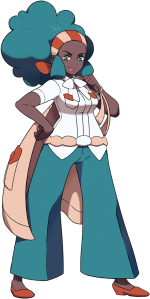
XY_Grant                XY_Olympia

Grant, Olympia

Pokemon XY, which takes place in the France-inspired Kalos region, features not only Gym Leaders Grant (Zakuro) and Olympia (Gojika) but also individual trainers throughout the game such as the male Pokemon Ranger and Rising Star. As is evident from their designs, a greater amount of care is put into them as well. The location of not-France is also perhaps an influence here, as taking into account the centuries-old Arabic influence in Europe, colonialism, and even just recent immigration from other continents creates a complex milieu of cultures that differs in significant ways from that of the United States. The vagueness of these character designs may be a reflection of that aspect.

However, the biggest change is undoubtedly the fact that Pokemon XY actually allows you to choose the skin color (and eventually hair color) for your player character. Now, in addition to choosing gender (a feature available since the second-generation Pokemon Crystal), it is possible to get closer to having your avatar appear the way you do (or don’t, as the case may be). The ethnic vagueness idea comes to the forefront here, as only three skin tones are available, which leads to the question of whether or not this is the right direction to take, if it’s perhaps a washing out of cultural identity.
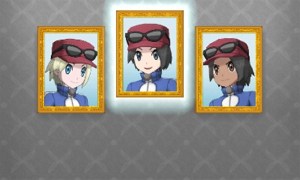
malecharactercustomizationchoices

femalecharactercustomizationchoices

I’m of two minds about this. With some characters such as the Gym Leader Marlon (Shizui), it’s actually difficult to tell if he’s supposed to be a darker skin color or just someone with a nice tan. The lack of concrete information, as well as the fact that many of the characters have very Japanese-sounding names in Japanese regardless of appearance, makes it easy to accuse them of just taking “white/Asian” designs and swapping the hues. On the other hand, it’s erroneous to assume that certain features are meant to evoke one race rather than another. After all, it’s a classic mistake to assume that anime characters “look white” because of their large eyes. When the racial features are relatively nondescript, perhaps it gives them a versatility that prevents those features from being abused as stereotyped caricature. That’s not to say that future games couldn’t benefit from adding more skin tones, for example, but there’s something to be said about allowing players to make their own interpretations.

Whether or not the racial ambiguity of character designs in Pokemon helps or hinders (or both), one positive that is hard to deny is the benefit of just having so many depictions of characters of color being happy and successful. They talk to dragons, climb mountains, run museums, practice martial arts, and go on adventures. They’re intelligent, dedicated, compassionate, funny, people you can look up to and want to know better. They’re role models with limitless potential. It’s especially notable that, in the follow-up games of Pokemon Black 2 and White 2, Iris would go from being a Gym Leader to being the Pokemon League Champion herself. The Pokemon games have always done a good job of portraying female characters, with three of the most recent games featuring female Champions, and to have a woman of color be the strongest and most celebrated individual in the land is nothing to scoff at.

Black_2_White_2_Iris

In the end, what I see as the greatest contributing  factor in the depiction of diversity in Pokemon is that the series has not gotten complacent. With every passing generation of games they continue to make improvements, and it’s a likely sign that this will continue as long as Pokemon stays alive.

The Fujoshi Files 97: Nakajima

Name: Azumi (あずみ)
Alias:
Nakajii (なかじー), Mikoten Trio (みこてんトリオ, Manken Three (漫研三人組)
Relationship Status:
Dating
Origin:
Fudanshism: Fudanshi Shugi na Seikatsu

Information:
Nakajima is a teenage student at Kentei Academy, and of the three primary members of the Miko x Ten faction of her manga club, or the group which supports the pairing of Omakase Tentel mascot characters Mikoto x Tentel, the opposite of Ten x Miko. Liker her best friends Azumi and Takaide, she also pairs the manga club president Matsumoto Atsumu with his best friend Kiyokawa Atsumu, in that order. Nakajima is also friends with amateur voice actor Ookubo, who eventually becomes her boyfriend.

Along with Azumi and Takaide, Nakajima watches Omakase Tentel every week to see if Miko x Ten will prevail over Ten x Miko. She also draws and publishes Miko x Ten doujinshi with her two friends.

Fujoshi Level:
Nakajima’s devotion to Miko x Ten is about the clearest indicator of how rotten she is.

Half Court Press: Genshiken II, Chapter 99

After being absent for many chapters, Yoshitake Risa makes her return. Having given up a potentially successful career in basketball to take the entrance exam for Shiiou University, she and her older sister Rika have a heart to heart talk the night before, which quickly turns extremely otaku. At the same time, Yajima, Hato, and Sue have their own conversation about the younger Yoshitake, based around the fact that part of her inspiration for trying to get into their university is Hato and his crossdressing. Despite waking up late, a freak snowstorm delays the test, and Risa manages to make it there on time and pass the test.

The title of this chapter, “Little Sister Entrance Exam II,” is a reference to when Sasahara’s sister Keiko tried to get into Shiiou University herself. She failed, though Risa appears to be a good deal sharper academically, which changes the result.

This month’s Genshiken, despite having a clear general focus on Risa and her test, is still surprisingly complex to the extent that I’m not sure if I can cover everything, though to be honest I rarely every do despite my attempts. There are three areas which I think are especially interesting, though, so I’ll focus on those. The first would be Risa’s relationship with Hato, or more specifically her image of him. An unabashed shotacon, Hato’s naked body is what made Risa realize that her interests could be fulfilled in the adult world. However, the fact that she sees Hato as a kind of real life version of her ideal male fantasy (she asks him to wear legs-exposing short pants if she passes, which over the course of the chapter degenerates into some kind of reverse-gender take on zettai ryouiki), clashes in an intriguing way with the developments we’ve seen Hato go through all this time. He’s gone through a period where he refused to wear women’s clothing, and then come back around as he’s accepted his own feelings for Madarame, and here Risa is projecting her own interests onto him. What was already a complicated situation continues to grow, and that’s not even mentioning Risa’s own gender-bending actions.

The second area would be the start of Hato’s “harem.” Recently, the focus of Genshiken has been the number of people interested in Madarame, which the series has been using to explore the idea of the harem manga by way of the otaku sensibilities of the Genshiken characters. In this chapter, we not only see once again that Yajima has feelings for Hato, but that there might also be something with Sue, and Risa expresses her own interests in Hato (even if they’re mixed up with her otaku fantasies). Then there’s also Konno the googly-eyed goddess, who doesn’t appear in this chapter. Suddenly the series isn’t about one man’s “harem” (even though the term is kind of bad for describing when two or more people like you), but two intersecting ones. Granted, Yajima’s fear of Sue seems fairly unfounded, and I think it’s meant to show more her concern over potentially being outclassed, as well as her realization that it’s getting harder for her to deny her own feelings for Hato when she references her and Risa as “rivals.” I also find it notable that Risa is the only one to state some sort of interest in Hato to him, instead of only confessing to friends.

The third area is of course the subject of the entrance exam itself. Rika’s advice to her little sister is this mix of big sister attitude and fellow understanding as an otaku. In particular, Risa struggles with whether it was okay to walk away from basketball on a whim, to which Rika essentially responds that being an otaku means living by your passions even if it means making seeming unreasonable choices. The idea is that otaku aren’t as able to stifle their interests in the hopes of integrating with the rest of the world, and Risa already has done a relatively bang-up job what with her successful high school life. Something about this really strikes a chord with me, probably because I know others who’d probably give the same advice, and it’s something I’d encourage as well. On the other hand, this advice can also be abused such that one might refuse to better oneself, but that’s the kind of risk that exists with this sort of philosophy.

One last note: Sue’s snow shenanigans at Madarame’s place make me think of her as a kindred spirit to Calvin from Calvin & Hobbes. Now that’s some crossover fanart I’d be interested in.

What do Takumi from Initial D and Izumida from Yowamushi Pedal have in common?

They both have HUMAN ABS.

The Best Reference in Gundam Build Fighters

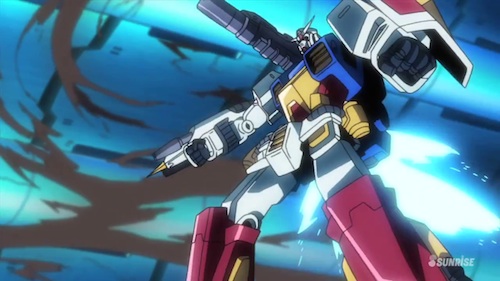
Gundam Build Fighters is a fun series about people using Gundam model kits to fight each other, and it’s absolutely oozing with references to both popular and obscure parts of the Gundam franchise. In the last episode, the anime pulls out what I think is the best reference of all, especially given the concept of the show.

In the final battle against the (scale-model) space fortress A Baoa Qu, the characters work together to take down a common threat. Among these characters is the father of the protagonist Iori Sei. Having won the silver medal at a previous tournament using a model of the original Gundam, in this scene Sei’s father Takeshi brings out the Perfect Gundam.

Though it did get a Master Grade model kit a number of years ago, the Perfect Gundam is not the most well-known Mobile Suit in the franchise. Its relative lack of popularity, however, is less important than its actual origin. The Perfect Gundam is featured as the hero’s Gundam in the 1982 manga Plamo Kyoushirou, which is premised around kids using Gundam models to fight each other in virtual reality environments. In other words, the appearance of the Perfect Gundam is actually an homage to the spiritual predecessor of the Gundam Build Fighters concept, reinforced by the fact that it’s the father of the hero who is using it.

Amazing.

VGCW is a Slice of Fandoms

In the second episode of the Video Game Championship Wrestling series spinoff, “Extreme Dudebro Wrestling,” Lucina from Fire Emblem: Awakening made her way to the ring. Just as VGCW makes the chat itself part of the viewing experience, so too does EDBW, and Lucina’s arrival brought with it some powerful (text) chants.

“LET’S GO CINA!”

“CINA SUCKS!”

Anyone who’s familiar with the WWE over the past decade is likely familiar with the origin of these dueling chants. Loved by kids, reviled by adult fans who grew up with The Rock and “Stone Cold” Steve Austin, John Cena’s popularity splits the audience in two whenever he wrestles. Naturally, VGCW fans did not pass up an opportunity for some wordplay.

Of course, this is to be expected, right? It’s a constructed wrestling universe based on popular video game and occasional anime characters, so this type of crossover should lead to cross-demographic jokes. And yet, when I watch and participate in any of the VGCW chats, I feel like I’m being exposed to a group which I normally don’t interact with otherwise. Somehow, even though I’m friends with anime fans, gamers, and smarks, I’ve never found myself in the middle of their convergence as much as I do in VGCW. That’s what makes all the Table-san jokes work, where the announcer’s table is jokingly viewed as a shy and meek anime girl whose day always get ruined when Wrestler A decides to powerbomb/suplex/elbow drop Wrestler B on top of her.

The connection between anime fandom and wrestling is a lot stronger in Japan, where you had series like Kinnikuman which continue to get referenced even today, as well as real life wrestlers based on anime like Jushin Liger and Tiger Mask. It’s sort of like if Zeus from No Holds Barred turned out to be one of the best, most beloved wrestlers ever when he made his WWF appearance.

As for Lucina, she fell behind the entire match, barely missing out on being pinned for the 3-count over and over. Then, as if the entire match was simply an opportunity for her to mount a comeback, she landed a DDT and a devastating finisher and won the match. The chat exploded, realizing that Lucina was even closer to John Cena than expected.

As they say, Hustle, Royalty, Respect.

The Fujoshi Files 96: Azumi

Name: Azumi (あずみ)
Alias:
Azumin (あずみん), Mikoten Trio (みこてんトリオ, Manken Three (漫研三人組)
Relationship Status:
Single
Origin:
Fudanshism: Fudanshi Shugi na Seikatsu

Information:
Azumi is a teenager attending Kentei Academy and a member of the school’s manga club. She is the de facto leader of the Miko x Ten faction in the club, or the group which prefers the pairing of Omakase Tentel mascot characters Mikoto x Tentel, the opposite of Ten x Miko. Similarly, she pairs the manga club president Matsumoto Atsumu with his best friend Kiyokawa Atsumu in specifically that order, the opposite of fellow fujoshi Konishi Nozomi.

Azumi and her best friends Nakajima and Takaide typically gather every week to watch the newest episode of Omakase Tentel, looking for Miko x Ten moments that they can use, as well as watching to see if Miko x Ten prevails over Ten x Miko that episode. Azumi also draws.

Fujoshi Level:
Little is known about Azumi’s fujocity, other than that she actively pursues Miko x Ten along with her friends.

NadeNadeShikoShiko and Beauty

I’ve been trying out Manga Box lately, an official manga app for some more obcure titles. One of the titles I keep up with is NadeNadeShikoShiko, a bizarre 4-koma gag manga about a boy and the time-displaced cavegirl who loves him. It’s not the funniest thing in the world but it consistently gets a chuckle or two out of me.

The latest joke to get a laugh out of me involves one of the teachers. In the story, the boy attends a school with a “yamato nadeshiko” major where girls learn how to be traditional Japanese beauties. Part of the yamato nadeshiko thing is to contrast the cavegirl’s attitude, while another is to have kimono as school uniforms (which reminds me of Taisho Baseball Girls and its depiction of the transition between kimono and sailor uniforms). However, when we see the head teacher for the yamato nadeshiko department it turns out that she indeed embodies a more “classical” idea of Japanese beauty.

The joke of course is that she looks like stepped straight ouf an ukiyo-e print, and how this contrasts so utterly with the typical manga bishoujo style used for the rest of the characters. More than just being funny though, it really got me thinking about illustrated perceptions of beauty because neither the manga style as we know it nor this classical style of depicting women are “realistic” in the most common sense. They both make specific decisions on how features should ideally look (small eyes vs. big eyes), and while there are some overlapping points namely in the valuing of pure tones for skin, their differences really bring out the way culture plays into what we see as beautiful and how this builds upon itself.

Honestly, I can’t quite comprehend how that’s supposed to be beautiful. In realizing this, however, I realize I’ve been somewhat hypocritical when I question how younger or newer anime fans have trouble watching older shows. After all, if I can’t quite appreciate this older conception of beauty, am I all that different?

Saki Individuals Tournament Dream Match-Ups

Over yonder, beyond the horizon, is the Saki individuals tournament arc. It’s been referred to frequently throughout the series, and though at this point the manga is a long, long way from reaching it, it does give me the joy of speculating who might face whom as they go through the brackets (or round robin system, not sure which they’re using). One I’ve already mentioned before is Amae Koromo vs. Oohoshi Awai because of how their strengths lie at opposite ends of the game, but there are plenty of others.

Minor manga spoilers, by the way. Remember though, these are not actual matches but just ones (in no particular order) that I’d like to see.

1) Kataoka “Tacos” Yuuki vs. Usuzumi “Hell’s Gate” Hatsumi

I think this one is pretty obvious. Imagine Yuuki as dealer in the East round (meaning she’s double East) versus Hatsumi in the North position. To whom do the East tiles go?

2) Oohoshi “Double Riichi” Awai vs. Anetai “Undertaker” Toyone

Awai’s insane Double Riichi vs. Toyone’s Pursuit Riichi. Who overpowers who?

3) Matano “Fisherman” Seiko vs. Inoue “Strategic Pon” Jun

Both have a tendency to call for tiles but for very different reasons (winning vs. control). Seeing them in the same match would likely make for a very aggressive game.

4) Funakubo “Osaka Data Girl” Hiroko vs. Sawamura “Nagano Data Girl” Tomoki

Two characters who specialize in gathering information on their opponents. Who is the better strategist?

5) Aislinn “New Zealander” Wishart vs. Hao “Chinese-Style” Huiyu

Aislinn is capable of envisioning the perfect scenario in her mind and having it play out to her advantage. Mako ruined her day by disrupting the discard patterns that Aislinn had set out, but then Huiyu tends to prefer closed, quiet hands. At the same time, Huiyu’s Chinese-influenced play style is highly unorthodox and could disrupt Aislinn possibly without any effort on Huiyu’s part.

Samurai? Flamenco?

If you’ve watched all of Samurai Flamenco you’ll know that even though the show has humble beginnings and then progressively gets into increasingly more outlandish territory. It’s the kind of thing that you try to keep your mouth shut about so as not to spoil the uninitiated (by the way, SPOILER WARNING), partially because it’s obvious how intentional the whole thing has been.

The main character Masayoshi goes from tryng to be like a Kamen Rider-type to actually being a Kamen Rider-type, to being the leader of a Super Sentai team (with giant robot) and eventually even an Ultraman-style giant (and that’s not even mentioning the final genre shif at the end). The changes are so abrupt and swing so heavily from one thing to the next that I can only interpret the show as poking fun at the mid-season corporate meddling that can happen to a tokusatsu series and yet genuinely embrace it as a part of tokusatsu history.

I have to wonder, did Samurai Flamenco hint at this from the start? Perhaps Samumenco was always projecting an aura of neverending incongruities. Just think about the name “Samurai Flamenco.” What gimmicks or powers would a guy with a codename like that have? He’d maybe have some rhythm or dancing abilities (like Cure Lovely in Happiness Charge Precure) and probably a costume based more on a Japanese suit of armor. Real tokusatsu series do similar things, like how Ressha Sentai ToQger currently features trains, and even the fake in-universe shows of Samurai Flamenco like Red Axe features… a guy with an axe. Samurai Flamenco, however, is neither Samurai nor Flamenco, and when he finally gets a set of effective weapons his gimmick of all things turns out to be “weaponized office supplies.” In that respect suddenly getting a giant robot that’s a mix of Combattler V and Dancougar isn’t so odd.

Perhaps Samurai Flamenco was always about the hodgepodge, the elements that don’t quite fit together so you have to smash them all in and enjoy what comes out. After all, it does start with a guy dressed like a superhero getting beat up by kids, who then forms a friendship with a cop where they sit around and watch children’s television.