Robotech, Voltron, Nostalgia

When the Robotech/Voltron crossover comic was announced a few months ago, my immediate response was, “Why?” Of course the answer is “nostalgia grab,” but there’s something strange about both of these works and their continued presence in the geek public eye (and perhaps even beyond that). Unlike Transformers which not only has a huge variety of toys both old and new, as well as a long history of cartoons both from America and Japan (not to mention the live action films), both Robotech and Voltron do not really renew themselves, aside from the occasional thing like the The Shadow Chronicles or The Third Dimension.

Though this speaks more about the people I associate with, I can’t say I’ve ever talked to anyone, online or offline, who is hardcore into either Robotech or Voltron. I know that there’s a Robotech community of course (they even have an official site for it), though I have little interest in it. With Voltron, I know people who have fond memories of it, myself included, but the foundation that Voltron has in geek culture seems not only deeper than Robotech‘s but to the extent that, when you say cool giant robot with a signature finisher, Lion Voltron is just the default, or it shares that spot with the Megazord from Power Rangers. It’s like Voltron as a source of nostalgia goes so far beyond itself that the vague perception of it exceeds the influence of the actual anime. 

What’s funny about a show like Voltron and its emblematic presence in US geek culture as de facto super robot is that the process of dubbing and adaptation that turned the anime King of Beasts Golion and Armored Fleet Dairugger into Voltron: Defender of the Universe happened with different anime in different countries to similar effect. In the Philippines, Voltes V exploded with popularity. In France and Italy, UFO Robo Grendizer captured attention as Goldorak and Goldrake respectively (with success in the Middle East to boot). In Brazil, Gloizer X became O Pirata do Espaço, the country’s first real exposure to giant robots. While it’s possible say that this was all a matter of timing and that they’re all interchangeable in that respect, I do think that the specific properties of each show had a major impact on how each country perceived giant robots from that point forward (I’m less sure about Gloizer X so if any Brazilians want to help, feel free to leave a comment).

One thing that I do believe plays a role in how these series become more specific in their nostalgic output is the level of support the original works have in Japan. I visited France recently, and when I went into the comic stores I would regularly see displays of Grendizer merchandise. Whether it was the Super Robot Chogokin or the Soul of Chogokin or a chibi version, it was all straight from Japan, sitting prominently in the store. Grendizer has enough cultural presence in Japan that it can continue to get these toys and even a fairly stable presence in Super Robot Wars, whereas Golion has had to content itself with just one Nintendo DS appearance. In lieu of support from Japan, Voltron‘s had to carve its own place, and often times it’s not even from the company World Events which holds the Voltron license but from fans conjuring it up in their own minds. And while Robotech is an utter legal mess due to the way it stifles the presence of Macross in the US, if you put that aside part of Robotech‘s prolonged presence comes from the fact that its fans want new Robotech to constantly feel like old Robotech, whereas Macross changes according to the whims of its dark lord Kawamori Shouji.

Actually I wouldn’t mind at all if Voltron got a revival with a solid piece of fiction to support it which doesn’t rely too much on nostalgia. I know we got Voltron Force, but the less said about that the better.

Visual Timing: Three Great Things About Kill la Kill

Kill la Kill, the new anime from the creators of Gurren-Lagann and Inferno Cop, is pretty much living up to the huge amount of hype surrounding it. For me, there are a few areas pertaining to the visual element of the show which really stand out.

1) Kill la Kill excels at creative sight gags.

When it comes to works that are humorously absurd, often times we say they succeed despite themselves because the humor is because it takes itself seriously and doesn’t realize its own power. In contrast, we then say other works fail to capture this glory because they tried too hard. I find Kill la Kill generally hits that sweet spot where the humor is clearly intentional, but doesn’t go overboard in extending its jokes, so it’s even more possible to appreciate its cleverness.

Two scenes from episode 3 stick out in this respect. The first happens at the beginning of the fight between Ryuko and Satsuki, when their combined willpower literally blows away the surrounding bystanders. It’s a pretty typical sight in anime which wants to establish the sheer power of its primary characters. Then, in the next shot, Kill la Kill extends that sequence to the point of absurdity by having the bystanders’ bodies continuously flying through the air. The shot lasts for about 5 seconds, and during that time it’s easy to wonder if there are more bodies being blasted away than were actually standing there moments before.

The second is after the battle, when Satsuki says to Ryuko that in order to fight her she’ll have to go through her goons, her goons’ goons, and her goons’ goons’ goons. Kill la Kill sets the image up in a somewhat abstract fashion, much like one of those old dramatic Dezaki Osamu painted stills (which I just found out recently is called a “harmony” shot thanks to Anipages). Then, as the show switches to a bird’s eye point of view, you realize that Satsuki and all of her minions are actually standing there like they’re posing for a group photo.

These sight gags stretch their conventions just far enough to pull you out a bit, but neither of them overstay their welcome. Both of them use the screen to create strong images, which brings me to my next point.

2) Kill la Kill has strong image composition.

The series uses a lot of the extreme poses key to a Kanada Yoshinori-style animation, but even in still shots and pans Kill la Kill exhibits a lot of intelligence and creativity which both enhances the mood of the show while also encouraging an appreciation in the animation (or lack thereof).

This shot of Ryuko and the tennis club captain from episode 2 literally consists off two figures sliding and changing size against a background. There’s little to no animation, and yet the moment helps to create tension because the initial image of the two standing away from each other on the tennis court gradually turns into a face-to-face confrontation with the net acting as a visual separator between the two. I find it really impressive because it was able to do so much with so little, and it’s a trend you’ll see throughout each episode.

In the same episode, Ryuko confronts Satsuki. Satsuki begins to swing her sword and she grows to massive proportions on-screen to convey the idea that she’s a massive threat and that she’s much more powerful than she looks. Obviously from the context of the show she’s not actually getting bigger, and this sort of visual representation reminds me of two things.

First, is an American football manga mentioned in Fred Schodt’s Manga! Manga!, where a tiny Japanese player blasts through a massive American roughly five times his size. Second, is Fist of the North Star, and I don’t just mean the giant mohawk thugs. That series often exaggerates the size of Kenshiro’s foes yet shows them to be relatively even in size moments later, just to transmit danger.

3) Kill la Kill makes a lot of anime references but doesn’t overdo it.

This point relates heavily to the first.

Kill la Kill makes numerous references to old anime each episode, but doesn’t depend on them for success. In episode 1 Mako can be seen performing a Kinniku Buster from Kinnikuman on her little brother, but it’s never referred to by name, and there isn’t any sort of big fancy scene where she jumps from the air and lands with an impact. They save those moments for the actual fights.

A lot of the anime and manga references involve Mako, which makes me think that this is part of her purpose as a character. In episode 3, she goes to “shield” Ryuko but more to give a strange speech about how Ryuko should get naked. During that lively sequence this shows up:

That’s right, Kill la Killi threw in a Space Runaway Ideon reference (see 14 seconds into the video). Evangelion is known to be inspired in part by Ideon, and to have ex-Gainax employees bringing it out doesn’t surprise me too much. Again, the reference doesn’t linger too long, is more about the ridiculousness of Mako as a character, and is actually a little easy to miss.

There’s also the recurring use of stars blinking in and out in Kill la Kill. It reminds me of the opening to Evangelion, right before the title logo appears, and I really suspect that it’s intentional.

Actually, I think Mako herself is an anime reference, as her hairstyle and position as the main character’s best friend immediately reminded me of the character Maki from Aim for the Ace! Ryuko’s messier hair even somewhat resembles Aim for the Ace! heroine Hiromi’s style relative to Maki’s. That Mako’s first name is written in Katakana like Maki in the Aim for the Ace! anime, that she is a tennis club member, and that her membership sets up the conflict in episode 2 all point towards this being likely.

In each case the references aid the show but do not dominate it. If someone fails to get certain references (and given the amount it’s going to happen to pretty much everyone, including me) then it doesn’t unravel the humor or make the series any less visually strong. If a reference does get through, it is capable of becoming not only a matter of spotting the homage but also considering how Kill la Kill relates to that older work. For instance, there’s this interesting relationship between Kill la KillGurren-LagannAim for the Top! Gunbuster, and Aim for the Ace! that I’d like to unravel in terms of how these shows approach similar ideas.

I also have other thoughts about the narrative and thematic elements of the show, but I’ll save those for another time. If you want to check out Kill la Kill though, it’s being simulcast from a variety of sites: Crunchyroll, Hulu, and for international audiences, Daisuki.

The Fujoshi Files 83: Ishioka Yuri

Name: Isihioka, Yuri (石岡ゆり)
Alias:
N/A
Relationship Status:
Dating
Origin:
Fujoshissu!

Information:
Ishioka Yuri is a college-aged woman who moved to the prefecture of Yamagata in the Tohoku region of Japan when she was little. While growing up, she spent years exchanging letters with her friend and long-time crush Roppongi Takefumi. A shy and clumsy girl since childhood, Yuri was able to begin a relationship with Takefumi upon moving back to her old hometown.

In Yamagata, Yuri was able to make a few friends, notably her neighbor Kana and eventually in high school her classmate Mihara Touko. As a fujoshi, Touko began introducing Yuri to various classic BL stories, which Yuri enjoyed without quite knowing what they were. Yuri is also a skilled pianist, having performed in recitals as a child.

Fujoshi Level:
It is unclear as to whether or not Yuri is fully a fujoshi, but the fact that she displays a Dear Girl ~Stories~ Hibiki cell phone strap is possible evidence as such. In addition, her friend Touko seemed intent to slowly mold Yuri into a fujoshi during their high school years, and the fact that Yuri was so moved by those BL stories indicates that the potential is definitely there.

Non-Seduction of the Innocent

I’ve come to notice that there are few female characters in anime with seductive personalities.

There are characters who are physically good-looking, characters who are proud of their appearance, characters who are in love, and characters who try to get closer to the person they’re interested in. Rarer is the type of female character whose mannerisms ooze fiery passion in such a way that their sexuality is more than simply their physical design.

Here’s a character who I think qualifies: Fuwa Aika from Blast of Tempest.  Good-looking but not to an incredible degree, you can sense in her interactions with her boyfriend Yoshino not only the way she focuses all of her charm on him, but also the strong physical and emotional response that Yoshino has to Aika’s desire. It’s difficult to capture this impression in a single image.

Another lesser example comes from a few years ago in Macross Frontier. The character of Sheryl Nome is more sexy than seductive normally, but in one scene both she and Ranka Lee are trying to out-sing each other in order to demonstrate their interest in the protagonist Alto and why he should choose one over the other. In that moment, both Sheryl and Ranka exude strong desires which fill the space they’re in.

In thinking about this, I’m reminded of an old post on Heisei Democracy, in which Shingo states that lips aren’t moe. The argument is that lipstick denotes an assertive un-moe character, while lips in general are a sign of active sexuality which is counter to moe’s ostensible image of innocence. I don’t quite agree with that premise, and my discussion of characters isn’t limited to just those who would be considered “moe,” but I do feel like there’s something relevant in Shingo’s argument. There’s this rough idea that moe characters, even when they are attractive or overtly sexualized, at most tend towards conflicted expressions of desire (e.g. tsundere) or displays of innocence even in less “innocent” moments. If you then move the idea to being about the difference between sexual/seductive, maybe it’s not so unusual for seductive characters to be a rarity.

Looking at the Choice of Pokemon in “Pokemon Origins”

If ever there was a “nostalgia anime,” Pokemon Origins is it. An intentional recreation of the first Pokemon games, it limits its world to 151 Pokemon instead of the steadily climbing total count of later generations. There’s a lot to look at in terms of how it portrays a simpler time for the Pokemon franchise, but one thing I wanted to focus on is the main character Red’s team when he fights Blue for the championship, because it’s actually extremely deliberate and meant to reflect the experience of going through those first games, as well as the diversity of choices available to you along the way.

From left to right:

Scyther was a Pokemon exclusive to Pokemon Red and represents one half of the version exclusivity which helped to define the games and the necessity of trading to get all of the Pokemon. Being that the main character is named Red, the implication is that he caught this one in the wild.

Persian represents the other half of version exclusivity, being only in Pokemon Blue (or Green for the Japanese). This implies that Red at some point traded for it or its pre-evolution Meowth.

Lapras, unlike most of the Pokemon which are caught, evolved, or traded (or in the case of Porygon purchased), is a gift. In the games you receive it from an employee in the Silph Co. headquarters, so Lapras represents the “Pokemon by plot event,” and shows how he went through Silph Co. dismantling Team Rocket along the way.

Jolteon evolves from Eevee, a Pokemon which like Lapras you receive as a gift. Unlike Lapras, however, it also represents the act of the permanent choice: in the first games you were supposed to only get one Eevee (barring any creative glitches), and the choice of whether to evolve it into a Jolteon, Flareon, or Vaporeon was permanent, so the choice of Jolteon is meant to make you think, “Ah, so Red went with this one.”

Charizard is of course the Starter Pokemon, the first choice a player has to make in the game. Once again Red is Red, so the choice for which starter he’d go with is pretty obvious.

That leaves Dodrio. Its pre-evolution Doduo is available in both versions, is caught in the conventional manner, and also evolves in a normal fashion. However, the fact that Dodrio is common is what makes it special within the context of this team.

If you look at the rest of the battles in Pokemon Origins, you’ll find that the choice of Pokemon reflects this idea that the anime should give a sense of the progress Red has made. For instance, both Hitmonlee and Kabutops appear as Red’s Pokemon, and both are Pokemon whom you have to choose over others in the game (Hitmonchan and Omastar). Snorlax is a Pokemon you have to encounter because of the way it blocks certain routes, and a sign that the Poke Flute was used. Using the Legendary Birds against Mewtwo also shows how Red intended to go against it at full strength. Perhaps the most interesting decision of all, however, was having Pikachu appear only towards the end, to acknowledge its value to the franchise but to prevent it from overshadowing everything else or associating it too closely with the other anime.

Why I Like Eren Jaeger

In Episode 117 of the Anime World Order podcast, Daryl Surat, Gerald Rathkolb, and Tim Eldred briefly discussed the idea that, in order to modernize a classic, the creators of Space Battleship Yamato 2199 gave its protagonist Kodai Susumu a less gung-ho personality to match the current male audience for anime. Daryl pointed out that such heroes were the exception these days, and gave Eren Jaeger from Attack on Titan as an example of someone cut from an older cloth in terms of shounen main character tropes. I agree with the overall statement, but I also find that Eren works especially well as a protagonist in this current age because of the perspective it provides for his actions and personality.

The character of Eren Jaeger is essentially a boy who has dedicated himself to a singular goal in life, to wipe out the enemy Titans that destroyed his village and killed his mother. Characters in the series point out his immense drive and the willingness to work hard to accomplish his desires, and in this sense he exhibits the same qualities as many of the most famous shounen heroes. However, unlike Naruto whose overwhelming personality and “act before you think” approach is generally seen as a positive and the source of his series’ fundamental themes (heart is what’s important for instance), Eren Jaeger’s similar mindset is shown to have not only strengths but also critical limitations.

I see Eren as the kind of guy who makes people better than him feel worse for not accomplishing as much. Aside from his transformation, Eren is shown as not being particularly exceptional when it comes to fighting Titans, but he’s more willing to just go and do it, and not let his fears get the better of him. This is mainly what drives his relationship with Jean, as Jean is clearly smarter, wiser, and comparable in physical ability to Eren, but lacks his ability to throw himself into danger. On the other hand, Eren’s narrow-mindedness is the reason he can’t accomplish everything on his own, and that if he were a leader of men, for instance, he would probably send them all to their deaths just by being himself, as opposed to Naruto who’s supposed to become a leader with pretty much the same personality.

This is what drives the dynamic interaction between Eren, Armin, and Mikasa. Eren’s lack of forethought is tempered by Armin’s strategic insight and willingness to sit back and observe, but Eren’s fearlessness also helps keep Armin from overthinking things or succumbing to self-doubt. Similarly, although Mikasa lacks the vast dreams of Eren and Armin in terms of wanting more out of the world, her cool head and decisiveness help to keep both of them moving forward.

The fact that Eren has trouble transforming into his Titan form in one instance basically comes down to the fact that Eren has vision and drive but lacks perspective. When the Titans were simply an absolute enemy, someone who cannot be compromised with and who must be destroyed no matter the cost, it was easy for Eren to obtain the level of focus needed to become his Titan form, but when it turns out that his enemy is actually someone he considered an ally and a fellow human being, he cannot process this idea due to that same rigidity. It is ultimately his friends, who each see the world from a different place, who help him resolve this issue, and even that comes at the price of Eren having to throw away the basic love he has for humanity.

Critical Mass: Gatchaman Crowds

What is the best way to describe Gatchaman Crowds? Though I don’t think it’s valid to say that Gatchaman Crowds is Gatchaman “in name only”, it’s certainly nothing like the original. Whereas Science Ninja Team Gatchaman was Super Sentai before Super Sentai was a thing, a team of costumed warriors dispensing martial arts beatdowns and bird missiles, Gatchaman Crowds is far more conceptually driven series that brings up and explores a variety of ideas pertaining to heroism, human motivation, living within an interactive and digitally connected world, and the advantages and limitations of large and small-scale group efforts.

Gatchaman Crowds follows a team of warriors who have the ability to transform with slick armor and powerful abilities. Their newest member is main character Ichinose Hajime, a relentlessly hyper and comfortably honest girl whose sheer energy is simultaneously both exhausting and invigorating. Assigned to fight an alien menace, their efforts as heroes are contrasted by another character, Ninomiya Rui, whose social networking service GALAX brings people together to collectively solve problems, Rui’s ultimate goal being a world where people realize the inherent value in helping others. Two shades of optimism interact with each other, sometimes cooperating and sometimes conflicting.

Crowds was my favorite anime of the summer for a number of reasons. Its presentation is extremely slick, with character designs reminiscent of Kyousogiga and Heartcatch Precure!, and 3DCG work on the Gatchaman outfits that really brings out the individuality of each character. It doesn’t just present a wide variety of ideas pertaining to large-population interactions and moralism, but actively explores them from a variety of angles. Its characters are streamlined extensively, but in a way which supports the overall sense of an exchange of ideas.

In terms of the show’s ability to encourage an evaluation of how we perceive problems, there are two aspects of Gatchaman Crowds which impress me in particular. The first is that it says there’s a difference between criticism and cynicism. Often when a text or a work of fiction presents a “QUESTION EVERYTHING” attitude, there’s a sense that it wants you to feel as if the world is in a neverending death spiral and that trust is a fantasy. As Hajime demonstrates numerous times throughout the series, however, just because you’re optimistic doesn’t mean you’re unable to see a situation from a variety of perspectives, or unable to make informed decisions. The second is that Gatchaman Crowds actually makes an effort to show how there are problems in the world that are best solved without violence, without resorting to an overblown or shallow “killing is wrong” message, or that it’s just a matter of trust.

When the Gatchaman are fighting the MESS early on in the series, strange alien creatures resembling alien rubik’s cubes who take over inanimate objects, it’s Hajime’s ability to think outside the box which allows her to try and communicate with the MESS instead of constantly fighting it out like the rest of the team. However, with the other alien presence Berg Katze (loosely based on the antagonist from the original Science Ninja Team Gatchaman), Hajime realizes that Katze is different and dangerous. At the same time, Berg Katze is someone who can’t be defeated through force because of the way it turns the characters’ own fears against them, and so a different and more creative solution is needed.

Speaking of Berg Katze, I find Katze to be a powerful antagonist because of the way its most diabolical skill is attacking people psychologically, whether that’s creating chaos through deception, or by openly mocking a person’s efforts in the most grating way possible in order to compromise their self perception.

As for the role of heroes in a digital world, Gatchaman Crowds reminds me somewhat of Tiger and Bunny, but whereas that series explores the image of heroes with respect to mass media, Gatchaman Crowds explores it with respect to “media of the masses.” In particular, it looks at the concept of gamification, an idea that’s been gaining traction lately, which posits that much can be accomplished if you turn tasks and activities into “games” complete with points and high scores and such, from regular exercise to organizing files for your company. One of the key drawbacks of the concept of gamification is that it appears to imply that people are less capable of accomplishing something if there isn’t a carrot dangling in front, and Gatchaman Crowds asks the viewer to look at this from both sides. Rui’s desire to “update” the world hinges on an almost socialist view of the modern masses in which proletariat and capitalist are able to work together.

Overall, if you really want an anime that encourages you to think, then check out Gatchaman Crowds. It’s thoughtful without getting bogged down by the weight of its ideas, and even if you don’t agree with its conclusions, I think it’s still worth ruminating over what it has to say. You can watch the show for free on Crunchyroll.

The Fujoshi Files 82: Himenogi Rin

Name: Himenogi, Rin (姫乃木凜)
Alias: Rinrin (リンリン ), Hime Ringo (姫リンゴ)
Relationship Status: Single
Origin: Princess Ringo’s Adventures in “Wota” Land

Information:
Himenogi Rin is a fashionable office lady who seeks the reputation of “Princess of OLs” among her co-workers, though unbeknownst to them she is also a hardcore fujoshi. This changes when one of her new co-workers turns out to be Yamada Moe, an old acquaintance and fellow fujoshi who tries to push Rin to be more open about it. Secretly a virgin, Rin tries to get with one of her fellow coworkers, but when he turns out to be a manipulative womanizer she cooperates with Moe and a victim named Chitose Sakurako to get revenge.

Rin’s favorite series is Prince Salaryman, and her favorite character is “Red.” Although once ridiculed out of cosplaying due to being overweight in her younger years, Rin returns to it with Moe’s encouragement where her current beauty garners her new popularity, including (to her horror) with one of her coworkers who isn’t aware of “Hime Ringo’s” true identity.

Fujoshi Level:
All of Rin’s prospective first times were halted by her yaoi fantasies when each man involved got too scared. In another instance, Rin, cosplaying as Red, was so into her BL persona at a doujin event that she french kissed Sakurako cosplaying the same character in front of an audience.

Genshiken Second Season Episode 13 is the Ribbon

When it comes to the adaptation process of Genshiken Second Season as an anime, most of the time the changes ranged from minor to medium at best. Here at the very end though, we’re presented with an actual 100% original anime episode to wrap things up. As such, for the first time I’m going to be applying the level of detailed analysis I usually reserve only for the Genshiken manga to the anime.

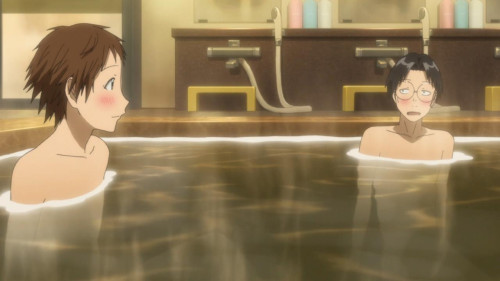
In the previous episode, Madarame revealed that he had decided to quit his job, and Hato has ended up blaming himself for this turn of events. Seeing that Hato has been avoiding Genshiken for weeks, the club invites Hato and Madarame to a hot springs so that they can relax and Hato can move forward, much in the way that Ogiue was able to have her own breakthrough. Hato, originally planning to stop crossdressing due to the perceived troubles it’s caused, gets some advice from Madarame: basically, just do whatever you want until you don’t want to, stop, then start up again if you feel like it. It’s no big deal. Hato decides to continue his ways.

On some level I think that this final episode is an attempt to finally get the Karuizawa arc (the point in the manga Ogiue finally learns to accept herself) into the anime. At this point, Ogiue is no longer really the focus of Genshiken, so it wouldn’t fit quite right to have them just devote around three or four episodes flashing back to the pre-Nidaime days, but it’s also such a significant part of Genshiken‘s story that its absence has been felt rather strongly both among fans and just in that something was missing from the anime the whole time. After all, for those who’ve stuck strictly to the anime adaptations, Ogiue somehow went from a frustrated and antagonistic individual to a somewhat gentle but still easily flustered mentor, and there was no explanation, at least until now. Even if it’s just a few brief glimpses, I’m glad to see part of Ogiue’s breakthrough animated.

With Ogiue’s desire to help Hato the same way that she was helped back then, not only do I see Episode 13 as a place for the Karuizawa storyline to make a “cameo appearance,” but I consider it to be a spiritual successor of sorts as well. In particular, Madarame’s advice to Hato resembles Sasahara’s words to Ogiue, that you can’t help what you like, only tailored to a less traumatic and dramatic situation. There’s no realization of love here, only the comfort of acceptance., andMadarame’s reached his own turning point in life, so he can look back and reflect for Hato. In addition, the discussions of collaborating on the next “Mebaetame” clearly point to the idea that Genshiken the club is a family of sorts, and a place for people to change through interacting with people both like-minded and otherwise.

Yoshitake’s presence in this episode is notable, as I think that as much as the show put Hato into the spotlight, Yoshitake (or should I say her voice actor Uesaka Sumire) has still ended up being a mascot of sorts for Nidaime. She’s that nerd you put out there to show how fashionable nerds can be, and I think just having a couple of scenes primarily of her geeking out over history from a fujoshi perspective is a part of the character’s position.

This is the first time that a Genshiken anime has seen fit to wrap things up with original content, though it makes sense because previously they had sort-of-okay stopping points and this time around if they had continued to just follow the manga, there would be no proper wrap-up for the series. The only thing viewers would get is more questions and perhaps the worst case of “READ THE MANGA” ever. Thankfully this isn’t the case, and even if I’m aware of the fact that there’s so much more material out there, this is a respectable bookend. Also, in what I’m sure is an intentional move, both the final episode of the anime and the latest chapter of the manga involve public baths, but the two are actually completely different in terms of narrative development and content outside of a more general theme of honestly expressing oneself, and so a comparison between them isn’t that useful.

This episode is also apparently a place for the people who made it to go wild with the references. A lot of the legwork was already done by the blogger Orezui, so I have to give ’em thanks.

1) “She’s not here! There’s no Hato-kun here!” is apparently a Patlabor: The Movie reference.

2) “Let’s go to the roof. I haven’t felt this angry in a long time,” is a line from the manga Salaryman Chintarou.

3) “But I can’t go [out] with a guy” is a direct reference to a line from Ogiue during the Karuizawa arc, also parodying the fact that Sue did something similar in Episode 1.

4) Sue’s obsession with taking pictures of everything related to the city of Tachikawa mirrors Yui and Mio’s initial reaction to London in the K-On! movie.

5) Kuchiki’s creepy run comes from Attack on Titan (that video above is highly recommended).

sue-chunli

6) Sue’s followup attacks are taken directly from Super Turbo-era Chun-Li from Street Fighter II. Specifically, the moves shown are Kikouken -> Jumping fierce -> Close standing fierce -> Senretsukyaku -> Tenshoukyaku.

7) Sue makes a Tomoko from Watamote face.

Obviously I know that this isn’t truly the end of Genshiken, and I hope those who’ve watched it are interested in following the manga to find out what happens next. In retrospect, the anime’s had its fair share of ups and downs, though mostly from the perspective of someone who notices subtle differences in tone and narrative timing, and I think that there’s something about the way Kio Shimoku frames each of his chapters and laces it with bits of characterization that I think gets increasingly lost as he continues to improve these already strong aspects of his work. At the same time, I think the anime generally captures what the new Genshiken is about, which includes an otaku generation gap, the complexities of gender and sexuality within the otaku framework, as well as the on-going process of change, development, and at least a bit of maturity that is college life. So if you’re still interested, stick around.

Besides, we still have that limited edition anime packaged with Volume 15 of the manga.

When in Rome: Genshiken II, Chapter 92

This month’s Genshiken provides what may be the best use of a pool/bath/hot springs chapter that I’ve ever seen.

As a bunch of the guys take Madarame away to get his hand treated, the rest of Genshiken (and company) go to a public bath to relax and air things out. Angela and Keiko make their intentions regarding Madarame clear to each other, beginning a strange rivalry of sorts between the two. Meanwhile, Hato finally admits out loud that he has feelings for Madarame, while Sue continues to contradict herself every step of the way.

I get the feeling that this chapter plays a lot with standard anime and manga tropes, especially in the fact that it manages to fit in both an extended bath scene and a festival-like environment, but does so in a way which actually leaves the guy at the center of all this drama literally at home. Obviously with a chapter that takes place almost entirely in a bath there’s bound to be an element of fanservice, but I found it also to be quite enlightening. This isn’t just referring to Hato finally coming to terms with himself, but just the way everyone involved communicates so openly. It’s as if the abundance of nudity this month is a metaphor for simply baring it all: no boundaries, no restrictions, just the truth from the heart (at least in most cases).

There’s actually a lot of information and development this time around, and it’s presented in a way that I think has become characteristic Kio Shimoku, more refined than ever as he continues to improve his storytelling ability in manga. This page above caught my eye in particular, because of how well it conveys not only the fact that Ogiue and Keiko’s have gotten a bit closer (by virtue of Ogiue being Sasahara’s girlfriend) just through the page composition and their positions within it, but also how the panel with Angela gives the impression that you’re seeing her from Ogiue and Keiko’s point of view. The height and the angle of the “camera,” as well as the panel following it give this impression. The way you can see Keiko’s confidence falter as soon as she sees Angela is also a nice touch. This is only the second time that Genshiken has done one of these bath scenes, and the last time around the relationship between Ogiue and Keiko was quite a bit more antagonistic, so it’s interesting to see them getting along in a similar setting.

Similarly, Yajima, though she doesn’t do a lot this chapter, actually says a lot. With the way the manga focuses on her at key moments, it really does give the impression that she feels something for Hato, even if it might not be strictly romantic. When I think about it, the fact that Yajima isn’t being particularly body-conscious despite being around Ohno and Angela must mean that she’s so distracted by Hato’s situation that she’s ignoring her own normal worries. I also have to point out that Kio actually drew her naked, and not in a way which is directed at appealing to a chubby lady fetish.

It’s been quite a journey with Hato, and when I look back at my own musings about him from chapter to chapter, it’s interesting to see how my own views have gone. At first, I took his self-assessment in regards to things like his self-image and his sexuality at his word, but over these few years it’s become clear that even Hato himself didn’t quite understand, though it wasn’t as simple as “Hato’s BL obsession was a sign of a closet homosexual/bisexual all along.” I think there’s enough evidence so far to say that his gender, sexuality, and fantasies don’t all perfectly correlate with each other. Last chapter, I wrote about how the “Stand” versions of the female Hato and Kaminaga are meant to be two separate aspects of his psychology, and here it’s made plainly obvious by the fact that both appear simultaneously. The way I see it, the female Hato represents Hato’s fudanshi side, or rather the image of a fujoshi in his mind who can communicate with other like-minded individuals, while the Kaminaga relies on Hato’s view of the real Kaminaga as someone who is always true to herself. This is why it’s the Kaminaga who has made it impossible for him to deny his own feelings about Madarame, whereas Hato has been easily able to brush aside the female Hato’s fantasies. Though having them float above Hato just has me thinking that the two are having a “conversation” in the men’s bath the whole time. It may also be of interest that none of Genshiken takes issue with Hato on this whole matter.

I honestly don’t think there’s going to be a Hato x Mada (or Mada x Hato) ending, and Madarame’s going to be in a position where he’s not just been rejected by someone but had to reject someone himself. Overall, if this is the case it’ll be a serious change for the otaku among otaku.

At this point in Genshiken we’re already familiar with the fact that characters like Angela and Keiko don’t prescribe to the true love romance mantra that appeals to otaku so much, but it’s still kind of refreshing nevertheless. Angela is provocative in more than one sense of the word, and the more I see of her the more I get that she’s actually quite intelligent. Angela’s insistence that Madarame needs “help” after buying “all that doujinshi” and that Keiko “wouldn’t be able to satisfy him,” ends up coming across as measured and calculated. Obviously Angela knows that Madarame is not some studly he-man with an unquenchable thirst for womanly conquest, and so the idea that Keiko wouldn’t be enough for him is clearly facetious. She’s just trying to get a rise out of Keiko, though what I find funny about all of this is that I can see a definite friendship forming between the two. They both want to win out, but at the same time their smiles and even the way they decide that Sue should be the one to go visit Madarame means that neither of them are especially bothered by the idea of losing. There are more fish in the nerd sea, and a bitter competition this is not.

Speaking of Sue, for all of the attention Hato and Madarame get, I feel like in the end it’s Sue who really steals the show this chapter. Her expressions are amazing, even more than Ogiue’s (which I enjoyed immensely).

Though her own emotional turmoil is played for comedic purposes in contrast to Hato’s, I do wonder what’s in store for her. Her development throughout the new series has come in fits and starts, but it’s undeniably there.It’s interesting how Sue is normally immune to embarrassment but here it overwhelms her to the point of violence and frustration, and I feel like I want to say more about her, but I don’t know where to start.

So, I think I’ll save it for the future.