Chop Chop Chop, Judo Flip: Genshiken II, Chapter 86

Genshiken II, Chapter 86 looks to possibly be a turning point. We’ve had quite a few of those already though. Also, next month there might be more news about the upcoming anime! It’ll be a long 30 days or so.

Sue visits Hato’s place, using Janglish to ask if he likes Madarame. Hato denies, but is clearly hiding something. After a tussle pitting Hato’s judo training against Sue’s freestyle which ends in a win by submission for the American, Sue discovers Hato’s secret Mada x Hato (in drag) drawings. Hato, who is increasingly confused about his feelings for Madarame (he feels that at this rate he might actually start liking Madarame), decides to just stop crossdressing and go back to being “a normal otaku.” This clearly makes Yajima uncomfortable despite her previous objections to Hato’s crossdressing.

With this chapter, I think I finally understand one of the big overarcing themes of Genshiken II. Yes, there’s the generation gap and the otaku/fujoshi distinction, but even more fundamental to the manga is a concept I’d describe as “the complexities of personal perceptions.”

The foremost example is Hato. He is getting to the point where he likely feels something for Madarame. I want to point out, however, the fact that Hato had no problems showing his “Hato x Mada” art to Sue, declaring that it was just the realm of fiction, but for some reason he also felt it necessary to keep his “Mada x Hato” hidden. I think the distinction between the two pairings is extremely important because it indicates a denial of clear-cut narratives about sexuality in describing otaku.

“What’s fiction is fiction, and what’s real is real” is a clear and concise argument. So is “what you’re attracted to in fiction can influence your real life preferences (and vice versa).” The former argument is used by Hato, while the latter was suggested by Kaminaga. With Hato and his feeling towards Madarame, however, it might actually be the case that his yaoi delusions are separate from his real feelings, but he began developing feelings for Madarame anyway due to their growing friendship, and that this manifests as Hato x Mada vs. Mada x Hato. I wonder if this is the case just because Mada x Hato for some reason apparently has to involve Hato crossdressing, as if to say the idea does not “make sense” to him otherwise.

In anime and manga about (or including) fujoshi, often there is significant time spent explaining how important the orders of pairings are important. “It’s like saying ‘curry on rice.’ No one says ‘rice on curry!’ says a character from the 4-koma series Doroko. This is generally played for laughs while trying to introduce to the reader the “mysterious” mind of the fujoshi, to allow the reader to say, “Oh fujoshi, you’re so lovably wacky.” I think that with Genshiken, Kio is trying to discuss that mindset a little more seriously.

I predict Ogiue is going to start playing a bigger role in this, just because Hato looks like he’s trying to run away from his current situation at all costs. Ogiue is more than familiar with this situation, is aware of how much trying to deny oneself can generate a festering wound of self-loathing, and just how complicated the real/fiction distinction can get. I think, or perhaps I simply hope, that Ogiue will manage to be Hato’s mentor, like how Ohno was there for her. Also, Hato says he’s “going back” to being a normal otaku, but was he ever a normal otaku? He discovered yaoi in junior high, so it’s been with him for a long time, which makes me think that Hato is trying to simply act like how a “normal otaku” is supposed to without truly direct experience, somewhat like how Ogiue sometimes tried to approximate a “non-otaku.”

If the Hato example is a little too crazy, I think Yajima in this chapter also provides an interesting case of personal perception. Clearly the reason why Yajima blushes at the end is because she still associates male Hato with the time she accidentally saw him naked, in addition to just the fact that he’s a guy. She doesn’t react this way so much to Hato in her female guise, which means that the wig and dress is enough to “trick” Yajima psychologically so that the first thing she thinks about is Hato’s clean-shaven personal area. What Yajima thinks of Hato is of course its own puzzle having at its origin her own self-image and her lack of experience interacting with men.

I don’t know if Sue counts towards this as well, but I do find it interesting that Sue’s embarrassment over kissing Madarame has nothing to do with him and everything to do with the fact that Kasukabe saw her doing it. On some level, I feel like I can really understand that distinction. Somewhat like that famous scene in His and Her Circumstances when Miyazawa accidentally runs into Arima while out of her “perfect student” guise,” there are people you feel like you can be a fool around and people you don’t. I also continue to think that it’s kind of brave of Kio to give Sue a larger role, as semi-fluent foreigner is not the easiest thing to pull off without reverting to very basic stereotypes. Sue is many things, but “basic” isn’t one of them.

By the way, there’s something I find really impressive about Sue and Hato’s fight scene, particularly the panel where Hato drags her and sweeps the leg. It captures that one moment so incredibly well, while allowing it to transition into the next set of panels. It actually makes me want to see Kio draw an action series.

To end, I want to ask a simple question: Sue x Hato, what are your thoughts? If this were a more popular series, I’m sure that neck-licking thing would have people talking.

No-Smile Precure: The Transformation of Kenzaki Makoto

Recently,  Dokidoki! Precure revealed all of its main cast and their transformations. In seeing comments about them, I’ve noticed that the transformation for Cure Sword (pictured above), has received somewhat less fanfare compared to the others because it’s not nearly as fanciful as the others. When you look at the Makoto/Cure Sword sequence, it really does lack many of the flourishes of the other Cures, but rather than this being simply a less impressive transformation I do think that the simplicity both in the “camera work” as well as the small amount of details is intentional, as it gives a better sense of Cure Sword’s character.

curerosetta-outfit curesword-armsraised
(All gifs taken from http://lemedy.tumblr.com)

Cure Sword is different from the other Cures in Dokidoki! in that she is a seasoned warrior familiar with being a Precure. Just the fact that she stretches her arms above her head and lets the costume simply form over her is reminiscent of someone just putting on a standard and familiar uniform. When you compare that with Cure Rosetta’s playfulness and spring in her step as she transforms, it becomes especially obvious.

Makoto’s change into Cure Sword is thus rather straightforward. While other girls’ hairstyles bob and flow tremendously, Makoto’s barely does so. And where the other girls move as if they’re dancing while announcing their names, further giving that feeling of excited performance, Cure Sword slashes at the air, giving the impression of a serious fighter.

curediamond-posecuresword-slash

The thing that really differentiates the Cure Sword transformation from the rest of the Dokidoki! team is simply the fact that, unlike the rest of them, she has a glower on her face pretty much the entire time, only changing her expression into a smile during the final team pose. When put side by side with the other Cures, it really makes her stand out, and along with the lack of movement in her tranformation it becomes indicative of her more serious personality.

Makoto is not the first character in Precure to have a stern look on her face as she transforms, as Cure Moonlight’s features a similar expression, and much like Cure Sword, Moonlight’s transformation appears more efficient than the others’ in Heartcatch Precure! There is still a difference, however, and I think the key factor to consider is Makoto’s origin. When you look at the transformations of other characters in Precure, including Dokidoki!, it’s as if they’re undergoing a metamorphosis. Even when you look at the characters who are from other worlds like her, such as Milky Rose, Cure Passion, Cure Beat, and Cure Muse, they take on a new identity by transforming. Makoto, however, is simply returning to her true self. Rather than being a normal girl who becomes a warrior, she is a warrior who disguises herself as a normal girl.

How Robotics;Notes Explores the Meanings of Giant Robots

(Warning: This post contains spoilers.)

There are many interesting aspects about the anime Robotics;Notes, but one thing that’s particularly noteworthy is that it is a show about giant robots. That might not sound so impressive on its own, but it’s actually quite rare for a show to be “about” giant robots. Certainly, there are anime which include giant robots, anime which place giant robots in the spotlight, and giant robot anime which are driven by strong themes, all of which can be strong in their own rights. Where Robotics;Notes differs, however, is that it concerns the very thematic concept of giant robots, particularly what they mean to the people who watch and follow them.

Senomiya Akiho, Robotics Club President

In episode 1, we’re introduced to the Central Tanegashima High School Robotics Club and its president, Senomiya Akiho. An energetic girl, Akiho is an avid fan of giant robot anime, particularly the highly influential and hot-blooded series Gunvarrel. Akiho’s primary goal as Robotics Club president is to complete a 1:1 scale functioning robot replica of Gunvarrel called the Guntsuku-1, a task she inherited from her sister Misaki. Akiho, we are shown, has nowhere near the genius of her sister who designed the blueprints for Guntsuku-1 in the first place, and the enormous task before her sets up a couple of important questions. First, is Robotics;Notes the sort of anime that would, after deliberately pointing out how unfeasible it would be to replicate the design of an in-story fictional robot while also providing examples of “realistic” robots in society, allow Guntsuku-1 to be completed? Second, whether it ends up being finished or not, how prominently will Guntsuku-1 figure into the narrative? More specifically, will it actually somehow fulfill the role of a giant robot even with its various setbacks? These two mysteries work together to create a slow-burning sense of anticipation in Robotics;Notes which center upon the idea of “giant robots,” or more specifically the “giant robots of anime.”


Legendary anime
Gunvarrel

The “high school kids in a club” setting is not new to anime, but because of its increasing prominence in recent years Robotics;Notes initially gives off the impression that it might stay primarily in the microcosm of the clubroom. Even when factoring in the fact that Robotics;Notes is from the same company which created Chaos;Head and Steins;Gate, two series with grander themes than K-On!, there still exists in the early episodes the possibility that the anime would focus on the everyday of the Robotics Club amidst this greater story, or at most show how small their world is by comparison. While the story of the Robotics Club does eventually begin to tie itself into a greater conspiracy and makes it clear that the show is not so limited in scope, even from the beginning Robotics;Notes creates a strong sense of connection between many of the characters and varying conceptions of robots. This in turn helps to establish that deeper thematic level of the meanings of giant robots.

Robotics Club members (left to right): Senomiya Akiho, Daitoku Junna, Koujiro Frau, Yashio Kaito, Hidaka Subaru

Going by just the club members, the male lead and childhood friend of Akiho, Yashio Kaito, is a slacker who primarily experiences giant robots through a fictional Virtual On-esque game called Kill-Ballad, which is itself inspired by Gunvarrel. The hikikomori fujoshi Koujiro Frau, turns out to be not only the creator of Kill-Ballad, but also the daughter of the producer of the original Gunvarrel anime, making Gunvarrel her tie to her missing mother. Hidaka Subaru, who initially refuses to join, is a champion of small-scale robot battle competitions who is forced to compete in secrecy because of his father’s disapproval. Daitoku Junna’s grandfather specializes in robotics, but an accident at a young age left her with a fear of robots. In each of these examples, Robotics;Notes in some way connects the theme of giant robots to other people.

The completed Guntsuku-1

There are two important developments about halfway through the series. First, the Robotics Club manages to complete Guntsuku-1, but it turns out to have accumulated over time so many compromises and shortcuts in its construction that the final product is a cumbersome and ugly-looking machine. Physically speaking, it is no more a robot than a golf cart with a head grafted on. Second, it is revealed that the final episode of Gunvarrel never aired because it was actually brainwashing propaganda (the broadcast of which was was stopped by Frau’s mother), which creates an extremely negative public opinion of Akiho’s beloved anime. Here, Akiho’s reactions to both events emphasizes the role of giant robots in her life, which in turn foregrounds how giant robots as a fictional concept can be interpreted.


The
Gunvarrel conspiracy

In regards to Guntsuku-1 and its lackluster debut, Akiho specifically mentions that they are not abandoning Guntsuku-1. Rather, they are setting it aside so that they can come back to it later, which is indicative of Akiho’s belief in the spirit of the giant robot concept. Even as the Robotics Club moves onto working on a more realistic robot (the Guntsuku-2) for a robotics expo, Akiho not only makes sure not to forget Guntsuku-1, but her influence encourages the other club members to create an augmented reality modification so that people using a technological interface can view Guntsuku-2 as if it actually were Gunvarrel. Similarly, even when the horrible truth of Gunvarrel becomes known and people view it with disdain, Akiho resolves to still love Gunvarrel because she believes that her positive experiences with it trump whatever diabolical authorial intent may have been at the heart of it. At this point, it becomes increasingly clear that what is important to Akiho (and Robotic;Notes) is not the physical component of giant robots as massive titans of power but as symbols and icons of inspiration, existing in the hearts of those who love what it could be, instead of what it was supposed to be.


Akiho’s persistent spirit along with Guntsuku-2

Akiho embodies this “giant robot spirit.” Late in the series, when the conspiracy which underpins the series is in full swing, Akiho falls into a panicked depression, which comes as a shock to Kaito. Throughout the series, Kaito acts like a reluctant accomplice to Akiho’s madness, someone who follows only because he must. In this situation, however, Kai reveals that he was only able to act the role of the slacker because Akiho was there as his beacon of light, with enough motivation to carry the both of them. Kaito always saw in Akiho what Akiho sees in giant robots: something (or someone) who is not the most logical or rational but is an enduring source of motivation.

Guntsuku-1, revived

By the end of the series, the Robotics Club must stop the leader of the conspiracy and prevent the death of millions. In order to do so, they (along with their friends and family) repurpose the Guntsuku-1 using parts of Guntsuku-2, giving it functional modifications that they were simply unable to the first time. Appearance-wise, it’s still more or less the cumbersome hunk of metal it was before, but at this point in the story it’s clear that what makes Guntsuku-1 into a valiant giant robot just like Gunvarrel is not how closely it matches the original design but rather the intent of the people who support it. This includes not just the current Robotics Club and the people they know, but the people who worked on it throughout the years such as Akiho’s sister. As if to reinforce this point, when the antagonists view Guntsuku-1 through the technological interface of their own robot, all they can see is the actual Gunvarrel (via the same augmented reality image used for Guntsuku-2), complete with signature attacks.

The virtual image of Guntsuku-1

In describing Robotics;Notes as an anime about giant robots unlike so many others, this distinction mainly has to do with the fact that Robotics;Notes incorporates into its story how giant robots as cultural artifacts are received and interpreted by the people who engage with them. It is not the only anime to address this on some level, with Martian Successor Nadesico and the 2004 Tetsujin 28 being a couple of examples, but Robotics;Notes does so while putting into question throughout its narrative the very existence of its signature robot. It is not until the conceptual processes for conceiving the effects of “giant robots” are in place that Guntsuku-1 truly takes center stage, which in turn creates a unique and interesting position for Robotics;Notes. If one were to categorize Robotics;Notes, would it be considered a “giant robot anime?” The fact that this can be argued both ways is, rather than being a weakness of Robotics;Notes, one of its greatest strengths.

Dyuhuhu

The Fujoshi Files 68: Hisakawa Ayane

Name: Hisakawa, Ayane (久川綾音)
Alias: N/A
Relationship Status: N/A
Origin: The Manken Club, Like Whirlwind and Surge Waves!!

Information:
Hisakawa Ayane is a 1st-year student and a member of the Manken Club lead by Rinbara Megumi. In addition to an interest in yaoi doujinshi, Hisakawa is also an exhibitionist.

Fujoshi Level:
Hisakawa joined her club president Rinbara in using up the club’s funds to buy yaoi doujinshi.

Why the Little Sister is an “Osaka Mama” is a Little Sister

Boku no Imouto wa “Osaka Okan”, or, My Little Sister is an “Osaka Mama” is an odd anime. Ostensibly about a younger sister who grew up in Osaka having to move back to Tokyo, this (sparsely animated) show is actually a way of showing various cultural differences between the two cities. It’s a funny little series, with the ever-changing ending theme based on the events of each episode being a highlight, but what I find especially funny about this anime is its origins.

Boku no Imouto wa Osaka Okan actually comes from a series of books designed to educate people about Osaka customs. The first book, Osaka Rules (as in “to live by,” not as in “Hulkamania”), is itself part of the Rules series for various parts of Japan. It was followed by Osaka Okan, which was designed to help people marrying into Osakan families to understand and deal with their in-laws better. What this means, then, is that the “little sister” component was added specifically for the anime, as if to try and capitalize on current otaku trends. I certainly can’t think of any other reason.

There’s something unbelievably shameless and perhaps even tongue-in-cheek about this that I can’t help but clap in admiration rather than hang my head in shame. Sure, little sister-focused stories are a dime a dozen in light novels, but what if the scope was widened in the way that Boku no Imouto wa “Osaka Okan” has shown us?

My Little Sister is a Forbes 100 CEO

My Little Sister is Doing a PhD on Molecular Biology

I Discovered My Little Sister is an Excellent Game Show Host

I Can’t Believe My Little Sister is the Catalyst for a Proletariat Uprising

The possibilities, as they say, are endless. I’m also aware that this sort of parody joke exists already, but I think the key difference is that the little sister component should appear deliberately grafted on, rather than being the axis upon which an anime revolves.


By the way, this show is from the gdgd Fairies people so you know it’s good.

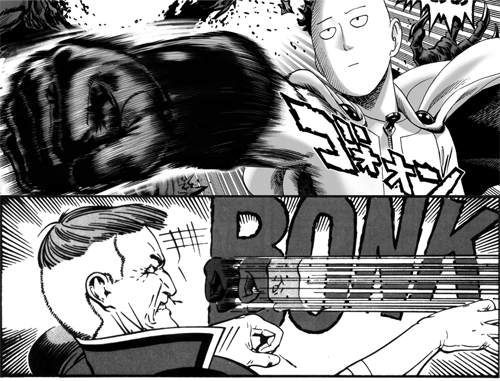
I Seriously Can’t Believe No One’s Made This: One Punch

onepunchman-guygardner-small

On JManga’s Closure, and the Movement of People and Technology

JManga, the digital manga service backed by a number of Japanese publishers, is shutting down. No more points may be purchased, and all titles will be taken down by May 30, 2013. Any remaining points on users’ accounts will be refunded to them in the form of Amazon Gift Cards.

JManga, unlike so many other official manga sites, was at least partly accessible in regions outside of the US, and it was for this reason that I initially supported it in spite of its initial convoluted pricing scheme. Eventually, they changed the pay format to something a little more enticing and easy to understand, but when a friend told me that he wished he could purchase a title that was already on JManga, it made me realize just how unknown the site was. I tried to do my part and encourage others to use JManga, but for one reason or another it apparently wasn’t enough. It’s a shame, because I think they really made some excellent strides in getting manga to a digital format, even if their reader left something to desire in terms of functionality and ease of use.

The news of JManga’s impending demise brought up conversations about piracy and users’ rights that is affecting industries well beyond manga at this point (the Sim City server problems being currently the most prominent), and one of the arguments being made is that it’s in the end the fault of scanlations. I have a problem with this. While I don’t doubt that scanlations impact sales, especially when it comes to the popular titles, the fact is that none of the manga on JManga were heavy hitters. Their famous titles were things that simply don’t sell too well, like volume 1 of Golgo 13. I believe their most successful manga was Soredemo Machi wa Mawatteiru (some of which I purchased and am kind of miffed that it’s going to vanish in a couple of months), which to put it lightly is not a Naruto or a Sailor Moon.

The lineup at JManga was extremely esoteric, and while this had a great amount of appeal for me personally, I’m also aware that the average manga fan, whether they read free manga online or not, is not going to chomp at the bit to go read about a Heian era fujoshi (another purchased title I will miss). Essentially, the titles on JManga were so out there that for the most part they were not the things people would look to scan and distribute, so the traditional argument of piracy doesn’t really apply here. Also, JManga was apparently shackled by the fact that publishers would not hand over their A-List titles. Tokyopop tried the flood of mediocrity approach as well, and that didn’t go so well in the end. While it is possible to say that fans should have subscribed anyway in order to give JManga the opportunity to go after the big titles, as Narutaki over at Reverse Thieves and the Speakeasy podcast pointed out, you can’t expect people to pay money in the hopes that they might someday get the titles that they want, especially if they’re from wildly different genres and demographics.

I could see it argued that manga scanlations created the environment which made publishers fear handing over their major titles, and by extension was the cause for JManga’s demise, but I think this would be overlooking the fact that media companies tend to be conservative about trying out new platforms until they absolutely must. HBO’s business model, for instance, is based on subscriptions to their premium cable service. This is fine and all, but it turns out that people who only want to watch online (legally, mind you) must also buy cable and HBO anyway. Media companies, if they can help it, will dig their feet into the ground to the point that they pretty much have to be dragged kicking and screaming to evolve alongside their potential customers’ habits. As a classic example, would the music industry have even bothered with digital distribution and the mp3 format if something like Napster hadn’t forced them to do so?

This is not me defending piracy as some kind of noble endeavor, but merely making the point that if scanlations did not exist and were not so ubiquitous, then I highly doubt that Japanese manga publishers would have simply decided to put manga online “just because.” In other words, to say that JManga would have been fine had readers of manga behaved all along is I think a flawed argument because there’s a good chance we wouldn’t even have sites like JManga or J-Comi. Valuing creative talent and creative output is still important, but defining that value according to current conventions and blindly accepting the current distribution methods (or lack thereof) is problematic itself. That’s not to say that one must rebel against the system in order to “save manga” or “stick it to the man,” but it would be beneficial to acknowledge where it is flawed, and to also not put blame squarely on the shoulders of readers, especially when the site was not giving them what they want.

Pavlov’s Anime Blogger

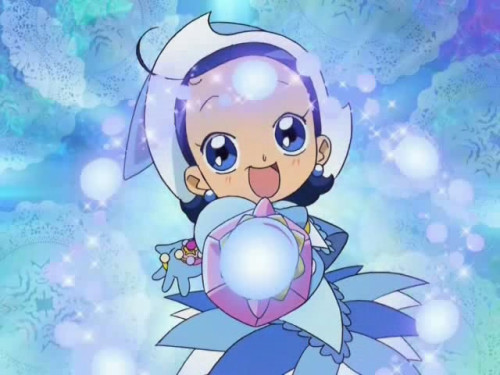
After more than a year of intentionally delaying it so as to not use up my supply of excellent magical girl anime, I’ve begun Mo~tto! Ojamajo Doremi, the third series in the Ojamajo Doremi franchise.

As I was watching one episode, there was the standard stock footage of one of the girls using magic, which starts off by showing a closeup of a music-playing magic wand. Before the show even revealed on-screen which girl was casting the magic, I thought, “Oh, it’s Aiko,” the tomboy character from Osaka. Moments later as Aiko appeared, I wondered to myself, how did I figure that out?

Upon re-watching, I realized that the signal to indicate Aiko was the music playing from her wand, which mimics a harmonica. Each of the characters in Doremi have an instrument associated with them, so in hindsight this is a rather obvious part of the show. As mentioned before, however, I hadn’t watched any Doremi in quite a long time, so it felt more like an unconscious response. I had watched enough of the show to absorb its elements into my psyche, and that “conditioning” showed up in this instance.

By the way, Doremi is a really fantastic show, and I wrote a review of the first series. If you’re wondering why there isn’t a review of the second series, it’s because pretty much everything I say about the first series more or less applies to it as well.

The Fujoshi Files 67: Rinbara Megumi

Name: Rinbara, Megumi (林原恵)
Alias: Buchou/President (部長)
Relationship Status: Complicated
Origin: The Manken Club, Like Whirlwind and Surge Waves!!

Information:
Rinbara Megumi is a second-year student and the president of her school’s manga club, though somewhat irresponsible. She is comfortable with using her body for personal gain.

Fujoshi Level:
Rinbara depleted the Manken Club’s funds by buying nothing but yaoi doujinshi.

Gattai Girls 3: Rinne no Lagrange – Flower Declaration of Your Heart and Kyouno Madoka

Introduction: “Gattai Girls” is a series of posts dedicated to looking at giant robot anime featuring prominent female characters due to their relative rarity within that genre.

Here, “prominent” is primarily defined by two traits. First, the female character has to be either a main character (as opposed to a sidekick or support character), or she has to be in a role which distinguishes her. Second, the female character has to actually pilot a giant robot, preferrably the main giant robot of the series she’s in.

For example, Aim for the Top! would qualify because of Noriko (main character, pilots the most important mecha of her show), while Vision of Escaflowne would not, because Hitomi does not engage in any combat despite being a main character, nor would Full Metal Panic! because the most prominent robot pilot, Melissa Mao, is not prominent enough.

Rinne no Lagrange – Flower Declaration of Your Heart (2012) is one of the most recent titles to qualify for the Gattai Girls series. Comprised of a galaxy-spanning war affected by the portrayal of the everyday lives of a select few characters, the approach that Rinne no Lagrange takes is fairly indicative of contemporary non-franchise giant robot anime and the tendency for plot to revolve primarily around individuals and their emotions.

The main heroine is Kyouno Madoka, an endlessly energetic teenager living in the city of Kamogawa. Always seen helping around the city while clad in a track jersey, Madoka inadvertently becomes the pilot of the ancient robot Vox Aura, spoken of in legends of destruction, she also becomes involved in a war between the two faraway planets Le Garite and De Metrio.  Madoka manages to befriend a girl her age on each side of the conflict, Fin E Ld Si Laffinty (aka Lan), princess of Le Garite, and De Metrio representative Muginami, inspiring change in both alien girls to move towards peace for their peoples.

When I say that the daily lives of the characters affect the overarching story, what I mean is that Rinne no Lagrange literally spends episode after episode primarily focused on the three girls’ deepening bonds to the point that its pacing can come across as slow and uneven when one can argue that there’s development of the universe to be had. The show does make an effort to establish the science fictional aspects of the story and the origin of the conflict between the two planets, and the robots themselves have an interesting aesthetic that approaches to a small degree the same sense as the Motorheads from Five Star Stories, but a more prominent and fundamental theme of the anime is how Madoka the simple local girl can literally change the universe through a never-say-never attitude.

Madoka’s incredibly infectious spirit and a willingness to work hard for herself and others is probably the biggest draw of Rinne no Lagrange. Fueled by energy drinks, her philosophy in life is something along the lines of “If you give a man a fish, he’ll eat for a day, and if you teach to fish, he’ll eat forever, but if you do both then it’s perfect.” Madoka is perpetually strong, the sort of character who is not entirely without flaw, but who is practically designed to be a walking, talking inspiration generator. Madoka’s strength both physically and mentally are not because she’s a girl or in spite of being a girl, but more having to do with her love for her city, a topic removed from debates about the role of women. Also, in the first episode she uses her robot to German suplex the enemy into submission.

In looking at the other girls, Lan and Muginami (who are both pilots of legendary machines themselves), their place in the story is clearly an active and important one, though they’re also designed strongly along popular character stereotypes. Lan is a mostly stoic blue-haired noble girl clad in a skintight suit who’s clumsy and easily embarrassed, while Muginami is clearly the ditzy big-boobed blonde type. The two manage to flip some of these conventions to a certain degree, such as the fact that Muginami’s airhead personality is clearly just an act, but they also show a great deal of loyalty to their “big brothers” while their friendship with Madoka provides a prominent yuri subtext for the series. While the show isn’t absolutely about yuri, it’s also obvious that Rinne no Lagrange encourages the viewer to read into it that way if they should so choose, provided plenty of reasons to do so. This isn’t an indictment of any of the elements discussed, but rather a reminder that this show is indeed about the closeness of its main heroines before it’s about giant robots.

I know it sounds a little strange to be saying this about an anime that came out just last year, but Rinne no Lagrange really feels like a product of its time. The way it de-emphasizes some of the more traditional elements of a giant robot anime of favor of “possibly yuri friendship adventure” is also suggestive of the heavy character-as-icon and moe styles of anime that have been a big trend for the last ten years or so. However, while its female characters cater to the viewers a good deal, the three heroines also establish themselves strongly, with Madoka herself and her boundless attitude creating the strongest impression.

(Last note: the show has a fantastically addictive opening .)