Of Mice and Spies: Stripfestival Breda 2012

When it comes to comics, the Netherlands is an interesting country. Situated close to Belgium and France, the Dutch have had close ties with that bande dessinée (Franco-Belgian comics) culture, particularly when it comes to the Flemish comics, but they’ve also developed a comics culture all their own. While I’d learned about this a fair deal before, when I went to the Dutch comics festival “Stripfestival Breda” this past month, I was able to see it much more clearly.

Taking place in the city of Breda and spread across different locations near the center of town, Stripfestival Breda is a two-day event to celebrate comics. There, you could buy comics from a variety of venders, get your picture taken with your favorite characters (whether that means cosplay by fans or actual people hired to dress up), and even meet the artists responsible for all of these comics. Each location specialized in a certain area, such as one for events and awards, though I didn’t attend all of them due to time constraints and other inconveniences such as my lack of Dutch fluency. Instead, I primarily looked at the industry area, located in a theater, and the self-published area, located in the city’s Great Church (every Dutch city seems to have one).

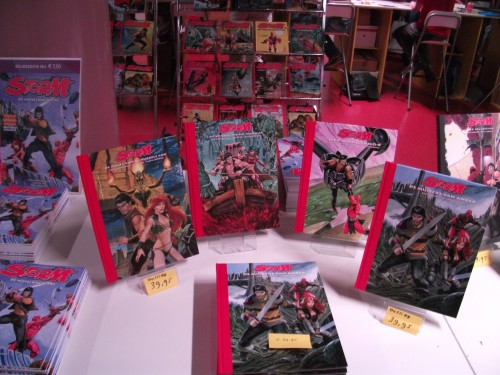
The industry locale was the epicenter of the festival, and companies from both inside and outside of the Netherlands were there. They had plenty of books to sell, but what I found to be most impressive is that in a lot of cases, not only were the artists themselves there, but they were offering free sketches. The biggest booth was the Eppo booth, home of a variety of Dutch comics both classic and new (and in some cases the comics have run long enough to be both), which housed about 8-10 artists each with their own lines. With big names in Dutch comics such as Martin Lodewijk of Agent 327, as well as Jorg de Vos and Roman Molenaar, the artists behind Storm (which is available in English), it was a collection of heavy hitters, but amazingly the lines were short enough that I could get multiple sketches in well under an hour.

Martin Lodewijk

In fact, by my estimation, the combined lines between all of the Eppo artists was about as long as a line for Fred Gallagher (Megatokyo) at Otakon. This isn’t to say knock either Fred or the Dutch artists, but just to say that I was amazed by how accessible these artists were.

Interestingly, the most popular comic among young Dutch kids is an Italian series called Geronimo Stilton. I don’t know much about it other than the fact that it features an anthropomorphic journalist mouse who goes on adventures, or whether it’s doing well in the US, but its success was clear as kids line up to take photos with a real Geronimo Stilton, Disneyland-style.

There was definitely a French/Belgian presence as well, though I didn’t spend much time with them, and there were vendors selling a huge variety of comics, including (what I assumed to be) old, hard-to-find items. Many of the vendors sold comics with some erotic content, but there didn’t seem to be any particular separation or shame in it. In some cases they were shrink-wrapped, in some cases they weren’t.

There was some presence for manga and American comics, especially the life-sized Iron Man statue, the anime fan artists who I’ve seen at the Dutch anime cons, and the requisite maid cafe, though they definitely weren’t the main focus. Asking one vendor of superhero comics about the status of American comics in the Netherlands, he told me that The Walking Dead is quite popular.

The independent/alternative comics area was quite a different experience from the hustle and bustle of the industry location, though I think that may have had to do with the fact that it was held in an old-fashioned gothic-style church and featured many art pieces which I might call not very church-like at all. Featured here were many comics which strayed from convention, featuring really erratic character designs and strange subject matter, the artists were not just comics makers but sometimes contemporary art scene artists as well. Items were generally more expensive for the alternative comics than they were for the industry items, but often times not by much.

I spoke to one artist, who told me that his favorite comic was the one that had the sold the least because it wasn’t really to Dutch tastes. Intrigued, I asked him what he meant by Dutch tastes, because I don’t have anywhere near as keen a sense for European comics as I do for American and Japanese, he mentioned that it had to do with round, cartoonish characters with big feet and so on. It’s something I’ll have to do more research on.

In the end, what probably stood out to me most was the fact that gender and age distributions seemed very even. I saw people from five-years-old to fifty-year-sold both male and female lined up at booths, whether it was to buy comics or to meet the artists or their favorite characters, often times for the same series. It made me realize how much comics is a thing for all ages in the Netherlands.

The Meaning of “Vanilla”

About a year ago I wrote a post wondering about the “NTR” (essentially cuckolding) genre of porn in anime and manga, and in it I had a small aside in the introduction where I mentioned the English-speaking anti-NTR fanbase that has developed in response, people who will proudly and adamantly proclaim their love of “vanilla.” At the time, I referred to these vanilla fans and their fervor as if they were an extreme response to the popularity of NTR because the intense championing of very conventional depictions of sex seemed odd (though understandable). Upon thinking about this subject again recently, however, I realized that I had overlooked something, and that one of the reasons there seems to be this contingent of vanilla supporters is that the definition of “vanilla porn,” at least according to certain fans of anime and manga, is quite a bit broader than how people would normally define it.

In general usage, vanilla (used for sex or otherwise) implies something that is ordinary and simple, and if one is being negative, bland and boring. In depictions of sex, this generally means something along the lines of missionary position between a couple. But when you look at the categories used in English to describe specific works of erotic anime and manga, you’ll sometimes get tag combinations such as “BDSM HAREM INCEST VANILLA.” I’m not making a value judgment on those other categories by any means, but I think that everyone can agree that, typically, those things don’t go hand in hand with “vanilla.”

What this has me realizing is that the ardent support for “vanilla” may be an even more direct response to NTR than I had first thought, because it ends up being defined by fans as essentially “not-NTR,” though to be more accurate it would probably be “anything that is not gay, rape, or NTR.” Given this definition-by-negation, it would seem that the most vital aspect of “vanilla” is loyalty. In this conception of vanilla, the relationships can be polygamous, they can be extreme in one way or another, but if there is a sense of betrayal or if feelings are hurt through sex, then it falls to the other side.

If you liked this post, consider becoming a sponsor of Ogiue Maniax through Patreon. You can get rewards for higher pledges, including a chance to request topics for the blog.

A Boy and His Universe: Turn A Gundam

Gundam is one of the most well-known, influential, and highly regarded franchises in anime history. At this point over three decades old, many changes have occurred in Gundam, but none may be as interesting or so able to fulfill its potential as 1999’s Turn A Gundam. Created to celebrate the 20th anniversary of Gundam and directed by the creator of Gundam himself, Tomino Yoshiyuki, it differs in many ways from other iterations, notably in its setting and aesthetics, but at the same time does wonders with everything it has. It shores up many traditional weaknesses of Gundam and Tomino’s work, and brings a variety of interesting twists to Gundam that don’t just come across as differences merely for the sake of them, resulting in just an all-around strong, engaging, and multifaceted story.

In stark contrast to every other Gundam series in current existence, Turn A Gundam takes place on an Earth with roughly World War I-level technology and social standards. In an age of biplanes and debutantes, the world is flipped upside down when lost descendants of humanity from the moon return to the planet with intentions to emigrate. Because the humans on Earth see this “Moonrace” as alien invaders taking away the land of their ancestors and the Moonrace sees the Earthlings as backwards barbarians prone to violence, tensions rise.

The only things keeping the scenario from boiling over and the Moonrace from wiping out the opposition with superior technology are the fact that the political scenario is not as simple as “Us vs. Them,” and the discovery of ancient and seemingly anachronistic “mechanical dolls” (what the people of the Moon call mobile suits) in the mountains, particularly the powerful and mysterious “White Doll.” Caught in the middle of this conflict is a Moonrace boy living on Earth named Loran Cehack, whose love for both his original and adopted homes pushes him to pilot the White Doll in an effort to prevent all-out war from breaking out.

There are certain phrases thrown about when reviewing anime, such as “character-based,” “theme-based,” “story-based,” and “world-based,” as if these categories are mutually exclusive or even contradictory, but Turn A Gundam is a series which strongly delivers on all these levels and more because of the way all of those components reciprocate with one another. The history of the world shapes the thoughts and backgrounds of the characters, who act within that world to create a grand story with many intricate elements, and it ultimately results in the delivery of certain themes, such as “the strengths and weaknesses of technological progress” and “awareness of history,” by taking a large-scale, global perspective and focusing it through smaller and more intimate character struggles.

This can be seen in the way the series portrays the constant clash of values and beliefs at various levels and between different people, consistently showing how many of the people involved are intelligent or enlightened or even kind-hearted in their own way, but are prone to mistakes due to the limits of their experiences. An archaeologist who cares little for religion and ceremony is so intent on digging for the sake of knowledge that he ends up exacerbating the conflict between the two sides by uncovering powerful military technology. Politician characters possess the negotiation skills and long-term thinking necessary to balance out their followers’ shortsighted and hotheaded reactions to the deaths of their comrades, but their high ambitions blind them to their own misdeeds. Qualities praised in soldiers, such as valor and daring, become problematic in the face of dangers well beyond their comprehension. As such, when these characters and many more sabotage themselves it comes across as perfectly understandable.

The cast of Turn A Gundam is absolutely gigantic, but it never comes across as too unwieldy for the show. Civilians and soldiers alike are given proper time and elaboration, and it really makes Turn A Gundam feel like a comprehensive world populated by real people. Loran is a gentle soul, but not one whose desire for peace prevents him from taking action, and over the course of the series is simultaneously built up and torn down by events both within and out of his control. Dianna Soreil, the leader of the Moonrace, is beloved by her people, but must deal with not only the difficulties of being opposed by Earth militias but also political infighting on her side. Her personal bodyguard, Harry Ord, is a loyal and admirable man, but one who over the course of the series shows how he is not blind to deception or his own feelings. Neither of Loran’s companions from the moon, Keith Leijie and Fran Doll, are soldiers or anything close to it, yet their stories about trying to start new lives on Earth are just as strong.

The Heim sisters, the adopted family of Loran (pictured in the middle below), or more accurately, the masters he works for as a servant, probably grow the most in the series. The tomboyish Sochie (left) must deal with her prejudice and anger against the Moonrace, while Kihel (right) and her uncanny resemblance to Dianna puts her in a situation central to the story, where she must push her already clever mind to its limits. Even extremely minor characters exude a sense of place in their world, and in some cases a lack of sense of place actually winds up becoming a strong defining trait in and of itself.

Also contributing to the strength of the show’s cast is the fact that the romance is actually extremely well done. Traditionally this has been a weakness of Tomino’s anime, particularly in the Gundam franchise because it is often ran through at an accelerated rate so that it can be a plot point or cause for tragedy, but Turn A Gundam manages to provide relationships which grow organically over time, particularly the two most prominent ones in the series. In these cases, the characters don’t so much have a moment where they Fall in Love, but rather as you watch them you see how they grow closer. Even the relationships which are a little more fast-paced are given reason in the series itself: in a situation like war, people start to think about their own mortality and regrets.

Possibly one of the reasons why the romance comes across so well is that many episodes are devoted primarily to showing people living out their lives amidst the backdrop of war, what might be deemed sillier episodes but which work to build the characters further. For Loran in particular, he is able to show how the White Doll, the titular “Turn A Gundam” as is revealed later, can function as more than just a weapon of destruction, and even the instances where he ends up having to crossdress (apparently an enduring legacy of Turn A if fanart is any indication) becomes both a plot point and a hint for later character development. War is shown as both the forefront and the background depending on the episode, and it creates a more robust setting as a result.

One topic that is difficult to avoid when discussing Turn A Gundam is the aesthetics of the show because of how the series visually sticks out among its fellow Gundam anime. Central to this is the fact that the Turn A itself is a far cry from the traditional Gundam design, and I remember that back when the series and its visuals was first announced there was a backlash against it. Designed by American Syd Mead (Blade Runner, Tron), the style of the Turn A, with its signature white mustache and strange angles, seemed to go against the image of Gundam that had been cultivated over the years. Even over a decade ago I jokingly photoshopped the Devil Gundam from G Gundam onto a Turn A Gundam head and called it “The Ugliest Gundam Ever.” But now, my opinion of the Turn A Gundam is that it not only looks good, but that it fits the role of a Gundam far-removed from those that have come before it. Over the course of the anime, the “White Doll” plays many roles and carries with it the question of to what degree can we break from the past, and this break in design says a lot in and of itself.

What’s even more impressive to me, however, is that each of the robot designs in Turn A are strikingly different from one another in a clear manner even, I would argue, when the person watching doesn’t have a particularly keen eye for mecha. The ostrich-like WaDOM looks nothing like the “muscular” Sumo, and even when it shares the same color scheme as the WaD their sheer difference in size makes it plainly obvious which is which. At the same time, the mobile suits of the Moonrace share a certain similar aesthetic quality which unites them thematically.

Compare this with the mobile suits of Zeon in the original Mobile Suit Gundam, where even though there is a clear direction for enemy design, it can potentially be difficult to tell a Gelgoog from a Zaku from a Dom, or from a later series like Gundam W or Gundam 00, where the “Gundam design rules” mean the differences are primarily in little details like weapon types or color schemes or what sits on their backs. With Turn A Gundam, even the retro Mobile Suits found over the course of the series by the people on Earth are so different from each other and everything around them that they gain individual identities all over again.

Like the mobile suits, the characters have a particularly strong pedigree somewhat outside of traditional mecha anime, as the character designer for Turn A Gundam is Yasuda “Akiman” Akira, a man known for his work on the Street Fighter franchise, particularly the creation of Chun-Li. Also like the mecha, the characters and animation for the series don’t seem to carry the best reputation, often times regarded as “okay” or “serviceable” due to the simplicity of the designs, but in my opinion the character designs are excellent.

The designs are deceptively elegant, and that “simplicity” gives me an impression similar to Yasuhiko Yoshikazu’s original designs from the first Gundam. Careful attention is paid to details such as clothing and hair without going overboard, and even the sparse shading contributes to a more refined and subdued look. Much like the mecha, the characters all stand out uniquely at a glance, with one notable (and intentional) exception in Kihel and Dianna.

If I had to describe Turn A Gundam using other anime titles, I would say it has the thematic elements of Panzer World Galient, half the grandeur of Legend of the Galactic Heroes (which keep in mind is still a vast amount), and characterization on the level of Eureka Seven. The show is amazing. It’s gripping in a way that shows Tomino at his finest, with its balance of heavy elements with a sort of lighthearted whimsy which also manages to enrich every aspect of the story, its characters, and its ideas. As I finished Turn A Gundam, I could feel it taking over my thoughts and emotions. It’s amazing, and I can’t get it out of my head.
The Fujoshi Files 54: Kiryuu Yuuzuki

Name: Kiryuu, Yuuzuki (桐生夕月)
Alias: N/A
Relationship Status: Dating
Origin: Kissxsis

Information:
Kiryuu Yuuzuki is a high school teacher and closet fujoshi who actively keeps her colleagues from learning about her hobbies. Scatter-brained at times, she develops feelings for one of her students, Suminoe Keita, but must compete with a number of other girls for his affections, notably Keita’s older sisters, one of his classmates, and even Yuuzuki’s own younger sister Mikazuki. At first against the idea of a relationship between siblings, her disapproval turns from moral to personal as a result of her own romantic interest in Keita.

Yuuzuki’s taste in otaku entertainment is fairly diverse, but she has a particular affinity for samurai-themed works such as Sengoku Mabara. She also has a preference for cosplay, and an unusually sensitive sense of smell.

Fujoshi Level:
It is not entirely clear how much of a fujoshi Kiryuu Yuuzuki is, but she does own samurai-themed hug pillows which she keeps and uses in the privacy of her own home.

My First Exposure to 70s Robots

I can still remember my first exposure to pre-Gundam giant robot anime. I had a VHS fansub which at the very end had a number of retro openings on it, a preview of what was to come from that fansub group. That’s where I was first introduced to Zambot 3, which I thought looked pretty cool, and where I first got a glimpse of the 80s’ Aura Battler Dunbine, whose catchy theme song sticks with me even today. At the same time, though, I remember distinctly thinking that Koutetsu Jeeg looked like the dumbest thing ever.  I still think Jeeg is an ugly robot with its pickle legs, but it was more the overall style, fashion, choice of song, everything, that made it seem so foreign to me as an anime fan. I loved robots then as I do now, but obviously I needed some education, and I’m glad that I now know better.

I think what really sticks out in my mind in that video was the second Mazinger Z opening, mainly because of the way that Mazinger Z itself was shaded. It didn’t have the standard shine+shade of later giant robot anime, and instead had these large areas of pencil (or something like it) blocked in. When you watch the opening, you can literally see the grit of the drawing materials right there on the limbs and stomach. I hated it then, thought it made the show look old and tacky, but looking back, the way it stuck in my mind is part of why I started being able to look well past the aesthetics of 90s anime I had become so accustomed to, and to eventually realize how much the time that we’re in influences the look of everything around us, including the entertainment we watch.

The Eggshell of Gundam Fandom

Ever since Mobile Fighter G Gundam, various anime in the franchise have been accused of not really being Gundam, or for betraying the idea of Gundam in some capacity. Whether that’s robots powered by martial arts, a preponderance of pretty boys, or the presence of a mustache and biplanes, it’s clear that, at least to some, there is a vague idea of what Gundam shouldn’t be, but what I find interesting is that over time these prejudices seem to fade or in some cases even become something of a minority. Where once in the English-speaking fandom G Gundam was seen as a freak accident at best, nowadays you’ll find plenty of people who actually will say that G Gundam is their favorite Gundam, or even that G Gundam is the only good Gundam.

I am not here to judge anyone’s tastes or preferences, but rather I would like to wonder aloud about how and why this happens. In the case ofGundam W and G Gundam, the answer partly lies in the way they were situated in the Toonami block of the early to mid 2000s and were able to build up a fanbase as a result, but I feel like that is just one instance of a more basic process at work.

Whenever opinions form about a current or upcoming Gundam, it seems to come primarily from those most invested and devoted to Gundam. This group consistently has Gundam-ness as a priority, and so the initial discussion is shaped by that established fandom and their values. What I’m thinking is that over time, a series has a greater chance of reaching more people, and eventually they’re found by people who won’t necessarily label themselves as Gundam fans, whose value sets are different. At that point, a series may reach an audience more receptive to its ideas or less prejudiced against it (though they may carry their own prejudices different from the ones of more hardcore Gundam fans).

Essentially, what I’m wondering about is whether or not Gundam series (and perhaps other franchises like Macross) undergo a process where they first start off surrounded by their immediate fandom created by the franchise, and then break through that established core, such that the discussion about these series starts to change, that it’s not simply “a matter of time” but also a matter of reaching people who might be more receptive to it. That might not mean that a series will be loved, but that there is a greater chance of it happening.

Gattai Girls 2: Shishunki Bishoujo Gattai Robo Z-Mind and Ayame

Introduction: “Gattai Girls” is a series of posts dedicated to looking at giant robot anime featuring prominent female characters due to their relative rarity within that genre.

Here, “prominent” is primarily defined by two traits. First, the female character has to be either a main character (as opposed to a sidekick or support character), or she has to be in a role which distinguishes her. Second, the female character has to actually pilot a giant robot, preferrably the main giant robot of the series she’s in.

For example, Aim for the Top! would qualify because of Noriko (main character, pilots the most important mecha of her show), while Vision of Escaflowne would not, because Hitomi does not engage in any combat despite being a main character, nor would Full Metal Panic! because the most prominent robot pilot, Melissa Mao, is not prominent enough.

When you look at the full title of the 1990s OVA Shishunki Bishoujo Gattai Robo Z-Mind: The Battling Days of the “Shitamachi” Virgins, which is a mouthful to say the least, you get a pretty good indication of what’s in store for the 6-episode OVA. Shishunki Bishoujo Gattai Robo” literally means “Beautiful Girls in Puberty Combining Robot,” so in other words, expect pretty teenage girls piloting a big beefy robot, that peanut butter-and-chocolate combination which is at this point something of a staple in anime. And if it isn’t clear that this OVA is targeting robot fans, then note that 1) the vast majority of the robot attacks reference other anime (“Z-Boomerang” and “Z-Tomahawk” for instance), and 2) they even managed to insert a small Reideen cameo of sorts, as shown below.

Z-Mind centers around three Japanese sisters, Ayame, Renge, and Sumire, who pilot a giant robot named Z-Mind created through collaboration between the Japanese and American militaries. Together, they fight the Orgapiens, aliens with advanced technology who all look like creepy oversized babies. As the main heroine and leader, Ayame differentiates herself from her younger sisters by having a yamato nadeshiko-esque quality to her in contrast to her sisters’ more Western looks and fashion sense, making Ayame a character somewhere in the vein of Shinguuji Sakura from Sakura Wars.

The girls all exhibit strength and courage, and are also responsible for beating back the monsters at the end of the day, but the overall flat characterization in the series means that there isn’t much to discuss about them, other than that the desire to make Ayame more of a traditional beauty than her feistier sisters may say something about the kind of face the series wanted. Ayame is pretty inoffensive in any direction, but she suffers from the same lack of depth as the anime she’s in. Even Ayame’s love interest, a mysterious man from the future in a stylish red jacket named Kouji, is just kind of there until their relationship decides to grow abruptly, so it’s hard to say how much it affects her character.

When I finished each episode of Z-Mind, I would find myself regarding it as decent, but when I asked myself if I wanted to keep watching immediately after, the answer was definitely “no.” While this may have something to do with the fact that each episode exists somewhat independent of the others, in the end there was nothing so thrilling or compelling that I had to see the girls of Z-Mind again as soon as possible.

If I were being a little harsher, I would call the series mediocre, and if I were being a little kinder, I would say that it had potential, but I think the best way to describe Z-Mind is that if it had been properly released back in the 1990s in the US, I think it would have been a big hit. It’s short, it’s pretty, and while it’s sparse on characterization and development, it has enough in those categories to spark the imaginations of fans hungry to explore a fantastic world, one which sparks their imaginations and makes them thirsty for possible areas to elaborate. In this sense, I feel it would have garnered a reputation similar to Bubblegum Crisis, though one advantage it has over Bubblegum Crisis is that it actually has a conclusion instead of ending abruptly on a self-contained episode.

For Z-Mind, the character types, art style, and and overall feel of the series all come across as very much a product of their time, and Ayame too is a naturally both a part and a result of that combination. As such, Ayame winds up being a girl full of admirable qualities, but hard to categorize as anything more than a basic outline of a strong, ideal girl. Her character, and her anime, exist as one stop along the path of female heroines in robot shows.

The Night Before the Battle: Genshiken II, Chapter 79

Chapter 79 of Genshiken II is either the chapter everyone’s been waiting for, or the prelude to the chapter everyone’s been waiting for.

After denying to everyone the possibility of having anything to hide in his apartment, Madarame is made aware of the fact Hato already knows about his secret stash of Saki cosplay photos. Hato, in turn, accidentally tells Keiko about it, misinterpreting her awareness of Madarame’s crush on Kasukabe as knowledge of the photos as well. Keiko hatches a plan to finally get Madarame and Kasukabe together and to resolve that whole mess, stringing Hato along as well. Although they run into some trouble, they succeed in their goal of getting the two into the same room.

This chapter is full of something that I associate with many manga but especially Genshiken, which is this dire feeling of awkwardness and embarrassment. It’s practically what Genshiken is built on. Sasahara and doujinshi, Kasukabe and cat ears, Ogiue and the Scram Dunk event, the nose hair incident, here we have a string of moments right along those lines, and the interesting thing is always seeing what happens in the aftermath.

One of the major dangling plot threads of the original Genshiken was Madarame’s feelings for Saki, and at the time the first series finished, I had assumed that Madarame’s case would just be one of those where a guy never confesses his feelings because of fear that things can never be the same again after the fact. It’s certainly not an unheard-of scenario, particularly when it comes to awkward nerds, and I figured that it was just another instance of realism in Genshiken. In this respect, I was totally fine with this sort of non-conclusion for Madarame: it was the other side of the romance coin. Given that Genshiken did end up continuing though, I realize it would be much worse to have that hanging overhead and to have it simply never get resolved.

While Kio Shimoku could still pull a fast one and have Madarame say nothing and solve nothing, it looks like Madarame is finally going to have to say what’s been on his mind for years now. What’s clear, despite the hopes of Mada x Saki fans out there, is that Madarame has a less than 1% chance of success because Kohsaka and her are so comfortable together. You can see this even in the interaction between them towards the end of the chapter, when Kasukabe sees Kohsaka in his crossplay, and their conversation flows in such a way that obviously she finds that to be completely bizarre but accepts it and even congratulates him on his victory at the fighting game tournament. For those of you lamenting, just remember that Spotted Flower exists.

The funniest moment for me in this chapter has to be the panel where mostly oblivious Kohsaka slowly realizes what’s going on. Something about the way he says, “Ah- …Ahhh. Ahhh…..” before asking Sasahara to leave with him had me cracking up. We don’t see very much of Kohsaka anymore, and I feel like this one scene (and remember that he’s cosplaying as the trap character based on himself at the same time) encapsulates his character almost perfectly. It’s also obvious that Kohsaka has known about Madarame’s crush on his girlfriend for a long time, though it may have taken Saki herself to explain it to him.

The second funniest moment, then, is definitely Sue’s “GETS” pose, shown here. If you’re not aware of the reference, just watch this. Sue’s graduated from referencing just anime and internet memes to bad Japanese pop culture in general.

And if we’re talking references, I find it interesting that the next chapter preview for the past two chapters have referenced older series (Getter Robo Go and Wedding Peach), when the trend has been newer shows. I wonder if this has to do with the focus on Madarame, older anime for an older character.

Going back to people’s awareness of Madarame’s feelings, I realize from this chapter just how much Hato has drawn his own conclusions in regards to Madarame’s whole situation.  After all, the reason he even knew about Madarame’s interest in Saki is because he accidentally discovered those cosplay photos. When I think about it, it’s interesting that he’s never spoken with anyone else about this, not the new members of Genshiken nor the old ones, not because it doesn’t make sense (why would he share what he believes to be Madarame’s deepest, darkest secret), but because his understanding of the whole situation has been mainly his own (mostly accurate) inference. It’s just that his fear of betraying Madarame is what generates those moments of rambling outbursts, whether it’s at Comic Festival in front of Angela or this chapter in front of the crew.

I don’t know if I could call her a “counterpart,” but I like the Keiko-Hato dynamic quite a bit, I realize. Hato’s attempts to pave things over and the consequences of that interact interestingly with Keiko’s frustration at Madarame’s inaction. It’s also in a character like Keiko that I think Genshiken shows its strengths, because she’s not a main character by any stretch of the imagination, but has her development all the same. When you look at where she came from (shallow “gal” type) and where she is now, while she hasn’t changed significantly it’s still a different place from where she was. You might not call her “mature,” but at least she’s more mature.

Also, I’m under the impression that Ohno was aware of the photos (or something like them) all along. Back when Ohno finally got Saki to take some cosplay photos with her (it was the chapter with absolutely zero word bubbles in it), she brought some photos in secret to share with Madarame. Not only does this mean she knew about his feelings, but that he was on some level willing to have photos of Saki. All Ohno does this chapter is sweat nervously, but I have to interpret that as someone who has some idea of the very thing Madarame is trying to deny.

There was one Ogiue moment in this chapter, involving her in a discussion with Saki having to do with how the club has changed (answer: more fujoshi). Really, though, the main point of that conversation was to highlight the fact that Madarame comes around less often now, and to note how Kasukabe reacts to this fact. The way I see it, her surprise at the fact links to the general idea of Madarame “growing up” in general, though I am extremely curious as to whether or not they’ll end up talking about this in addition to the main topic in the next chapter.

The Fujoshi Files 53: Aoi Haruka

Name: Aoi, Haruka (葵ハルカ)
Aliases: Vitamin Wonderful, (ビタミン・ワンダフル), Vita One (ビタワン)
Relationship Status: Engaged
Origin: Mousou Shoujo Otakukei

Information:
Aoi Haruka is the writing half of the famed doujinshi circle “Vitamin Wonderful” alongside its artist, Chiba Yuki. In the past, she was in a relationship with Yuki’s younger brother Shunsuke and was even his first love, but Haruka is currently engaged to someone else. Kind and gentle, she is beloved by her fans not only for her Fullmetal Prince yaoi parodies but also her personality as well.

Fujoshi Level:
As the writer for Vitamin Wonderful, Aoi shows a great ability to craft stories which affect many fujoshi deeply, and implies her own connection to yaoi as well.

Sakuga and “Action”

When it comes to the animation itself in anime, I believe myself to be a person who can appreciate not only the well-executed but also the bold and daring, but compared to all of the sakuga fans out there who can name names and pride themselves on spotting particular animators I am but a rank amateur. Especially because ending credits of anime are in Japanese (and Japanese names can be a pain to read), it’s traditionally been difficult to find out these things, but thanks to YouTube videos, presentations, and websites such as Anipages, it’s become easier and easier to find this information out.

So now we have an accessible history of Japanese animators, with names ranging from the ultra-famous (Tezuka, Miyazaki) to ones well-regarded but not so much in the public eye (Kanada, Itano). When it comes to the way that “great animators” and “great animation” are discussed, however, there appears to be a bias—perhaps an unintentional one—towards action scenes. By action, I don’t mean just “movement,” but  displays of violence, explosions, mecha, and so on. Itano is known for his “Itano Circus,” that detailed missile barrage most associated with the Macross franchise, but if Gundam Sousei is any indication, Itano’s talents also extended to something as simple as the way a key falls. And yet, much of what I hear and read about sakuga emphasizes “action.”

The appeal of a good fight scene, be it between two humans or two robots or even two planes, is fairly obvious, I would think. It catches the eye immediately, and there’s a lot of movement to work with. What I’m wondering, though, is to what extent this focus on action has shaped the discourse of “great animation in anime,” and whether or not that may have changed over the past decade or so.

Anime looks different now than it did two or three decades ago, and in that time the amount of mecha in anime has also risen and fallen, while the detailed animation of cute girls has increased. Though I say this without any real evidence to back me up (so please prove me wrong if you can), I get the feeling that the fans who grew up to be animators in the anime industry took to heart that which they saw on TV, so a generation of animators who fell in love with Yamato and Gundam wound up in the anime of the 80s and 90s, pushing “mecha” and “action” forward. But at some point, the new generation became the old, and the one that has started to take its place has its interests elsewhere, be that cute girls or something else entirely.

I can only assume that there have always been animators in love with the girls they animate (so to speak), so this isn’t strictly a new vs. old, but perhaps that the ratio has changed to the extent that values about animating have changed as well. That, and maybe changes to the toy industry connected to all of this may play a role as well.

This is not my condemnation of animators who work for the sake of giving motion to cute girls (or boys), as when you think about it that’s no better or worse than animating for the sake of mecha violence, and as I stated, this is not my expertise. If this is merely a mistaken hunch, then I’ll be glad to learn more.