How Kio Shimoku Got His Groove Back

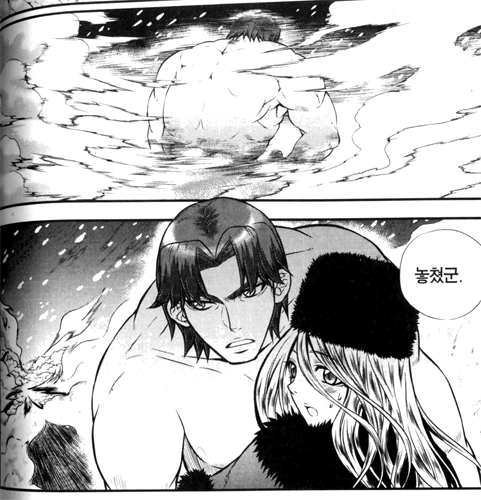
Genshiken II‘s been running for a while now, and every so often I go back and look at the earlier chapters of the new series (would you expect me to do otherwise?). Upon a recent revisit, it hit me just how much the artwork had changed between the inaugural Chapter 56 and its immediate followup in Chapter 57.

For comparison, here is Ogiue in Chapter 56 on the left, and 57 on the right.

There’s a clear difference between the two versions of Ogiue (or any other character) that can’t be chalked up simply to the gradual evolution of art style that happened throughout the original Genshiken. This change, given just how drastic it is, was more abrupt, though one has to keep in mind that the real life gap between 56 and 57 was almost a year (Chapter 56 was originally a one-shot that got turned into the start of a new series).

Because of how much softer and more cutesy Chapter 56 Ogiue is portrayed, my suspicion is that Kio’s style was affected by his time working on Jigopuri. Indeed, Chapter 56 of Genshiken actually came out in the middle of his run on Jigopuri.

In fact, if you look at one of the characters in Jigopuri, the little sister Kaname (pictured left), she looks pretty close to the Ogiue of Chapter 56. What’s also kind of funny is the fact that Volume 1 of Jigopuri features an Ogiue cameo on the inside cover, and it’s clear that the Jigopuri style hadn’t fully taken over Kio’s artwork yet at the time he drew it.

I think it’s interesting how an artist can get so influenced by how they’ve been drawing that it makes it difficult to shift gears back to a different kind of story. It’s different depending on the artist of course, but I have to wonder how much effort Kio put into switching into a less moe-type art style. Something tells me it wasn’t easy.

The Year of Fujoshi Figures

As someone who likes to keep track of fujoshi characters in anime and manga, I also tend to keep an eye out for merchandise if only to see how much coverage these characters are getting. Aside from the manga and anime they come from, there tends to be not much else, but one thing I’ve noticed is that, over the past months or so, multiple fujoshi character statue figures have been announced or released… which might actually make 2013 the Year of Fujoshi Figures, but we’ll let that slide.

First up is Wave’s “Beach Queens Shiguma Rika” from Boku wa Tomodachi ga Sukunai. A member of the “Neighbors’ Club,” Rika is a genius who is not only into homosexuality but also “mechasexuality.” All of the other female characters in her show, as well as from many other series, are in the Beach Queens line.

Next is Ryuusuke’s “Narumi Nakuru” (NSFW) from Mayo Chiki! A glasses-obsessed high school student, she gets her very own episode at the very end of the anime. This figure is not only expensive as all get-out, but it’s gigantic at a whopping 30+ cm in height. An important warning, this figure’s clothing is removable, so it may not be the best display piece.

Then there’s the “Excellent Model Limited Sazanka Bianca” from Aquarion EVOL. I wrote about her recently, and one thing I have to say is that in an interview with the writer of the series, Okada Mari, she mentions that Sazanka was meant to be a much more minor character but that she gained popularity after episode 4, which revealed her status as a fujoshi. Sazanka’s figure is an exclusive.

Coming from the Winter 2012 season is the Nendoroid Koujiro Frau from the popular Robotics;Notes. A programming genius, Frau (real name Furugoori Kona) is something of a recluse, and talks in real life almost entirely in internet slang. Might we expect a full-size figure of her at some point?

Finally, if you want to count it, there’s this “Gray Parka Service’s Homoo.” Homoo is an ascii art-based character from the mesageboard 2ch, and is meant as a parody of fujoshi and their behaviors. It (she?) crawls around on all fours, exclaiming “Homoo!”

So all in all, kind of a crazy year if you happen to be into fujoshi characters and you enjoy buying figures. That said, I have to wonder why there’s this increase, at all. Sure, there was the Ogiue figure from 2007 (which I gladly own), and some Ohno figures before that, but there seems to be an unusually high amount, likely because we’re seeing more fujoshi characters appear in these ensemble cast anime. With more shows out and on the horizon, I would not be surprised at all to see a figure of, say, Akagi Sena from Ore no Imouto ga Konna ni Kawaii wake ga Nai.

The Fujoshi Files 61: Yoshizawa Eri

Name: Yoshizawa, Eri (吉沢えり)
Alias:
Eri (えり)
Relationship Status:
Dating
Origin:
Fujoshissu!

Information:
Yoshizawa Eri is a member/current vice-president of the manga club at Ryouhoku High School, where she writes original doujin prose fiction and spends time with her best friends, Aoi Yuki and Satou Megumi. Ridiculed all her life for her overactive and eccentric imagination, her unusual but passionate stories were the catalyst for her friendship with Megumi in junior high. Extremely fashion-conscious with a large appetite, Eri views Megumi’s statuesque appearance with some envy, failing to realize that Megumi herself sees Eri’s round features and petite figure as much cuter than her own. Eri is a fan of many series, including Sengoku Basara and its hero, Date Masamune.

Eri is the last of her friends to enter a relationship, dating her younger brother Kenta’s friend and classmate, Mizoguchi Shigeyuki, though her initial reluctance to reveal her fujoshi side complicated matters. Though older than her boyfriend, Eri is also significantly shorter, creating a strong contrast between the two. She also has a very close, if at times typically raucous, relationship with her younger brother.

Fujoshi Level:
Eri gets easily lost in thought and fantasy while at “work,” the words flowing out of her fingertips with little effort. Though she is able to restrain her mindset in more general settings, she is most comfortable letting her imagination run wild along with her friends’.

Super Robot Wars UX is Full of Whippersnappers

A new Super Robot Wars game was announced yesterday, Super Robot Wars UX for the Nintendo 3DS, and the amount of new and unexpected entries makes me want to talk about it, as well as some other SRW-related thoughts.

I think you can roughly categorize Super Robot Wars into two types of games: the flagship titles, and the experimental ones. The former consists of the titles with the best animation and the most-anticipated anime entries into the franchise. The latter can go in a number of directions, from aesthetics (3D models instead of 2D sprites in Super Robot Wars GC) to gameplay (a switch from turn-based to real-time strategy as with Super Robot Wars Scramble Commander), but often times “experimental” simply ends up referring to the titles chosen for that game.

That’s pretty much where UX is. Just look at the debut works for this version.

  • Kishin Houkou Demonbane
  • Fafner in the Azure: Heaven and Earth
  • Wings of Rean
  • Cyber Troopers Virtual On’s Fei-Yen HD
  • Mobile Suit Gundam 00: A wakening of the Trailblazer
  • SD Gundam Three Kingdoms Legend: Brave Battle Warriors
  • Mazinkaiser SKL
  • Heroman

When you include the other titles that are in this game, the first thing that jumps out is just how new most of the anime are. Not only is the Mazinger franchise represented by its latest one-off OVA series, but the actual oldest anime in the entire game (and the only two from the 1980s) are Aura Battler Dunbine, and then Ninja Senshi Tobikage of all things. If it were a flagship title, there would have to be certain staples, but with a “lesser” SRW like this, it’s possible to inject a ton of new blood into it and not offend anyone.

Not only that, but when you look at some of the recent titles chosen for UX, they seem to be among the least likely candidates even among non-flagship SRW games. Brave Battle Warriors is actually an already-super deformed Gundam anime done entirely in 3DCG and based on classical chinese literature, the sort of title one would least expect to represent Gundam even with the fact that SEED Destiny and 00 are there. Though I’m sure it’s based on the anime version, Demonbane‘s inclusion may be the first instance (and correct me if I’m wrong) of a visual novel appearing in SRW, which opens the gate for things like Muvluv Alternative.

Heroman I wasn’t even sure counted as a giant robot anime, though I guess if you think about it, it’s basically a combination of Tetsujin 28/Giant Robo with Gold Lightan (though Gold Lightan has yet to make its debut). Possibly craziest of all is the inclusion of Virtual On in the form of a Fei-Yen dressed like Hatsune Miku. Virtual On in SRW Alpha 3 paved the way for non-anime/manga to appear in Super Robot Wars games, and this takes it to another level, as I’m pretty sure Miku Fei-Yen is nothing more than a model kit!

It might sound like I’m complaining, but I’m really not. I actually love it when SRW games go a little wild like this, though one complaint I do have is that the DS SRW games have never been the most impressive when it comes to animation. My issue isn’t even with the quality of the sprites or an unfair comparison to the exquisitely animated Z series of SRW, but that a lot of the shortcuts taken to try to make the games look better actually end up making them look worse. In particular, I’m referring to the way the DS games including UX incorporate cut-ins, and detail shots. Instead of creating the images to better match the sprites and the visuals of the rest of the game, the DS SRWs basically take screenshots directly from the original anime, and while this means things look accurate, it also sticks out in an odd way and messes with the way the attack animations end up looking in a manner which didn’t quite affect previous games with worse sprite animation.

But it might just be that with a game with this daring of a series list, some things have to give. In that case, I’ll take it, but will still hope for better the next time around.

In-Flight Mahjong, the Riichi-style Airplane Mahjong

Over the past few years I’ve had the opportunity to fly to other countries, and with flying comes checking out the in-flight entertainment. More often than not these days, in-flight entertainment includes a number of games from Chess to Tetris to even Doom, and sometimes the list even includes mahjong. While much of the time this refers to the tile-matching game, what I’ve found is that on Asian airlines it can actually refer to the real game we know and love. That’s how I found In-Flight Mahjong on Korean Air.

Actually, based on the full description provided, which used the phrase “match the tiles,” I ignored it for a while thinking it was going to be Shanghai, but curiosity got the better of me, for which I’m grateful. Programmed by the guys who make all of the other in-flight games (DHC or something?), the game purposely tries to aim for the anime fan audience by not only following the rules of Japanese-style riichi mahjong, but also boasting what it refers to as “anime-style” characters, which you can see in the videos below (trust me they’re worth it, if only for a healthy laugh).

I’m actually a little sad that I wasn’t able to record the audio (headphones-only after all). Whenever you see a character pop up in those videos with a “PON!” or a “KAN!” as in the first image above, just pretend they’re being exclaimed by people with heavily American-accented Japanese. The voice “acting” is anything but, though I don’t exactly hold my free game programmed to distract me for a few hours in between meals (which included bibimbap by the way) to the standards of Mahjong Fight Club or even Tenhou.

The game offers two modes: “quick game,” and “career,” which is meant to be like a single-player adventure mode (and in fact there is no multiplayer) with a few paragraphs to tell you whether you’re playing in a local parlor or at the end against some significant bigwigs. All of your favorite hands are there, though it refers to some in interesting ways (Chanta and Junchan are “Hon Chanta” and “Chanta” for some reason) The game offers three levels of difficulty, from easy to difficult, and of course I chose difficult out of some bizarre and fragile sense of pride. The computer opponents aren’t tough, but what I did notice is that on the difficult setting they tend to be extremely safe and conservative, and more often than not the rounds would end in a draw.

While this is not too surprising or annoying normally, it unfortunately comes with a peculiar rule in In-Flight Mahjong that rounds, at least in the South half of the game, will repeat if no one wins, even if East wasn’t in Tenpai. What this means is that the same round might last for 10 games in a row, and the only way to break out is to go for a win or hope a non-dealer computer pulls something off. Games that should have taken maybe half an hour total ended up taking about twice that.

Still, it is mahjong and definitely plays like mahjong, so if you happen to be flying to Korea (or wherever, as I assume this specific version appears elsewhere), and you have a desperate mahjong itch, you’ll know how to handle it.

The Japanophile Without Japan

Whenever we talk about the japanophile (or the wapanese or weeaboo or other terms), the rhetoric is that this person discovers anime (or something), starts to believe Japan is a superior country and culture to the one they currently live in, and if they stop believing, it’s because they realize that the ideal Japan of their imaginations does not match up with the truth. The assumption here is that because Japan is not simply the land of anime and Pocky, or ukiyo-e and sushi, that it trivializes the japanophile’s beliefs because there is this contradiction with reality. But what if we removed “Japan” from this process?

It makes logical sense for the japanophile to discover Japan, create a modified image of it in their head, and then desire it as a “superior” culture, but what of that potential for desire in the first place? Does Japan trigger this desire to be a part of a different culture, or is that sentiment already there to some degree, and that it takes Japan (or anywhere) to allow a person to focus those desires on a concrete example with a relationship to reality? As intelligent and visionary as human beings can be, there tend to be limitations as to how far we think or consider imaginary or hypothetical situations, and maybe this is just one version of that

If we remove “Japan,” then what we’re left with is a person who desires for a better culture and environment than the one they currently live in, where better means one more understanding, one which reinforces their beliefs and their wants. Whether that is out of some progressive vision or simply a venue to live out fantasies without consequence, I’m not stating any moral or intellectual prerogative to such feelings, but I almost find it to be a sort of utopian mindset.

Sexualization Without Objectification in Spotted Flower

When it comes to debates regarding how women are portrayed in media and entertainment, one recurring trend is the way that sexualization gets conflated with objectification. Whether it’s comics or not, Japanese or not, often times the two are presented as one, so it’s no surprise that there are readers who see them as one and the same and argue from a stance that reducing or removing certain depictions of women means a puritan-like removal of sexuality itself from media. While I don’t have the same problems with objectification that others might, it’s still an issue because this misunderstanding begets many other misunderstandings. It’s for this reason that I’m impressed by how the manga Spotted Flower handles the female body, and I think it gives a very clear case of how it is possible to draw sexual characters who aren’t necessarily sex objects.

A manga by Genshiken author Kio Shimoku, Spotted Flower is about an otaku husband and his pregnant non-otaku wife, and the small challenges they face as their lives enter a new stage. With a title referencing Madarame and Saki from Genshiken (Madara refers to spots—take note Naruto fans—and Saki means “bloom”) but clearly pointing out that the characters are not them, much of the manga revolves around how being an otaku can influence the relationship in certain ways. The other prominent theme, and the one I’m more concerned with for this post, is that of the pregnant wife’s sexual frustration. The problem the wife faces is that even through pregnancy she still wants sex and wants it badly, but it’s difficult for the husband to overcome the misconception that pregnant women are entirely different from sexual women (despite the act that it takes to get them that way). This makes sense, as depictions of pregnancy tend to focus on their motherly qualities and ignore the woman’s sexuality.

Spotted Flower does not draw that line in the sand. Much like his work on Jigopuri (about raising an infant), Kio doesn’t play it safe. He draws nudity. He draws bare breasts. He doesn’t shy away from showing sex and the desire for sex as very physical, mental, and emotional, but at the same time also doesn’t reduce pregnancy into a simplistic fetish or kink that you would find in some adult manga. He expresses the wife’s frustration in such a way that, even if she does not have the ideal body or the easy appeal of the “virgin” or the “nympho,” there is a kind of sexual attractiveness to her, an undeniable sensuality radiating from her which has little to do with the woman as object of desire and more as a person who desires.

As is obvious at this point, Spotted Flower is rather unusual in a number of ways, but it is also a series of possibilities and potentials. It pushes boundaries which probably shouldn’t be boundaries in the first place, and does so with a strong sense of characterization fans of Kio Shimoku have come to appreciate.

The Fujoshi Files 60: Aoi Yuki

Name: Aoi, Yuki (青井由起)
Alias: Yuki-kun (ユキ君)
Relationship Status: Dating
Origin: Fujoshissu!

Information:
Aoi Yuki is a student at Ryouhoku High School, where she participates in the manga club. An avid cosplayer, With her boyish looks and tall frame. Yuki has a preference for dressing up as male characters, including Ryuuji from Toradora! and Tezuka Kunimitsu from The Prince of Tennis. Having spent junior high hiding her true nature, she met her best friends and fellow fujoshi Satou Megumi and Yoshizawa Eri in the beginning of high school while looking for people she could truly open up to. A self-professed shotacon, in terms of her passions, her love of cosplay seems to edge out her devotion to BL, though both are quite strong.

Yuki began dating her boyfriend and childhood friend Sawaguchi Masaki (whom she affectionately refers to as “Maa-bou”) before the start of her second year of high school, and is the first among her friends to be in a relationship. Masaki tries his best to understand and be supportive of her hobbies, but the fujoshi lifestyle is too foreign for him to truly understand. In spite of this, it is clear that Yuki cares for him; when given a choice between Masaki and a fellow cosplayer and friend, Yuki chose Masaki.

Fujoshi Level:
Yuki may be a cosplayer first and a fujoshi second, but still owns about 300 doujinshi, and is keen to “BL” moments in her everyday life. Her doujinshi preferences and her cosplay preferences overlap considerably.

Variety Limits

I’ve often been told that I cherish variety in my entertainment (particularly my anime) to an unusual degree,  and if there’s one anime I find myself getting into disagreements over more than anything else, it’s The Sky Crawlers (second might be Xam’d: Lost Memories).

Directed by Oshii Mamoru of Ghost in the Shell fame, I reviewed The Sky Crawlers favorably, noting that the way it’s able to effectively instill in the audience the same sense of mind-numbing monotony that the characters themselves experience is something quite impressive. Of course, that also makes it difficult to watch, something that can bore you beyond the point of no return, so the debates over the quality of The Sky Crawlers tends to come down to the following question: how entertaining should entertainment be?

The argument against The Sky Crawlers is that you can make a film which conveys that sense of monotony in its characters without having to drag the audience down with it, but my feeling has always been that this is just not the same effect. However, what I realize as well is that, as a person who highly values variety of content and concepts in my anime, it’s not so much that I think the approach taken by Oshii’s film is superior, that there is indeed something inherently more artistic about making the audience live that boredom, but rather that it is a valid approach to take in making a work of art (or entertainment). In other words, I would not want all of my anime to be like The Sky Crawlers, and I do not put it above other anime as I do not prize experimentation above all else: I simply like the fact that something like The Sky Crawlers exists.

Broadening the point of view to not just focus on something as esoteric as The Sky Crawlers, I have to wonder how much people are willing to welcome greater variety in anime provided they get enough of the types of anime they enjoy. We can talk about how there’s too much of X or Y genre of anime and how it might be stifling the kinds we enjoy, but what if that wasn’t the case, and the popular thing was the niche and vice versa? Is any imbalance problematic, or are “problematic” anime okay if they’re in small doses?

Blink-801: Genshiken II, Chapter 82

“Just once in my life I’d like to grow a penis!”

-Yoshitake Rika

Yes, it’s that kind of Genshiken chapter.

Yajima’s birthday has just passed, and noticing that Yajima has never engaged in a truly candid discussion with fellow girls, Yoshitake tries to get the straight-laced Yajima to open up moe. When the two discover a strange object in the club room, Yoshitake immediately assumes it to be an enema plug, and as the two let their imaginations run wild, the two narrow down the most likely owner of the plug to be Hato. As Hato and Yoshitake give their belated presents to Yajima, it becomes increasingly difficult to ask him about the enema. However, it turns out that Hato knows nothing about it, that it’s actually Ohno’s, and that it’s simply a small accessory from one of her cosplay outfits.

That Yoshitake and Yajima believed the owner of the “enema” had to be a guy is very telling of the ways in which yaoi has influenced their imaginations. Rather than simply limiting it to fujoshi psychology, though, I feel like the characters this chapter are showing more delusions run rampant, as if BL was more a key to a forbidden kingdom of the mind. It’s interesting how this contrasts with the predominantly male Genshiken of old in that awkward expression of sexuality has been a part of Genshiken since the very first chapter, and was something of a constant throughout the series, but it usually took the form of professing doujinshi or character preferences. It was certainly never to the level that the guys would wonder aloud about genitalia, and in hindsight it lent a good deal of realism to the series, both in the fact that they all had their own quirks and kinks, and that they were embarrassed about it and kept things understated.

When I think about it, the female characters have always been the ones to discuss sex and relationships more directly. Whether that’s Kasukabe describing her “friend’s” doggy-style with her boyfriend, Kasukabe asking Ohno if she and Tanaka had done it in cosplay, or even Ohno and Ogiue’s tough heart-to-heart discussions, the girls have done a lot less tiptoeing around the subject of sex. It’s even clear from this chapter that Yajima is pretty open with Mimasaka as well, relatively speaking, even telling her all about seeing Hato naked.

Yoshitake, however, takes that prospect to an all-new extreme, and I don’t know if that’s because she’s a social fujoshi of a younger generation, or if it’s just because she’s weird. Either way, the manga portrays Yoshitake as a character who at least wants to be unafraid of taboos, and the fact that she almost manages to ask Hato directly about the “enema plug” shows her as a person who can overwhelm whatever fear of awkwardness might still linger within her. Also, as this chapter and previous ones have shown, get a little alcohol in her and all bets are off. The quote at the beginning of this review is followed by Yoshitake declaring that anyone interested in BL has to wonder about having a penis, a line which certainly blows Ohno’s famous “There’s no such thing as a girl who hates homos!” straight out of the water.

One thing I like about Genshiken is the way in which details are not forgotten and can come up again in later parts of the story. One example is Yoshitake’s hair, which had more of a wavy look in the earlier chapters and then became much straighter down the line, which was explained previously as Yoshitake perming her hair to look good at the start of the school year but being unable to keep up with it. In this chapter, the detail which caught my eye was Hato’s present to Yajima, a basket of skincare products. Back when the first years originally all hung out in Yajima’s apartment, the manga showed how Yajima had a complex about her poor skin condition when compared to Hato’s meticulously kept complexion. It’s unclear whether Hato’s realization of this came from some implied off-panel moment or if she picked up on it way back, but the gesture is clear that she wants to help Yajima look better and feel better. Speaking of, in the image above of Mimasaka you can really see how she is perhaps held back by her own lack of fashion sense, similar to Ogiue in the old days.

The previous chapters with their heavy focus on Madarame and Kasukabe casted a fairly large shadow on the newer characters, but I think this chapter shows how well the new characters can hold up on their own side of things. They’re different from the old crew in many ways but there’s still a sense of relatability to them, and they’re interesting characters in their own right. Next chapter though looks to be focused on Ohno, who actually has never gotten a whole ton of coverage in the manga. I wonder if it’ll have anything to do with her tendency to put off getting a job and entering the “real world.”