Introduction
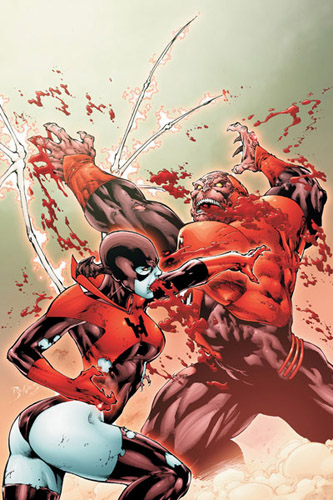
When it comes to the controversial approach to sexuality in superhero comics, probably nothing is more exemplary than the oft-seen exaggerated pose where a female character twists her torso such that both her butt and her breasts are facing at the reader directly. Known as the “brokeback,” the pose is frequently the target of criticism as an example of sexualization gone wrong. Generally, the criticisms concern the fact that, as action-based stories, the pose is a completely impossible and extremely impractical thing to do in fighting. The idea is that, by showing them as such, comics communicate the idea that when it comes to female characters the T&A is more important than their identities as heroes or characters in general.
The point at which I might diverge from other opinions is that I believe strongly in freedom of artistic expression and think that such works have a right to be drawn and a right to be enjoyed by readers on a sexual level. While I think that the disparity in idealization between genders can definitely be too much, something has to be said for the fact that the visual arts in general can make the impossible happen in the first place. If people are literally physically incapable of contorting themselves into the “brokeback” pose, then mediums such as comics are the only places where it is possible at all.
I also think people have the right to admire a character while simultaneously desiring her or the pose that she’s taking. Again, the fact that forms of fiction such as comics make it more than possible for the portrayal of a female character to be an effective fighter while doing the least physically sensible thing possible is not an inherent negative, as long as we’re being honest about the fact that it is indeed done for sex appeal. No matter how much we’re able to point out that those contorted positions would shatter someone’s spine, or that other poses come straight out of pornography, they successfully generate sexual attraction. Individual tastes may vary, but they’re also called “porn poses” because they work, and at the end of the day pornography drawn or otherwise does not automatically turn people into misogynists.
But while the act of making or consuming such products causes no harm in and of itself, when the brokeback pose becomes the default method for portraying sexual attractiveness, it creates two major problems in particular. First, while anyone has the right to enjoy any type and degree of sexualization, if the goal is to try and attract a larger female readership, then no one should be surprised when such portrayals lessen their desire to pick up superhero comics. Second, and what will be the primary concern in this article, is that by having that style of sexualization be so ubiquitous, it creates a singular image of how a female (character) is supposed to look when they’re being “sexy.”
Sex as Character
Over the month of February, comics news and editorial site Comics Alliance published a series of articles on sex in comics. One of the articles discussed Adam Warren’s Empowered, where writer David Brothers argues that, even though Empowered is more sexually explicit and has more overt fanservice than regular superhero comics, it still approaches the topic of sex in a much healthier and more mature fashion.
Although a majority of commenters have voiced their understanding of David’s points and explanations, there are a few dissenting responses which I found interesting for what they imply. The recurring criticism, which not only appears in David’s article on Empowered but also many of the other posts, basically calls out the writers for having a double standard, praising the portrayal of sex in indie comics, while lambasting the presence of sexuality in superhero comics, in something of a high art, ivory tower, porn vs. erotica-type argument. Another criticism leveled at Empowered in particular, is that its crass displays of actual sexual content and juvenile-sounding dialogue make it worse than the other superhero comics to which David compares it.
I think David actually addresses this well in the article itself when he describes the primarily sexual relationship in Empowered, that of the main heroine, Emp, and her ex-henchman boyfriend, Thugboy:

Empowered‘s eponymous heroine is a superhero with issues. Her costume is too skintight and ineffectually fragile, and neither her teammates nor her nemeses respect her. She gets tied up way too often for her liking.
…
They both get different things out of the relationship, aside from just sex. Thugboy clearly loves Emp, and expresses that in a way that’s both a little paternal and a lot touching. He gets her issues with her body and career, and when she doubts herself, he’s there to point out how wonderful she is. He supports her, and the reverse is true, too.
More important than that, though, is the fact that she’s comfortable expressing her insecurities to him.
The thing to take away from their relationship is that when Emp has sex, it’s not simply a display of sex but rather shows the specific scenario of “sex with Emp.” It takes all of the various bits and pieces of her characterization and doesn’t forget them even during moments of titillation. The trouble with how sexuality is frequently visualized in superhero comics then, assuming the goal is to show female characters in a sexual manner in the first place, is that this level of specificity doesn’t exist in most portrayals. Rather than a female character making a sexy pose, it becomes a female character conforming to a sexy pose template, no matter her personality, history, or quirks. When combined with the way that superhero comics can grow and reinforce bad ideas, we end up in the current situation where this approach to sexuality generates an entrenched position that causes people to staunchly defend it as if it is simply the way that comics communicate “sexy,” as if there is little alternative.

The issue of posing isn’t confined to just “bad” artists, as the above example from Jim Lee demonstrates. Taken from his famed X-Men run in the 90s, the image is well-drawn and the women are idealized without necessarily going off the deep end, but aside from Jubilee (front) all of them are taking the same sexy stance. Psylocke (left), Rogue (center), and Dazzler (right) all have very different backgrounds and personalities, so it seems strange that they would all be in the same pose. This goes double when you compare them with all of the male characters, each of whom showcase their individuality in the way they’re standing or sitting, or Jubilee once more, whose “attitude” comes across in her slouched position.
Again, there’s nothing wrong with showing attractive girls in exaggeratedly attractive poses in and of itself, nor is there any fault in enjoying them, but superhero comics are in the business of creating unique, iconic characters. This is why they have different origin stories, different costumes, and different powers. The goal is to be able to see how a particular character stands out from the rest, and if sexuality is involved, then comics can benefit from making sure that the erotic is also made to fit the characters.
Alternatives from Anime and Manga
I’m going to steer away from superhero comics and take a look at anime and manga, a territory I’m much more familiar with, and one which I find provides some strong examples of works where the sexuality of their characters is both emphasized and individualized. This is not to say that anime and manga are devoid of sexism, or that any of the examples shown below are perfect in their portrayal of women. Instead, I want to show how these works go out of their way to portray their characters’ sexuality in ways which also reflects their unique characteristics, and to point out how the issue with pushing just one type of sexuality can be an issue even when the goal is to portray characters in a sexual fashion.

Senjougahara Hitagi (above) and Kanbaru Suruga (below) from Studio SHAFT’s Bakemonogatari/Nisemonogatari
The first title is Bakemonogatari (and its sequel Nisemonogatari), which features a number of attractive and highly-sexualized female characters. The characters depicted above are both the same age and both attracted to the main character. However, Senjougahara’s seductive body language is fed by her sardonic personality, whereas the athletic Kanbaru, a self-admitted pervert and an exhibitionist, shows a more forward and aggressive approach. What isn’t as clear from these screenshots is that the show banks on their sex appeal being highly individualized down to the very way that conversations happen.
 Left to right: Ran, Madoka, and Muginami, from Rinne no Lagrange by Studio XEBEC/Production IG
Next is the recent Rinne no Lagrange. The three main characters depicted above are all clearly meant to be attractive, but in addition to having varying styles of dress which set them apart at the same time that they emphasize their figures, the three girls also literally sit differently. Just having them relaxing on chairs in unique manners suggests the differences (as well as differences in physical appeal) between them, and I might even go so far as to say that a person could get a rough idea of their personalities based on this image alone.
What of the brokeback itself, then? Is the pose forced to contain only one connotation, such that it cannot become a characterization factor? I believe the answer is that any way of posing a character, even the brokeback, does not automatically void its own potential to be a factor in showing a character and their particulars. The easy answer here is that if some seductress character wanted to stand that way to entice men sexually (and I’m assuming heterosexuality here mainly because that is the site of this debate), then it would make sense, but it doesn’t require that the character herself to be hypersexual, provided that it does not take over her overall portrayal or the view of sexuality in the comic itself.
 Akashi Kaoru (right), heroine of Zettai Karen Children by Shiina Takashi
In these pages from Zettai Karen Children, we have its main heroine Akashi Kaoru standing in a way that emphasizes both her chest and her rear. It’s in the context of “stretching for a run,” which lends some practicality to it, but as I said in the introduction, I find arguing from a point of realism as if to say that once you undermine the physics of the pose, you break its spell to be a flawed one, somewhat like arguing that Superman shouldn’t fly with one arm out because that would just create unnecessary wind resistance. Instead, the reasons I see Kaoru’s pose as being be different on some level compared to the typical broke back are that first, the twist of the torso isn’t quite as exaggerated, and second, it is shown to be just one pose among many within these two pages, let alone the rest of the book. Her stance is neither the primary display of athleticism nor the primary display of Kaoru herself, and on top of that she contrasts with the other girls shown.
To re-emphasize, my goal with these examples isn’t to assert some kind of general superiority of manga over American comics, but to say that the problem with having the brokeback and what it represents be the default for comics in general is problematic for more reasons than simply “sexism.” Comics and other media don’t necessarily have to go so far as to possess the highest quality of characterization, nor do they have to be the most tasteful or thought-out. Rather, if the goal is to create unique characters, then that uniqueness shouldn’t be subsumed by some generic template, sexual or otherwise.
Conclusion
The topic of poses and how they emphasize female sexuality in certain ways almost inevitably leads from the action of the body to the body itself. That is, the idea of “defaults” and “templates” can also encompass specific body types, and even a cursory glance at superhero comics shows that certain proportions on women are far more prominent than others. To address the issues of “body” and “body image” would make for an entire essay (or several) in and of itself, so I won’t touch on it except to acknowledge it, and to state that, like the brokeback for poses, the “big-breasted porn star” look isn’t inherently valueless, but it can be abused. Instead, the real problem lies not in the porn poses or the porn star bodies in and of themselves, but in their sheer ubiquity, as the singular image of sexuality that they create winds up narrowing the overall perception of beauty and idealization in comics. However, by broadening the approach to sexualization and showing that different forms of “erotic” exist, it is possible for even female characters with extremely similar bodies to show a greater degree of variety as characters, and can help to expand the number of ways a woman’s sexuality can be portrayed.




 OGIUE MANIAX