While in Japan last winter, I decided to check out one of the oldest soba shops in Tokyo, Kanda Yabu Soba. The restaurant dates all the way back to 1880, during the Edo period, and comes from a time when soba got famous as a fast food for busy people.
To my surprise, my group managed to get in. While the wait was somewhat long—around 30 minutes—it was nowhere near as bad as I was expecting for a restaurant with its reputation. When our number was called, we sat down at one of the traditional floor spots (as opposed to having western-style chairs), and I ordered seirou soba: a plain buckwheat noodle, served hot with a thin dipping sauce.
It was literally the best soba I’d ever eaten. The noodles were simple but satisfying with a fresh buckwheat taste with lots of depth, and the restaurant also offered hot water at the end that you could mix with your remaining dipping sauce to create a nice after-meal broth. Not only that, but it was very affordable, not even factoring in a strong dollar to yen exchange rate.
Japan is a land of genuinely good food at reasonable prices, and Kanda Yabu Soba is a prime example. While this value is most apparent in the many convenience stores that dot the country, what’s truly mind blowing to me is that even a nationally renowned, 144-year-old restaurant would still be so accessible budget-wise. But even putting aside such a long-lived establishment, I find that the US, by comparison, suffers from high rent, the cost of real estate, and the segregation of communities due to the prevalence of car culture. These factors make it almost impossible for niche restaurants to get off the ground and remain reasonably priced.
My only regret about going to Kanda Yabu Soba is that I didn’t have the opportunity to try more than the basic. It was excellent, of course, but now that I’ve had the seirou soba, I want to try their more elaborate options (like the one with duck!). That’ll hopefully be for next time, if I happen to be in the area again.
Bang Brave Bang Bravern is like an anime that has traveled through time to reach us in 2024, but it’s not clear whether it came from the past or the future.
The show’s creator, Obari Masami, is near-synonymous with mecha. He’s been involved since the 1980s with works like Dancouga and Gravion, he’s the reason the Brave Pose exists, and they even bring him in to animate giant robot parodies in other genres. So when he announced a new series in the form of Bravern, I wondered what form it would take, especially with him as director and mecha designer.
The answer is: one filled with shocking twists that are as baffling as they are exciting. This is very much intentional, as the initial promo material and even most of the first episode has you believing that Bang Bravern is on the grittier side, with mecha as weapons of war. The first meeting between its central characters, Japanese soldier Ao Isami and American soldier Lewis Smith, seemingly portends a story about true camaraderie on the battlefield.
Then everything goes into Obari Overdrive. A shiny red robot shows up, literally shouting all his special attacks with a sincere level of camp. This namesake, Bravern, is a heroic sort who draws a lot from the Brave franchise, especially the bonding of kid and robot that is a hallmark of those anime. Only, Isami is a grown man instead of a wide-eyed grade schooler and reacts with a mix of awe and horror. The arrival of Bravern then kicks off a culture clash between the serious original setting and its brightly colored new reality that leaves everyone perplexed and hesitantly hopeful in the face of imminent doom.
During all this, we’re treated to the opening and then ending themes. The former is a blood-pumping super robot song that draws from the genre’s collective past, with shades of Godannar, Gaogaigar, Daiohja, and even Space Battleship Yamato. The latter features Isami and Smith in the rain, slowly undressing themselves as they sing dramatically like they’re starring in a musical. Together, these two songs encapsulate much of what Bravern is about.
And that’s only the first two episodes!
At least one shocking revelation or pivotal moment hits every episode, in a manner reminiscent of both Gurren-Lagann and Samurai Flamenco. The stakes keep escalating in wonderfully outlandish ways so frequently that Brang Bravern feels like 52 episodes got condensed into 12. The result is a show that leaves little breathing room for major moments, but also appears to act as an acknowledgement that giant robot anime comes from a time when year-long shows were the norm—and that such an era has long since passed.
With its muscular and passionate men in a setting that’s normally about masculine bravado, Bang Bravern might give the impression that it’s queerbaiting. In reality, it’s not really a bait: The show is very gay. At the same time, it feels very different from a lot of other works in that territory. For one thing, the attractive guys are also surrounded by attractive girls and attractive mecha, making it a smorgasbord of hotness all around. And amidst all this cheesecake and beefcake, the story told by Bang Bravern cuts to the heart of living up to childhood ideals.
This isn’t really plot spoilers, but the final episode plays the opening but with added sound effects like explosions and clanking sounds. This is a reference to the fact that many giant robot anime of yesteryear would at some point change their openings to include similar SFX. I think that says a lot about the spirit of Bang Brave Bang Bravern.
When I first tried the hololive fan game Holocure, I was stepping into a recent video game genre that I had never experienced. But things were different with the developer’s new hololive-themed title: the side-scrolling beat-em-’up Holo X Break. In it, players take control of the members of NePoLaBo (hololive’s 5th generation) and brawl their way through waves of goons in order to defeat Secret Society holoX (hololive’s 6th generation) and rescue the CEO of hololive, Yagoo.
Beat-’em-ups are near and dear to my heart. I remember being a small kid, barely able to reach the joystick at my local Blimpie’s arcade section, staring in awe at games like Final Fight and Teenage Mutant Ninja Turtles. They were once the games that best showed off the heights of video game graphics, eventually becoming a decidedly “retro” genre as the decades passed.
A big part of the appeal of Holo X Break is, naturally, getting to indulge in hololive fandom. All four initial playable characters have their own strengths, weaknesses, and unique abilities based on their personas. Nene is a peppy girl from another world who throws beetles and can heal herself and others. Polka is a witty clown who has a balanced moveset and can create objects out of thin air. Lamy is an alcohol-loving snow elf who can magically freeze enemies. And Botan is a lion girl whose skill in FPS games translates into a specialization in ranged weaponry. Everyone is voiced by the VTubers themselves, and numerous cute references and cameos are also strewn throughout.
The gameplay stands on its own quite well, though I found that I had to get used to its pecuilarities. Holo X Break is a curious mix of genres, built on the straightforward nature of beat-em’ups but also adding in randomized power-ups in the vein of rogue-like descendants such as Holocure. But unlike Holocure, a lot of the extra things you can do are not just automatic, and have to be actively selected. Between the core movesets featuring both basic and special techniques and an ultimate, five item slots you can fill with weapons and healing that you have to cycle through in real time, and the equipment that you can pick up and wear (or store for later)—all while being attacked by throngs of enemies—and it can feel overwhelming.
With time, I got the hang of things, especially when I realized how the game wants to be played. I wanted to hoard items, but Holo X Break discourages that, and intends for you to use your weapons liberally. It wants you to spend coins to upgrade your equipment in between stages as much as possible rather than trying to “save more for later,” even punishing you by taking away all coins upon death. Different enemies require different tactics, and figuring out who to prioritize when they gang up on you is part of the challenge. According to the developer, Holo X Break is heavily inspired by the game Little Fighters 2, but given that I’ve never played that, I find that it feels more like the older Technos games: Double Dragon, River City Ransom, etc.
Speaking of enemies, I’ve always loved fighting bosses in video games, and having them be the members of holoX (a group I adore) only adds to the charm. Just like with NePoLaBo, they’re voiced by the actual talents, and their identities have been adapted in fun and interesting ways. Fighting against them feels a little more akin to taking on a Mega Man robot master, with the way you have to take into account their different abilities and movement tendencies. Getting to see La+ Darknesss shoot orbs of dark energy and summoning bolts of obsydian lightning is nothing short of rad.
While I had some setbacks (Lui in particular can be a real skill check), I did beat the game within a day. When I went online to check out other opinions, I found that its reception is a lot more mixed than holocure’s, and much of it seems to come from simple unfamiliarity with older beat-’em-ups, as well as the modern belief that gameplay should be a more streamlined experience. The game currently has no save system and unlimited continues, which brings me back to my childhood while being a source of frustration for others.
In light of this, the developer plans on adding saves. I’ve also seen comments about not being able to get past the first boss, Koyori, despite playing for hours, and it made me realize just how difficult stepping into an unfamiliar genre can be, especially with a game that doesn’t pull its punches. One review complained that they were tired of just hitting the same button over and over—something that didn’t really bother me in the least, and hadn’t even realized was an issue in the first place. I actually don’t necessarily enjoy when games have all the fat and excess shaved off, so to speak, and I appreciate Holo X Break for not taking that route.
I haven’t gone through everything Holo X Break, but I hope to savor every piece of it. And while I’m still looking forward to seeing holoX in Holocure, I’m happy to see them here. Now, if only I could play some co-op for the true beat-em’up experience.
I’ve been keeping up with the One Piece manga for many years now, though I don’t write about it all too often because I don’t feel the need. When the subject is one of the most gargantuan works of fiction in history, it’s not hard to find opinions, articles, podcasts, and videos discussing—or even dedicated entirely to—One Piece. However, the events of recent chapters, particularly the actions of certain characters, have been so significant that I feel compelled to share my thoughts.
Naturally, I’m going to be talking about HUGE SPOILERS for the One Piece manga. To the anime viewers and anyone else who doesn’t want the surprise ruined: turn away now.
The milestone in question is the long awaited arrival of the Five Elders into the main story and the full debut of their monstrous alternate forms. The impact they have is almost unparalleled—something that only a select few series can ever accomplish because they lack the longevity. The only one that springs to mind aside from One Piece is Detective Conan, whose main bad guy is still shrouded in mystery even after some major revelations.
In action manga, especially the shounen battle genre, villains come in many forms and can often be among the most exciting and interesting characters: minor nuisances, archenemies, rivals, erstwhile allies, etc. But one area that can make or break a battle manga is the appearance of a major antagonist, especially one that has been built up in the background. Freeza in Dragon Ball is an iconic example of this being done well, from the first mentions of him, to his initial reveal, and then to Freeza’s many transformations. The span of Freeza’s debut to his true form was a little over a year, or 58 chapters. The anime stretched it out even longer, as it was wont to do.
In contrast, the Five Elders in One Piece first showed up in 2002, and their descent onto Egghead Island happened this year in 2024. That’s 22 years, and over 860 chapters—enough time for infants to grow into full-fledged adults. And what’s even more astounding is that the Elders actually lived up to literal decades of anticipation!
On a very basic level, part of the reason the Five Elders are worthy of the hype is their physical appearance. They are legitimately menacing and bizarre in a way that none of the most dangerous and freakiest of Luffy’s foes thus far can match. All five are based on demons and mythological creatures, and they exhibit a new level of uncanny. Moreover, their powers are such that merely gazing upon them knocks the average soldier unconscious, and even Luffy’s new “Sun God Nika” form can only stymie them temporarily. In other words, the Elders look and feel like unprecedented threats to the Straw Hat Pirates.
Beyond the artistry in their designs, the weightiness also comes from how these monstrous forms have been mostly kept under wraps for so many years. Aside from an earlier hint when Sabo infiltrated their domain (which showed the Elders’ silhouettes transforming), it wasn’t even clear that they were physically strong in their own right. After all, as the heads of the World Government, it could easily be the case that they were just a group of wizened old men who rule through intellect, hegemonic inertia, and political influence. The fact that they’re actually capable of outclassing nearly every other character in One Piece is both a great twist and a satisfying fulfillment of the core of shounen battle manga. Why wouldn’t the literal leaders of the world also be the biggest badasses around?
The Five Elders also now open up even more speculation:
Why are they able to regenerate from any damage, and is there a catch that might just be their Achilles’s heel? And why are the Giant Pirates able to hold their own against the Elders?
Their names are references to five of the planets in the Solar System: Saint Jaygarcia Saturn, Saint Marcus Mars, Saint Topman Warcury, Saint Ethanbaron V. Nusjuro, and Saint Shepherd Ju Peter. Three of the other planets have references in the Ancient Weapons: Poseidon, Uranus, and Pluton (remember that this series began before Pluto was officially redesignated to a dwarf planet). What is their relationship, and could the Ancient Weapons somehow be key to defeating them? The two Weapons we know about in detail are associated with the sea—Poseidon is a mermaid who can control the massive Neptunians, and Pluton is the greatest battleship in history—so might the Five Elders be vulnerable to water in a way similar to Devil Fruit users? And could their distant-yet-absolute dominion over the world of One Piece have to do with a profound fear of the sea?
And what of their true leader, Imu? How can beings as powerful as the Five Elders be subservient to this individual?
One Piece is currently on a brief hiatus. This might be for the best—not just for the author, Oda, but for us readers. Maybe we need this breather before things get even more unpredictable.
Frieren: Beyond Journey’s End is a major hit, and deservedly so. In an age where fantasy anime and manga often lean heavily on gaming and RPG tropes to a fault, here instead is a much more conventional setting that also isn’t prone to the typical older swords-and-sorcery clichés. It’s a marriage of old and new while quietly forging a path all its own.
Unlike many titles in the genre, Frieren: Beyond Journey’s End takes place after defeating the big threat to the world. Its heroine is the quiet elf mage Frieren, who helped vanquish the Demon King as a member of the party of heroes. Due to the nature of her species, Frieren is extremely long-lived: To many, their 15-year quest would be a milestone, but to her, it’s just a drop in the bucket. However, at the funeral of an old party member, the kindhearted (albeit somewhat vain) hero named Himmel, Frieren realizes just how life-changing that “brief excursion” really was. In response, she embarks on a new adventure that has her retracing the steps the Party of Heroes took, gaining a new appreciation for both the past and the present, and the people who walked into her life.
Essentially, Frieren: Beyond Journey’s End is like an epilogue extended into an entire series of its own.
The original manga is currently serialized in the magazine Weekly Shounen Sunday. This ostensibly places it in the same demographic as works like Detective Conan and Inuyasha, but it also doesn’t carry the same essence as your average shounen or their typical power fantasies. Sure, Frieren can be seen kicking ass and schooling the ignorant, but what makes her an incredible heroine is not the ability to sling deadly magic or her many years of honing magic. Rather, it’s the way Frieren has very different priorities when it comes to magic.
Her real motivation is collecting fake grimoires and spells of all kinds—especially ones that are often considered mundane or even useless by others. Frieren is like a master chef from the world’s most highly rated restaurant whose eyes light up every time she gets to try the latest fast food gimmick item or cheap street stall. To her, the beauty of magic is most deeply reflected in the small and humble spells, and Frieren’s experience makes her marvel at both the familiar and the unfamiliar. There’s only one very specific exception, and it’s where Frieren is most able to show her true power in combat.
I relate to Frieren and her ideals a lot. In the pursuit of my hobbies and interests, I try to view them through a lens of discovery where silly little things are valuable in their own right.
Frieren has neither rose-tinted nostalgia for the past, nor a conviction that the forward march of progress is inevitable. Some things used to be better, some were worse, and contemporary cultures are a product of centuries of change and development but also the fading of memories. Even magic is affected by cycles and trends, which is something Frieren tries to convey to her student, Fern, and also anyone willing to listen.
The combination of the epilogue-like nature of the series, its heroine’s personality, and her tendency to take a very long view on things makes Frieren: Beyond Journey’s End feel more like equal parts fantasy adventure and travelog in the vein of Kino’s Journey. Episodes can take place over the course of a day or even six months, and travel companions will sometimes literally mature. The series also often flashes back to moments with Frieren’s original party to provide context or an interesting parallel to her current journey. And much like Kino, when things go down and action is necessary, characters don’t disappoint.
While Frieren: Beyond Journey’s End is not entirely devoid of console and PC RPG tropes (the hero and demon lord archetypes are chief among them), I want to reiterate just how much the series is not an isekai, a reincarnation story, or based heavily in the aesthetic trappings of RPGs where badassery is the main appeal. Sure, it can scratch a similar itch because Frieren is often secretly the strongest person in the room, but the series doesn’t rely on those tropes as lazy shorthand in lieu of actually being accessible.
In other words, this is potentially a perfect gateway anime that also holds up for longtime fans of anime and manga. With Frieren: Beyond Journey’s End, you have a reminder that sometimes a work is popular not because it appeals to some lowest common denominator, but because it’s just solid storytelling with compelling characters, an interesting world, and a narrative that encourages thoughtfulness. It’s definitely going on my list of all-time greats, with Frieren herself being one of the best to ever do it.
And by “do it,” I mean appreciate life and all its wrinkles.
Sometimes, I think about how so many members of hololive have “other personas,” and I don’t mean past lives as other streamers or entertainers. More than simply being a yandere-esque hidden side, they’re more like split personalities or alter egos. Some come from lore, while others are developed over time. It really reminds me of what we see in pro wrestling.
Haachama, Eater of Worlds
Akai Haato, aka Haachama, is arguably the most famous example of showcasing alternate identities. What began as a conscious decision to move from low-key tsundere schoolgirl to unpredictable eccentric eventually turned into an interactive narrative, and then as two possible ways for Haachama to stream. You never know which one you’re gonna get, and it gives special meaning to her self-proclaimed title of “World’s Strongest Idol.”
While I once compared her to Brian Pillman and Matt Hardy, this versatility also reminds me of the late Bray Wyatt, who drastically evolved his gimmick over time to feature multiple contrasting identities. At one point, he would switch between being a disturbed children’s show host and the otherworldly Fiend. Before that, he was a bayou cult leader. Every time, it felt like a grand opportunity to peer into an unpredictable mind, and this is what Haachama brings as well.
Moona Hoshinova and Gawr Gura, and their Demons
Moona from hololive Indonesia is supposed to be a college girl who also works as an idol and a singer. According to her official bio, she is sometimes taken over by another self called “Hoshinova,” who has a deeper voice and a sadistic streak. The transformation is best showcased when she performs her original song “High Tide,” further emphasized recently by a change in eye color. It’s as if having the two sides allows her to be both silly and serious.
Similarly, Gawr Gura has her “red version.” It wasn’t originally part of her lore, but it became a feature of her character with the release of her original song “Reflect.” This facet is part of the song’s lyrics, and even factors into her animated short Shark’d. Red Gura doesn’t appear often, but when she does, it’s special.
Because their alter egos appear more rarely, they bring to mind wrestlers like Jushin Liger and Finn Balor. Each has had a special transformation where they get more fierce: Kishin Liger and The Demon, respectively.
Ayunda Risu and Shirakami Fubuki, Masters of Versatility
Moona isn’t the only hololive Indonesia member to have two contrasting sides: her fellow genmate Ayunda Risu also divides herself between being the high-pitched Risu and the silky-smooth Ayunda. Over in Hololive Japan, fox girl Shirakami Fubuki sometimes turns into the darker Kurokami Fubuki. In both cases, the transformations highlight the vocal talents of the performers. Risu is regarded as one of the best singers and possesses impressive range, while Fubuki is famous for her impersonations.
These transformations are similar to the difference between Mutoh Keiji and his other self, the Great Muta. Unlike so many other transformations, Mutoh and Muta actually wrestled different styles—not unlike how Risu and Fubuki can significantly change their voices.
The Many Faces of Amelia Watson
The time-traveling detective has gone a different route by creating an entire story built around a multiverse. According to herself, Amelia is just one of an infinite number of Amelias whose ranks include smol gremlins, bees, muscular hulks, and more. Here, Amelia shifts her personality slightly and treats each model as a different entity, but they’re all fundamentally the same persona.
In this way, Amelia resembles latter-day Mick Foley, who would wrestle as all his various gimmicks: The violent Cactus Jack, the disturbed Mankind, and the groovy Dude Love. And like how Mick once actually appeared as all three in a Royal Rumble match, it was once not unusual for Ame to feature her parallel selves. These days, it happens much less often.
Other Occasional Gimmicks
There are a few who will have creative costumes meant to be alternate selves. Inugami Korone has her fur ball model. Kureiji Ollie has Olivia (see above), a meek human version who never died. Takanashi Kiara sometimes has her stream taken over by Frogiwawa, a gun-toting amphibian version of her.
These I would consider similar to one-off jokes. Elias once became his brother, Ezekiel. Braun Strowman once came out in nerd glasses claiming to be a sibling named Brain Strowman. This approach makes for a bit of enjoyable mirth.
The Power of Possibility
I think the consequence of these alternate selves is that it allows a greater degree of creative freedom and a chance to experiment. Just like in pro wrestling, doing this seems to help prevent a VTuber from getting too boxed into being a specific way no matter what. It can help break up a sense of monotony, and hopefully just make things fun and fresh for the creator and audience alike.
March was a hell of a month and kind of a bad time for fans of Japanese creators, between the deaths of Toriyama Akira, Tarako (the voice of the main character in Chibi Maruko-chan), and Inomata Mutsumi (character designer on the Tales RPG series). I feel like I’m still reeling from the passing of Matsumoto Leiji and Kimura Takahiro last year. It drives home to me the conviction that I need to cherish artists, performers, and creators—because you never know when things might change.
At the same time, I’m still high off the hype of hololive 5th fes. I can’t stop watching all those wonderful performances, and I’m looking forward to whenever the Blu-ray comes out. And how about that Bravern, huh? Expect a review soon.
April is when the Japanese school year starts, and while that has nothing to do with my life, I feel a sense of renewal in the air. Maybe it’s my imagination.
The spring 2024 anime season is upon us, and it is stacked, especially when it comes to returning series and sequels. Here’s to hoping that Shinkalion: Change the World actually gets picked up for streaming!
Spotted Flower Chapter 45 is out in the physical edition of Rakuen (digital is end of March). Kio also shows off all the issues of Rakuen he’s collected.
Kio retweeted a previous tweet of his showing an old model kit of the L-Gaim MK-II that he tried to rework and improve. It’s not quite to his liking yet.
The adult video version of Kio’s 18+ doujinshi was on sale (ended 3/11). The tweet includes one old drawing, and I believe one that’s entirely new (on the right).
Kio reacts to the death of Toriyama Akira. “Ever since I discovered Dr. Slump in my boyhood days, I was happy to have the art of Toriyama Akira with me through life. May your soul find happiness.”
Kio finally finished reading through the 7th The Five Star Stories Designs book. He especially likes the character 剣聖ヴェイデリ・コーダンテ (Sword Saint Veidery Codante? I can’t find an official English spelling).
Responding to the death of Tarako, the voice of the main character of Chibi Maruko-chan (also the second voice of Monokuma in Danganronpa). “Whoa, whoa, whoa. Hold on…”
Kio tries out a Five Star Stories Shindanmaker, and the site decides that he would be part of the Magic Kingdom Buchtgma, his Motorhead would be Batsch the Black Knight, and he would be compatible with the Fatima Harper.
Kio has apparently been shadowbanned on Twitter for the past year. When someone replies that he should consider bluesky, he’s hesitant because of how long it took him to get on Twitter.
Kio reacts to the death of Inomata Mutsumi, character designer on the Tales RPG series. “Inomata Mutsumu-sensei…I feel so sad…May your soul find peace in the afterlife.”
Reacting to the manga artist Kusada drawing the Jamru-Fin from Gundam ZZ, Kio joins in on talking about how awesome the design is. Kio remembers seeing it in a plastic modeling magazine back then.
Kio is surprised to discover there are Gundam model kits that are Real Grade Ver.2. He remembers having trouble with the fine details of the Version 1 Real Grades due to his aging eyes, but now he has Hazuki Loupe magnifying glasses, so it should be okay
I’m always interested in trying new foods. That’s why, on my trip to Japan last year, I had a particular restaurant in mind as I landed: Chanko Kawasaki.
I had heard a lot about chanko nabe, aka “sumo stew.” It’s supposed to be the stuff sumo wrestlers consume to help bulk up—nutritious and high in protein for building muscles, and easy to eat in large quantities to pack on those calories. I happened to find Chanko Kawasaki through a simple Google search, and soon discovered that it’s not just any chanko nabe restaurant, but the original! It was founded by a former sumo wrestler turned stable head, and he devised the dish as a way to feed his wrestlers well.
The restaurant is located only a few minutes by foot from Ryogoku Station, and not far from the Ryogoku Kokugikan Sumo Hall, where matches happen. The station is decorated with large images of famous sumo wrestlers, proudly announcing the historic nature of the area.
Chanko Kawasaki is fairly small, and its entrance is around the back when heading there from the station. Given its legendary status as the origin of chanko nabe, I was worried that I wouldn’t be able to get a seat. Fortunately, though, I happened to go during the sumo off-season, so there were only a couple other parties there.
My group got a standard chanko nabe, as well as a variety of skewered meats. The hot pot stew is primarily chicken meat (plus liver and kidney), along with tofu and vegetables such as nappa cabbage and carrots. It’s kept at the ideal temperature using a single portable stove. While this was indeed authentic sumo food, they don’t serve it in sumo-sized portions to ordinary folks (though you can keep ordering more).
The thing that surprised me most about the chanko nabe is how clean and refreshing it tasted. I had expected a fairly heavy dish, equivalent to brawny bodybuilders eating steaks, but it all went down easily. That doesn’t mean it was lacking in flavor, though. The broth was nice and savory, and the ingredients all tasted great. Nothing was overcooked either, and even the chicken breast was far from dry. I could easily see myself eating it often and in large quantities.
Overall, I am very glad I went to Chanko Kawasaki. While I haven’t had other chanko nabe to compare, I would be satisfied with versions even half as good. I’d be curious to see what it’s like during sumo season, but for now, I at least have my memories of hot stew on a pleasant winter’s night.
Over the past few years, hololive Super Expo & hololive fes (a combination convention and live music event) have cemented themselves as the premiere event of not just hololive, but all of VTubing. This year, “hololive 5th fes. Capture the Moment” bookended an incredible 365 days that saw the debut of two new generations, a swathe of 3D debuts, and other milestones all culminate in a whopping four-concert series.
The big visual change this year was a new triple-stage setup for the live audience. By having three stages (one in front and two on the sides), it gave the chance for different sections of the crowd to have a better view of the action at different times. This didn’t matter much to anyone like myself who was watching via the live stream, but I appreciated the effort on behalf of those attending in person.
In anticipation for 5th fes, I watched the Blu-rays of the previous years’, as well as videos of other concerts. While this year’s event was indeed bigger than ever before, it also really felt like the latest point in each VTuber’s journey. Seeing the progress of your favorites is a part of the idol experience, but what I find notable in this situation is how hololive encourages the fans to meet the talents “where they are.” Improvement is relative to oneself rather than absolute, and can consist of circuitous and unpredictable paths.
Because there were dozens and dozens of hololive talents involved, I will only be writing about a handful. That said, even if I did not include your favorite, you might be able to find them fitting into one of the categories below.
Debuting on the Big Stage
For the 3rd generation of hololive Indonesia, this was their very first hololive fes, marking a major milestone in their VTubing careers.
Kobo Kanaeru showcased her versatile singing voice and her boundless energy. Vestia Zeta displayed her sleek dancing but decided to go a cuter route compared to the hip-swaying routines of her 3D debut. Kaela Kovalskia went a simpler and more subdued route that fit her “gamer grind” persona. The range in their personalities was on full display, especially when performing the ID gen 3 group song “Save Our Hearts.”
Making Strides
Some talents, often by their own admission, are not the best singers or dancers. However, it was clear from their performances at 5th fes that they’ve taken steps to get better.
Himemori Luna has been known for her nonexistent stamina, once even needing to literally sit down in the middle of a performance while everyone else continued. At 5th fes, though, Luna was like a new person, showing no signs of severe fatigue. On top of that, her song choice—“Kamippoi na”—was a far cry from the cute and bubbly tunes she typically prefers. The contrast between her famous baby voice and the eerie feel of the number was a pleasant surprise.
Amelia Watson was originally so down on her own singing that one of her YouTube stickers is a bleeding ear. But many karaoke sessions and one original song later, things have changed. At 5th fes, she covered “Sugar Song and Bitter Step” (the ending theme to Blood Blockade Battlefront), and went full-on idol for it, not only showing better vocals but also including dancing a more complex routine compared to previous concerts. Amelia’s karaoke streams are among her most popular because they feel like going out to sing with a friend, and she maintains that feel on the big stage even as she develops.
Pushing the Limits
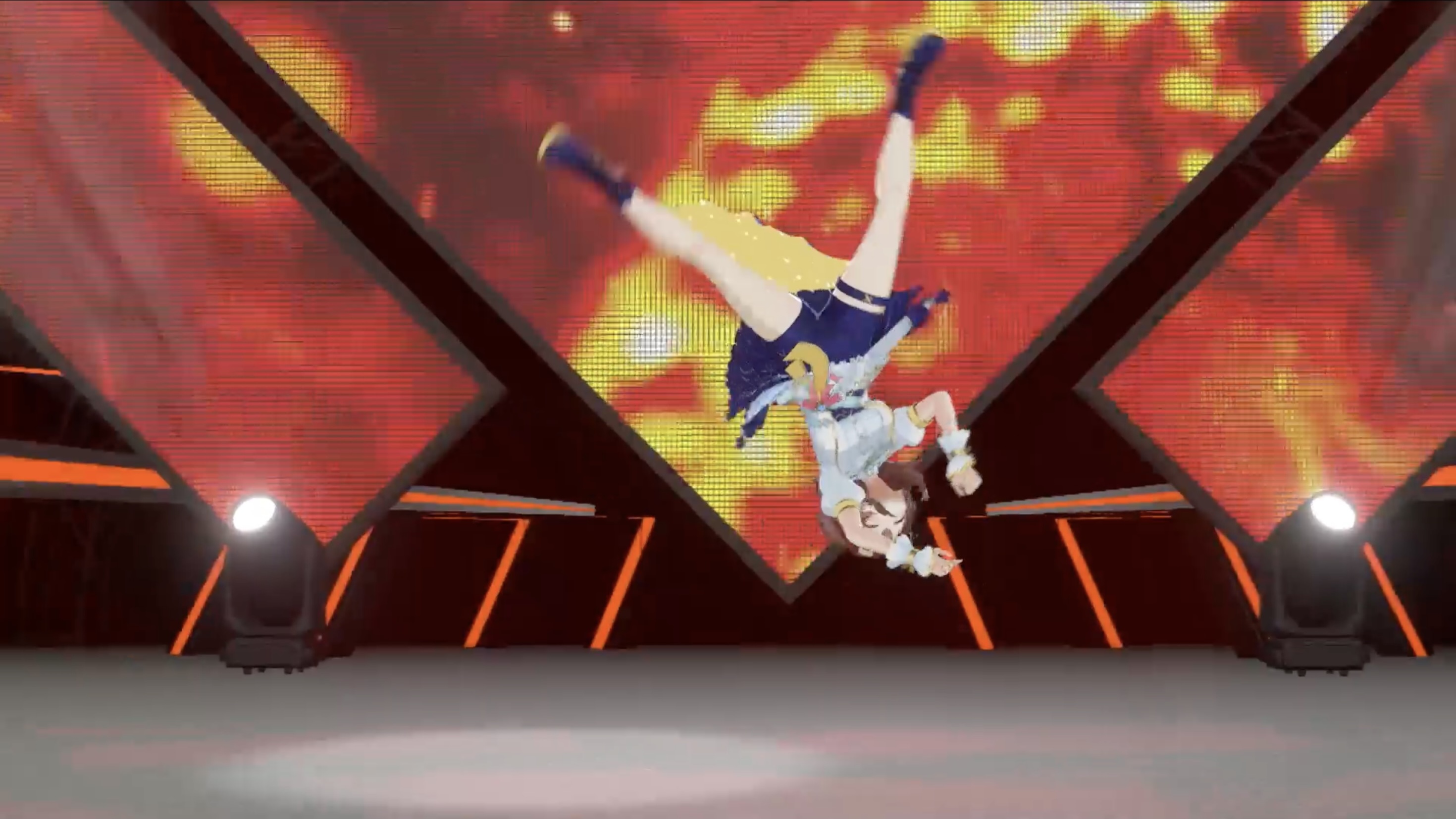
Progress didn’t just come from those who were lacking ability, but also those who were already highly skilled and took things to the next level. For example, Inugami Korone has gone from a front walkover flip two years ago, to back-to-back cartwheels last year, and now a fully unsupported side flip.
I’ve devoted many words to the mesmerizing performances of La+ Darknesss, and I think 5th fes is her best ever. Her song of choice was her first original, “Aien Jihen,” and its inclusion has a special importance. La+’s first performed it during her 3D debut, and it was when fans realized what a phenomenal dancer she is. However, she used a pre-recorded track due to the difficulty of the choreography (which she came up with herself!). At Waku Waku Dark Nightmare (her Nissin- sponsored solo live), she managed to both sing and dance at the same time, but the audience was all online. This time, La+ was there in front of a crowd of 11,000+—and she killed it.
Additional adjustments to the choreography made her look even more crisp, her voice remained mostly strong throughout, and her overall movement felt more intricate and daring than at 4th fes. In her own words, La+ thought the 5th fes “Aien Jihen” was stronger compared to at Waku Waku Dark Nightmare, and I’m inclined to agree. I’m happy to have seen my favorite hololive song performed so beautifully.
Takanashi Kiara is a similar case. When Myth, the first generation of hololive English, first appeared in official 3D at 3rd fes in 2022, Kiara made a big impression. There was no doubt that she was one of the best dancers in hololive, as she displayed a level of grace and confidence few could match. Then, at 4th fes the following year, an amazing debut performance by Hakos Baelz actually prompted Kiara to declare Bae the best dancer in EN. Over time, other strong dancers have also joined hololive, and it felt like Kiara was getting “powercrept,” so to speak.
Then Kiara went on stage in 5th fes and blew away all prior notions. While singing a brand new song, “Chimera,” she moved in a way I’d never seen from her before. Most (all?) of her prior choreographies have been arranged by an expert dancer named kianna, and Kiara’s “Chimera” looked closer than ever to matching that professional level. It really felt like Kiara was out there to show the world that you can never write her off, and that she was willing to put in the time and effort to prove this point. Watching in the moment, I wondered if Kiara might shine brighter than everyone else this year.
Changing the Conversation
Then Hakos Baelz came in and showed how pointless comparisons could be. By that, I don’t mean that she was inherently or objectively better than Kiara or anyone else, but that she decided to flip the script in a way that rendered such discussions moot.
Ever since her first 3D appearance at 4th fes, Bae has brought a very high level of quality and energy to every performance. Because she has been so consistently great, however, it became a question of how she’d be able to outdance herself this time around. Add in the fact that Bae herself commented on how her plans could potentially result in a flop, and fan speculation was all but inevitable. What feats of dance would she show this time?
To my (and it seems everyone else’s) surprise, Bae went in another direction entirely. Eschewing the high-octane routines she was known for, Bae went for a slow and passionate interpretive dance set to “Uta yo” (aka “Gales of Song”) from the Hosoda Mamoru film Belle. Watching her, I could feel my emotions welling up in response to her sublime choreography, the shock of seeing something so unexpected, and the boldness of Bae’s decision. Moreover, her voice was haunting in a way we rarely hear from her.
The next day, when she performed again for the hololive x Honeyworks stage, Bae did something more typical for her, and the contrast between those performances makes her sheer ability all the more impressive. Later, Bae also said that 1) she’d never done interpretive dance before this and 2) it takes her only about 2 hours to fully learn a choreography. It all goes to show how ridiculous she really is.
Returning in Style
In a few cases, certain performances were like reunions. Some of the hololive members have spent time not using YouTube and social media, and their circumstances meant that their presence at 5th fes ended up being reunions of sorts with their fans.
Murasaki Shion has been on hiatus for the past few months, and this was her first public appearance since she went on break. The roar of the crowd felt like a big “welcome back,” and seemed to communicate the idea that her supporters are there for her through thick and thin.
But while it was already known that Shion would be there, there was actually one talent whose performance came completely out of left field. Last year, Haachama ended up in the hospital not long after 4th fes, and she had to take eight months away from streaming. Because so much time had passed and because there wasn’t much time for her to practice after she did return, Haachama was not scheduled to be at 5th fes.
Then, without any anticipatory fanfare, Haachama blinked onto the stage. Watching the stream, I could hear the slight delay as general confusion in the crowd transitioned into pure excitement. Haachama sang “Idol,” the opening to Oshi no Ko—a song whose content fits an unpredictable girl who declares herself to be the “Worldwide Strongest Idol.” At the very end, she transformed one of the lyrics into a shout of “I love you!” as if to show her gratitude to everyone watching.
There was one other reunion of sorts, though it was more like a story going full circle. One of the last songs of the event was “Last Frontier,” performed by Hoshimachi Suisei and AZKi. The two are among the very best singers in the entire company and naturally sounded amazing, but the song also has a special significance: It was originally written by AZKi for Suisei when Suisei was transitioning from hololive’s INNK music label to the main branch, and AZKi was considering retirement. However, both have stayed with hololive, and Suisei even secretly rewrote some of the lyrics to go from being about sending someone off to achieving new goals together. When Suisei then read out a letter to AZKi about their time together, AZKi couldn’t hold back her tears.
Final Thoughts
It’s funny seeing just how massive hololive has gotten. In those earliest blu-rays, it’s clear that this whole project was a much more humble affair. The concerts were just decently large (but not gigantic) crowds of people in front of screens displaying their favorite VTubers, and actively buying into the illusion presented. Now, everything is so slick that it feels like another world. A bit of the intimacy has been lost in the process, but despite that one drawback, I think this change has been good for hololive and VTubing as a whole.
All the different journeys detailed above, combined with the variety of performances, made for an emotional rollercoaster. There were even plenty of fantastic showings that I didn’t touch on, where the stories weren’t as dramatic but were still wonderful to see play out—even ones as simple as “They put on a great show that the audience adored.”
My only worry is that 6th fes in 2025 looks like it’ll have at least 10 new talents to account for, and I can see my free time (and my sleep schedule) slipping away.
Official VODs are currently available until April 17.









 OGIUE MANIAX