In July this year, I attended the Dokibird birthday concert at Anime Expo—the same one that was just uploaded to her YouTube. It had a lively atmosphere, and a group of fans had assembled in front of a screen to do their wotagei performances. Others shouted with excitement. But next to me was a guy who remained silent throughout. It was clear he was a fan. He just wasn’t expressing it loudly.
The contrast had me thinking about how there are challenges to being a quiet fan. So much of how we “show” fandom these days is through very visible and very vocal gestures. Online, we have react videos and social media platforms that thrive on “virality.” Offline, we have enthusiastic crowds drawing the cameras to them. It makes sense that they would get so much attention, much in the same way that cosplayers are the most photographed element at conventions. But it can create this notion that this is the way fans “should” be, when that’s not true.
I think it’s important to remember that being quiet doesn’t make you less of a fan. You might not get all the positive affirmation or even the attention that more vocal fans do, but that doesn’t mean the passion inside you is somehow not as vibrant. I’m not a terribly expressive person myself, and it’s probably part of why I started blogging—I’m full of thoughts and emotions, but they just don’t necessarily come out through pronounced physical actions.
At the same time, the fans who do go out there and make their presence known are expressing themselves in their own way. Unless they’re disruptive to the point of ruining the experience entirely for others, it shouldn’t be an issue. Everyone is their own person. There’s no specific “right” way to be a fan, and I salute my fellow quiet types because I know the passion is there.
Back in 2019, manga artist Kotoyama was just coming off of his snack-themed comedy series, Dagashi Kashi. So when a new series of his launched, I wondered what it would be like. Would it also be a kind of silly comedy fueled by character interactions related to a specific gimmick and a dash of romance? Or would it be something more standard for a shounen manga, with superpowers and greater drama?
The answer turned out to be “Yes, and also yes.”
Call of the Night (Yofukashi no Uta in Japanese) is the story of Yamori Ko, a boy who has stopped going to middle school and is suffering from insomnia. One night, he decides to leave his apartment to see what his town is like around in the late hours. There, he encounters an eccentric girl named Nanakusa Nazuna, who seems older than she looks, and offers to help him sleep. Ko agrees to try out her services, but soon discovers that she’s actually a vampire. Rather than being scared for his life, however, he gets an idea: If life right now sucks, why not become a vampire? The only problem: In order to turn, one must fall in love with the vampire first, and Ko has no idea what love is supposed to feel like.
Unlike the eight-volume Dagashi Kashi, which is largely short and episodic vignettes, Call of the Night has a serial narrative over a whopping 20 volumes. The relationship between Ko and Nazuna somewhat resembles the dynamic between Kokonotsu and Hotaru in Dagashi Kashi, but it’s really its own thing—a dynamic geared towards momentum and development, rather than stasis.
While Call of the Night initially feels it can go on forever at a pace reminiscent of another favorite series in Mysterious Girlfriend X, it then proceeds to break its own “rules” time and again. As it adds interesting twists and wrinkles to its story, the manga achieves a nice balance between genres and the emotions it invokes. Because the series keeps adding ingredients and formulating new recipes in itself, I find it to be a very Shounen Sunday manga. This is historically the magazine of Touch!, Inuyasha, Detective Conan, etc., and Call of the Night feels like it exists in the space between these and other iconic Sunday series.
The everyday hijinks make way for a genuine friendship, and the answer to whether it will turn into romantic love always feels like it’s right around the corner yet also somehow far in the distance. And as the story progresses, the cast of characters expands and details about how vampires like (and unlike) Nazuna move through human society help to expand the world and create new stakes. There are even some supernatural brawls straight out of a battle manga. And through all these events, Call of the Night still manages to feel grounded and low-key, and also still tapped into that initial malaise that plagues Ko.
Silly yet serious, simple yet full of intriguing little complexities—Call of the Night is worth a read. I think it has something even for those who aren’t fans of vampires and the supernatural. It’s ultimately the story of a boy and a girl who come from very different circumstances who find common ground in the late evening hours, and the world that unfolds before them.
PS: It really is awesome that the anime version got the ending theme to be its namesake, “Yofukashi no Uta” by Creepy Nuts.
Mono Monet, a VTuber from the agency V4Mirai, recently revealed herself to be a Genshiken fan.
What’s more, I was directly involved in this reveal! During a chat about a different topic, I was specifically called out by Mono for having “Ogiue” in my name. It spurred her on to start talking about the series, and the possibility of doing a Genshiken watchalong at some point.
This is the second time I’ve seen a VTuber explicitly express a fondness for Kio Shimoku’s title. (The first was when FUWAMOCO from hololive sang “Kujibiki Unbalance.”)
The above clip is over 20 minutes long because Mono talks about not just her love of Genshiken itself, but also Evangelion and what she looks for in fiction. It’s quite interesting overall, and Mono is just full of good takes, particularly when it comes to the appeal of flawed and messy characters.
Maho Girls Precure!! ~Mirai Days~ (also known as Witchy Precure!! ~Mirai Days~) is the second case of the Precure franchise creating a direct sequel anime that features its heroines many years after their original stories. While it might be a bit unfair to compare this series and Precure Full Bloom, their diverging approaches to portraying their respective characters as adults is noteworthy for how they connect to the concept of “youth” and all it entails.
Ever since the end of their original story, heroines Asahina Mirai and Izayoi Liko have each been living in the non-magical and magical worlds respectively. Mirai is a college student now, but she also continues to secretly use her witch powers to help people as the mysterious “Maho Girl.” Liko has become a teacher at her old school, training a new generation of magic users. When a new enemy threatens both worlds, the two reunite to become Cure Miracle and Cure Magical once more.
To me, the biggest difference between Full Bloom and Mirai Days can be summed up in the transformations. While the Yes! Pretty Cure 5 and Pretty Cure Splash Star girls revert back to their middle school selves when transforming, Miracle and Magical remain adults. In the former, the power of Precure is locked to the youth of the past, but in the latter, that power continues forward.
One aspect that might have influenced these diverging approaches is the fact that they are targeting different age demographics. Yes! 5 and Splash Star are around 10 years older than Maho Girls, and that means one sequel is targeting women around 30, as opposed to those closer to 20. Thematically, the first group are adults worn down by society and the clash between the dreamy ideals of your youth and the harshness of the “adult world.” In contrast, Mirai and Liko have to fight those who want to remain in an ideal past where they felt happiest.
Even then, I liked the way Maho Girls did it even more. I want to see how adults might look in magical outfits, and how they would carry their life experiences in their actions. Why can’t we see women in their mid to late 20s (and beyond) undergoing full, proper magical transformations that acknowledge their maturity?
When Baelz Hakos of hololive made a promotional video for a convention appearance in Hong Kong earlier this year, she gave an abbreviated version of her standard self-introduction. Naturally, it was subtitled in Cantonese, and the word used for “chaos” was wandeon—or hundun in Mandarin Chinese.
English: I am Chaos, the End of Ends.
Cantonese: 我喺混沌、萬物終結。
Cantonese Jyutping: Ngo hai Wandeon, Maan Mat Zung Git.
Literal translation: I am Chaos/Hundun, the Termination of All Creation
Hundun (混沌) refers to primordial chaos, but it can also be the name of a legendary creature from Chinese mythology that existed before the universe was created. It’s typically depicted as a faceless beast with many wings and feet. Incidentally, I became aware of it myself through the anime Lazarus, where it’s a plot point for a certain character.
The Hundun from Lazarus
Bae is Cantonese, and the fact that her original lore also describes her as Chaos itself makes the similarities between Bae and the Hundun more striking—both are “chaos” as concept as well as being. So I got to thinking: What if in the lore of hololive, Baelz Hakos is the Hundun under a different guise?
The backstories of Bae and her fellow members of hololive EN Promise updated a couple years ago to be simpler. All of them are essentially about how these representatives of primal forces (chaos, time, hope, etc.) have integrated more thoroughly into the human world, with Bae in particular focusing on her desire to perform on new and different stages.
Playing off this, I could see some kind of written piece about how Baelz Hakos is what the Hundun became out of a desire to interact more directly with the mortal realm. Dance (Bae’s specialty) is also a creative art that feels both controlled and chaotic, and perhaps her multiple wings and feet could manifest through her amazing dance moves.
This has just been some random fanfic-tier speculation on my part. I’m looking forward to the Promise 2nd year 3D concert in a few hours:
At Anime Central 2025, I received an opportunity to interview Pili, the Taiwanese studio that co-produced Thunderbolt Fantasy. I hope that fans of Thunderbolt Fantasy, fans of Pili, and anyone curious about unique media and entertainment can learn from the in-depth answers they gave.
1) Taiwan has a celebrated tradition of puppet theater, something that is likely unfamiliar to much of the English-speaking audience. What are some of the special aspects of Taiwanese puppetry, and how do you incorporate them into your work?
Pili puppetry has a unique advantage: puppets have no facial expressions. This means that all emotions are conveyed through the atmosphere of the scene, the performance of the voice actors, and the impact of the music. As a result, regardless of culture or language, emotions can still be conveyed through the puppets.
About how we incorporate them into our work, we can share how Thunderbolt Fantasy entered the Japanese market as the example. Although the genre is Wuxia fantasy, Urobuchi-san naturally incorporated various elements of Wuxia into the story, which allowed Japanese audiences to easily understand and appreciate it.
2) Given that Thunderbolt Fantasy has both Japanese and Taiwanese dubs, have you found it a challenge to work with two different languages and styles of speech?
The production of Pili puppet performance always begins with the audio. The puppeteers always perform based on the pre-recorded voices. For Thunderbolt Fantasy, once the Japanese script was delivered to Pili, it first had to be translated into Chinese, then dubbed in Taiwanese. The puppeteers would then perform based on the audio data.
However, because there are language differences between Chinese and Japanese, Urobuchi-san would need to revise the script and communicate with every voice actor about how the characters should be performed after watching the filmed version. For example, in puppet theater there are many actions similar with Japanese Kabuki movements and gestures. To voice properly for such movements, Urobuchi-san had to discuss with voice actors to provide guidance and suggestions in person.
3) Do the puppeteers treat their performance as akin to live theater when recording, or is it more like a movie or television show production?
Our production now is closer to that of films and TV dramas. The biggest difference is that traditionally Pili puppet performance was live on stage. In this case, the puppets’ heads must face the audience. However, now in a studio setting, the puppets’ heads must face the camera, so the concentration and ways of expression become different. In addition, we use narration, jump cuts, and other techniques to change settings and transition the scenes.
4) I must ask, how did a giant robot end up in Thunderbolt Fantasy? It was an unexpected choice, but speaks to the fun and unpredictability of the series.
Robots are one of Urobuchi Gen’s personal interests. He is also a big fan of Kamen Rider and Tokusatsu, so he came up with the idea of including them and designed that robot. Pili also filmed similar things before, such as scenes where puppets battled a giant gorilla. In our Su Huan-Jen movie, we collaborated with Japanese studios to create the monster Qilin. We really enjoy Tokusatsu filming style, so Urobuchi-san took the opportunity to design and incorporate more of these elements into the work to make it fun.
5) Are there any plans to bring more of your shows to English-speaking audiences? I ask simply because I would love to see more.
Of course, we do have plans. We are working with Urobuchi-san on other projects, and both now and in the future, we will be working on scriptwriting and concept design for works that appeal to a wider fanbase, especially to those who are not fans of the Wuxia genre.
6) I’ve read that one thing you had to learn from making Thunderbolt Fantasy is that Japan is more accustomed to a slower pace for action scenes. Could you elaborate on how you changed things to accommodate this?
From the very beginning, we have been constantly adjusting the pace. Especially when shooting the first episode of the first season, we studied how to present the puppets’ body movements in greater detail so that the audience could better appreciate their performance. We knew that the fight scenes in puppetry always switch too quickly, like in seconds, and the puppets have no facial expressions. The audience would need more time to process the information and understand the plot. That’s why we kept adjusting the pace. I must say that we rely on puppeteers’ live performance and improvisation as well as the director’s guidance and arrangement.
7) How do you puppet the characters relative to the voices? Does voice come before the puppetry, or vice versa? Or perhaps there’s a back-and-forth process between the two stages?
First, we record a reference track in Taiwanese, and the puppeteers perform based on that. Next comes the official dubbing. Since the official dubbing could involve various adjustments and changes, we need to reshoot and revise the makeup. This back-and-forth adjustment continues until everything is finalized. Once finalized, we proceed to the last phase of handling Japanese dubbing.
8) Are there unique aspects of specific characters that require puppeteering them in special ways? For example, is controlling Shang different from controlling Lin?
One of the biggest advantages of Thunderbolt Fantasy is that the script and character designs were developed simultaneously. This allowed our puppeteers to imagine the personalities of the characters more concretely and design unique gestures based on the script since there was sufficient information. For example, Shang scratching his nose, or Lin carrying a smoking pipe in his mouth, which looks humorous. Because we had enough prerequisites and Urobuchi-san could provide explanations in time, the puppeteers were able to enrich the characters as best as they could.
9) Is there anything unique to the technical process of making Thunderbolt Fantasy that differs from your other series?
At this point, Pili’s puppet drama series updates every week, like Shonen Jump in Japan, so the production schedule is extremely tight.
During the technical process, for example, creators often need to design characters based on only a few lines of description, while voice actors must imagine the voices of the characters before even seeing the actual designs. When these two processes run at the same time, mismatches are likely to occur. Just imagine they designed an old lady, but voice was like Rie Kugimiya’s tsundere tone.
Producing weekly episodes is very demanding. Ding Bi, who is sitting beside me, works on the weekly-updating drama. His team often found that even after finishing filming and wrapping up, they would still discover parts that needed reshooting, which was stressful and frustrating.
On the other hand, Thunderbolt Fantasy is different. Since both the script and pre-production details were ready in advance, everything was clear, which made filming much easier. Moreover, our Pili team has developed such a strong teamwork spirit over the years that we can almost instinctively know the best way to shoot a scene, so the whole process was quite smooth.
10) How involved was PILI with the overall story and the character personalities in Thunderbolt Fantasy? What was it like to work creatively with NITRO PLUS?
Pili’s involvement is very high. Although most of the character designs from NITRO PLUS are for protagonists, we are in charge of classifying characters by levels of importance. Pili also contributed a lot to the character design. For example, many of the demon realm generals and lieutenants and other organizations were designed by us after internal discussions.
NITRO PLUS trusted in Pili’s puppet-making, so their feedback was generally positive with few comments on things that need to be corrected. For the process of converting 2D character designs into 3D character models, we also communicated with NITRO PLUS frequently, so our interaction with them has been very close.
NITRO PLUS is a highly disciplined and experienced company. Even though its core business is gaming, its creative strength and design framework are astonishing. Pili really needs to learn from them because our style in designing sometimes tends to be loose and irregular, so working creatively with NITRO PLUS was previous experience.
11) Looking back on your long history with Thunderbolt Fantasy, are there any important lessons you’ve learned from making it?
To be honest, ten years have not been easy. Collaborating with Japan was a huge challenge for Pili.
The first lesson is cultural differences in language. For example, in Japanese texts or messages, expressions like sumimasen can sound indirect or ambiguous for us considering the seriousness, but they could be a very clear refusal from the Japanese side. We might think the level of that dislike from them was not strong at all, but in fact their rejection was much stronger than we expected. What’s more, when we said something like “Okay, we can consider this proposal and maybe give it a try”, the Japanese cast sometimes understood it as a clear decision to move forward along this plan.
Another big lesson is in the character market and community management. In Japan, these aspects, as well as production details, are treated with great importance, while Pili had not given them as much consideration before. After we started working together with Japanese people, we learned a lot from them in these areas.
About technical skills, we also learned tremendously. Through Thunderbolt Fantasy, we had the opportunity to learn from Japanese creators and companies other than NITRO PLUS, such as monster design just mentioned, sound production, etc. In particular, the sound director Miwa Iwanami gave us invaluable advice on how to strengthen the use of voice performance to make puppet theater characters more powerful.
Once the interview was over, one of the puppeteers demonstrated the way they control the puppet of yandere princess Cháo Fēng.
The staff also asked me how I got into Thunderbolt Fantasy. And then they even gave me the chance to hold Cháo Fēng’s puppet myself!
It’s literally one of the best things I’ve ever gotten to do.
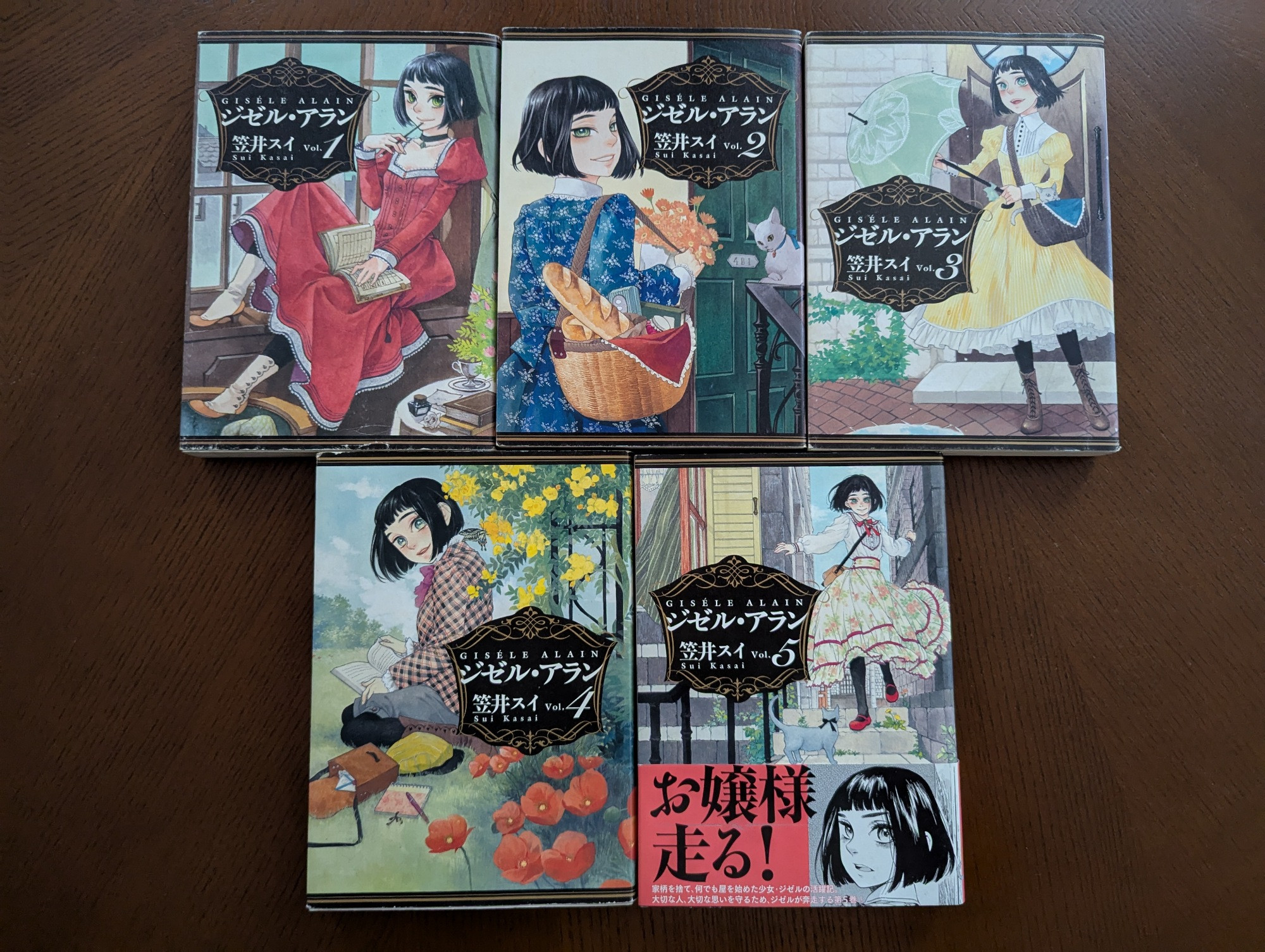
I feel like I’ll never be used to this, but another one of my favorite creators has left us. Kasai Sui, author of the historical fiction manga Giséle Alain, passed away on September 12.
With a drawing style reminiscent of Mori Kaoru (A Bride’s Story, Emma) and Miura Kentaro (Berserk), Kasai’s art was stunningly gorgeous, and really captured that Harta Comix style. Giséle Alain follows a young and wealthy tomboy by the same name who opens her own “all trades” business taking care of odd jobs, and it is one of the best manga I’ve ever read. The art is simply gorgeous, with character expressive and lovingly rendered—particularly when it comes to Giséle herself. The period clothing, architecture, and little details are some of the best I’ve ever seen in manga. The story, told through the little adventures of our heroine and eventually her complex relationship with her own past, is something that drew me in deeper and deeper.
Giséle Alain ran for five volumes before going on hiatus in 2014. I was looking through the archives of this blog, sure I had posted something about it over the years, and I was shocked to discover that I had not devoted a single post to this series. I think a part of me was still holding out hope that Giséle Alain would return, and that I would be able to write about Kasai’s work then. Alas, I guess this is my review now: Go read the manga if you can.
I didn’t follow Kasai closely, and I kind of regret that now. For one thing, I never quite realized that Giséle Alain stopped serialization because the author had become ill. Nor did I know that they had a wife who is also a manga artist. I also wasn’t aware that Kasai had opened a Pixiv Fanbox, and had been posting to it off and on for the past six years, and I wish I could have been supporting them this whole time. During this time, Kasai’s output fluctuated a lot (I assume due to health issues), but their art remained incredible. They even tabled at Comitia last year! A part of me wants to take up drawing again, being faced with the mortality of an artist whose work I adored, especially because they were close to my own age.
News articles have also revealed that an extra Giséle Alain story was actually in the works and close to completion before Kasai died. The author had tweeted innocuously just four days prior, and it seems like everyone assumed this was going to be her triumphant (albeit limited) return. I really hope we get to see this extra story, even if it’s in disorganized pieces.
Kasai’s Fanbox is going to close paid subscriptions after October 31. Visiting it is a great and convenient way to see the work of a master.
I need to say it: I’ve been worried about the world. We’re seeing government silencing of creative expression, bullying and pressure to silence video games and other artistic projects by credit card companies and payment processors, and a media engine that seems obsessed with trying to convince everyone that red is blue and up is down. It reminds me of every time an overblown hype machine tries to convince us that NFTs or generative AI are the future, except it’s targeting big organizations and regular people who haven’t been paying attention for the past 15 years to a fascist propaganda machine.
I feel some relief that people managed to push back against the attempts to censorship, but also some disgust over the way organizations and companies with real money and power are so ready to capitulate. Having so much influence should make you geared to fight back, not bend the knee.
A new anime season is starting this month, and I hope I can enjoy it.
As for the Patreon, here are my sponsors for the month. Many thanks to them all.
This month, I’m going to be doing a lot of fun things not necessarily related to anime and manga. I’m thinking about whether to write about them for the blog, but leaning heavily towards “yes.”
Sounds like Chapter 50 of Spotted Flower will have a hell of a finale. It’s not clear whether this means the end of the series, or it’s just the final scene of the chapter that’s a big deal.
Different stores in Japan have different purchase bonuses for Volume 8 of Spotted Flower! Almost all of them are basically different girls in skimpy swimsuits.
It also seems like Kio will be including something like a doujinshi with Volume 8.
There will be a live action adaptation of Kio’s erotic doujinshi sequel, It’s All Your Fault, Sensei.2. Here’s an NSFW tweet with a barely censored picture of the actors.
While visiting Obata Castle in Ibaraki Prefecture, Kio heard a loud roar coming from the south. Then he remembered that the JSDF’s Hyakuri Base is there.
It is a hell of a move to conclude Demon Slayer, one of the biggest anime and manga of the past 10 years, with a trilogy of movies. I have to assume that putting it in theaters is a way to both create hype and make lots of money in the process, and dang it, it’s working. Not only is Demon Slayer: Kimetsu no Yaiba –Infinity Castle- Part 1 an overall compelling watch, but it’s apparently the biggest box office weekend in the US for an anime film since Pokémon: The First Movie.
Despite being the finale, the premise of the Infinity Castle movies is a simple one: After a costly confrontation against Kibutsuji Muzan, protagonist Kamada Tanjiro and the rest of the Demon Slayer Corps seemingly have the villain cornered. However, the heroes suddenly find themselves teleported into the heart of enemy territory. Here in the infinitely expanding castle that Muzan calls his home base, they must face his strongest lieutenants while dealing with a space that defies logic and reason. If they don’t take out the demons here, all will be lost.
The setting is pretty much perfect for a shounen battle anime: an array of elaborate and intense fight scenes that also tell interesting stories about the characters involved. Some clashes are culminations of previous storylines, others reveal previously unknown sides of characters, and everything remains pleasantly hard to predict. It’s a little bit Ninja Scroll and a little bit Girls und Panzerfilms in terms of never letting up on the tension, with the occasional requisite backstory flashback being the main way to calm things down.
But while Infinity Castle Part 1 is pretty much all “fight, fight, fight,” I think it still portrays compelling and often tragic dramas involving both the beauty and ugliness of humanity in a satisfying manner. Through it all, the film emphasizes ideas that have been core to Demon Slayer: Mutual cooperation can overcome obstacles, compassion is a strength, and humanity is built on helping the weak and paying it forward to the next generation.
One issue with this movie is that while it has not yet been adapted for TV episodes, it still feels like a series of episodes or chapters stitched together. There was little attempt to structure it as a feature-length film, especially when it comes to the positioning of flashbacks (of which there are many). Moreover, Part 1 is over two and a half hours long, and while I enjoyed every minute, it did feel a little bloated and awkwardly paced at times.
Every battle in the movie are amazing, but I do want to give particular attention to the main fight of this first movie, so there will be SPOILERS AHEAD.
As Tanjiro and the others try to make their way through, he and Giyu the Water Hashira are attacked by Akaza, Muzan’s third strongest minion, and the one with whom Tanjiro has the most history. It was Akaza who killed a valiant Rengoku Kyojuro during the Mugen Train arc, and when they last met, Tanjiro was far outclassed by the demon and his hand-to-hand fighting skills. However, Tanjiro also left a searing impression in Akaza’s mind, calling him a coward for fleeing at dawn when Demon Slayers have to fight demons in the dark of night all the time.
In this violent reunion, Tanjiro manages to accomplish what he couldn’t before when he slices through Akaza’s body. While this is only a temporary setback for the demon, it’s the first sign that Tanjiro has grown as a warrior. Unfortunately, Akaza quickly adapts to both Tanjiro and Giyu, and it isn’t until Tanjiro manages to piece together various thoughts and memories related to Akaza, the nature of battle and conflict, and his own childhood with his father that he manages to tap into a higher plane of martial expression (the “transparent world,” where killing intent is absent and only movement remains) that he deals a catastrophic blow to his opponent.
While Akaza somehow survives and even starts to regenerate from the brink of demise, the fact that Tanjiro surpassed him in battle, if only for an instant, helps jog Akaza’s faded memories. Remembering his turbulent past life as a child thief trying to get medicine for his gravely ill father, and the second chance he received from a martial artist and daughter before Akaza’s happiness was ripped from him by a petty local clan, Akaza realizes that Tanjiro is exactly the kind of person he wanted to be. The bloody pursuit of strength that has defined him as a demon is revealed to be a corruption of his own desire to live honorably and protect his loved ones. Akaza willingly defeats himself (literally), and visions of his departed fiancee, adoptive father, and birth father help him to shake off Muzan’s control and pass on for good.
I am utterly impressed by the way this fight plays out. It just encapsulates so much of what makes Demon Slayer a great series, especially the way Tanjiro’s heart breaks through even the toughest obstacles, including the very demons he fights. Akaza is shown to be a human who struggled with the unfairness of the world that punishes the poor for merely existing, and that much of the trauma he suffered came from human hands. Yet, he also recalls a lesson from his old life that it’s never too late to start over, and this puts him on the path to relinquishing his demonhood, even at the cost of his life.
END OF SPOILERS
As someone who was there in the theater to watch Mewtwo Strikes Back back in 1999 and remember the buzz surrounding it, this record-breaking achievement says a lot about how far anime has come. This is maybe the biggest sign that anime has truly, truly arrived on American shores, and the long-time fan in me rejoices in this development. And given what a great watch Infinity Castle Part 1 is, I wouldn’t be surprised if fans are going to watch it multiple times.


 OGIUE MANIAX