After years of hemming and hawing, I decided to actually do Inktober this past October. The results were, well, results.
Especially with the state of Twitter being extremely abunai, I decided it’d be good to just have a gallery here.




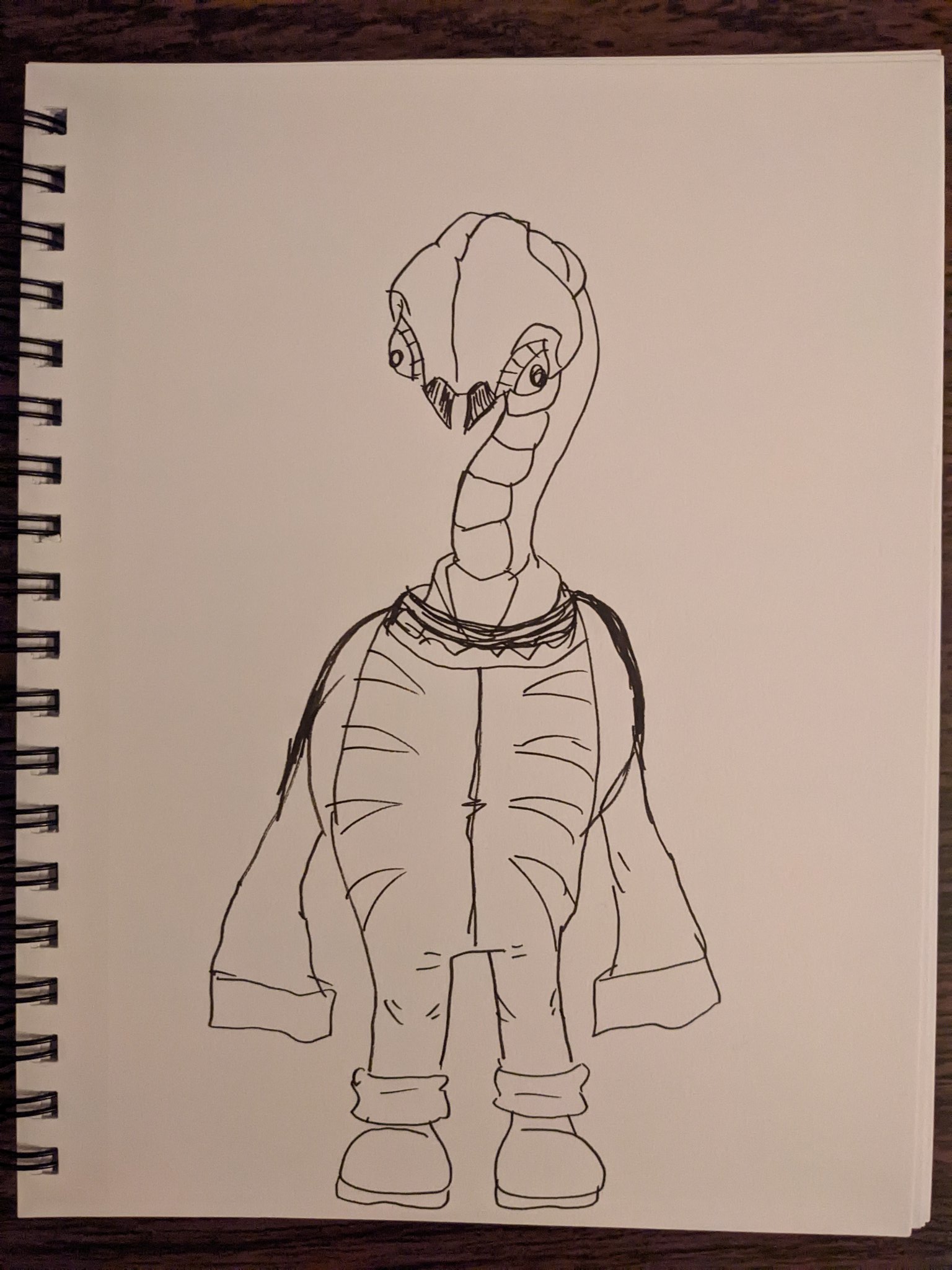
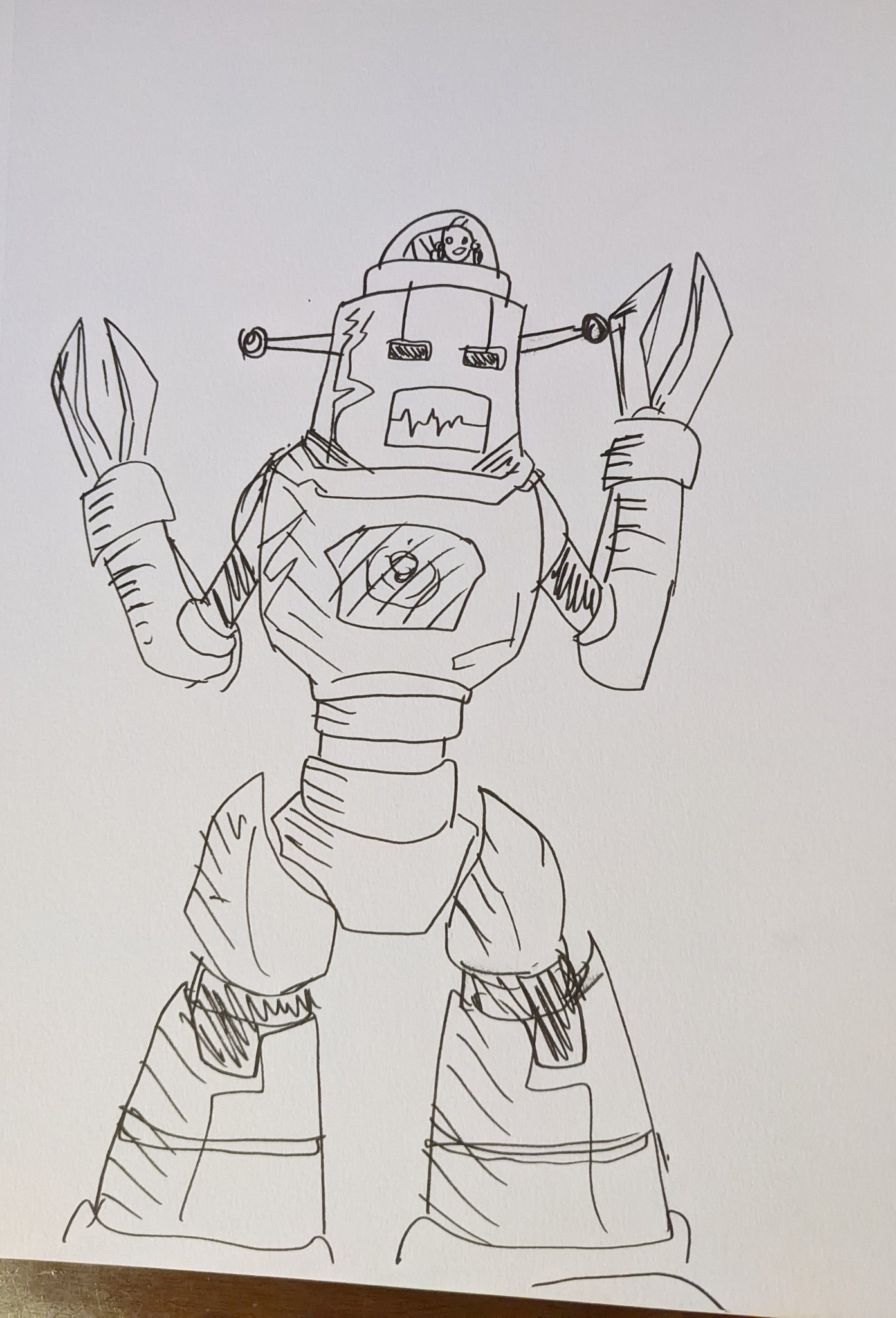
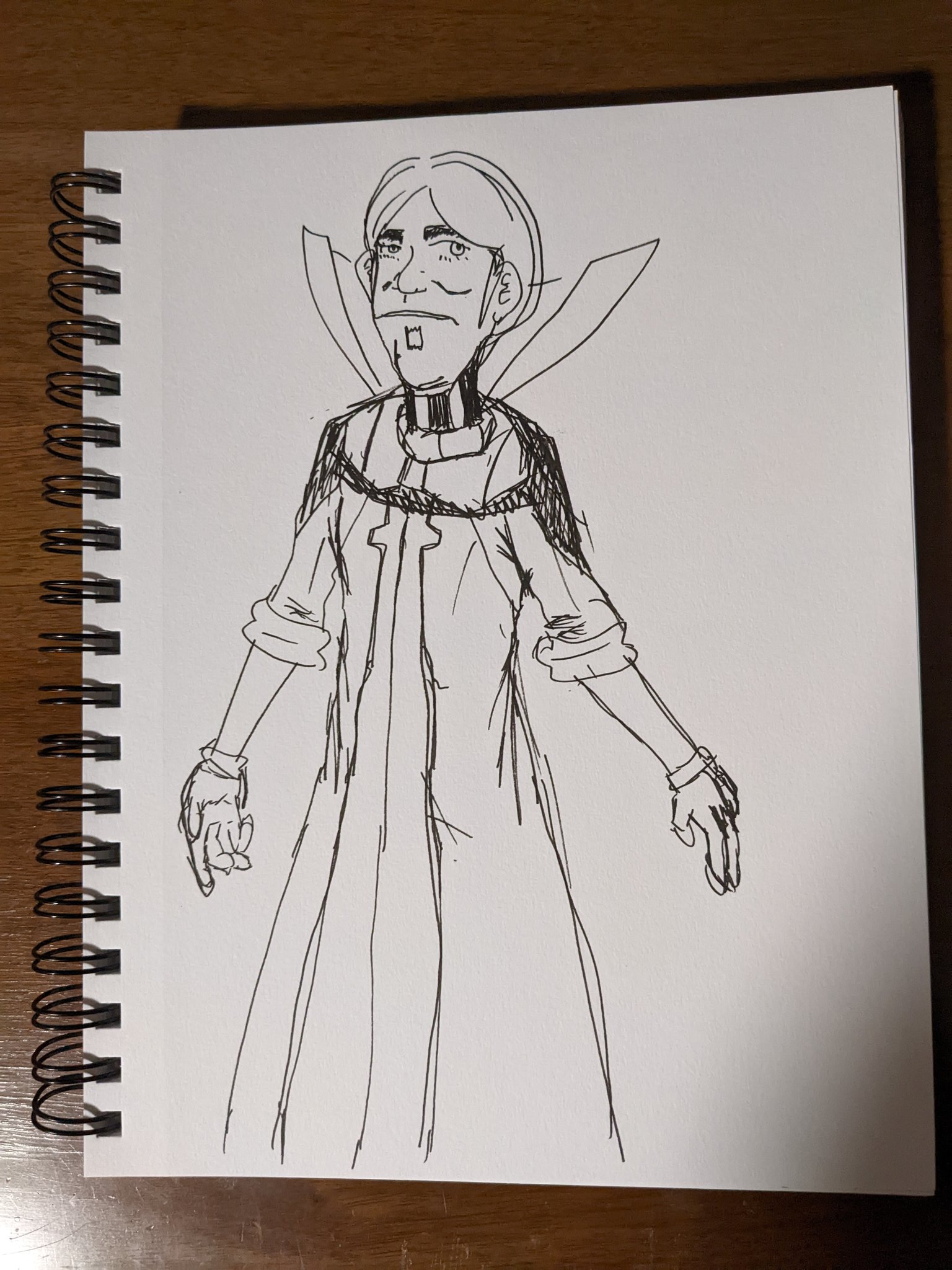

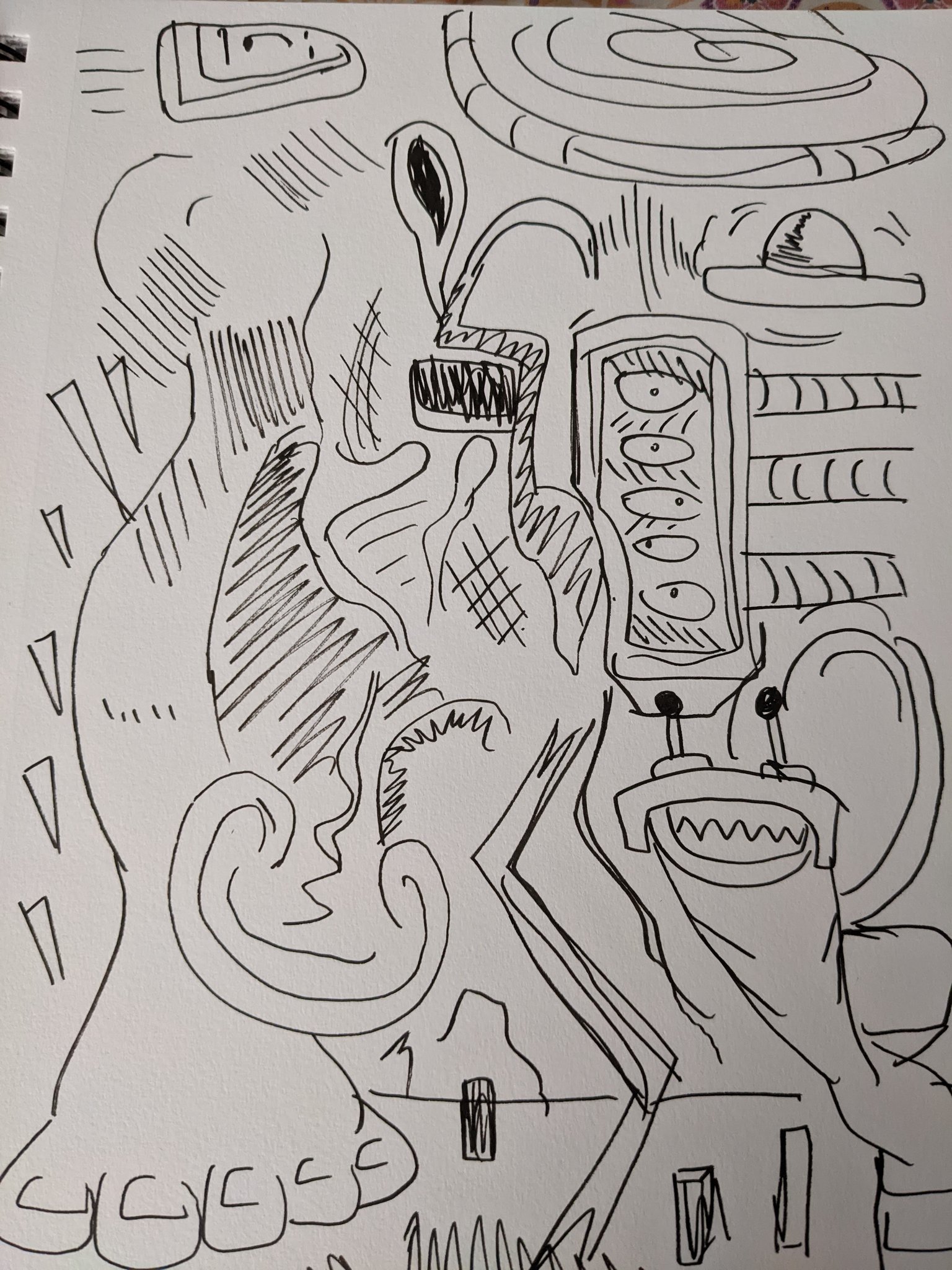





After years of hemming and hawing, I decided to actually do Inktober this past October. The results were, well, results.
Especially with the state of Twitter being extremely abunai, I decided it’d be good to just have a gallery here.
Many viewers have remarked on the similarities between The Witch from Mercury and another anime, Revolutionary Girl Utena. Both feature heroines having to protect a prized bride in ritualized duels that involve cutting off a symbol to win (an antenna and a rose, respectively). It’s hard not to make the comparison. But I think the fact that we are seeing “Utena Gundam” so readily embraced is a sign that the Gundam fandom has progressed in ways I couldn’t have seen years ago. This is especially the case when looking at a different spiritual predecessor to The Witch from Mercury, 1995’s Mobile Fighter G Gundam.
There was a time when G Gundam was the black sheep of the family. Eschewing the backdrop of war for a gigantic mechanized fighting tournament, many fans regarded it as antithetical to what Gundam was supposed to be. But as the decades have passed and new fans have come to the franchise and brought new perspectives, the notion of Gundams in formal duels isn’t viewed in such a negative light anymore. We even got a tournament anime about fighting with Gundam model kits! There might be an inherently ridiculous quality that seems to (double) harken back to 70s super robot shows like UFO Robo Grendizer, but that doesn’t mean such a series can’t be serious and insightful in its own way.
The larger setting of The Witch from Mercury, beyond the school, clearly sets up a world where the shady politics of militarism and capitalism shape events in ways worth analyzing that feels very current but connected to the past. When the duels are viewed in this context, they feel not so much separated from the outside as connected to the larger problems that exist. In this sense, it truly does feel like the child of G Gundam and Utena, but also the grandchild of Gundam itself.
The new anime season is in full swing, but while I’m enjoying the hell out of so many things (like Gundam: The Witch from Mercury!), my mind is on the upcoming US midterm election. I plan on (sort of) following up with my thoughts on this subject in a few days but for now, I’m using this time to encourage citizens to vote however they can: in person on Election Day, by mail, by early voting, anything.
I’d also like to thank my Patreon subscribers for this month of November 2022.
General:
Ko Ransom
Diogo Prado
Alex
Dsy
Naledi Ramphele
Sue Hopkins fans:
Serxeid
Hato Kenjirou fans:
Elizabeth
Yajima Mirei fans:
Machi-Kurada
Gattai Girls 12: “Idolmaster Xenoglossia” and Amami Haruka
After like two years, Gattai Girls is back with a new entry!
Evangelion + Beavis & Butt-Head = Chainsaw Man
Call it an epiphany?
Rock-Troll Remake: “Mobile Suit Gundam: Cucuruz Doan’s Island”
My review of the nostalgic Gundam movie.
Kio Shimoku
A sparse month of comments, but his tortoise is feeling better!
Apartment 507
Thinking about VTuber Gawr Gura’s recent animated short relative to other bonus animations.
Congratulations to Brazil for making the right choice and not re-electing an authoritarian nationalist who cares more about his self-image than the wellbeing of the people (sounds familiar).
How about I make some Saint Seiya posts to celebrate?
Mobile Suit Gundam: Cucuruz Doan’s Island can be described as one of the most elaborate shitposts ever.
This doesn’t mean the film is bad—quite the opposite, in fact. But it’s precisely because Cucuruz Doan’s Island turns out to be a solid work that makes it even more of a shitpost.
Cucuruz Doan’s Island was originally Episode 15 of the 1979 Mobile Suit Gundam TV series, about an AWOL Zeon soldier who is now raising orphans on an island that the protagonist, Amuro Ray, crashes on. It’s infamous for a variety of reasons, not least of which are its abysmally off-model animation quality, and the fact that Director Tomino refuses to let it be included in releases outside of Japan. It’s an early instance of a yashigani crab episode, the kind of thing that seems to embarrass all involved. Well, what if 43 years later, they decided to turn it into a feature-length piece with the budget of a full-fledged animated film?
It’s about as cheeky a move you can make, especially because the idea of re-animating something from First Gundam like this isn’t really done. Sure, there’s Gundam: The Origin, but while the manga is a retelling of the entire story of the One Year War, the anime version mainly covers events before that conflict, making it a prequel of sorts.
So how do you stretch a 20-something-minute episode into a full movie? Well, you give it More of Everything. There’s more fights: Doan is shown in his Zaku to be fending off unwelcome island visitors from the start, and even has a tussle with the Gundam early on. There’s more plot: The White Base crew’s visit to the island, as well as Doan’s former role in the Zeon forces are given greater context. There’s greater stakes: The threat of worldwide catastrophe looms in this film in a way it never did as a TV episode. There’s more characters: Doan goes from having four orphans to having about three times as many (including an older boy who’s jealous of Amuro), and a whole new platoon of Zeon soldiers is incorporated into the story. Also, Char Aznable shows up (of course), but only in a literal fever dream.
On top of all that, Doan’s Zaku for the film has been purposely designed to be thinner and with a different head construction compared to the standard. This is actually a reference to it being horribly off-model in the original TV series, which has now become the catalyst that has transformed artistic mistakes into the baseline for a unique mobile suit design. This is perhaps the biggest indicator of the somewhat trolling nature of Cucurzu Doan’s Island.
Yasuhiko “Yaz” Yoshikazu, the original character designer from the TV series, is actually the director of this film, and it shows. In many ways, it feels more like an episode of Giant Gorg than Gundam in the way characters interact with and explore their environment. The character designs in the film are very clearly based on Yaz’s more modern work a la Gundam: The Origin, but there’s also something about the way characters move that evokes their personalities more powerfully than even some of the best episodes of First Gundam. When Amuro walks around the island, he does so with an awkwardness that really hammers home the fact that he was originally an introverted tinkerer who got thrust into piloting the most powerful weapon of the time. The ways he walks, runs, and reacts come across as possibly even neurodivergent, and makes him feel that much more out of place in the world where he lives.
In this way, one of the remarkable things about Cucuruz Doan’s Island is the way it acts simultaneously as a nostalgia piece and a work that reflects on Gundam’s long history. In addition to being an opportunity to see the old White Base crew in action again, there are all sorts of details that convey a kind of homecoming. For example, when you see Zeon soldiers (Doan included) react to the presence of the Gundam with fear and awe, it both makes sense in the context of the story and as a nod to the fact that this is the RX-78-2, the Ur-Gundam. Pretty much all the old characters are there with their original voice actors (provided they’re alive). It’s very clear that Furuya Toru and Furukawa Toshio are four decades older and can’t quite play teen characters as naturally as they used to, but they also bring just as many years of experience and refinement to the roles.
There’s another aspect of Cucuruz Doan’s Island as a do-over that stands out to me, and perhaps to anyone who cares about Gundam lore: Despite being a remake of a TV episode, the movie places itself more in the original film trilogy’s version of events. In addition to the complete absence of the Core Fighter—the cockpit plane that was used as part of the “docking” sequences used in the TV series to give it more of a “super robot” aesthetic like Gundam’s predecessors—Cucuruz Doan’s Island also features the Core Booster vehicle that was created for the trilogy. And while I can’t remember offhand the exact sequence of events, the flow of the story seems to place it more in the trilogy’s timeline of events as well. This, too, feels like Yaz trying to correct past mistakes.
I’m not sure which would be funnier: this movie leading to an international release of First Gundam with the missing episode, or if we actually end up with the movie available to purchase but still no Episode 15. Either choice would add onto the legacy of Mobile Suit Gundam: Cucuruz Doan’s Island as arguably the ultimate shitpost, and I have to wonder if other properties might attempt something similar.
Every so often, I’ll come across a specific type of retcon in a long-running series that essentially says a certain important character or thing was unseen in the background all along, and that the audience just wasn’t aware of this. It’s a kind of shortcut to make new information not feel shoehorned in, and it’s not necessarily a bad thing—just evidence that things weren’t planned from the outset, for better or for worse.
The Gundam franchise has sort of always been this way, whether it’s the Mobile Suit Variations line that talked about all the other aces fighting in the One Year War offscreen or anime such as 08th MS Team showing events from a different perspective. But the film Gundam Narrative takes it to a whole other level, being what is essentially spackle for a specific period in the Universal Century timeline.
Early Gundam series were not made to overly adhere to a finely tuned canon, as they were usually set years apart chronologically to emphasize the idea that “things have changed.” But as the timeline has become more dense with sequels, prequels, sidequels, and spin-offs, there developed a certain unexplained plot element that had no real answers: why did the crowning technology from the film Char’s Counterattack, the Psycho-Frame, stop being used in later UC works like Gundam F-91 and Victory Gundam? It’s the kind of thing that can be explained by simply saying, “Stuff happened,” but the space-opera minutiae fairly present in Gundam potentially makes that an unsatisfying answer.
The result is a movie about three kids—Jona Basta, Michele Luio, and Rita Bernal—whose lives are tied to major events throughout the Universal Century series. They were there when a space colony fell on Australia before the start of First Gundam, but burgeoning Newtype powers resulted in them being able to evacuate their town to safety. They were involved in the Cyber-Newtype experiments that were a major element in Zeta Gundam. And now their story takes them to being directly involved with the aftermath of the events of Gundam Unicorn and the hunt for the third Unicorn-class mobile suit, known as Phenex.
Gundam Narrative basically tries to act as a bridge between two eras, and while the story is decent on its own, the focus with reconciling that incongruity results in an unusually jargon-heavy work (even by Gundam standards!), and a bit of weakness when it comes to the social and political themes that usually come part and parcel with the franchise as a whole. I’m not sure if it’ll end up being anyone’s favorite Gundam, but it’s also not a hot mess. Gundam Narrative serves a function, and it’s fairly entertaining while doing so, but I tend to prefer something with more meat on its bones.

The third Gundam: Reconguista in G film continues the trend of breathing new life into a less beloved Gundam series. The edits make it noticeably easier to follow than the TV series, although I do acknowledge that the story is rarely ever straightforward or presented plainly, and this is a sticking point and the reason G-Reco is fairly divisive.
But as I watched Gundam Reconguista in G Part III: Legacy of Space, I had an epiphany of sorts that I think helps explain this split opinion. Namely, the key to understanding G-Reco is to get into the minds of individual characters. I understand how this sounds a little obvious (plenty of stories are about achieving personal goals), but what I mean is that character actions can seem inscrutable until you actively try to get into their heads.
The story as of Part III: As alliances and allegiances have shifted since Part I and Part II, Earth’s great continent-states now send forces into space to meet with Towasanga, a nation on the other side of the moon, created by the descendants of the humans who settled in space colonies in the Universal Century era. Not only do Towasangans have access to technology unobtainable by those on Earth, but the Towasangans see themselves as arbitrators between the Earth and the far-off colonies of Venus Globe, which provide to the Earth the photon batteries needed for it’s civilization to function, and thus see the need to equip themselves for conflict amidst the increasing tensions on Earth. Bellri Zenam, still thinking about the deaths he’s seen and caused, tries to figure out what he should do and where he fits into the big picture.
One of the big differences between G-Reco and other Gundam series is that there aren’t two major sides, like Federation vs. Zeon or Earth Alliance vs. ZAFT. Rather, there are multiple governments and factions: Ameria, Gondwana, Towasanga, Capital Tower (which is then further divided into the Capital Guard and the Capital Army). These groups are then comprised of singular people who think independently and have their own ideas of right and wrong, which results in G-Reco being more confusing when you think primarily in terms of who is on what side and which side is winning, because these positions are always in flux. Rather, the important thing is actually to understand what motivates each character and how it affects their decision-making.
Bellri, for example, is initially driven by his opposition to the Capital Army and its inherent militarization of what is supposed to be a neutral defensive force. Upon meeting Aida Surugan, he’s also moved by his own horniness. By the third movie, he’s also filled with regret—both from having accidentally killed his own teacher in mobile suit combat and learning why having a thing for Aida is a bad idea—and his actions reflect this. Bellri constantly tries to avoid dealing lethal damage, but also isn’t so naive that he thinks he shouldn’t do anything. When he loudly shouts that he’s about to fire and does a purposely bad job of aiming, one gets the sense that he’s trying to deliver warning shots that are nevertheless real and dangerous.
The Char Aznable of the series, Captain Mask, is motivated by something very different: improving the standing of his people. As a descendant of that Kuntala, people raised to be human livestock when food was abysmally scarce on Earth, Mask’s kind are still discriminated against. It’s little wonder why he’d be so willing to ally himself with the powerful and influential. To Mask, it’s all a means to a noble end.
So when the forces of Towasanga show up, and many seem to have pursuit of glory in mind, it highlights their hypocrisy and elitism. Particular attention is paid to the female commander Mashner Hume and her boytoy, Rockpie Geti, who are overly eager to mix business with pleasure. It’s as if the film is trying to say that the only thing that’s worse than ignoramuses perpetuating war on Earth is ignoramuses who live in space who are supposed to know better and perpetuate war anyway. Still worse is the man who consciously exacerbates all this: Cumpa Rusita, the leader of the Capital Army.
I will admit that I remember little of this section from the TV series, but the slightly condensed nature of the film brings with it better pacing that makes certain events feel less abrupt. The restoration of Raraiya’s memories now comes across as strange yet reasonable, like it takes going into space to jog her memories. Bellri learning why he shouldn’t be hot for Aida also has a realness to it, as he’s shortly after shown to be struggling with some serious emotional turmoil (and his insistence on calling her Big Sis from then on feels a bit like a self-reminder).
The next parts of G-Reco are originally where the series went from okay to great for me, but I’ve also read that Tomino plans on doing some heavy changes to the end. As Bellri and Aida reach Venus Globe in Part IV, I’d like to see how it might reshape my experience. For now, it’s still a fun and contemplative ride.

The Universal Century’s fight between the forces of the Earth Federation and the space-dwelling Zeon is both the foundation of Gundam and also, at times, the albatross around its neck. After 1988’s Char’s Counterattack closed the book on the central rivalry between Amuro Ray and Char Aznable, future Gundam anime would for decades do everything but provide a direct sequel. Gundam F91 and Victory Gundam set their stories decades after the events of Char’s Counterattack, other works like 0080: War in the Pocket and Gundam: 08th MS Team are side stories adjacent to Amuro’s story, and G Gundam launched the concept of alternative-universe Gundam—titles that take the name and basic aesthetics but are worlds unto themselves. This all changed with 2010’s Gundam Unicorn, also known as Gundam UC.
As a sequel to Char’s Counterattack, can get pretty deep into the weeds. For example, to understand the power of the Unicorn Gundam and its heavy incorporation of Psycho Frames and its NT-D system (short for Newtype Destroyer) is to be invested in the lore of the Universal Century timeline. Newtypes are people who have gained extrasensory abilities in response to humankind’s expansion into space, and their subsequent weaponization of leads to the development of both aforementioned technologies; the former is a way to fully utilize their mental and emotional power (and which was once the key to saving the Earth), while the latter is a counter to such abilities. However, while these world-building elements can get complicated, they also provide a rich backdrop for Banagher and Audrey’s stories of confronting the crimes of their forefathers.
SPOILERS BEGIN HERE
Much like the later Mobile Suit Gundam: Hathaway, Gundam Unicorn is based on a novel, but it’s also the first franchise novel to be adapted into a part of the main canon. Taking place shortly after the Earth narrowly avoided having the Luna II asteroid base dropped on it, Gundam Unicorn tells the story of Banagher Links, a student living in a space colony who gets wrapped up in a strange conspiracy after encountering a girl calling herself Audrey Burne. The head of Banagher’s school and head of the Vist Foundation, Cardeas Vist, is the most powerful man in Banagher’s colony, and his immense influence over the Federation has to do with the latter’s fear of something known as “Laplace’s Box.” When a mobile suit battle breaks out in the colony, Banagher’s psychic desire to protect Audrey leads him directly to Vist and the mysterious Unicorn Gundam, a weapon that serves as the “key” to Laplace’s Box. Why the box has such a hold on the Federation and how characters reconcile with their family histories and ties to the history of the founding of the Universal Century are central to the story of Gundam Unicorn.
By the end of the first episode, Banagher discovers that he’s actually the estranged son of Cardeas Vist, and shortly after sees his dad die before Vist gives him exclusive access to the Unicorn Gundam—and with it, a bridge to a secret that terrifies the Federation top brass. In the next episode, Audrey reveals her true identity: She is Mineva Lao Zabi, the last surviving member of Zeon’s original royal family whose leaders steered a fight for independence into a militaristic fascist regime. These central characters, both with deep roots in the two respective warring sides, are continuously challenged to look long and hard at the privileges they’ve received on the backs of the fallen. Their situations are contrasted with another character, Riddhe Marcenas (the son of a Federation politician), who desperately tries to maintain the status quo in order to avoid disrupting the familiar world he’s known.
Banagher is the protagonist, but Mineva is the stand-out character in so many ways. For those already familiar with the history, Mineva is familiar as the innocent baby daughter of Dozle Zabi, who perished fighting the original Gundam in the first anime. The monstrous-looking Dozle was ironically the most righteous and pure-hearted of the Zabis (albeit while still being guilty by association of Zeon’s atrocities), and his selflessness and loyalty are what allowed Mineva to escape with her mother. As the last Zabi, she is revered by the remnant Zeon forces, and she has a regal bearing that speaks to her status. Now on the verge of adulthood, however, Mineva sees her mission as atoning for the sins of the Zabis.
The ultimate direction taken by Banagher, Mineva, and eventually even Riddhe is what I would summarize as “Do good with the advantages you have.” None of the power they possess, whether physical or political, is bloodless, but they decide to reveal the truth that lies behind Laplace’s Box despite the fact that its contents could potentially flip everything upside down. Laplace’s Box turns out to be a monument containing the very first Universal Century charter, previously thought to be lost in a terrorist attack. While something so ceremonial should not be so revelatory, it turns out that this original charter contains a clause surreptitiously removed in later versions:
“In the future, should the emergence of a new space-adapted human race be confirmed, the Earth Federation shall give priority to involving them in the administration of the government.”
In other words, the Federation government was supposed to have enshrined the equal treatment and political representation of the space-born, but purposely revoked it in secret in order to rule over the Spacenoids. This action is revealed by Mineva to all as a successful move to consolidate power, its obfuscation of the truth arguably being the first catalyst that would lead to the One Year War and the continued bloodshed between Federation and Zeon. I have to wonder if this is also meant to be the catalyst that leads to the decline of the Federation that we see in later sequels like F91 and Victory.
The series does not absolve Zeon of their crimes through this, and Mineva outright states that her family is guilty of much tragedy, but that this is about spreading the real history of what transpired and to open the path for a better future. I can’t help but think of the current situation in the US and the attempts to ban the teaching of its racist past and present in an attempt to indoctrinate children into a blind patriotism. I understand that both the novel and anime predate this current unfortunate phenomenon, but nevertheless it feels more relevant than ever. Perhaps it ties into Japan’s own ongoing struggle with rewriting its history books to hide the things its wartime government inflated on its own people and those throughout Asia.
There’s a lot of meat I didn’t even touch upon, and all of it has a lot to say about war, peace, society, and justice. While Gundam Unicorn is really dedicated to trying to fit neatly in the canon of Gundam, it’s also a solid and compelling science fiction anime in its own right. Somehow, its lessons feel more relevant than ever.
This month’s tweet highlights for Kio Shimoku are a little different: I’m doing them in chronological order rather than grouping them by subject. Tell me what you think!
January is also the month that Hashikko Ensemble ended. Check out my review!
Kio decides to drink and bathe at the same time, then watch some DVDs. He can’t drink the next day, so he hopes he can indulge in the moment.
Various model kits he built.
Kio talks about what a big personal step it was for him to start a Twitter, and that he’s gradually learning how to use it. He thought he had to do it at some point, and thinks it was good timing in more than one sense.
A compilation thread of all the various drawings he posted on Twitter over the past year.
Kio compliments a follower’s Kurotaki Mai fanart.
Kio wishes everyone a Happy New Year.
The man loves Dennou Coil, (like everyone of great taste).
Kio draws Kousei as a tiger man to celebrate the Year of the Tiger. B, the “I love Jin” superfan for the Hashikko Ensemble character asks if Kousei’s always been that buff (while also stating how Kousei’s cat-like qualities make the image work), to which Kio says he added a bit of fantasy to the drawing.
(Just as a warning, that Jin fan’s Twitter account is very NSFW. Their love of the character is serious business—as the Ogiue Maniax, I should know.)
Kio mentions finishing the manuscript for the final chapter of Hashikko Ensemble. When the Jin fan asks if the series got canceled, Kio says “more or less.” Elaborating a bit, he says he got the call to start wrapping it up in summer of 2020, but was given the opportunity to go past the School Festival arc and end on eight volumes total. For reference, the original Genshiken was nine.
Unbuilt model kits, including Girls und Panzer.
And Five Star Stories kits, of course. He actually got the first one as a gift from a reader!
Feeling some nostalgia from when he got this at Wonder Festival. A fan shows a similar arm from a model kit of theirs, and Kio replies that he was never able to get that one (the Mighty Beta).
Kio found an old L-Gaim Mk.II model kit he built 25 years ago. He loves the look of the mecha, and finds that it has a real “Showa” feel to it.
Kio got a new scarf, and decided to draw what it looks like with Madarame as the model. He saw it being called an ascot scarf, but found that it didn’t match his Google searches. “New York scarf” seems to fit the bill better.
In light of the death of famed baseball manga artist Mizushima Shinji (Dokaben), Kio reminisces about growing up with Mizushima’s manga. In his home, there would always be assorted volumes of Dokaben around, and he would read them voraciously. In his estimation, a lot of baseball know-how for kids his generation came from reading Mizushima manga, and he especially enjoyed the series Dai Koshien. Kio offers a prayer at the end.
Also, at some point, the Dai Koshien character Kyuudou looks like a Scope Dog from VOTOMS (I don’t understand the context to this).
Kio wanted to reference an old chapter of Spotted Flower for his manuscript, and opened his old file, only to remember that he did it in the program Comic Studio. He’s switched over to Clip Studio Paint now, and seeing Comic Studio start up took him by surprise. He also notes that Asaka-sensei had a different hairstyle in this earlier chapter.
B the Jin fan has a question for Kio, asking how Kio managed to get a music note generator version of Sukima Switch’s “Kanade” because it doesn’t seem to be for sale. Kio responds that he uses a program called Score Maker Zero by KAWAI, which can also sing using a synthesized voice. Kio can’t read sheet music, so it’s very helpful for him.
Kio says that he generated these notes for “Kanade” himself, and asks if B lives nearby. B thanks him and doesn’t say anything about location, but he does mention going to the high school that Hashimoto Technical High School is based on. Kio is impressed.
As Kio was rearranging his desk in his room, his pet tortoise awoke (after barely moving during these winter months), and then stepped out of its box, ate some food, went outside, and then peed and pooped.
Kio made a Hashikko Ensemble Youtube channel, and uploaded a video of his tone generator version of “Kanade” by Sukima Switch for two male voices. It’s supposed to evoke the image of Akira and Jin singing together.
Kio made a Hashikko Ensemble Youtube channel, and uploaded a video of his tone generator version of “Kanade” by Sukima Switch for two male voices. It’s supposed to evoke the image of Akira and Jin singing together.
Some old NEO-GEO games from his college days that he found in a cardboard box. They include a bunch of Fatal Fury games, Samurai Sho-down, and even Far East of Eden.
Another month of Kio Shimoku tweets. The real highlight this month is his opinion on ero manga artists.
Hashikko Ensemble
Kio promoting Hashikko Ensemble Chapter 46. He doesn’t like how Kurotaki Maki is cut off here, so he retweeted his old drawing of her as a bunny girl. Kio also remarks how he’s noticed that all the girls are pretty stacked (with one exception).
Here are the specific chorus/glee club versions of the songs from this month’s Hashikko Ensemble.
Anime and Manga Impressions
Kio saw the anime film Sing a Bit of Harmony. As the creator of a manga about singing, he noticed the realism with which the main character of the film, Aya, breathes while performing.
He didn’t know a Zombieland Saga movie was on the way.
Kio thinks the Zombieland Saga first ending theme sounds like a graduation song.
Kio drunk-reviewing the latest chapter of Five Star Stories. He doesn’t remember lines or story details, but it made an impression on him—particularly the character Auxo’s expressions.
Hobbies and Model Kits
There are official water-based Gundam model kit paints now, and Kio comments that he’s had cases of the paint going all over the place using water-based acrylics. It was still fun, though. He’s painted a Juaggu and a Z’Gok that way.
Some old Gundam model kits that Kio built.
Kio finally managed to store a ton of manga in boxes. At least some of the boxes are from 20 years ago, and there are about 25 boxes with 30 books each.
Health
Lately, Kio’s knees have been hurting after walking.
He used a saw for the first time in a long while, and now his arm aches.
Kio drinks the Japanese energy drink Lipovitan D Super to start working on a new manga manuscript. He also decided to take an outdoor bath because it’s not that cold outside, and finds it’s actually good for work.
Thoughts on Ero Manga Artists
Kio has much respect for ero manga artists because of how much they have to master: poses, anatomy, camera angles, etc. Apparently, one thing people say is “If you want to get good at drawing, do porn.” But Kio also respects those porn artists who aren’t trying to make a career and just want to draw horny things. He actually drew some in middle school, but he stopped because he was afraid of his family finding out.

Gundam Reconguista in G compilation films Part I and Part II are currently available on the official Gundam Youtube channel. Having previously seen the first film at Anime NYC 2019, I wondered if the smart changes that made Part I significantly better than the TV series would also carry into the sequel. I’m happy to say this is indeed the case.
Gundam Reconguista in G Part II: Bellri’s Fierce Charge continues where Part I: Go! Core Fighter left off. In this era of the classic Gundam‘s Universal Century timeline, the massive space wars of the past are ancient history and the nations of the Earth are managed by a central mediating body known as the Capital Tower, home to a space elevator that receives energy batteries from space and distributes them across the world. Bellri Zenam is the son of Capital Tower’s leader, but after the Tower’s defense force, the Capital Guard, starts to be supplanted by the more militaristic Capital Army, Bellri gets caught up in the middle of a new conflict. As the pilot of the mysterious G-Self, he ends up traveling with what is ostensibly a pirate crew as he tries to figure out his place in the world.

This film continues the trend of being far more understandable compared with its source material, though that’s not to say it’s easy to follow—merely easier. Director Tomino Yoshiyuki’s style can be famously obtuse and bombastic, and that’s the case here as well. However, Bellri’s Fierce Charge establishes the characters more solidly and allows them to act as a focal point for the story. So while the complex and sparsely explained politics of the G-Reco setting can still be a recipe for confusion, viewers can anchor themselves to the emotions of those characters who are often equally confused. If there’s anything viewers might get mixed up on that the characters take for granted, it’s the distinction between the Capital Guard and the Capital Army, which reflects an ongoing debate over the role of the Japan Self Defense Force and Japan’s constitutional anti-war stance.
This is especially the case with Bellri himself, who in the TV series could sometimes unintentionally come across as carefree at best and a sociopath at worst. Here, what should have been a major turning point in his life in the original version gets a proper amount of attention, and you can see the degree to which there is a clash between Bellri’s ideals, his frustration at adults for making the world a worse place, and the decisions he feels forced to make.

Other characters shine as well. Whether it’s Captain Mask, Aida Surugan, or even Bellri’s mom, the strong portrayals of their personalities—facilitated by great animation—give Part II an extra oomph that keeps it memorable and shows the complexity of their world. Yoshida Ken’ichi’s character designs are always excellent, with side character Barara Peor (above) being an especially strong design.
I think the Gundam Reconguista in G movies are well on their way to becoming the definitive version. The new edits and footage take what were excellent but obtuse ideas and criticisms about humanity’s current relationship with war, and convey these ideas much more solidly and emotionally. I would have watched the entirety of the tetralogy already, but now I’m really looking forward to seeing the end again.
One final note: The main theme of Bellri’s Fierce Charge is by the famous Japanese group Dreams Come True, arguably better known internationally as the composers of the first two Sonic the Hedgehog games. The theme, shown above, can be found on their official channel.

 OGIUE MANIAX