
Gundam is a massive and unwieldy franchise. With a history spanning over four decades of anime, sequels, spin-offs, alternate universes, and more, after a while the distinctions between each Gundam series starts to blur. Each time there’s supposed to be a “unique” take on Gundam, they will often carry enough of the common tropes to be familiar, or will slowly jettison the new elements in favor of going with the tried and true. This is the perpetual challenge that Gundam faces, so it is to my surprise that not only did I enjoy the recent Mobile Suit Gundam: Iron-Blooded Orphans TV series (which is not the shocking part; I love Gundam in general), but that I felt it maintained its identity and its high quality despite it being just the kind of series set up to derail itself.
Iron-Blooded Orphan (IBO) takes place in a futuristic world where battles are waged using giant robots called mobile suits. The story centers around the characters Mikazuki Augus and Orga Itsuka, two boys who belong to the bottom-most rung of society, uncharitably called “human debris,” and who at the start of the series are essentially indentured child soldiers for a mercenary group. Early on, they and their fellow human debris rebel against their masters, create their own mercenary group called “Tekkadan,” and fight to try and find a place in a world that literally calls them garbage. Along the way, they meet a number of allies, notably Kudelia Aina Bernstein, a young aristocrat from Mars with lofty ideals of justice and equality, an encounter which changes their lives.
On the surface, Mikazuki as the pilot of the Gundam Barbatos appears to be cut from a certain cloth of Gundam protagonist. As a highly skilled pilot who has fought from a very young age and whose lack of expressiveness makes him appear emotionless, Mikazuki is descended from previous characters such as Heero Yuy from Gundam W and Setsuna F. Seiei from Gundam 00. Where Mikazuki differs from the other two is how IBO highlights his connections with Orga.
Mikazuki is cold and merciless to his enemies, but within his friendship with Orga (it’s perhaps better to call them “brothers”), there’s a very unique connection. Mikazuki is not an empty shell, but he sees in Orga a strong ambition, and he essentially acts as a right arm for the sake of his long-time companion. Similar relationships exist between Mikazuki and Kudelia, as well as between Mikazuki and a long-time female friend named Atra Mixta. Other notable characters are Naze Turbine, a man who literally has a harem of women as his ship’s crew but is actually more about empowering women by giving them skills and educations, and McGillis Fareed, a high-ranking officer who shows what happens when friendship and ambition collide. These characters and relationships are among the many that collectively create a narrative where camaraderie and family persist in the face of harsh odds. IBO never abandons that sense of family, and it is crucial to understanding the role of Tekkadan in all of the conflicts that occur as the series moves towards its conclusions.
One notable aspect of IBO relative to past Gundam series is that, in spite of the series being subjected to the dreaded “split-season” approach, it remains remarkably consistent. One of the major pitfalls of many mecha anime from Studio Sunrise over the past 10 years or so is a tendency to try and improve aspects of the series based on marketing and merchandising feedback. Often times, the series end up losing much of what made them special in the process, but this never really happens with IBO.
In terms of emphasizing toy sales over story, IBO actually shows a great deal of restraint. According to series lore, Gundam Barbatos is just one of 72 different Gundams used in a previous conflict known as the “Calamity War.” In another series, especially one more focused on profits from merchandise, it’s likely we would have seen all 72 show up onscreen. However, even at the conclusion of IBO, only a handful appear. The Barbatos itself is also supposed to have a feature that allows it to integrate the weapons and abilities of other mobile suits, but the anime never really puts this front and center. Changes that occur in the Barbatos more reflect the changes and traumas that Mikazuki goes through as the series progresses.
Because IBO keeps its feet firmly planted and doesn’t fly off-track in a desperate attempt to cater to market research, Tekkadan never stops feeling like Tekkadan. No matter how powerful Mikazuki becomes, and no matter how much Tekkadan’s forces are bolstered, they never stop feeling like an underdog. The steps they take to get further are microscopic compared to the vastness of what surrounds them, especially when it comes to the realm of human society. One of the recurring aspects of IBO highlights this well. While Tekkadan gains military power, their approach to life, which is to treat themselves as a family first and a mercenary group second, often leaves them lacking and inexperienced in terms of diplomacy. On multiple occasions, success on the battlefield is contrasted with failure politically.
The story told in Mobile Suit Gundam: Iron-Blooded Orphans feels like just a small slice of a vast world and history. Whether this is the end of the IBO universe or the start of something more, I come away immensely satisfied.
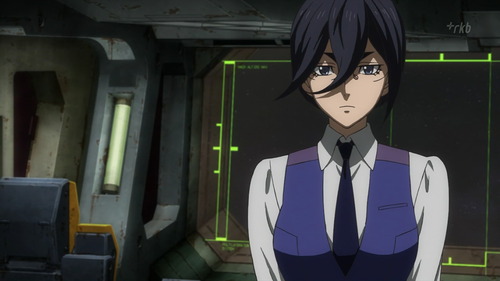
 Ever since Char Aznable became one of anime’s most memorable characters, many Gundam series have included similar rivals for their heroes. In general, they’re enemy pilots of roughly equal power who wear masks or something similar to hide their faces, and who often have their own ulterior, if noble, motives. Most recently joining the likes of Zechs Merquise, Harry Ord, and more is McGillis Fareed from Mobile Suit Gundam: Iron-Blooded Orphans, and his approach to being “a Char” is probably the most well-realized out of all of them.

 Gundam: Reconguista in G continues to be the kind of whirlwind experience that I love in a Tomino anime. Part of that feeling comes from the show’s tendency to throw around a lot of terms without explanation that everyone but the viewer understands, only to gradually peel back the layers over time. Among these many terms are clear references to the Universal Century timeline of the original Mobile Suit Gundam that Tomino directed back in 1979, and I’ve noticed that there are a couple that relate strongly to the character Lalah Sun from that first series.
 OGIUE MANIAX