Love Live! Sunshine!! and the Complexities of Anime Tourism

Love Live! Sunshine!! Real Escape Game in Numazu

Love Live! Sunshine!! is a media-mix property whose purpose, apart from pushing its stars and profiting from a match of anime fandom and idol fandom, is to promote tourism to the region around the city of Numazu in Japan. What I find fascinating about its approach, however, is that it not only encourages people to visit Numazu, but also reflects and tries to address many of the problems facing Japan in terms of the link between sustaining population, community, and business.

There are three main issues brought up in terms of population in Japan in recent years. First, and the one that gets the most attention, is declining birth rates. Whether it’s “herbivore males” or the difficult choice many women have to make between starting a family and having a career, theories abound as to why fewer Japanese people are having children. Second is the post-3.11 decline in tourism; a nuclear meltdown scares off not just international visitors, but those from within Japan as well. Third, and perhaps the most familiar to people around the world, is people moving out of rural areas into urban ones, leaving the old towns a shadow of their former selves with little new blood coming in.

Flying Witch

The ways in which anime have been used in response to these problems are myriad. Famously, the popularity of the anime Lucky Star led to people visiting the very shrine featured in the show, Washinomiya Shrine. The first Love Live! School Idol Project anime had a similar effect on Kanda Myoujin Shrine in Akihabara, where the character Nozomi works. But there are also anime which try to show the splendor of Japan whether directly or not. I don’t think it’s a coincidence that Flying Witch was made into an anime a few years after 3.11 when Japan was trying to revive tourism to the affected Tohoku region. Taking place in Aomori (a prefecture in Tokyo), Flying Witch features lovingly crafted shots of picturesque landscapes as if to say, “This area is lush with life.” The studio P.A. Works used the series Hanasaku Iroha to create the fictional “Bonbori Festival” and then bring it into the real world. Their more recent work, Sakura Quest, is an anime explicitly about trying to deal with a declining population in a small town through tourism and promotion.
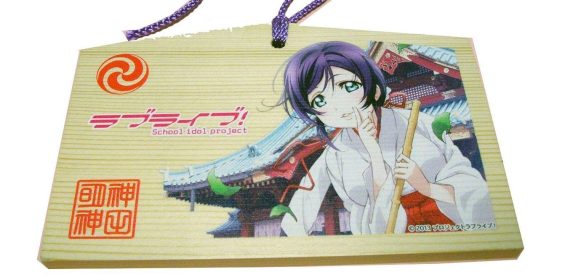
Official Love Live! Wish Board from Kanda Myoujin Shrine

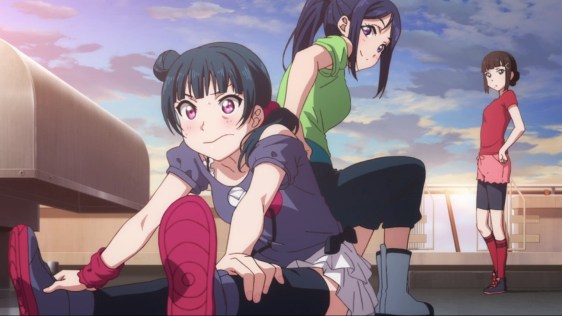
Love Live! Sunshine!! takes place in the small town of Uchiura, near Numazu. Much like the first franchise, the main characters’ school is threatened with closure due to declining attendance rates. The girls, inspired by the group known as μ’s (from the original Love Live!) attempt to replicate the latter group’s success in saving their own school, and form their own idol group called “Aqours.” Already, it’s clear how Love Live! Sunshine!! touches upon issues of population movement and tourism, but it’s especially notable when comparing the series to its predecessor.

Consider where the two properties take place. The μ’s girls of the original Love Live! are centered around Akihabara, which is both the spiritual center of otaku in Japan and, as a result, already a popular tourist destination. The Aqours girls of Love Live! Sunshine!!, on the other hand, are situated near Numazu, which has a population of under 200,000 as well as a recent history of absorbing nearby towns—a major plot point in Sakura Quest and a potential future for Uchiura. Unlike Akihabara, Numazu is hardly world-famous. And yet, if Love Live! had started differently—if it had decided to go with Numazu from the start—then I don’t think it would’ve reached its original success. Much like AKB48, it relied on the notoriety of Akihabara to build itself up, and is now paying it forward, in a certain sense. Love Live! used tourism, and now tourism is using Love Live!
Love Live! Sunshine!! can be seen as another arm of the “Cool Japan” concept, which uses Japan’s fame as a symbol of cultures both traditional and popular to promote itself at home and abroad. It appears to be succeeding, at least in the short term. In fact, over at Apartment 507 where I also write, one of the most popular posts is a guide to visiting Numazu. But as Gundam director and Anime Tourism Association chairperson Tomino Yoshiyuki has warned, short term success is not enough; permanent change is necessary, even if it’s to come from anime. The fact that Love Live! went from being supported by pop culture to being a pop cultural influence that can potentially make a change is a big deal, and I’m curious to see if this experiment has any long-term impact that goes beyond the cute idols of Aqours.

Save

Save

[APT507] School Idols vs. Pro Idols: The Hints of Sobering Reality in Love Live!

Something that’s stuck with me for a long time is the distinction that Love Live! makes between idols and school idols. I find that it hints at the harshness of the idol industry, though in a very, very indirect way. I wrote a short article on it over at Apartment 507, if you’re curious.

Save

Normal Girls Ascend to the Throne: School Idol Festival Perfect DREAM Project

In the world of Love Live! and its “school idol” setting, there have traditionally been stars that shine brighter than others. This is by design—in the Love Live! School Idol Festival mobile game, for example, a sharp distinction is made between “rare” characters, i.e. those based on the main eighteen characters of the franchise, and “normal” characters used to level up your stronger cards. Over time, however, the “normal girls” have increasingly encroached on that hierarchical barrier. Their artwork on the cards has improved. They’ve received special gag comics dedicated solely to them. Now, thanks to Love Live! Perfect DREAM Project, a new School Idol Festival endeavor, three of the “Normals” have crossed over to become part of an actual school idol group.

The trio in question are Osaka Shizuku (a yamato nadeshiko type in the drama club, sixth from left), Emma (a Swiss exchange student, first from left), and Konoe Kanata (a perpetual sleepyhead, second from left). Along with six brand new characters, they’re receiving the star treatment: distinct profiles with blood types and ages, more extensive details on their backgrounds, and even voice actresses to play them. They even have a school to call their own, Nijigasaki Academy, instead of just being “students at your school!” in LLSiF. It’s a major step up for characters who started off as experience fodder.

A comparison to The iDOLM@STER Cinderella Girls is inevitable. Cinderella GIrls originally began as a mobile game that expanded the number of idols dramatically, but restricting their format to something more simplistic. Over time, certain characters gained popularity, and when the Cinderella Girls anime was made, a lot of them gained voices and more firm identities. However, a major difference is that all of the later iDOLM@STER characters that began in Cinderella Girls and on were designed to be someone’s favorite, instead of having the sharp distinction between “rare” and “normal.”

Perfect Dream Project seems to be a middle point between the older Love Live! philosophy and The iDOLM@STER‘s. It’s not as if all of the Normal Girls are getting upgraded immediately, after all. This could change over time (as is implied in the phrase “and more…”), but for now only three have reached the other side, as far we know. I have to wonder if they’ll end up in a similar position as the three main girls of the Cinderella Girls anime—aspiring idols who are being thrust into a new and exciting world.

One question I have is why Shizuku, Emma, and Kanata were chosen. I have nothing against them or any particularly strong opinion, but it’s just curious that these would be the first. My initial assumption is that they’re the most popular, but that’s not necessarily guaranteed either. Do they hit upon various elements that have not yet been emphasized in Love Live!? Perhaps the unqiue appeal of Emma that, while she’s of European descent like Eri and Mari, she isn’t half-Japanese and she isn’t blonde. Or maybe they’re directly trying to compete with Cinderella Girls. Kanata’s state of constant tiredness brings to mind the master of sloth, Anzu Futaba.

I find the potential future of Love Live! to be quite intriguing. At the same time, I wonder if going too far off their original formula might lead the franchise to lose its core appeal. Having a smaller core roster to work with has its benefits. As long as Love Live! doesn’t lose sight of itself, I think this will turn into a net positive.

Save

[APT507] The Canon of Kanan: Love Live! Sunshine!! Character Controversy

I wrote a followup to my previous Apartment 507 post on Love Live! Sunshine!! character Matsuura Kanan. It goes into the character’s differences across various formats, and my own disconnect from other aspects of Love Live! fandom.

[APT507] How Love Live! Sunshine!!’s Least Popular Character Rocketed to #1

I wrote a bit about the change in fan opinion over Love Live! Sunshine!! character Matsuura Kanan over at Apartment 507. I know she became one of my favorite characters by the time I finished the anime, but did you find your impressions changing as well?

Love Live + Yellow Magic Orchestra?!

One of my favorite Love Live! songs is “Suki desu ga Suki desu ka?.” It’s a tune by Hanayo and Kotori with a kind of funk/disco flair. What I might have discovered recently, however, is a more specific reference to 70s music. Namely, the song might be taking cues or paying homage to the electronic music and techno pioneers known as Yellow Magic Orchestra.

At about 1 minute 13 seconds into “Suki desu ga Suki desu ka,” there’s a particular melody during the following lyrics:

Soshite watashi dake o (Oh yeah, oh yeah!)
Mitsumete hoshii no (watashi dake mitsumete)

If you listen to Yellow Magic Orchestra’s hit song Technopolis, there’s a similar combination of notes early on in the song, at about 42 seconds in. Have a listen below:

What do you think? Mere coincidence or an intentional nod to the masters of electronic music?

Good Idol/Wise Sister: Dia, Ruby, and Notions of Ideal Japanese Women in Love Live! Sunshine!!

diaruby-featuredimage

Following up my character spotlight articles for the girls of Love Live!, I’ve written a post analyzing Dia and Ruby from Love Live! Sunshine!! and their relationships with the concept of the “ideal Japanese woman.” Spoiler alert: It can be hard to be the perfect wife when men seem to barely exist in the world of Love Live!

Love Live School Idol Festival and Ten Fes: Rise of the Normal Girls?

tenfes

Recently, the Love Live! School Idol Festival rhythm game began featuring a new comics series within the English-language app itself: a 4-panel comic series called Ten Fes: Transfer Student Fesival. Its premise is that, rather than focusing on the expected stars of Love Live!, these manga put the spotlight on the lesser-known girls exclusive to the game. Whereas once these characters’ stories were told in only the briefest vignettes, they might now have the chance to really show off their charms.

llsifgirls-small

I once expressed a desire to see these “Normal Card” characters fleshed out more than they currently are, and I feel that Tenfes, while not an absolute game changer, is significant in this respect. To understand the potential impact it can have, it’s important to look at a rival fictional idol franchise: The iDOLM@STER.

The iDOLM@STER is devoted to having every one of its idols, be they the original ensemble from the first game or new ones created for their mobile apps, feel like a star. Love Live!, on the other hand, went as far as to create a new set of core girls to focus on, while the lower tier from School Idol Festival remain as essentially “fodder,” cards sacrificed to level up the ones that “matter.” Although being featured in short gag manga isn’t quite the same as getting to star in a full-fledged show like what happened with The iDOLM@STER Cinderella Girls, it still gives a chance for these “lesser” Love Live! characters to be characterized in more than just brief vignettes you earn within the game.

I’m not the kind of person who can thrive off of just sparse character descriptions. Even when it came to the main stars of Love Live!, I needed the anime. I could not feel any particular attachment to them when they were merely faces with semi-long descriptions. Also, while properties like Touhou and Kantai Collection can get away with it because all of its characters are equally barebones, the fact that this massive rift exists between the central casts of Love Live! and the School Idol Festival-exclusive girls makes that much more difficult.

Ten Fes allows for greater opportunities to portray interactions and relationships between the “common” characters. In isolation, these girls can only provide so much interest, but if they’re reacting to each other, playing off of each other, and maybe even butting heads with each other, then it gives them the chance to establish a lasting presence and build fan bases of their own.

Save

Save

Moe + Saki = Maki: A Genshiken/Love Live! Character Comparison

sakimaki

On occasion I’ve had to explain to those unfamiliar with Love Live! the appeal of Nishikino Maki. While terms like “beautiful” or “cooldere” kind of get the point across to an extent to those who already know her, I’ve found that they still don’t quite do the trick for people outside the fandom. However, I’ve recently thought up a comparison that I think works well, provided that you have some experience with Genshiken. Maki, in esssence, is like Kasukabe Saki—or more specifically, the “moe” version of Saki that Madarame once envisioned.

In the extra at the very end of Volume 9 of Genshiken (the finale of the first series), the characters are discussing why Saki isn’t “moe.” They talk about how she essentially has no weaknesses, that she’s just an extremely capable person overall. Even her boyfriend agrees that Saki isn’t moe. Then, Madarame has an idea: the only way Saki would be moe is if she was a virgin.

While this might bring to mind the issue of “purity,” it’s more that being a virgin would be a chink in the armor of Saki’s all-powerful self. She would be this smart, no-nonsense woman who just knows how to get things done, but her relationship advice would come not from personal experience. By being a virgin, she’d have that essential vulnerability that would bring her into moe territory.

When it comes to Love Live!, being a virgin isn’t any more or less special from on character to the next, as it’s implied that all of the main girls don’t have sexual experience (no matter what fans think/hope). However, the idea of an overall intelligent, talented girl with a firm head on her shoulders who is also naive in certain respects and easily flustered by embarrassing things is right in the same territory as “Moe Saki.” Within Nishikino Maki exists both the girl who keeps Nico in check, and the girl who believes in Santa.

Side Note: While Maki is basically Moe Saki, I bet Madarame’s favorite Love Live! would be Nico. 2D is different from 3D, after all.

Save

Christmas Feast!

Save