Street Fighter 6 has succeeded in its goal of bringing in new players through a simplified control scheme labeled “Modern.” The signature special inputs that Street Fighter pioneered are basically replaced by one-button inputs and cardinal directions, with the caveat that damage dealt is reduced by 1/5. The Modern control scheme has also spiced up discussion in the community as competitive players try to figure out if having your most powerful moves be instantaneous is a worthwhile tradeoff for having fewer options overall. But this is not the first time fighting games have included easier inputs, and I think it’s interesting to see how past games have tried to incorporate more accessible control schemes.
In the GameCube Capcom vs. SNKEO and the 3DS Street Fighter IV, the advantages their shortcuts provide is tremendous. The only thing that kept them at bay is that they were not the “main” tournament versions; if they were, high-level play would be fundamentally worse because the characters were simply not balanced with instant specials and such in mind.
Another approach comes from Granblue Fantasy Versus. In that game, players have simultaneous access to both traditional specials and simplified ones (on a cooldown timer), with the expectation that stronger players will use the former and newbies the latter. In actuality, competitive players use both, recognizing that faster inputs are more reliable in certain situations.
Then there’s Super Smash Bros., a game franchise built around more simplified controls. When traditional 2D fighter characters became playable, the big question was how they would be incorporated into the Smash system. The answer, it turns out, was to allow everything—you can use Smash-style special inputs and classic fighting game motions, the latter rewarding the player with greater damage and KO power. However, no Ryu, Ken, or Terry Bogard players worth their salt play a primarily “Modern”-esque style. And unlike Granblue, the simplified versions are only ever used when recovering offstage.
This is because the aforementioned distinction between damage and KO power is an important part of Smash. In SF6, your Shoryuken taking a bit less off might just mean you need to land one additional hit. In Smash Ultimate, it might mean not being able to finish off the opponent at all. The fighting-game characters are balanced around their ability to take stocks relatively early through their “true” specials, as they’re called by the community.
The saving grace of SF6’s Modern controls is probably the fact that they’re part of the game from the very beginning, and they make players feel powerful without going overboard. Unlike some games, you cannot have your cake and eat it too with respect to accessing both modes, and Modern comes with drawbacks that feel neither ineffectual nor overly harsh. Efficacy seems to vary from character to character, and players have to be cognizant of what they give up to obtain instant specials and supers—advantages the opponent can know about and play around. I expect them to be a staple of Street Fighter going forward, and are one big step in helping to chase the elusive specter of accessibility all while maintaining competitive integrity.
Super Smash Bros. creator Sakurai Masahiro has long frustrated the game series’ competitive community. A developer whose motivation is to bring in players daunted by the hardcore reputation that precedes fighting games, Sakurai is not against competition inherently, but places priority in ease of access and play for Smash Bros.
A common response from the competitive community is that Nintendo should fully embrace the competitive aspect of the series and push it to the forefront. The argument, generally, is that the competitive fans are more loyal, and it won’t affect the overall reputation of the games. Casual players will still approach it without tournament play, remaining blissfully ignorant. I think this is naive, or maybe even bullheaded.
It is true that any game that can act as a test of skill will inevitably lead to players who are better than others. And yes, Smash has proven itself to be viable for tournament play, despite what detractors say. The issue, however, is how having the series touted as a hardcore, competitive game influences the overall image of it, especially in an age when information proliferates so rapidly.
I love competitive Smash. I don’t play as much as I used to, but I still follow tournaments and keep up with discussion. When I go on the Smash subreddit, I find loads of valuable information on top players, tier list debates, upcoming tournaments, and more. More scarce, however, are posts about the casual side of the games: item shenanigans, stories of playing free-for-alls with friends, etc. While the subreddit is not devoid of less competition-oriented content, it does feel as if those posts get pushed down. I wouldn’t be surprised if more casually minded fans are afraid to post there.
In contrast, while Nintendo’s unorthodox shooter Splatoon has an active and robust competitive element to it, the Splatoon board on Reddit only has about 10% of posts devoted to tournaments and high-level play. While I sometimes wish there was more in-depth discussion of weapons and maps, it also means the outward reputation of Splatoon fandom is more light-hearted and focused on contributions like fanart, lore speculation, and general love of all things squiddy.
Neither subreddit’s approach is inherently better, but it’s clear to me that a game’s presentation and how its fans interpret that presentation into their own hobbyist displays has an affect on a game’s image. People who go to r/smashbros will think that fans mainly care about 1-on-1 competition, while those who visit r/splatoon will come away with the idea that its fans are less obsessed with wins and losses.
Both series see success in casual and competitive domains, but Smash is a case of the competitive reputation encroaching on the chance of casual community interaction a bit more. I believe this is what has long concerned Sakurai, and if he could achieve the casual/competitive balance of Splatoon, then he would.
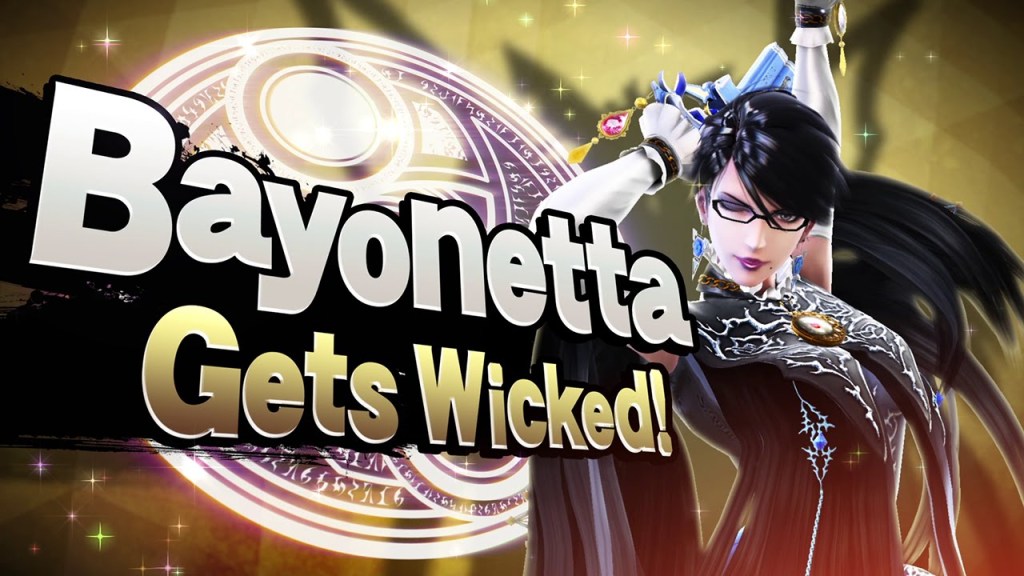
Since her first appearance in Super Smash Bros. for Wii U, Bayonetta has been a controversial character, with a style designed to frustrate opponents and combos that frequently snatch victory from the jaws of defeat. A combination of factors—recent tournament success, audience backlash, and the difficulty mid to low level players have dealing with her potentially driving away new blood—have once again brought up the question of whether Bayonetta should be banned.
Personally, I think the answer is “no,” simply because none of the reasons I’ve read are solid enough or objectively quantifiable enough on their own to form a solid foundation for a ban argument. Collectively, they combine together into a murky sense of “she kills people’s desire to play the game,” as opposed to the more concrete reasoning of other banned characters in fighting games of years past. Bayonetta might be able to combo someone to death when they’re at 0% damage after a few reads, but it’s not like Super Street Fighter II: Turbo Akuma, whose could not be dizzied and had an air fireball that none could properly defend against.
Even as I disagree with those calling for a ban, however, I still find myself sympathizing with their arguments because their dissatisfaction is real. In particular, I find the idea that Bayonetta is discouraging new talent from sticking with the game to be fascinating because it’s specifically about how Bayonetta affects not the strongest players, but the ones underneath that upper echelon.
One common argument made against banning Bayonetta involves comparing her to another top character from a previous Smash Bros. game: Fox McCloud in Super Smash Bros. Melee. If you look at the amount of representation Bayonetta has among the top 50 Smash 4 players, it pales in comparison to the number of Melee Fox users. “But,” the pro-ban side will say, “Fighting Fox at mid-level is fun because you can exploit his weaknesses and combo him. You can’t do the same to Bayonetta.”
So you have a situation where, while Bayonetta is not as dominant as Fox at the highest skill tiers, this doesn’t matter to a large chunk of players for whom that might never matter. Mid-level players fight mid-level Foxes and can take advantage of their opponents’ mid-level flaws. In contrast, taking on mid-level Bayonettas requires both a combination of very solid fundamentals (in particular to not overextend and to force the Bayonetta to act first), and specialized knowledge (how to properly fall out of her combos to avoid the next hits, and the decision-making necessary to hide one’s countermeasures against those combos) In a way, if the reason you play competitively is to land satisfying combos, the study and practice needed to fight Bayonetta might feel as interesting as doing taxes or studying trigonometry.
I think all of this would be an easier pill to swallow if the reward for learning how to fight Bayonetta is a consistent plan on how to exploit her weaknesses and shut her down. Little Mac garnered complaints early on because he was difficult to fight for newer players. Lucario, like Bayonetta, is argued to go against the “rules” of fighting games by becoming more powerful as it takes more damage. Sonic the Hedgehog’s evasive style can easily wear down people’s patience. In all of these cases, better players have shown the way as to how to fight them properly and satisfyingly. With Bayonetta, even though she’s the least dominant #1 character in Smash history, she can still aggravate even the best players in the world.
Here’s an analogy that I think conveys the conflicted feeling of knowing that some of the strongest competitors in the world can still succumb to Bayonetta’s shenanigans. Imagine two people have each discovered treasure maps. They require learning an ancient language, trudging through deadly jungles, and a general toll on body and mind. For the first person, the reward is a treasure chest full of gold and riches. All that hard work yielded a mighty reward. For the second person, however, they find a contract that lands them a 9-to-5 job that pays decently well but still requires them to keep pushing ahead, and there’s not even a guarantee the job will last. It’s a “reward” in a certain sense, but that amount of effort might not seem worth it. The latter situation is how I imagine mid level Smashers feel when they look to the top for inspiration, and see many of their heroes still falter against Bayonetta. Learning all of those tricks and tips only results in relatively less stress.
Tactics and characters that can crush weaker players might not necessarily work on stronger ones. Bayonetta is in a similar situation, but the degree to which she threatens the motivation of those non-top players is still worth noting. One possible solution is to simply restrict her usage at smaller, local tournaments. However, this runs the risk of harming an important subsection of players: those who are not yet good enough to compete at the highest level, but might become strong enough. If you have a smaller scene that bans Bayonetta but have bigger settings that allow her to remain, then you’ve basically harmed those transitional players because they have to fight Bayonetta now while lacking experience against her. A blanket ban technically fixes this as well, but just as lower level players might find it unfair to have the expectations of skill and talent from the top tell them what can and can’t be done, basing a ban on how those lower level players feel can be even more stifling to the top. There’s no easy answer.
Bayonetta is generally considered the best character in Smash 4. While her strengths are many, her key trait is the ability to instantly turn the tables on her opponent’s assault and transform a disadvantageous situation into a chance for victory. As with many #1 characters in games, there have even been calls to ban her from competitive play, more than any other character in the game. But I don’t believe the outcry is simply because she’s “too good.” Rather, it’s about why she’s good. Her character strategies are akin to those of a dominatrix, and her denial of pleasure in Smash 4 is what frustrates many to the point of crying foul.
Heroic stories are often built on giving antagonists their just desserts. Whenever Stone Cold Steve Austin managed to corner Vince McMahon, fans cheered as Austin drowned his evil boss in beer. When Kenshiro in Fist of the North Star confronts Jagi, the satisfaction of having Kenshiro beat Jagi to death for all his injustice is a moment meant to scratch that revenge itch. The villain, by virtue of being a villain, must pay.
Looking at fighting games, it’s possible to label the top tier characters as the villains in the story of competition. They’re the fastest, the strongest, and the most dominant. So what happens when the “hero,” i.e. whoever’s fighting the top tier, finally catches up to this scoundrel? Well, it depends.
Take Fox, from Super Smash Bros. Melee. Widely considered the strongest character in that game by a margin wider than Bayonetta’s grip over Smash4. But while Fox is basically a master of all trades, he’s also a glass cannon who, if hit, can be combo’d hard by many of the best and worst characters in the game. Stringing a series of attacks together and watching Fox’s damage percentage rapidly rise is satisfying. So is spiking him offstage and seeing him plummet like a rock to his doom. Making Fox pay goes a long way in providing pleasure to the player or viewer opposing him.
This results in a kind of “combo catharsis.” Even if the opponent loses to Fox, seeing a Marth or a Mewtwo chain grab him for a couple of stocks can still make it seem like the dastardly space animal was on the ropes, if only for a few moments. The villain barely got away! Even in loss, it’s possible to feel powerful—a quality that I believe is important in attracting and keeping players.
Bayonetta, in contrast, is intentionally designed to deny easy combos and follow-ups on her. Multiple jumps and ways to recover mean edgeguarding her is difficult. Afterburner Kick acts as an escape button for those trying to juggle her. Witch Twist deflects and draws in the opponent into a potentially high-damage or even fatal string of attacks. Witch Time actively punishes overly aggressive and predictable players. While it’s possible to land multiple blows on her, each hit requires about as much work as the last. Bayonetta stymies combo catharsis, making the release that comes with it incredibly difficult to achieve. Even in gameplay, she’s truly a dominatrix.
A unifying point between Bayonetta and Fox is another character notorious for denying combo catharsis: Melee Jigglypuff. A proverbial flyweight who makes up for its lack of diverse tools by stonewalling opponents through strong aerial attacks and deft aerial movement, Jigglypuff is so light that the opponent can usually only land one or two hits before it goes flying out of reach. And yet, when it comes to Fox’s reputation vs. Jigglypuff’s, the latter receives more scorn from players and spectators despite the fact that the former excels at nearly everything and boasts a much larger player base at the lowest and highest levels of competition. Catch Fox, and you can pound him for an extended period. Catch Jigglypuff or Bayonetta, and you might get just a single lick before you have to start all over again.
In spite all of the above innuendo, this is only an analogy, and I don’t think anyone actually derives sexual pleasure from playing Smash Bros.—though I could see it being just as satisfying. But at the same time, it’s clear that Bayonetta is, by design, hard to combo, and that one of the most popular and enduring elements of Smash Bros. and fighting games in general is the combos (or chains or strings). I don’t know if it’s intentional, but Bayonetta in essence works from an almost BDSM-like playbook. This doesn’t necessarily mean Smash4 players are masochists, but those who still choose to fight Bayonetta are at least those who can manage to hold back their desire to just let loose.
With the surprise announcement of Cloud Strife in Super Smash Bros. for 3DS & Wii U, as well as the upcoming mysterious December Smash Bros. special report, I felt inspired to start up a new line of Smash character what-ifs. You can see the previous ones I’ve made below.
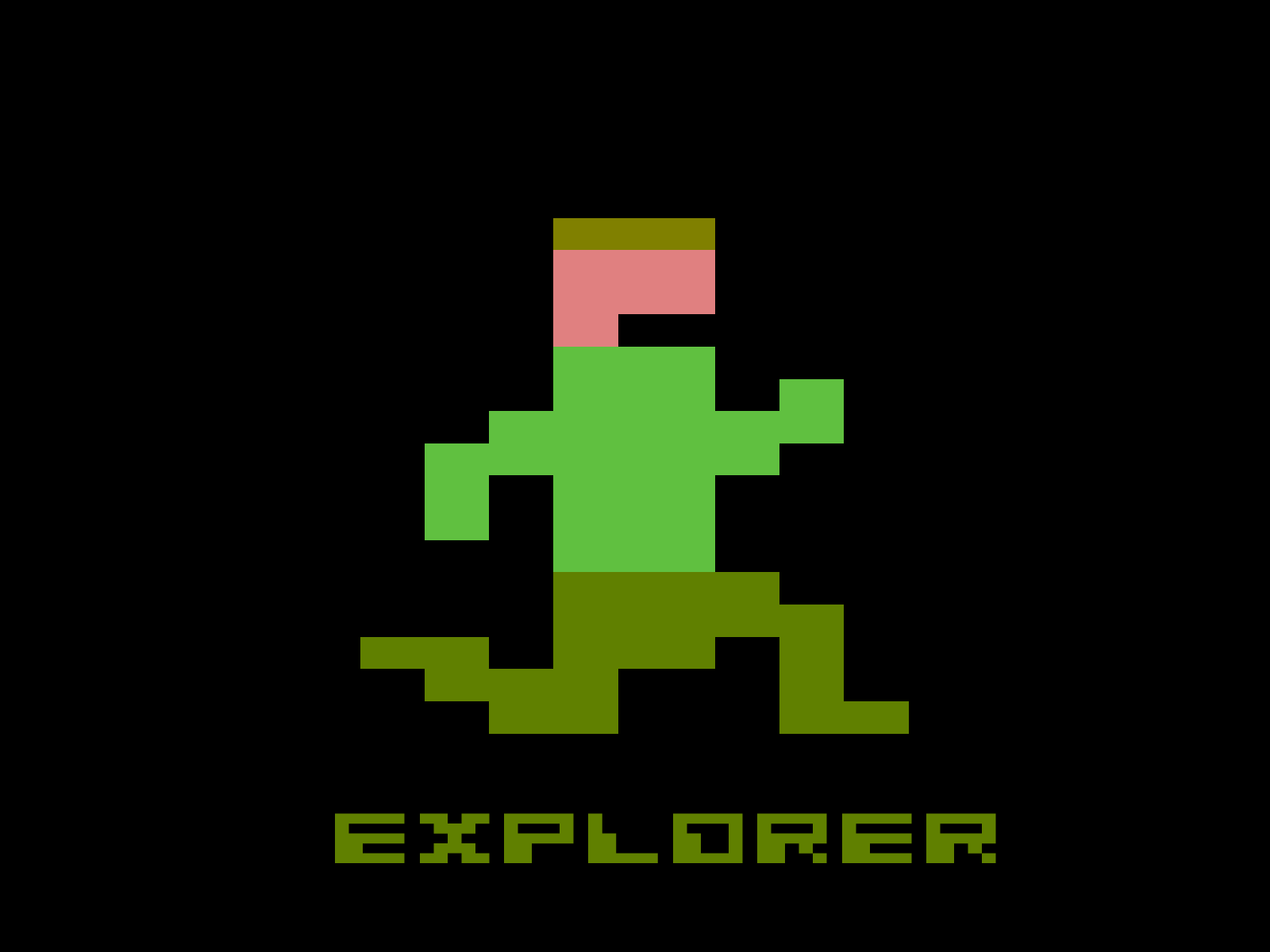
Thinking about how 3rd-party characters in Smash tend to be ones from influential or important games (Cloud), or representative of entire genres (Ryu), I decided to create a moveset and design for Pitfall Harry, the hero of the classic Atari 2600 game Pitfall. If you don’t know who Pitfall Harry is, that’s probably not surprising, as 1) the game is from 1982 and 2) even if you know the game Pitfall Harry doesn’t have much of a presence. After all, this is what he looked like:
Pitfall is significant in that, to my knowledge, it’s the first horizontal multi-screen platform game, and in terms of its implementation on the Atari it is a technical marvel, like creating boeuf bourguignon out of leather shoes and ketchup. Because of this, I think Pitfall Harry could reasonably have a place in a pantheon of gaming icons, however unlikely.
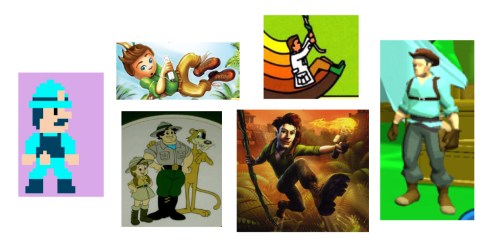
However, the first challenge that presented itself is the fact that Pitfall Harry has no consistent design. In addition to the fact that his original sprite (although amazing for its time) has no real identifiable features, Pitfall Harry across adaptations and sequels changes size, hair, clothes, musculature, personality, and more from one iteration to the next.
Possible Costumes?
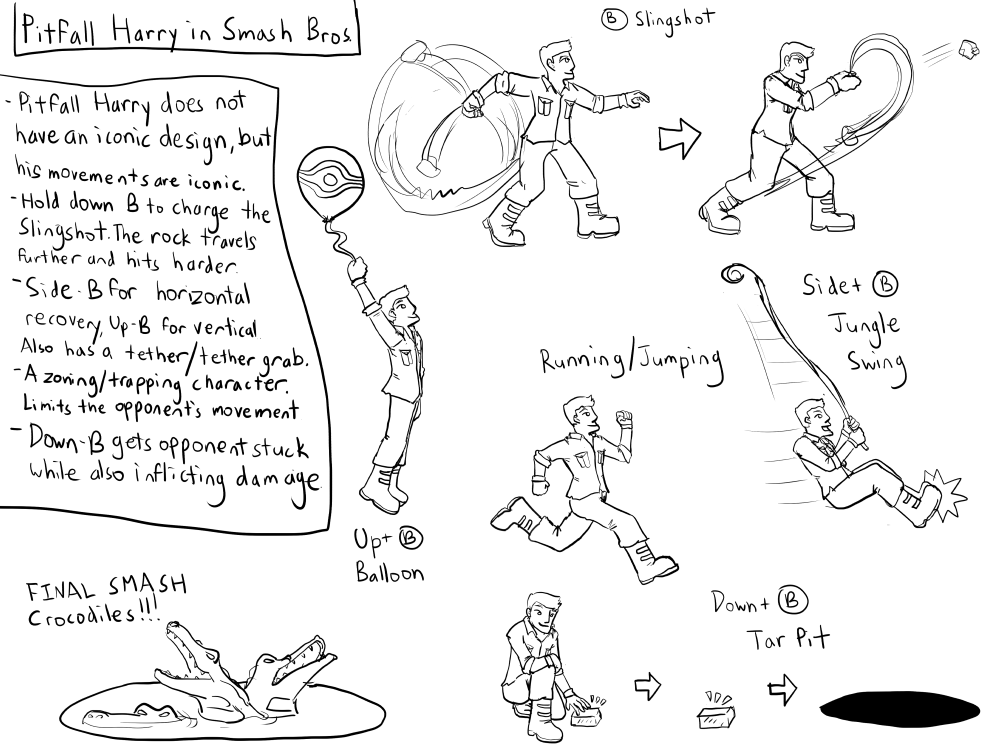
As mentioned on the image itself, I decided to prioritize Pitfall Harry’s movements, because they’re what’s iconic about him, while trying to keep his silhouette closer to the original sprite wherever possible. If he can for the most part capture the animations of the Atari 2600 sprite in Smash, then his identity should come through. This should also be reflected in the audio. When he jumps, he should make that distinct Atari noise (or a higher-quality version of it), and when he does his Jungle Swing Pitfall Harry should yell out like Tarzan.
As for the attacks themselves, I feel that Pitfall and Pitfall II are where most of the game franchise’s influence comes from, and so they should be prioritized. His Final Smash is his “deadliest enemy, the crocodiles,” his Balloon recovery move comes straight out of Pitfall II (and is super vulnerable so only useful as a last resort), his Tar Pit trap references both the treasure and hazard aspects of Pitfall, and the Jungle Swing is iconic. The main exception is the Slingshot neutral special, taken from Pitfall: The Mayan Adventure and other sequels. If his son can use it, I’m sure Harry can as well.
Gameplay-wise, I picture Pitfall Harry as being average in weight, average in ground speed, a little above average in air speed, and below average in racking damage and KO power. He’s not that much of a fighter (unlike Mario, jumping on enemies just kills Harry), so he would function primarily as a zoning and trapping character who controls space with his specials, but doesn’t have as much sheer recovery power as Smash 4 Villager. If anything, he’d be closer to Duck Hunt. However, his trapping game is not to be underestimated. Tar Pit works like a souped-up version of a burying attack, both getting the opponent stuck and dealing damage over time. It would also be unblockable, which somewhat makes up for his tether grab. The caveat is that it is very obvious where it is located, with the big glowing gold bar to indicate the trap, but this also means that the opponent best steer clear of the location. Essentially, Harry could cut off a portion of the stage, such as Smashville’s platform or Battlefield’s top platform, and manipulate the opponent to get hit by a Jungle Swing or a smash attack (which would mostly involve fists).
Overall, Harry would emphasize cunning and ingenuity. To succeed as Pitfall Harry requires a clear understanding of space control, as well as adapting to a somewhat unorthodox neutral game.
So, who do you think I’ll be showing next time? I’ll leave you with a hint. “Japan shut down.”
—
If you liked this post, consider becoming a sponsor of Ogiue Maniax through Patreon. You can get rewards for higher pledges, including a chance to request topics for the blog.
This month I’m happy to say that the Ogiue Maniax Patreon is currently at almost $100, thanks to my generous patrons both new and old. Even getting close to the three-digit mark is kind of like a dream, and I hope to continue to provide interesting content for my readers.
This past month, I’ve gotten around to making a number of posts I’ve been planning for a while, most notably my review of the fujoshi friendship manga Fujoshissu!, my first look at DLC character Mewtwo in Super Smash Bros. for Nintendo 3DS & Wii U, and my review of the anime about anime, SHIROBAKO. In the case Fujoshissu! I’d been anticipating writing the review of years.
This month’s special Patreon sponsors are:
Ko Ransom
Alex
Johnny Trovato
anonymous (not Capital A “Anonymous”)
One of my contributors wanted to remain anonymous, but because they fulfilled the “Decide My Fate” tier, I wanted to mention them as I am writing a special post this month. As always, if you’d like to request a topic for me to write, you can pledge $30 or more to my Patreon. If you don’t want to or can’t contribute that much every month, you can always change the amount to something lower, or force a maximum limit on how much you give.
For this month, I’d like to ask what people want to see out of my rewards and goals. I understand that my goals and sponsor rewards aren’t exactly world-shattering, and while I’m certainly not willing to sell myself out, I’m curious as to what people would like to see. Perhaps Skype conversations once a week on any topic? Post requests with unique twists? Drawing requests? I’m not sure if I’d be able to do everything, but I’d like to at least offer more.
In terms of milestones, I’m open to suggestions. How would people feel about a tongue-in-cheek negative review of Genshiken and/or the character review of Ogiue?
Upon hearing Mewtwo in Super Smash Bros. for Nintendo 3DS & Wii U for the first time, I was convinced that they had brought back the original actor, Ichimura Masachika, from the film Mewtwo Strikes Back. However, it actually turns out to be someone doing an excellent imitation (with the help of a voice filter), and whose acting chops are impressive in their own right. While the new actor Fujiwara Keiji might not have the cred of being an established theater actor like Ichimura is (he’s most famous for playing the titular character in the original Japanese Phantom of the Opera), you might know him for some of the following roles:
Ladd Russo in Baccano!
Nohara Hiroshi in Crayon Shin-chan
Kuzuhara Kinnosuke (Biker Cop) in Durarara!!
Holland Novak in Eureka Seven
Maes Hughes in Full Metal Alchemist (both original and Brotherhood)
Ali-al Saachez in Mobile Suit Gundam 00
Hannes in Attack on Titan
Jake Martinez in Tiger & Bunny
I actually had my suspicions because Mewtwo makes certain sounds in the new Smash Bros. that I don’t recall from Super Smash Bros. Melee, but I chalked it up to my own faulty memory. It’s also a lot more difficult to hear because only the Japanese version has voiced victory quotes. It was the same in Melee, except you could change the language settings there to Japanese, which is how I and a lot of other people learned that Mewtwo had victory quotes in the first place.
Here are videos of the old and new voices for you to compare:
Old (ignore the skins; they’re from a mod)
New
And for fun, here’s a video of Ichimura Masachika as the Phantom of the Opera:
—
If you liked this post, consider becoming a sponsor of Ogiue Maniax through Patreon. You can get rewards for higher pledges, including a chance to request topics for the blog.
It’s been six months since Mewtwo was announced as a downloadable character for Smash 4, but it’s felt more like a lifetime. With the vague arrival date of “Spring 2015” and not a single image beyond a basic character model, information was scarce, and it left Mewtwo fans such as myself starving. Then came the April Nintendo Direct, which not only showed Mewtwo in action and gave an April 28th release date (April 15th for people who registered both games through Club Nintendo), but also revealed the return of Mother 3 hero Lucas as well as a worldwide poll asking who you want in Super Smash Bros. Suffice it to say, it’s been crazy.
(More on the poll in the future. Stay tuned!)
That brings us to today. As one of the many people who bought and registered both the Wii U and Nintendo 3DS versions, I’ve had the privilege of getting early access to Mewtwo, and I’d like to give my impressions. This comes from the perspective of someone who used the character avidly in Super Smash Bros. Melee (though not so much in a high-level competitive sense), as well as a long-time fan of Mewtwo as a character.
On an aesthetic level, Mewtwo looks so much better than it did in Melee, with body proportions closer to more recent depictions (taller, smaller head, etc.), as well as much more detailed animations. Though all of Mewtwo’s moves are more or less the same as they were back in the Gamecube era, they all have an extra bit of flair that really captures the essence of the character. When Mewtwo does a back throw, it effortlessly lifts the opponent through its telekinesis and, with its eyes closed as if it’s discarded a piece of trash, launches them. The voice, which I know was a bit of a concern for people, is actually just the same as its Melee voice, veteran theater actor Ichimura Masachika. Actually, it’s literally the Melee clips re-used, only that we don’t get the option of changing the game language to Japanese and hearing Mewtwo speak actual lines. I’m not totally against English dubs, but a part of me would have been a bit sad if this had been replaced.
In terms of gameplay, the first thing I want to say is that it actually took me less time to figure out how Mewtwo is supposed to function as a character than it did for me to learn Mega Man, who has been my primary character (the spotlight will now be shared between Blue Bomber and Genetic Pokemon). Once you get a sense of Mewtwo’s attributes, including its attacks, its speed, and its weaknesses, its game plan becomes clear. Mewtwo is a glass cannon, with an overwhelmingly powerful offense contrasted by being one of the lightest characters in the game who’s also one of the largest targets out there.
Especially coming from the perspective of a Mega Man player, Mewtwo’s attacks flow together incredibly well. A lot of its attacks, namely down tilt, up tilt, Side Special (Confusion), and Down Special (Disable) are designed to set opponents up for juggles or follow-ups. There aren’t very many reliable combos from Mewtwo, but a lot of the character is about forcing 50/50 guessing situations that favor you in terms of reward, and you can do things like Confusion -> down tilt, dash attack, forward air, second jump into up air. If you’re not someone who plays and found that a bit confusing, just know that Mega Man by comparison is lucky to get more than 3 hits on an opponent while juggling.
Another feature of Mewtwo’s is that it’s actually much faster on the ground now compared to Melee, and both the range and power of its attacks have been increased. Dash attack in particularly is affected positively by this new-found speed and range, as it’s easy to catch someone landing with it, pop them up in the air, and start a juggle. Mewtwo also now sports some of the most tremendous and reliable kill power in the game. Shadow Ball has more kill power than Samus’s Charge Shot and can be spammed more reliably than Lucario’s Aura Sphere. Up Smash comes out quickly and is absurdly strong, KOing many opponents off the top at about 90%. Forward Smash and Down Smash are slow but powerful, and their weak points can be mitigated through setups such as Confusion and Disable. In particular, if you Disable someone at about 80% and charge a smash attack, they’re almost assuredly going to get taken out.
Mewtwo also eats shields for breakfast, and it’s kind of frightening to see just how effective it is at whittling them down. Many characters have attacks that can either destroy shields or do massive damage to them, but none are quite as reliable and effective as Mewtwo’s Shadow Ball. Its only real weakness is that it takes a while to charge, but once you have it at full power, it has positive effects whether it hits or is blocked, and its erratic trajectory can make it difficult to avoid through dodging. Even if it doesn’t hit anything, Mewtwo can act quickly out of the move allowing follow-ups, and for those characters that love to reflect projectiles, Mewtwo now has a properly-working Confusion that can send it right back for a game of Ocarina of Time-esque volleyball.
Of course, it wouldn’t be Mewtwo without some strong throws, and it sports some of the best around. All of them do significant amounts of damage, somewhere between 9-11%. Back throw is a decent kill move, and up throw is the strongest in its class. With a good amount of rage (in Smash 4, characters become stronger as they take more damage), up throw can KO most opponents between 120-140%. While that might not seem too impressive, and it’s actually weaker when compared to Melee, it’s important to remember that, unlike many other killing throws (which are mostly back throws), Mewtwo’s is reliable at pretty much any point on the stage, instead of requiring you to be closer to one side or the other.
That’s Mewtwo on offense. Mewtwo on defense is another matter, as it is actually one of the lightest characters in the game, even easier to KO than Mr. Game & Watch. Combined with its large frame, it takes attacks easily, and doesn’t have many moves that can keep it from being juggled. Somewhat similar to Mega Man, Mewtwo’s main game plan is to drift towards the edges to avoid follow-ups, and thankfully a combination of excellent air speed, huge jumps, and the best teleport in the game means that it can often escape. However, because Mewtwo is so frail, it sometimes doesn’t matter, as a stiff breeze can send it reeling. In other words, the basic principle of Mewtwo is to deal a crazy amount of damage before the opponent gets the chance to touch you, otherwise you’re probably in trouble. In this way, Mewtwo somewhat resembles Akuma from Street Fighter, another character known for having high damage and low health.
Regardless of how good Mewtwo is as a character in the end, the collective effect of all of this is that Mewtwo feels more representative of the character’s original concept. In the original Pokemon games, Mewtwo is among the strongest in the game, with insanely high offensive stats and relatively good defensive stats. In an effort to promote game balance, the creators of Smash 4 clearly decided to make these aspects more extreme by giving it such terrible defenses, but I think this plays into Mewtwo’s character more than what it had in Melee, which generally amount to having a few decent moves wrapped up in a bunch of terrible qualities. Now, at least those terrible qualities are equally met with terrifying potential on offense. Destroy or be destroyed.
I do find it kind of interesting that the two characters I picked are the ones that are deceptive in terms of size to weight ratios. Mewtwo is very large and extremely light, while Mega Man is much heavier than he looks. It also means that their game plans are also somewhat opposite, as Mewtwo is a very unforgiving character while Mega Man can be afforded more mistakes. Whether they complement each other or succumb to the same issues, only time will tell.
—
If you liked this post, consider becoming a sponsor of Ogiue Maniax through Patreon. You can get rewards for higher pledges, including a chance to request topics for the blog.
This past month I lost one Patreon sponsor while gaining another. While in business this might be called stagnation, I’m actually very grateful that so many of my patrons have decided to continue to stick with me. Of course I can’t hit it out of the park for everyone all the time, so I’m thankful for even one-time contributors.
Speaking of thanks, shoutouts to the following fine folks for being especially awesome patrons.
Ko Ransom
Alex
Johnny Trovato
There are also a few others, but they’ve chosen to remain anonymous, and I can appreciate that.
Last month’s most popular post was Smash Bros. vs Traditional Fighters and What Lies at the Core of Fighting Games, where I wrote about different philosophies concerning simplicity vs. complexity between different fighting game communities. Part of the reason it got so many hits is that I posted it to Reddit myself, but I do think it’s some of my better work. I know I’m more of an anime and manga blogger, but I do have interest in video games and other things as well, and I hope, even if you’re not quite into everything I enjoy, that I can at least make you think.
A few questions for my readers to end off:
1) What kinds of rewards do you think would be interesting for Patreon sponsors of Ogiue Maniax?
2) What do you think of review posts that cover more of the middle point of an anime as it’s airing, as opposed to ones that wait until the very end? They kind of serve two different functions, with the former being more “in-the-moment,” and the latter being more retrospective. I’m aware that some anime fans like to keep up with the new season as much as possible, while others prefer to wait and build up a back catalog, and I’m curious as to which type reads Ogiue Maniax more.

 OGIUE MANIAX