Keep Chugging Along: Shinkansen Henkei Robo Shinkalion Z

I never got the chance to watch all of the first Shinkalion anime. I discovered it a little late, and the way episodes would be up on Youtube for only a week meant that a busy schedule could derail my hopes of keeping up with it. And let’s face it: The series is pretty generic in a lot of ways. Still, I wished I could have kept pace with it better.

In 2021, Shinkansen Henkei Robo Shinkalion Z debuted, and I saw this as my opportunity to do what I couldn’t before. I decided to keep up with the series week to week, not expecting my world to be rocked or anything. 

The basic story is that years after the events of the original Shinkalion, a new boy named Arata Shin becomes the driver of the new Shinkalion Z E5 Hayabusa. Unlike the original main character, Hayasugi Hayato, Shin is not a train otaku but rather a cryptid enthusiast. Alongside him is a new friend, Usui Abuto (named after the Apt trains), who is the train fan but can’t drive Shinkalions for some reason. Together, along with other allies, they have to fight against the forces of the extraterrestrial Teoti.

Shinkalion Z doesn’t dazzle, but it’s fun and it has a few twists and turns that add some welcome tension and drama. Also, it has a grade schooler version of Maetel from Galaxy Express 999. In a way, part of watching Shinkalion is seeing their argument for being the most ambitious crossover, as the meme goes.

One of the issues with Shinkalion in general is that the characters and the mecha themselves both feel kind of bland. I know I’m not the target audience, and I’m not saying they need to look amazing, but there’s something decidedly milquetoast about the aesthetic. In particular, the fact that all the Shinkalions have basically the same design with minor differences and even transform virtually the same way makes it less exciting than it could be—imagine if they had unique transformation sequences a la Precure or Sailor Moon. I’m sure it makes for convenient toys, though.

Shinkalion Z makes some improvements in both regards, though nothing mind-blowing. Abuto has some depth to him, while a Shinkalion driver named Taiji is hard to forget because he’s this weirdly muscular little boy from a family of lumberjacks or something. The inclusion of a big-bodied lady as a side character that doesn’t fall into fatphobia is also worth noting. As for the robots, there’s one that can turn into a centaur, which is the most eye-catching thing to come out of this franchise so far.

The show winds up being 41 episodes long, a bit unusual of a number, and it makes me wonder if the show got cut short. Of course, that means it’s in the company of many classic robot anime—First Gundam, most famously. Between this and its toyetic, “for kids” feel, perhaps Shinkansen Henkei Robo Shinkalion is the purest mecha series of all.
Ogiue Maniax Panels at Otakon 2022

Otakon 2022 is this weekend, July 29–31, and I’ll be heading back to my favorite anime convention of all. This year, I’m running two panels: one by myself, and one with an old partner in crime.

Hong Kong in Anime and Manga 

Friday 4:30 PM – 5:30 PM / Panel 2

I was motivated to do this panel because I wanted to celebrate the culture of Hong Kong but also critically investigate how it is used in anime and manga. Those who’ve been to my panels will know that I tend to take a more scholarly (yet still fun) approach, and this is no exception, I hope

Mahjong Club 
(aka Riichi! Ten Years Later)

Friday 5:45 PM – 6:45 PM / Panel 5

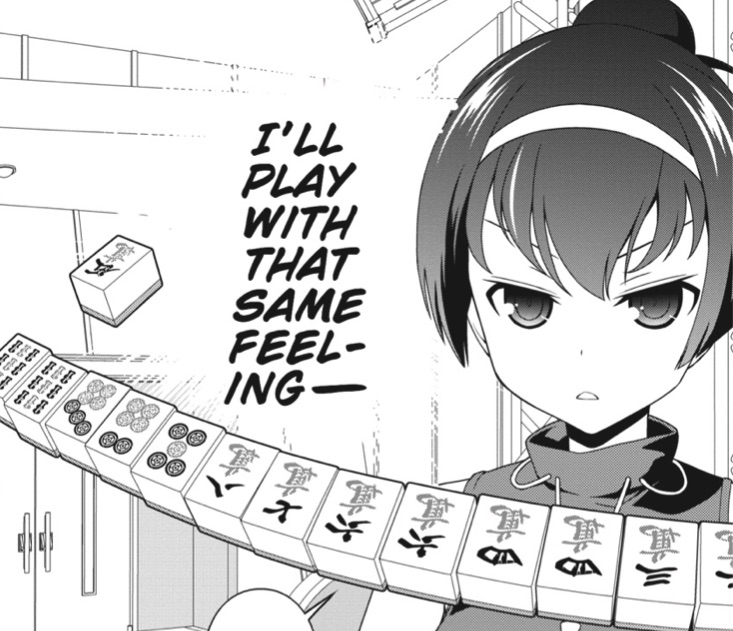
It’s been ten years, the Japanese mahjong panel is back! Once again, it’ll feature myself along with Kawaiikochans creator Dave. There are more riichi mahjong players outside of Japan than ever before, and more easy ways to play too! Whether you’re an experienced hand or someone who only knows mahjong by name, this panel has something for you.

See you in DC!

Kinoko Loco: Sabikui Bisco

I’m a fan of the combination of serious and silly in the anime Sabikui Bisco. Its premise of a post-apocalyptic world that revolves around conflicting views on mushrooms is patently absurd, but the sincerity of its characters is endearing and gives weight to their actions and decisions.

The world of Sabikui Bisco is full of peculiar individuals. There’s Milo, a gentle doctor who experiments with black market mushrooms in the hopes of healing his sister who’s afflicted with the “rust” disease that plagues humanity. The same sister, Pawoo, leads an elite guard in their city using her depth-defying strength. There’s the corrupt leader Kurokawa, who controls the city with an iron fist and goons in mascot heads. And then you have the brash protagonist Bisco, a member of the mushroom tribe who slings mushroom arrows and knows the truth about fungus: While it’s commonly believed to be the cause of rust, the reality is quite different. This here is an eclectic bunch, to say the least—but as ridiculous as they are, they’re all deadly serious about either saving the world or controlling it.

The general energy of the series reminds me a lot of the 1990s anime I grew up with. It’s not so much that Sabikui Bisco traffics in 90s tropes, but rather that it has a particular brand of irreverence combined with a lack of archetypes common to anime made in the 21st century. Had it emerged two or three e decades earlier, I don’t think it would look out of place alongside titles like Slayers or Trigun. In fact, there’s something very Vash the Stampede–esque about Bisco.

The anime thus far only covers part of what is an ongoing light novel series, but it ends in a satisfying place and never loses sight of that balance of earnestness and absurdity. Sabikui Bisco is about heroes going out there and doing things, and that simplicity is welcome.

La+ Darknesss, Dance, and True Power Levels

Since her debut, Hololive’s La+ (pronounced Laplus) Darknesss has become one of my favorite Virtual Youtubers. Her premise states that she’s both a mighty alien (?) demon (?) whose power has been sealed off—as well as the founder of Secret Society HoloX, an organization with designs for world domination. In practice, however, La+ comes across as a cheeky and overconfident brat. It’s within this context that the biggest surprise about her characters was revealed: the fact that she’s actually a fantastic dancer. I find myself re-watching her dancing clips, even though I normally don’t do that—not with VTubers, not with flesh-and-blood performers, and not even with the many anime dances over the years.

To those who are unfamiliar with Hololive and specifically the process by which its Vtubers go from “2D” to “3D,” most start off as flatly animated characters. In this “2DLive” format (named after the program used to rig their animations), La+ and others like her are able to move and tilt their bodies and heads to some degree, but it’s generally not meant to track the entirety of the performer’s physical movements. Over time, a Hololive member receives a 3D polygonal model, and can use more robust motion capturing to match the movement of their entire bodies. In other words, you generally can’t tell how comfortable a VTuber is with physical activity like dancing before they make their so-called 3D debut.

La+ was the last of HoloX to become 3D. Prior to that, she was primarily defined by two things. First, despite being the leader of her clandestine group, she’s actually the smallest; her oversized horns further emphasizing La+ as a relative pipsqueak. Second, she has an extreme amount of ego that swings wildly between being justified and unjustified. So when she started busting a move, I felt a degree of cognitive dissonance. “Wasn’t she supposed to be bad at this sort of thing?” In a later collaborative stream with the rest of HoloX, the sheer contrast in dancing ability between La+ and her subordinates (who are usually her betters in a variety of ways) hammered home that she’s a cut above the rest.

I think the reason this aspect of La+ works so well is that it ends up making her feel even more like a being of contrasts. She has that aforementioned “shortest but most important” quality, but in terms of competence, it’s like you never know if she’ll be a Hellmaster Fibrizo (Slayers) or a Katyusha (Girls und Panzer). If this really were an anime or something, La+’s dance reveal would be that moment where Yoda or Shifu from Kung Fu Panda gets serious. It’s a winning trope, generally speaking.

La+ Darknesss is neither fully an anime character or a fully flesh-and-blood performer, which is why the combination of her character background plus her strength as a dancer shine through. Like other VTubers, she lives in that transitional space between the real and fictional worlds. The fact that she’s so physically talented is inevitably to the credit of the performer, but it’s the surrounding setting that gives La+ the stark contrast to render her moves to be even more unforgettable.

Happy Girlmore – “Birdie Wing: Golf Girls’ Story”

As far as I can tell, no one expected Birdie Wing: Golf Girls’ Story. A yuri anime? Sure, there are plenty out there. An over-the-top sports series? That’s a well-established subgenre. A world run by powerful underworld forces? Organized crime is not an uncommon subject matter for Japanese media. To have all three and unexplained deep-cut Gundam references, and to put it all in an intensely bright package is to approach the schlocky majesty of Birdie Wing.

The heroine is a blonde teen named Eve, who lives in the fictional country of Nafrece. She’s a career golfer, but not in the traditional Tiger Woods sense. Rather, she plays high-stakes gambles where risk and reward are intense, and she does so by breaking almost every textbook convention possible. To Eve, golf is but a tool for psychologically attacking her opponents through her signature “bullets”—swings that embody the gunshot-like style taught to her by a mysterious mentor who sounds a lot like Char Aznable. 

However, when Eve meets Amawashi Aoi, an elite legitimate high school golfer whose skills are different yet similarly mindblowing, the gambler’s world begins to change. Eve begins to think that playing with Aoi would be the ultimate thrill, but what would it take for the two to meet? Is she willing to stake her livelihood, or perhaps even more? 

Eve, Aoi, and everyone else’s golf is sheer absurdity. It takes from the fine tradition of exaggerated competition like Star of the Giants, Saki, and Prince of Tennis—but just as much from gambling series like Kaiji and One Outs. In fact, Eve’s use of only a handful of golf clubs is reminiscent of the One Outs protagonist using only fastballs thrown at different rotational speeds. Yet, as ridiculous as the golfing is, I realized what makes Birdie Wing transcend even further is that the world surrounding the golf is even more mind-boggling. 

While a series like Yu-Gi-Oh! revolves around card games as the premier form of entertainment, this doesn’t seem to be the case in Birdie Wing. Sure, golf is a common sport used for illegal gambling, and there are entire high schools in Japan with elite golf teams, but the setting of the series is such that it would be a haven of bizarre world where sometimes a public figure just gets murdered by rocket launcher. 

I don’t think anyone could have predicted the places Birdie Wing has gone. For me, the peak so far might be the moment you think that the series is going for a powerful visual metaphor, only for it to be REAL. Even the de-escalation of hijinks that happens in the second half of this first season feels like a challenge to expectations. And yet, I can’t shake the feeling that the monster is still there, like they stapled Aim for the Ace! to the Mutant League cartoon. When the series comes back, there’s a 50/50 chance the girls are going to end up putting in outer space, and I’m all for it.
Is Birdie Wing about golf? The sport does play a prominent role. Does it feature girls? Yes, they are the stars. Is it a story? Boy, is it ever.

Remembering Watanabe Chuumei

Composer Watanabe Chuumei (real name Watanabe Michiaki) died on June 23, 2022 at the age of 96. At first, the name didn’t ring a bell for me, but I initially saw the news thanks to a tweet from Obari Masami of all people, and it began to click. 

Watanabe was actually responsible for the music in Mazinger Z, helping to set the template for all future giant robot anime. The original singer, Mizuki Ichiro, reminisced and posted photos together. Watanabe also did the music for Dangaioh (an Obari series), including the unforgettable opening, “Cross Fight,” which features a duet of Mizuki and Horie Mitsuko. Another series with songs by that titanic combo is Godannar (one of my favorite anime), of course also composed by Watanabe. The Godannar soundtrack includes callbacks to Space Sheriff Gavan, whose opening is by Kushida Akira (who also sang for Godannar). Watanabe has a prolific career in tokusatsu, and among his songs are one of my all-time karaoke go-to’s: the Toei Spider-Man.

The above chain of thoughts is a little convoluted, but that’s how my brain was processing the info as I realized just what an impact Watanabe’s music has had on me both directly and indirectly. He was the man who made the songs for some of my favorite shows, but also for the shows that inspired my favorite shows. His style is exactly the energy that makes me feel good when I sing myself (however poorly). And his work manages to sound both classic and timeless. It could be dropped into any era, and while it wouldn’t necessarily sound like it all fits perfectly, the emotional impact would shine through.

We’re All Stars: Love Live! Nijigasaki High School Idol Club Season 2

As a franchise, Love Live! encourages people to be unique and do what they love despite self doubts. That said, I found its third incarnation, Love Live! Nijigasaki High School Idol Club to be the first to really shake things up for the franchise. It emphasizes not just uniqueness but also individuality. Its anime utilizes a different art style from the rest. And it’s the first to challenge what it means to be a school idol. Season 2 of the anime brings more of that welcome divergence from the standard, most notably in a message that encourages people to not box themselves in. It’s as if Love Live! Nijigasaki is saying, “In life, there’s no such thing as ‘minor characters.’”

At the end of the first season, Nijigasaki High’s School Idol Club successfully pulled off the School Idol Festival, bringing fun and inspiration to all attendees. Now with newfound fame, the girls want to do even more as school idols. However, a couple new arrivals at Nijigasaki High are looking to shake things up: Zhong Lanzhu from Hong Kong, whose confidence lives up to her immense talent, and Mia Taylor from New York, a young prodigy and professional songwriter. Lanzhu finds the School Idol Club’s desire to treat the fans as equals to be a mistake, and believes that school idols should be about demonstrating to fans that the performers are a level above. Her defiant attitude leads to exploration of unfamiliar territory among the members, each of whom approach the challenge differently. Perhaps the most affected of all is Takasaki Yu, the only member of the club who’s not a school idol, and who has taken up piano as a way to help the other girls and to find herself.

One of the things I greatly enjoy about Season 2 is its celebration of lesser spotlights. To start with, three of the girls (Shizuku, Emma, and Kanata) began as generic “normal-rarity” characters in the first mobile game before being “promoted” to full-on franchise reps, but it doesn’t end there. Throughout the series, they meet and talk with school idols from other schools in the Odaiba area, and all of them are actually other “N girls”—the peers of Shizuku, Emma, and Kanata before Love Live! Nijigasaki came into being. Given life through voice and animation, they go from throwaway characters in a mobile game to people with lives and ambitions of their own.

Takasaki Yu also falls into this idea of elevating characters beyond what they’re “supposed” to be. An unusual presence in Love Live!, Yu is actually based on the player character from the second mobile game, Love Live! School Idol Festival All Stars. There, she has neither a default name or a character design—both came as a result of the Love Live! Nijigasaki anime. In Season 1, she more or less fills this role of audience insert/support, but Season 2 makes a concerted effort to flesh out Yu by giving her struggles and conflicts all her own. Together, both Yu and the N girls bring about this sense that everyone has their own journey.

The Nijigasaki Idol Club’s school idols do have the biggest spotlight, but even their stories end up being about taking the path that brings you joy, and to hell with sticking with what “suits you best.” This philosophy comes into play with Lanzhu, Mia, and especially a third new girl named Mifune Shioriko, but it also echoes across the club—and the anime—as a whole. Notably, whereas the other Love Live! anime make getting into and competing in the titular Love Live! national school idol tournament, it’s more of a background element here. The many performances throughout the season end up acting as culminations of personal and interpersonal growth, rather than a showcasing of talent and showmanship progress as idols.

Love Live! Nijigasaki High School Idol Club Season 2 places greater attention paid to what would otherwise be less prominent characters. It also introduces new characters as a way to challenge notions of what a school idol is supposed to be like. Then, it looks at the expected goal of school idols, and turns that on its head too. Over and over, this anime expresses how there is no one-size-fits-all approach to passion, and that passion need not be precluded by having the accepted forms of talent. Because of all these qualities, I find Nijigasaki to be perhaps the most encouraging Love Live! of all. Plenty of fiction talks about the importance of being yourself, but this feels special nevertheless. That message is expressed with a powerful sense of grace and caring that leaves a lasting impression.

The Musician and the Mastermind: Ya Boy Kongming!

Ya Boy Kongming! is an anime with the most absurd, yet perfect premise: What if legendary Chinese Three Kingdoms–era tactician Zhuge Liang was reincarnated in modern-day Shibuya, and became the manager of a fledgling musician? The concept is relatively succinct and easy to envision, though it feels like it could lose steam pretty quickly. But that’s why Ya Boy Kongming! is all the more impressive: Where it truly shines is in taking what could be a one-note gimmick and executing it in a way that feels fun, uplifting, and never stale.

Based on a manga, the Japanese title for this series is Paripi Koumei. The former word is short for “Party People,” i.e. people who like to get out and live it up, and the latter is the Japanese pronunciation of “Kongming,” Zhuge Liang’s courtesy name.

There’s a basic formula to Ya Boy Kongming!: Tsukimi Eiko—the aspiring singer—faces a challenge that can further her career or sink it. There are rival musicians looking to get ahead of themselves, and they seemingly have Eiko outgunned in every way. However, Kongming’s brilliance comes through, and using tactics inspired by his most brilliant ideas as found in Records of the Three Kingdoms, he helps Eiko overcome all obstacles. It’s reminiscent of a series like the mahjong manga Akagi, both in getting to see a genius on display and the fact that prior knowledge of the central focus (Chinese history in this case) isn’t required. It’s also charmingly lighthearted: Seeing one of Kongming’s famed stratagems in the context of exploiting the architecture of a Shibuya night club, for instance, is a great blend of silly and compelling. 

If it remained rigid in its format, Ya Boy Kongming! would be a quirky little thing that people can point to as an example of how wacky anime can get. But what the series also does to remain engaging is to give its characters a real sense of growth. This applies not only to Eiko and others she meets in her journey, but also to Kongming himself. Whereas Eiko is on a journey to stand on bigger stages and sing her heart out, Kongming is all about wanting to change the world in a time of peace rather than war. 

The show also just looks and sounds good. The art style is conventional, yet still charming. Eiko’s songs are beautiful and properly convey her as a hidden gem to whom Kongming is rightfully devoted. The themes are actually covers of popular club songs, which fits the series to a tee, and has helped Ya Boy Kongming! reach beyond a niche audience.

Applying war tactics to a music career reminds me of something I’ve heard often, which is that all businessmen should read Sun Tzu’s Art of War. The difference is that CEOs reading about how to be brutally efficient in war sounds like everything that is wrong with the world we live in, whereas Kongming’s gentle applications of theory in this specific context are fun and never void of human decency. It’s that gentleness and purity of premise that allows Ya Boy Kongming! to be both eminently memeable and fully capable of standing on its own legs. It possesses both fluff and substance, and watching it makes me feel better about the world.

Dance Dance Danseur, Ted Lasso, and Healing Masculinity

There’s a problem when it comes to toxic masculinity, and I don’t just mean that it exists. Rather, the recurring issue is the fact that it gets easily misconstrued by detractors as meaning “masculinity is inherently toxic,” which then gets extrapolated to be an insult towards men as a whole and an attempt at widespread emasculation. The counter to that erroneous view is to point towards non-toxic examples of masculinity, but often they exist in the abstract. Recently, however, I’ve watched two shows, one anime and one American live-action, that go beyond toxic masculinity or even non-toxic masculinity, all the way to what I’d call “healing masculinity.” Those are Dance Dance Danseur and Ted Lasso.

To clarify a key definition to start, toxic masculinity mainly refers to the damage done to men and those around men by the dread of not living up to societal standards of manhood. “Boys don’t cry” is the classic example, as is the general reluctance to open up to others emotionally out of fear of being vulnerable. Dance Dance Danseur and Ted Lasso each address this in somewhat different ways, but the result is encouragement for guys to not be held back by what men are “supposed” to be like.

Dance Dance Danseur takes a more overt approach to addressing toxic masculinity. Its main character, Murano Jumpei, is a boy who fell in love with ballet when he was little. However, a combination of seeing other boys ridicule the style and his own wish to live up to the memory of his martial arts actor father leads him to suppress this passion—and take up Jeet Kune Do instead. It’s only after a female classmate notices that Jumpei’s supposedly kung fu–influenced spins look suspiciously like ballet moves that he sets back on the path of his true love. Even after starting practice, Jumpei initially tries to keep his training a secret for fear of his friends knowing, but he’s forced to confront the fact that maybe they’re just close-minded, and directly deal with their preconceived notions.

Jumpei carries a lot of classically “manly” traits. He’s loud and aggressively outgoing, and he’s very athletic. His love of ballet is expressed the same way a guy might get excited about his favorite sports team or band. However, instead of trying to play off these emotions, he embraces them even to the point of tears—all while his peers remain in their proverbial boxes.

Ted Lasso addresses toxic masculinity less directly, but arguably provides a more robust counterexample to it. Its eponymous protagonist is a successful small-time American football coach who gets hired to instead work with a soccer/association football team despite his utter lack of experience or knowledge in the latter. The English team he ends up with is full of all the expected problems: egos, lack of mutual respect, and a recent history of failure. But rather than trying to whip them into shape like a drill sergeant, Ted Lasso encourages his players to share their feelings and to develop camaraderie through emotional bonding—even the most hypermasculine among them.

Ted’s own personality is cheerful, laid-back, and optimistic to a fault (which does come into play as a point of contention). When it comes to leading by example, though, he excels and gradually changes the way his players see themselves, the sport of soccer, and their world. And while his attitude might appear to make him a pushover, Ted is anything but. He will step up to others, not out of excessive tough-guy pride, but instead a desire to lift up others in pain. This applies to his coaching style as well: Ted’s main drive isn’t wins and losses, but to make everyone on the team the best versions of themselves.

Both Jumpei and Ted remind me a bit of Guy Fieri, a figure who helped make cooking “okay” for a lot of guys. Beyond that kind of “dude-safe” presentation, however, what I think contributes to them being strong models for a less damaging conception of masculinity is that they try to aid others find their own ways out of their own trauma, all the while being far from infallible. Their approaches to life don’t come without setbacks: Jumpei’s hot headedness gets him into plenty of trouble, and Ted’s American Midwestern positivity can sometimes leave certain problems unanswered. Yet, both are able to help others by being supportive, defiant, imperfect, and vulnerable. They provide a form of masculinity that isn’t just neutral but actually heals.

Ikura NanDemo: Ogiue Maniax Status Update for July 2022

I would love if the only thing on my mind was the summer anime season that’s just beginning. There are plenty of shows I’m looking forward to, but the news coming out the US Supreme Court is just too dire to ignore, especially this close to July 4. A lot of people are going to get hurt because of the family planning services denied to them, and the very fact that we’re seeing an established civil right being taken away is truly disheartening—though I choose not to give up hope.

Recently, I’d been watching old clips of George Carlin, and there’s a line that stuck with me that rings with the painful truth about the Conservative mindset in America: “If you’re pre-born, you’re fine. If you’re pre-school, you’re fucked.” It drives home the fact that we’re forcing babies into a world that doesn’t give a damn about them; otherwise, we’d have reliable healthcare and infrastructure that prioritizes bringing people out of poverty instead of acting like all the suffering the poor have to endure is somehow deserved.

Readers might be wondering if I’m going too far off track from the core focus of this anime blog. To that, I say: While there is no inherent political direction to anime, with works that go in every direction on the political spectrum, there is a strong and complex history of feminism through anime and manga that has helped to shape the lives of adults and children around the world. How many, including myself, were inspired to see the notion of women as heroes in a new light through shows like Sailor Moon? What about the fact that there was an episode of Hugtto Precure! dedicated to addressing the stigma towards C-sections in Japan, or how Delicious Party Precure has a non-cisgender character? Even something decidedly more horny and muddled in its politics like Darling in the Franxx portrays a world where pregnancy is controlled against people’s wills, and the main couple can’t actually have children.

Remember: You can be morally against abortion but still be in favor of bodily autonomy. It’s about leaving the choice up to the person whose body has fundamentally changed due to pregnancy.

As with every month, I’d like to thank my Patreon subscribers, particularly these fine folks below.

General:

Ko Ransom

Diogo Prado

Alex

Sue Hopkins fans:

Serxeid

Hato Kenjirou fans:

Elizabeth

Yajima Mirei fans:

Machi-Kurada

Blog highlights from June:

If You Love Literature and Violence, Gimme a Hell Yeah—Hibiki: How to Become a Novelist

I finally got around to reviewing a really great manga about Japanese literature, and it’s one that comes with no shortage of pleasant surprises.

A Deluge of Riches: Super Robot Wars 30

At long last, my actual review of Super Robot Wars 30.

Hololive Alternative, TakaMori, and the Speed of Memes

A post that talks about Virtual Youtubers, but also the way that information changes so quickly in that world.

Kio Shimoku

Kio Shimoku’s Twitter this past month was pretty light, but I definitely enjoyed finding out his thoughts on various movies, both anime and non-anime.

I also got to ask him about his participation in a Star Wars artbook.

Closing

I know many in the US are feeling like their votes don’t matter—otherwise, this stripping of civil rights would never have happened. And indeed, voting is very limited in what it can accomplish. It can be disappointing to see those with greater influence, especially politicians, not do enough to exert more lasting change. However, to not vote at all is to concede a very fundamental power. And while it may seem like a drop in the bucket, the consequences of its utter absence will be far deeper and suffocating. Please don’t give up.