The Fujoshi Files 42: Alexia Cole

Name: Cole, Alexia (アレクシア・コール)
Alias:
Alisa (アリサ)
Relationship Status:
Single
Origin:
Kiddy Girl-and

Information:
Alexia Cole, better known as Alisa, is a receptionist for the Galactic Trade Organization alongside her friend and colleague Belle. Often spending her free time at work at the Touch & Go Cafe, she gets along with the two maids there, Ascoeur and Q-Feuille, as well as its owner Mi Nourose. Possessing a large bust and a cheerful demeanor, Alisa is in fact the descendant of Liquide Cole, a receptionist for the predecessor of the GTO, and also the daughter of the powerful Cole Zaibatsu.

As a fujoshi, Alisa’s room is adorned with yaoi posters, and on her days off she visits “Say You Cafe: Beyond Loads,” a cafe which doubles as a training ground for male voice actors. Alisa writes BL stories for the purpose of having the voice actors-in-training perform them. Her favorite actor there is “Top.”

Fujoshi Level:
In addition to her custom scripts, Alisa does not keep her love of yaoi entirely restricted to her personal life, storing a giant stash of BL manga behind the reception desk at work.

My Dream Spinoff: Boss Borot the Animation

On the most recent Speakeasy Podcast, the Reverse Thieves discussed spinoffs/re-imaginings/sequels of series we love, with the caveat that they had to have definite endings, and asked listeners to come up with their own examples. It was actually a difficult question for me at first because what would have been my top two choices, Genshiken and Eureka Seven, are now currently enjoying sequels themselves. Obviously fortunate for me, but still a monkey wrench into the question at hand.

Then I remembered another idea I had some years ago: an anime starring Boss, the bumbling side character from Mazinger Z and his eponymous mecha, the Boss Borot. Sure, we got Shin Mazinger with its more charitable portrayal of Boss wherein he showed some competence and a fair amount of courage, but he was still ultimately on the sidelines. What I would like instead is a show where Boss and his Borot are in the spotlight, and a villain appears that he has to deal with more or less all by himself.

The way I picture it, the villain would be this diabolical mastermind who would always envision the mysterious pilot of that “round menace” to be some genius tactician who can read five moves ahead, when in fact Boss probably defeated him accidentally. It would be a relationship similar to Inspector Gadget and Dr. Claw, or if we want to just stick to anime examples, Boss would be like Yurika from Nadesico or Captain Tylor (though I’ve never actually seen The Irresponsible Captain Tylor so I’m hesitant to make that comparison only on what I know from listening to others).

I’m not really sure if there should be a Penny to provide competent support, though. Maybe his henchmen Nuke and Mucha would be help enough.

In any case, I even thought of the main hook for the opening theme.

“BORO BORO BORO BORO BOROTTOOOO

-Kageyama Hironobu (in my imagination)

Gundam AGE as Healthy Failure?

I’ve been enjoying Gundam AGE quite a bit since it began airing, and I think it’s a solid show (thought not without its flaws) which successfully utilizes its main premise of a battle being fought over multiple generations. The second generation hero Asemu is a far cry from his dad Flit when they were similar ages, and through hindsight it ends up highlighting what made Flit unique in the first place. As it turns out, though, Gundam AGE isn’t doing so well in the ratings, and it apparently has failed to reach the kids demographic it was trying for in the first place. At this point, it’s pretty easy to just say that the mistake was marketing to kids, that they shouldn’t have repulsed the older fanbase through the kiddier designs and the like, and that the solution is more UC (or things similar to the Universal Century stories), but I think this would be a huge mistake.

Putting aside the fact that this is not the first time that a good Gundam series has disappointed in the ratings (see Gundam X and even the original Mobile Suit Gundam) and just assuming that nothing the show does now will turn it around, the kind of risk that Sunrise took in gearing Gundam AGE towards a younger demographic is, in my opinion, the healthiest kind of failure there is. Well, if you consider it in terms of profits lost I’m sure there would be some disagreements, but what I mean by healthy failure is that they didn’t have to do this, but saw that there is a potential market from a new generation far removed from the original 1979 anime, and made a concerted effort to appeal to it. It reminds me of Sunrise’s recent hit, Tiger & Bunny, because that show was a surprise hit to even Sunrise themselves, and I have to wonder if it encouraged them to take more risks. Obviously I don’t know if AGE was in planning before or after T&B, but there seems to be this general spirit of experimentation which I’d rather not see stifled because of this setback.

When Sunrise did research into why kids weren’t getting into AGE, they arrived at the conclusion that kids these days don’t understand or know about wars and space colonies. It seems like an odd result, but assuming that this is the problem (or perhaps more accurately that modern kids don’t care about space war by default), the thing I want to point out is that there are ways to work from this information without just abandoning it entirely. If the children of Japan today are ignorant of wars and space colonies, then perhaps one of the goals of a Gundam which targets them should be to introduce those concepts  as if they were entirely new. In other words, if it’s unfamiliar, make it familiar.

Perhaps an easier solution would be to just find out what the kids like and transform the premise to fit the current trends, but I don’t think the solution has to be an all-or-nothing endeavor, even if Gundam AGE may have toed the line too much. Heck, I think looking back at the previous alternate universe of G Gundam could provide some nice possibilities, not so much because of the martial arts aspect, but the premise of having Gundams from various nations each with their own special abilities, which isn’t that far off from the cast of a collectible card game/monster battle show.

Ao is His Father’s Son (Eureka Seven AO)

Eureka Seven is one of my favorite anime ever, Eureka is one of my favorite characters ever in a show full of incredible characters, and I consider the pacing of the show to be among the best I’ve ever seen. It’s a tough act to live up to, and so with the new Eureka Seven AO currently running in Japan, I wanted to at least give it more than one episode before I started talking about it. Not that I thought that the first episode was bad and needed a second one to “give it a chance,” but my experience with the original told me that this may very well be a show which continually ramps up and whose threads (plot, thematic, or otherwise) are only barely visible in the beginning.

To cut straight to the chase, the main character Ao is clearly implied to be Eureka and Renton’s son. As a result, I feel like Ao inevitably draws comparisons to Renton, but also that the show obviously wants you to do so. The first episode of the original Eureka Seven was all about how Renton wanted to escape his boring, do-nothing town and join the fabulous rebels of Gekkostate, whereas Ao has to deal with the constant materialization of skub coral and the destruction it causes. On top of that, both have parents whose legacies at first seem larger than them, with Renton’s father Adrock being regarded as the greatest hero who ever lived and Ao having to cope with the fact that even mentioning his mother and her turquoise hair on the island garners animosity. The difference between the overbearingly positive reputation that Renton had to deal with and the overwhelmingly negative one that Ao must live with draws an additional interesting parallel, but I feel like it does so while making Ao seem like his own character.

It also doesn’t hurt that Ao’s relationship with his friend Naru is distinctly different from Eureka and Renton’s. It seems to be built on this strong friendship which goes beyond the immediate conventions of the island where they live, and I actually have it in my mind to judge anything related to Eureka Seven based primarily on how it handles its main romance. The reason is that when Eureka Seven was originally airing, during the breaks there would be commercials for the Eureka Seven: New Wave PS2 game where the slogan for the game was “Another Boy Meets Girl.” This of course implies that Renton and Eureka were themselves a “boy meets girl” story, and the fact that their romance was so unbelievably strong supporter that concept. In that respect, and many others, I continue to look forward to Eureka Seven AO. No guarantees it won’t wipe out (see what I did there), but I feel like it’s definitely off to a strong start.

The Fujoshi Files 41: Oshiroi Hana

Name: Oshiroi, Hana (白粉花)
Alias:
Muscle Deka (筋肉刑事)
Relationship Status:
Single
Origin:
Ben-To!

Information:
Oshiroi Hana is a high school student and member of her school’s Half-Price Food Lovers’ Club. Along with fellow club members Satou You and Yarizui Sem, she engages in fiercely violent late night battles in supermarkets around Japan to get bentou for 50% off. Despite her lack of martial prowess, Hana is still able to achieve success through a combination of good timing and a knack for avoiding direct conflict. She is friends with student council president Shiraume Ume, who is in love with Hana. Oshiroi is likely aware of this.

Oshiroi is known online for her BL novel Muscle Deka (“Muscle Cop”), which she populates with characters who are (thinly-veiled) references to fighters in the supermarket half-price food fights. Changing everyone involved into sweaty, beefy musclemen (including the women), her stories tend to involve Satou Saitou being brutally violated by other equally large men.

Fujoshi Level:
In order to garner inspiration for her novel, Hana cuts out and pastes photos of guys’ heads on top of pictures of bodybuilders. This is especially the case with Satou.

Created Equals

Warning: Spoilers for Aquarion EVOL in this post
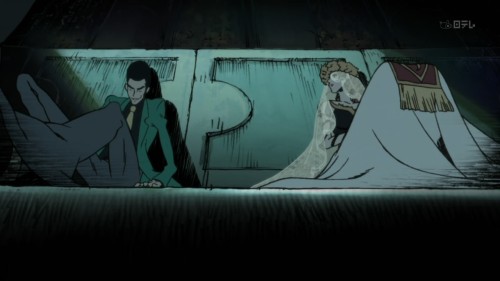
Amidst fears that a television series starring the matron saint of anime femme fatales would be mired in an inescapable well of sexism, Lupin III: The Woman Named Mine Fujiko manages to assuage those worries through extremely sharp characterization. Say what you will about nudity or Fujiko as an object of sexual desire, but the show makes it clear that they all have the skills and the smarts to succeed in their mutual world of thievery. Even if trust is at a premium (as is often said), there is no shortage of respect between Fujiko, Lupin, and the rest, and with mutual respect comes a sense of equality.

I’m not about to decry anime and manga as being polluted with unequal male-female relationships, as I can think of many examples to counter that idea, enough so that they don’t collectively turn into “the exception that proves the rule,” but this very idea of representing gender-egalitarianism has me thinking about what goes into portraying such relationships. For example, if a boyfriend and girlfriend each alternate being “dominant,” then is that “equal” or is it merely just multiple instances of inequality? Does breaking things down for comparison defeat the idea of equality between a guy and a girl by putting too much emphasis on haves and have-nots, or is ignoring it a bigger mistake?

As far as recent anime goes, the other show besides Lupin: Fujiko which has me really considering the concept of equality among opposite sexes is Aquarion EVOL, particularly that of Yunoha and Jin, the (literally?) star-crossed lovers who seem to have taken Pixiv by storm. Yunoha is an extremely quiet girl whose very shyness translates into her power (invisibility), and when she meets Jin (an enemy spy whose power is to keep others away), the two form a bond which gradually grows stronger.

Between Yunoha’s diminutive size in multiple respects (in a series full of toned and busty girls, her proportions are significantly more subdued) and her personality, Yunoha can seem to carry a potential problem that is similar, yet in a certain sense opposite to that of Fujiko in the sense that she can come across as the girliest girl, harmless and pleasant and easy to dote upon. Yet, despite the awkwardness of some of her interactions with Jin which can come across as her being dominated (notably the part where he tries to kidnap her out of love so that she can be the mother of his children and save his woman-less population from dying out), I don’t get that sense from their relationship.

While Yunoha can seem weak, and even her willpower and inner strength aren’t particularly impressive, Jin in many ways seems even weaker despite the basic idea that he’s an extremely skilled pilot and a deadly fighter. There’s something to his personality, perhaps a combination of naivete and extremely subtle yet numerous emotional scars, which make even his “domination” seem weak. In that sense, I find their relationship to be a very equal one, but in the sense that the two seem to grow to understand each other, a resonance between similar, yet complementary individuals.

One of the big ideas I keep running into when it comes to portraying a character well with respect to their gender is “the right to be a weak character.” By that, I mean how weakness (mental, physical, emotional, etc.) is generally thought of as a trait which makes one character “lower” than another, and which implies that their appeal is in their “lower” status, but at the same time that weakness can resonate on a more “equal” level with those who perhaps find themselves similarly weak. I think this is probably part of what makes arguments over moe so volatile, but let’s leave that for another time.

(Please don’t argue over moe.)

Mysterious Girlfriend X is Somewhat Different in Anime Form

I’m actually a pretty big fan of the manga Mysterious Girlfriend X, so I naturally had to check the anime out. While it followed the manga very closely, I still came away with a somewhat different experience (though not necessarily a bad one), and it has something to do with some of the choices they made in adaptation, as well as the very act of adaptation itself.

Mysterious Girlfriend X is definitely a weird concept that just isn’t for everybody. The story centers around a high school couple, Tsubaki Akira and his girlfriend Urabe Mikoto, and their connection through saliva, specifically the fact that Urabe’s drool seems to have paranormal properties related to empathy. As boyfriend and girlfriend, rather than kissing, they exchange saliva by finger. I’ve seen it argued that the series is solely for people who have a saliva fetish, but I think this is really shortchanging the series and its viewers, because the reasons for following it aren’t as overly specific and narrow as “liking drool.” The appeal is more basic than that, as you have this thrilling and bizarre romance between an established couple who share a bond that seems to go deeper than anyone else’s.

That said, I found the experience of watching the whole saliva exchange to be different between the anime and manga in a way I’m not entirely for. In the manga, the drool is kind of a visual motif, drawn very simply, something that while ever-present is almost just like a rendered symbol. In the anime, however, they go out of their way to make the drool glisten and glow, to give it depth and dimension. The real killer is the sound, because in addition to all the effort they put into it visually, they also tried to make it sound as loud and slimy as possible. Again, drool is definitely a part of the series, but I think a little too much attention is given there.

Another thing that makes the anime quite different is the lack of manga-style paneling. This is kind of unavoidable, as anime is a different medium that works along different rules (unless it went out of its way to mimic the panel-based structure of manga), but Mysterious Girlfriend X has really fantastic page composition and paneling, especially in its smart usage of the contrast between black and white. I even used it in my article about decompression in comics. Take a look at the page above, and you’ll see that even if you took every one of those panels and animated them together, it would simply lack the overall structure of the “columns” created by the characters. When you then add color to the film-like style of the anime, it just makes for a different impression.

There are also a couple of more minor things to note. The first is that the elaborate dream backgrounds, which are fully drawn in the manga, are rendered in CG in the anime. A practical change of course, but one which kind of takes away that impressive bit where you realize someone drew all of that. The second is that the voice actor for Urabe doesn’t sound like I imagined she would, though that’s more on my end than anything else. Her voice actor also seems to be quite new at this, showing something of a similar effect to Omigawa Chiaki in her days as Maka from Soul Eater.

I’m still going to keep watching Mysterious Girlfriend X, of course, and I’m probably going to enjoy it. I just wanted to say something about the subtle changes that are present, and perhaps how this speaks to the things that can occur in adaptation from one medium to another.

The School in Aquarion Evol is a Pokemon

The Fujoshi Files 40: Yoshitake Rika

Name: Yoshitake, Rika (吉武莉華)
Alias: N/A
Relationship Status: Single
Origin: Genshiken: The Society for the Study of Modern Visual Culture II

Information:
Yoshitake Rika is a student at Shiiou University who, despite her youthful looks and demeanor, actually entered college at the age of 20. She initially joined the Society for the Study of Modern Visual Culture (Genshiken) after seeing a particularly appealing drawing of Sengoku Basara characters by Genshiken president Ogiue Chika at the club fair. As a member, she quickly befriended everyone in Genshiken, especially her fellow freshmen, Yajima Mirei and “fudanshi” Hato Kenjirou. Yoshitake has a younger (but taller) sister named Risa who is also an otaku, and has bought doujinshi for Risa, who is typically unable to attend events due to her obligations to her basketball team.

Her sense of fashion, forward personality, and willingness to break a few rules in the name of fun (like convincing her slightly underage friends to drink) belie a person who is more comfortable in social settings that the average fujoshi might not be. At the same time however, Yoshitake has a capacity for expounding endlessly on BL-related topics, which allows her to strike up conversation with her fellow fangirls just as easily as she would non-otaku. Yoshitake’s taste in media is also very diverse, going from classic literature to anime and manga to live-action films.

Fujoshi Level:
Yoshitake is able to combine both the wide breadth and depth of her interests with her fujoshi mindset, and consider the pairing and yaoi potential of a range of works far greater than the average fujoshi. Notably, she believes that the judo novel Sugata Imatarou is excellent in part for the emphasis on sweaty men forging close bonds with one another.

SRWZ2 Saisei-hen Out Already?! And It Has Tetsujin 28?!

Recent events have made me aware of how out of the loop I am with the mecha fandom. Whereas I would’ve once known and posted about it within days of the first announcement, this time I wasn’t even aware of it until someone linked me to a video the day it came out.

(Thanks, Jorge.)

Probably the most surprising thing about the new game is that, finally, after something like 20 years’ worth of games in the franchise, the grandfather of the heroic giant robot, Tetsujin 28, has made its SRW debut. Now, all of the questions about how Shoutarou factors in will be put to rest (he doesn’t even appear next to the robot, meaning he won’t accidentally get smashed by falling debris).

Granted, it’s not the original 1960s Tetsujin 28 here, but rather the 1980 remake, Emissary of the Sun Tetsujin 28 (not to be confused with Emissaries of Light Cure Black and Cure White, or Brave of the Sun Fighbird). I have to wonder why they decided to go with this iteration, as opposed to the ultra-90s remake, or the more recent Imagawa adaptation, but I figure it probably has to be for one of two reasons (or maybe a combination of the two). First, its style meshes the best with all of the other robots in the series, and so it has the least chance of sticking out. Original Tetsujin, which also appears in the 2004 version, is too clunky and rough, and the 90s version is too beefy and doesn’t share enough of the iconic look of the original. Second, as per the reason Space Emperor God Sigma got into SRWZ (the director said, “I liked it as a kid so now it’s in the games), maybe someone just wanted it in there.

One thing I find interesting, however, is the fact that they managed to get Tetsujin 28 in any form into the game at all. I remember hearing that back when Super Robot Wars Alpha 3 came out that they were originally going to have Giant Robo: The Animation in, just as they had it in the first Alpha game, but that the license had become too expensive after the creator of Giant Robo and Tetsujin 28, Yokoyama Mitsuteru, passed away. But now years later we have what might be his most lasting legacy ever in an SRW game. What gives? Was that rumor merely just that? Is the cost perhaps the reason why there are so few new series in Saisei-hen? Does being an adaptation factor in, much like Godmars?

In any case, check out the game’s animation. It is fantastic.