
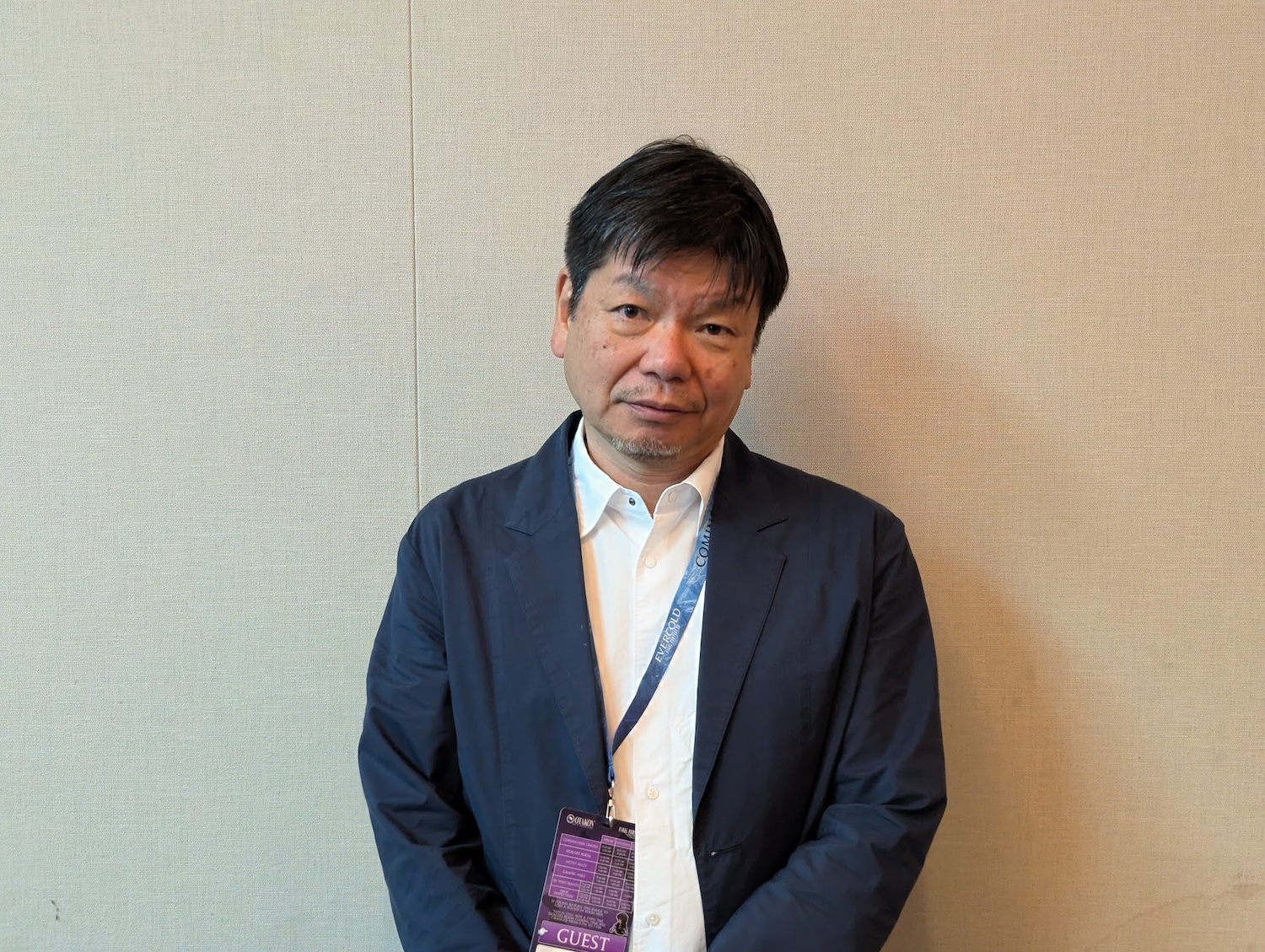
Minami Masahiko is one of the founders of Studio BONES and was at Otakon to promote an upcoming 2027 Okinawa Animation Festival, scheduled for January 29–31. This interview was conducted on July 31, 2026.
Thank you for this interview. You are one of the founders of BONES, but you had a long career before that as well.
You—or rather, a version of you—appears in the drama Aoi Honoo. Have you seen it before, and what did you think of your depiction?
This is a live-action drama series based on a manga, and the author is Shimamoto Kazuhiko-sensei, a classmate of mine in my college years. I heard from him that I should treat it as fiction based on our time in college, and I think it should be viewed as fiction. Some parts are exaggerated.
The original Eureka Seven is one of my favorite anime, and I’ve had the opportunity to interview both Director Kyoda and Kawamori Shoji. But I wanted to hear your perspective as to what it was like to bring this project together.
I originally worked for Sunrise, which created a lot of original robot animation, and later on I worked as a producer on Mobile Fighter G Gundam. Building original robot animation myself is something I find very fulfilling, and when it comes to making a year-long series, I find it’s extremely important to collaborate with lots of different people.
Speaking of Sunrise, you worked as a producer on various titles, and I wanted to know what it was like for you working with Director Tomino, Director Imagawa, and Director Takahashi Ryousuke
First, when it comes to Director Tomino and Zeta Gundam, I only worked in production management for one episode. For G Gundam, I worked as producer, and for Layzner, I actually worked on production management but was also rotating that role with different teams.
To give a little bit more context, back during this period, the vital thing about original robot animation was the “plastic model/toy/merchandising” model So it was important to understand two pillars/aspects, as a toy product but also as an original work. What’s really memorable is that all three of these directors took this challenge very seriously.
It seems you worked the most with Director Imagawa. Would you be able to explain in detail how he dealt with this balance?
Back with G Gundam, this was the era of laser disc and DVD—Blu-ray hadn’t come out yet. But while we had to think about the business of packaging the show for those formats, shows were produced fundamentally with the television broadcast in mind. G Gundam‘s big sponsor was Bandai, and when it came to a work with the “Gundam” name, it was a matter of when the next Gundam would come out. G Gundam is a Gundam with a lot of Gundams from all over the world, and the timing with which they appeared was tied up with when the merchandise would be available. Within that, Director Imagawa is a man with a lot of great ideas, and he was focused on how to insert originality and drama into the story’s setting.
I have one more question: From a producer standpoint, what is the advantage of doing an original work over an adaptation?
First off, when it comes to works based on something, originality is derived from the creators So when we work on animated adaptations of existing work we have to think about how we can maximize the appeal of the work in animation through artistic and creative expressions. That’s our top priority.
On the other hand, when it’s our wholly original work, the sense of originality lies with us as the creators. We think about how to incorporate the appeal of animation as we proceed with the project planning—how we can incorporate the themes and also how we as the project creators can more effectively convey the work through animation.
Thank you!


Pingback: Cons and Concerts: Ogiue Maniax Status Update for September 2026 – OGIUE MANIAX
Pingback: Absence Makes the Heart Grow Weebier: Otakon 2026 – OGIUE MANIAX