Shinkalion and Japan’s Railway Museum

On my winter 2023 trip to Japan, I happened to do a good deal involving trains and train accessories. This is Part 1 of my experience, focused on the Railway Museum in Omiya, Saitama.

The Railway Museum

Owned and operated by Japan Railway, the museum features exhibits about the country’s trains, as well as actual decommissioned train cars. Getting to see and even sometimes walk through trains from throughout the history of Japanese rail is a blast that scratches two itches: a fondness for exploring cultural development and a love for large machines. Whether it was going inside the very first bullet train, seeing a train meant exclusively for the emperor, or learning about manually powered carts that utilized laid tracks, I got a lot out of simply being there. 

There was also a restaurant that served authentic train cafeteria foods from the olden days, but unfortunately, I already had lunch plans that prevented me from eating there. I did snag some microwaveable train curry to try at a later date, though (more on that in the future).

One highlight was seeing the kids who loved being there. Whereas some museums typically have adults dragging bored children there, this was not the case at all. These young train fans were captivated by everything they saw, and some even dressed up as conductors. It made me realize that the train otaku of Japan start young—a recurring theme that I saw throughout my trip.

Shinkalion Shorts

Speaking of kids stuff, I was delighted to find out that the Railway Museum has showings of two shorts from Shinkansen Henkei Robo Shinkalion: The Animation, the mecha anime about transforming bullet trains. Specifically, they’re Shinkalion: The Animation—360° The Movie and Shinkalion: The Animation—360° The Movie: The New Driver. Both cost a little extra—around 700 yen each—with each around five to eight minutes. The seating capacity was quite small (around 20 seats), but I did see some kids and parents watching as well. They also had showings throughout the day, so anyone curious could dip in at their own convenience.

Both shorts take place in the world of the anime, with the second taking place later in the story than the other and including the audience as the titular “new driver.” The main gimmick for these shorts is they’re shot in 3D and (as implied) in 360 degrees. When laser beams go flying, you can look over your shoulders to see it disappear in the distance. They’re fun little things that I’m glad to have experienced.

Coincidentally, the makers of the series actually announced a new anime on Christmas called Shinkalion: Change the World. The characters look a bit more mature than in previous series, and I wonder if they’re aiming for a slightly older audience.

That’s all for now. Look forward to Part 2!

Ganbalance de Desk Job: “Power of Hope: Precure Full Bloom”

With only a few exceptions, Precure has always been resistant to portraying its heroines when they’re older. If they’re middle schoolers, that’s all you’ll ever see them as; if they’re high schoolers, same deal. That’s why one of the 20th anniversary projects, which portrays some of them as adults, came as such a surprise. 

Power of Hope: Precure Full Bloom is a series that brings back the cast of 2007’s Yes! Pretty Cure 5 and 2006’s Futari wa Pretty Cure Splash Star in their 20s, clearly aimed at the original audience of young girls who have themselves grown up. Known as Kibou no Chikara: Adult Precure ’23 in Japan, the story centers on the eight former Precures as working adults. When mysterious shadow monsters start appearing all across town, they discover that they can age backwards to their old middle school selves and transform once again into combat-ready magical girls.

Thematically, one of the biggest things about Power of Hope is the way it portrays a messier and more complicated world than the actual main series of the franchise. In contrast to the generally rose-colored optimism of their youth, the girls are all running into challenges that can’t be solved by sunny dispositions alone. Even those who have basically achieved their childhood dreams see that joy crashing into reality. What’s worse, they are well aware of how little other adults care about their fellow human beings. Rather than concerning itself with girls who are trying to find themselves and what they want to do in life, the anime is more about confronting the cynicism of the “real world,” both locally in Japanese society and on a global scale. Among the topics brought up are overly conservative and sexist workplace bosses, climate change, fear that you peaked too early and that your life is all downhill now, unethical mining in Africa, rampant capitalism, and so on. 

It’s funny to me that this series would come out in the same season as Bullbuster, an anime also about working adults connected to a domain usually seen as kiddy (magical girls, mecha). Like Bullbuster, Power of Hope refuses to say that things will work out in the end—it just hopes we can reach that better outcome. 

The creators of the show clearly put a lot of thought and effort into aging up the girls. Where many series might just make them taller, change their hair a bit, and call it a day, Power of Hope really gives each of them a mature quality that is uniquely their own. In fact, I consider these adult designs to be some of the best I’ve ever seen. The only shame is that they decided not to give them grown-up versions of their magical girl forms. I suspect it was as much a time saver as anything else—it allows the anime to reuse stock footage from the original series they came from. Splash Star kind of gets shafted here just because it’s a digital-paint anime from before the transition to HD broadcasts in Japan, so it really shows its age. 

A number of characters make cameo appearances, and fans of those earliest Precure series are likely to get a kick out of their presence. Of particular interest are the hosts of the online video channel “Dark Night Light,” in which two familiar voices make for surprisingly hilarious comedians. My only real gripe about the guest characters is the fact that Masuko Mika—the old intrepid school journalist—is nowhere to be found.

While the mainline Precure titles touch on some serious topics, they also are not in the business of crushing children’s aspirations. The presence of adversity usually carries a message to not give up because things will look brighter on the other side. But now that those same kids are older, it wants to speak to them as adults. In Power of Hope, it’s more like “some people just suck, but you still gotta work for a better future for yourself and the world.”

Black Jack in the 22nd Century: Gene of AI

My initial impression of the anime Gene of AI was that it reminded me of Urasawa Naoki, manga author of Pluto, 20th Century Boys, and more. Urasawa has a distinct way of drawing characters, and Gene of AI author Yamada Kyuri seems to follow many of his stylistic quirks. But it’s not just the aesthetics that are reminiscent— the robust examinations of humanity and culture are also of a similar vein.

All this might sound like I’m accusing Yamada of being a pale imitation, but I’m not. Gene of AI stands on its own two legs as an interesting piece of science fiction that speculates about a world where artificially intelligent beings called humanoids live alongside humans. Humanoids have their own unique medical challenges, as well as moral and ethical quandaries. In the thick of it all is the main character, a fully human doctor of humanoids named Sudo Hikaru who also secretly performs extralegal treatments for those who can’t go through normal channels.

More than merely asking what it means to be human, Gene of AI examines the complexities that come from a world where equal human rights for sentient AI has long been the norm. The series presents a variety of intriguing problems, like how the artificial limits of humanoid capability and the unknown/volatile nature of human capability can create mutual envy, of how the distinction between humanoid and robot is blurry and imposed from the top down. In this way, Gene of AI bears some resemblance to Urasawa’s Pluto. However, while Pluto is a reimagining of a Tetsuwan Atom story by Tezuka Osamu, Yamada’s series is more like a futuristic Black Jack, all while maintaining its identity as a work of speculative fiction.

There’s more manga than what the anime covers, so I’m hoping we get the next part of the Gene of AI series. In an industry where science fiction is often just window dressing, this is one that challenges viewers to consider more about their world and the future that lies ahead.

Spectacle and Success: Spy x Family Code: White

My winter trip to Japan last year gave me the opportunity to see Spy x Family Code: White, the very first Spy x Family movie. As a fan who has kept up with both the manga and the anime, I was curious to see how they would approach a theatrical release. I sat down with my buttered-potato-topped hot dog and my sour-cream-and-onion popcorn, ready to find out.

Spy x Family is the story of Twilight, an unrivaled master of espionage whose latest mission is to create a false family so that he can get close to a former prime minister, all with the goal of preventing another war from breaking out. To this end, he marries an office worker named Yor and adopts a girl named Anya. Unbeknownst to him, Yor is really one of the deadliest assassins alive. And while neither husband nor wife know the truth about the other, Anya certainly does because she’s actually a psychic. Despite all the secrets, though, the three manage to form a family that on the surface is the envy of all, yet also increasingly seems to be motivated by genuine love and affection.

The recent trend with some Jump series (such as Demon Slayer and Jujutsu Kaisen) has been to adapt an arc or major plot point into a feature-length work, and I wondered if Spy x Family would do the same. However, it turns out that the makers went with a different tack. Rather than going for something canonical, they created an original story. It’s the common choice for mega franchises, e.g. One Piece, Precure, Doraemon, Detective Conan.

In fact, Code: White is pretty much a Detective Conan movie with way less mystery solving and way more action. The story is all right, but spectacle is the name of the game: gorgeously animated chase scenes and fights, a story that takes the trio to ridiculous(ly cool) places, wild stunts, and plenty of explosions. The actual plot developments stretch the limits of what would plausibly keep Twilight and Yor from suspecting each other and wouldn’t be feasible if the movie wasn’t standalone. But given what it is, the makers are allowed to go ham, and they have enough for ten Christmas dinners. It’s a short but sweet popcorn flick.

I think the fact that Spy x Family Code: White is a non-canon entry says a lot about how the franchise is regarded in Japan. Basically, it’s a pop culture hit, almost on par with the heavy hitters. That much was clear even when discounting all the merch available in chains and other big stores to promote the movie. At one point, I stopped in a stationery store that barely sold five manga, and one of those titles just happened to be Spy x Family

It doesn’t look like the hype will be dying down anytime soon.

Kio Shimoku Twitter Highlights January 2024

Tweets for a new year, including the announcement of a planned set of Genshiken LINE stickers!

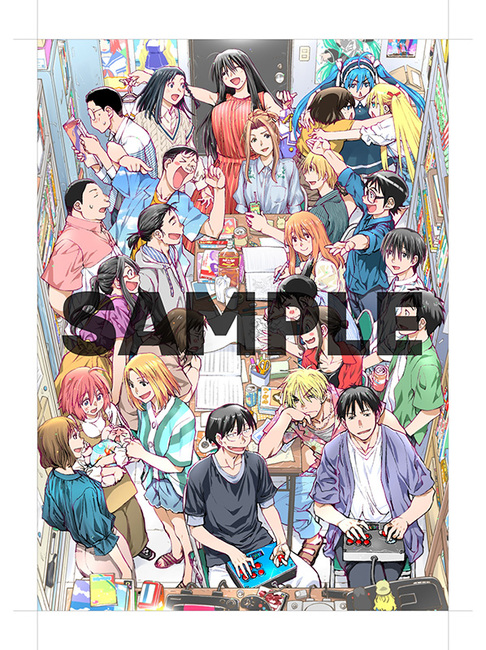
An Ohno from Genshiken drawing for 2024, the Year of the Dragon.

A Genshiken drawing used for the cover of a 2014 issue of Monthly Afternoon.

Kio considers making Genshiken LINE stickers, and then decides to do some investigating.

Kio discovers late that there was a Sayonara Zetsubou Sensei talk event and exhibition featuring the anime’s voice actors as well as the author Kumeta Kouji. Tsuchiyan, a person involved with Sayonara Zetsubou Sensei’s manuscripts replies to Kio and thanks him. Apparently they’ve met before, back when stuff was original airing.

Kio started wearing a haramaki, a stomach band for keeping warm. People in the replies love Sue.

Kio enjoys a Sayonara Zetsubou Sensei afternoon movie, and plans to watch the evening one as well. (I think this has to do with the SZS exhibit mentioned above?)

A person who is staff for anime radio shows realizes Kio follows her, and gets excited. They’re a big fan of Genshiken. Kio replies that he followed her on Twitter to make sure he doesn’t miss another event like the SZS stuff. 

Kio’s ideas for most of the Genshiken LINE stickers, with him asking for suggestions. I asked him if he was planning on having them available internationally, but he said he didn’t even know that was possible.

The final line-up for the LINE stickers. Many famous Genshiken quotes are in there.

Kio drew the belly band art for Volume 2 of the manga Oshibana. He’s a fan and retweets the author Shima Tokio’s work quite often. Shima thanks Kio, and Kio mentions really liking the main heroine and wanting to draw her.

Kio was smiling all the way while looking at Daydream Hour, the Delicious in Dungeon artbook.

A short comic about building the model kit for Our Treasure’s Magna Palace from The Five Star Stories. Kio also has the comic up on Pixiv.

Wishing Shima Tokio a happy birthday.

Kio saw the live-action Golden Kamuy movie. The bear was properly scary.

Kio read the final chapter of Kuma Miko, and feels a sense of release.

LINE sticker roughs. Kio never thought he’d be drawing Haraguchi in the Reiwa era.

Someone pleads with Kio to get all of Genshiken animated, but Kio mentions that as much as he’d like that, it’s not up to him but anime producers.

Kio got the new Panpanya manga collection, titled Yuriika. He wasn’t able to read the comics in it when they were first being published, but he still take his time and get through them now.

Patlabor, Dai-Guard, and Now Bullbuster

I love me some mecha, and that’s why I want to give my thoughts on the recent giant robot anime that’s been the talk of the internet. I’m referring, of course, to Bullbuster

Was there something else?

Joking aside (Go watch Bang Brave Bang Bravern!), I think 2023’s Bullbuster unfortunately went under the radar in a season and year full of great anime. It’s a mature show, but not in the mocking or edgy sense. Rather, it’s more akin to a salaryman anime with mecha included that, along the way, makes an argument for ethical companies in contrast to greedy corporations and their craven, plundering capitalism.

The plot: Okino Tetsurou is a mecha designer who is assigned to work with a small company called Namidome Industries. He’s a big fan of giant robot anime, and his latest work, the Bullbuster, was created to embody that aesthetic while also being useful for pest control. However, he soon finds out that “pest control” is a euphemism for large monsters roaming, and he learns that Namidome Industries was actually set up to eliminate these creatures so that the displaced residents can return home. However, there are many more hurdles than simply blasting the monsters away—like actually keeping a business running.

Bullbuster is cut from a cloth similar to that of Patlabor and Dai-Guard. While it doesn’t get into the heady philosophy of the Patlabor movies, Bullbuster has that environment of regular people working regular jobs that just happen to involve giant robots. In fact, the mecha are less glamorous than either of those aforementioned series, and they typically come across as more vehicles with robot aesthetics grafted on. That has a charm of its own.

There’s actually an even older work also springs to mind: The Unchallengeable Trider G7, a series about a boy who owns his own company and his own super robot. In its opening, the singer (Taira Isao) asks: “Do we fight to protect our company funds?” He then immediately answers his own question: “NO! We fight to protect the Earth!” Bullbuster is presented with a similar situation, only the heroes are not an ultra-rich kid with nigh-unlimited money like in Trider G7, but rather adults who have to deal with issues like budgets, gaining local support, and other unsexy things. In the process, it becomes a David vs. Goliath story that pits Namidome Industries against the major corporation, whose threat comes not merely from their size but also their prioritization of profit at the expense of all else. One thing I find notable is that while there are moments where the big corporation comes across as possibly just suffering from a few bad apples, it becomes increasingly clear that the rot is actually deep in the roots. 

The main fault of Bullbuster is that it doesn’t look particularly good. Nothing about the visuals whether in stills or in motion is anything to write home about, and the CG used for the monsters looks outdated by a decade or more. Even for someone like me who doesn’t put too much stock into “animation quality,” I think it holds the show back.

Ultimately, what tells me that Bullbuster has an adult perspective is not just the business setting or the lack of teen tropes. Rather, it’s because whatever hopeful message the anime conveys is inevitably tinged with a bit of cynicism that can only come from being worn down by entering “the real world.” Even when problems are solved and people are held accountable, often the ones truly responsible for the harm caused remain protected by power and privilege. Nevertheless, I respect Bullbuster for telling us to not give up.

PS: The singer of the opening is NORISTRY, and he’s actually an utaite, or amateur/semi-pro online singer. If you like the song, he streams and releases covers pretty regularly.

Doraemon the Antifascist – Doraemon: Nobita’s Little Star Wars 2021

On my recent trip to Japan, I watched an anime movie as in-flight entertainment: Doraemon: Nobita’s Little Star Wars 2021. This film is actually a remake of 1985’s Doraemon: Nobita’s Little Star Wars. While I have not seen the original, I have heard that it’s a beloved work in Japan.

Doraemon is one of those Japanese mega franchises that was never part of my childhood, so I hold no particular nostalgia for it. Even so, I do know that the annual movies for enduring mega franchises are big deals (see: One Piece, Detective Conan), both in terms of box office sales and getting major industry names to work on them. For example, in this case, the screenplay is actually by one of my favorite creators, Sato Dai (Eureka Seven, Battle Spirits: Shounen Toppa Bashin).

The basic premise of Doraemon is that a hapless boy named Nobita meets a robot cat from the future named Doraemon, whose main feature is the ability to pull out all sorts of fantastical gadgets: a door that can lead to anywhere, a block of gelatinous konjac that when consumed works as a universal translator, and so on. Nobita, Doraemon, and friends thus get into all sorts of hijinks in general, but in this instance, the adventure comes to them. A diminutive alien named Papi has escaped to Earth because of a coup that threatens his world’s democratic government, and the gang ends up helping out when the coup’s militaristic leader, Gilmore, comes to pursue them. 

I definitely did not expect Doraemon to turn into Voltes V, but the flavor is similar in that both stories turn into the struggle between an oppressor and people who seek to be represented by their government rather than ruled by it. I don’t know if this pro-democracy message is the reason the old film got remade, but given the current state of the world and the rise of authoritarianism, I have to wonder. 

Another thing I noticed is just how much love and care was put into animating Nobita’s friend and crush, Shizuka. I’ve read many times over the years that she is a common first love among kids in Japan, and it feels like the movie really leans into this. 

I came in with few expectations, and got out of it a kid’s movie with a surprisingly important message relevant to this time and all times. Hope it’ll work!

In Search of Hanayo: My “Love Live!” GiGo Collabo Cafe Experience

On my recent trip to Japan, I did the expected thing and went to Akihabara. While there, I spotted a Love Live! collaboration cafe at the arcade GiGO Akihabara Building 3, and decided that I had to go. Not only was it Love Live!-related, but it was actually focused on the OG μ’s girls!

I followed the signs, which led me all the way to the top floor. Curiously, the setup is such that you can’t take escalators all the way. 

Upon entering, I found myself in a small room covered in Love Live! paraphernalia, including posters, gashapon machines, and display cases. As a video played with scenes from the anime, Love Live! Songs could also be heard at the same time, dividing my attention a bit. The actual cafe was hidden behind a door, making it impossible to actually see what it’s like without registering with the cashier there.

In addition to registering a time slot for the cafe, the cashier has another role: accepting payments for even more merch. The goods weren’t limited to the original girls but included all generations, though the only things that weren’t blindbox items were the acrylic stands featuring μ’s in pink outfits. I decided to play the odds a little bit, but as someone who much prefers a guaranteed thing, I also bought the acrylic stand for my all-time fave, Hanayo. Because I bought a couple things, I hit a threshold to also receive a free plastic mini poster with the other eight girls included.

There just so happened to be a time slot available shortly after I arrived, so I decided to put my name down. 

The actual cafe was brightly lit and covered in μ’s art on the walls and the tables. A couple of the voices, Uchida Aya (Minami) and Iida Riho (Rin), had autographed some of the displays. 

The only other collabo cafe/restaurant I’d attended had been for Legend of the Galactic Heroes, which is aesthetically and thematically quite far-removed from Love Live! However, one thing it had in common with the Love Live! cafe is that you could also get merch by ordering food and drinks. In this case, the items consisted of coasters selected at random (of course), with drinks and desserts netting patrons one coaster and main courses two. 

I already had meal plans for later, so I decided to go with just a single Hanayo-themed beverage, which was a soft drink consisting of apple juice and muscat grape jelly (Side note: I learned through this trip that muscat grape is ridiculously delicious). I did not win a Hanayo coaster, but rather one for “START:DASH!!,” which in the anime is the first song performed by Honoka, Umi, and Minami. 

In contrast to my conservative order, other patrons went quite hard. I saw one person end up with around five drinks, two main courses, and I recall at least one dessert (though my memory might be off). Other individuals were similar. However, as someone who never, ever whaled in gacha in mobile form, I was hesitant to do the IRL version any more than I already had. I understand the desire, though.

You can see everything I ended up with (plus a canvas badge of Yugiri Tsuzuri from Hasunora I purchased elsewhere). While nothing there is really mind blowing, I’m glad I got to have this experience, and I’m happy I got to share it today, on Hanayo’s birthday.

Emotional Continuity in Anime

What does it mean for a work of fiction to feel “realistic?” It’s a question I return to over and over because of how subjective the answer can be. The more I’ve thought about different possible takes, however, the more I’ve found that I resonate strongly with something I call “emotional continuity,” and it informs which series I view most positively.

Broadly speaking, there are many types of continuity in storytelling. There’s the simple that the events of the past should inform the events of the future. A character who loses an arm in episode 1 of a show shouldn’t get it back with no explanation in episode 10. Then there’s capital “C” continuity, like what American superhero comics often deal in, where all the individual parts ideally look together to form a consistent universe and timeline across multiple different series. “Emotional continuity” isn’t nearly so complex. Instead, I define it as simply when events that should affect a given character emotionally result in an appropriate response, and that this character remembers this feeling on some level. Those reactions and memories don’t have to be “sensible,” and they don’t have to result in a “character arc,” though both are possibilities. They simply have to feel consistent with the character and their way of being, and then leave a mark on that character.

One work I’ve debated with others about realism (and by extension show quality, though the two are not necessarily related) is the anime Mobile Suit Gundam: Iron-Blooded Orphans. Whereas others saw the character actions as making little sense and thus stunting the overall story, I felt the opposite. I came to strongly understand each character’s motivations, especially in the core cast, and to see how early events both happy and tragic would inform the general trajectory of their approaches to life.

Another anime that I’ve argued about is Kill la Kill, specifically in regards to the idea that the heroine, Ryuko, is a strong main character even though she didn’t receive much “character development.” The big sticking point for detractors is that she doesn’t really change significantly throughout the series or learn any personal lessons. However, I find that even if she doesn’t transform dramatically, she conveys a strong sense of “emotional continuity” based in her anger, her stubbornness, and her desire to right wrongs. Even if she’s still the same rage-filled Ryuko by the end, it’s impossible to say that the events of the series don’t affect her emotionally or inform her friendships, battles, and decisions.

I realized that “emotional continuity” also greatly informs my utter fondness for the series Heartcatch Precure! and might even explain why the series is often seen as the best of the Precure franchise or somewhat overrated. Years ago, a blogger named Scamp tried to watch through as much Precure as he could, but ended up dropping every show, including Heartcatch. His reason was that nothing ever seemed to happen for the most part, and that dramatic, story-changing moments came too abruptly. This surprised me, because I felt the total opposite—that the show built up to every significant plot point like a skilled architect oversaw the construction. I even wrote a response. In hindsight, while I used the phrase “emotional logic,” i.e. reasoning through feelings, to describe what I saw, what I was actually highlighting was emotional continuity.

Moonlight…in suffering loss…felt wracked with guilt, giving up her role as protector. The task to defend the world had been passed onto a new generation…and as they collected the Heart Seeds, they laid the groundwork for Moonlight to redeem herself, to learn from her mistakes while also forgiving herself…. Although Cure Moonlight’s return is telegraphed to a degree, for me it built anticipation … I felt satisfied that the show had reached a strong emotional point with a solid expression of how the feelings of each character, especially Moonlight, defined their actions.

Rarely in fiction is anything utterly devoid of emotional continuity, but the best series make you feel as if they care about what’s happened to their characters. Something that has had issues with maintaining this continuity in recent years was World Wrestling Entertainment, and that seems to be finally turned around in the past couple years. While there are general structural issues with how WWE presents itself that go beyond emotional continuity, it’s telling that fans had very little faith in their favorites wrestlers being recognizable beyond a basic template. Continuity is played fast and loose in general, and the highly physical nature of their format means injuries and other unpredictable elements can gum up the best laid plans, but there’s a persistent sense that what a given wrestler does or says one week should actually matter the next.

Do you find emotional continuity to be important? If so, how much is it a priority for you? I’m curious to see how others feel.

Frieren, Ikari Shinji, and Lost Love

Frieren: Beyond Journey’s End is simply one of the finest fantasy series I’ve ever seen, on par with Witch Hat Atelier. From its premise, to its intriguing world-building, to its endearing cast of characters, Frieren is like an oasis in a desert of flimsily conceived genre works. Among its many strengths, one thing that I find most compelling is the way it portrays how different races perceive time differently. This is especially the case with the titular heroine, Frieren.

A long-lived elf mage, Frieren was originally a member of the small party that managed to defeat the demon lord after a decade of adventure. Shortly after their victory, she and her allies are invited to live in the royal capital, but she leaves for a “short” while to continue her pursuit of weird and obscure spells. By the time she returns (50 years later), their young and handsome leader, the vaunted hero Himmel, is old and gray. At his funeral, Frieren deeply regrets having been his companion for “only” 10 years—what others would consider a long and life-defining era instead barely existed for her.

Later episodes reinforce just how much of a drop in the bucket the 10-year quest was for Frieren. Against Aura the Guillotine, a mighty and feared demon, all other adventurers would do everything in their power to eliminate her for the danger she posed. Yet, Frieren held back so that she could deceive Aura for 80 years before dropping the hammer in the modern day. This truly gives a sense of how differently Frieren sees everything as an elf many centuries old, but also just how impactful Himmel was to her.

In thinking about Himmel’s influence, another anime character came to mind: Ikari Shinji from Evangelion. Specifically, his relationship with Nagisa Kaworu at the end of the TV series holds some parallels.

Kaworu shows up in Episode 24 of Neon Genesis Evangelion, and he makes an incredible impact on Shinji. Their immediate friendship is a salve for the emotionally wounded Shinji, who opens up to Kaworu. However, by the end of the episode, Kaworu is dead. This relationship lasted only half an hour of runtime, and less than a week in-story. Nevertheless, this brief love (be it platonic or romantic) is powerful indeed.

The way Frieren sees her time with Himmel is not unlike how Shinji views his few days with Kaworu. It was there, it was magical, and it was gone just like that. It’s beautiful yet heart-rending, and these couple of details really showcase how amazing Frieren the series is as a whole.