Koko Nuts: Here Is Greenwood OVAs

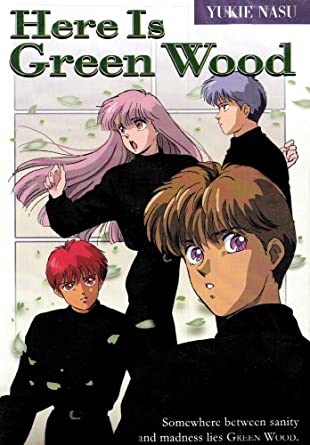
Here Is Greenwood is a title I’ve long heard of but pretty much knew nothing about, other than the vague sense that it was popular with girls. Based on the name and an image or two, I thought it might have been a fantasy series. 

Having finally watched the 1991 OVA, it turns out that Here Is Greenwood is actually a shoujo high school comedy about a bunch of weirdos in a dorm. My impression: there really aren’t many series like it in recent memory. The closest I can think of is Honey and Clover, but even that series doesn’t have quite the same level of quiet absurdity.

When I look at humor in anime over the past two decades, it usually goes in two directions: either mellow and low-key or balls-to-the-wall extreme. Those qualities manifest in different forms, whether it’s Hidamari Sketch or Pop Team Epic, but a work usually picks its lane and sticks to it. Here Is Greenwood, on the other hand, has a kind of slow-burn humor of a more down-to-earth anime, but its characters and situations are all over the place. Whether it’s a main character in love with his sister-in-law, the dude who looks like a lady, the Snidely Whiplash-esque plots of a rich upperclassman’s vengeful cousin, or a literal ghost that no one seems terribly shocked by, there’s a sense that both normal and abnormal blend together into a mellow taste.

The OVA is unusual in that it’s not a sneak-peek at the manga or a more liberal adaptation of the manga. Instead, it takes a nine-volume manga and condenses it into a  mere six episodes, operating more like a ” best hits” compilation. The anime makes more sense once you know that, but I also know what anime fandom was like in the 1990s, when Here Is Greenwood was on Blockbuster Video shelves. Knowledge about anything related to anime and manga was sparse, nowhere near the wealth of information we have today. Many OVAs were confusing and open-ended, and the result was tons of fandom speculation and musings. I could totally see someone trying to fill in the blanks of Here Is Greenwood armed with only their imagination (and a few 4th-wall-breaking mentions of the manga in the anime itself) to construct their own mental manga. I could also picture those six episodes defining what “anime humor” meant in fans’ minds, like extrapolating an assumed picture of a period in history based on some anthropological items. 

I think Here Is Greenwood largely holds up, though there are a few questionable red flags in the year 2020 (notably a joke about touching a kid). In general, the series stands in contrast to the pacing of comedy today, but that also gives it some extra charm.

A Mixtape of Influences: Listeners

In a pre-recorded interview for FunimationCon, writer Sato Dai was asked how he came to work on the anime Listeners. His response: the original creator, Jin, specifically sought him out due to his work on anime like Eureka Seven. But for anyone who’s watched even a little bit of Listeners, that much is crystal clear. Everything about the series—from the heavy music references to the mecha to the boy-meets-girl-in-a-nowhere-town science fiction plot— attests to that influence. While I at first wondered why they would try to, in spirit, remake such a classic anime, it occurred to me that Eureka Seven is actually 15 years old. How time flies.

Echo, a teenage boy, lives in the town of Liverchester, where people are taught to be content with staying in town forever and leading uneventful lives. Echo believes this to be his fate as well, but he has dreams deep down, thanks to his idolization of “Players,” individuals who fight mysterious creatures known as the Earless by commanding giant robots known as “Equipment.” An encounter with an amnesiac girl he finds in a scrap heap takes him far off the predictable track and towards discovering the true secret of his town and its history.

One big difference between Listeners and Eureka Seven is that the former is only 13 episodes in contrast to the latter’s 50, and this inevitably leads to very different storytelling. Eureka Seven is a relatively slow burn that very gradually and powerfully escalates its drama. Listeners, on the other hand, has more of a travel-show vibe that’s layered with unambiguous music references. When you see characters who are literally Prince and Kurt Cobain parodies, it goes a step beyond just “subtle nods.” Because of this, Listeners often comes across like Eureka Seven by way of Xam’d: Lost Memories (for its 1:1 world-building to plot reveal ratio) and Rolling Girls (for the “town to town” episodic feel), but isn’t really greater than the sum of its parts.

I do think Listeners is a decent series with plenty going for it. The characters, particularly the main duo of Echo and Mu, give a very “authentic” impression in that they aren’t overly “perfect” in design. Similarly, the aesthetics of the series have this sort of messy and put-together feel, and I like how the main robot doesn’t look terribly “heroic.” However, I really think that 13 episodes is too short for the story it tries to tell (even Xam’d has 26), and the music references are much more tied into the appeal of the show compared to how Eureka Seven utilizes them. 

What I’m actually looking forward to most from Listeners is seeing it someday debut in Super Robot Wars. Can you imagine the interactions with the cast of Eureka Seven or Macross 7? That would, well, rock.

Love Over Hate: Ogiue Maniax Status Update for November 2020

It’s no secret that politics and the health of the United States has been on my mind these past few months, and now we’re a mere two days away from Election Day. I hope that this is the most important election of my life, because I don’t want to imagine another presidency worse than this past four-year ordeal. For those who have already voted, either by mail or through early in-person voting, I hope you remained safe. While I am deeply horrified at the idea of Trump getting another term, I respect the exercise of democracy as long as all who are rightfully eligible are afforded the same opportunity.

Please bear with me as I express my strong beliefs about this election.

Long-time readers may know that while I could touch on a lot of related topics in years previous, my specific political beliefs were rarely ever front and center on Ogiue Maniax. However, the 2016 election changed something in me, as I came to feel that my distanced academic outlook did not do enough. While I still believe in robust dialogue aimed at finding common ground, I’m much more aware of the fact that right-wing extremism is a dangerous part of the current landscape, whether that’s attempting to recruit kids through video games, voter suppression, or outright violence. I changed my policy of allowing any and all relevant comments to a blog post because there’s a difference between disagreement and merely wearing a facade of civil discourse as a means to push ridiculous ideas. I recently deleted a comment that started with the notion that “wokeness” is ruining anime because it’s an extension of a general right-wing corrosion of Youtube as a whole.

As for Trump himself, I’m going to say straight-up that he needs to be stopped if the United States is to survive, literally. We cannot take even more negligence and death rates when it comes to COVID-19. We cannot take a man who purposely sabotages the US Postal Service in the age of a pandemic and in an election year. We cannot take a man who will sell out the US to the highest bidder, a man who abandons allies to the slaughter and allows bounties on American soldiers. We cannot take a man who thinks climate change is fake yet also believes windmills cause cancer. The Paris Climate Accord is crucial to the well-being of not just the US but the entire planet, and if the country does not rescind our withdrawal, we are headed straight for catastrophe upon catastrophe. Most importantly, we cannot take more damage from the Republican Party, which has enabled this would-be dictator to escape responsibility just because they use him as a battering ram to get more federal judges into the system, including three Supreme Court justices.

To all readers in the US, if you see voter intimidation at your polling place, contact the Election Protection Hotline.

And now, back to Ogiue Maniax proper.

Thank you to this month’s Patreon sponsors.

General:

Johnny Trovato

Ko Ransom

Diogo Prado

Alex

Dsy

Sue Hopkins fans:

Serxeid

Hato Kenjirou fans:

Elizabeth

Yajima Mirei fans:

Machi-Kurada

Blog highlights from October:

Smash Bros. and the Concept of Restrictive Consequences

A thorough look at how the notion of constant freedom plays heavily into competitive Smash Bros., and how it contrasts with the ability to be “very wrong” in other fighting games.

Manga Made for Theater: Maku Musubi

A recent manga series focused on a school drama club that has a nice theme of finding a new creative direction after the loss of a dream.

Dick Dastardly’s Gun Kata: Appare-Ranman!

Last season’s transcontinental racing anime is not quite what I expected.

Hashikko Ensemble

Chapter 33 starts a battle of the bands at the high school culture festival! Lots of great side characters return for this one.

Patreon-Sponsored

Anime Faces: VTuber vs. Horror Games

Thinking about how the limitations of virtual youtubers actually enhances the horror-game-streaming experience for viewers.

Apartment 507

Love Live! Nijigasaki’s Yu Takasaki is the Perfect Audience Character

The new anime pulls off transforming the mobile game’s player character into a fleshed out individual.

Closing

Vote if you can, stay safe no matter what, and I’ll see you on the other side.

The Kickstarter that Seeks Better Pay for Japanese Animators

A common question among anime and manga fans is “How do I support the creators in these industries?” The simplest answer is to subscribe to legitimate anime streaming sites and purchase manga from publishers (whether they’re the Japanese companies or licensors in your country), but it’s undeniable that there are still issues with people in these fields not getting paid enough. 

Back in August, I wrote about different ways I found to support creators more directly, and the most ambitious idea was Sugawara Jun’s New Anime Making System Project—a method of production that involves having animators work directly with musicians to create music videos. Recently, they launched their new Kickstarter, and it runs until November 22, 2020. They’ve gotten a number of musicians to provide music for them already, including Donna Burke, the voice of Raising Heart from Magical Girl Lyrical Nanoha

As of this post, they’ve actually hit their target goal of 5 million yen (about $48,000 USD). Actually, I’d been planning this blog post for a while, but by the time I got around to it, they’d already been funded! That being said, it’s still possible to contribute and make the project even bigger. As for myself, I’ve already supported them through their gogetfunding page, which still hasn’t reached its goal, but unlike Kickstarter, is not an all-or-nothing proposition.

I’m not savvy enough to predict how successful this whole endeavor will be, but I like that Sugawara is trying to innovate. I’ve also been a long-time supporter of his other project—the Animator Dormitory—and the fact that they’re trying to tackle the problem from both ends (housing and salary) gives me hope. Maybe something can truly change.

Mind Craft: Steve in Smash Bros. Ultimate Impressions

The impossible has happened once again as Steve (and Alex) from Minecraft joins an increasingly unthinkable roster in Super Smash Bros. Ultimate. While I’ve never touched Minecraft, I appreciate its creativity and the joy it has provided so many people young, old, and virtual. Having now played (and played against) him for the past few days, I would say that in both visual style and gameplay, Steve from Minecraft is likely the most bizarre character in franchise history. 

Where most characters end up having their appearances updated or at least rendered in finer detail, Steve joins Mr. Game & Watch in having a look deliberately hyper-faithful to his source material to the point of incongruity with the rest of Smash. In terms of his skill set, Steve moves differently, attacks differently, and his block-formation + resource-mining mechanics only have the loosest similarities to other fighters. He’s a little bit Olimar (gathering resources), a little bit Robin (resource management), and some degree of Mega Man (movement while attacking), but also far beyond being a simple chimera of those three. His blocks also kind of resemble what Kragg in Rivals of Aether and Olaf Tyson in Brawlout are capable of, but Steve’s version exists as more than just an unusual recovery move. 

I have quickly come to the conclusion that I’m not a good Steve player (and likely never will be), so I can’t offer any tips or hints as to how to best play the character. I can, however, talk about how it feels to struggle with and against Steve.

With Steve, moving around feels counterintuitive to what I’m accustomed to in Smash. For example, in Ultimate, one common way to avoid attacks is to jump. Unlike in previous games, all characters take the same amount of time to leap, so you can go above a lot of things, especially grabs. Steve, however, has one of the worst first jumps in the roster, and so he can actually get grabbed in situations where others wouldn’t. Steve needs to burn his second jump instead, which would be a bad idea for most other characters—except unlike everyone else, he can create a block underneath and restore his jumps instantly. You have to literally approach concepts like being grounded and being airborne in a new way compared to everyone else, and for me, it is taking a lot of time to get used to. 

In addition to not having any ups, Steve has some of the worst mobility stats in the game—roughly bottom 10 in nearly everything. He feels sluggish when I’m in control of him, but when I play against him, he somehow feels incredibly squirrely. I believe this is because of a combination of qualities Steve possesses. 

First, he can attack while walking in a fashion akin to Mega Man and Min Min, so he can retreat and advance with ease, even if he’s slow.

Second, he has a deceptively thin hurtbox that makes spacing moves against him difficult. “Hitting” his arms doesn’t do any damage, and often attacks that seem like they hit will whiff easily when combined with his ability to move back and forth easily.

Third, it’s very hard to tell what he’s doing based on his animations because so many of them overlap or look extremely similar. His walk, dash, run, roll, jump, and even his getting-hit animations all have the same ramrod-straight stance with arms and legs flailing, and his other actions aren’t far off. The fact that he remains “standing” while getting hit in the air also means he sometimes lands on platforms where others wouldn’t.

Fourth, his actual attacks are surprisingly fast, and the ability to rapidly throw out simple moves means it’s hard to tell when he’s vulnerable and when he isn’t.

When Steve is at full strength—plenty of resources to burn and diamond tools for early kills—he seems very strong. He lets a player be as creative as they want, and already, people are discovering unique combos, techniques, and glitches (that will likely get patched out). What he lacks in movement, he makes up for in fast, strong, and useful attacks, somewhat like Luigi. The Minecart looks like one of the best moves in the game at the moment, as it protects Steve from attacks, and the ability to stay in the cart (for an attack) or jump out (turning the cart into a grab) is a scary mixup. It’s basically Diddy Kong’s Monkey Flip on steroids, and I’m unsure of whether it’s the online setting that makes the move frustratingly difficult to react to, or if it’ll be just as potent online. I do feel that the character benefits a lot from lag, but it’s very possible that his quicker properties would be of greater benefit offline.

I’ve still yet to fully decide which characters I think do especially bad against Steve, but Little Mac’s reliance on ground movement means that blocks mess him up pretty easily, and his recovery is rife for exploitation by Steve’s crafting blocks and down-tilt (a descending fire attack). Big-body characters get comboed to hell and back by him, but I can see certain ones doing better or worse. I can’t quite figure out if Mewtwo does well against Steve or not, but I think the online environment plus the strength of Minecart is skewing my perceptions. 

As for which characters seem to demolish Steve, it’s likely characters who can either outcamp him, or who can quickly get close and overcome his attacks with better range. Zelda’s Din’s Fire can be a pain for Steve because its properties let it circumvent block placement. Marth and Lucina have the speed, strength, and long pointy swords to make life difficult. Shulk’s Monados may be hard to contend with as well. Also, the rigid hurtbox of Steve comes with a potential drawback: it looks strangely easy to hit him with sweetspot attacks, like Zelda’s lightning kicks and Marth’s tipper sword attacks. 

Of course, that’s all speculation on my part. Steve is such a decidedly non-cookie-cutter character that it’s going to be months or even years before he’s even halfway understood. If Smash Bros. is about bringing together all these different video game legends and showing off their unique qualities, then Steve feels like they imported an entirely new game engine into that universe. He’s both fun and annoying at the same time, and I suspect we’re going to be seeing a whole lot of him for a long while.

A Harbinger of the Future? My Life as a Villainess: All Routes Lead to Doom

If there’s any recent series that I think is capable of uniting disparate parts of the anime fandom, it’s My Life as a Villainess: All Routes Lead to Doom! By design, it’s an isekai series that draws upon many of the familiar tropes that have the genre so popular and arguably overplayed: reincarnating to another world, having unique knowledge or gifts no one else does, and having every other character fall madly in love with the main character. However, it also bucks the trend in many ways.

The Appeal of My Life as a Villainess

In a genre that has recently been dominated by male heroes, My Life as a Villainess stars a female protagonist, Catarina Claes, who defies her character archetype of the antagonistic rich girl. The series is very positive and uplifting, while also avoiding a lot of the sexism and occasional homophobia that permeates popular isekai work. Here is an anime that can appeal to those who love a good power fantasy and those who want something heartwarming as well.

Arguably, this puts My Life as a Villainess in the same territory as a lot of older isekai shoujo series such as Fushigi Yuugi, but one thing that works in its favor is that Catarina is extremely charming. Somehow, her near-perfection comes across as endearing due to her enthusiasm, energy, and the fact that she’s both cunning and naive at the same times. When it comes to harem (or reverse harem) series, my belief is that they work best when you can see why so many people would fall in love with the main character. Catarina passes this test with flying colors. 

The Tip of the Villainess Iceberg

The specific term translated as “Villainess” is akuyaku reijou—literally “the eldest daughter in a villainous role.” It describes a type of character seen throughout the long history of shoujo anime and manga, as well as all that it has inspired. A 2016 Japanese blog post attempts to go through the history of akuyaku reijou from 60s shoujo manga all the way to the present day, and the archetype is ubiquitous. The first otome game, Angelique, features just such a character and some of the most memorable faces in anime, e.g. Naga from Slayers and Nanami from Revolutionary Girl Utena, fall within this archetype. The Japanese title for My Life as a Villainess is Otome Game no Hametsu Flag Shika Nai Akuyaku Reijou o Tensei Shita… (“I Reincarnated as a Villainous Eldest Daughter Who Only Triggers Demise Flags…”), specifically emphasizing that it takes place within a girls’ visual novel.

The reason I put specific emphasis on akuyaku reijou and not just antagonistic female characters is because “reincarnating into an akuyaku reijou” has actually become a huge trend in light novels and related media. Searching for it in Japanese on Bookwalker returns 251 results (some being multiple entries within a series), and a significant number of them feature the exact term in their very titles. The oldest entry is Akuyaku Reijou Victoria from 2009, which puts it five years before My Life as a Villainess

To a Future of Villainy?

If My Life as a VIllainess is as successful as I hope it is, this could mean seeing other titles in the genre adapted into anime and manga as well. The tricky thing here is that whereas the English title is meant to be fairly snappy, it ironically might make it harder for other titles to distinguish themselves. I don’t think “Villainess” is that bad translation for akuyaku reijou—merely a somewhat imprecise one that trades accuracy for efficiency. Because of that, I’m curious if other English translations are going to willingly adopt the term as a clear genre identifier, or if they’re going to try to avoid getting crowded out by bigger titles. As with so many other trends, we’ll probably get a combination of forgettable misses and memorable hits, but I don’t think I’d mind the process at all.

Ohohohoho.

Hungry Hungry Hime: Princess Connect! Re:Dive

Anime based on gacha games generally have one overarching goal: get you to play the original mobile game. It’s unclear whether this approach is lucrative, and if anything, it comes across more as a serious flex to say, “Look at how much money we can put into making these gorgeous-looking anime adaptations. In this arena, Cygames is one of the kings. Between strong anime versions of Granblue Fantasy and Rage of Bahamut, among others, it’s exceedingly clear just how much money they have to throw around, given the gorgeous animation, strong writing, and excellent direction seen. 

In this respect, Princess Connect! Re:Dive is another success story. Despite the fact that it’s clearly meant to lure viewers into spending their paychecks, there’s no denying the ridiculously high production values and effort, as it ends up being one of the best-looking and most enjoyable anime of 2020. 

Princess Connect! Re:Dive takes place in a fantasy world and centers around an eclectic group of adventures who end up forming the Gourmet Guild, which is dedicated to trying out delicious foods all across the land (and not afraid to slay a monster or ten to get some grub). Leading the charge is Pecorine, an ultra-strong princess knight with a bottomless appetite, and joining her are white mage Kokkoro, the cat-eared black mage Karyl, and the strangely amnesiatic human boy Yuuki—the last of whom is clearly the “player character” from the game. 

I went into the Princess Connect! Re:Dive without any foreknowledge of the original game, and only with a faint awareness that it was getting high praise from animation buffs. I don’t know how much is based on the source material and how much comes from the anime staff putting in their own spin on things, but there were two main impressions I came away with:

First, the general world and premise are standard fantasy-mobile-game fare—a setting that ostensibly has an overarching ongoing story, but is more a vehicle for you to fall in love with the characters (and want to roll for them once you play the game). Second, the character work is so strong and consistent that it makes the first point more palatable. Major and minor characters alike are ridiculously charismatic, and well-traveled tropes like the moeblob, the tsundere, the yandere, and even bland male lead are portrayed in fun and refreshing ways. Yuuki’s characterization in particular is impressive, as the anime leans so hard into the concept of him being a potato that it falls through the ground and ends up on the other side of the world.

It might just be because I’m an adventurous eater and that I love food-themed anime and manga, but the very idea of the Gourmet Guild holds a lot of appeal to me. It gives plenty of opportunity to animate some amazing-looking dishes, and there’s a certain heartwarming vibe that comes with basing an adventuring team on “eat tasty things.” That innocence also becomes a narrative point, as the day-to-day pursuit of something so simple and pure connects with the motivations and inner conflicts of different characters. Sure, the big-picture story is pretty convoluted, but I still want to see Pecorine and the others succeed within that ridiculous world.

After I finished the anime, I looked up the original game, which is actually the second iteration of the Princess Connect! mobile game franchise—hence the Re:Dive appellation. Apparently, the two versions are tied together in some way, and the anime itself hints at this heavily. It’s not particularly clear what the connection is, and feels more like an attempt to simultaneously introduce Princess Connect! newbies like myself and inform veteran players alike of what’s going on. Ultimately, I don’t think it matters too much.

There’s a lot that’s pretty typical of the Princess Connect! Re:Dive anime, and by the time the final few episodes hit, you’ll know which of the countless numbers of cameos are probably the fan favorites. Still, even as the show is driving its sales pitch at you at full throttle, it’s still a superbly well done anime that fires on all cylinders. In a sense, efforts like these not only shatter the age-old stereotype that anime based on video games are terrible, but it’s even possible that anime like Princess Connect! Re:Dive are better than the games.

Dick Dastardly’s Gun Kata: Appare-Ranman!

The anime studio P.A. Works generally follows a consistent formula: establish an interesting setting such as an old-fashioned hotel (Hanasaku Iroha), an animation studio (SHIROBAKO), or a small town in decline (Sakura Quest), and then place front and center a cast of primarily cute girls with lots of emotion, humor, and drama. That’s why the recent Appare-Ranman!—a show starring a primarily male cast about a transcontinental race across the United States in the late 19th century—caught my eye. It’s in many ways the total opposite of the studio’s standard output. While the title is not entirely what I initially hoped for based on the premise, Appare-Ranman! turns out to be both an inspired and inspiring anime.

Appare-Ranman! stars Sorano Appare, an eccentric Japanese guy whose love of engineering and invention puts him at odds with his traditional merchant family. A series of strange events (largely of his own making) takes him and a samurai named Isshiki Kosame to the US, where Appare decides to compete in the Trans-Atlantic Wild Race. Competitors range from heroes to nobles to criminals, but unlike the rest who are using gasoline-powered cars, Appare aims to take the win with his own steam-powered creation.

Racing shows are usually about, well, racing. Whether it’s the classic Speed Racer/Mach GoGoGo, the insanely energetic Redline, the technical Initial D, or even Hanna-Barbera’s slapstick Wacky Races, one expects emphasis on three things: what the vehicles can do, who will come out on top, and how each of the competitors go about trying to win. Appare-Ranman! does highlight all those aspects to a degree, but half the time it feels like those things take a backseat to both more personal character stories and more conventional action outside of their vehicles.

This shifting of priorities is by no means a sign that Appare-Ranman! is a bad anime, and it benefits a lot from exploring its characters through their relationships with violence, adversity, and ambition. Jing Xialang is a female Chinese racer who’s had to overcome sexism and racism to find a place in the racing world. Appare himself is a great protagonist whose creative genius and flouting of cultural standards is shown to have both its strengths and limitations, and while it’s not outright stated, I get the impression that he’s non-neurotypical. In certain ways, this series reminds me of the fantastic Mobile Fighter G Gundam. That being said, the comparison to G Gundam goes beyond the multicultural cast and competitive setting. Appare-Ranman! ramps up the martial-arts-action gunfights to such a degree that, as the series reaches its climax, you begin to wonder where the heck that transcontinental race went.

Appare-Ranman! kind of swerves a bit, but it’s ultimately an entertaining anime that starts off strong and finishes well, even if it goes to some odd places. The main character’s car being steam-powered also makes the story feel like some kind of reverse-steampunk because of its portrayal as being on the way out historically. Now, what I find funny is that the focus away from racing at times actually brings to mind what I mentioned at the very start of this review: the fact that P.A. Works anime tend to use their settings as background for the real story they want to emphasize, and in a sense, Appare-Ranman! fits that bill perfectly. Only, istead of romantic drama, it’s wild shootouts.

Talk About a Scary Month: Ogiue Maniax Status Update for October 2020

The new anime season is starting up with plenty of potentially great shows, and we’re one month away from one of the most important general elections in the history of the United States. It would be an understatement to say I’m feeling some whiplash.

Before I get into the two sides, though, I want to thank this month’s Patreon sponsors.

General:

Johnny Trovato

Ko Ransom

Diogo Prado

Alex

Dsy

Sue Hopkins fans:

Serxeid

Hato Kenjirou fans:

Elizabeth

Yajima Mirei fans:

Machi-Kurada

First, the fun part:

For the new anime season, there are strong sequels galore—the two I’m hyped for are Haikyu!! To the Top part 2 and Golden Kamuy season 3. In terms of new titles, I’m curious about Dragon Quest: The Adventure of Dai (I’ve heard good things about the manga over the years), Hypnosis Mic (because everything fans have told me about it is bonkers), and Taiso Samurai (gymnastics + MAPPA).

I’m also looking forward to experiencing Love Live!: Nijigasaki High School Idol Club as a full-on anime instead of as the story in a mobile game. I’m curious to see how the different art style they’re using will affect the feel of the show. The Fall usually is traditionally great for anime, and while real-world events have thrown many anime off course, things are looking strong for now.

And then the not-so-fun part:

We are less than one month away from seeing if the United States is capable of rejecting a president who wishes he was a dictator, the corrupt politicians and businessmen who continue to enable his reckless destruction of the US, and whose combined greed and incompetence have the blood of over 200,000 people on their hands. And now, we find a president who not only denies reality when it gets in the way of him being beholden to debtors for what may be over a billion dollars, but is also currently hospitalized due to COVID-19: the very pandemic that he has tried to deny over and over again in order to prop up the economy at the expense of human lives.

I know I have readers outside the US, and you don’t have a direct say in the outcome of this election, but you’re probably concerned. I’m thinking of this as the most important election of my life, but that’s only because I hope and pray that it doesn’t get worse from here.

Now, back to good ol’ anime blogging.

Blog highlights from September:

Gattai Girls 11: “Granbelm” and Kohinata Mangetsu

Gattai Girls—wherein I review giant robot anime starring female pilots—is back!

Wyld Stallyns’ Greatest Triumph: Bill & Ted Face the Music

My review of the long-awaited sequel to one of my favorite movie franchises of all time.

Try Angles: My Teen Romantic Comedy SNAFU Climax!

The anime adaptation of one of the best modern light novels comes to a close.

Hashikko Ensemble

Chapter 32 starts a new trimester and a new story arc for the singers of Hashimoto Technical High School, and it’s one of my favorite chapters yet.

Patreon-Sponsored

Hololive EN and Multilingual Fluency Among Virtual Youtubers

Some thoughts on crossing the language and (sub)cultural barriers through the new English-language VTuber group

Apartment 507

The Matter of Family in Demon Slayer: Kimetsu no Yaiba

When it comes down to the appeal of this popular series, I really think it’s about familial love.

Closing

Take care of yourselves.

Try Angles: My Teen Romantic Comedy SNAFU Climax!

My Teen Romantic Comedy SNAFU (aka My Youth Romantic Comedy Is Wrong, as I Expected) is the modern light novel anime that reminded me to never judge a book by its cover. While on the surface it looked to be another series about a cynical protagonist who ends up surrounded by attractive girls, it quickly became clear that what the series is selling is less a fantasy and more observations of reality—namely the ups and downs of growing mentally and emotionally in the messiest yet sincerest ways. Now, the final anime season has arrived, and what we’re left with is a satisfying conclusion that stays true to the series’s identity.

My Teen Romantic Comedy SNAFU Climax! once again revolves around loner Hikigaya Hachiman, bubbly Yuigahama Yui, and no-nonsense Yukinoshita Yukino as they run the Service Club: a group dedicated to problem-solving for any student who asks. All three are very different in personality, which makes their views on how to fix a given issue very different, but they complement one another well. This season, their main obstacles are pulling off an American-style prom, dealing with Yukino’s impossibly perfect mother who maps out her daughters’ lives to the letter, and the three main characters (at long last) resolving their feelings. 

All three storylines come down to battles of words and wills, and it’s this angle that highlights just how important language is to SNAFU. This series loves its wordplay—it’s why all the character names sound like superhero alter egos—but it doesn’t end there. SNAFU absolutely revels in both utter verbal ambiguity and extremely precise word choice that the Japanese language is so frustratingly good at. 

Take a couple of the keywords that showed up in the second season and present themselves here in full force: tasukeru and honmono. Tasukeru can mean “to help” or “to save,” and the ambiguity between the two gives a certain weight to Yukino’s words when she says it. But it’s also precisely because the characters can be so roundabout that they find a certain kinship. Honmono, introduced by Service Club faculty advisor Hiratsuka-sensei, can be translated as “genuine article,” “real deal,” “something real,” and so on. What exactly that means can change with context (is it more physical or more abstract?), and it’s not even clear whether Hachiman himself quite understands—other than it might just be worthwhile even while the fear of losing what you already have (even if it’s built on lies) is ever-present. Each character is both hurt and helped by how they utilize language, and it’s their strong friendship that brings them both smiles and tears.

The title of this series was originally about how the kinds of teenage romances celebrated in media are a lie, and that Hachiman’s life is anything but picturesque. By the end, but the meaning has morphed into the idea that it might not have been what the cool and popular kids get, but it’s something just as special. In a way, it’s perfect that SNAFU Climax! puts such emphasis on a prom, that classic symbol of Hollywood and American rom coms. The fact that the battle over the prom is more important than the event itself is especially fitting.

I’m happy to see this series to the end, but it also makes me aware of how different my own life and perspective has become since I watched the first season seven years ago. Back then, the sinews of high school and college social interaction still felt somewhat  fresh in my mind, and I could see pieces of myself and friends I knew in Hachiman. Now, my interaction with SNAFU has transformed from relatable experience to nostalgia. It’s as if I started as Hachiman the student and became Hiratsuka-sensei.