
Two of Toei Animation’s most enduring franchises are Ojamajo Doremi and Precure. Magical girl anime that are as different as they are similar—the former is four seasons following the continuing adventures of the same core characters, while the latter is currently running 10 years strong and changes its cast almost every season)—the two are chronologically separated by only one year. What filled that gap was a 50-episode anime known as Ashita no Nadja. Literally meaning “Nadja of Tomorrow,” the title points to the idea of a young girl who, in spite of all hardships, continues to look forward.Unlike the shows that bookend it, Ashita no Nadja is not a magical girl series, though it is similar in being a shoujo series geared towards a Sunday morning children’s audience. The anime’s story follows a young English orphan in the early 20th century named Nadja Applefield as she travels the world as part of a traveling troupe of entertainers in search of her mother. Initially unaware that her quest will get her entangled in the complications of European nobility, along the way she makes lifelong friends, a few bitter enemies, and manages to make almost every guy she meets fall in love with her energy and honesty. While Doremi and Precure thrive on varying degrees of entertaining “filler” episodes combined with the occasional dramatic climax, Nadja more or less continuously builds up its narrative, though not without throwing in an aggravating twist of fate every so often, to emphasize the small tragedies of Nadja’s life, and by extension her never-give-up attitude.In this way, Ashita no Nadja bears similarities to both melodramatic 70s shoujo series such as Candy Candy, as well as World Masterpiece Theater series such as Anne of Green Gables. Namely, while the main narrative isn’t about romance, it is a constant presence in the series, and in that respect it’s also similar to Candy Candy in that Ashita no Nadja is sort of a reverse-Bechdel Test. There is rarely a single conversation in the series between two men that doesn’t somehow involve Nadja. Men rich and poor, young and old, and on all sides of the law fall for Nadja Applefield. If this makes it sound like Nadja is something of a Mary Sue, that’s not necessarily all that far off, but it also doesn’t mean that Nadja is a bad character. The anime as a whole just wouldn’t quite work without Nadja being a strong protagonist both in terms of personality and what she contributes to the overall story. While she does have certain elements of wish fulfillment for a young audience, she always comes across as very human, maybe even ultrahuman (as opposed to superhuman). What I mean is that her humanity, her emotions, radiates seemingly without end.This is not to say that the series is endlessly optimistic. While I’ve already mentioned that the show has tragic elements at times, I want to emphasize this point again because Ashita no Nadja can get surprisingly dark at times. Although it’s not exactly butchering people left and right, it’s not afraid to take away a beloved character or sprinkle in a bit of betrayal. Notably, the series addresses the gap between the rich and the poor during the period in which it takes place. For example, two aristocrats frustrated at the system also vehemently disagree over how to solve this problem: one believes in working within the system, using his family’s money to help the needy, while the other believes in attacking the system Robin Hood-style. Rather than confine this theme to an episode or two, or using it merely as flavoring, this portrayal of a turning point in history, when nobility is on the verge of becoming a relic of bygone times, is actually a persistent plot point throughout Ashita no Nadja.The surprising level of consideration for Nadja’s world and the interplay between tragedy and hope are such prominent parts of the series that it even affects the merchandising engine that Ashita no Nadja was supposed to be. Like Doremi and Precure (as well as Sailor Moon, of course), Ashita no Nadja was a vehicle for selling toys. Indeed, the show is full of conspicuously toy-like products, from pink castanets to umbrellas, and even a flashy typewriter for some reason. However, at one point in the series, a male character gives Nadja a kaleidoscope, with the meta-intent being that kids will surely want this exciting new product, but the back-story they created for it is anything but joyful. It turns out to be the most prized possession of his dead mother, who lived a sad and lonely life inside the mental and emotional prison known as aristocracy, and the closest she could come to seeing the outside world was that kaleidoscope. That’s Ashita no Nadja, a show where even “BUY OUR TOYS” comes with an element of sadness.
Category Archives: anime
Ogiue Maniax Talking Love Live! on The Anime Now! Podcast

Love Live! is a cool show not to be underestimated. I recently made a guest appearance on The Anime Now! Podcast to talk about it along with ANN’s Bamboo and host Bradley. More importantly, I explain why Hanayo is the best Love Live.

We’re Having an Intervention: Selector Spread Wixoss

Combining the fun of an anime about card games with the classic idea of “be careful what you wish for,” I genuinely enjoyed Selector Infected Wixoss. It explores the lives of various girls sucked into a zero sum occult game, with a protagonist who defies the rules in the sense that she plays for the love of the game, which has its own consequences. Selector Spread Wixoss is an immediate sequel that follows up on the cliffhanger from the first series, and it tries to take all of the disparate information strewn throughout the series and thread it together into a coherent story. The results are mixed.
At the end of the first series, protagonist Kominato Ruuko has a climactic battle with the fashion model/fellow “Selector” Urazoe Iona, but in spite of Ruuko winning, it is Iona’s wish that triggers. Iona, wishing to battle alongside the strongest, becomes Ruuko’s Lrig—her main card. Along the way, Ruuko and her friends have also learned the terrible truths of the Wixoss TCG: those who lose three times have their wishes reversed (someone who wishes for friends can never make friends again), and even those who win have their minds swapped with their own Lrigs. Selector Spread Wixoss explores the origins and reasons behind the Selector battles as well as the truth of a mysterious “white room” and the girl that resides there.

As elaborate as the story can get, plot was never really the strength of Wixoss and it shows in this second series as there are a number of huge inconsistencies. While sometimes narrative consistency can be set aside for dramatic flair and strengthening characters, with Wixoss those plot holes are really impossible to ignore. I won’t go into detail about them, but there are certain explanations, connections, and reveals that just don’t quite make sense if you think about it for a few seconds, and more often than not it’s to instill a major change in a character. The story resolves well enough, and Ruuko’s stance is ultimately an interesting one, but it could have happened without all of the attempts at intricacy.
Even so, I still hold Selector Spread Wixoss in high regard. While the “conspiracy” behind the Selector battles kind of falls flat, this second series still maintains and even amplifies the strengths of the original, namely the exploration of various characters’ psychologies and the idea of wishes and desires born out of suffering, ambition, and various other emotions. For example, after Ruuko learned the truth about Wixoss in the previous series, she and her friends become dedicated to never battling again. They’ve lost too much, and are too conscious of the dangers. However, Ruuko loves Wixoss, and along with prodding from Lrig Iona she comes across as a recovering addict. “One more card battle, just one more, no biggie,” Ruuko says, as her friends try to pull her away from her deck, which she actually keeps in her pocket the whole time. At the same time, while she eventually finds a reason to battle and a noble wish to grant that is very fitting for her character, it is a bit disappointing to lose her Ryu-like status from the previous series.
I had previously compared Wixoss to Puella Magi Madoka Magica because their similarities make it almost impossible to ignore. In looking at these two works again, I realize that they essentially have opposite strengths. Whereas Madoka Magica thrives on its twists and manages to bring it all together in the end at the expense of characterization (which often feels stiff and unnatural), Wixoss as a whole manages its characters’ stories, feelings, and humanity much more deftly, with the overall plot holding together like a game of Jenga. In the end, I find Wixoss to be a fascinating series that doesn’t deliver on all of its promises, but the ones it manages to fulfill are satisfying and thought-provoking.
PSA: Tread Carefully When Episode Reviewing Yuri Kuma Arashi
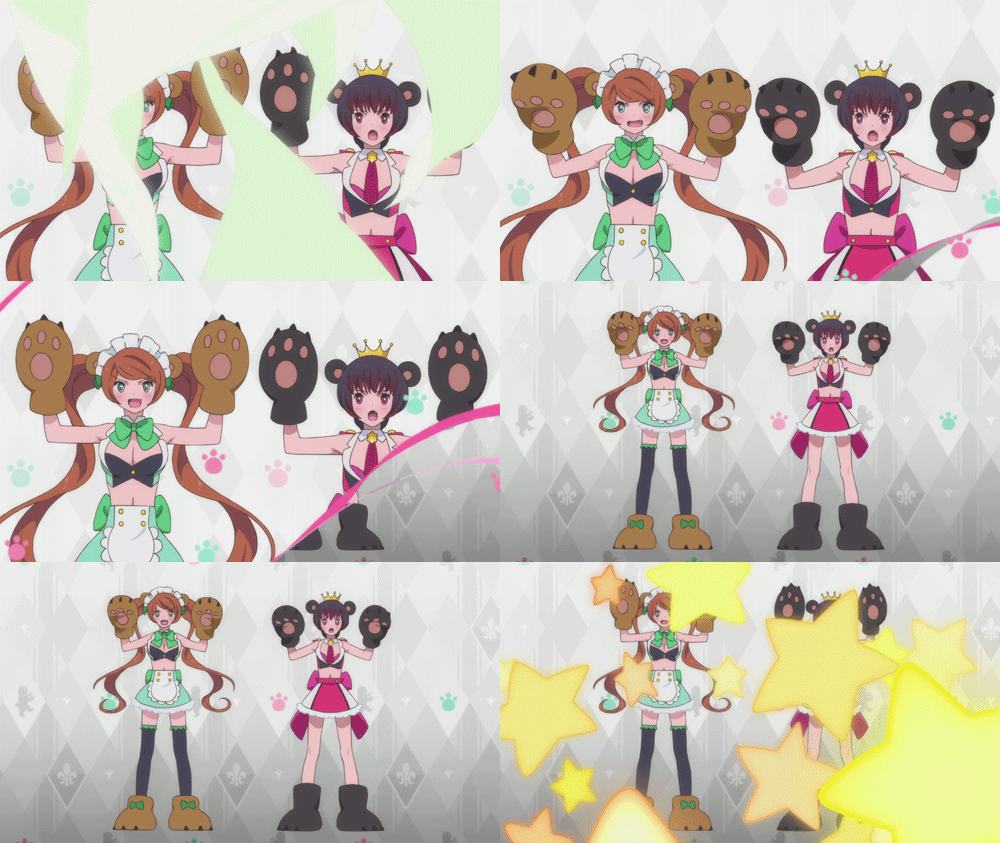 Gif taken from this tumblr
Ikuhara Kunihiko does not direct anime often, but when he does they almost inevitably end up being very abstract, theatrical, and full of hidden and disguised themes. Best known for Revolutionary Girl Utena and Mawaru Penguindrum, this season he comes at us with a new series, Yuri Kuma Arashi. It brings to us exactly what is in its title: lesbians, bears, and some kind of invisible storm.
Episode 1 is extremely disorienting with a lot of seemingly strange decisions. It’s easy to jump on the keyboard and begin typing out how wacky or bizarre the series is. However, while I don’t want to stop anyone from writing their feelings on the show from week to week, I want to warn my fellow anime fans, whether they’ve got blogs, vlogs, podcasts, or maybe even some kind of anime review diary (???) that it is best not to approach Ikuhara’s anime as if they were any other works. This might some a bit pompous or pretentious but I really mean it, especially in light of how episode reviews of Mawaru Penguindrum generally went.
When Mawaru Penguindrum originally aired, I would see reviewers pick apart the show each week, asking something like, “Was episode 8 better than episode 7? Well, the characters didn’t really develop more, so probably not!” People ended up focusing on small, almost pointless details and missing the bigger picture, because they were used to how a typical anime might try to improve itself from week to week. Ikuhara’s anime don’t really work that way.
One thing to watch out for is repetition. Often times, whether it’s use of stock footage or just having characters repeat some process episode after episode, this is generally not merely a time-saving measure nor solely visual flourish but something that gains meaning through that repetition. Ikuhara also likes to build in subtle hints towards the truth of what his series are about, while throwing in a few red herrings. Why would he do that? Because truths and lies and the the blurring of fantasy and reality are big themes of his, practically as big as girls loving other girls.
Given that we only have one episode I, like everyone else, don’t have much material to work with at the moment. I don’t intend to episode review Yuri Kuma Arashi, but I’ll say a few things I found notable that I think are worth keeping track of for this show. First, yuri is often something of an undertone in Ikuhara’s works, but this time it is front and center, to the extent that it appears in the title. It’s overt, maybe too overt if you get where I’m going: it is likely going to be tied to some greater concept than solely girls’ love. Second, the distinction between (yuri) girls and bears and the whole theme of “eating.” Yes, the imagery is clearly meant to imply some serious sexual activity, but why make that metaphor, and why contrast it against the chaste-looking beauty of a girls-only world? Third, consider the concepts of “Life Beauty,” “Life Sexy,” and “Life Cool,” as they pertain to how people view yuri as a genre and lesbian relationships. For more speculation from reviewers more familiar with Ikuhara’s works, check out the Reverse Thieves’ S.W.A.T. Review of Episode 1, who also helpfully ask the question why the only men in the series so far are there to judge the interactions between girls.
Again, it’s not an impossible task to review each episode of Yuri Kuma Arashi, but don’t take the show lightly, and don’t write it off as if it’s merely a vehicle for fanservice. Obviously I can’t say how the show will turn out, but don’t go seeing the inevitable twist and thinking, “But that came out of nowhere!” In all likelihood, it really didn’t.
Popularity is Fleet-ing: Discussing Episode 1 of Kantai Collection on Riot Control Reviews

Despite having never played the game, I recently appeared on the Reverse Thieves’ Riot Control podcast to talk about the first episode of Kantai Collection with Alain. We just barely avoid turning the review into a Girls und Panzer podcast.
Ogiue Maniax on the Veef Show Reviewing M3: The Dark Metal

Once more I’ve joined up with mecha fan and toy collector Veef to review a Satelight anime. This time we’re talking about M3: The Dark Metal, a show which presents the combination of Sato Jun’ichi as director (Sailor Moon, Ojamajo Doremi, Kaleidostar) and Okada Mari as writer (Lupin III: The Woman Called Mine Fujiko, Aquarion EVOL, Anohana). It’s an interesting show with some…mixed results.
The Melancholy of Anime Openings
As I imagine is the case with many fans of anime, one of the first things about anime that caught my attention, one of the things that helped make me into a fan, was the quality of openings. Whether it was the music itself or the animation that accompanied it, anime openings felt like they blew the cartoon intros I was accustomed to out of the water, not to mention the dubbed anime openings which populated American TV. This is not to say that anime music is the best music ever, but once upon a time I often felt that way.
Recently I began to reflect on this feeling. What was the appeal? What was different about them? The more I think about it, the more I believe that it has to do with the sense of melancholy, angst, and forlornness that often appears briefly in anime openings.
A lot of anime openings make the viewer feel as if they are privy to the characters’ inner turmoil. In some cases, this is almost the entire point of the opening: see, for example, the “Tsubasa Cat” arc from Bakemonogatari (warning, it’s kind of not work-safe). The Galaxy Express 999 opening above doesn’t even have characters in it. In others, this feeling will be concentrated into a single, perhaps introspective moment. Think of the first Gundam W opening and Relena in the snow, or the Slayers NEXT opening when Lina reaches for Gourry. This melancholy is even mildly present in the opening to Fist of the North Star until it roars into overdrive during the chorus, accompanied by images of Lin, Bat, and the other destitute wanderers.
However, its ubiquity doesn’t end there, as it will appear in shows you might not expect to care about that sense of melancholy in the first place, such as Bistro Recipe (aka Fighting Foodons) and Medarot (aka Medabots). The openings for these anime both feature brief scenes where the main characters appear to be lost on an emotional level, despite the fact that they’re largely absurd comedies vaguely built around the concept of competition. It even shows up in one of the openings to the Japanese dub of the 1990s X-Men cartoon!
On some level, I wonder if openings might be a make-or-break moment for some as to whether or not they become anime fans. It’s the kind of thing that can easily cause someone to exclaim from the rooftops that anime is the best, or to dismiss it for not being as aggressively powerful as, say, the 1990s X-Men opening!
This is not to say that having this quality automatically makes an opening better, even if it is what likely caught my attention every time. Rather, just the fact that so many openings in a whole slew of genres utilize it at least to some extent feels like it speaks to something more deeply ingrained into, if not Japanese society, then how anime is viewed by society. Anime has gone from having openings designed specifically for the show itself to becoming vehicles to promote musical groups and back again, and consists of both shows designed for large audiences and hardcore fans, and yet somehow these melancholic moments have persisted over the years through all of these changes. I can only believe that there is a tacit assumption that anime openings, more often than not, should on some level evoke a strong sense of sympathy in the viewer, and this influences their structure.
The Mystery of Stocking’s Virginity (or Lack Thereof)
The idea that otaku over-value virginity is prevalent. This sexism is not limited to otaku or even just Japan of course, and there are equivalents around the world in different forms, but whether it’s people getting mad over their favorite anime characters having had past relationships, or scandals over Japanese idols secretly dating, it’s become a valid point of criticism for otaku subculture. At the same time, I wonder if that mindset isn’t so cut and dry. Just as girls do not fall under a simple virgin/slut dichotomy, I think it may be faulty to view otaku as liking only one or the other.
The main title that has me looking over the otaku preference thing is actually Panty & Stocking with Garterbelt. It’s well-established, based on sales of merchandise both official and unofficial, that the sweets-loving goth Stocking is much more popular among Japanese fans than the sex-crazed Panty. This seems to fall in line with the general rhetoric that otaku hate non-virgins, as Panty as a character is defined by the sheer amount of sex she has. She has extremely shallow standards for men, possibly spends more time having sex than not, and will even have important conversations in the middle of sex with people other than the guy(s) she’s with. The image of otaku’s preferences would work out perfectly, if not for the fact that the show states that Stocking is also sexually active.
Stocking mentions during the series that she also has a love life. It’s not even that she’s only had long-term relationships, or is merely a non-virgin still hesitant about sex even after having it. Though she’s more selective than Panty in terms of men, she establishes that she’s been with multiple guys, and will candidly discuss with Panty that some were great in bed and others weren’t. In light of this, why do the fans prefer Stocking to the point that her figures will go out of stock while Panty’s will get discounted heavily due to lack of sales?
One possibility I’m considering is pretty much a matter of relativity. Within the context of individual shows, it becomes easy to categorize characters in comparison to each other. In a show where everyone is small and cute, the character with any sort of bust becomes the “big-breasted” one, whereas in a show where all the character designs are leggy supermodels there may be a different standard among fans. Because Panty’s head is filled with sex (as the opening shows us), and Stocking is not so preoccupied with the same subject, it becomes a matter of Stocking being preferable by contrast even though she probably has more sex than your typical female anime character?
Another possibility is that it just comes down to character design, that Stocking’s gothic lolita look and Panty’s blonde hair and cocktail dress are the main ways in which they’re judged regardless of what happens in the show. Or maybe it’s that, at a cursory glance, Panty’s sexual activeness is extremely visible (the first thing we see of her in Episode 1 is her crawling out of bed with a guy), whereas Stocking’s love life is not so prominent? Only by watching the show do you learn that Stocking is no stranger to the opposite sex either, but it’s possible to understand this about Panty from the anciliary material.
If you have any thoughts or opinions on this, feel free to leave a comment, as I don’t feel like I quite have the answers. I’m not really sure myself, but I get the impression that Stocking’s relative popularity shows that things aren’t as simple as otaku liking either only the “pure” or the “promiscuous.” There are other examples as well, like how Akihabara idol Momoi Halko married and had a child but is still beloved. I have to wonder then if there’s another factor at work, like an inside/outside-group dynamic (and I don’t mean strictly in the Japanese culture sense) which dictates that allows some girls, fictional or otherwise, to be okay no matter what while others are judged more harshly.
Best Anime Characters of 2014
BEST MALE CHARACTER

Iori Sei (Gundam Build Fighters)
Much like last year’s winner, Armin Arlert, Iori Sei is a character whose skills come from forethought, patience, and preparation. Unlike Armin, however, Iori Sei is in fact the protagonist of his own series, reflecting a more general trend as of late where those who would normally be considered side characters are entering the limelight. In this respect, Sei’s talents, designing and building exquisite plastic Gundam models to use in holographic simulated battles, are best seen when his designs are utilized in the hands of his teammate Reiji. His gentle personality both contrasts with and complements his dedication to honing and refining his craft, and while he eventually becomes a skilled “pilot” as well, it feels like a very natural progression. Also, his innocent romance with Kousaka China is adorable.
BEST FEMALE CHARACTER

Kiryuuin Satsuki (Kill la Kill)
The main rival in Studio Trigger’s popular series of 2013-2014, in order to understand Satsuki’s strength as a character it’s necessary to also be aware of the surface impression that Kill la Kill often first creates. The main motif of Kill la Kill is clothing and nudity, and Satsuki herself is no exception as early on in the series she dons her Kamui Junketsu, a sentient battle uniform, and proceeds to fight in an extremely skimpy and revealing outfit. At many points in the series, her body is on full display, and it is portrayed as very sensuous in its own right. However, when thinking of the character Kiryuuin Satsuki, what first comes to mind is not what she’s wearing (or not wearing), but her commanding presence, her ambition, her radiant confience, and ultimately her redemption. One of the strongest moments in the series has to be when Satsuki apologizes, taking a deep bow that humbles her yet also elevates her to even greater heights as a human being of iron-clad will and determination that nevertheless has room for love and compassion.
BEST DUO

Andy and Frank (Yowamushi Pedal)
Andy and Frank (pictured left and right) support, advise, and push Hokane Academy’s 1st-year sprinter Izumida Touichirou to strive for victory. Developing their strength throughout his training, one has to wonder where Izumida would be without the help of Andy and Frank; it’s almost impossible to picture him without them. Though they seem quite similar, what’s also remarkable is how each of them have their own unique yet complementary personalities. It’s what makes them such an incredible team.
Final Thoughts
While there’s nothing that clearly links these characters together (though Andy and Satsuki might have something in common), I found that my choices this year were surprisingly not that difficult. Especially in the case of Satsuki, while there are plenty of great female characters this year, such as Anetai Toyone from Saki: The Nationals, Koizumi Hanayo from Love Live! School Idol Project, or even her fellow Kill la Kill characters, Satsuki’s sheer presence dominated them all in my mind. Perhaps the most notable thing is how different Sei and Satsuki are in terms of personality, and that their paths during their series lead them in what might be called opposite directions. Sei, though talented, learns confidence, while Satsuki learns humility and the value of friendship. At the same time, both remain true to themselves and their convictions.
The Fujoshi Files 120: Koujiro Frau

Name: Furugoori, Kona (古郡こな)
Aliases: Koujiro Frau (神代フラウ), FRAUKOJIRO, Frau Bow (フラウ・ボゥ)
Relationship Status: Single
Origin: Robotics;Notes
Information:
Furugoori Kona, better known by her internet handle “Koujiro Frau,” is the genius hacker and programmer of the popular mecha battle game Kill-Ballad. A hikikomori who tends to use internet lingo in real life, Frau is also obsessed with yaoi and erotic games, and will make frequent mention of them in everyday conversation, provided she’s talking to anyone in the first place. She is also known for her distinct laugh: duhuhu.
Unbeknownst to most, Frau is also the daughter of the director of the giant robot anime Gunvarrel, though her mother mysteriously disappeared after the show was abruptly canceled. Though reluctant at first, Frau eventually becomes a part of the Tanegashima High School Robotics Club, where her expertise helps the club to not only create a second prototype of their life-size giant robot, but also aids them in unraveling the elaborate conspiracy responsible for her mother’s disappearance.
Fujoshi Level:
In addition to her constant playing of yaoi games, Frau also frequently exclaims her desire to see her male club mates go at it, with her continued ramblings giving increasingly elaborate detail along the way. Frau is not only a fujoshi, but also one with very little filter.

