The Fujoshi Files 102: Student from Warm Watch Group

Name: N/A
Alias:
Student from Warm Watch Group (見守る会の生徒)
Relationship Status: 
N/A
Origin:
Mayo Chiki

Information:
This girl is a student of Roran Academy and a member of the “Subaru-sama Warm Watch Group,” a fan club for the butler of the Suzutsuki household and Roran student Konoe Subaru. Their group, comprised mostly of fujoshi, are in favor of Subaru’s friendship with a male classmate named Sakamichi Kinjirou, which puts them constantly and secretly at war with a rival group opposed to that relationship, “Shooting Star Subaru Sama,” aka S4. This member is one of the few in the Warm Watch Group other than their leader Narumi Nakuru to interact directly with Kinjirou.

Fujoshi Level:
After rescuing Kinjirou from an S4 member’s attack, she asks him if he is the “seme” (top) or the “uke” (bottom).

Gattai Girls 5: Juusou Kikou Dancouga Nova and Hidaka Aoi

Introduction: “Gattai Girls” is a series of posts dedicated to looking at giant robot anime featuring prominent female characters due to their relative rarity within that genre.

Here, “prominent” is primarily defined by two traits. First, the female character has to be either a main character (as opposed to a sidekick or support character), or she has to be in a role which distinguishes her. Second, the female character has to actually pilot a giant robot, preferrably the main giant robot of the series she’s in.

For example, Aim for the Top! would qualify because of Noriko (main character, pilots the most important mecha of her show), while Vision of Escaflowne would not, because Hitomi does not engage in any combat despite being a main character, nor would Full Metal Panic! because the most prominent robot pilot, Melissa Mao, is not prominent enough.


Juusou Kikou Dancouga Nova, the 2007 sequel to the 1980s anime series Choujuu Jishin Dancouga, can be considered in some ways the epitome of an “average” anime. A more accurate description, however, would be that it’s a show that is overall somehow fun and satisfying despite not living up to a lot of the ideas it presents, which is evident in not only its narrative but also its sense of characterization.

The basic premise of the anime is that four unrelated people in Japanese society are summoned to pilot the mighty super robot Dancouga Nova, which intervenes in battlefields around the world in order to aid the losing side. However, rather than simply aiding the weak, this mission of Dancouga Nova’s is quite literal, as it will defend a military force one day and attack it the next, depending on that force’s relative strength in any given scenario. It’s an interesting idea to be sure, and Dancouga Nova even takes some steps to explore its consequences (a journalist character actively questions whether or not Dancouga Nova’s actions are merely creating stalemates that perpetuate war, for instance), but given the obvious question of what this will all possibly lead to, the series responds by more or less dropping the issue like a hot potato and shouting, “aliens!!!” Then they fight the aliens and it’s fairly exciting, but it leaves one wondering where the rest of the story went. As an aside, for some reason I find this less disappointing than how Gundam 00 transitioned between similar plot points despite being a stronger work overall.

Given these issues, it would be reasonable to expect the show’s treatment of its characters to be equally inconsistent. This is indeed the case to a fair extent, as the members of the Dancouga Nova team are all defined by sets of traits that seem destined to lead jokes about their personalities that fall pretty flat, (though they don’t come across as unbearable). Dancouga Nova gunner Tachibana Kurara for instance does the Golgo-13-esque “Never approach me from behind” thing, but the fact that she says it every time the situation calls for it turns it from an interesting character trait to a catch phrase that wears out its welcome (like most of the quips in the series). Main character and team leader Hidaka Aoi has the fewest of these qualities, which makes her lead position more enjoyable than if anyone else had as much of a spotlight.

However, whatever weakness in plot and characterization that exists in the show, it’s worth nothing that its portrayal of the female pilots is for the most part neither putting them on a pedestal above men nor subordinating them to supportive roles. A number of series that focus on groups of female characters both inside and outside of the mecha genre have a tendency to be about how beautiful and wonderful the girls are, a setup which has its place, but here the team of four is divided between two men and two women, all of whom contribute in battle evenly.

(It’s also interesting that all of the pilots are adults, rather than teenagers).

An additional female character is added later, but is shown to be just as effective as the others (and for a while is even their rival). Aoi herself is more or less a solid if underdeveloped character in terms of her portrayal, and while one possible criticism might be that she lacks agency in that she’s thrown right into the thick of things with little say in the matter, that’s more a problem for all of the characters in the show regardless of gender. In fact, the only point of “inequality” might be that the female characters (Kurara is a narcotics officer, Aoi is a professional racer and model) are more glamorous than the guys’ (salaryman and hobo). However, beyond this, neither male or female characters are rendered useless, and even the sole situation that might be considered a “damsel-in-distress” situation is more a matter of a female character staying to fight knowing that she’s at a clear disadvantage due to a number of factors wholly unrelated to her gender.

This is not to say that this series is aiming for a strong sense of feminism. On some level, all of the girls in Dancouga Nova are clearly supposed to be attractive feminine ideals, albeit in different ways. Fanservice, or more broadly the overt sexualization of its female characters, is certainly present in the series in quite a noticeable way. However, while creatively positioned camera angles and bouncing breasts appear throughout the anime, at the same time they are also not so prominent that fanservice becomes raison d’être for Dancouga Nova unlike a number of other similar series. For the most part, the anime keeps the “cheesecake” separate from the fighting, so battles do not consistent of prominent T&A shots while the female characters are being tossed around in their cockpits. Some revealing shots do occur in the action scenes, but they’re usually brief and fairly mild, and instead the summoning of weapons and the destruction of enemy mecha comes across as powerful and mostly gender-neutral.

When it comes to Aoi in particular, I do find it notable that while she is a fairly hot-blooded type as befits a super robot protagonist, she still comes across as relatively subdued as far as passionate yelling pilots are concerned, especially when compared to the hero of the original Dancouga, Fujiwara Shinbou. In contrast, there is a similar character in Dancouga Nova, Kamon Sakuya (the homeless one), but his attempts at playing the role of the 70s super robot hero are, like Kouji from Godannar, mostly a source of comic relief. A part of me wonders if this is making some kind of statement, that the old school nekketsu inevitably makes way for a newer type to fit modern times. I must admit that my impression of Dancouga comes mainly from its appearance in Super Robot Wars and just a little bit of the actual show, but even from this partial view Dancouga is famous for its passionate yelling and a dynamic visual style that makes even standing still an exciting assault of flashing lights and colors and crazy exaggerated proportions courtesy of Obari Masami (animator on Dancouga, director of Dancouga Nova).  Perhaps in light of this, the look of Dancouga Nova is not as exaggerated either. I would have chalked this up to “digital animation,” except Choujuushin Gravion, also directed by Obari, proves otherwise.

Dancouga Nova is a simple show that presents a female mecha lead who, while not exactly at the forefront of feminism, is strong, confident, narratively significant, and passionate enough that it’s easy to wonder why more characters aren’t like Aoi. It’s not so much that she’s a shining example of a great protagonist, but rather that she (or a character like her) should be the base line of what is minimally required for a heroine in this type of show. Aoi can be a bit simplistic, but in that way that defines a generation of male heroes in giant robot anime. Of course, as Dancouga Nova shows, being able to portray a female character well doesn’t necessarily mean a show itself is going to be amazing or that it won’t have its fair share of problems, but all the same Dancouga Nova is made better for having a lead like Aoi.

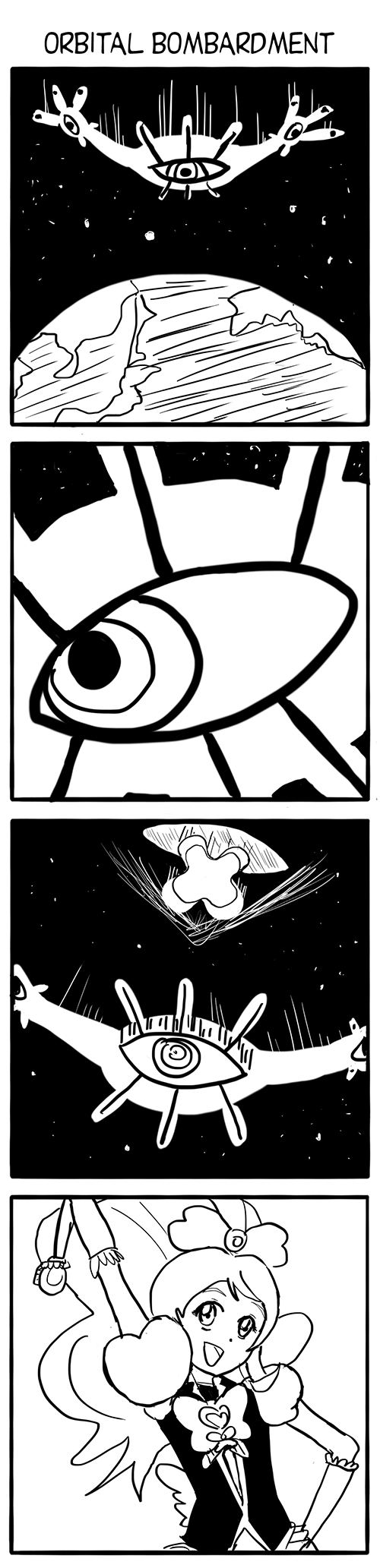
I’ve Been Wanting to Draw this Comic for a While

orbitalbombardment-small

Where the American Anime Fandom Goes

I’ve been living outside of the United States for the past few years, though funnily enough I’ve spent every 4th of July in the US. This year is an exception, but at the same time I will also be heading back home soon. So at least for the foreseeable future, this is my first and last Independence Day in Europe. What better time then to talk about America? I haven’t done that in a few years either.

Specifically, there are a bunch of thoughts related to Americans and anime fandom that have been whirling around in my head as of late, and I’m using this opportunity to try and organize them into some cohesive ideas. Not sure if I’ll succeed or not but that’s part of the entrepreneurial spirit or somesuch. AMERICA.

Two pieces of news that caught my eye over the past few weeks have been the announcement of a sequel and animated television series for Pacific Rim, and the fact that the recently revived Toonami block on Cartoon Network is doing better and better. In the case of Pacific Rim, one of the biggest talking points concerning the first movie’s release was that it didn’t do well in the United States, but in contrast found some success nternationally, especially in China. The idea permeating Pacific Rim and its “failure” was that it needed to do well domestically for it to have any real hope of continuing, but this news has shown otherwise. Scott Mendelson over at Forbes argues that this is the first movie that has received a sequel despite of its lack of success at the American box office, and may hint at the increasing importance of that overseas market. Various arguments have been made for why Pacific Rim didn’t click with American audiences, from idea that “mecha” isn’t a popular genre in either the US mainstream or among its anime fandom, to the opinion that it was just a bad movie, but there’s something intriguing about the idea the US is not the epicenter of this property’s future.

In contrast, it looks like anime is in a certain sense “rediscovering” its American fandom through Toonami. For a long while anime looked like it was on its way out of the American geek culture, as the presence of Japanese cartoons on Cartoon Network faded from their heyday in the early to mid 2000s. The “Toonami” concept itself, a block dedicated to anime and anime-like cartoons, even went away in 2008. And yet, whether it was because the folks in charge smelled profit in the air from anime once more or there was just some personal desire somewhere to bring anime back to the fore of Cartoon Network, Toonami has returned and is doing quite well.

Historically, anime has not needed its American fanbase. Sure, there have been a lot of viewers, but anime’s domestic market is Japan, and it also finds success around the world, in Europe, South America, and Asia. The US certainly has an online presence when it comes to anime discussion and enthusiasm, but over the years it’s been easy to get the impression that this fandom is a paper tiger, especially when it comes to popular shows among the internet fandom not translating to home video sales. Of course, this also has something to do with how expensive anime was for a long time (and still kind of is relative to other forms of media), but overall it wouldn’t be surprising if people perceived American audiences of anime as just somehow lacking. Now, however, not only are American viewers tuning in to catch Toonami and its latest anime, but the shows people are most interested in are also the ones that have developed large fanbases online as well.

It would be remiss of me to minimize the importance of the actual shows themselves, as I think regardless of anyone’s opinions of these anime, it’s fairly easy to see why series such as Sword Art Online (MMORPG plus swords and sorcery), Attack on Titan (violent post-apocalyptic world with large cast of interesting characters), and Black Lagoon (guns and action) would do well with an American audience even if all three are significantly different from each other. One thing that I find interesting, however, is that at least for the first two their Japanese fanbases are also quite substantial. In this situation, you have the support of a hardcore Japanese fanbase, a mainstream Japanese audience (especially for Attack on Titan), a hardcore international and American fanbase, and a relatively mainstream presence in the US as well. It’s as if the division between fan and casual has been collapsed, and interests that are often viewed as mutually exclusive now overlap.

So on the one hand, you have a property in Pacific Rim where the American audience turns out to not be as important as originally thought, and on the other hand you have in Toonami the rediscovery of an American audience that is, while arguably not significant, still good to have. I feel like there’s some connection or relationship here but I’m not exactly certain of what it is. One thing that might help is that I recently read an academic article from 1998 on Sailor Moon, which was written during the time that Sailor Moon was already a runaway hit in Japan and was beginning to air in the US. Though Mary Grigsby’s “Sailormoon: Manga (Comics) and Anime (Cartoon) Superheroine Meets Barbie: Global Entertainment Commodity Comes to the United States” is more about arguing how the series is influenced by cultural hegemony (essentially the continuous and subconscious reinforcement of how things are in society) yet somehow defies it, what caught my attention is the fact that a note at the end mentions how by the time this article was published Sailor Moon had already been a commercial failure in the US.

Sailor Moon was not the profit machine that the various companies supporting its US distribution had hoped, but in light of a new  Sailor Moon anime in celebration of its 20th anniversary and the clear continued significance it has to American anime fandom, it’s clear that the show has had an impact, and possibly that what was seen as a failure of the show at the time may have been more a failure of marketing. To some extent, this may have had to do with the cultural landscape of the US in the 90s. After all, in contrast to the revising of Sailor Uranus and Sailor Neptune from lesbian lovers to cousins back then, currently more and more people in the US are accepting or at least tolerant of same-sex relationships. However, there’s another important point to consider. In the Pacific Rim article, Mendelson also writes that “The deciding factor separating Pacific Rim 2 from Robocop 2 may be the passionate fan base of the former. It’s easier to talk financial parties into a sequel to a somewhat under-performing original if paying audiences actually liked said original.” Sailor Moon grew a powerful fanbase that the models for success at the time couldn’t properly account for. As the American anime fandom grows once more, now may be the time for both old and new fans to find some common ground.


The Fujoshi Files 101: Narumi Nakuru

Name: Narumi, Nakuru (鳴海ナクル)
Alias:
Narunaru
Relationship Status:
Single
Origin:
Mayo Chiki

Information:
The cat-eared high school student at Roran Academy with an extreme fondness for glasses, Narumi will go as far as to dive out windows to save a pair. She, like many of the girl at her school, is a big fan of fellow student and butler Konoe Subaru, and is even the president of the “Subaru-sama Warm Watch Group,” one of two major Subaru fan factions in her school. The Warm Watch Group is constantly at odds with their rival group, S4 (Shooting Star Subaru Sama), though neither is aware that Subaru is actually a girl.

Narumi and the rest of the Warm Watch Group are mostly fujoshi, and thus support the friendship between Subaru and “his” male friend, Sakamachi Kinjirou. Narumi herself goes as far as to write BL novels starring thinly-veiled analogues of the two which are so lengthy that they require someone with superhuman strength to staple the pages together, and then acts out the scripts. Owing to the popularity of her doujinshi, she has a loyal fan club of her own.

Fujoshi Level:
Narumi once turned down a boy who had confessed to her, for the reason that she has dedicated her entire high school life to creating BL.

Of All Things, an Introspective Card Game Anime – Battle Spirits: Shounen Toppa Bashin

A few years ago, I went to an event at the Japan Society in NYC, where Satou Dai of Cowboy Bebop and Eureka Seven fame was a guest. In the lobby, they had design materials from shows he’s written for, and among the works on display was something unfamiliar which caught my eye. This anime was Battle Spirits: Shounen Toppa Bashin, a show whose character designs by Shimogasa Miho (probably best known for Demashitaa! Powerpuff Girls Z) stayed with me for years. Having finally decided to take a look, it turns out that Shounen Toppa Bashin is surprisingly strong in the categories you wouldn’t expect a trading card game-themed anime to even take into consideration, such as personal psychology and portrayals of parent-child bonds. It’s one thing to be an anime like Selector Infected Wixoss, which tries to mess with the conventions of this genre, but this very first Battle Spirits doesn’t subvert so much as challenge and uplift.

The basic premise of Battle Spirits: Shounen Toppa Bashin is about as standard as it gets: kids (and adults) love a trading card game, and they somehow are able to access another dimension and battle with 3DCG monsters. They challenge each other, enter tournaments, form friendships. It basically sounds like a Yu-Gi-Oh! clone. What is notable, however, is that the character relationships in Shounen Toppa Bashin really stand out in a way that I would expect more from a Satou Jun’ichi magical girl show (Ojamajo Doremi, Fushigiboshi no Futagohime) than a TCG merchandising engine. I guess I shouldn’t be that surprised that the man responsible for the series composition of Eureka Seven would also give an impressive showing here.

For example, when you see the extremely straightforward, shounen fighting spirit main character Bashin Toppa talk to his mom Hayami (both pictured above), you get a real sense that his energy and attitude come directly from how she’s raised him. Rather than ignore or deny that familial connection as is often the case with anime, the show uses it to give a real sense of personality to Toppa, to show that his simple-mindedness is also surprisingly deep. After all, what does it really mean to always look ahead, to always want to “Break through the front,” as Toppa often says? It sort of reminds me of Sei and his mother in Gundam Build Fighters, though it also doesn’t hurt that Hayami is not only a classy lady just like Rinko but a taxi driver famous for her Initial D-level driving.

There are a lot of other examples too, but I’ll only mention one more. Another source of delightful interaction comes from the fact that the devious ace player Suiren is actually the popular idol My Sunshine, and Toppa’s inability to see through her disguise in spite of how much time they spend together is pretty hilarious. At the same time, however, it’s also the impetus for Suiren to open up to others and to form friendships with the rest of the main cast. The character designs by Shimogasa really shine here, which reminds me somewhat of Chousoku Henkei Gyrozetter and its own strong character designs and personalities. Speaking of character designs, they’re probably at their best when looking at the show’s ending videos.

Seeing all of these characters with really simple yet vibrant personalities interact with each other in clever and entertaining ways while sporting those strong character designs just makes the show a joy to watch to the extent that it pretty much overshadows the card battling aspect of the series, which almost feels intentional given how much the show rushes through the matches. Usually, when it comes to TCG anime like Yu-Gi-Oh!, the drama is mostly focused on the card game, seeing step by step how the hero overcomes his opponents, but Shounen Toppa Bashin is different. In fact, in most episodes it generally skips a lot of turns to get straight to the climax of a match. The result is that, like Yes! Precure 5, the “fights” seem supplemental to the characters. Maybe not the best for selling the “Battle Spirits” card game, but purely as an anime I would rate it higher than most other shows in its genre.

There is one TCG-relevant aspect, however, that I do find unique to Shounen Toppa Bashin, which is that the anime makes an effort to show how the characters gradually gain experience with the card game they’re playing in a way that is easy to follow. Toppa is head-strong and prefers a straightforward approach of busting through his opponent, for example, but then loses a match early on because he doesn’t take into account strategies that more directly counter his deck type. By the next battle, you see this weakness made up for to an extent, and then strengthened further in a following match. It’s a nice touch to show that the characters are learning, instead of just seeing them bust out a new deck with “all-new secret strategies!!!” (though that happens sometimes too). What also helps is that a lot that both male and female characters are considered strong players, and everyone will take games off of each other fairly regularly so there are no real “weak links” in the core group, and even those who start off that way improve over time.

I’ve only watched 26 episodes so far, but I definitely look forward to seeing how the show continues to unfold. It’s the kind of show I wish more morning boys’ anime would be.

I Didn’t Go to AnimeNEXT 2014 But I Have Some Thoughts on the Studio Trigger Panels

I was unable to go to AnimeNEXT this year, but thanks to the Reverse Thieves and their con report, I’ve learned that the Studio Trigger panels were fantastic and I’m totally jealous of them for being there. Obviously I can’t write about the experience, but there are two points in their post on Trigger that I find interesting to look further into.

The first aspect I want to talk about is in regards to them having an initial version of Kill la Kill with five episodes already planned out in full, but decided to scrap it and start over again with something they felt was stronger. Back when I wrote my review of Kill la Kill I got some comments from a particular poster that criticized Kill la Kill‘s writer for making numerous revisions to the script, as if it had hacked together haphazardly, but with this clarification it’s now obvious that the drastic changes came from the planning stage and were less about cobbling together a frankenstory and more about trying to find the right direction no matter what.

The second little factoid that caught my attention is the fact that the staff at Studio Trigger is really into American superhero comics, which is sort of obvious if you’ve watched all of Inferno Cop. What I find funny about this is the fact that for American comics, superheroes are increasingly seen as this bland, boring, mainstream yet niche thing that we need to move past, while Studio Trigger has this reputation for being a new and cutting-edge anime studio, and they take inspiration from superhero comics.

Love Live! is Like a Golden Age Sitcom

It’s kind of a curious experience watching Love Live! School Idol Project because the more I see, the less the “idol” aspect matters to me. Sure, the songs are catchy and the dance sequences can be quite fun, but I find that it’s actually the show’s sense of humor that really stands out for me.

There are many different ways in which anime does comedy. There’s the slice-of-lifey approach of K-On! or Hidamari Sketch, where the idle moments provide grounds for chuckles. There’s the wild and wacky form of something like gdgd Fairies or Sakigake!! Cromartie High School, featuring one absurdity after the other. In many cases, the characters themselves are not only important to the jokes, but the jokes are subordinate to showing off the characters and how crazy/cute/sexy/rad they are. Love Live!, especially its second season, often feels closer to a classic sitcom than a typical gag anime.

Episode 7 of Season 2 is probably the best example of this so far. When Hanayo is happily chowing down on her over-sized onigiri as Honoka complains about her diet, there’s both the humor of Hanayo inadvertently rubbing it in and the humor of Hanayo’s increasing hubris leading to her inevitable downfall (carbs, man). Later in the episode (10 minutes, 30 seconds), Honoka and Hanayo are jogging when they come across a restaurant. The sight gags and the way they communicate with only excited grunts reminds me of an I Love Lucy skit like the chocolate factory, or maybe something from The Honeymooners. There’s even sort of a similarity between Yazawa Nico and Ralph Cramden.

That’s not to say that the characters are not a focus of the anime, as it is in the end a show about idols designed to have you become a fan and buy all of their merchandise. Despite their looks, however, I often find that the humor isn’t simply about “moe” even when it comes to highlighting their personalities, or if starts out that way then it becomes something else over time. Hanayo, who I describe as “a G Gundam character with the volume turned down to 10%,” essentially has a soft scream that sets up or supports a lot of the jokes in the show. Perhaps the most prominent example of the show doing more with its characters is Sonoda Umi, who in Season 1 is sort of an Akiyama Mio from K-On! type—a cool-looking and responsible girl who is easily embarrassed and writes cute lyrics. However, while she retains those elements to a degree in Season 2, she also begins to show a kind of hilarious intensity that is best summed up by the gif below.

umi-angryface

Another aspect that works in the show’s favor is that it will sometimes take episodes to set up a joke and reward those who’ve been paying attention. In Season 1, it’s when they get a club room (or something, my memory’s still a little shaky), and you can see Hanayo just casually using a rice cooker in there. It’s not the focus of the scene, and no one really makes mention of it, but then when they have their training camp, you see the fact that Hanayo has this gigantic bowl of rice piled so high that it looks like a snowy mountain. When someone finally asks about it, Hanayo’s rsponse (“Don’t let it bother you”) comes and goes so quickly in part due to her soft, high-pitched voice that somehow it just gets funnier.

In Season 2, episode 1 shows Honoka yelling at the sky to stop raining. When rays of sunshine start peaking through the clouds, we’re supposed to think of it as Honoka showing that people can do anything if they set their hearts on it, an inspirational moment for the characters. However, a few episodes later Honoka, Umi, and Kotori get trapped in Okinawa because of a typhoon, and as the weather gets increasingly bleak, we can see Honoka trying to stop the weather again, only this time to no avail. I actually think that little moment in the first episode was partly done to pave the way for this punchline a little down the road.

I find that humorous anime tend to attract a particular audience because it isn’t quite the same as what you’d find on television, and the fact that Love Live! often veers towards the latter may either be a welcome aspect or the very thing that they ran away from when they discovered anime in the first place. The “idol” aspect may also be a turn-off for some, as the concept implies a certain desired level of maniacal devotion, even more than other anime that rely on the charm of its female cast. With Love Live!, however, there’s some real meat to the comedy, utilizing the characters’ personalities but not being solely in service to them.

By the way, my Love Live! top 3 are Hanayo > Nico > Nozomi. 4th is actually A-Rise lead Kira Tsubasa.

The Price of Art: Miyazaki Hayao’s “The Wind Rises”

It’s been a few weeks since I took the opportunity to see Miyazaki’s The Wind Rises. For personal reasons I’ve been unable to write about it until now, which makes me a little sad since my memories of the movie are no longer as fresh. Nevertheless, the film made such an impression on me that I can still remember its effects on me, the mild trembling and near-existential crisis I experienced after leaving the theater that I feel compelled to write about it. This is because while other Miyazaki films have been beautiful, profound, poignant, heart-warming, and intelligent, The Wind Rises is challenging.

I’m going to spoil quite a bit. If you haven’t seen it, I highly recommend this movie.

The Wind Rises is a highly fictionalized account of the life of Horikoshi Jirou, inventor of the “Zero,” the most famous Japanese plane of World War II. We first see him as a child in love with the idea of flight, though sadly unable to ever truly take to the skies due to his terrible eyesight. Instead, in a dream where he meets Caproni, a famous Italian aeronautical engineer, he realizes that if he can’t fly the planes, then at least he can build them. The movie is thus the story of a man with a passion that stays with him throughout his life. The main issue is that he lives in the 1930s, and Japan already has an alliance with Nazi Germany. We know what Jirou’s passion will lead to, and this aspect of his story is how The Wind Rises confronts its audience with difficult questions.

There is a sort of romantic image surrounding the artist who lives for his craft, and over and over again the movie shows how Jirou would rather not think of anything but the plane itself. However, The Wind Rises juxtaposes this quality in Jirou with the era in which he lives. Given the imperialist and militaristic nature of Japan at the time as depicted in the film, it is clear where Jirou’s inventions will eventually take him, and yet given the context of his society, it’s also the only opportunity he really has to fulfill his dream. He makes the best of his situation, pursuing his life-long goal using the means available to him, and though on a personal level this can be seen as the emblematic of the adaptability of the creative human mind, it also comes at a very real cost of millions of lives, claimed essentially by Jirou’s imagination. At the end of the movie when Jirou returns to his dreams of the sky and we see the clouds in the sky transform into his greatest invention, there’s a clear sense of tension on the screen between the beauty of the Zero and the ugliness inextricably tied to it. This is why when I see people accuse this film of being militaristic, I feel as if they did not bother to actually see what was happening in the film.

Can art truly be made for art’s sake? This is one of the central questions of the film, and The Wind Rises answers that this passion, as much as we might want to bottle it and isolate it from the world, is nevertheless still a part of it. Even the refusal to compromise ends up being a type of compromise in itself, and the film makes this point clear not only through Jirou’s profession but also his personal life. Falling in love with a woman suffering from tuberculosis in a time when there was no cure, throughout the movie they make sacrifices between their immediate and future happiness. When ultimately they decide to live together despite knowing that this will shorten her lifespan, the parallel is clearly established that, whether it is at home or in another country, Jirou’s passion in a sense destroyed lives. And yet, it is impossible to see Jirou as a “villain,” or as morally reprehensible. There is no guarantee that we would not have done the same thing, living in the here and now while hoping for a brighter future. Jirou’s choices cannot simply be divided into “right and wrong.”

The very fact that Miyazaki himself is an artist making some of the most successful animated films ever makes the ideas of The Wind Rises feel both self-critical and targeted toward society at large. One of the more interesting decisions for the movie was that Anno Hideaki, creator of Neon Genesis Evangelion, animator on Miyazaki’s Nausicaa of the Valley of the Wind, and otaku extraordinaire was cast as the voice of Jirou. Anno is no voice actor, and it shows in his amateurish performance, but I think this was a deliberate choice because Anno is also a “passionate person” as an otaku. Evangelion was Anno’s attempt to tell otaku to get out there and confront the world, and in certain ways the opposite happened, so I believe that Anno in the role of the protagonist speaks to the idea that otaku are generally considered obsessive people in some sense “cut off” from society. There is an earthquake at the beginning of the film, and when the ground begins to crumble and shake, it looks like the old Gainax style more than that of Ghibli, and I have to wonder if it was animated in this way to call attention to the otaku. As with Jirou, the question would be if we can call otaku a pocket of society, a subculture, or if that passion should be contextualized. It’s a confrontation with both otaku and non-otaku.

I saw this movie at a period in my life where many things are in flux. The future often looks uncertain, the present looks frightening, and more than a few people I’ve known have become ill or worse in recent years, and this movie hits me hard in those areas. Moreover, as someone who has spent his life in creative endeavors, whether it’s art or writing, I feel as if this movie peered straight into my soul, asked me about my life, and forced me to ask myself what a human being really is. In spite of this—or perhaps because of this—however, The Wind Rises may very well have become my favorite Miyazaki film ever (which has been Laputa: Castle in the Sky for the longest time). In fact, when I think about it, the last time I felt this profoundly affected by any anime was the masterful Turn A Gundam. If I had to summarize my thoughts on the film in three words it would be: beautiful, deep, painful. 

The Fujoshi Files 99: Shiina Mafuyu

Name: Shiina, Mafuyu (椎名 真冬)
Alias: N/A
Relationship Status: Single
Origin: Seitokai no Ichizon

Information:
Shiina Mafuyu is a shy and demure girl who often has her face buried in a video game. So addicted to video games is Mafuyu that she will bring multiple home consoles and portable systems with her on long trips. Though open to diverse genres, Mafuyu mainly plays visual novels, for which she creates internet guides.

Along with her older sister Minatsu, Mafuyu is a member of the Hekiyou Academy student council, voted in by her fellow students. There, Mafuyu participates in the idle discussions which characterize the student council, and has a tendency to pair the only male council member, Sugisaki Ken, with another male student named Nakameguro. She is also somewhat antagonistic towards Ken’s younger sister as the two have “overlapping characters.”

Fujoshi Level:
Mafuyu describes herself as “half-games, half-Boys Love.” She believes being able to fantasize about a pen and a pencil together is a fundamental skill.