Kakazu Yumi is a voice actor arguably best known for her role as Yuffie Kisaragi in the Final Fantasy franchise. I had the opportunity to interview her at Otakon 2024, where my questions focused primarily on her work in mecha anime.
One actor you seem to work with pretty often is Hiyama Nobuyuki, such as in Gaogaigar, Godannar, and even Initial D. Do you have any fun memories of performing alongside him?
Thank you for coming to this interview. I’ve been a fan for many years, and I want to start off by asking about one role I know you for that others might not think about: Shizuru in Godannar. Do you recall what it was like working on that series, and how you approached the character?
Kakazu: Shizuru is a very grounded, very mature character, and she was also a commanding officer. It is a characteristic that’s unlike me, so I tried to perform that part when I was voice acting.
Another staff member who was on Godannar was Kimura Takahiro, who recently passed away. He also worked on another series that you were involved with: Gaogaigar FINAL. Did you ever get to know him, and do you have any memorable stories about him?
Kakazu: Actually, Kimura-san came to visit the studio when we were recording, and we also spoke together on stage. At the event, he tried to apply his own makeup, but he had never done it before, so he asked, “Kakazu-san, can you help me with this?” So behind the stage, I was doing it for him.
I never knew that he cosplayed! Do you remember who he cosplayed as?
Kakazu: I think he had a white wing…? Or maybe it was Shishioh Guy. I forget.
On the topic of Gaogaigar, you returned to the role of Renais a few years ago in Super Robot Wars 30. What was it like playing Renais back when you first worked on FINAL, and did anything change for you playing the role over the years in SRW?
Kakazu: Not a lot changed.
Related to that, I was actually at the Final Fantasy panel earlier, and you mentioned playing Yuffie since Ehrgeiz. So, similar question: Do you think your performance has changed, or has it been pretty solid throughout?
Kakazu: I said this on stage, but when I first started voicing Yuffie, she was one character in a fighting game. The only sounds she had were “Hahh! Hahh!” type noises.. But over time she’s gotten more chances to speak and more lines, and now she stands alongside the other characters, showing how mainstream she’s become. I’m grateful that I was able to meet Yuffie all the way back in the beginning, and also even more grateful to the people who have supported her up until now.
Another anime you worked on is a series called RahXephon, and your character, Hiroko, has a very powerful and tragic death. And do you have any advice for voice actors on how to approach such a challenging scene?
Kakazu: So I remember getting the script when I was recording, and I remember being very focused on reading and trying to understand it. Also, I remember the pain I felt when I was recording. When I’m acting out these tragic scenes, I try to recall my personal experience, and also use my imagination to expand the performance. So maybe this isn’t advice, but I realize that everything I’ve experienced in my life has become a resource that fuels my acting and performance. So maybe the advice I would give another voice actor is to find meaning in everyday life.
You seem to act alongside the actor Hiyama Nobuyuki pretty often. Do you have any fun memories of performing alongside him in any of the shows you worked on together?
Kakazu: I actually have a lot of fun memories with him. When Hiyama would say the line, “GAO! GAI! GAAAAR!,” he would shout the line in a great big voice, and it would reverberate through his entire body. I remember the first day of this recording, he did the line, and the mic actually broke!
Oh, I found the cosplay that Kimura-sensei did. [Shows a picture of Guy from Gaogaigar.]
Ah!
I interviewed the director of Gundam X, Takamatsu Shinji, at Otakon nine years ago. Do you remember what it was like working on that series and playing the character of Sala?
Kakazu: Sala was actually my debut role as a voice actor. She’s actually second-in-command and has an important role, but she’s only 17 years old. So there’s a difference between how she has to behave as second-in-command versus how old she actually is. So it was really difficult to figure out the balance between her age and her having this mature, heavy responsibility as second-in-command. I remember working very hard figuring that out, and this contributed to learning more about voice acting.
This interview was conducted at Otakon 2024. Uchida Aya is a Japanese voice actor, famous for playing the character Minami Kotori in Love Live! School Idol Project.
Many of my questions will be Love Live!–related because I’m a fan, but coincidentally, I was in Tokyo last December, and I visited the Love Live! cafe.
Uchida: Ahhh!
I just happened to sit at a table you autographed.
Uchida: In Akihabara!
I was wondering, for my own curiosity, do you remember when you visited to sign the table?
Uchida: I think it was December!
Love Live! Is now a worldwide phenomenon; people know it everywhere. But I know it was much less popular at first. How did you get started in Love Live!?
Before I was on Love Live!, I got my first regular role on an anime project, and the music director told me that his next project was something called Love Live! That’s how I got into it.
What was it like when you first started, and at what point did you realize it was starting to get huge?
Uchida: Love Live! was a very new creation, so there was a lot of motivation across the time. And personally, I love anime and also idols, and the fact that both those things are core to this project made me very excited. This made me want to really want to take the lead and bring it to the next level, and make this work even more fun. As it gained more popularity among fans, and as I realized more and more people were listening to the songs, it made me feel very, very happy. But because it started very small, I feel like I grew with this project, and that makes it more special.
Speaking of growth, that’s something I also noticed. I first became a fan of Love Live! through the anime, and when I looked at the prior material—all the song performances and recordings and such—I noticed that you and the other members of μ’s had grown a lot as performers. In what ways do you think your performance as Kotori, in acting but also singing and dancing, had evolved over time?
Uchida: I’m not so sure about my skills improving…I was always aiming to become a voice actor and didn’t necessarily want to be an idol, standing in front of a crowd smiling and dancing. I didn’t have any intention of doing it professionally, and it was something I had to get used to and was hesitant about in the very beginning.
At some point in the middle, we started doing more live performances, and it was a challenge. But because the other members were there and we were a team, we taught each other things—dancing, practicing, etc.,—and gradually, we acquired those skills and got better. I’m glad I had friends in the same boat with me who I could strive with and improve with together.
So you’ve performed many songs with the others, including with Hanayo’s voice, Kubo Yurika. One of your songs, “Suki desu ga, Suki desu ka?” Did the ’70s feel of the song change how you two approached it?
Uchida: It’s been quite a while, so give me a moment! So it’s a song featuring our characters, Koizumi Hanayo and Minami Kotori, and it was a duet of a kind we had never done before, so it was very fun. Hanayo-chan’s voice has a very “howaaah” fluffy and cute feel, and Kotori is a very cute character herself. So I was confident it would be a cute song.
Thank you for this interview!
Postscript
Two days after I interviewed Uchida, I managed to get an autograph from her. As she signed my copy of Love Live! The School Idol Movie, she actually recognized me from the interview. I point this out because I’ve had cases where the guests do not recognize me despite having spoken to them, and it made me realize that Uchida is indeed a pro at this, be it through her experience as Kotori or in her voice acting career. I left with an even more positive impression of her.
Anime NYC 2024 was a focal point for many areas of Japanese pop culture, but the one that caught my attention the most was the massive presence of hololive, the world’s biggest VTuber agency. Because I wanted to miss out on as little of it as possible, I prioritized it above all else, and this con report reflects that fact.
A New Date
2024 saw the first summer Anime NYC, as it moved from the weekend before Thanksgiving to the tail end of August—a controversial move because it brought potential advantages and disadvantages. Being at the tail end of the summer con season could also carry some of the momentum of other events, and according to the showrunners, LeftField Media, was that they would now be able to utilize more of the Jacob Javits Center. However, this drastic change could disrupt people’s planning for cons. Also, summer in New York City can be very hot and humid—even dangerously so if attendees have to wait outside.
Luckily for Anime NYC, weather was on their side. The weekend was probably the most pleasant the city had been all summer. The good fortune didn’t stop there either: It also narrowly avoided the curse of the missing 7 train.
Averting Train Trouble
For many years preceding Anime NYC, the closest subway to the Javits still necessitated a 15–25 minute walk (depending on how quick you were). The 34th St. Hudson Yards station on the 7 Line was specifically built to get people closer to the Javits area, making it ideal for conventions. However, every Anime NYC up through 2023 occurred on weekends where the 7 was shut down for construction, making the stop pointless. With the move to the summer, it seemed as if Anime NYC was finally going to avoid this fate—only for construction on the 7 to be announced.
Thankfully, the MTA at some point changed it so that the 7 Train would run as a shuttle from Time Square to Hudson Yards (a total of two stops). Thus, while the loss of most of the 7 Line was a real inconvenience for those coming from Queens, there as at least this little bit of good news.
This one small change mattered a lot for VTuber fans: That same weekend, hololive’s second ever English concert, Breaking Dimensions, was taking place in Brooklyn. While not terribly inconvenient due to the presence of public transportation, traveling between boroughs could still be a hassle that required some time management and perhaps sacrificing some events to get there on time. Had that shuttle train not been there, it would have been a real struggle.
Phase Connect + Mint Fantome
Before getting into the hololive content, I want to shine the spotlight on another VTuber agency that had a presence at Anime NYC: Phase Connect.
A couple weeks before the start of Anime NYC, the Canada-based organization announced that they would be holding their own 3D concert on Sunday, and that it would feature talents from their first generation, Phase Origins: Tenma Maemi, Pipkin Pippa, Fujikura Uruka, and Lia. They also revealed as a special guest the indie darling Mint Fantome, adding some significant star power.
Aside from Mint, I was only passingly familiar with a couple of them, but it was overall enough to convince me to plunk down some more cash despite expecting a busy weekend. Tickets came in two price tiers, but they did not affect the quality of the seat. Instead, the slightly pricier option meant an attendee could get a special gift, which turned out to be a random polaroid-style image (of Uruka) and a random keychain (of Maemi).
(I also bought a Dizzy Dokuro keychain on Saturday at the Phase Connect Booth.)
Though not completely sold out, there was still a sizable live audience. All the Phase girls had 3d models that matched their default appearances, while Mint (who I believe doesn’t have an official standard 3D design) went with a chibi look. The acoustics weren’t great (that’s the Javits for you), but between Uruka’s rich singing, Maemi’s versatility, Pippa’s energy, Lia’s confident dancing, and Mint’s idol spirit, all of them brought something memorable. I also got a real sense that Phase Origins set the tone for the rest of Phase Connect’s talents and their generally unhinged presentation.
The event felt less polished than hololive’s concerts, but I knew that would probably be the case going in. The moments that stood out to me the most were Uruka’s darkly comedic Self-Introduction song (about having to go against her family to pursue music), and a huge chunk of the live crowd getting up and forming a circular dance line as Mint sang the Hamtaro opening. Apparently a lot of the crowd was familiar with wotagei culture. (Security was also clearly visibly confused by what was going on.)
There’s one last thing I want to mention about Phase Connect. One unique aspect of the company is that they sell VTuber-themed coffee beans. Though I didn’t plan on getting any, I was curious about it. When I asked, though, it turned out that they had completely sold out by Saturday.
The hololive Meet Booth
The most visible hololive presence of the Exhibit Hall booth. Like last year, it featured exclusive talent streams for con attendees. Participants included members of every branch (including Holostars JP and EN), and ran the gamut of topics. Kureiji Ollie taught the crowd fan chants for popular hololive songs, Haachama and Roboco tried to make edible insect gelatins from insect powder, and various karaoke sessions had the crowd singing along throughout. The least popular times were during showcases of Holoearth—not surprising, given how those were the least interactive, and that the game still has no clear direction.
One very conspicuous thing about the booth was the large crowd that would form in front of it (which sometimes included myself). It was located near the front of the Exhibit Hall, and it would actually sometimes bleed out past the entrance. This could cause traffic flow issues, and while I don’t blame the attendees for wanting to see their favorites in this unorthodox environment, I do have to wonder if there’s a better option.
Other hololive events, like the panels and the in-person concerts, have IRL audiences, but these Meet booth showcases are like an interesting halfway point between those and the standard online streams. The physical presence of the crowd combined with the less structured and more informal setup of the broadcasts themselves made for an entertaining and comfortable interactivity that both the VTuber and the people watching could feed off of.
I find that there are certain talents who thrive in this environment. Ollie’s unmistakable enthusiasm for all things hololive was infectious. Momosuzu Nene had to overcome the language barrier, but she also showed her best side through her karaoke.
As big a fan of Haachama as I am, I ended up leaving hers early in order to catch the train to the Breaking Dimensions concert. Given that the latter started an hour late, I could have made it in hindsight, but I didn’t want to risk the possibility, the NYC subway being infamously inconsistent.
hololive STAGE World Tour ’24 Soar
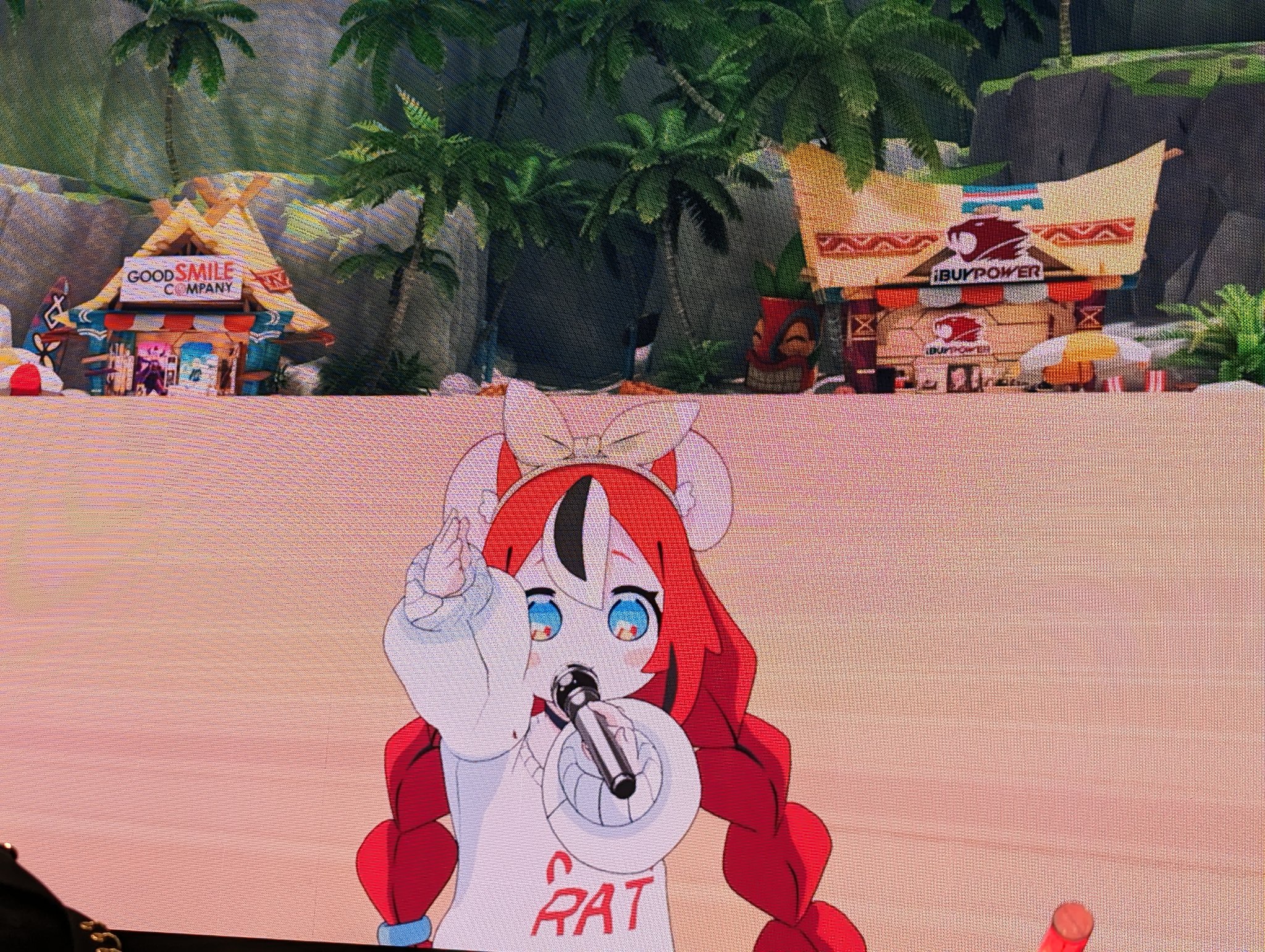
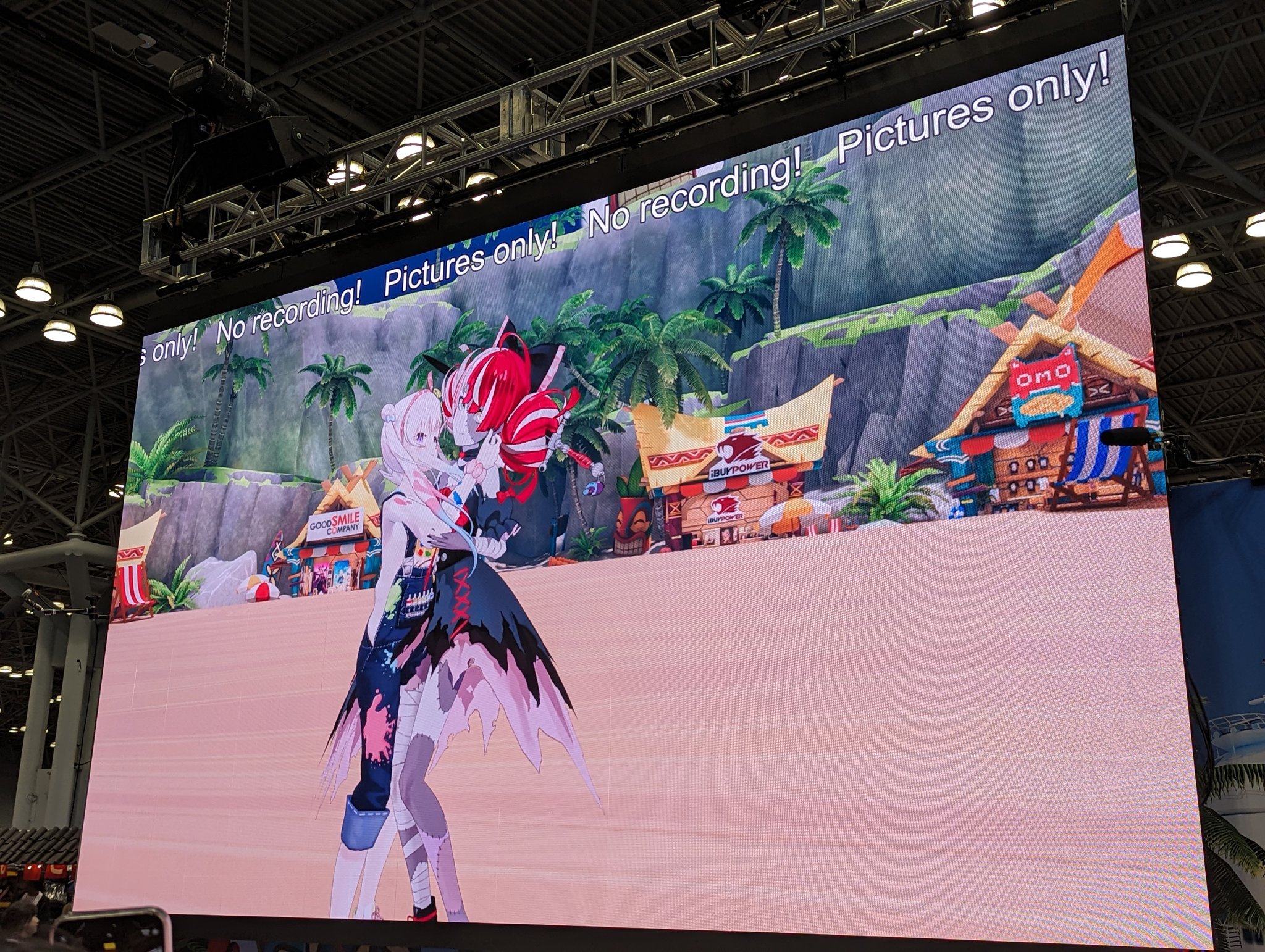
Photography was not allowed at the concert, so look at these standees instead.
Ever since hololive announced that their 2024 world tour would be kicking off at Anime NYC, I’d been anticipating it. Not only was it a rare opportunity to see something that wouldn’t be streamed, but the lineup was stacked: Baelz Hakos, Moona Hoshinova, Takanashi Kiara, AZKi, Nimomae Ina’nis, Kobo Kanaeru, and Tsunomaki Watame.
Each number got the audience pumped and eager for more, and there were plenty of personal highlights. I was pleased to see Bae bring out an exciting new choreography for her song “RxRxR”; when she debuted the song for her birthday concert earlier this year, Bae simply freestyled it. Getting to hear AZKi’s singing was a real treat—she never sounds anything less than amazing. I cheered when Kobo came out for her original song (and one of my favorites in hololive) “HELP!!” And when Bae, Kiara, Moona, and Kobo performed Kiara’s “DO U” together, it made me wish that everyone else could someday, somehow get the chance to see it and be amazed.
The official call-and-response chant was: “The world is the stage!” “Soar, soar, soar!”
My only complaint about the concert was the space itself: As with the Phase Connect event, the Main Events Hall for Anime NYC is simply not great for seeing music acts. Not only are the acoustics lacking, but the seating isn’t elevated, so if the people in front stand, it forces everyone else to do so as well if they actually want to see what’s going on. Combine that with the harsh concrete floor of the Javits, and your feet may not forgive you. I actually purchased a new pair of sneakers this year to help deal with situations like this (the New Balance Fresh Foam More, if you’re curious), but I still think that’s a lot to ask of people.
holoEN Justice
It’s become tradition for the newest generation of hololive EN to make their US convention debuts at Anime NYC. Elizabeth Rose Bloodflame, Cecilia Immergreen, Gigi Murin, and Raora Panthera—collectively known as Justice—joined the event remotely, talking to the MC and answering trivia questions about New York City. It was in many ways similar to Advent’s panel from last year, except rather than doing audience polling, they would ask a few attendees up. Later, it became questions about themselves that the audience had to answer, where a correct answer would make one of the talents do a random embarrassing voice line, and a wrong one would mean the audience had to do one instead.
A couple moments that really stood out to me both involved Gigi, the self-proclaimed “Fister” of Justice. First, when in the second part with attendees answering, Gigi quickly suggested a rule amendment to avoid cheating. I think it gave an interesting glimpse into her thought process. Second, at one point Gigi had to do a tsundere roleplay, and it turned into an improv skit where she tried to pass off a cake she baked for Ceci as one she picked up off the floor after a rat had already been on it. Ceci then hit a reversal by saying she’d only eat a nibble if Gigi ate the rest of it.
I think it ran a bit more smoothly compared to 2023, and I wonder what might happen if there isn’t a new generation to showcase next year.
Shirakami Fubuki and Ookami Mio
The pair from hololive Gamers also had a Main Events panel, and it followed a similar format to Justice’s, with the added element of an interpreter for these Japanese VTubers. Fubuki and Mio asked members of the audience trivia about hololive Gamers, including the order of all four members’ birthdays. They also invited people for an English language challenge that they themselves had to answer. Every so often, Fubuki would bring out a mask of Yagoo (the hololive CEO) to get a laugh out of the audience.
The two also had a nice treat for the audience at the end, with a mini karaoke session featuring their signature songs. It made the hour feel more special.
Final Thoughts
It’s interesting to see hololive gradually turn into a bigger part of Anime NYC, and to treat it as a major event. To have both a concert at the con and a separate one in the same city on the same weekend made it feel like things are only getting more intense. The downside I see is that I actually did want to check out other aspects of the con (like the appearance of three members of the group Liella! from Love Live! Superstar!! and manga scholar Frederick Schodt), but I had to pick and choose. I don’t regret my decision, but I do wish there was more than one of me sometimes. I’m also kind of giving up on the idea of Anime NYC ever having regular hololive meet ’n’ greets.
One very important takeaway I had from Anime NYC (and Breaking Dimensions) was that it’s beautiful to see people gathered who want to bask in what they enjoy. It might sound a bit generic, but when you look at online spaces and social media, there can sometimes be an atmosphere of negativity surrounding both the VTubers and their fans. But being there live and seeing people just having good times—it feels like that is the actual core of the fandom. That doesn’t mean you’re only a true fan if you attend in person, but that this loving energy and positive enthusiasm should ideally be the driving force of VTubing.
Otakon celebrated its 30th anniversary this year in Washington DC from August 2 through 4. Somehow, despite growing from a humble event to one over 70 times bigger, Otakon still manages to keep a lot of its inner fandom heart intact.
Otakon Matsuri
2024 saw the return of the Otakon Matsuri, a free outdoor event the Thursday before the convention proper. The last time it was held, Otakon was still in Baltimore in 2016.
The small venue (right across the street from the Walter E. Washington Convention Center) had a stage that featured performances like a sumo demonstration and wotagei dance/call lessons, as well as food samples and food trucks for anyone curious and hungry. The food served wasn’t necessarily Japanese or even Asian-themed, but the variety was welcome. I did not stand in line to get some Fogo de Chao (Brazilian) but I did eat some hearty Indonesian food from the Saté food truck.
The Otakon Matsuri being an outdoor event meant it had to deal with the weekend being especially hot and humid even by already sweltering DC standards. Just standing could be an unpleasant experience, but thankfully, by the time the event started winding down to its main event—the Korean YouTube anime singer aLF—the temperature had become a bit more bearable.
I had been passingly familiar with aLF, but it was a treat to hear her sing live, the only hiccup being some issues with the speakers. Her setlist included songs like “Brave Heart” from Digimon Adventure, “Chala Head Chala” from Dragon Ball Z, and “Men of Destiny” from Gundam 0083: Stardust Memory. aLF’s solid, yet ever-so-slightly raspy vocals worked especially well with “Men of Destiny” (even if it’s very different from the original singer). She also sang an original number in Korean: the opening for the Korean dub of a Kindaichi Case Files anime (aka Kim Jeon-il). While I generally prefer the original Japanese openings to shows, I like hearing localized intros if they’ve had a lot of care put into them.
General Health
The sky-high temperatures were an issue across the weekend, though I understand that it was well outside of Otakon’s control. But one thing I do want to bring up that they can address is the lack of a real masking policy. The convention encourages masks and respirators as a way to mitigate the spread of disease, but there has not been a mandate in place for a few years now. It’s easy to forget that COVID-19 still exists (and continuously mutates), that long COVID is still an ongoing issue, and there are both new and old forms of con crud hitting attendees. I know the US has pretty much abandoned any attempt to mitigate contagions through masks at this point, but I think high-density events like Otakon would benefit immensely from this. So once again, I’m hammering the point.
The (Former) Bottleneck
If there was one noticeable issue with Otakon in 2023, it was the hall leading to the Artist Alley and Dealer’s Room. The way the con is set up, the lowest floor space is dedicated to these two spaces, and they see a lot of traffic. Last year, Otakon had a point where attendees were supposed to start walking by staying to the right and then switch to staying to the left. If this sounds confusing, that’s because it is. Having to criss-cross with people walking in the opposite direction led to inevitable problems, and it made that corridor more of a chore.
This year, one big change appeared to have solved this issue. Before, the Dealer’s Room and Artist Alley were blocked off from each other, but now the space between them was opened up. The result is that, rather than making attendees go up an escalator and back through the hall to go down a different escalator, it was as simple as walking from one to the other. The result was a near-total lack of bottlenecks, and the complete elimination of the criss-cross.
Another side effect of this was that it made getting to the Autographs area easier. That section is right between the Dealer’s Room and Artist Alley, and this setup allowed those who were looking to get stuff signed to take the Artist Alley escalator instead of being forced to use the Dealer’s Room’s entrance. It was actually an unintentional bonus—Otakon staff mentioned that they did not have that in mind. Because I was looking to get some autographs myself, this was a major boon for me. As for the Autograph Area itself, well, things were more complicated.
Autographs
I know some folks who dedicate the majority of their time to autographs at conventions. My approach varies tremendously depending on the guest list, but this year there were a few guests I was hoping to see. The problem with any signings at a convention, though, is that there’s no perfect system to deal with the fact that you’ll sometimes have many more people vying for those autographs than there is available time.
For the domestic guests, they’re usually around for long periods, and people generally have to pay for autographs. The foreign (i.e. Japan and Korea–based) guests typically operate by different rules: They’re present for one or two one-hour sessions across the weekend, but charge nothing. As I focus more on the latter type of guest, I got to experience Otakon’s approach quite a bit.
This is not my first Otakon by any means, and this spot by the Dealer’s Room has been the Autograph Area for many years now while always running into similar issues about how to manage the space. This year, the rule was that attendees were only allowed to line up 30 minutes before the start of a signing, but they were also not allowed to loiter in the area until then, lest they incur the very vocal wrath of the staff in charge. It’s an understandable policy meant to prevent fire hazards resulting from huge amounts of people stuffed into that area, but the result is this bizarre meta where the hopeful have to test the limits of what is okay, see how well they can judge the rush that occurs right as the minute hits, and also accept random luck.
For example, I initially failed to get an autograph for Uchida Aya (Kotori from Love Live!) because I got blocked out by a closely packed group of cosplayers. The second time, I managed to get through because I ended up very close, but also because a person a little in front of me had a panic attack from getting tightly packed in between a bunch of bodies—and it would have been worse because I could feel the crowd behind me pushing up against me. I can’t help but feel that the Autograph Area in Baltimore (away from the Dealer’s Room) was a better space, though the Japanese signings were split up from the domestic signings back then.
I also encountered the scourge of signings in modern times: the Funkopops. From what I understand, people looking to sell famous autographs and make a profit often use Funkopops as their item of choice due to their relatively low cost and popularity. The problem is that these profit-focused outsiders can end up crowding out actual fans, so Otakon (and other cons) implement varying degrees of anti-Funkopop policies, with some coming from the guests’ teams themselves. In the case of one guest, it was announced at the last second that they would not sign any figures (not just Funkopops). I couldn’t help but feel sorry for those who meant well and brought their favorite figure merch, not realizing that others had ruined it for them.
Ultimately, I ended up with autographs from Uchida Aya and Kakazu Yumi (Renais from Gaogaigar FINAL and Shizuru from Godannar), plus Japan-based American talent Diana Garnet and manga artist Aiba Kyoko. I think I made out pretty okay.
Fan Panels
I’m a bit ashamed to say that I didn’t attend very many fan panels this year, so I didn’t really get the chance to see anyone with whom I was unfamiliar. Here are a couple of highlights, though.
Ani-Merry Christmas
I’ve attended a number of Viga’s panels over the years, and this one was all about Christmas in anime. It was a fun journey through its portrayal in the media of a that treats it less like a time for family and/or religious reflection and more like a “third Valentine’s Day,” as Viga put it. There were some titles I recognized and expected, but also a couple that I’d never heard of. It was one of the first panels Friday morning, and a nice way to kick off the con officially.
Anime in Non-Anime
Gerald from Anime World Order ran this panel, and this was a new version of one I’d seen before a number of Otakons ago: Anime in Non-Anime. However, the central thrust of the presentation differed significantly, and that’s because anime has reached actual mainstream recognition in recent years. Thus, talking about all the ways anime pops up in funny ways on the news and such doesn’t quite have the same meaning. Instead, the panel was all about going back to the times when anime was niche and liking it might get you proverbially (or literally) shoved into a locker, and the joy one felt when any show had even the slightest nod to anime.
Fitness in Anime is WHACK and Here’s Why…
I’m not a very physically active person, but I was curious what this was about. The person running the panel mentioned being a track athlete in the past, and called a lot of things cringe. The general takeaways were that anime bodies aren’t realistic because training for different goals will produce different bodies, and the cut and chiseled figures you see are often a result of aesthetic bodybuilding. Also, the exercises that make you want to exercise more are better than great ones that you’ll never want to do. Incidentally, it was one of two “fitness in anime” panels this weekend, and each was run by a different person. Quite the coincidence.
I feel I need to put a reminder on myself to make the effort to look at fan panels and not just get enticed away by the glamor of the industry stuff. With that said…
Industry
Final Fantasy
The biggest industry guests this year were probably the Final Fantasy VII Remake crew. Not only is VII just a major part of video game history, but the guests included Japanese and English voice actors, as well as staff that had worked on Final Fantasy games for decades. The producer of VII Remake, Kitase Yoshinori, was also the director on Chrono Trigger in the 1990s.
I have never truly played Final Fantasy VII in any form, and so my interest was limited, but I still went to their biggest panel just to see what might come up. Outside of a couple surprise video-only appearances (including Vincent dub actor and Critical Role DM Matt Mercer), it was mostly an audience Q&A. One thing that was interesting was the format they used to take questions: attendees could submit questions online, which would then be filtered by the Square-Enix staff. It was a decent middle ground between totally curated questions and an entirely open mic, allowing for some degree of spontaneity. There wasn’t a whole lot of interesting info, but I did learn that Cait Sith has a Kansai accent in Japanese, and that Kakazu Yumi has been voicing Yuffie all the way since the 1998 fighting game Ergheiz.
Aiba Kyoko
Manga artists are notoriously busy, so it was a pleasant surprise to see not just one, but two at Otakon. Neither are massive names in the business, but getting to hear any artists talk about their work and processes is valuable.
Aiba Kyoko is mostly known for her BL work, and she ran a panel Friday morning focused on tips to help artists draw in a more “manga”-esque style compared to more typical American comics. She prefaced it by saying that neither approach is worse than the other, but for artists who are always wondering why their art might seem “off,” it might have to do with the stuff one absorbs by growing up in and being surrounded by a particular culture (or lack thereof). For example, the barrel-chested, inverted-triangle superhero anatomy often signals power in American comics. In Japanese media, popular strong characters are often not only thinner but also have a casual nonchalance to their posture that demonstrates a cool confidence. Aiba went with extreme examples to make a point, but I think it was illustrated well.
She took drawing requests from the audience, and we ended up with Michael Keaton Batman and Mordecai from Regular Show. She specifically mentioned how she still has some trouble drawing in that American style, and that she had to widen her Batman drawing to make it look right.
One of the coolest things Aiba showed was actually how she uses kinesio tape (or perhaps some offbrand equivalent?) on her hand. I’ve never used it so I may have this wrong, but I believe she said that the tape actually has to be wrapped in a way that it pulls in the opposite direction of the muscle to stabilize it.
Kino Hinoki
The other artist was Kino Hinoki, whose works include the manga adaptation of NO.6 and a series called Setsuna Graffiti, bout a fireworks maker. Her panel was on Sunday. Funnily enough, Aiba was also there helping the interpreter with obscure manga-specific terms and literally running around with the mic for Q&A.
Kino was very forthcoming with information and tips. Comparing her work on NO.6 to other manga, she mentioned needing to do a lot more plotting in advance (it being an adaptation and all). She gave a tip on using screentone on faces, which is to only use it on closeups. She also cautioned artists to be careful of making what people in the industry derogatorily refer to as “face manga,” i.e. are just close-up headshots with little variety. And when asked about her biggest inspirations, Kino answered 1) Arakawa Hiromu (Fullmetal Alchemist) for the way she constructs and composes her stories, and 2) Tanemura Arina (Full Moon o Sagashite) for her illustrations.
I asked her if she had her own editor or if she worked with the ones at different publishers, and she said the latter (which is more common). Other fun trivia included the fact that she pole dances as a hobby, she’s left-handed (and thus has to deal with the fact that most devices for digital artists tend to favor righties), and her favorite FMA character is Edward (she likes good-looking short characters).
Animeigo + Discotek
Animeigo has been bringing anime to home video for English-speaking fans since the 1980s, and they’re still alive and kicking. But recently, there was a big change as the original president, Robert Woodhead, sold the company to MediaOCD’s Justin Sevakis, himself an industry veteran. At Otakon, the new Animeigo announced their plans to bring back their known titles in improved editions, such as Megazone 23 and Bubblegum Crash—but also to license rescue works from outside their catalog, like Full Moon o Sagashite. This will be the first time that Full Moon is fully available legally in the US, as the previous release many years ago stalled. This series was an internet darling in the 2000s, and I expect a lot of fans from that era to rise back up for it.
The basic takeaway was that Animeigo and Sevakis came across as very dedicated to media preservation and giving it their all to make releases worth owning. It’s similar in a lot of ways to Discotek, the other current publisher really dedicated to retro anime—a company to which Sevakis also lends his and MediaOCD’s video restoration and authoring skills on a regular basis.
The Animeigo panel was followed by the Discotek panel in the same room. Like every year, it was chock full of announcements, so many that they couldn’t even fit them all in, showing them through an extra stream after the panel had ended. My personal highlights were a trio of mecha works: Space Musketeer Bismark (the original Japanese version of Saber Rider and the Star Sheriffs), the HD blu-ray version of Giant Gorg, and the utterly unexpected Groizer X.
I attended the Friday concert by FLOW, a band I’m quite familiar with—I even got their autograph many years ago at another convention.
The group was here as part of a world tour that is specifically focused on their anime music. Before the concert began, voices from the titles they worked on gave words of encouragement: Team 7 from Naruto, Lelouch from Code Geass, and Eureka and Renton from Eureka Seven, among others.
Their set list was as follows.
01 BURN
02 KAZE NO UTA
03 LOVE AND JUSTICE
04 Steppin’ out (Intro, Long version)
05 CHA-LA-HEAD-CHA-LA
06 HERO~Kibou no Uta~
07 DAYS
08 Brave Blue
09 COLORS
10 WORLD END
11 United Sparrows
12 Re:member
13 Member Introduction: Tick Tack
14 Sign ~ Intro Long Version
15 GO !!!
16 GOLD
One could tell how popular a particular show/song was based on the rumbling along the floor. A very new song like their Kinnikuman opening got some cheers. “DAYS” from Eureka Seven definitely caught people’s attention (It’s my favorite song of theirs). “COLORS” reflected that Code Geass was indeed a defining anime for a great many. But when “GO!!!” from Naruto hit, the floor literally felt like it was undulating from the stomps and excitement. I think it really says how essential and fundamental Naruto was to the fandom, and how much that fifth opening helped put FLOW on the map. It’s literally one of two openings people will generally point to as the series intro (the other being “Haruka Kanata”). Overall, it was an excellent time.
Retro AMVs
Otakon this year brought back old school Anime Music Videos, this time from its 1996 Otakon AMV contest. I’ve never been that big on AMVs in general, but there’s just something fun about it as a time capsule. As expected, the anime involved were the fan darlings of the era: Bubblegum Crisis, Armitage III, so much Tenchi Muyo!, and so on. I highly recommend checking this out at least once, not least of which is because of the level of technology the AMV makers had to work with at the time. I do wonder how attendees who weren’t around for this era of anime feel when watching these.
Miscellaneous
Skipped the Korean Content
I keep not attending the Korean stuff despite having every intention to check out at least a little. Maybe next time!
30th Anniversary Exhibit
Near the front entrance was a special area showcasing memorabilia from every Otakon since the very beginning, including things like Otakon Vegas and 2020’s Otakon Online. It was fun reminiscing on all the past Otakons I had attended, and to see what came before I ever started going.
The most astounding thing is realizing just how much it’s grown: 1994 had only 350 attendees, and now it’s over 50,000! At the Closing Ceremony, the staff revealed that the entirety of the first Otakon would have fit into the relatively modest 30th anniversary exhibition area.
Otakon 2025 Hotel Reservation Fiasco
Although this has nothing to do with Otakon 2024, I do need to point out the numerous problems that occurred with reserving hotels for 2024. Otakon announced that the hotel blocks would open at 12PM EST on August 13. Many other conventions have similar queuing systems for everything from autographs to concerts, and usually the point of the queue is that the order is randomized to be more fair to people who couldn’t get there right on the dot.
However, this was not the case for Otakon, which ended up being a first come, first served system. That in itself was potentially not an issue, but Otakon did not communicate clearly that it was non-random, and the social media didn’t announce that they were actually starting at 11AM until the day before. On top of all that, they had apparently tried to test the system at around 1030AM, which opened the queue and allowed people who were waiting to get in before even the earlier start time.
I hope Otakon can fix this problem for next year, as it is one of their biggest missteps in years.
Food
In addition to the above-mentioned Saté food truck at the Matsuri, I ate at a number of spots over the weekend. As always, the Caribbean food in the convention center is probably the best deal and consistently delicious (though be warned that it’s still convention prices). SUNdeVICH is another mainstay of the Otakon trip, and this year I got their bulgogi-based Seoul sandwich. The kimchi and slaw make it really work. Dolcezza’s gelato is as good as ever.
I also visited a small German restaurant called Prost DC, and got the sauerbraten (see above). It was surprisingly pleasant, and made me reevaluate my previously very neutral opinion on this national dish of Germany.
Cosplay
Closing Thoughts
At the Q&A session on the final day, there were a few people who expressed that they wished it felt more like a 30th anniversary celebration, but I think it feels very Otakon to just do a solid job of putting on a convention. Just about everything I enjoy about Otakon is still there, and I have faith that the hiccups and issues that are there will be at least partly improved by the next go around.
I want to end with a little story: At the Matsuri, I was sitting with some friends, one of whom was chatting with someone else sharing the table. This young individual was attending Otakon for the first time, and they had come to this event cosplaying as Inuyasha. I was a little surprised because the heyday of Inuyasha (and its ubiquitous cosplay at cons) had long passed, but I found out that Inuyasha was this person’s first anime ever. It really felt like time is on some mysterious cycle; perhaps all too appropriate for a 30th anniversary.
It’s February, which means the day everyone with romance in their hearts looks forward to.
That’s right: It’s new Precure anime time. And with Precure Full Bloom and Soarin’ Sky Precure finished, I’m hoping to have reviews of both series done this month.
Of course, the must-watch show for me this season is Bang Brave Bang Bravern. The culture clash between a very super robot and a gritty realistic world is hilarious, and I want to see where it all goes.
This month is also a momentous time for two of my favorite VTubers. La+ Darknesss, fresh off a new outfit reveal, will be having her first solo concert. It’s sponsored by Nissin UFO yakisoba, of all things. Meanwhile, Hakos Baelz will be celebrating her February 29 birthday with streams every day (and hopefully won’t collapse from overwork). After the string of unfortunate VTuber events recently, I am looking forward to some fun times.
I can count on one hand the number of times I’ve been to Japan, and every stay has been memorable in the best ways. However, there’s was always one item on the bucket list that I could never quite fulfill: going to Comic Market (aka Comiket), Japan’s—and likely the world’s largest comics-related event in the world.
That’s now changed. In an adventure that felt like nearly two decades in the making, I am proud to say that I am (technically speaking) a Comiket veteran.
My Feelings Going In
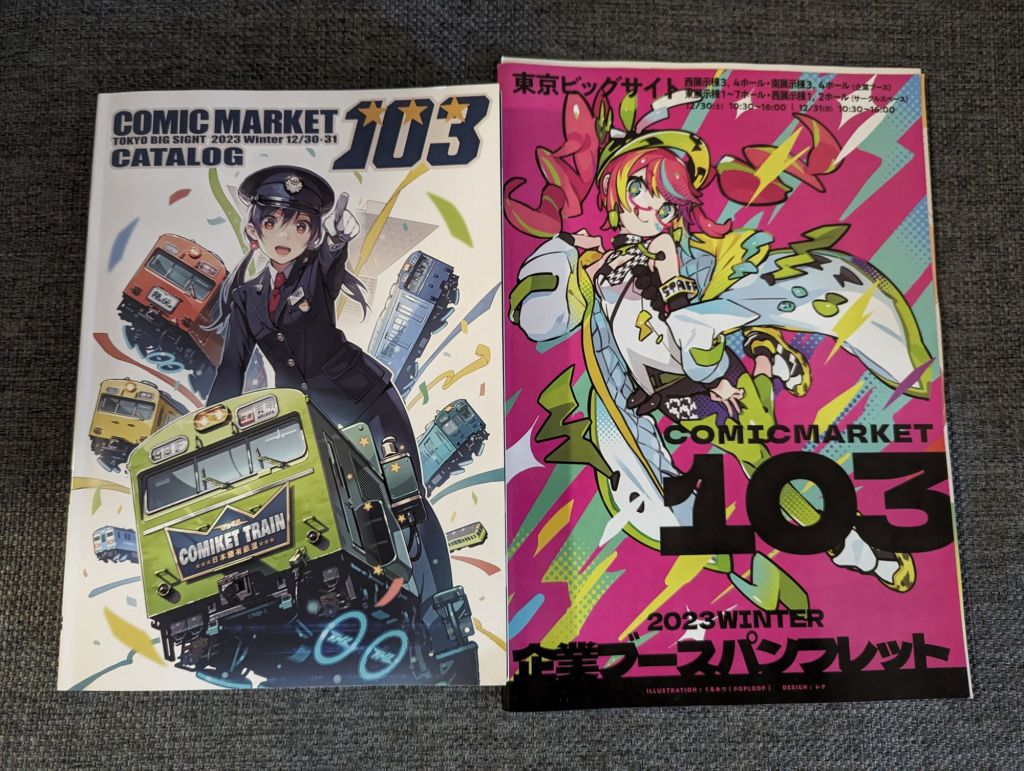
Comic Market 103 catalog and industry booth pamplet
I’ve read a lot about and related to Comiket over the years. I’ve had friends and acquaintances tell me about the times they went and the money they burned. The event also looms large in my favorite manga, Genshiken—scenes such as Sasahara losing every inhibition his first time attending, Madarame breaking his hand but choosing to try to stay anyway, and an incognito Ogiue spilling her BL all over the floor are all downright iconic. But I’ve also seen comments that the event is some combination of overrated and overhyped, so I wanted to make sure I came to Comic Market 103 with expectations that were neither ridiculously lofty nor blatantly unfair.
A classic cautionary tale is that of the anime fan who gets disillusioned upon visiting Japan, because they had previously been viewing the country and its culture through the inherently distorted lens of anime. My first time there, I was prepared for everyone I met to actually dislike anime because I didn’t want to make that mistake, only to have a different experience. While Japan wasn’t quite like my animes, it was also not that far removed, and I could still appreciate it as a fan. I approached Comiket with all this in mind.
Downside
I want to start by laying out some of the negatives I ran into.
First and foremost, there were no Genshiken doujinshi, as far as I could tell. Boooo.
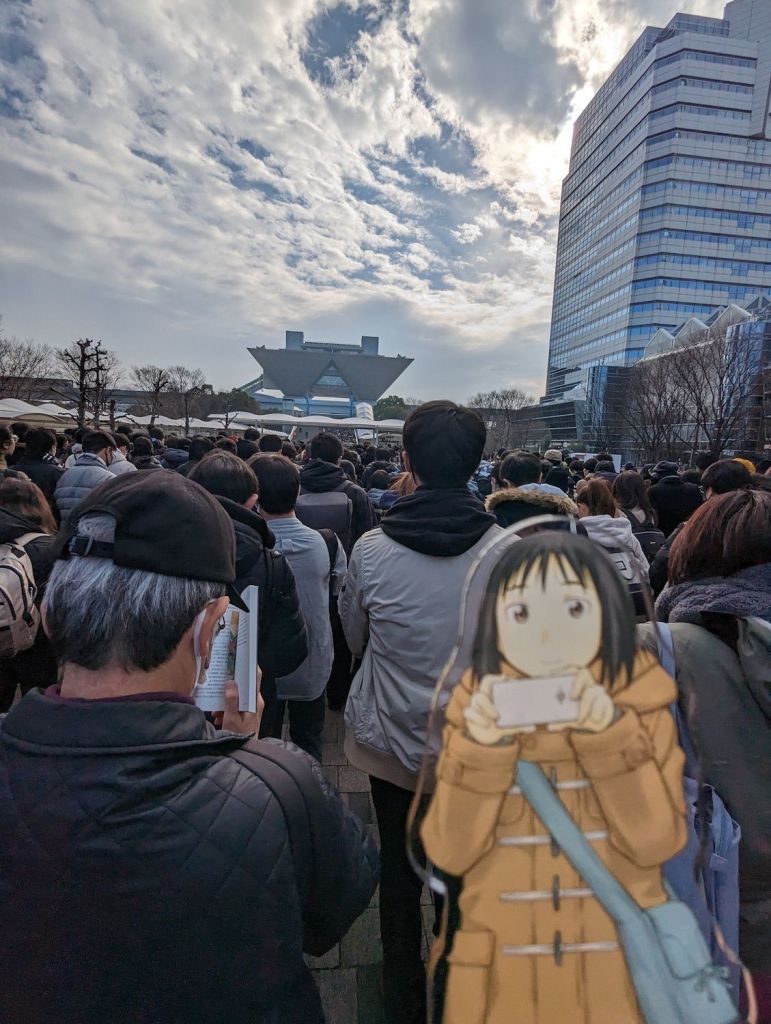
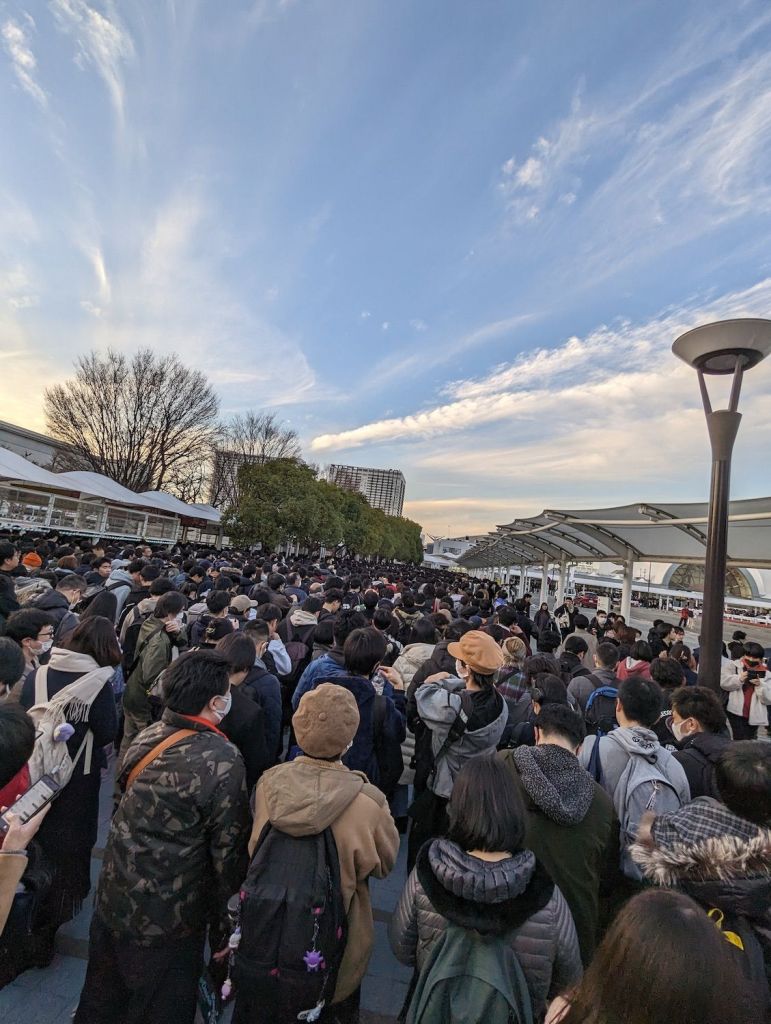
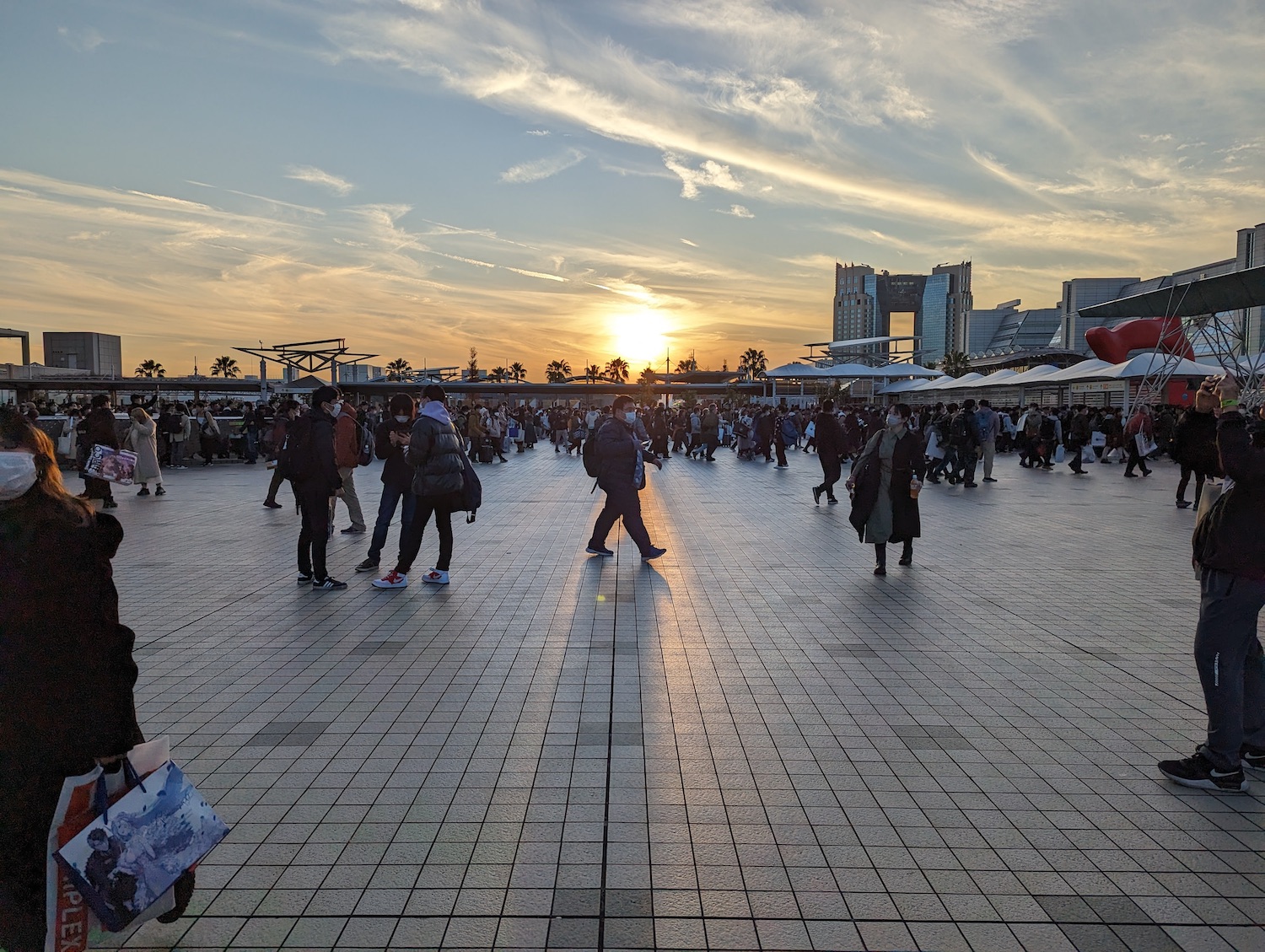
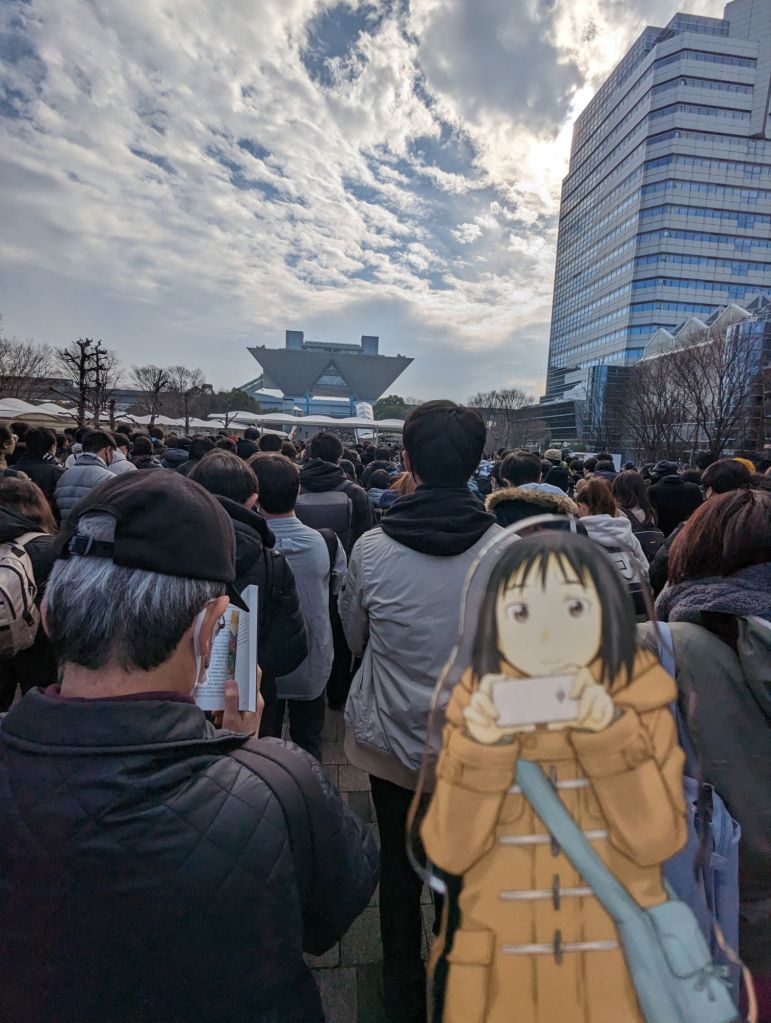
Second, getting to and from the venue, Tokyo Big Sight, can be an ordeal—especially depending on what time you decide to travel. On Day 1 (of 2), I ended up in a classic sardines-in-a-can situation in the morning, had to wait in line for about two hours before I could actually get into the exhibition space, and made the mistake of staying to the very end. In that last instance, it meant that a walk back to the train station that should have taken five minutes ended up being about an hour. Comiket is literally the most highly attended comic event in the world, and the approximately 30,000 circles (i.e. doujinshi vendors) would itself be considered a large convention. When you have to walk back with that many people, the pedestrian traffic jam is intimidating.
I was very fortunate that, despite Comiket taking place in late December, the weather was surprisingly pleasant. Had things not been so nice, the wait (and my overall experience) might have been more miserable.
Third is that there is very limited time to get anything, and nothing is guaranteed. A small fraction of tickets are for early entry (the doors open at 10AM), and are sold at a premium while also being lottery only. Otherwise, most people (including myself) have regular morning or early afternoon entry tickets, and can only get in later. On top of that, each day ends at 4pm, circles typically are there for only one day, and the most popular artists (especially the 18+ ones) will have massive lines. For example, I tried to get something from Mika PikaZo (character designer of Hakos Baelz and Fire Emblem Engage), and ended up going through three lines only to discover she had sold out of everything. There is a serious sense of FOMO that can make the losses sting—if something is popular, you basically have to impulse buy, or else it might be gone.
But This Is Accounted For!
There may be inevitable issues at Comiket, but that’s all the more reason I have to commend the staff for their excellent organization and crowd control. While things took time, they still progressed smoothly. And once inside, the crowds were not difficult to manage—about comparable to a large-ish anime convention. This is also owing to the attendees and circle members themselves, both of whom generally tried to follow the rules. On a few occasions, I had inadvertently blocked one table while looking at the content of another, and was asked to avoid doing so in consideration of others. The sense I got was that a lot of people involved, be they staff or otherwise, were very familiar with both Comiket and Tokyo Big Sight itself.
Something that helped with the crowds was that halls could open up to the outside, which prevented massive lines for certain artists from clogging up the aisles. I heard from a friend that this seems to have started since 2020 as a COVID precaution, and that this is an added side benefit. There’s a chance I might have felt somewhat differently if the weather hadn’t been so good, but I would have appreciated the improved ventilation regardless.
And as for FOMO, it turns out that a lot of artists sell their stuff in stores after the event, in places like the popular doujin shop Melonbooks. So not all hope is lost (though for buyers outside of Japan, you likely have to spend more on shipping fees and third parties).
What this all means is that negatives do exist, but they are accounted for and mitigated to a decent degree.
Upside
My haul
Although Comiket is not perfect, it’s still a great event that showcases what makes the otaku spirit special. There are drawbacks to being so massive, but the sheer amount of stuff both ultra popular and extremely niche, all in the same space, is a sight to behold.
The biggest categories this year were VTubers and various mobile games (or at least mobile game–adjacent works). But even if you’re into none of that, there’s still a chance you can find creators with which you share a common interest—and that’s even putting aside the 18+ stuff.
Here is some of what I ran into over the course of two days.
Srungle fanfiction
Guides to NYPD call signs and insignia
Illustrated food guides
Andy Hole x MIX from Aquarion EVOL in the year 2023
Original mecha drawings
Pilgrimage guides for fans of particular franchises
A book dedicated to events for Kawamura Maria, the voice of Naga from Slayers
Guides to bootleg ZOIDS
Cure Precious x Black Pepper Precure het shipping
Illustrated collections from actual VTuber character designers/collaborators
Cosplay model photo collections
Initial D BL
Yotsuba& parodies of Zambot 3 and Daitarn 3
Both het and LGBT Gundam: The Witch from Mercury shipping
Literally Sonoda Ken’ichi
It might be easier to find smaller events throughout the year that are hyper-focused on your particular interests, but nowhere is the sheer diversity of fandoms more on display than at Comic Market, even if certain specific titles dominate the majority of the physical space. It’s wonderful.
Vs. Conventions
The sense of discovery at Comiket is second to none, and I can’t help but contrast it with anime conventions in the US. One of my biggest problems with artist alleys is that it’s hard to find fanart of more obscure titles. This is because con tables are expensive (Otakon is $375 USD as opposed to Comiket’s 8000 yen, around $60–$80), and artists tend to display what’s most popular, probably out of the need to recoup the expenses. It’s not impossible, but sussing out the weird stuff involves going through artist portfolios or asking, which can be awkward or time-consuming. On the other hand, because Comiket tables are generally grouped together by interest, and their specific interests are front and center, you can know at a glance what to expect.
The hololive booth
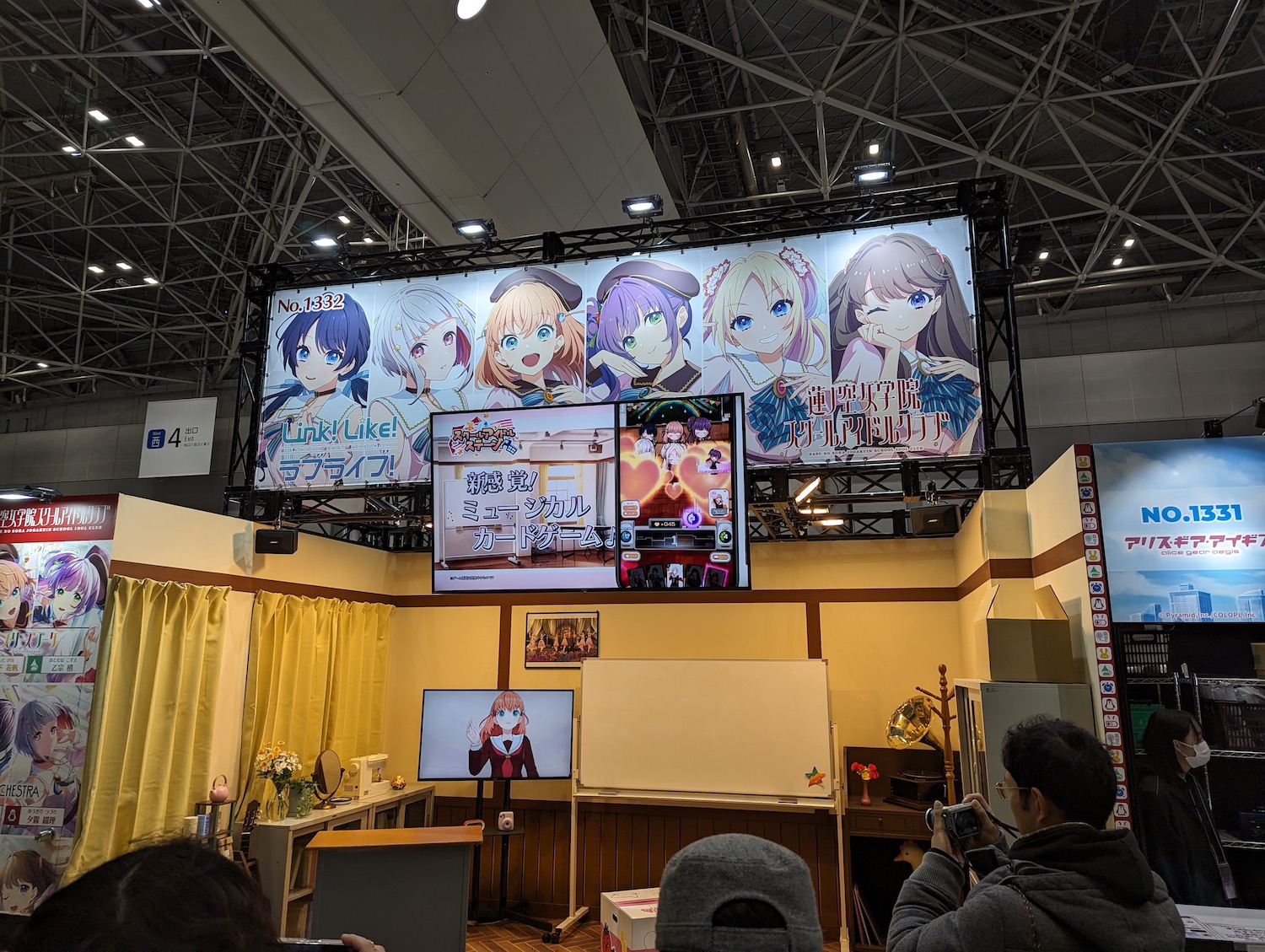
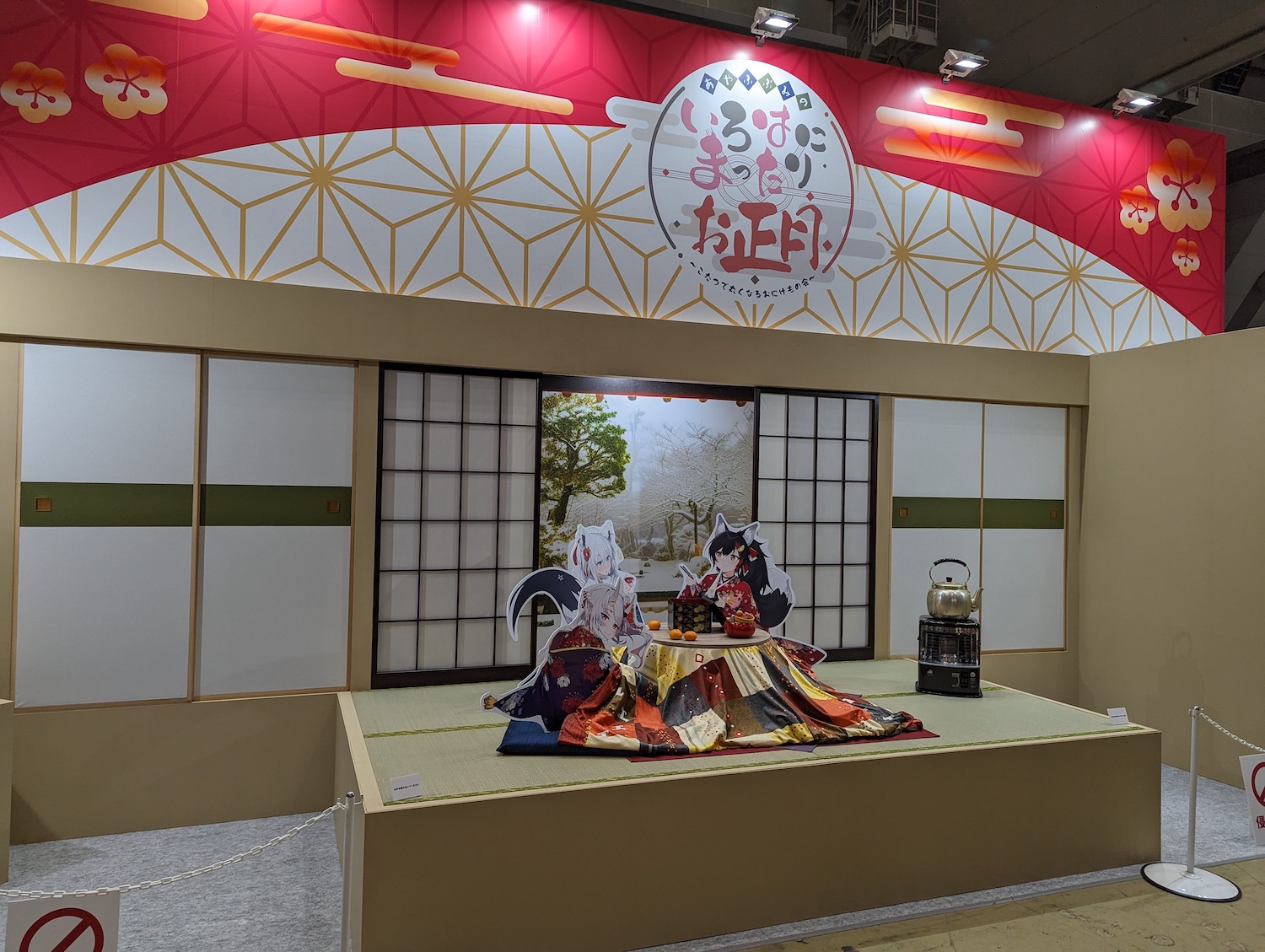
There was an industry presence at Comic Market 103, but it was much smaller than the space dedicated to doujin works. This is actually the opposite of American conventions, where the official booths and merch usually take up the majority of floor space. One thing I found interesting is that most of them, more than being manga-related, were more otaku-focused. That is to say, they were properties that attract hardcore dedicated fans—things like VTubers, Love Live!, The iDOLM@STER, mobile games, etc. One interesting presence was a booth for My Youth Romantic Comedy Is Wrong, As I Expected, which is celebrating its 10th anniversary. I saw quite a line for merch there, and as a fan of the series, I’m glad to see it get some real love.
Another difference is that con-style panels and talks, be they fan-run or professional, are non-existent. They’re typically one of my favorite things, so their absence is a tad disappointing, but I also already knew that would be the case. All this goes back to time being a precious resource. No one really lingered or tried to socialize either, and the fact that the food truck lines were short (unlike an anime con) encapsulated one important fact: Attendees had priorities, and only a few hours to get what they wanted.
Overall Thoughts
Comic Market isn’t really one fandom, but rather dozens side by side in the same space. This approach has its strengths and weaknesses, and both are magnified by the sheer size of the population attending it. But while there are disparate groups, they all have the same general goal of finding the books that resonate on a personal level, and I think this gives the entire event a certain focused energy.
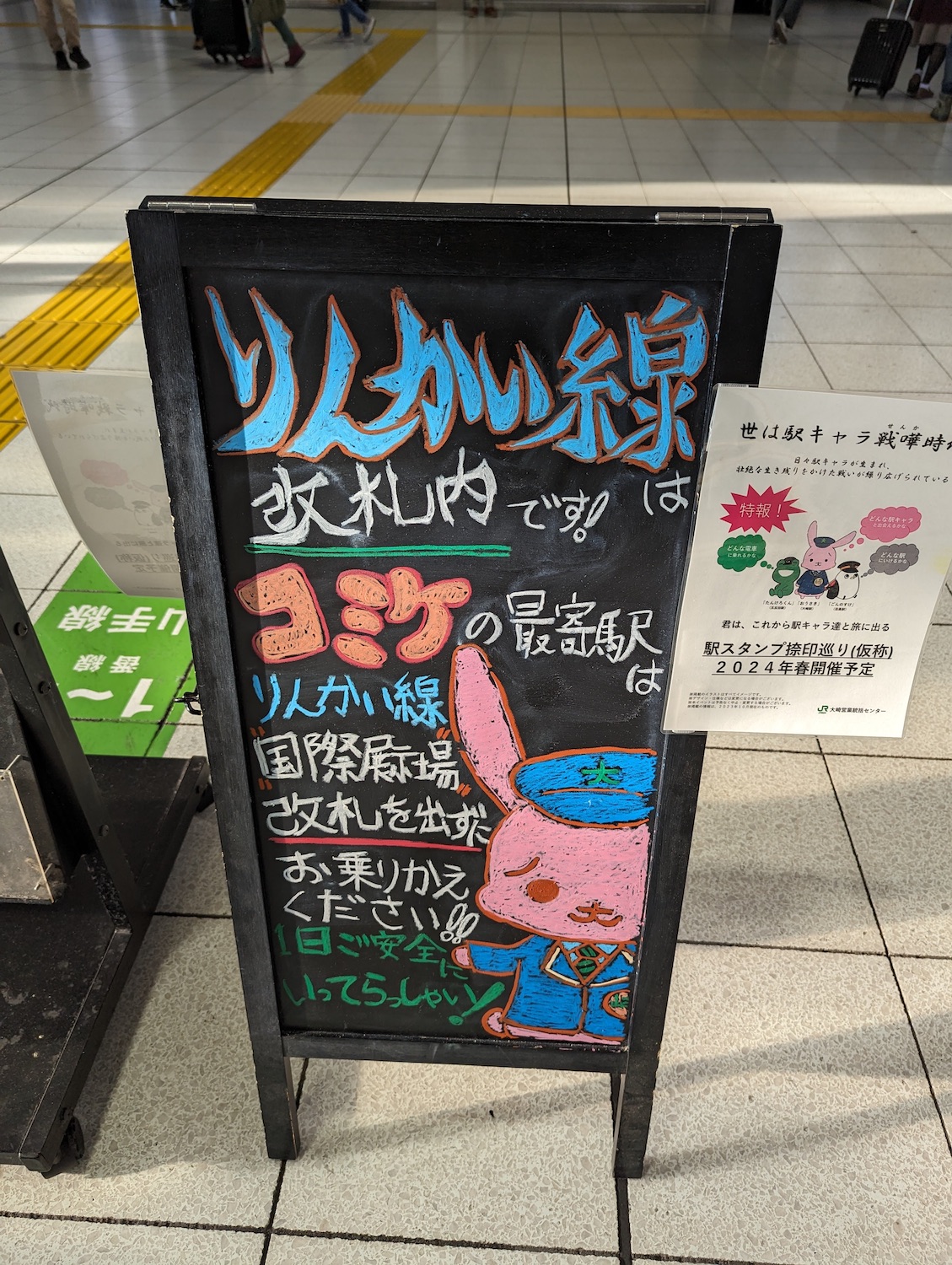
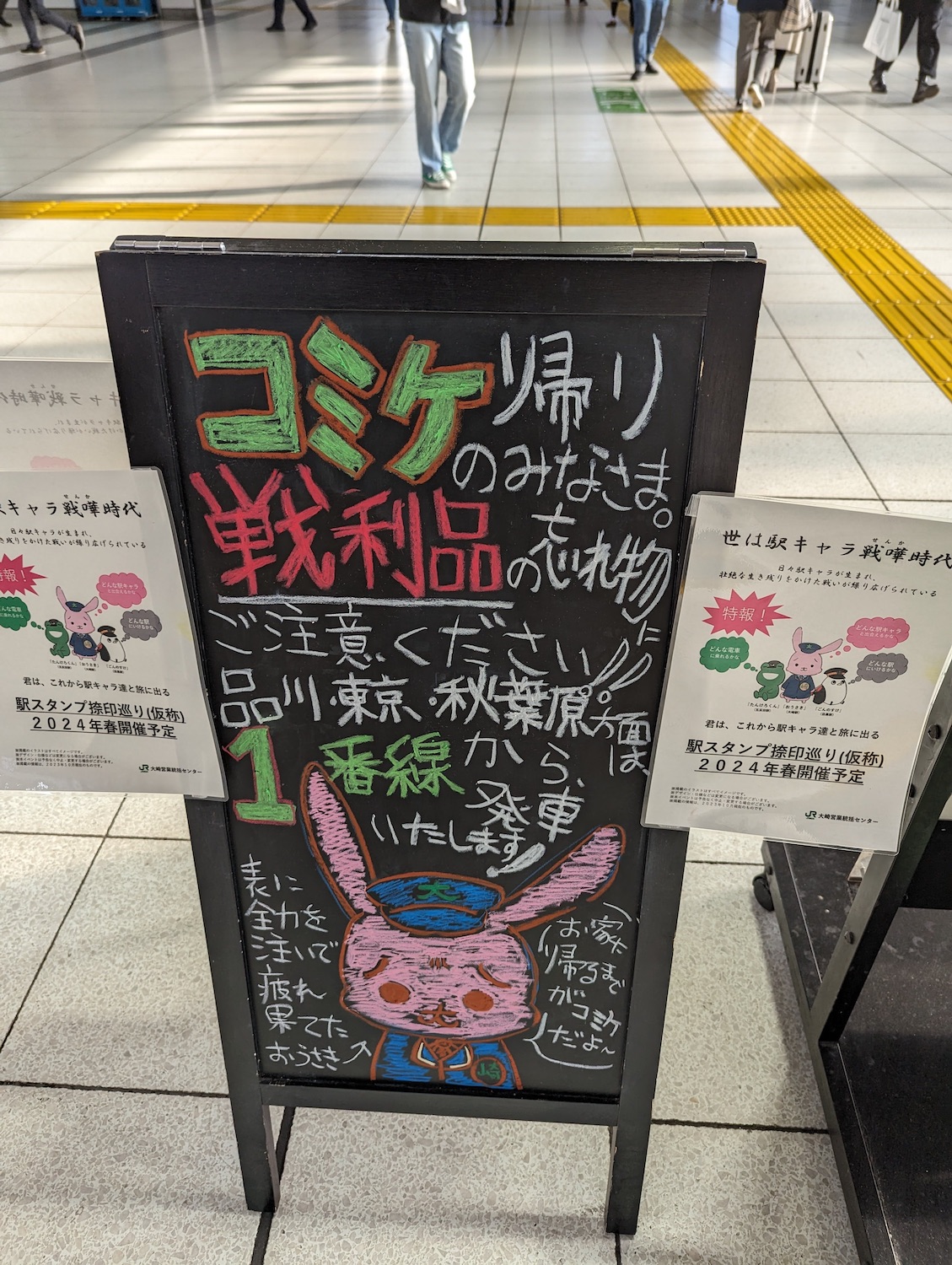
At the Osaki train station, one of the transfer points to get to Tokyo Big Sight, there was a chalkboard sign both welcoming people to Comiket and thanking everyone on the way back, depending on which direction you were coming from. It’s a small gesture in the grand scheme of things, but this double-sided sign’s presence really hit home for me the fact that the majority of hardcore fandom in Japan descends on a small strip of land.
I can’t say if this should be the first doujin event a person should visit, and it might not even be the best choice, depending on what one values. However, I can personally say that I had a great time, I’m happy to have done it, and if the stars align, I’d be more than willing to go again.
I mentioned having some fun surprises last month, and I let the cat out of the bag on Twitter a few days ago: I attended Comic Market for the first time!
While I don’t have a schedule fully planned out, you can expect the next couple months to have at least a few blog posts about my experience at Comiket, as well as other bits of my trip to Japan. I’m actually a bit worried about them overshadowing other topics, including the new anime season, but hopefully it’ll all work out.
May the Year of the Dragon bring fortune to everyone, but especially my Patreon subscribers:
I did experience the earthquake that hit Ishikawa Prefecture, but fortunately only from a great distance. I know there have been some tragic losses, but I hope everything gets up and running for those most affected.
While I spent the majority of Anime NYC checking out the plethora of events related to hololive, I also want to broadcast my thoughts on various other topics.
Getting In
In previous years, Anime NYC would often run into issues with getting attendees into the Jacob Javits Center. This year, I did not hear any major rumblings, though I don’t know to what extent that was the result of improved planning and how much it was because the weekend was blessed by nice weather.
Crowds
As Anime NYC has grown and the COVID-19 pandemic still lingers, foot traffic and crowd size are topics of concern for me. That said, I found the convention center relatively easy to navigate this year. While bottlenecks did happen on occasion, I never really felt like a canned sardine, even in places where it could get very cramped last year, like the Artist Alley.
In terms of masking, at his point, it’s become increasingly uncommon in New York City as a whole, which is unfortunate. I still hold out a modicum of hope that convention runners here and elsewhere might be willing to get more stringent with a mask policy if things get more dire again, but for now, I can only recommend doing so for your own safety.
The Witch from Mercury Panel
Surprise—I actually did something that wasn’t hololive-related this year.
Upon arriving at Anime NYC to attend the Gundam: The Witch from Mercury panel, I was pleased to see how big the turn-out was. The line extended from essentially one end of the convention space to the other, and had people of all ages and genders. It’s only natural, given the pioneering nature of G-Witch both in Gundam and anime as a whole, but it was still a pleasant sight to behold.
WARNING: GUNDAM WITCH FROM MERCURY SPOILERS
The main takeaway from the panel is just how much everyone involved with the series sought to do something different with Gundam and to make it clear that G-Witch would chart its own direction. Production had already begun in 2019, and they had wanted to differentiate it from Iron-Blooded Orphans, even working with the technical director to give the series a different look. A lot of changes happened behind the scenes before the new show even aired.
The producer of G-Witch was there along with the two main actors, Ichinose Kana (Suletta Mercury) and Lynn (Miorine Rembran). I had actually interviewed Ichinose a few months ago at Anime Central, but at the time was not allowed to ask questions pertaining to Gundam. Though I was only an audience member here, I was glad to at least get some of her perspective, as well as the others’.
When asked what they liked about the series, Ichinose and Lynn both expressed a fondness for all the different relationships between characters, and just how even the same types of relationships were unique depending on who was involved. The example they gave was parents and children, and how they all lead to their own interesting conclusions.
Ichinose got the call about passing the audition after waking up, only to fall back asleep after. Because of this, she thought she might have dreamt it. Lynn is a long-time fan of Gundam even before voice acting, and actually found out about landing the role on her birthday.
Evoking Suletta’s sense of difficulty with interacting with people her age was something Ichinose worked hard on. As an introvert who gets anxiety herself, she empathized with Suletta. Lynn was aware Miorine would go through changes, that she would start off bored and prickly but would meet Suletta, get her own company, and so on, and become more of her own person in the process.
Ichinose had a tough time deciding a favorite scene, but chose one from Episode 21, where Suletta takes her mom’s mantra “Run, gain one. Move forward, gain two” and rethinks it to be about doing what you can even in hard circumstances. For Suletta, who always followed her mom and wasn’t her own person, her time with Miorine and the other students allowed her to form her own opinions and have her own life and destiny.
Lynn’s favorite is the climax in Episode 24, when Suletta brings the Gundams together and stops Quiet Zero, due to the sheer Gundam-ness of it all: characters, music, and mecha all on full display. The fact that Suletta truly shows herself as the main character also contributes to why Lynn likes it.
Towards the end, the two actors did a live reading of a scene from the episode “The Witches from Earth,” which was excellent. Following that was a video about how Gundam is sponsoring an F-1 racer, which just made me want to make Gundam F-91 jokes
Anime NYC 2024 in the Summer
I want to end by talking about what’s maybe the biggest news of the con: Anime NYC 2024 will be in August instead of November. I already gave a few thoughts in a previous post, but would like to elaborate on my opinion here.
It is uncommon for conventions to move dates so drastically from one year to the next. Sure, a week or even a month isn’t out of the question, but three months is a hell of a difference. The fact that they have a lot of advance warning is helpful, but I do feel for the people who plan longer-term and might have arranged things with the assumption that Anime NYC would be in the fall.
I do not have any insider knowledge about why LeftField Media made this decision, but I can imagine a number of reasons. First, Anime NYC has previously been the week before Thanksgiving, a holiday when people tend to travel. Second, the (typically) cold weather can be unpredictable: While this year was pleasant, we’ve also seen snowstorms in the past.
August means avoiding such issues. The summer is the time for vacations that don’t necessarily involve seeing family. It makes Anime NYC part of the packed summer convention circuit, which includes notably Anime Expo and Otakon. Also, Anime NYC has mentioned that the entire Javits will be open for the con in 2024, so I suspect that there is something preventing them from having full access in November.
One problem: While blizzards won’t be a concern, New York summers are very hot and humid, especially in recent years due to climate change. I worry that we’re trading shivering in the cold to passing out in the sun, and if Anime NYC isn’t on the ball, this can become a real issue.
I also have concerns about Anime NYC trying to compete with Otakon, despite the fact that they’re actually quite different from each other as anime cons: Anime NYC is a very slick product, while Otakon is more grassroots. That said, this date change might be mutually beneficial for them, as DC and NYC aren’t far from each other. I really hope this is a net positive overall.
I will likely attend Anime NYC 2024 regardless, and I really won’t know if it ends up being better or worse until it happens. But I will miss having a fall con season in New York City.
I didn’t intend for my Anime NYC 2023 experience to become more like “hololive NYC,” but that’s what ended up happening. Between multiple special events and an Exhibit Hall filled with sellers who knew that it’d be a hot commodity, my time was filled with VTubers and VTuber accessories.
Anime NYC 2023 took place from November 17 through 19, once again on the west side of Manhattan at the Jacob Javits Center—a mediocre venue that tends to just win by default because there’s nothing bigger around. While the con brought guests and screenings from lots of different anime and manga, the highlight for me was indeed the sheer amount of hololive programming. Each day brought something big: the Hoshimachi Suisei paid concert on Friday, the very first hololive Advent panel on Saturday, and then the surprise hololive Indonesia tour concert, viv:ID Cruise. On top of that, Anime NYC had originally announced each one separately, so what we originally thought would be one major event (the Suisei concert) gradually turned into three—not to mention the hololive booth in the Exhibit Hall that had nonstop live programming.
One of the challenges for the big hololive events is that they all required attendees to go through a somewhat convoluted reservation system. Rather than first come, first served, people were randomly assigned a spot in the queue. The idea is to 1) not have people line up unnecessarily the day of an event, and 2) to make sure those with the privilege of more free time or fortunate timing didn’t have an unfair advantage. I find that there are pros and cons to this approach, the downside being that I think it makes many people try to get in even if they don’t necessarily care. Nevertheless, I count myself incredibly lucky that I managed to get into all three events.
Suisei
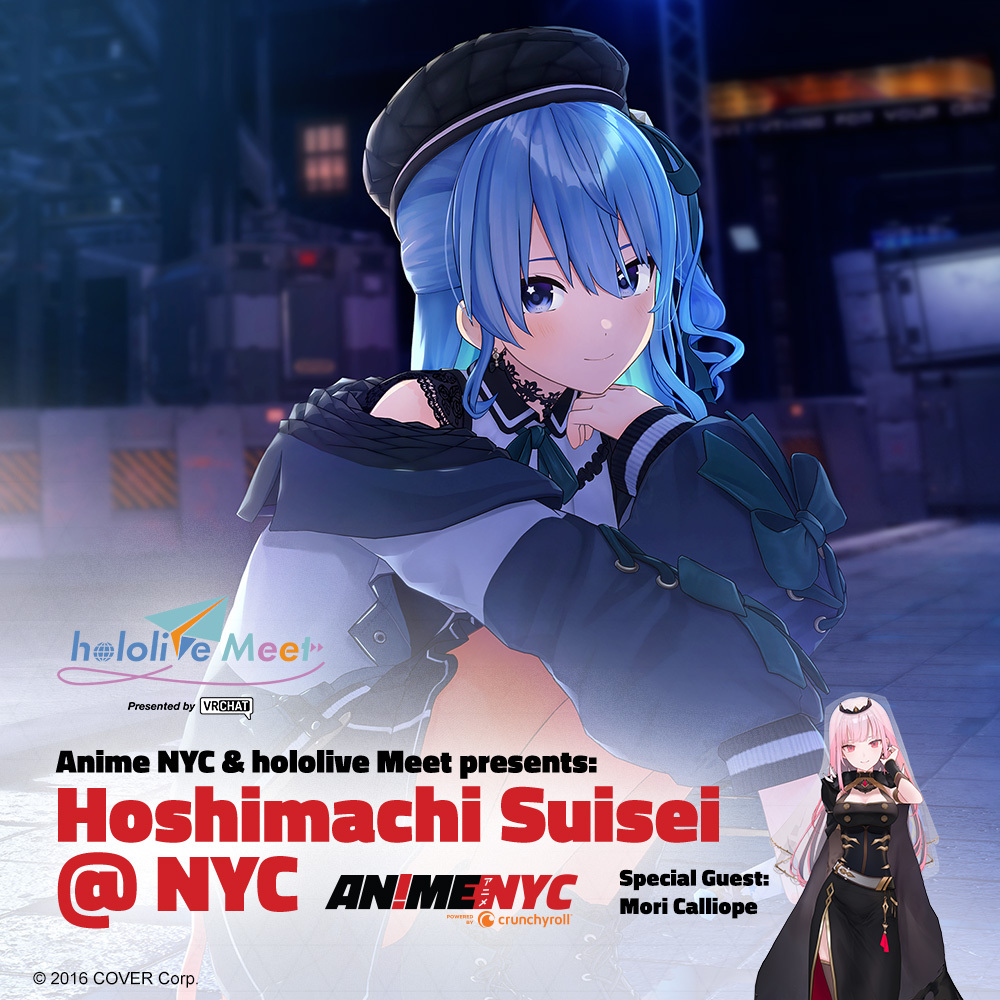
Hoshimachi Suisei is one of the most popular and celebrated VTuber singers today. She introduced viewers of the The First Take to the world of Virtual Youtubers, and she’s already had a couple concerts in Japan. Her appearance at Anime NYC was pioneering in multiple ways: Not only is it the first (mostly) solo 3D concert for hololive in the US, but it’s also the first to spotlight Japanese talent, as opposed to the English-focused Connect the World from last July. Suisei did not disappoint, bringing her characteristic powerful vocals and performing her original songs like “Ghost” and “Stellar Stellar.” In an industry where lots of post-processing is common to make people sound much better, Suisei stands out as someone with legit singing chops.
hololive EN’s Calliope Mori also guest-starred with a solo and a duet with Suisei. The big surprise to me was that, of all the pieces she could have done, Mori performed “Miraijima ~Future Island~,” her promotional song for the One Piece manga. Though in hindsight, it’s the perfect fit for an anime convention.
The concert was basically a glorified screening (Hatsune Miku–style 3D holograms aren’t a thing yet for parent company Cover Corp.), but buying into the kayfabe “live” notion is part and parcel with enjoying hololive in general. Also, the Special Events hall was not an ideal space for concerts (it’s just not built for that purpose), and standing on the hard concrete floor for extended periods was murder on my legs. Despite the pain, I had fun.
hololive Advent
Just like how hololive Council made their group convention debut at Anime NYC in 2021, the third generation of hololive English appear this year together for the first time. Unlike the other events over the weekend, it was not a musical performance. Instead, it was a Family Feud–adjacent panel where the members of Advent competed to see who could successfully guess what the audience would answer in polls related New York City. Questions included topics like iconic NYC foods (pizza) and the coolest New Yorker (Lady Gaga). The funniest thing was seeing the generational/informational divide among Advent—most notably Shiori Novella (an “archiver” in VTuber kayfabe) calling Al Pacino “Al Pakino” and “Al Capino.”
This panel ran a lot more smoothly than Council’s two years ago, and didn’t have the awkward formality that came from being connected to an official cultural tourism thing. I think it really goes to show what strides hololive has made among American fans that they didn’t feel the need to have that association.
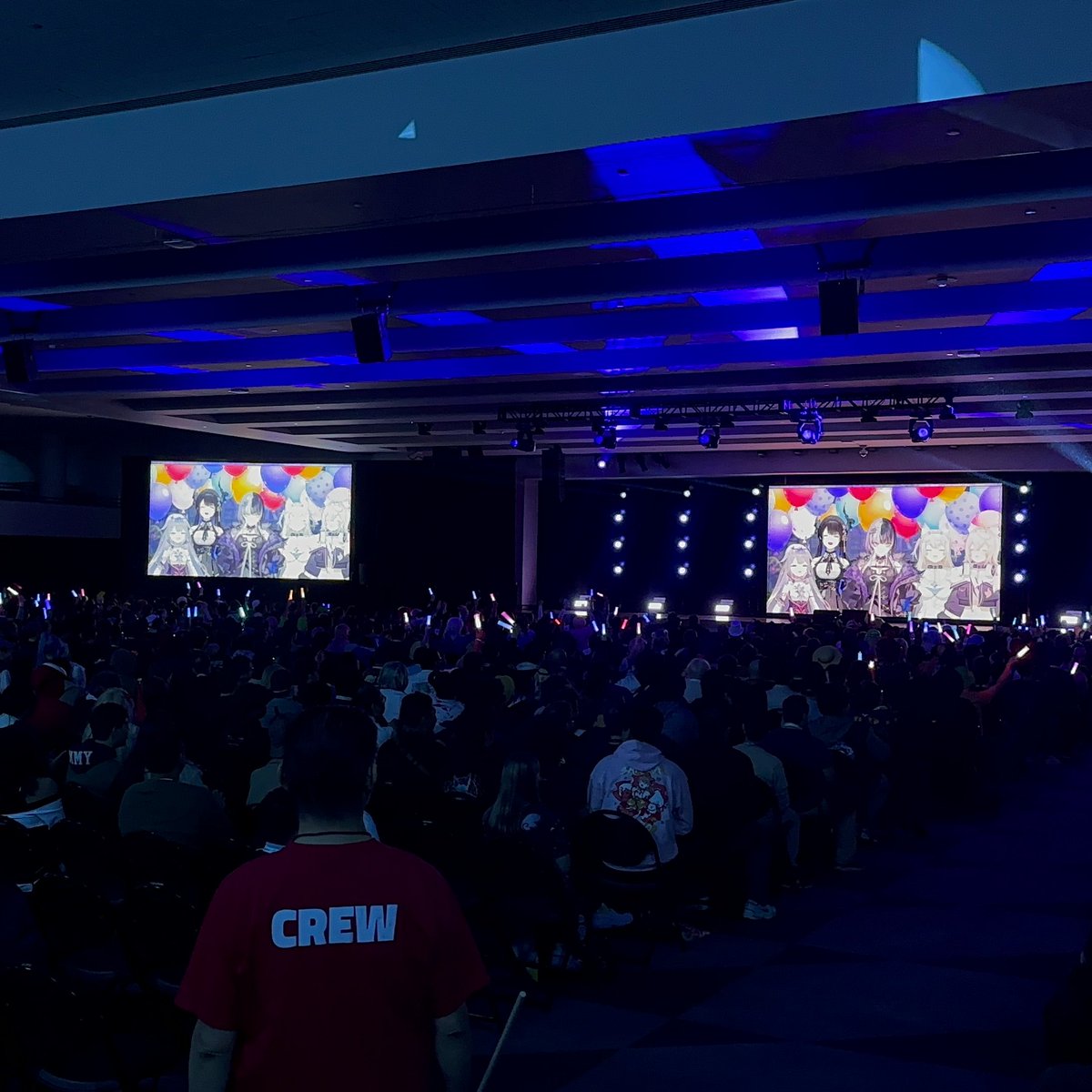
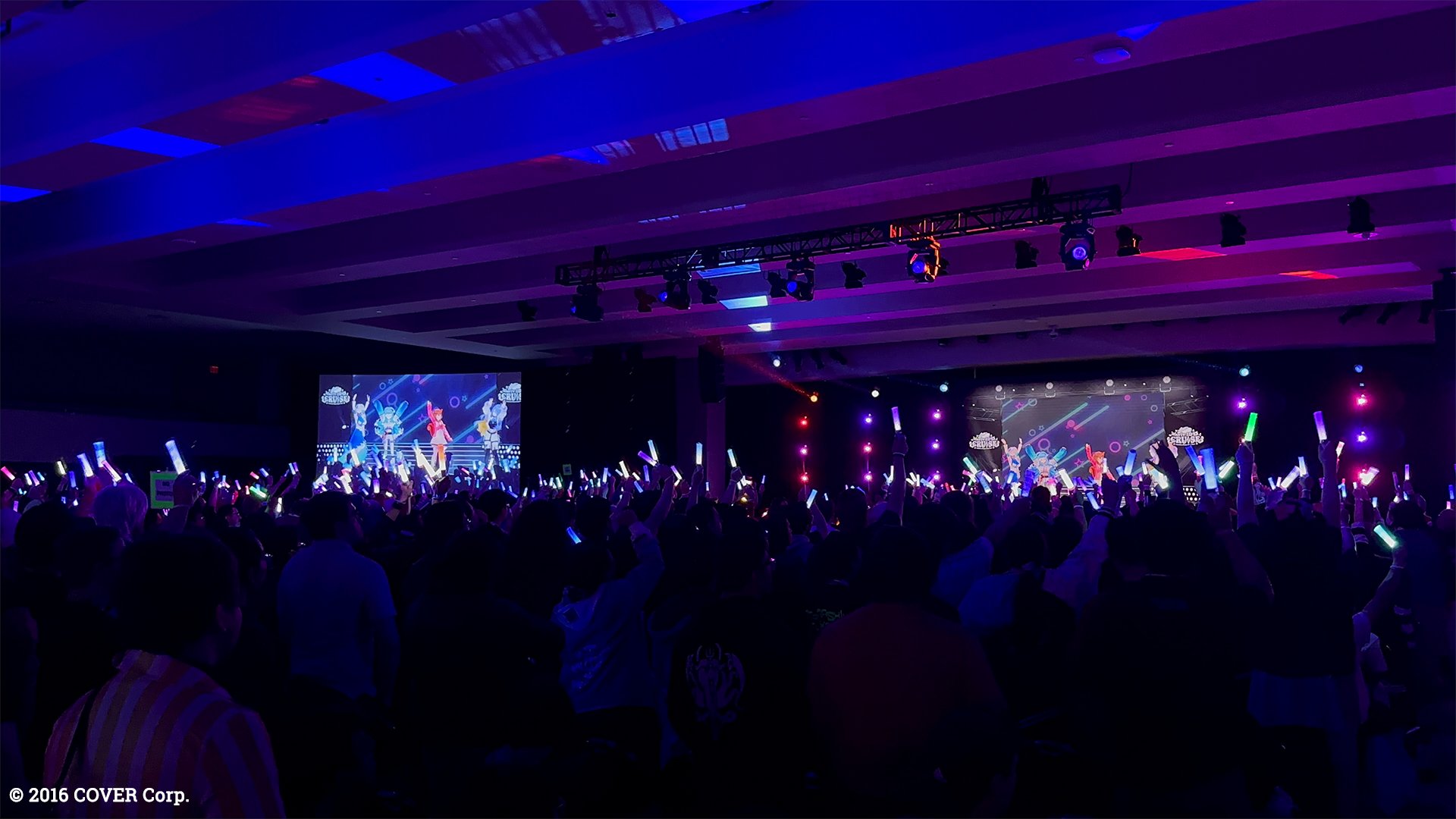
viv:ID CRUISE
The appearance of hololive Indonesia at the con was a big surprise, namely because viv:ID Cruise was originally announced for Southeast Asia only. Now, the tour schedule reads as “Jakarta, Singapore, Kuala Lampur…and New York.” I’m definitely not complaining, as it ended up being my favorite part of Anime NYC as a whole.
The members of viv:ID CRUISE are Moona Hoshinova, Ayunda Risu, Pavolia Reine, and Kobo Kanaeru. In their group numbers, it was great to see how each VTuber brought their own personal quirks to their performances and the choreography, such as Risu’s unmatched songstress status and Kobo’s theatrical dance moves. In their solos, each girl shone brilliantly. Moona made the biggest impression on me with her song “Perisai Jitsu,” particularly with the catchy chorus and the simple-yet-powerful choreography. I’ve had it stuck in my head for days, and it reinforces my opinion that Moona is one of the most complete packages in all of hololive.
https://www.youtube.com/watch?v=LXRSp8QbOeg
I also noticed that Reine seemed to be the most popular with the audience there, though I don’t know how representative the live crowd was compared to, say, US fandom for hololive Indonesia as a whole. Speaking of texting, before and after the concert, there was an ad promoting the new holostars English generation, Armis. Online opinion about male VTubers in hololive Production can be mixed or even negative, but the attendees seemed to be largely enthusiastic about the guys.
The hololive Booth
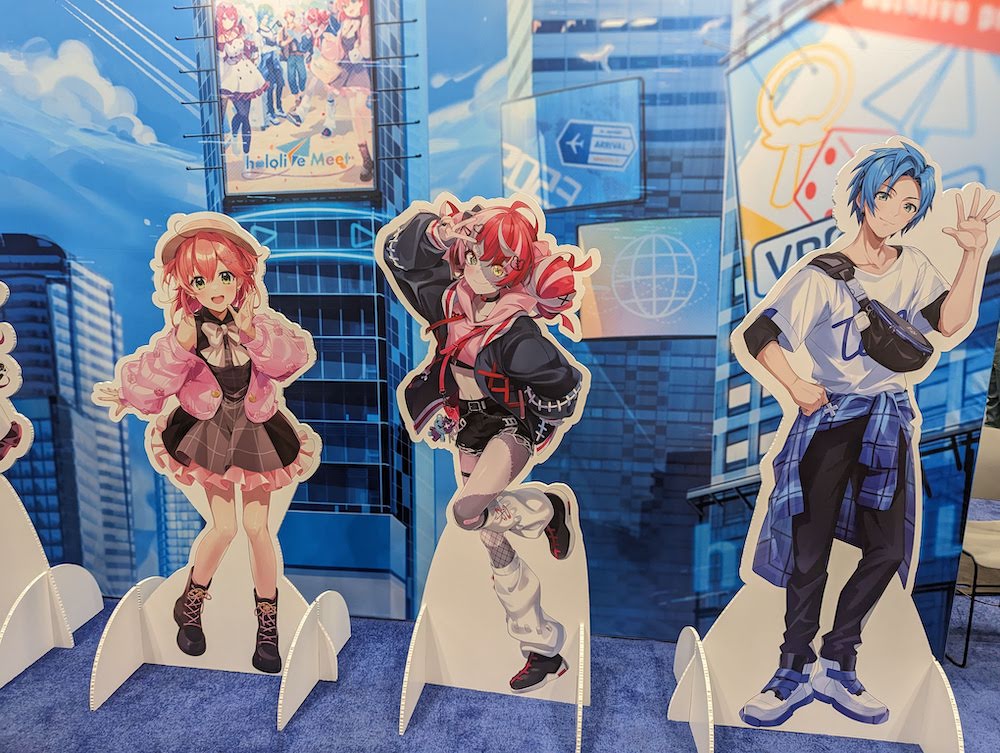
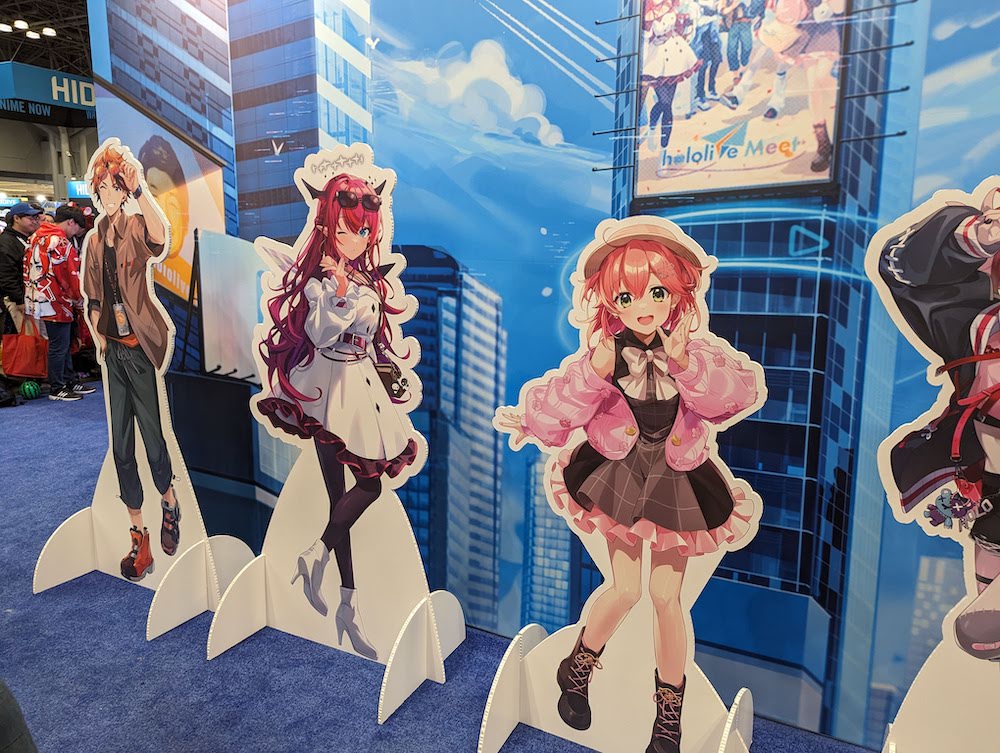
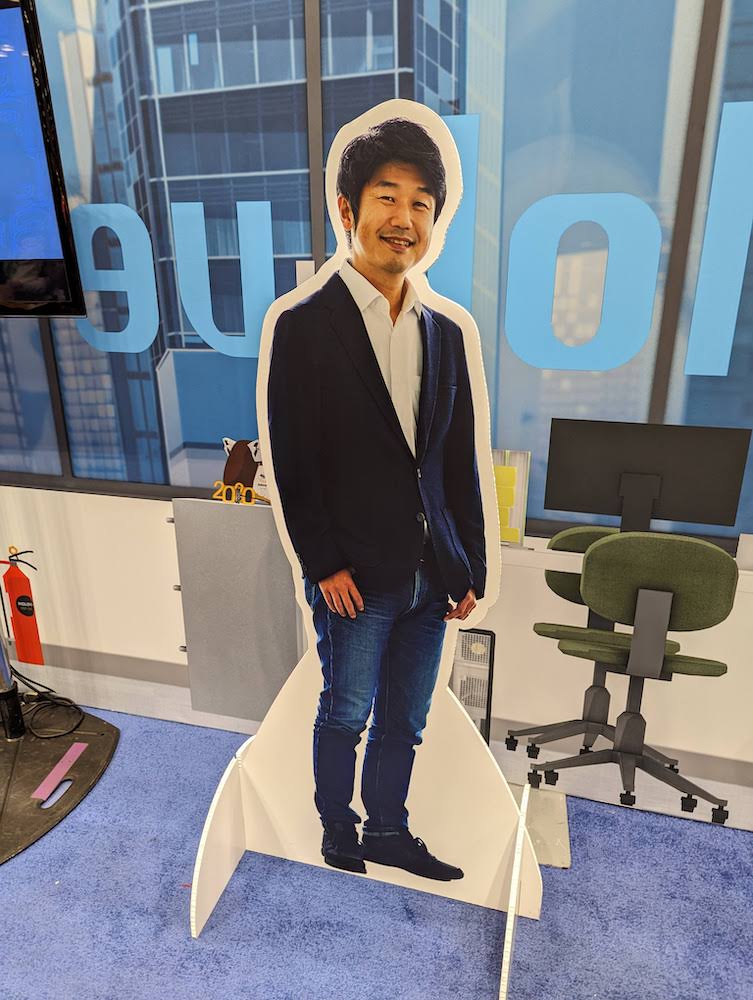
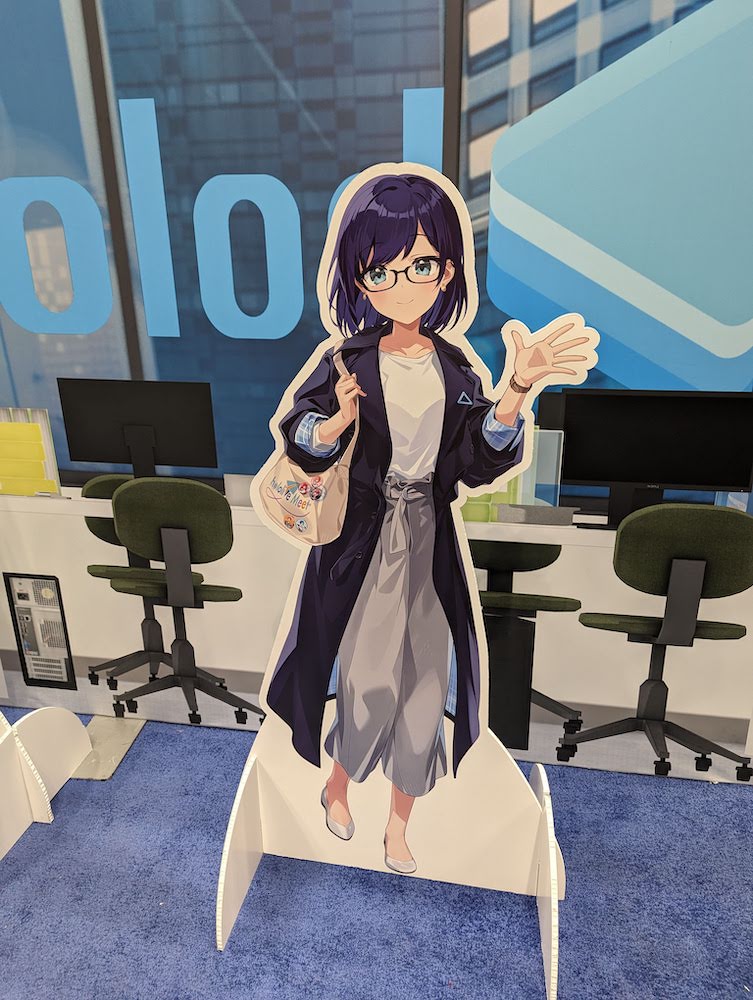
In addition to all the above events, the official hololive Meet booth returned to the Exhibit Hall this year. On the sides were life-size standees of this year’s representatives for hololive Meet, as well as ones for the CEO of hololive, Tanigo “Yagoo” Motoaki, and fan-favorite staff member A-chan. Like last year, they also had live streams on display there especially for Anime NYC. The booth was sponsored by VRChat, and fans not attending the con could still see them through VRChat. I think this was a great idea, and even provided something for the fans who couldn’t attend all the ticketed events mentioned above.
I wasn’t able to see all of them, but I did catch a couple.
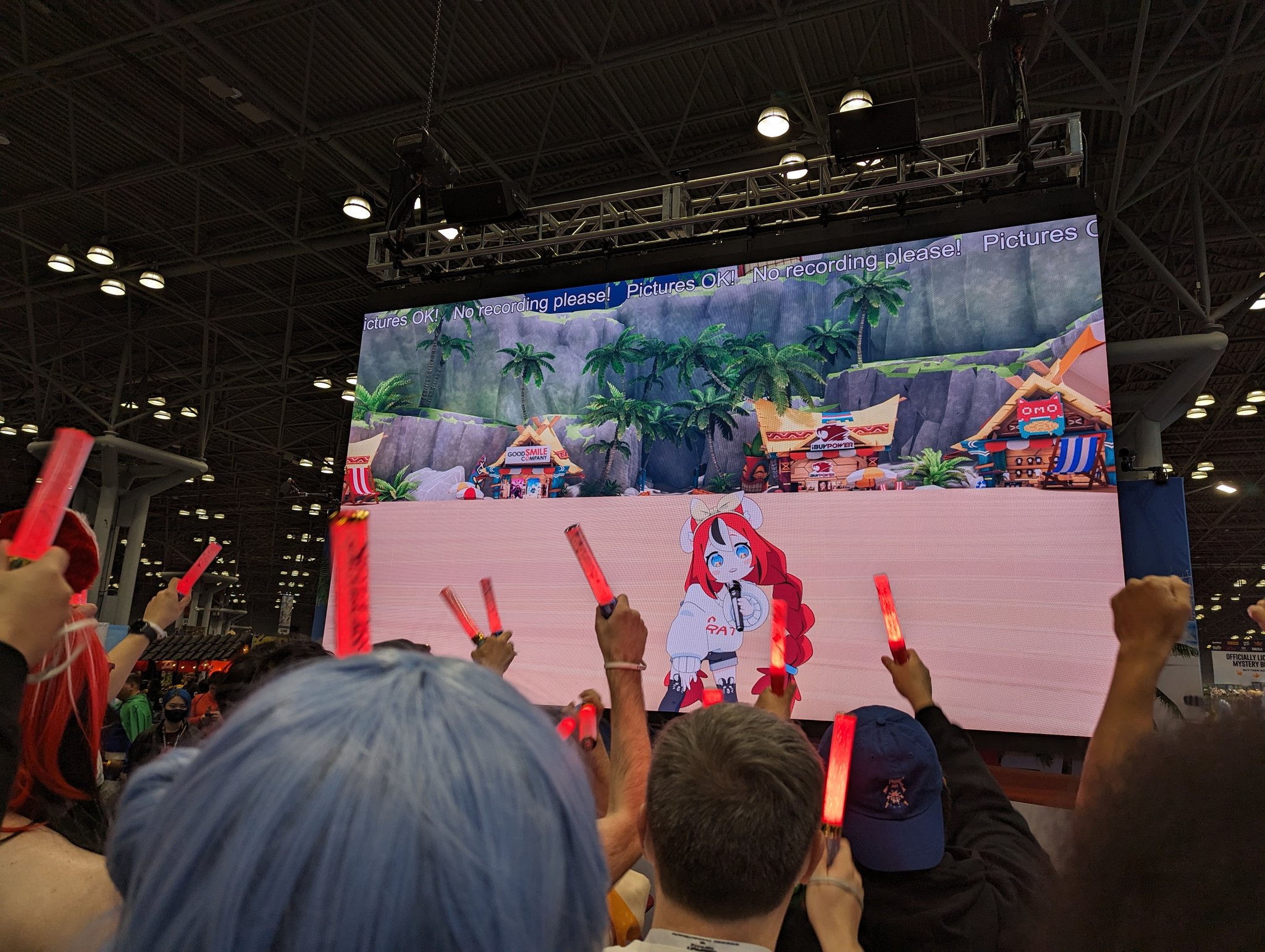
Hakos Baelz is an official ambassador for VRChat, so it’s no surprise that she’d be there, but her embracing of the platform—particularly through her “Dawn of the Dork” karaoke streams—makes her a fitting rep. She brought one such karaoke session to Anime NYC, and showed off both her fun, casual singing and her well-honed dance moves. Utilizing a cutesy model version of herself dubbed “Strawberry Bae,” she sang some anime tunes, took requests from members of the audience (each of whom only suggested hololive songs), and even almost covered Mariah Carey’s Christmas song, until a vocal part of the audience booed the notion. I wish I could have heard it.
The other stream I saw was by two members of the Indonesian branch who weren’t at the concert: Airani Iofifteen and Kureiji Ollie. They’re actually my two favorites of the Indonesian girls, so I was glad to have had the opportunity to see them. Their panel was more of a goofy one, where they had the audience tell them to do certain poses, and they had to see if they both did the same thing. Both Iofi and Ollie have ways of thinking that stray from innocence, so the antics could get rather spicy (but in a fairly PG-13 way). There were also some technical mishaps that would make one or the other disappear or mess up their models, but it was all in good fun and the audience understood.
I could not view the FuwaMoco karaoke session, but I could definitely hear it. The highlight for me was getting to listen to their rendition of “Ojamajo Carnival,” the first opening to Ojamajo Doremi.
One big improvement over last year’s booth was that they elevated the screen to be high up and visible from a distance. However, the crowd that formed around it still took up a huge chunk of floor space and could make it difficult for passersby, especially because it ended up blocking the exits a little. If something could be done to fix that, it would be a boon to both the fans and the other attendees.
Merch
hololive merchandise comes in many forms. There’s the official stuff, the fanmade goodies, things from previous events and milestones, and limited edition convention items, among others. Pretty much all of this was available at Anime NYC 2023, no doubt because everyone knew hololive was going to have a presence there.
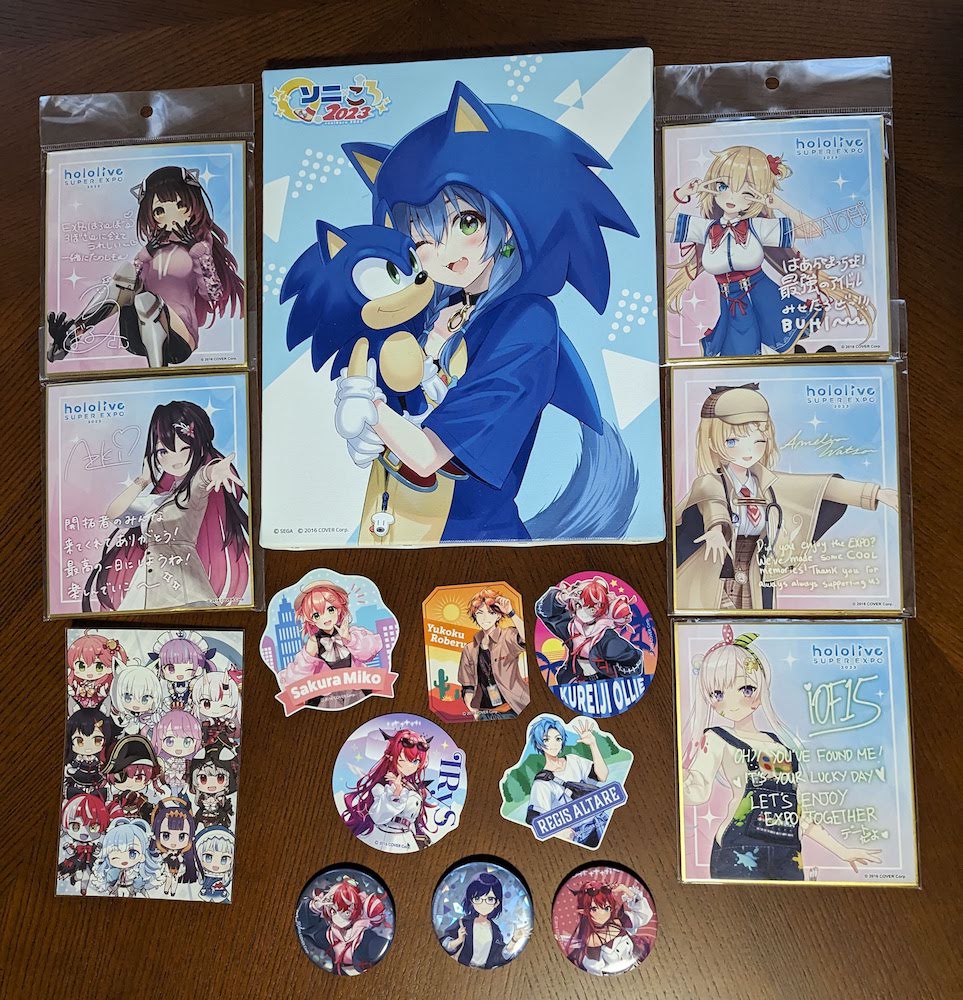
I have an ongoing mission to get at least one item related to every hololive member at some point, so this was a great opportunity for me to take a few steps closer:
I am very fond of the hololive Meet casual outfits, so I wanted to get something from that line. One of the big selling points is also that it had A-chan merch (a rarity, given that she’s not technically a “hololive” performer despite working for the company), and I count myself incredibly fortunate that I managed to get a button of her, as well as ones for Ollie and holoEN’s IRyS (the best singer in EN, in my estimation).
I also really had not expected to get something as amazing as an official canvas image of Inugami Korone in her Sonic the Hedgehog cosplay. I believe my life to be enriched by its presence.
Final VTuber Thoughts
The hololive experience at Anime NYC was unforgettable, and topped this year only by the fact that I got to see Connect the World live. I think it’s great that a convention so close to me gets VTubers in a major way. That said, I do have two hopes for future appearances.
First, I think it would be great for everyone if all these events could be announced sooner so that fans could save up and prepare. While I had the benefit of a press pass, in recent years, the cost for regular attendees has skyrocketed, and those who missed the opportunity for the already-low-number 3-day passes had to pay in the triple digits just to get Friday, Saturday, and Sunday. I know from experience that conventions sometimes simply can’t announce things as soon as they’d like, but anything to give fans more prep time would be great.
Second, Anime NYC has still yet to have proper meet-and-greets for VTubers—something that seems to be common at other conventions throughout the world. I have to wonder if there’s a space issue that prevents it at the Javits, though the fact that Anime NYC 2024 is going to use the entirety of the convention center might bode well for such a change. That all said, next year’s con is going to be moving from November to August, which will bring a whole host of uncertain variables. Whether this turns out to be a good move remains to be seen, but I hope it ends up being a net positive.
Terada Takanobu is a veteran game producer, and has been involved with the Super Robot Wars franchise since the 1990s. This interview as conducted at Otakon 2023 in Washington, DC.
Hello, it’s great to meet you. I’ve been a long-time fan of the Super Robot Wars series, and I’m very glad that is finally easy for people to play around the world.
My first question: You recently announced that you were becoming a freelancer. How has that change been for you? Have there been any particular advantages or challenges that come with it?
There were lots of interests I wanted to pursue, so I decided to step down from the producer role to become a supervisor, and use that time to do the things I’d like to do.
I want to make toys and plastic models, and original robot animations—ones that are not Super Robot Wars OG.
Do you have any all-time favorite anime or even tokusatsu works?
My favorite super robot is Mazinger Z. As for tokusatsu, Ultraman and also Masked Rider. And more and more.
Original Kamen Rider, or…?
It would have to be the first Masked Rider, fundamentally.
One signature element of SRW is the continued use of very creative 2D attack animations. What are the reasons you have stuck with this style even though so much has changed about video games over time?
In Super Robot Wars DD, we’re doing 2D animations and something between 2D and 3D too, so we’re diversifying.
In SRW DD, the idea behind going for 3D animation is to better capture the original. But more than when I was a producer, I can now better create the content I make compared to before
What has it been like developing mobile games, as well as having multiple games out there? Is it part of a broader strategy?
With regard to the overall strategy of creating mobile games, that lies with the publisher, Bandai Namco, so I can’t really speak to it. However, as for challenges in mobile games specifically, I’d say one that having a deadline every month is a bit challenging. For example, before, if it was for a console, you had three years to get the battle animations and the scenarios and put everything into one package. But now, with the mobile games, you have everything packaged every month.
You started at Banpresto in the 90s. Are there any staff from that era still at [its successor] BBSoft?
There are some.
Do you have any specific series or character units that you thought turned out especially well in terms of their presence in SRW? Or do you think there were any storylines that were executed very well?
It’s a bit difficult, because all of them are a lot of work, and I’m mainly putting effort into making what’s there. It’s a cyclic process of making and releasing and making. More than myself, it’s ultimately the users who decide what’s good.
Are there any titles you are especially proud of being able to obtain for SRW or thought you’d never get for the series?
Space Battle Yamato, aka Star Blazers. As for recently, too many. Hmm…recently, Gridman, Mobile Suit Victory Gundam, and Gun x Sword. In SRW DD, Devilman and Koutetsu Jeeg. What’s it called in English?
Translator: [Steel] Jeeg.
Oh, just that directly.
Ogiue Maniax: There isn’t much of a Jeeg presence in America.
Ah, I see. Oh, and there are two Jeegs now: [Steel] Jeeg and [Steel God] Jeeg.
The impression I have about SRW is that there are the “main” games—Alpha, F, F Final, V, X, T, 30, etc.—and then there are smaller ones that tend to be a little more daring with game mechanics and what series they include. One title I think of is SRW Neo, with Jushin Liger. Is there any truth to the idea that you see the smaller games as more experimental?
Before, yes, there was a difference with the more experimental ones. But now, SRW DD is the only one out, and in there, we try all sorts of things like Jushin Liger and Granzort. SRW DD does embrace the style of SRW, such as the game stages and the scenarios and everything.
I know that you cannot reveal any unannounced information, but has there ever been any consideration to include giant robots from non-Japanese media?
I’m not allowed to say what it was, but there were past attempts. There’s lots I would like to license, but it didn’t work out.
Do you receive feedback from the directors and other staff involved with the titles included in SRW? For example, have you ever had to interact with directors Tomino or Anno?
Yes, there has been some feedback—and actually, there have been some ideas that came from Tomino-san and Anno-san. And actually, I came across some suggestions that Kawamori-san of Macross had earlier. But I had to tell him that’s not something I have control over.
One last question: Over the years, you’ve worked with many voice actors, and unfortunately, some have passed away. Sometimes, they are replaced by new actors, and other times, you re-use existing voice clips. Do you have any say in who gets recast in SRW, or is it outside your control?
If it’s stated by the original source material, I will do as the source material requests. Otherwise, I have the freedom to choose.




 OGIUE MANIAX