Genshiken II‘s been running for a while now, and every so often I go back and look at the earlier chapters of the new series (would you expect me to do otherwise?). Upon a recent revisit, it hit me just how much the artwork had changed between the inaugural Chapter 56 and its immediate followup in Chapter 57.
For comparison, here is Ogiue in Chapter 56 on the left, and 57 on the right.
There’s a clear difference between the two versions of Ogiue (or any other character) that can’t be chalked up simply to the gradual evolution of art style that happened throughout the original Genshiken. This change, given just how drastic it is, was more abrupt, though one has to keep in mind that the real life gap between 56 and 57 was almost a year (Chapter 56 was originally a one-shot that got turned into the start of a new series).
Because of how much softer and more cutesy Chapter 56 Ogiue is portrayed, my suspicion is that Kio’s style was affected by his time working on Jigopuri. Indeed, Chapter 56 ofGenshiken actually came out in the middle of his run on Jigopuri.
In fact, if you look at one of the characters in Jigopuri, the little sister Kaname (pictured left), she looks pretty close to the Ogiue of Chapter 56. What’s also kind of funny is the fact that Volume 1 of Jigopuri features an Ogiue cameo on the inside cover, and it’s clear that the Jigopuri style hadn’t fully taken over Kio’s artwork yet at the time he drew it.
I think it’s interesting how an artist can get so influenced by how they’ve been drawing that it makes it difficult to shift gears back to a different kind of story. It’s different depending on the artist of course, but I have to wonder how much effort Kio put into switching into a less moe-type art style. Something tells me it wasn’t easy.
After the intensity and emotion of the last chapter, this month’s winds down with a post-confession Madarame. In order to try and cheer him up, the old Genshiken girls (+ Hato and Kohsaka) cosplay for him, and for a brief moment the old impassioned expository Madarame makes a triumphant return. As Tanaka and Kugayama leave with Madarame for some male bonding, Saki encourages Madarame to not let go entirely of his past with Genshiken. There also seems to be some bad blood between Keiko and Hato, though the reasons are unclear.
As is the case with recent previous chapters, this one also referenced an old anime, in this case the title of Akuma-kun‘s final episode. Appropriate, because whether you want to call it the denouement of dramatic structure or the ketsu of kishoutenketsu, Chapter 81 feels like a wrap-up of the crazy developments that have happened over the past few months with Madarame, at least when it comes to his feelings for Kasukabe. As such, this chapter feels a lot less overt with its significance and its presentation of information compared to last time, but there are still plenty of moments which radiate with potential. As always, this isn’t an end (well obviously because the manga isn’t finished but you know what I mean), but a continuation.
There’s one scene in particular this chapter that I’ve read over and over because I’m not sure how to interpret it. As the girls (and guys) cosplay for Madarame from the gender-bender game that Kohsaka worked on, Kasukabe herself joins in as well. Before we see Saki in un-drag though, we see her having a conversation with Kohsaka about her character, who’s supposed to be “boyish,” to which Saki retorts that it’s actually a boy. Then, we see two characters off-panel speaking to each other (their words are visible but they aren’t), who I’m pretty sure are Kohsaka and Kasukabe. One of them asks if they accidentally “let it slip” and the other says that it’s not about that. I believe we’re supposed to read it as Kohsaka having hid the details of his game from Saki and her response being that the content of his game is besides the point. However, because of the way she says “it’s a boy,” and the follow-up conversation about a secret being out, and the fact that we see Saki go from what others have charitably referred to as “maternity clothes” to an outfit with a corset such that we can never get a clear idea of her figure, and the fact that even with the corset she looks bigger than she used to (notably in the chest area), I feel as if this chapter is lending credence to the theory that Saki is indeed pregnant.
I might just very well be overanalyzing, and things like Saki’s slightly larger figure and larger breasts might just be either a stylistic change by Kio or a sign that she’s growing older, but it just has me wondering. If my speculation turns out to be unfounded, I’m of course fine with that.
This chapter we get to see the “old” Madarame make a return as he muses on the very concept of “trap” characters and how there are different things to consider when translating them to 3D, a rant which Saki quickly reminds everyone is reminiscent of the Madarame she first met and despised. Is this scene a sign of Madarame getting his otaku groove back? Is it the case that the last few years have been a continuous trial and now that it’s over with he can go back to being himself, or is it that Madarame is trying to force it? Is it a regression to a past identity, or is it a progression, a nerd phoenix rising from the ashes of rejection and anxiety? I’d like to believe that the old Madarame is a new Madarame, and I’m definitely looking forward to where his character will go from here.
As a side note, if you’ve ever wondered what I meant by density of information looking unusual in manga, just look at the page above where Madarame is ranting. If you’re used to manga at all, just the whole page seems to stray from how Genshiken usually flows, though that’s what also gives this page its impact.
An interesting thing I’ve noticed about Madarame’s character is that Madarame seems to get paired with more characters than anyone else both inside Genshiken itself and among fans both English-speaking and Japanese. There’s of course the whole ordeal with Kasukabe, but there’s also Ogiue’s Sasa x Mada fantasies, Angela putting the moves on him hard, the ambiguity of Hato’s friendship, Kohsaka feigning (?) interest this very chapter, and then on top of that I’ve seen fanart and such going all the way back to 2005 that put him with Keiko and Sue, well before they interacted with him like they do now. It might just be that, as Hirano Kouta of Hellsing fame puts it, that “Madarame is the most moe character in Genshiken,” but I just find it interesting that so many, fictional or otherwise, seem to want Madarame to be happy (or at least less pathetic). It’s probably a testament to his enduring character and the fact that he is above all others the quintessential nerd/otaku.
In any case, it makes Saki’s comment that Madarame could very well make his own harem feel both tongue-in-cheek, yet somehow serious, though in the end I interpret it more as Saki telling Madarame that he is actually attractive in his own way. That said, I have to wonder how awkward it would be to have a girl who just rejected you also tell you that it’s okay for you to keep the sexy(ish coplay) photos you have of her. That’s the kind of scenario that so many nerds ae desperate to avoid (“What if she knows that I find her sexually attractive?”), but it’s a new world I guess. I wouldn’t be surprised if Madarame ends up throwing them out anyway, though I also wouldn’t be surprised if he keeps them.
I’ve used this comparison to describe multiple characters over the series, but Keiko is something of a Saki-type for Genshiken II. Yajima is a Saki in the sense that she’s a fish out of water and has the dry wit, but Keiko serves the role of being the character with the most “real world” experience, though as Sasahara remarks it’s more the result of making numerous mistakes. Still, it gives Keiko a type of perceptiveness that’s lacking in the current members of Genshiken, and it makes the moment where she just shows Madarame how his secret never really was one quite hilarious. Given how she didn’t even appear in the second TV series (though as far as I know that was just an unfortunate scheduling conflict, and she does make an appearance in one of the drama CDs), it almost feels like the series is making up for that by giving her more presence in the current manga.
As for the dirty look Keiko gives Hato, it’s yet another ambiguous moment in this chapter whose path will lead us who knows where. If we go by the harem view mentioned before, then this could be interpreted as Keiko exhibiting jealousy, but I think it’s something else. If I had to guess, I’d say that Keiko’s impatience towards Madarame dancing around and avoiding his own feelings for fear of confrontation is also showing itself with Hato and where he might stand with Madarame.
Even though she’s clearly not the focus, I do want to talk a bit about Ogiue’s part in this chapter. When Kohsaka grabs Madarame’s arms and tells him that they could’ve had a polygamous relationship with each other and Saki, I like how you can tell who is thinking what in that moment. For most of the guys, it’s just an awkward moment, but clearly Ogiue and Hato think more of it. Ohno seems much less affected, though it might make sense given her preference for significantly older, hairier, and balder guys. Keiko’s blushing on the following page is probably the most surprising, and another moment in this chapter open for interpretation. Could Keiko be a candidate for the Fujoshi Files after all?
The chapter ends with the reappearance of Katou, who we don’t know much about other than that she has Ohno-esque preferences, and that she’s been job-hunting as of late, but I wouldn’t mind seeing more of her at all. At this point Asada has more development than her, and she doesn’t even have a real face! I don’t have confidence we’ll see much of her, but one can always hope.
Chapter 79 of Genshiken II is either the chapter everyone’s been waiting for, or the prelude to the chapter everyone’s been waiting for.
After denying to everyone the possibility of having anything to hide in his apartment, Madarame is made aware of the fact Hato already knows about his secret stash of Saki cosplay photos. Hato, in turn, accidentally tells Keiko about it, misinterpreting her awareness of Madarame’s crush on Kasukabe as knowledge of the photos as well. Keiko hatches a plan to finally get Madarame and Kasukabe together and to resolve that whole mess, stringing Hato along as well. Although they run into some trouble, they succeed in their goal of getting the two into the same room.
This chapter is full of something that I associate with many manga but especially Genshiken, which is this dire feeling of awkwardness and embarrassment. It’s practically what Genshiken is built on. Sasahara and doujinshi, Kasukabe and cat ears, Ogiue and the Scram Dunk event, the nose hair incident, here we have a string of moments right along those lines, and the interesting thing is always seeing what happens in the aftermath.
One of the major dangling plot threads of the original Genshiken was Madarame’s feelings for Saki, and at the time the first series finished, I had assumed that Madarame’s case would just be one of those where a guy never confesses his feelings because of fear that things can never be the same again after the fact. It’s certainly not an unheard-of scenario, particularly when it comes to awkward nerds, and I figured that it was just another instance of realism in Genshiken. In this respect, I was totally fine with this sort of non-conclusion for Madarame: it was the other side of the romance coin. Given that Genshiken did end up continuing though, I realize it would be much worse to have that hanging overhead and to have it simply never get resolved.
While Kio Shimoku could still pull a fast one and have Madarame say nothing and solve nothing, it looks like Madarame is finally going to have to say what’s been on his mind for years now. What’s clear, despite the hopes of Mada x Saki fans out there, is that Madarame has a less than 1% chance of success because Kohsaka and her are so comfortable together. You can see this even in the interaction between them towards the end of the chapter, when Kasukabe sees Kohsaka in his crossplay, and their conversation flows in such a way that obviously she finds that to be completely bizarre but accepts it and even congratulates him on his victory at the fighting game tournament. For those of you lamenting, just remember that Spotted Flower exists.
The funniest moment for me in this chapter has to be the panel where mostly oblivious Kohsaka slowly realizes what’s going on. Something about the way he says, “Ah- …Ahhh. Ahhh…..” before asking Sasahara to leave with him had me cracking up. We don’t see very much of Kohsaka anymore, and I feel like this one scene (and remember that he’s cosplaying as the trap character based on himself at the same time) encapsulates his character almost perfectly. It’s also obvious that Kohsaka has known about Madarame’s crush on his girlfriend for a long time, though it may have taken Saki herself to explain it to him.
The second funniest moment, then, is definitely Sue’s “GETS” pose, shown here. If you’re not aware of the reference, just watch this. Sue’s graduated from referencing just anime and internet memes to bad Japanese pop culture in general.
And if we’re talking references, I find it interesting that the next chapter preview for the past two chapters have referenced older series (Getter Robo Go and Wedding Peach), when the trend has been newer shows. I wonder if this has to do with the focus on Madarame, older anime for an older character.
Going back to people’s awareness of Madarame’s feelings, I realize from this chapter just how much Hato has drawn his own conclusions in regards to Madarame’s whole situation. After all, the reason he even knew about Madarame’s interest in Saki is because he accidentally discovered those cosplay photos. When I think about it, it’s interesting that he’s never spoken with anyone else about this, not the new members of Genshiken nor the old ones, not because it doesn’t make sense (why would he share what he believes to be Madarame’s deepest, darkest secret), but because his understanding of the whole situation has been mainly his own (mostly accurate) inference. It’s just that his fear of betraying Madarame is what generates those moments of rambling outbursts, whether it’s at Comic Festival in front of Angela or this chapter in front of the crew.
I don’t know if I could call her a “counterpart,” but I like the Keiko-Hato dynamic quite a bit, I realize. Hato’s attempts to pave things over and the consequences of that interact interestingly with Keiko’s frustration at Madarame’s inaction. It’s also in a character like Keiko that I think Genshiken shows its strengths, because she’s not a main character by any stretch of the imagination, but has her development all the same. When you look at where she came from (shallow “gal” type) and where she is now, while she hasn’t changed significantly it’s still a different place from where she was. You might not call her “mature,” but at least she’s more mature.
Also, I’m under the impression that Ohno was aware of the photos (or something like them) all along. Back when Ohno finally got Saki to take some cosplay photos with her (it was the chapter with absolutely zero word bubbles in it), she brought some photos in secret to share with Madarame. Not only does this mean she knew about his feelings, but that he was on some level willing to have photos of Saki. All Ohno does this chapter is sweat nervously, but I have to interpret that as someone who has some idea of the very thing Madarame is trying to deny.
There was one Ogiue moment in this chapter, involving her in a discussion with Saki having to do with how the club has changed (answer: more fujoshi). Really, though, the main point of that conversation was to highlight the fact that Madarame comes around less often now, and to note how Kasukabe reacts to this fact. The way I see it, her surprise at the fact links to the general idea of Madarame “growing up” in general, though I am extremely curious as to whether or not they’ll end up talking about this in addition to the main topic in the next chapter.
Otakon is an event I look forward to every year, and to give you an idea of just how much, I actually plan my time in the US to coincide with it. I went in with the intent of getting some autographs (but not too many as I felt a bit autographed-out from my Anime Expo experience), but ironically I pretty much got everyone but the three I was looking to get the most: Hirano Aya, Nanri Yuuka, and Kakihara Tetsuya. Though a bit disappointed as a result, I realized that this is Otakon and it’s always impossible to accomplish everything you want to do. The scheduling is so jam-packed with events that time is always against you, but then you look back and see all of the fun you had.
This year, as seems to be the case over the past few Otakons, Baltimore was hot. Given that most of it is spent inside an air-conditioned space this isn’t so bad, but there always came a time where people had to brave the heat. Taking Megabus to Baltimore, for example, requires one to walk quite a distance to catch the local city bus. It’s a trek I’m accustomed to at this point, but still one I have to brace for. As for the people in elaborate cosplay, you have my pity to an extent, but seriously you guys must have been dying, especially the full-on fur suit wearers.
Industry Panels
Urobuchi Gen
When it comes to industry guests, my main priority is generally the Q&A sessions followed by autographs, and the reason is that I love to see people pick their brains, especially the creators. I always try to think of a good, solid question or two to ask them, and over time I think I’ve become pretty good at it, because the responses I receive are generally great, though actual credit for the answers of course goes to the guests themselves.
The first industry panel I attended was that of Urobuchi Gen, writer of Fate/Zero and Puella Magi Madoka Magica, two shows which are the new hotness, and by extension make the man himself the new hotness as well. Surprisingly, there was only one question nitpicking continuity, and the rest were about his work, and even some “what if” questions. From it, we learned that Urobuchi is inherently suspicious and so would never sign a magical girl contract, considers Itano Ichirou (of Itano Circus fame) to be his mentor, that he would never pick Gilgamesh as his servant, that the main reason Kajiura Yuki did the music was because of SHAFT Producer Iwakami’s magic, and that working with both UFO Table and Shaft is like being aboard the USS Enterprise and meeting different alien species. In addition, it turns out that Madoka Magica wasn’t influenced by any magical girl series in particular, and the closest lineage it has is with Magical Girl Lyrical Nanoha (atypical magical girl show with striking and violent imagery) and Le Portrait de Petit Cossette (a gothic-style show by Shinbo). Given my recent post about this topic, I have a few words in response to that, but I’ll save it for another post.
As for my question, I asked Urobuchi how he felt about influencing such an enormous industry veteran in Koike Kazuo (who is in the middle of creating his own magical girl series), to which he answered that he considers it something he’s most proud of. Though the two have not talked since that interview, he still follows Koike on Twitter. Later, I would get a Madoka poster signed by him.
Satelight
I also attended the Satelight (Aquarion, Macross Frontier) panel, attended by Tenjin Hidetaka (who technically isn’t a Satelight employee), which was just a fun introduction to their studio. They explored their history, from making the first full-CG television anime (Bit the Cupid), the creation of some of their less-regarded shows (KissDum, Basquash!), and into the modern age. Given the small attendance it actually felt a bit personal, and in this time we had some pretty interesting facts dropped on us. A studio which prefers to do original animation instead of adapations, we learned that they sometimes just like to animate things because they can. Case in point, they showed us Basquash! footage they animated just because they liked the characters and world so much, with no additional TV series planned for it. About director and mecha designer Kawamori Shouji, we learned that he likes to work on 3-5 projects simultaneously despite his somewhat old age (52), that Kawamori is devoted to making anime look good, sometimes at the expense of his budget.
They also showed us some CG-animated clips of concerts by Ranka Lee and Sheryl Nome from Macross Frontier, which were really nice and elaborate. Originally they were meant to be used in commercials for a Macross Frontier pachinko machine, but the 3/11 earthquake prevented the commercial from going on air. Another Satelight anime they showed was the anime AKB0048, which actually looks amazing, and from all reports by even the most cynical of reviewers, actually is. Kawamori even graced us with his recorded presence, giving an interview where he briefly discussed topics such as attending Otakon years ago and making the second season of AKB0048.
Given the flow of conversation, when it came to the Q&A portion there was one question I just had to ask: Why did Kawamori end up directing a show like Anyamaru Detectives Kiruminzoo, a show about girls who turn into animal mascot characters and solve mysteries, an anime seemingly far-removed from his usual mecha and idol work? The Satelight representative’s response was, Kawamori is known for working on anime with transforming robots, and when you think about it, transforming animals are not that different from transforming robots. Hearing this, I actually had to hold back my laughter.
One last thing to mention about the Satelight panel was that the laptop they were using was on battery power, and when it started to run out of steam, rather than finding an AC adapter to plug into a wall, they actually just gave the industry speaker another laptop entirely, also on battery power. An amusing hiccup in an otherwise great panel.
Maruyama Masao
Maruyama Masao is a frequent guest of Otakon. One of the founders of Studio Madhouse, he’s been to Baltimore for many, many Otakons, and it had gotten to the point where I began to feel that I could skip his panels to see other guests. This year was different, though. First, with the unfortunate death of Ishiguro Noboru, the director of Macross and Legend of the Galactic Heroes who had died just this past year, it made me realize that the 70+ Maruyama won’t be around forever. Second, this year Maruyama actually left Madhouse to form a new studio, MAPPA, an unthinkable move for someone in as good a position as he was. The studio was created in order to obtain funding for Kon Satoshi’s final project, The Dream Machine, but in the mean-time it also released its first television anime, Kids on the Slope. Even if Hirano Aya’s autograph session was originally scheduled for that time (it got moved), I felt I had to attend Maruyama’s Q&A. In fact, if you are ever at Otakon, I highly suggest anyone, even people who think they might not be interested in the creative side of anime, to attend one of his panels. His answers are always so rich with detail and history given his 40-year experience that you’re bound to learn something and then thirst for more knowledge.
Some of the highlights include the fact that he’d very much like to make an anime based on Urasawa Naoki’s Pluto but thinks the right format, eight hour-long episodes, would be difficult to fund (the manga itself is eight volumes), that half of the animation budget of Kids on the Slope went to animating the music performances, and that he is looking to try and get funding for Kon’s film in the next five years. I find it personally amazing that he would think of the format best-suited for Pluto first, instead of thinking how the series would fit the typical half-hour TV format. In addition, Maruyama pointed out that a lot of work was done in Kids on the Slope to blend and hide the CG, and I think it shows.
In any case, while I would normally be content to just give a summary of the panel, I’m going to link to a transcript just so that you can read the entire thing. The question I asked is as follows:
How did director Watanabe Shinichirou (director of Cowboy Bebop and Samurai Champloo) become involved with Kids on the Slope?
“I was working with Watanabe from back in the MADHOUSE days. Unfortunately there were about three years where nobody got to see his work — his projects always got stopped at the planning stages. So when I got Kids on the Slope, I handed him the manga and said, ‘here. You’re doing this.’ At MADHOUSE we had developed a feature — it was already scripted and ready to go, but then I left the company and the project fell through, so I gave him this as something to do. I really think he’s one of the top directors in Japan, one of the top 5. That’s why I wanted to create a theatrical animation with him. Up until this project, he’d only worked on original projects, so this was his first adaptation from a manga, and as a result, he didn’t really know how faithful he had to be, or if he had room to adapt, so he put up a lot of resistance at first.
“Mr. Watanabe loves music, and has a lot of deep thoughts on the music. So I told him that it was a jazz anime, and that he was likely the only director that could pull it off. That convinced him. Then Yoko Kanno said, ‘if Watanabe is working on this, I’d like to work on it too,’ and so that’s how that show came to be.”
Also note that in the photo above, Maruyama is wearing a shirt drawn by CLAMP to celebrate his 70th birthday, showing him to be a wise hermit.
Hirano Aya Concert
Partly because of scheduling conflicts, I attended the Hirano Aya concert knowing that it would be my only experience getting to see her. As expected, it was quite a good concert, and I had to get up despite my con fatigue for “God Knows,” but there wasn’t quite this process where I felt won over like I had with LiSA at Anime Expo. Thinking about it, it’s probably because I’m already familiar with Hirano Aya’s work.
I did wonder if her cute outfit was designed to kind of draw some of the controversy away from her, the large bow tie on her head possibly trying to restore her image in the eyes of certain fans. At the same time, given her songs and given her vocal range, I had to wonder if she would benefit from being presented as less of an “idol” and more of a “singer.”
Getting to the concert 15 minutes late on account of 1) the Baltimore Convention Center not being entirely clear as to what can lead to where, and 2) my own forgetfulness from not having done this for a year, I sadly missed the announcement that she would be signing autographs at the end, and ducked out after the encore was over. Alas, I’ll have to wait a while before I get the chance to have my volume of Zettai Karen Children signed.
Other
Apparently Opening ceremonies was ushered in by the Ice Cold Water Guy. Unfortunately I wasn’t there, but I heard it got quite a reaction.
I also attended (the last half of) the Vertical Inc. panel, whose big, big license is Gundam: The Origin. Honestly, I’d never expected to actually see it released in the US, seeing as Gundam is practically seen as poisonous in the States, and I doubly didn’t expect it from Vertical. In addition, though I didn’t attend, some friends went to the Kodansha Comics panel and got me a Genshiken poster! Would you believe that I’ve never owned a Genshiken poster? This one even has Ogiue on it! Granted, I can’t put it up just yet, but it’s basically a copy of the English cover to Volume 10.
Also, while I didn’t attend some of the guest Q&As, I did conduct personal interviews with some of them.
A panel run by the Reverse Thieves, I was happy to see that the room was so packed that people were starting to get turned away at the door. The goal of the panel is exactly in the name: the two panelists pointed out anime that have come out within the past five years that they felt older anime watchers, even the kind who have children of their own, could enjoy. By far the most popular show was The Daily Lives of High School Boys, which just got endless laughs. What I found to be really interesting though is that I could tell the panel was working because I heard more than one baby crying throughout the whole thing. Assuming that the babies did not magically crawl in on there own, I could only assume one or more parent was there with them, also learning about New Anime. I even had a couple of old college friends attending Otakon tell me how much they wanted to watch some of these shows.
Genshiken: The Next Generation
If anyone thought this was my panel, my apologies! It was actually run by my old Ogiue co-panelist, Viga, and offered an introduction for existing fans of Genshiken to its sequel, Genshiken Nidaime aka Genshiken: Second Season. Overall, I thought it was a fine panel, though at points I felt like Viga couldn’t quite decide who the panel should be for, explaining some things while omitting other details entirely. Should it assume that people had read the current chapters or not? If the panel could have a tighter focus with a clearer idea of where it wants to go, I think it would be much better.
Fandom & Criticism
This panel was dedicated to introducing and exploring the concept of “active viewing” to a convention audience, which is to say the idea of distancing oneself from one’s own emotions while watching something in order to more accurately gauge what the work is saying. Hosted by Clarissa from Anime World Order, as well as Evan and Andrew from Ani-Gamers, I took interest in the panel partly because I know the panelists, but also because as an academic myself the concept comes into play with my own studies. The discussion was quite fruitful I think, though one thing I do want to say is that I feel the concept of distancing and dividing between the rational mind and how one’s emotions operate while consuming media can make it difficult to see how other people might view a certain show, and that it is important, I feel, to consider emotions and “passive feelings” while watching a show, as they can shape one’s experience in a way that “active viewing” may tend to break down like a puzzle.
Anime’s Craziest Deaths
It was my second time seeing Daryl Surat’s violence smorgasboard of a panel, and probably what impressed me the most wasn’t any single clip, but the fact that the footage was (as far as I remember) 100% new compared to last year’s Otakon, and that a lot of it came from newer shows. The panel is a treat to watch, and that the craziness of a death doesn’t necessarily have to do with its violence level, but it certainly helps. The panel was a full two hours, so the middle felt like it started to drag, but I think it has to do with the basic idea that people’s attentions will slowly fade over time, so it’s somewhat necessary to up the ante as it goes along. I’ll finish this part by letting Daryl himself offer some sage advice.
The Art of Fanservice
The last fan panel I attended was hosted by the third host of Anime World Order, Gerald, and it was a brief look through the history of fanservice, as well as some of the general differences between fanservice for men and fanservice for women. Defining the art of fanservice as titillation which is not just outright pornography, Gerald’s theory, which seemed confirmed by the audience’s reaction, was that fanservice for guys is typically very visual, very isolated, while women usually require some kind of context. A pair of bare breasts, no matter what situation the woman is in, can be enough for a guy, but a girl usually wants some backstory. Possibly for this reason, the clips of women’s fanservice tended to be a little longer. Also of interest was the Cutie Honey Flash opening, which was a Cutie Honey show targeted towards girls, and though Honey is still leggy and busty, I noted that the way the shots are framed is a far cry from its most immediate predecessor, New Cutie Honey.
I think the idea of “context” does definitely ring true to an extent, but I have to wonder about the degree to which people, especially otaku, defy those gendered conventions. For example, there is definitely “context-less” fanservice in Saki, but there are also moments which are meant to thrill based on the exact circumstances of the characters’ relationships, like when Yumi tries to recruit Stealth Momo for the mahjong club and shouts, “I need you!
Speaking of Saki, why I had a panel to present this year as well.
Mahjong
It was likely thanks to Saki: Episode of Side A that Dave and I got the chance to once again present”Riichi! Mahjong, Anime, and You.” The format was essentially the same as our panel from 2010, where we try to help the attendees learn not so much how to play mahjong (an endeavor which requires hours and hours of workshop time), but how to watch mahjong anime. New to 2012 though were the fact that we had two years of additional playing experience, which meant we knew what we were talking about a bit more, as well as a number of new video clips to thrill the audience, including one that Dave was so excited about he was almost willing to skip the order of presentation just to reveal it).
It was held in a larger room than last time, and though there were still some empty seats, the fact that we were able to mostly fill a room at 10 in the morning on Friday pleased me so.
After the panel, I was waiting on line for the Urobuchi panel, when the people in front of me not only recognized me from the panel, but also let me join in a game of card-based mahjong, where instead of tiles playing cards with the images of tiles are used. From this I learned that mahjong cards don’t work terribly well because it becomes extremely difficult to see your entire hand, but I have to thank those folks anyway for giving me the chance to play, and though the cards are less than ideal, they’re still handy in a pinch, especially because carrying tiles takes so much more effort.
Thanks to Dave’s effort, however, we actually brought tiles with us to play, and on Friday and Saturday, Dave and I managed to find time to sit down and play for a few hours against not only opponents we already knew but also people we’d never seen before. The tables at the conference weren’t particularly suited for this, and we had to find a table edge and play the game with the mahjong mat angled diagonally. I ended up doing pretty well overall, including an amazing game where I never won or lost a hand and maintained a default score of 25,000, but what really stood out to me is the realization that we had all improved since we started playing mahjong. I know I said it before in discussing the panel part, but playing live against other people made it so that even my mistakes were the mistakes of a more experienced person who could learn from them.
Apparently we weren’t the only ones doing this, as we saw a second mahjong group as well. I couldn’t stay long enough to assess their ability, but as long as they were having fun it’s all good.
Other Photos (mostly cosplay)
Despite a number of good costumes out there, I actually didn’t take too many photos this year. I blame the amount of times I had to hurry to get to the next thing on the schedule. Also, I saw absolutely no Eureka Seven AO cosplay. Promise me for next year!
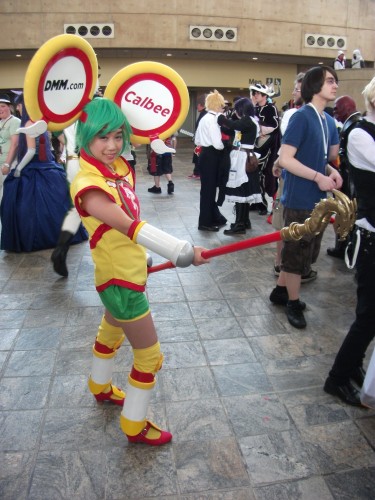
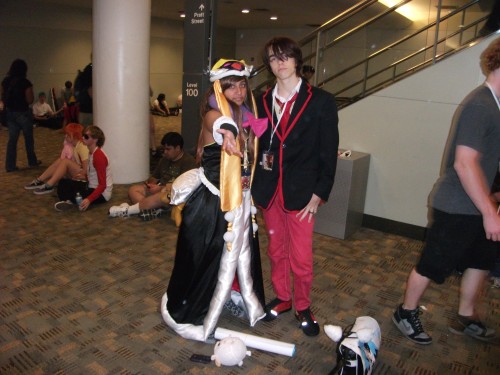
This was actually the first Fuura Kafuka cosplayer I had ever seen, and I’m amazed (and grateful) that someone would remember her. A funny story came out of this, as the cosplayer had not been aware that Nonaka Ai (Kafuka’s voice actor) was at the event. I told her about the autograph-signing on Sunday, and I hoped she was able to make it. Now, onto the next.
Overall
While at the convention I would notice little things here and there that I thought could use some improvement, the sheer amount of content at Otakon means that with even a few days of post-con recovery the bad mostly recedes away and all that I’m left with is fond memories. One complaint I do have, however, is that because the convention is set up to have some entrances and pathways usable and some off-limits, it is extremely difficult to tell just based on the map given in the con guide how to get from location to location. As an Otakon veteran at this point, I mostly have no issue with it, but even I ran into problems while trying to find the Hirano Aya concert. A combination of better signage to point people to the right locations alongside a clearer map would do wonders.
Even though Otakon had a “cooking” theme this year, I didn’t really feel it, pretty much because I didn’t attend any of those related events. At this point, every Otakon is starting to feel similar, but I can never hold that against it. After all, with a convention this big and with this much to do, I feel that we as fans of anime and manga make of the convention what we want. This isn’t to say that the way the convention is run doesn’t matter, of course, but that it is run smoothly enough that it becomes almost unnoticeable.
Truth be told, I used to take the sheer variety of panel programming and activities at Otakon for granted, but when I attended AX for the first time this year, I realized how limited that event is by comparison. Not only are there a good amount of industry panels with all of the guests they’ve flown over from Japan (or elsewhere), but the fan panels are a nice combination of workshops, introductions, and even philosophical explorations of topics concerning fans. Seeing Otakon once more in person, I knew this was indeed the con I waited for all year.
Kasukabe Saki visits Genshiken, bringing pangs of nostalgia to readers everywhere! As Hato puts it, “Is this what Genshiken used to be like?”
As Hato exchanges contact information with his old classmates, Kasukabe attends Shiiou University’s school festival, she catches up with her old friends, showing the degree of wit and perceptiveness she’s always been known for, the conversation turns towards the future, career paths, and even romance. Watching Saki work her magic, Hato can’t help but notice that the club somehow seems more lively when she’s around. Inevitably the topic of conversation turns towards Madarame, whom Saki caught receiving a kiss on the cheek from Sue in the previous chapter. Having heard about Madarame’s full-scale defense against the charms of Angela on top of that, Saki jokes that Madarame must be a lolicon, to which Hato comes to his defense in a rather awkward way.
As Sasahara’s sister discovers the truth of Hato, Saki silently considers that Madarame is finally hitting the point at which a guy like him becomes attractive to the opposite sex. Encouraging him to try out dating, the conversation ends on the kinds of porn that Madarame watches, which apparently is “everything.” We already knew that, though.
The new crew doesn’t get much exposure this chapter, but the hints towards Yajima possibly having feelings for Hato are definitely there. This is evident from the way her old friend Mimasaka, who thinks the world of her, reacts to Hato. Even if Mimasaka is being paranoid, it seems like she knows Yajima well enough to see when something is up. I actually expect them to be the focus in the next chapter or the one after that, especially because Hato’s story is “wrapping up” in certain respects, the mysteries of his existence now being a little less mysterious.
I have to wonder if showing Kasukabe again is a little cruel to the people who really miss the old Genshiken. While I know plenty of people who are fine with the new series, I also know people who much prefer the original style, presentation, and character dynamics of the first series. Giving them a glimpse of that environment once more might be equivalent to saying, “I could have continued Genshiken like how it used to be, but I didn’t!” In this respect it really does make the new club seem like a second generation.
That said, Kasukabe has always been that extra bit of spice which pushed Genshiken into interesting directions, the sole non-otaku in the club full of hapless dorks, as opposed to the current state where awkward isn’t quite what it used to be but no one is so firmly out of that sphere as Saki was. Just the way her statement about being okay with gay relationships getting misinterpreted by the fujoshi minds of Ogiue and Ohno (Saki’s response is that she’s referring to actual gay couples she knows in real life) shows that the rift still exists, albeit a rift that has had a solid bridge of friendship and understanding erected across it for years.
I realize that one of the limits of my analyses every month is that I don’t spend a significant amount of time on Hato, who seems to be getting more and more time in the story. At the same time, personally speaking I don’t think predicting whether or not he’ll end up with someone, be that Madarame or otherwise is particularly fruitful. I think Hato’s sexuality is not meant to be clear cut, whether that’s “he’s gay but denying it” or, as so many have mentioned both within the story and outside of it, that “2D and 3D are different,” and though I don’t have quite so much of a vested interest in the turn-out, I do find the degree to which the manga tackles the ambiguity of the topic to be particularly good. Hato destroys the lines which divide.
To what degree is otaku culture, especially male otaku culture, receptive to concepts like homosexuality or even sexuality in general? I’ve viewed it, both within Japan and outside of Japan, as being somewhat similar to geek culture in general in this regard, which is to say liberal in certain ways but can be quite conservative in others, which is why, as Kio Shimoku continues to bring the topic up through Hato and his potential feeling towards Madarame every chapter, I have to step back and think, “is this okay in a seinen magazine?” Granted, it is a seinen magazine which also runs Ookiku Furikabutte! (Big Windup), but I feel like there’s definitely a risk involved, especially when the potential target of homosexual affection is the most geeky of the otaku in Genshiken. Then again, if the guy was willing to make a detailed and in some ways harshly realistic manga about raising a newborn, then I guess nothing can stop him anymore (aside from lack of sales).
Saki views Madarame now as the late bloomer who’s apparently finally showing his petals. I’ve seen other manga talk about how there are simply times in a guy’s life when he’s more attractive to the opposite sex (and in the context of harem manga this means having it all concentrated into the present), but I don’t think Genshiken is quite going for that. Rather, I think it’s a complex interplay of elements that gives us the Madarame of today. When you actually look at him, although he’s similar to the Madarame we saw back in Chapter 1, he has in fact changed quite a bit. First, he’s not nearly as “aggressively otaku,” touting the lifestyle as a badge of sad pride, and second, he’s nowhere near as uncomfortable around girls as he used to be, probably from interacting with them so much in Genshiken.
Call it whatever you want, maturity, a betrayal of moe values, but I could easily see the how tempering of his passions to still be evident but not quite so extreme, as well as his overall understanding attitude (the result of being otaku in certain ways) could combine at this current point to make a fairly attractive guy. It doesn’t hurt that he dresses better now too. Madarame is seemingly no longer held back romantically by just being too much of an otaku, but by a combination of being unable to accept the possibility that he himself might be attractive, and that he has an unrequited love which he’s afraid to lose or to move away from. That said, I have to wonder if having to constantly interact with the girl he loves while hiding the fact (or at least trying to) also ironically helped him to develop more socially.
I noticed that there’s discussion as to whether or not Kasukabe is actually pregnant, given her choice of clothing, or if that’s just some fashion faux pas on the part of Kio. I can’t decide for myself, but I will say that because he’s tackled the topic of pregnancy and childbirth in his work, it wouldn’t be that surprising. It also might be me just making silly associations, but the way she looks reminds me of that moment in His and Her Circumstances where Yukino is pregnant and her mom, not knowing the truth initially, comments that she somehow looks more mature.
Again, though, I can’t say but it would lend meaning to Saki’s remark that Ohno’s wedding must be getting close. I have no idea whether she’s just joking or not, though Most of the relationship developments in the manga for Ohno and Tanaka have been off-panel (though the anime Genshiken 2 had its own steamy interpretation of things), so I can’t count out the possibility that this is actually for real.
Last thing I’ll say is, the reference for the next chapter is of Getter Robo Go, a decidedly older series compared to what’s been used lately. Curious.
In Chapter 77 of Genshiken II, we learn that while many fujoshi are strong, but Kaminaga may be Strongest of All.
The cat’s out of the bag as Kaminaga learns that Hato occasionally dresses up as her doppelganger, but as much as Ogiue downplays it as coincidence, and as much as Hato’s old classmate Konno mentions that it’s because of Hato’s crush, Kaminaga has other ideas entirely. Presented with an older brother and a younger brother who dresses up like the elder’s girlfriend (and now fiancee), Kaminaga creates the pairing of Yuu x Ken, or Hato’s older brother and himself. This is made all the more outrageous by the fact that she herself is the girlfriend.
Kaminaga throws out the tough questions pertaining to Hato’s sexuality. She brings up the possibility that he might be bisexual, and also the fact that his stance of “I’m not gay but I like yaoi” is similar to the BL trope of “I’m not gay, I just love you in particular.” As Kaminaga presses the question and asks if there’s a guy Hato knows who fits that situation, Madarame shows up, though Hato’s feelings about him are still left ambiguous. Instead, Hato mentions that everything’s fine, because he has plenty of friends, male and female, who know and accept him.
I’ve previously written about how the new Genshiken members in a way resemble Kohsaka in terms of the way they’re able to combine style with their very otaku mindsets, but I feel that, more than any other, including the attractive Angela and Ohno, that Kaminaga comes closest to the idea of a “female Kohsaka.” The ways in which she so unashamedly displays her delusions, especially to a guy she just met (Hato’s brother in the previous chapter’s flashback) and eventually turned him into a lover stands in stark contrast to the complexes that the other girls have about mixing fujoshi lifestyles with significant others. Ohno has Tanaka, but Kaminaga was able to get a decidedly non-otaku boyfriend for the long-term. When you think about Kaminaga that way, her sheer confidence and simultaneous ability to not compromise her compromised mindset is a kind of inspiration.
As we learn more and more about Hato’s past and set up his potential future, I feel that part of his purpose in the story is to “challenge.” Somewhat like how Ogiue flipped the story of Genshiken upside down, Hato really pushes the envelope in terms of assumptions about the club and how otaku behave and the like. The amount of Hato x Mada material in this chapter brings up certain questions about the nature of Genshiken II, and it reminds me of the fact that the new series is more than different enough from the original to seem somewhat alien to those who may have enjoyed the previous iteration.
I’m not referring just to Madarame’s rather confused feelings, but also the way the series has given him what in another work would have been some kind of “awesome harem” but in this case is an exercise in confusion and mixed emotions. While pining for Saki (still), he’s been growing a friendship with a very convincing crossdresser, gets kissed on the cheek by one American girl, and almost gets a full on boob grab on the other American girl.
Speaking of Sue’s “attack,” it’s a reference to Rei from Fist of the North Star.
Have I ever mentioned before how nicely Kio draws the blondes’ eyelashes in the new Genshiken? He out of his way to show only their outline instead of simply using black like he did previously, and it gives them a kind of mysterious quality. Aesthetically it’s quite pleasing, though perhaps it emphasizes their foreignness a little too much? I’m not exactly sure how I feel about it other than that I like the way it ends up looking.
Actually, when you think about Kuchiki and his accidental swipe at Risa’s chest in a previous chapter, which he did while totally unconscious from being choked out by Hato and thus unable to remember, or even the way the older Yoshitake was denied the privilege of seeing Hato come out of the shower, it seems like the series likes to mess with which characters get to have things happen on-panel. The rest of the actual sexual interaction, as we know, happens, it’s just that it’s never really shown. It’s that kind of manga.
As for Ogiue, this isn’t one of her chapters, but the mere fact that she refers to using one’s own boyfriend for yaoi source material as “normal” is rather amusing, and in its own way another sign of significant change within her. Could you have imagined the old Ogi half-admitting that she’s doing the very same thing on a regular basis, and on top of that is calling it normal?
Though it seems to be old news at this point, I thought I’d express my own disappointment at the fact that the re-release ofGenshiken(in massive omnibus) format.
Given the number of big re-releases of manga in English as of late, from Sailor Moon to Cardcaptor Sakura, I had originally bought Kodansha Comics’ Genshiken release with the expectation that, like those other revised editions, that it would come with a newer, more accurate translation. Instead, what we’re left with is a direct reprinting of the old translation which, while serviceable, not only made mistakes which are somewhat less significant to the story (like messing up the names of Mobile Suits from Gundam), but also changed characters’ dialogues to mean entirely different things (Ogiue’s introduction goes from her asking why girl otaku like yaoi so much to accusing the guys of being “queers”).
I don’t need to buy Genshiken over again. I have it a million times over, in anime form, in manga form, in Japanese and in English to differing degrees. I even own all of the special edition Japanese releases of the manga and their accompanying paraphernalia. The reason I bought the first omnibus was simply because I wanted to be able to share Genshiken with my friends who can’t read Japanese while treating them to a more accurate translation, but if that’s not the case then I have a problem.
If anything can be done to revise the later omnibus volumes I would like to know, as I think having a truly solid edition of Genshiken would only be for the best.
If last chapter was crazy, this one is downright mental.Genshiken II, Chapter 76 is the origin of one Hato Kenjirou, and what an origin it turns out to be.
After the truth of Hato’s identity is revealed by his former senpai and doppelganger Kaminaga, Hato tells everyone the story of his high school trauma. As has been previously revealed, Hato was in his high school’s art club, which was populated by fujoshi. Though a fan of BL himself at that point he denied any interest, until one day he found himself alone in the art club with Kaminaga’s doujinshi lying there.
Taking it to the bathroom so as to avoid anyone walking in on him reading, his classmate Konno found out about it and completely misinterprets the “reading it in the bathroom” aspect in a way that probably most people would. Konno told her fellow club members, who spread the rumor through the school and Hato became “that homo.” To rub more salt in, upon graduation Kaminaga, who Hato seem to have had a crush on, ends up dating Hato’s older brother, Yuuichirou.
And it looks like there’s going to be more next chapter! Not quite a flashback perhaps, but something.
Honestly, I am completely surprised they revealed Hato’s background so soon into the run of the new Genshiken. While it probably makes sense given that it’s been something like 19 chapters at this point, I always thought they would save something like that for a much later period. Thankfully the origin of Hato is a solid one. It’s the degree of trauma that would most certainly make life miserable for Hato, but not so miserable that he would end up like Ogiue, who had to deal with suicide and deep self-loathing.
Hato’s backstory is also fortunately supported by some really interesting characters. Truth be told, I was just a tiny bit concerned as to how Hato’s old classmates might turn out story-wise, but I’ve turned out pretty impressed. Kaminaga for one seems like a character with many layers to her. If there’s one word I would use to describe her, it’s perceptive.
Throughout this chapter, whether it’s pulling off Hato’s wig as he tries to throw off the girls by pretending to be someone else, or when she brings up the fact that Kuchiki mistook her for Hato “for some reason,” or even in the extended flashback, Kaminaga shows herself to be really smart and observant in a way that might even exceed Kasukabe. Probably the character most similar to her in Genshiken would be Yabusaki’s friend Katou. On top of the fact that she could talk so candidly with Hato’s brother about yaoi (in spite of the fact that Yuuichirou had zero knowledge about it) and then start dating him on top of that shows a new kind of fearlessness.
As great as Kaminaga turns out to be, however, I think Konno might actually be my favorite character of the new cast, and not just for her saucer eyes, though I find them to be hilarious. It’s quite clear that Konno had a crush on Hato all through high school and did not truly mean to make Hato’s life more difficult by spreading rumors. I think that Konno just had to confide in someone in order to deal with this problem, and I can imagine that Konno felt inferior to Kaminaga in both looks and talent, and to have the boy she likes have only eyes for her must have felt bittersweet. Moreover, the scene at the very end of the chapter where Konno now believes that she’s responsible for turning Hato into a full-on crossdressing homosexual makes you want to tell her everything will be okay.
Poor girl.
The biggest mystery that still remains is just why Hato dresses like Kaminaga most of the time, and while a less savory answer would have something to do with how she started going out out with his brother, I’m more inclined to believe that it’s because Hato, in transforming himself into the perfect fujoshi, saw Kaminaga as the ideal basis. With all of the positive attributes mentioned above, which includes physical appearance as well, it makes sense. The fact that Hato probably had feelings for her really puts an additional twist on the whole matter, but I’m inclined to believe that it still all relates to Kaminaga as the ideal girl (of sorts).
Another thing to consider is the fact that this chapter reveals that Hato can draw well, like when he copies from a still life. Perhaps Hato, who believes he can only imitate Kaminaga’s drawing style, might have more of an issue with trusting his own imagination?
So, not a ton of analysis compared to what I normally do this time around, but I am definitely looking forward to seeing what happens.
By the way, Genshiken Volume 12 goes on sale in Japan on June 22nd. There don’t seem to be any special editions, so I’m grateful I won’t be spending as much on it as I have the last two volumes.
If you’re coming from the Aniblog Tourney, welcome. I’ll make this short and sweet.
This blog’s been running for a while now and has what could be considered a rather daunting archive, so I’ve picked out some of my better posts. I encourage you to take a look. Don’t forget to check out the blog that’s going up against me as well, and remember that voting is open to both new and long-time readers of Ogiue Maniax.






 OGIUE MANIAX